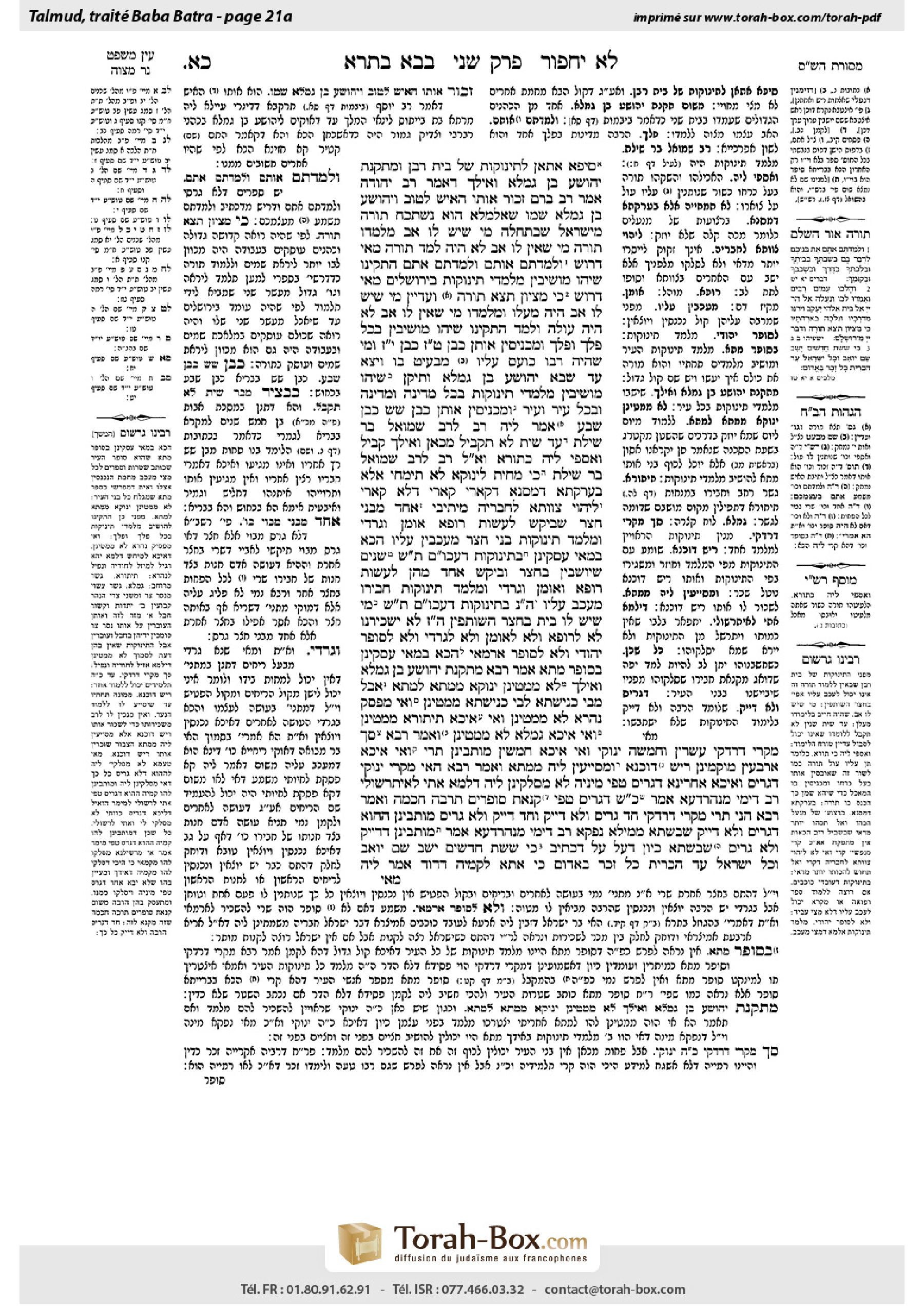
Bava Batra 21a: Talmud study for Daf Yomi
Daf Yomi is the daily study of one Talmud folio. Explore 37 tractates with scans, Hebrew text, Sefaria English and AI-generated French translations where annotated.
Passage selection and English or AI-generated French translation are available where the scan has annotations. Daf Study is independent of Torah-Box and Sefaria.
Browse Bava Batra · בבא בתרא · All tractatesBava Batra 21a text and translations
This page of Bava Batra includes the Aramaic text, an English translation and an AI-generated French translation, alongside the scan above.
בבא בתרא כ״א א · Aramaic and Hebrew text
סֵיפָא אֲתָאן לְתִינוֹקוֹת שֶׁל בֵּית רַבָּן, וּמִתַּקָּנַת יְהוֹשֻׁעַ בֶּן גַּמְלָא וְאֵילָךְ –
דְּאָמַר רַב יְהוּדָה אָמַר רַב: בְּרַם, זָכוּר אוֹתוֹ הָאִישׁ לַטּוֹב – וִיהוֹשֻׁעַ בֶּן גַּמְלָא שְׁמוֹ, שֶׁאִלְמָלֵא הוּא, נִשְׁתַּכַּח תּוֹרָה מִיִּשְׂרָאֵל. שֶׁבִּתְחִלָּה, מִי שֶׁיֵּשׁ לוֹ אָב – מְלַמְּדוֹ תּוֹרָה, מִי שֶׁאֵין לוֹ אָב – לֹא הָיָה לָמֵד תּוֹרָה. מַאי דְּרוּשׁ? ״וְלִמַּדְתֶּם אֹתָם״ – וְלִמַּדְתֶּם אַתֶּם.
הִתְקִינוּ שֶׁיְּהוּ מוֹשִׁיבִין מְלַמְּדֵי תִינוֹקוֹת בִּירוּשָׁלַיִם. מַאי דְּרוּשׁ? ״כִּי מִצִּיּוֹן תֵּצֵא תוֹרָה״. וַעֲדַיִין מִי שֶׁיֵּשׁ לוֹ אָב – הָיָה מַעֲלוֹ וּמְלַמְּדוֹ, מִי שֶׁאֵין לוֹ אָב – לֹא הָיָה עוֹלֶה וְלָמֵד. הִתְקִינוּ שֶׁיְּהוּ מוֹשִׁיבִין בְּכׇל פֶּלֶךְ וּפֶלֶךְ. וּמַכְנִיסִין אוֹתָן כְּבֶן שֵׁשׁ עֶשְׂרֵה כְּבֶן שְׁבַע עֶשְׂרֵה,
וּמִי שֶׁהָיָה רַבּוֹ כּוֹעֵס עָלָיו – מְבַעֵיט בּוֹ וְיֹצֵא. עַד שֶׁבָּא יְהוֹשֻׁעַ בֶּן גַּמְלָא וְתִיקֵּן, שֶׁיְּהוּ מוֹשִׁיבִין מְלַמְּדֵי תִינוֹקוֹת בְּכׇל מְדִינָה וּמְדִינָה וּבְכׇל עִיר וָעִיר, וּמַכְנִיסִין אוֹתָן כְּבֶן שֵׁשׁ כְּבֶן שֶׁבַע.
אֲמַר לֵיהּ רַב לְרַב שְׁמוּאֵל בַּר שִׁילַת: עַד שֵׁית לָא תְּקַבֵּיל, מִכָּאן וְאֵילָךְ – קַבֵּיל, וְאַסְפִּי לֵיהּ כְּתוֹרָא. וַאֲמַר לֵיהּ רַב לְרַב שְׁמוּאֵל בַּר שִׁילַת: כִּי מָחֵית לְיָנוֹקָא, לָא תִּימְחֵי אֶלָּא בְּעַרְקְתָא דִמְסָנָא. דְּקָארֵי – קָארֵי, דְּלָא קָארֵי – לֶיהֱוֵי צַוְותָּא לְחַבְרֵיהּ.
מֵיתִיבִי: אֶחָד מִבְּנֵי חָצֵר שֶׁבִּיקֵּשׁ לֵעָשׂוֹת רוֹפֵא, אוּמָּן, וְגַרְדִּי, וּמְלַמֵּד תִּינוֹקוֹת – בְּנֵי חָצֵר מְעַכְּבִין עָלָיו! הָכָא בְּמַאי עָסְקִינַן – בְּתִינוֹקוֹת דְּגוֹיִם.
תָּא שְׁמַע: שְׁנַיִם שֶׁיּוֹשְׁבִין בְּחָצֵר, וּבִיקֵּשׁ אֶחָד מֵהֶן לֵעָשׂוֹת רוֹפֵא, וְאוּמָּן, וְגַרְדִּי, וּמְלַמֵּד תִּינוֹקוֹת – חֲבֵירוֹ מְעַכֵּב עָלָיו! הָכָא נָמֵי בְּתִינוֹקוֹת דְּגוֹיִם.
תָּא שְׁמַע: מִי שֶׁיֵּשׁ לוֹ בַּיִת בַּחֲצַר הַשּׁוּתָּפִין – הֲרֵי זֶה לֹא יַשְׂכִּירֶנּוּ לֹא לְרוֹפֵא, וְלֹא לְאוּמָּן, וְלֹא לְגַרְדִּי, וְלֹא לְסוֹפֵר יְהוּדִי, וְלֹא לְסוֹפֵר אַרְמַאי! הָכָא בְּמַאי עָסְקִינַן – בְּסוֹפֵר מָתָא.
אָמַר רָבָא: מִתַּקָּנַת יְהוֹשֻׁעַ בֶּן גַּמְלָא וְאֵילָךְ, לָא מַמְטִינַן יָנוֹקָא מִמָּתָא לְמָתָא; אֲבָל מִבֵּי כְנִישְׁתָּא לְבֵי כְנִישְׁתָּא – מַמְטִינַן. וְאִי מַפְסֵק נַהֲרָא – לָא מַמְטִינַן. וְאִי אִיכָּא תִּיתּוּרָא – מַמְטִינַן. וְאִי אִיכָּא גַּמְלָא – לָא מַמְטִינַן.
וְאָמַר רָבָא: סַךְ מַקְרֵי דַרְדְּקֵי – עֶשְׂרִין וְחַמְשָׁה יָנוֹקֵי. וְאִי אִיכָּא חַמְשִׁין – מוֹתְבִינַן תְּרֵי; וְאִי אִיכָּא אַרְבְּעִין – מוֹקְמִינַן רֵישׁ דּוּכְנָא, וּמְסַיְּיעִין לֵיהּ מִמָּתָא.
וְאָמַר רָבָא: הַאי מַקְרֵי יָנוֹקֵי דְּגָרֵיס, וְאִיכָּא אַחֲרִינָא דְּגָרֵיס טְפֵי מִינֵּיהּ – לָא מְסַלְּקִינַן לֵיהּ, דִּלְמָא אָתֵי לְאִיתְרַשּׁוֹלֵי. רַב דִּימִי מִנְּהַרְדְּעָא אָמַר: כׇּל שֶׁכֵּן דְּגָרֵיס טְפֵי – קִנְאַת סוֹפְרִים תַּרְבֶּה חָכְמָה.
וְאָמַר רָבָא: הָנֵי תְּרֵי מַקְרֵי דַרְדְּקֵי – חַד גָּרֵיס וְלָא דָּיֵיק, וְחַד דָּיֵיק וְלָא גָּרֵיס – מוֹתְבִינַן הָהוּא דְּגָרֵיס וְלָא דָּיֵיק; שַׁבֶּשְׁתָּא מִמֵּילָא נָפְקָא. רַב דִּימִי מִנְּהַרְדְּעָא אָמַר: מוֹתְבִינַן דְּדָיֵיק וְלָא גָּרֵיס; שַׁבֶּשְׁתָּא, כֵּיוָן דְּעָל – עָל;
דִּכְתִיב: ״כִּי שֵׁשֶׁת חֳדָשִׁים יָשַׁב שָׁם יוֹאָב וְכׇל יִשְׂרָאֵל, עַד הִכְרִית כׇּל זָכָר בֶּאֱדוֹם״. כִּי אֲתָא לְקַמֵּיהּ דְּדָוִד, אֲמַר לֵיהּ:
Bava Batra 21a · English translation
In the latter clause we arrive at the case of schoolchildren who come to learn Torah in his house, and this ruling applies from the time of the ordinance of Yehoshua ben Gamla and onward.
What was this ordinance? As Rav Yehuda says that Rav says: Truly, that man is remembered for the good, and his name is Yehoshua ben Gamla. If not for him the Torah would have been forgotten from the Jewish people. Initially, whoever had a father would have his father teach him Torah, and whoever did not have a father would not learn Torah at all. The Gemara explains: What verse did they interpret homiletically that allowed them to conduct themselves in this manner? They interpreted the verse that states: “And you shall teach them [otam] to your sons” (Deuteronomy 11:19), to mean: And you yourselves [atem] shall teach, i.e., you fathers shall teach your sons.
When the Sages saw that not everyone was capable of teaching their children and Torah study was declining, they instituted an ordinance that teachers of children should be established in Jerusalem. The Gemara explains: What verse did they interpret homiletically that enabled them to do this? They interpreted the verse: “For Torah emerges from Zion” (Isaiah 2:3). But still, whoever had a father, his father ascended with him to Jerusalem and had him taught, but whoever did not have a father, he did not ascend and learn. Therefore, the Sages instituted an ordinance that teachers of children should be established in one city in each and every region [pelekh]. And they brought the students in at the age of sixteen and at the age of seventeen.
But as the students were old and had not yet had any formal education, a student whose teacher grew angry at him would rebel against him and leave. It was impossible to hold the youths there against their will. This state of affairs continued until Yehoshua ben Gamla came and instituted an ordinance that teachers of children should be established in each and every province and in each and every town, and they would bring the children in to learn at the age of six and at the age of seven. With regard to the matter at hand, since this system was established for the masses, the neighbors cannot prevent a scholar from teaching Torah in the courtyard.
Concerning that same issue, Rav said to Rav Shmuel bar Sheilat, a teacher of children: Do not accept a student before the age of six, as he is too young, and it is difficult for him to learn in a steady manner. From this point forward, accept him and stuff him with Torah like an ox. And Rav further said to Rav Shmuel bar Sheilat: When you strike a child for educational purposes, hit him only with the strap of a sandal, which is small and does not cause pain. Rav further advised him: He who reads, let him read on his own; whoever does not read, let him be a companion to his friends, which will encourage him to learn to read.
With regard to a courtyard, the Gemara concluded that it is permitted for one to establish an elementary school to teach Torah and the neighbors cannot protest. The Gemara raises an objection to this ruling from a baraita: With regard to one member of a courtyard who wishes to become a doctor, a bloodletter, a weaver [vegardi], or a teacher of children, the other members of the courtyard can prevent him from doing so. This indicates that neighbors can protest the teaching of children in their shared courtyard. The Gemara answers: With what are we dealing here, i.e., when can they protest his teaching children? We are dealing with a case of gentile children, as there is no mitzva to educate them. In this situation, the neighbors can protest about the noise.
Come and hear another baraita: With regard to two people who are residing in one courtyard, and one of them sought to become a doctor, a bloodletter, a weaver, or a teacher of children, the other can prevent him from doing so. The Gemara answers: Here too, we are dealing with a case of gentile children.
The Gemara suggests: Come and hear another baraita: One who has a house in a jointly owned courtyard may not rent it to a doctor, nor to a bloodletter, nor to a weaver, nor to a Jewish teacher [sofer], nor to a gentile teacher. This indicates that one’s neighbors can prevent him from teaching Jewish children. The Gemara answers: With what are we dealing here? We are dealing with the scribe [sofer] of the town, who does not teach children but writes documents and letters for residents of the town. This type of work is not a mitzva, and since many people seek his services, the residents of the courtyard can prevent him from performing this job near their houses.
§ With regard to the ordinance of Yehoshua ben Gamla, and concerning teaching children in general, Rava says: From the time of the ordinance of Yehoshua ben Gamla, that schoolteachers must be established in each town, and onward, one does not bring a child from one town to another. Rather, each child is educated where he resides. But one does bring them from one synagogue where they learn to another synagogue. And if a river separates the areas one does not bring the children across, lest they fall into the river. And if there is a bridge spanning the river one may bring them across the river. But if there is only a narrow bridge [gamla] one does not bring them.
And Rava said: The maximum number of students for one teacher of children is twenty-five children. And if there are fifty children in a single place, one establishes two teachers, so that each one teaches twenty-five students. And if there are forty children, one establishes an assistant, and the teacher receives help from the residents of the town to pay the salary of the assistant.
And Rava said: If there is a teacher of children who teaches a few subjects, and there is another who teaches more subjects than him, one does not remove the first teacher from his position to hire the second, as perhaps the other teacher will come to be negligent due to the lack of competition. Rav Dimi from Neharde’a said: On the contrary, all the more so is it the case that he will teach in a better manner if he knows that he is the sole instructor in the place, as jealousy among teachers increases wisdom. The one who was dismissed will try to refine his skills so that he will be rehired, and this will prevent negligence on the part of the other teacher.
And Rava said: If there are two teachers of children, one who teaches a lot of material but is not precise in his statements, and one who is precise but does not teach a lot of material, one hires the one who teaches a lot of material but is not precise. Why is this? Errors will be corrected by themselves, and no lasting harm will be caused. By contrast, Rav Dimi of Neharde’a said: One hires the instructor who is precise and does not teach a lot of material, as once an error is taught, it is taught, and cannot be easily corrected.
The Gemara cites a proof for the opinion of Rav Dimi of Neharde’a: This is as it is written: “For Joab and all Israel remained there six months until he had cut off every male in Edom” (I Kings 11:16). When Joab came before King David after this episode, David said to him:
Bava Batra 21a · Traduction française (IA)
Dans la dernière clause, il s’agit du cas d’enfants qui viennent étudier la Torah chez lui ; cette décision s’applique à partir du décret de Yehoshua ben Gamla.
En quoi consistait ce décret ? Rav Yehouda dit au nom de Rav : En vérité, cet homme mérite qu’on se souvienne de lui en bien, et son nom est Yehoshua ben Gamla. Sans lui, la Torah aurait été oubliée par le peuple juif. Au début, celui qui avait un père recevait de lui un enseignement de Torah, tandis que celui qui n’avait pas de père n’étudiait pas du tout la Torah. La Guemara explique : Quel verset interprétaient-ils de manière homilétique pour agir ainsi ? Ils interprétaient le verset : « Vous les enseignerez [otam] à vos fils » (Deutéronome 11, 19), comme signifiant : « Vous-mêmes [atem] enseignerez », c’est-à-dire que vous, les pères, enseignerez à vos fils.
Lorsque les Sages constatèrent que tous n’étaient pas capables d’enseigner à leurs enfants et que l’étude de la Torah déclinait, ils instituèrent que des enseignants pour enfants soient établis à Jérusalem. La Guemara explique : Quel verset interprétaient-ils de manière homilétique pour agir ainsi ? Ils interprétaient le verset : « Car la Torah sort de Sion » (Isaïe 2, 3). Mais même alors, celui qui avait un père montait avec lui à Jérusalem, où il le faisait instruire ; celui qui n’avait pas de père, en revanche, ne montait pas et n’étudiait pas. Les Sages instituèrent donc que des enseignants pour enfants soient établis dans une ville de chaque région [pelekh]. Ils y envoyaient les élèves à l’âge de seize ou dix-sept ans.
Mais les élèves étaient déjà âgés et n’avaient encore reçu aucune instruction formelle ; si leur maître se mettait en colère contre eux, ils se rebellaient contre lui et s’en allaient. Il était impossible de retenir ces jeunes contre leur gré. Cette situation dura jusqu’à ce que Yehoshua ben Gamla institue que des enseignants pour enfants soient établis dans chaque province et dans chaque ville, et que les enfants y soient envoyés pour étudier dès l’âge de six ou sept ans. Pour ce qui est de la question en discussion, puisque ce système fut établi pour le grand public, les voisins ne peuvent empêcher un érudit d’enseigner la Torah dans la cour.
À propos de cette même question, Rav dit à Rav Shmuel bar Sheilat, un enseignant pour enfants : « N’accepte pas d’élève avant l’âge de six ans, car il est trop jeune et il lui est difficile d’étudier régulièrement. À partir de cet âge, accepte-le et gave-le de Torah comme un bœuf. » Rav dit encore à Rav Shmuel bar Sheilat : « Lorsque tu frappes un enfant à des fins éducatives, frappe-le seulement avec la lanière d’une sandale, qui est petite et ne lui fait pas mal. » Rav lui conseilla aussi : « Que celui qui sait lire lise seul ; que celui qui ne sait pas lire soit le compagnon de ses camarades », ce qui l’encouragera à apprendre à lire.
À propos d’une cour, la Guemara a conclu qu’il est permis d’y établir une école élémentaire pour enseigner la Torah et que les voisins ne peuvent pas s’y opposer. La Guemara soulève une objection à cette décision à partir d’une baraïta : si un membre d’une cour veut devenir médecin, saigneur, tisserand [vegardi] ou enseignant pour enfants, les autres membres de la cour peuvent l’en empêcher. Cela indique que les voisins peuvent s’opposer à l’enseignement des enfants dans leur cour commune. La Guemara répond : De quoi s’agit-il ici, c’est-à-dire dans quel cas peuvent-ils s’opposer à ce qu’il enseigne aux enfants ? Il s’agit d’enfants non juifs, car il n’y a pas de mitsva de les instruire. Dans ce cas, les voisins peuvent se plaindre du bruit.
Viens et entends une autre baraïta : si deux personnes résident dans une même cour et que l’une d’elles veut devenir médecin, saigneur, tisserand ou enseignant pour enfants, l’autre peut l’en empêcher. La Guemara répond : Ici aussi, il s’agit d’enfants non juifs.
La Guemara propose : Viens et entends une autre baraïta : celui qui possède une maison dans une cour en copropriété ne peut pas la louer à un médecin, à un saigneur, à un tisserand, à un enseignant juif [sofer] ni à un enseignant non juif. Cela indique que ses voisins peuvent l’empêcher d’enseigner à des enfants juifs. La Guemara répond : De quoi s’agit-il ici ? Il s’agit du scribe [sofer] de la ville, qui n’enseigne pas aux enfants, mais rédige des documents et des lettres pour les habitants de la ville. Ce travail n’est pas une mitsva et, comme beaucoup de personnes font appel à ses services, les habitants de la cour peuvent l’empêcher d’exercer cette activité près de leurs maisons.
§ À propos du décret de Yehoshua ben Gamla et, plus généralement, de l’enseignement aux enfants, Rava dit : À partir du décret de Yehoshua ben Gamla, qui exige que des enseignants pour enfants soient établis dans chaque ville, on n’amène plus un enfant d’une ville à une autre. Chaque enfant reçoit plutôt son instruction là où il réside. En revanche, on peut les amener d’une synagogue où ils étudient à une autre synagogue. Si une rivière sépare les secteurs, on ne fait pas traverser la rivière aux enfants, de crainte qu’ils n’y tombent. S’il y a un pont qui enjambe la rivière, on peut les faire passer. Mais s’il n’y a qu’un pont étroit [gamla], on ne les fait pas passer.
Rava dit encore : le nombre maximal d’élèves pour un enseignant pour enfants est de vingt-cinq. S’il y a cinquante enfants au même endroit, on établit deux enseignants, de sorte que chacun en instruise vingt-cinq. S’il y a quarante enfants, on établit un assistant, et l’enseignant reçoit l’aide des habitants de la ville pour payer son salaire.
Rava dit encore : s’il y a un enseignant pour enfants qui enseigne quelques matières et un autre qui en enseigne davantage que lui, on ne remplace pas le premier par le second, car celui-ci pourrait se mettre à négliger son travail en l’absence de concurrence. Rav Dimi de Neharde’a dit : Au contraire, à plus forte raison enseignera-t-il mieux s’il sait qu’il est le seul enseignant de l’endroit, car la rivalité entre enseignants accroît la sagesse. Celui qui aura été renvoyé s’efforcera de perfectionner ses compétences afin d’être réengagé, ce qui empêchera l’autre enseignant de se relâcher.
Rava dit encore : s’il y a deux enseignants pour enfants, l’un qui enseigne beaucoup de matière mais manque de précision dans ses propos, et l’autre qui est précis mais enseigne moins de matière, on engage celui qui enseigne beaucoup de matière, même s’il manque de précision. Pourquoi ? Les erreurs se corrigeront d’elles-mêmes et ne causeront aucun dommage durable. Rav Dimi de Neharde’a, en revanche, dit qu’on engage l’enseignant qui est précis mais enseigne moins de matière, car une erreur, une fois enseignée, est difficile à corriger.
La Guemara apporte une preuve à l’opinion de Rav Dimi de Neharde’a : il est écrit : « Joab et tout Israël demeurèrent là six mois, jusqu’à ce qu’il eût exterminé tous les mâles d’Édom » (I Rois 11, 16). Lorsque Joab se présenta ensuite devant le roi David, David lui dit :
Traduction française générée par IA à partir de l’édition anglaise de Sefaria. Vérifie toujours un passage avec le texte source.
Text from Sefaria: William Davidson Edition - Vocalized Aramaic (CC BY NC); William Davidson Edition - English (CC BY NC).