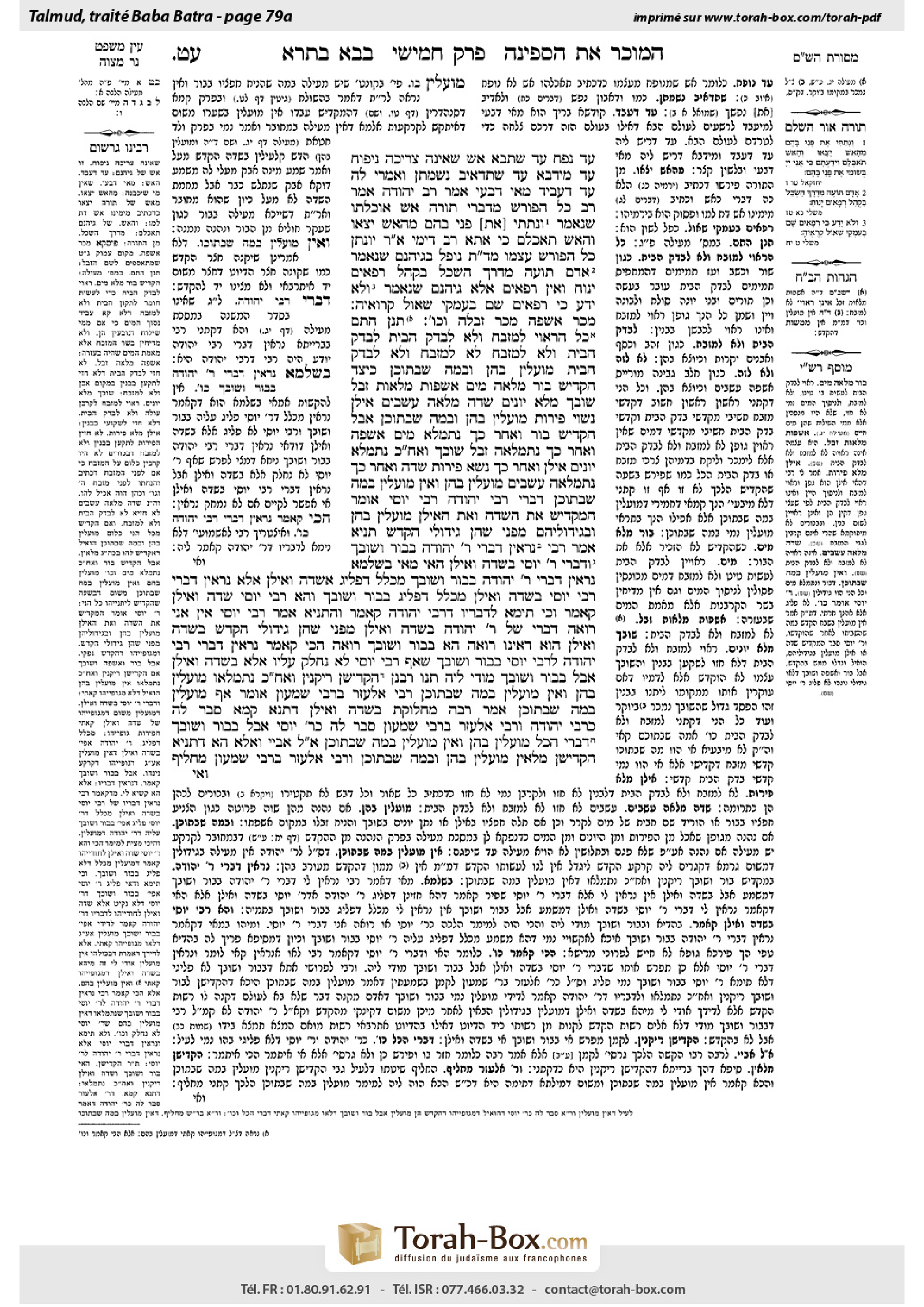
Bava Batra 79a: Talmud study for Daf Yomi
Daf Yomi is the daily study of one Talmud folio. Explore 37 tractates with scans, Hebrew text, Sefaria English and AI-generated French translations where annotated.
Passage selection and English or AI-generated French translation are available where the scan has annotations. Daf Study is independent of Torah-Box and Sefaria.
Browse Bava Batra · בבא בתרא · All tractatesBava Batra 79a text and translations
This page of Bava Batra includes the Aramaic text, an English translation and an AI-generated French translation, alongside the scan above.
בבא בתרא ע״ט א · Aramaic and Hebrew text
עַד נֹפַח״ – עַד שֶׁתָּבֹא אֵשׁ שֶׁאֵינָהּ צְרִיכָה נִיפּוּחַ, ״עַד מֵידְבָא״ – עַד שֶׁתַּדְאִיב נִשְׁמָתָן. וְאָמְרִי לַהּ: עַד דְּעָבֵיד מַאי דְּבָעֵי.
אָמַר רַב יְהוּדָה אָמַר רַב: כׇּל הַפּוֹרֵשׁ מִדִּבְרֵי תוֹרָה – אֵשׁ אוֹכַלְתּוֹ, שֶׁנֶּאֱמַר: ״וְנָתַתִּי [אֶת] פָּנַי בָּהֶם, מֵהָאֵשׁ יָצָאוּ וְהָאֵשׁ תֹּאכְלֵם״.
כִּי אֲתָא רַב דִּימִי, אָמַר רַבִּי יוֹנָתָן: כׇּל הַפּוֹרֵשׁ עַצְמוֹ מִדִּבְרֵי תוֹרָה – נוֹפֵל בְּגֵיהִנָּם, שֶׁנֶּאֱמַר: ״אָדָם תּוֹעֶה מִדֶּרֶךְ הַשְׂכֵּל, בִּקְהַל רְפָאִים יָנוּחַ״. וְאֵין רְפָאִים אֶלָּא גֵּיהִנָּם – שֶׁנֶּאֱמַר: ״וְלֹא יָדַע כִּי רְפָאִים שָׁם, בְּעִמְקֵי שְׁאוֹל קְרֻאֶיהָ.
מָכַר אַשְׁפָּה – מָכַר זִבְלָהּ וְכוּ׳. תְּנַן הָתָם: כׇּל הָרָאוּי לַמִּזְבֵּחַ וְלֹא לְבֶדֶק הַבַּיִת; לְבֶדֶק הַבַּיִת וְלֹא לַמִּזְבֵּחַ; לֹא לַמִּזְבֵּחַ וְלֹא לְבֶדֶק הַבַּיִת – מוֹעֲלִין בָּהֶן וּבְמַה שֶּׁבְּתוֹכָן.
כֵּיצַד? הִקְדִּישׁ בּוֹר מְלֵאָה מַיִם; אַשְׁפּוֹת מְלֵאוֹת זֶבֶל; שׁוֹבָךְ מָלֵא יוֹנִים; שָׂדֶה מְלֵאָה עֲשָׂבִים; אִילָן נָשׂוּי פֵּירוֹת – מוֹעֲלִין בָּהֶן וּבְמַה שֶּׁבְּתוֹכָן.
אֲבָל הִקְדִּישׁ בּוֹר וְאַחַר כָּךְ נִתְמַלֵּא מַיִם; אַשְׁפָּה וְאַחַר כָּךְ נִתְמַלְּאָה זֶבֶל; שׁוֹבָךְ וְאַחַר כָּךְ נִתְמַלֵּא יוֹנִים; אִילָן וְאַחַר כָּךְ נָשָׂא פֵּירוֹת; שָׂדֶה וְאַחַר כָּךְ נִתְמַלְּאָה עֲשָׂבִים – מוֹעֲלִין בָּהֶן, וְאֵין מוֹעֲלִין בְּמַה שֶּׁבְּתוֹכָן; דִּבְרֵי רַבִּי יְהוּדָה. רַבִּי יוֹסֵי אוֹמֵר: הִקְדִּישׁ אֶת הַשָּׂדֶה וְאֶת הָאִילָן – מוֹעֲלִין בָּהֶן וּבְגִידּוּלֵיהֶם, מִפְּנֵי שֶׁהֵן גִּידּוּלֵי הֶקְדֵּשׁ.
תַּנְיָא, אָמַר רַבִּי: נִרְאִין דִּבְרֵי רַבִּי יְהוּדָה – בְּבוֹר וְשׁוֹבָךְ, וְדִבְרֵי רַבִּי יוֹסֵי – בְּשָׂדֶה וְאִילָן. הַאי מַאי? בִּשְׁלָמָא ״נִרְאִין דִּבְרֵי רַבִּי יְהוּדָה בְּבוֹר וְשׁוֹבָךְ״ – מִכְּלָל דִּפְלִיג אַשָּׂדֶה וְאִילָן,
אֶלָּא ״נִרְאִין דִּבְרֵי רַבִּי יוֹסֵי בְּשָׂדֶה וְאִילָן״ – מִכְּלָל דִּפְלִיג בְּבוֹר וְשׁוֹבָךְ?! וְהָא רַבִּי יוֹסֵי ״שָׂדֶה וְאִילָן״ קָאָמַר!
וְכִי תֵּימָא: לִדְבָרָיו דְּרַבִּי יְהוּדָה קָאָמַר; וְהַתַּנְיָא, אָמַר רַבִּי יוֹסֵי: אֵין אֲנִי רוֹאֶה דְּבָרָיו שֶׁל רַבִּי יְהוּדָה בְּשָׂדֶה וְאִילָן, מִפְּנֵי שֶׁהֵן גִּידּוּלֵי הֶקְדֵּשׁ. בְּשָׂדֶה וְאִילָן הוּא דְּאֵינוֹ רוֹאֶה, הָא בְּבוֹר וְשׁוֹבָךְ – רוֹאֶה!
הָכִי קָאָמַר: נִרְאִין דִּבְרֵי רַבִּי יְהוּדָה לְרַבִּי יוֹסֵי, בְּבוֹר וְשׁוֹבָךְ – שֶׁאַף רַבִּי יוֹסֵי לֹא נֶחְלַק עָלָיו אֶלָּא בְּשָׂדֶה וְאִילָן, אֲבָל בְּבוֹר וְשׁוֹבָךְ מוֹדֵי לֵיהּ.
תָּנוּ רַבָּנַן: הִקְדִּישָׁן רֵיקָנִין וְאַחַר כָּךְ נִתְמַלְּאוּ – מוֹעֲלִין בָּהֶן, וְאֵין מוֹעֲלִין בְּמַה שֶּׁבְּתוֹכָן. רַבִּי אֶלְעָזָר בְּרַבִּי שִׁמְעוֹן אוֹמֵר: אַף מוֹעֲלִין בְּמַה שֶּׁבְּתוֹכָן.
אָמַר רַבָּה: מַחֲלוֹקֶת בְּשָׂדֶה וְאִילָן – דְּתַנָּא קַמָּא סָבַר לַהּ כְּרַבִּי יְהוּדָה, וְרַבִּי אֶלְעָזָר בְּרַבִּי שִׁמְעוֹן סָבַר לַהּ כְּרַבִּי יוֹסֵי; אֲבָל בְּבוֹר וְשׁוֹבָךְ – דִּבְרֵי הַכֹּל מוֹעֲלִין בָּהֶן וְאֵין מוֹעֲלִין בְּמַה שֶּׁבְּתוֹכָן.
אֲמַר לֵיהּ אַבָּיֵי, וְאֶלָּא הָא דְּתַנְיָא: הִקְדִּישָׁן מְלֵאִין – מוֹעֲלִין בָּהֶן וּבְמַה שֶּׁבְּתוֹכָן, וְרַבִּי אֶלְעָזָר בְּרַבִּי שִׁמְעוֹן מַחְלִיף;
Bava Batra 79a · English translation
even until Nophah,” meaning until the fire comes that does not require fanning [nippuaḥ], i.e., the fire of Gehenna, which will consume them. “Until Medeba [Medeva]”; this means until their souls are pained [tadiv]. And some say an alternative explanation: It means until God does what He wishes [mai deva’ei] with them and punishes them as they deserve.
Rav Yehuda says that Rav says: With regard to anyone who separates himself from matters of Torah, a fire consumes him, as it is stated: “And I will set My face against them; out of the fire they come forth, and the fire shall devour them” (Ezekiel 15:7). The Torah is likened to fire in the verse: “Is not My word like fire?” (Jeremiah 23:29). The verse in Ezekiel teaches: “Out of the fire they come forth,” referring to those who separate themselves from the fire of Torah; “and the fire shall devour them,” i.e., they are consumed by the fire of Gehenna.
When Rav Dimi came from Eretz Yisrael to Babylonia, he said that Rabbi Yonatan says: Anyone who separates himself from the matters of Torah falls into Gehenna. As it is stated: “The man who strays out of the way of understanding shall rest in the congregation of the spirits” (Proverbs 21:16). “The way of understanding” is the way of the Torah. And one who departs from the Torah arrives in the place of the spirits, which is nothing other than Gehenna, as it is stated: “But he does not know that the spirits are there; that those whom she has called are in the depths of the netherworld” (Proverbs 9:18).
§ The mishna teaches: One who sold a dunghill has sold its manure, and one who sold a cistern has sold its water. We learned in a mishna elsewhere (Me’ila 12b): With regard to any item that is fit to be sacrificed on the altar but is not fit for Temple maintenance, or is fit for Temple maintenance but not for the altar, or items that are fit neither for the altar nor for Temple maintenance in their current state and are slated to be sold with the profit used for the Temple, in all these cases if one consecrates these items and then derives benefit from them or their contents for a non-sacred purpose, he thereby is liable for misuse of consecrated property and is obligated to bring an offering as atonement.
How so? One who consecrated a cistern filled with water, dunghills filled with manure, a dovecote filled with doves, a field filled with plants, or a tree bearing fruit, and subsequently derived benefit from them or their contents is liable for misuse of consecrated property.
But with regard to one who consecrated a cistern and it was later filled with water, a dunghill and it was later filled with manure, a dovecote and it later was filled with doves, a tree and it later bore fruit, or a field and it was later filled with plants, if he derives benefit from them he is liable for misuse of consecrated property but he is not liable for misuse of consecrated property by deriving benefit from its contents. This is the statement of Rabbi Yehuda. Rabbi Yosei says: With regard to one who consecrated a field or a tree, he is liable for misuse of consecrated property if he derives benefit from them or that which grows from them, because they are growths of consecrated property.
It is taught in a baraita that Rabbi Yehuda HaNasi said: The statement of Rabbi Yehuda appears to be correct in the cases of a cistern and a dovecote, i.e., if one consecrated an empty cistern or dovecote, the water or doves that later fill it do not become consecrated. And the statement of Rabbi Yosei appears to be correct in the cases of a field and a tree. The Gemara asks: What is the meaning of this statement of Rabbi Yehuda HaNasi? Granted, when he says that the statement of Rabbi Yehuda appears to be correct in the cases of a cistern and a dovecote, by inference this means that Rabbi Yehuda disagrees with Rabbi Yosei in the cases of a field and a tree, and Rabbi Yehuda does explicitly disagree in those cases.
But when Rabbi Yehuda HaNasi says that the statement of Rabbi Yosei appears to be correct in the cases of a field and a tree, this indicates by inference that Rabbi Yosei disagrees with Rabbi Yehuda in the cases of a cistern and a dovecote. But Rabbi Yosei stated his opinion solely in the cases of a field and a tree, as only plants and fruit grow directly from consecrated property, and this reasoning is not relevant in the case of a cistern or dovecote.
And if you would say that Rabbi Yosei stated his opinion in accordance with the statement of Rabbi Yehuda, whereas he himself holds that even the items found in a dovecote or a cistern are consecrated, this is difficult: But isn’t it taught in a baraita that Rabbi Yosei said: I do not see the statement of Rabbi Yehuda as correct in the cases of a field and a tree, because the plants and the fruit are the growths of consecrated property? Infer from here that it is in the cases of a field and a tree that Rabbi Yosei does not see and accept the opinion of Rabbi Yehuda. But in the cases of a cistern and a dovecote, he does see and accept his opinion.
The Gemara answers that this is what Rabbi Yehuda HaNasi is saying: The statement of Rabbi Yehuda appears to Rabbi Yosei to be correct in the cases of a cistern and a dovecote. In other words, Rabbi Yehuda HaNasi is saying that even Rabbi Yosei disagrees with Rabbi Yehuda only in the cases of a field and a tree. But in the cases of a cistern and a dovecote, he concedes to him that the prohibition against misuse of consecrated property does not apply to items that were added afterward and were not present at the time of the consecration.
The Sages taught: In the case of cisterns, with regard to one who consecrated them when they were empty and they were later filled, if one derives benefit from them he is liable for misuse of consecrated property, but he is not liable for misuse of consecrated property if he derives benefit from their contents. This ruling will be clarified below. Rabbi Elazar, son of Rabbi Shimon, says: One is liable for misuse of consecrated property even by deriving benefit from their contents.
Rabba says: This dispute in the baraita applies only in the cases of a field and a tree, as the first tanna holds in accordance with the opinion of Rabbi Yehuda, and Rabbi Elazar, son of Rabbi Shimon, holds in accordance with the opinion of Rabbi Yosei. But in the cases of a cistern and a dovecote, everyone agrees that if one derives benefit from them he is liable for misuse of consecrated property but he is not liable for misuse of consecrated property if he derives benefit from their contents.
Abaye said to him: But consider that which is taught in the continuation of the baraita: If one consecrated them when they were full and then derives benefit from them or from their contents, he is liable for misuse of consecrated property. And Rabbi Elazar, son of Rabbi Shimon, reverses his previous ruling in this case and holds that if the items were consecrated when full their contents are not subject to the prohibition against misuse of consecrated property.
Bava Batra 79a · Traduction française (IA)
« Jusqu’à Nophah », c’est-à-dire jusqu’à ce que survienne le feu qui n’a pas besoin d’être attisé [nippuaḥ], autrement dit le feu de la Géhenne, qui les consumera. « Jusqu’à Medeba [Medeva] » : cela signifie jusqu’à ce que leurs âmes souffrent [tadiv]. Et certains donnent une autre explication : cela signifie jusqu’à ce que Dieu fasse d’eux ce qu’Il veut [mai deva’ei] et les punisse comme ils le méritent.
Rav Yehouda dit au nom de Rav : Quiconque se sépare des affaires de la Torah est consumé par le feu, comme il est dit : « Je tournerai Ma face contre eux ; ils sortiront du feu, et le feu les dévorera » (Ézéchiel 15,7). La Torah est comparée au feu dans le verset : « Ma parole n’est-elle pas comme un feu ? » (Jérémie 23,29). Le verset d’Ézéchiel enseigne : « Ils sortiront du feu », ce qui désigne ceux qui se séparent du feu de la Torah ; « et le feu les dévorera », c’est-à-dire qu’ils seront consumés par le feu de la Géhenne.
Lorsque Rav Dimi arriva d’Eretz Israël en Babylonie, il dit au nom de Rabbi Yonatan : Quiconque se sépare des affaires de la Torah tombe dans la Géhenne. Comme il est dit : « L’homme qui s’écarte du chemin de l’intelligence reposera dans l’assemblée des ombres » (Proverbes 21,16). « Le chemin de l’intelligence » est le chemin de la Torah. Celui qui s’écarte de la Torah arrive au lieu des ombres, qui n’est autre que la Géhenne, comme il est dit : « Mais il ne sait pas que les ombres sont là ; ceux qu’elle a convoqués sont dans les profondeurs du monde inférieur » (Proverbes 9,18).
§ La Michna enseigne : Celui qui vend un tas de fumier vend aussi le fumier qu’il contient, et celui qui vend une citerne vend aussi l’eau qu’elle contient. Nous avons appris dans une autre Michna (Meïla 12b) : Tout objet qui peut être offert sur l’autel mais ne peut servir à l’entretien du Temple, ou qui peut servir à l’entretien du Temple mais non à l’autel, ou encore les objets qui, dans leur état actuel, ne peuvent servir ni à l’autel ni à l’entretien du Temple et sont destinés à être vendus, le produit de la vente étant affecté au Temple : dans tous ces cas, si quelqu’un consacre ces objets puis en tire profit, ou tire profit de leur contenu à des fins profanes, il est coupable d’un usage abusif de biens consacrés et doit apporter un sacrifice expiatoire.
Comment cela ? Celui qui consacre une citerne pleine d’eau, des tas de fumier pleins de fumier, un pigeonnier plein de pigeons, un champ couvert de plantes ou un arbre portant des fruits, puis en tire profit, ou tire profit de leur contenu, est coupable d’un usage abusif de biens consacrés.
Mais si quelqu’un consacre une citerne qui se remplit d’eau par la suite, un tas de fumier qui se remplit de fumier par la suite, un pigeonnier qui se remplit de pigeons par la suite, un arbre qui porte des fruits par la suite ou un champ qui se couvre de plantes par la suite, et qu’il en tire profit, il est coupable d’un usage abusif de biens consacrés, mais il n’est pas coupable d’un tel usage abusif s’il tire profit de leur contenu. Telle est la déclaration de Rabbi Yehouda. Rabbi Yossi dit : Si quelqu’un consacre un champ ou un arbre, il est coupable d’un usage abusif de biens consacrés s’il en tire profit ou s’il tire profit de ce qui en pousse, car il s’agit de produits de biens consacrés.
Il est enseigné dans une baraïta que Rabbi Yehouda HaNassi a dit : La déclaration de Rabbi Yehouda paraît juste dans le cas d’une citerne et d’un pigeonnier, c’est-à-dire que si quelqu’un consacre une citerne ou un pigeonnier vide, l’eau ou les pigeons qui les remplissent par la suite ne deviennent pas consacrés. Et la déclaration de Rabbi Yossi paraît juste dans le cas d’un champ et d’un arbre. La Guemara demande : Que signifie cette déclaration de Rabbi Yehouda HaNassi ? Il est compréhensible que, lorsqu’il dit que la déclaration de Rabbi Yehouda paraît juste dans le cas d’une citerne et d’un pigeonnier, cela implique que Rabbi Yehouda est en désaccord avec Rabbi Yossi dans le cas d’un champ et d’un arbre ; or Rabbi Yehouda exprime effectivement son désaccord dans ces cas.
Mais lorsque Rabbi Yehouda HaNassi dit que la déclaration de Rabbi Yossi paraît juste dans le cas d’un champ et d’un arbre, cela implique que Rabbi Yossi est en désaccord avec Rabbi Yehouda dans le cas d’une citerne et d’un pigeonnier. Pourtant, Rabbi Yossi n’a exprimé son opinion que dans le cas d’un champ et d’un arbre, car seules les plantes et les fruits poussent directement à partir de biens consacrés ; ce raisonnement ne s’applique pas à une citerne ou à un pigeonnier.
Et si tu dis que Rabbi Yossi a exprimé son opinion conformément à la déclaration de Rabbi Yehouda, mais qu’il estime lui-même que même les éléments présents dans un pigeonnier ou une citerne sont consacrés, cela pose une difficulté : n’est-il pas enseigné dans une baraïta que Rabbi Yossi a dit : « Je ne considère pas comme juste la déclaration de Rabbi Yehouda dans le cas d’un champ et d’un arbre, car les plantes et les fruits sont des produits de biens consacrés » ? Déduis-en que c’est dans le cas d’un champ et d’un arbre que Rabbi Yossi rejette l’opinion de Rabbi Yehouda. Mais, dans le cas d’une citerne et d’un pigeonnier, il accepte son opinion.
La Guemara répond que voici ce que dit Rabbi Yehouda HaNassi : La déclaration de Rabbi Yehouda paraît juste à Rabbi Yossi dans le cas d’une citerne et d’un pigeonnier. Autrement dit, Rabbi Yehouda HaNassi dit que même Rabbi Yossi ne conteste Rabbi Yehouda que dans le cas d’un champ et d’un arbre. Mais dans le cas d’une citerne et d’un pigeonnier, il lui concède que l’interdiction de l’usage abusif de biens consacrés ne s’applique pas aux éléments ajoutés par la suite et qui n’étaient pas présents au moment de la consécration.
Les Sages ont enseigné : Pour les citernes, si quelqu’un les a consacrées alors qu’elles étaient vides et qu’elles se sont remplies par la suite, il est coupable d’un usage abusif de biens consacrés s’il en tire profit, mais il n’est pas coupable d’un tel usage abusif s’il tire profit de leur contenu. Cette décision sera expliquée plus loin. Rabbi Elazar, fils de Rabbi Shimon, dit : On est coupable d’un usage abusif de biens consacrés même si l’on tire profit de leur contenu.
Rabba dit : Cette controverse de la baraïta ne porte que sur le cas d’un champ et d’un arbre : le premier tanna suit l’opinion de Rabbi Yehouda, et Rabbi Elazar, fils de Rabbi Shimon, suit celle de Rabbi Yossi. Mais dans le cas d’une citerne et d’un pigeonnier, tous reconnaissent que si quelqu’un en tire profit, il est coupable d’un usage abusif de biens consacrés, mais qu’il n’en est pas coupable s’il tire profit de leur contenu.
Abayé lui dit : Mais considère ce qui est enseigné dans la suite de la baraïta : Si quelqu’un les a consacrés alors qu’ils étaient pleins, puis en tire profit ou tire profit de leur contenu, il est coupable d’un usage abusif de biens consacrés. Et Rabbi Elazar, fils de Rabbi Shimon, revient sur sa décision précédente dans ce cas et estime que si les objets ont été consacrés alors qu’ils étaient pleins, leur contenu n’est pas soumis à l’interdiction de l’usage abusif de biens consacrés.
Traduction française générée par IA à partir de l’édition anglaise de Sefaria. Vérifie toujours un passage avec le texte source.
Text from Sefaria: William Davidson Edition - Vocalized Aramaic (CC BY NC); William Davidson Edition - English (CC BY NC).