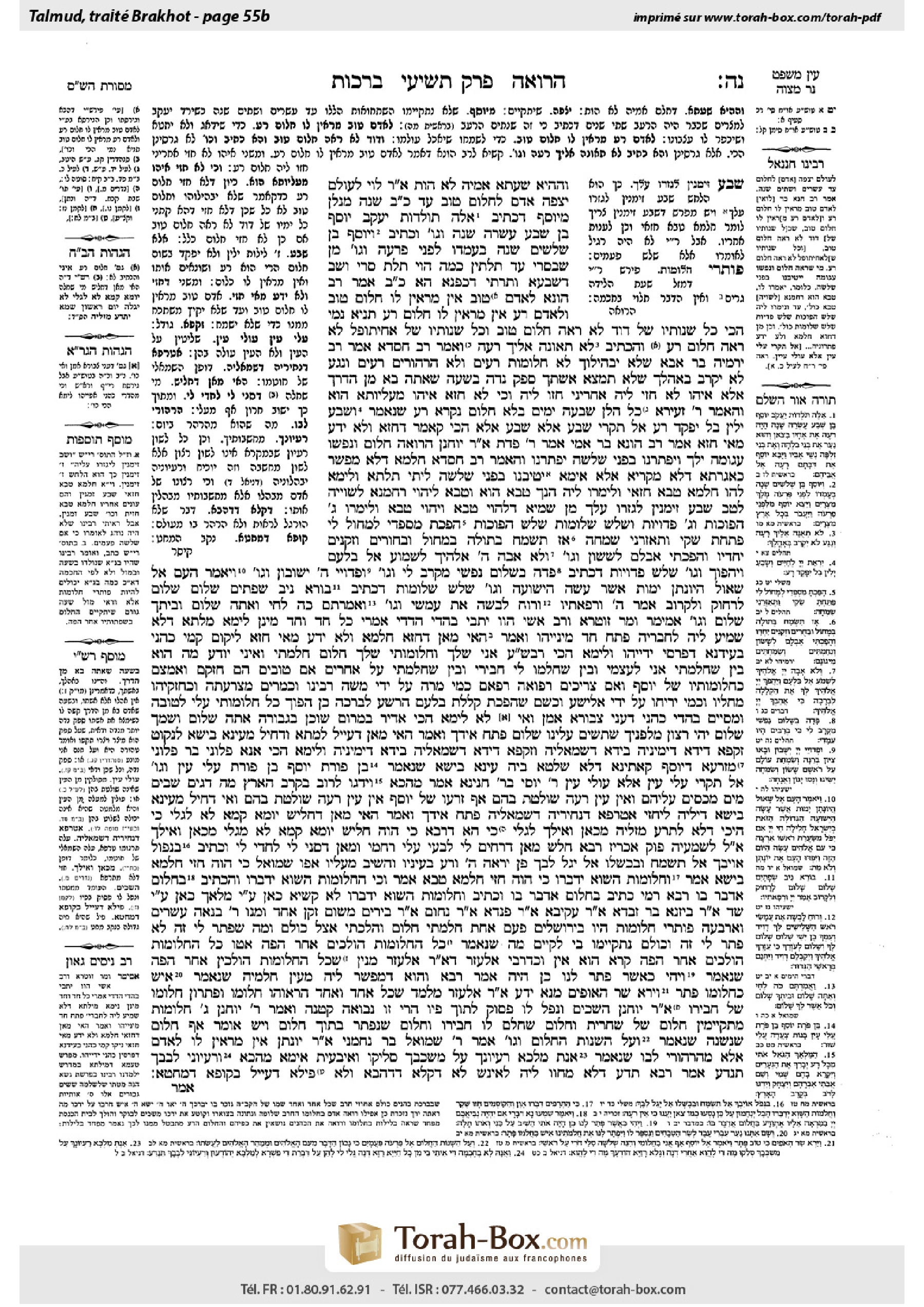
Berakhot 55b: Talmud study for Daf Yomi
Daf Yomi is the daily study of one Talmud folio. Explore 37 tractates with scans, Hebrew text, Sefaria English and AI-generated French translations where annotated.
Passage selection and English or AI-generated French translation are available where the scan has annotations. Daf Study is independent of Torah-Box and Sefaria.
Browse Berakhot · ברכות · All tractatesBerakhot 55b text and translations
This page of Berakhot includes the Aramaic text, an English translation and an AI-generated French translation, alongside the scan above.
ברכות נ״ה ב · Aramaic and Hebrew text
וְהַהִיא שַׁעְתָּא אִמֵּיהּ לָא הֲוָת.
אָמַר רַבִּי לֵוִי: לְעוֹלָם יְצַפֶּה אָדָם לַחֲלוֹם טוֹב עַד עֶשְׂרִים וּשְׁתַּיִם שָׁנָה. מְנָלַן? — מִיּוֹסֵף, דִּכְתִיב: ״אֵלֶּה תֹּלְדוֹת יַעֲקֹב יוֹסֵף בֶּן שְׁבַע עֶשְׂרֵה שָׁנָה וְגוֹ׳״, וּכְתִיב: ״וְיוֹסֵף בֶּן שְׁלֹשִׁים שָׁנָה בְּעׇמְדוֹ לִפְנֵי פַּרְעֹה וְגוֹ׳״. מִן שַׁבְסְרֵי עַד תְּלָתִין כַּמָּה הָוֵי? — תְּלָת סְרֵי, וְשַׁב דְּשִׂבְעָא וְתַרְתֵּי דְּכַפְנָא — הָא עֶשְׂרִים וּשְׁתַּיִם.
אָמַר רַב הוּנָא: לְאָדָם טוֹב אֵין מַרְאִין לוֹ חֲלוֹם טוֹב, וּלְאָדָם רַע אֵין מַרְאִין לוֹ חֲלוֹם רַע.
תַּנְיָא נָמֵי הָכִי: כׇּל שְׁנוֹתָיו שֶׁל דָּוִד לֹא רָאָה חֲלוֹם טוֹב, וְכׇל שְׁנוֹתָיו שֶׁל אֲחִיתוֹפֶל לֹא רָאָה חֲלוֹם רַע.
וְהָכְתִיב: ״לֹא תְאֻנֶּה אֵלֶיךָ רָעָה״. וְאָמַר רַב חִסְדָּא אָמַר רַב יִרְמְיָה בַּר אַבָּא: שֶׁלֹּא יַבְהִילוּךָ לֹא חֲלוֹמוֹת רָעִים וְלֹא הִרְהוּרִים רָעִים. ״וְנֶגַע לֹא יִקְרַב בְּאׇהֳלֶךָ״ — שֶׁלֹּא תִּמְצָא אִשְׁתְּךָ סְפֵק נִדָּה בְּשָׁעָה שֶׁאַתָּה בָּא מִן הַדֶּרֶךְ. אֶלָּא אִיהוּ לָא חָזֵי לֵיהּ, אַחֲרִינֵי חָזוּ לֵיהּ.
וְכִי לָא חֲזָא אִיהוּ, מְעַלְּיוּתָא הוּא? וְהָאָמַר רַבִּי זְעֵירָא: כׇּל הַלָּן שִׁבְעָה יָמִים בְּלֹא חֲלוֹם — נִקְרָא ״רַע״. שֶׁנֶּאֱמַר: ״וְשָׂבֵעַ יָלִין בַּל יִפָּקֶד רָע״. אַל תִּקְרֵי ״שָׂבֵעַ״ אֶלָּא ״שֶׁבַע״. — אֶלָּא, הָכִי קָאָמַר: דַּחֲזָא וְלָא יָדַע מַאי חֲזָא.
אָמַר רַב הוּנָא בַּר אַמֵּי אָמַר רַבִּי פְּדָת אָמַר רַבִּי יוֹחָנָן: הָרוֹאֶה חֲלוֹם וְנַפְשׁוֹ עֲגוּמָה, יֵלֵךְ וְיִפְתְּרֶנּוּ בִּפְנֵי שְׁלֹשָׁה. ״יִפְתְּרֶנּוּ״?! וְהָאָמַר רַב חִסְדָּא חֶלְמָא דְּלָא מְפַשַּׁר כְּאִגַּרְתָּא דְּלָא מִקַּרְיָא? אֶלָּא אֵימָא: יְטִיבֶנּוּ בִּפְנֵי שְׁלֹשָׁה. לַיְתֵי תְּלָתָא וְלֵימָא לְהוּ: ״חֶלְמָא טָבָא חֲזַאי״. וְלֵימְרוּ לֵיהּ הָנָךְ: ״טָבָא הוּא וְטָבָא לֶיהֱוֵי, רַחֲמָנָא לְשַׁוְּיֵיהּ לְטָב. שְׁבַע זִימְנִין לִגְזְרוּ עֲלָךְ מִן שְׁמַיָּא דְּלֶהֱוֵי טָבָא, וְיֶהֱוֵי טָבָא״. וְלֵימְרוּ שָׁלֹשׁ הֲפוּכוֹת, וְשָׁלֹשׁ פְּדוּיוֹת, וְשָׁלֹשׁ שְׁלוֹמוֹת.
שָׁלֹשׁ הֲפוּכוֹת — ״הָפַכְתָּ מִסְפְּדִי לְמָחוֹל לִי פִּתַּחְתָּ שַׂקִּי וַתְּאַזְּרֵנִי שִׂמְחָה״, ״אָז תִּשְׂמַח בְּתוּלָה בְּמָחוֹל וּבַחֻרִים וּזְקֵנִים יַחְדָּו וְהָפַכְתִּי אֶבְלָם לְשָׂשׂוֹן וְגוֹ׳״, ״וְלֹא אָבָה ה׳ אֱלֹהֶיךָ לִשְׁמֹעַ אֶל בִּלְעָם וַיַּהֲפֹךְ וְגוֹ׳״.
שָׁלֹשׁ פְּדוּיוֹת, דִּכְתִיב: ״פָּדָה בְשָׁלוֹם נַפְשִׁי מִקְּרׇב לִי וְגוֹ׳״, ״וּפְדוּיֵי ה׳ יְשֻׁבוּן וְגוֹ׳״, ״וַיֹּאמֶר הָעָם אֶל שָׁאוּל הֲיוֹנָתָן יָמוּת אֲשֶׁר עָשָׂה הַיְשׁוּעָה וְגוֹ׳״.
שָׁלֹשׁ שְׁלוֹמוֹת, דִּכְתִיב: ״בּוֹרֵא נִיב שְׂפָתָיִם שָׁלוֹם שָׁלוֹם לָרָחוֹק וְלַקָּרוֹב אָמַר ה׳ וּרְפָאתִיו״, ״וְרוּחַ לָבְשָׁה אֶת עֲמָשַׂי וְגוֹ׳״, ״וַאֲמַרְתֶּם כֹּה לֶחָי וְאַתָּה שָׁלוֹם וּבֵיתְךָ שָׁלוֹם וְגוֹ׳״.
אַמֵּימָר וּמָר זוּטְרָא וְרַב אָשֵׁי הֲווֹ יָתְבִי בַּהֲדֵי הֲדָדֵי. אָמְרִי: כֹּל חַד וְחַד מִינַּן לֵימָא מִלְּתָא דְּלָא שְׁמִיעַ לֵיהּ לְחַבְרֵיהּ. פְּתַח חַד מִינַּיְיהוּ וַאֲמַר: הַאי מַאן דַּחֲזָא חֶלְמָא וְלָא יָדַע מַאי חֲזָא, לִיקוּם קַמֵּי כָּהֲנֵי בְּעִידָּנָא דְּפָרְסִי יְדַיְיהוּ וְלֵימָא הָכִי: ״רִבּוֹנוֹ שֶׁל עוֹלָם, אֲנִי שֶׁלָּךְ וַחֲלוֹמוֹתַי שֶׁלָּךְ, חֲלוֹם חָלַמְתִּי וְאֵינִי יוֹדֵעַ מַה הוּא. בֵּין שֶׁחָלַמְתִּי אֲנִי לְעַצְמִי וּבֵין שֶׁחָלְמוּ לִי חֲבֵירַי וּבֵין שֶׁחָלַמְתִּי עַל אֲחֵרִים, אִם טוֹבִים הֵם — חַזְּקֵם וְאַמְּצֵם כַּחֲלוֹמוֹתָיו שֶׁל יוֹסֵף. וְאִם צְרִיכִים רְפוּאָה — רְפָאֵם כְּמֵי מָרָה עַל יְדֵי מֹשֶׁה רַבֵּינוּ, וּכְמִרְיָם מִצָּרַעְתָּהּ, וּכְחִזְקִיָּה מֵחׇלְיוֹ, וּכְמֵי יְרִיחוֹ עַל יְדֵי אֱלִישָׁע. וּכְשֵׁם שֶׁהָפַכְתָּ קִלְלַת בִּלְעָם הָרָשָׁע לִבְרָכָה, כֵּן הֲפוֹךְ כׇּל חֲלוֹמוֹתַי עָלַי לְטוֹבָה״. וּמְסַיֵּים בַּהֲדֵי כָּהֲנֵי דְּעָנֵי צִבּוּרָא ״אָמֵן״. וְאִי לָא, לֵימָא הָכִי: ״אַדִּיר בַּמָּרוֹם, שׁוֹכֵן בִּגְבוּרָה, אַתָּה שָׁלוֹם וְשִׁמְךָ שָׁלוֹם. יְהִי רָצוֹן מִלְּפָנֶיךָ שֶׁתָּשִׂים עָלֵינוּ שָׁלוֹם״.
פְּתַח אִידַּךְ וַאֲמַר: הַאי מַאן דְּעָיֵיל לְמָתָא וְדָחֵיל מֵעֵינָא בִּישָׁא, לִנְקוֹט זִקְפָּא דִּידָא דְיַמִּינֵיהּ בִּידָא דִשְׂמָאלֵיהּ וְזִקְפָּא דִּידָא דִשְׂמָאלֵיהּ בִּידָא דְיַמִּינֵיהּ, וְלֵימָא הָכִי: אֲנָא פְּלוֹנִי בַּר פְּלוֹנִי מִזַּרְעָא דְיוֹסֵף קָאָתֵינָא, דְּלָא שָׁלְטָא בֵּיהּ עֵינָא בִישָׁא, שֶׁנֶּאֱמַר: ״בֵּן פֹּרָת יוֹסֵף בֵּן פֹּרָת עֲלֵי עָיִן וְגוֹ׳״, אַל תִּקְרֵי ״עֲלֵי עָיִן״, אֶלָּא ״עוֹלֵי עָיִן״. רַבִּי יוֹסֵי בְּרַבִּי חֲנִינָא אָמַר, מֵהָכָא: ״וְיִדְגּוּ לָרֹב בְּקֶרֶב הָאָרֶץ״ — מָה דָּגִים שֶׁבַּיָּם מַיִם מְכַסִּים עֲלֵיהֶם וְאֵין עַיִן רָעָה שׁוֹלֶטֶת בָּהֶם, אַף זַרְעוֹ שֶׁל יוֹסֵף אֵין עַיִן רָעָה שׁוֹלֶטֶת בָּהֶם. וְאִי דָּחֵיל מֵעֵינָא בִּישָׁא דִּילֵיהּ, לִיחְזֵי אַטְרְפָא דִּנְחִירֵיהּ דִּשְׂמָאלֵיהּ.
פְּתַח אִידַּךְ וַאֲמַר: הַאי מַאן דַּחֲלִישׁ, יוֹמָא קַמָּא לָא לְגַלֵּי, כִּי הֵיכִי דְּלָא לִתָּרַע מַזָּלֵיהּ, מִכָּאן וְאֵילָךְ לְגַלֵּי. כִּי הָא דְּרָבָא, כִּי הֲוָה חֲלִישׁ, יוֹמָא קַמָּא לָא מְגַלֵּי מִכָּאן וְאֵילָךְ אָמַר לֵיהּ לְשַׁמָּעֵיהּ: פּוֹק אַכְרֵיז: ״רָבָא חֲלַשׁ״. מַאן דְּרָחֵים לִי — לִבְעֵי עֲלַי רַחֲמֵי, וּמַאן דְּסָנֵי לִי — לִחְדֵּי לִי. וּכְתִיב: ״בִּנְפֹל אוֹיִבְךָ אַל תִּשְׂמָח וּבִכָּשְׁלוֹ אַל יָגֵל לִבֶּךָ פֶּן יִרְאֶה ה׳ וְרַע בְּעֵינָיו וְהֵשִׁיב מֵעָלָיו אַפּוֹ״.
שְׁמוּאֵל כִּי הֲוָה חָזֵי חֶלְמָא בִּישָׁא אָמַר: ״וַחֲלֹמוֹת הַשָּׁוְא יְדַבֵּרוּ״. כִּי הֲוָה חָזֵי חֶלְמָא טָבָא אָמַר: וְכִי הַחֲלוֹמוֹת הַשָּׁוְא יְדַבֵּרוּ? וְהָכְתִיב ״בַּחֲלוֹם אֲדַבֶּר בּוֹ״!
רָבָא רָמֵי: כְּתִיב ״בַּחֲלוֹם אֲדַבֶּר בּוֹ״, וּכְתִיב: ״וַחֲלֹמוֹת הַשָּׁוְא יְדַבֵּרוּ״! לָא קַשְׁיָא: כָּאן עַל יְדֵי מַלְאָךְ, כָּאן עַל יְדֵי שֵׁד.
אָמַר רַבִּי בִּיזְנָא בַּר זַבְדָּא אָמַר רַבִּי עֲקִיבָא אָמַר רַבִּי פַּנְדָּא אָמַר רַב נַחוּם אָמַר רַבִּי בִּירִים מִשּׁוּם זָקֵן אֶחָד, וּמַנּוּ — רַבִּי בְּנָאָה: עֶשְׂרִים וְאַרְבָּעָה פּוֹתְרֵי חֲלוֹמוֹת הָיוּ בִּירוּשָׁלַיִם, פַּעַם אַחַת חָלַמְתִּי חֲלוֹם וְהָלַכְתִּי אֵצֶל כּוּלָּם, וּמַה שֶּׁפָּתַר לִי זֶה לֹא פָּתַר לִי זֶה, וְכוּלָּם נִתְקַיְּימוּ בִּי. לְקַיֵּים מַה שֶּׁנֶּאֱמַר: ״כׇּל הַחֲלוֹמוֹת הוֹלְכִים אַחַר הַפֶּה״.
אַטּוּ ״כׇּל הַחֲלוֹמוֹת הוֹלְכִים אַחַר הַפֶּה״ קְרָא הוּא? אִין — וְכִדְרַבִּי אֶלְעָזָר. דְּאָמַר רַבִּי אֶלְעָזָר: מִנַּיִן שֶׁכָּל הַחֲלוֹמוֹת הוֹלְכִין אַחַר הַפֶּה? — שֶׁנֶּאֱמַר: ״וַיְהִי כַּאֲשֶׁר פָּתַר לָנוּ כֵּן הָיָה״. אָמַר רָבָא: וְהוּא דִּמְפַשַּׁר לֵיהּ מֵעֵין חֶלְמֵיהּ, שֶׁנֶּאֱמַר ״אִישׁ כַּחֲלֹמוֹ פָּתָר״.
״וַיַּרְא שַׂר הָאֹפִים״, מְנָא יְדַע? אָמַר רַבִּי אֶלְעָזָר: מְלַמֵּד שֶׁכָּל אֶחָד וְאֶחָד הֶרְאוּהוּ חֲלוֹמוֹ וּפִתְרוֹן חֲלוֹמוֹ שֶׁל חֲבֵירוֹ.
אָמַר רַבִּי יוֹחָנָן: הִשְׁכִּים וְנָפַל לוֹ פָּסוּק לְתוֹךְ פִּיו, הֲרֵי זוֹ נְבוּאָה קְטַנָּה.
וְאָמַר רַבִּי יוֹחָנָן, שְׁלֹשָׁה חֲלוֹמוֹת מִתְקַיְּימִין: חֲלוֹם שֶׁל שַׁחֲרִית, וַחֲלוֹם שֶׁחָלַם לוֹ חֲבֵירוֹ, וַחֲלוֹם שֶׁנִּפְתַּר בְּתוֹךְ חֲלוֹם. וְיֵשׁ אוֹמֵר: אַף חֲלוֹם שֶׁנִּשְׁנָה, שֶׁנֶּאֱמַר: ״וְעַל הִשָּׁנוֹת הַחֲלוֹם וְגוֹ׳״.
אָמַר רַבִּי שְׁמוּאֵל בַּר נַחְמָנִי אָמַר רַבִּי יוֹנָתָן: אֵין מַרְאִין לוֹ לְאָדָם אֶלָּא מֵהִרְהוּרֵי לִבּוֹ. שֶׁנֶּאֱמַר: ״אַנְתְּ מַלְכָּא רַעְיוֹנָךְ עַל מִשְׁכְּבָךְ סְלִקוּ״. וְאִיבָּעֵית אֵימָא מֵהָכָא: ״וְרַעְיוֹנֵי לִבְבָךְ תִּנְדַּע״. אָמַר רָבָא: תִּדַּע, דְּלָא מַחֲווּ לֵיהּ לְאִינִשׁ לָא דִּקְלָא דְּדַהֲבָא וְלָא פִּילָא דְּעָיֵיל בְּקוֹפָא דְמַחְטָא.
Berakhot 55b · English translation
and eleven stars bowed down to me” (Genesis 37:9), and at that time his mother was no longer alive. According to the interpretation of the dream, the moon symbolizes Joseph’s mother. Even this dream that was ultimately fulfilled contained an element that was not fulfilled.
From the same source, Rabbi Levi said: One should always anticipate fulfillment of a good dream up to twenty-two years after the dream. From where do we derive this? From Joseph, as it is written in the story of Joseph’s dream: “These are the generations of Jacob. Joseph, being seventeen years old, was feeding the flock with his brethren” (Genesis 37:2); and it is written: “And Joseph was thirty years old when he stood before Pharaoh King of Egypt” (Genesis 41:46). From seventeen to thirty how many years are they? Thirteen; and add seven years of plenty and two of famine; the total is twenty-two and only then was the dream fulfilled when his brothers came and bowed down to him.
Rav Huna said: A good person is not shown a good dream and a wicked person is not shown a bad dream; rather, a good person is punished for his relatively few transgressions with bad dreams and a wicked person is rewarded for his relatively few merits with good dreams.
That was also taught in a baraita: All of King David’s life he never saw a good dream, and all of Ahitophel’s life he never saw a bad dream.
The Gemara raises a difficulty: Is it not written: “No evil shall befall you, neither shall any plague come near your tent” (Psalms 91:10)? And Rav Ḥisda said that Rav Yirmeya bar Abba said in explanation of that verse: This means that you will be frightened neither by bad dreams nor by evil thoughts. Neither shall any plague come near your tent, means that you will never find your wife with the uncertain status of a menstruating woman when you return from a journey. This proves that it is impossible that a righteous person will experience bad dreams throughout his life. Rather, one might say that he does not see bad dreams; others see bad dreams about him.
The Gemara asks: And when he does not see a dream, is that a virtue? Didn’t Rabbi Zeira say: Anyone who sleeps seven days without a dream is called evil, as it indicates that God does not wish to appear to him even in that indirect manner. Allusion to this is, as it is stated: “And he that has it shall lie satisfied [vesave’a], he shall not be visited with evil” (Proverbs 19:23). The Sages said: Do not read it as satisfied [vesave’a], rather read it as seven [vesheva], which is an allusion to the fact that one who sleeps seven times and does not experience a dream is considered evil. Rather, one must say that David saw dreams and the baraita says as follows: David certainly saw dreams, but he did not understand what he saw.
Rav Huna bar Ami said that Rabbi Pedat said that Rabbi Yoḥanan said: One who sees a dream from which his soul is distraught, should go and have it interpreted before three. The Gemara is surprised by this: Interpreted? Didn’t Rav Ḥisda say: A dream not interpreted is like a letter not read? If one is concerned about a dream, why would he actively promote its fulfillment? Rather, say as follows: He should better it before three. He should bring three people and say to them: I saw a good dream. And they should say to him: It is good, and let it be good, may God make it good. May they decree upon you from heaven seven times that it will be good, and it will be good. Afterwards they recite three verses of transformation from bad to good, three verses of redemption, and three verses which mention peace.
The Gemara elaborates: Three transformations:
“You transformed my mourning into dancing;
You loosed my sackcloth, and girded me with gladness” (Psalms 30:12);
“Then shall the virgin rejoice in the dance, and the young men and the old together;
for I will transform their mourning into joy, and will comfort them, and make them rejoice from their sorrow” (Jeremiah 31:12);
and: “Nevertheless the Lord your God would not hearken unto Balaam;
but the Lord your God transformed the curse into a blessing unto you” (Deuteronomy 23:6).
And three redemptions, as it is written:
“He has redeemed my soul in peace so that none came near me; for they were many that strove with me” (Psalms 55:19);
“The redeemed of the Lord shall return, and come with singing unto Zion, and everlasting joy shall be upon their heads;
they shall obtain gladness and joy, and sorrow and sighing shall flee away” (Isaiah 35:10);
and: “The people said to Saul: Shall Jonathan die, who has wrought this great salvation in Israel?
So the people rescued Jonathan, that he died not” (I Samuel 14:45).
And three mentions of peace, as it is written:
“Peace, peace, to him that is far off and to him that is near, says the Lord that creates the expression of the lips; and I will heal him” (Isaiah 57:19);
“Then the spirit clothed Amasai, who was chief of the captains: Yours are we, David, and on your side, you son of Yishai;
peace, peace be unto you, and peace be to your helpers” (I Chronicles 12:19);
and: “Thus you shall say: All hail and peace be both unto you,
and peace be to your house, and peace be unto all that you have” (I Samuel 25:6).
The Gemara relates: Ameimar and Mar Zutra and Rav Ashi were sitting together. They said: Let each and every one of us say something that the other has not heard. One of them began and said: One who saw a dream and does not know what he saw should stand before the priests when they lift their hands during the Priestly Blessing and say the following:
Master of the Universe, I am Yours and my dreams are Yours,
I dreamed a dream and I do not know what it is.
Whether I have dreamed of myself, whether my friends have dreamed of me or whether I have dreamed of others,
if the dreams are good, strengthen them and reinforce them like the dreams of Joseph.
And if the dreams require healing,
heal them like the bitter waters of Mara by Moses our teacher, and like Miriam from her leprosy,
and like Hezekiah from his illness, and like the bitter waters of Jericho by Elisha.
And just as You transformed the curse of Balaam the wicked into a blessing,
so transform all of my dreams for me for the best.
And he should complete his prayer together with the priests so the congregation responds amen both to the blessing of the priests and to his individual request. And if he is not able to recite this entire formula, he should say:
Majestic One on high, Who dwells in power,
You are peace and Your name is peace.
May it be Your will that You bestow upon us peace.
Another began and said: One who enters a city and fears the evil eye should hold the thumb [zekafa] of his right hand in his left hand and the thumb of his left hand in his right hand and recite the following: I, so-and-so son of so-and-so, come from the descendants of Joseph, over whom the evil eye has no dominion, as it is stated: “Joseph is a fruitful vine, a fruitful vine by a fountain [alei ayin]; its branches run over the wall” (Genesis 49:22). Do not read it as alei ayin; but rather, read it as olei ayin, who rise above the eye and the evil eye has no dominion over him. Rabbi Yosei, son of Rabbi Ḥanina, said: Derive it from here, from what is stated in Jacob’s blessing of Joseph’s sons: “And let them grow like fish into a multitude in the midst of the earth” (Genesis 48:16): Just as fish in the sea are covered by water and the evil eye has no dominion over them as they cannot be seen, so too the offspring of Joseph, the evil eye has no dominion over them. And if he is concerned about his own evil eye, lest it damage others, he should look at the side of his left nostril.
Another began and said: One who is sick should not reveal it on the first day of his illness so that his luck should not suffer; from there on he may reveal it. Like that which Rava does when he falls ill; on the first day he does not reveal it, from there on he says to his servant: Go out and announce: Rava is sick. Those who love me will pray that God have mercy on me and those who hate me will rejoice over my distress. And it is written: “Rejoice not when your enemy falls, and let not your heart be glad when he stumbles; lest the Lord see it, and it displease Him, and He turn away His wrath from him” (Proverbs 24:17–18). The joy of my enemy over my distress will also assist my healing.
The Gemara relates: Shmuel, when he would see a bad dream, would say: “And the dreams speak falsely” (Zechariah 10:2). When he would see a good dream, he would say: And do dreams speak falsely? Isn’t it written: “I speak with him in a dream” (Numbers 12:6)?
Rava raised a contradiction between these verses: On the one hand, it is written: “I speak with him in a dream”; and on the other hand, it is written: “And the dreams speak falsely.” The Gemara resolves this contradiction: This is not difficult because there are two types of dreams. Here, the verse, “I speak with him in a dream,” refers to dreams that come by means of an angel; here, the verse, “And the dreams speak falsely,” refers to dreams that come by means of a demon.
In a long chain of those transmitting this statement, it is said that Rabbi Bizna bar Zavda said that Rabbi Akiva said that Rabbi Panda said that Rav Naḥum said that Rabbi Birayim said in the name of one elder, and who is he, Rabbi Bena’a: There were twenty-four interpreters of dreams in Jerusalem. One time, I dreamed a dream and went to each of them to interpret it. What one interpreted for me the other did not interpret for me, and, nevertheless, all of the interpretations were realized in me, to fulfill that which is stated: All dreams follow the mouth of the interpreter.
The Gemara asks: Is that to say that all dreams follow the mouth is a verse cited as corroboration? The Gemara responds: Yes, and in accordance with the opinion of Rabbi Elazar, as Rabbi Elazar said: From where is it derived that all dreams follow the mouth of the interpreter? As it is stated in the story of the dreams of Pharaoh’s two ministers. The butler said to Pharaoh: “And it came to pass, as he interpreted to us, so it was” (Genesis 41:13). Rava said, one must attach a caveat to this: This is only in a case where it is interpreted for him in a manner akin to the dream, where the interpretation is relevant to the dream, as it is stated in the story of Joseph’s interpretation of the dreams of Pharaoh’s two ministers: “Each man according to his dream he did interpret” (Genesis 41:12).
With regard to Joseph’s interpretation of these dreams, the Gemara asks, it is written: “The baker saw that the interpretation was good” (Genesis 40:16); from where did the baker know that the interpretation was good? Rabbi Elazar said: This teaches that each of them was shown his dream and the interpretation of the other’s dream. That is how he knew that it was the correct interpretation.
With regard to the veracity of dreams, Rabbi Yoḥanan said: One who awakened in the morning and a specific verse happens into his mouth, it is a minor prophecy and an indication that the content of the verse will be fulfilled.
Rabbi Yoḥanan also said: Three dreams are fulfilled: A dream of the morning, a dream that one’s fellow dreamed about him, and a dream that is interpreted within a dream. And some say that a dream that is repeated several times is also fulfilled, as it is stated: “And for that the dream was doubled unto Pharaoh twice, it is because the thing is established by God, and God will shortly bring it to pass” (Genesis 41:32).
Rabbi Shmuel bar Naḥmani said that Rabbi Yonatan said: A person is shown in his dream only the thoughts of his heart when he was awake, as evidenced by what Daniel said to Nebuchadnezzar, as it is stated: “As for you, O king, your thoughts came upon your bed, what should come to pass hereafter” (Daniel 2:29). And if you wish, say instead that it is derived from here, a related verse: “And that you may know the thoughts of your heart” (Daniel 2:30). How will you know the thoughts of your heart? By their being revealed to you in a dream. Rava said: Know that this is the case, for one is neither shown a golden palm tree nor an elephant going through the eye of a needle in a dream. In other words, dreams only contain images that enter a person’s mind.
Berakhot 55b · Traduction française (IA)
« et onze étoiles se prosternèrent devant moi » (Genèse 37,9), alors qu’à cette époque sa mère n’était déjà plus en vie. Selon l’interprétation du rêve, la lune symbolise la mère de Joseph. Même ce rêve, qui finit par s’accomplir, contenait un élément qui ne s’accomplit pas.
À partir de la même source, Rabbi Lévi dit : On doit toujours s’attendre à ce qu’un bon rêve s’accomplisse jusqu’à vingt-deux ans après l’avoir fait. D’où le déduisons-nous ? De Joseph, car il est écrit dans le récit de son rêve : « Voici les générations de Jacob. Joseph, âgé de dix-sept ans, faisait paître le troupeau avec ses frères » (Genèse 37,2) ; et il est écrit : « Joseph était âgé de trente ans lorsqu’il se tint devant Pharaon, roi d’Égypte » (Genèse 41,46). Combien d’années y a-t-il de dix-sept à trente ans ? Treize ; ajoutez-y sept années d’abondance et deux années de famine : le total est de vingt-deux ans. Ce n’est qu’alors que le rêve s’accomplit, lorsque ses frères vinrent se prosterner devant lui.
Rav Houna dit : On ne montre pas de bon rêve à une personne juste, ni de mauvais rêve à une personne méchante ; au contraire, une personne juste est punie pour ses quelques fautes, relativement peu nombreuses, par de mauvais rêves, et une personne méchante est récompensée pour ses quelques mérites, relativement peu nombreux, par de bons rêves.
Cela a également été enseigné dans une baraïta : durant toute sa vie, le roi David ne vit jamais de bon rêve, et durant toute sa vie, Ahitophel ne vit jamais de mauvais rêve.
La Guemara soulève une difficulté : N’est-il pas écrit : « Aucun malheur ne t’arrivera, aucun fléau n’approchera de ta tente » (Psaumes 91,10) ? Et Rav Ḥisda a dit que Rav Yirmeya bar Abba a dit, pour expliquer ce verset : Cela signifie que tu ne seras effrayé ni par de mauvais rêves ni par de mauvaises pensées. « Aucun fléau n’approchera de ta tente » signifie que, lorsque tu rentreras d’un voyage, tu ne trouveras jamais ta femme dans la situation incertaine d’une femme menstruée. Cela prouve qu’il est impossible qu’une personne juste fasse de mauvais rêves toute sa vie. Il faut plutôt dire qu’elle ne voit pas de mauvais rêves ; ce sont les autres qui voient de mauvais rêves à son sujet.
La Guemara demande : Et ne pas voir de rêve, est-ce une qualité ? Rabbi Zeira n’a-t-il pas dit : Quiconque dort sept jours sans faire de rêve est qualifié de méchant, car cela indique que Dieu ne souhaite pas se manifester à lui, même de cette manière indirecte ? On en trouve une allusion dans ce qui est écrit : « Celui qui la possède repose satisfait [vesave’a], il ne sera pas visité par le mal » (Proverbes 19,23). Les Sages ont dit : Ne lis pas « satisfait » [vesave’a], mais lis plutôt « sept » [vesheva], ce qui fait allusion au fait que celui qui dort sept fois sans faire de rêve est considéré comme méchant. Il faut donc plutôt dire que David voyait des rêves, et que la baraïta veut dire ceci : David voyait assurément des rêves, mais il ne comprenait pas ce qu’il voyait.
Rav Huna bar Ami dit au nom de Rabbi Pedat, qui dit au nom de Rabbi Yoḥanan : Celui dont l’âme est bouleversée par un rêve doit aller le faire interpréter par trois personnes. La Guemara s’en étonne : Le faire interpréter ? Rav Ḥisda n’a-t-il pas dit : Un rêve qui n’est pas interprété est comme une lettre qui n’est pas lue ? Si quelqu’un s’inquiète d’un rêve, pourquoi favoriserait-il activement son accomplissement ? Il faut plutôt dire ceci : Il doit chercher à l’améliorer devant trois personnes. Il doit en réunir trois et leur dire : « J’ai fait un bon rêve. » Et elles doivent lui répondre : « Il est bon et il restera bon ; que Dieu le rende bon. Qu’on décrète pour toi du Ciel, sept fois, qu’il sera bon, et il sera bon. » Ensuite, elles récitent trois versets où le mal est transformé en bien, trois versets de délivrance et trois versets qui mentionnent la paix.
La Guemara précise : Trois transformations : « Tu as changé mon deuil en danse ; Tu as délié mon sac et tu m’as ceint de joie » (Psaumes 30,12) ; « Alors la vierge se réjouira dans la danse, et les jeunes gens comme les vieillards ensemble ; car je changerai leur deuil en joie, je les consolerai et les réjouirai après leur chagrin » (Jérémie 31,12) ; et : « Pourtant, l’Éternel, ton Dieu, ne voulut pas écouter Balaam ; l’Éternel, ton Dieu, changea pour toi la malédiction en bénédiction » (Deutéronome 23,6).
Et trois délivrances, comme il est écrit : « Il a délivré mon âme dans la paix, afin que nul ne m’approche ; car ils étaient nombreux ceux qui luttaient contre moi » (Psaumes 55,19) ; « Les rachetés de l’Éternel retourneront, ils viendront à Sion avec des chants, et une joie éternelle couronnera leur tête ; ils obtiendront l’allégresse et la joie, et la tristesse et les soupirs s’enfuiront » (Isaïe 35,10) ; et : « Le peuple dit à Saül : Jonathan mourrait-il, lui qui a accompli cette grande délivrance en Israël ? Le peuple délivra donc Jonathan, et il ne mourut pas » (I Samuel 14,45).
Et trois mentions de la paix, comme il est écrit : « Paix, paix pour celui qui est loin et pour celui qui est près, dit l’Éternel, qui crée le fruit des lèvres ; et je le guérirai » (Isaïe 57,19) ; « Alors l’esprit revêtit Amasaï, chef des capitaines : Nous sommes à toi, David, nous sommes avec toi, fils de Yishaï ; paix, paix à toi, et paix à ceux qui te viennent en aide » (I Chroniques 12,19) ; et : « Vous direz ainsi : Salut et paix à toi, paix à ta maison, et paix à tout ce qui t’appartient » (I Samuel 25,6).
La Guemara rapporte : Ameimar, Mar Zutra et Rav Ashi étaient assis ensemble. Ils dirent : Que chacun de nous dise quelque chose que les autres n’ont pas entendu. L’un d’eux commença et dit : Celui qui a fait un rêve sans savoir ce qu’il a vu doit se tenir devant les prêtres lorsqu’ils lèvent les mains pendant la bénédiction sacerdotale et dire ce qui suit : Maître de l’univers, je suis à Toi et mes rêves sont à Toi. J’ai fait un rêve et je ne sais pas ce que c’était. Que j’aie rêvé de moi-même, que mes amis aient rêvé de moi ou que j’aie rêvé d’autres personnes, si les rêves sont bons, affermis-les et renforce-les comme les rêves de Joseph. Et si les rêves nécessitent une guérison, guéris-les comme les eaux amères de Mara, par l’intermédiaire de Moïse notre maître, comme Myriam de sa lèpre, et comme Ézéchias de sa maladie, et comme les eaux amères de Jéricho, par l’intermédiaire d’Élisée. Et de même que Tu as changé la malédiction de Balaam le méchant en bénédiction, change ainsi tous mes rêves pour mon bien. Il doit conclure sa prière en même temps que les prêtres, afin que l’assemblée réponde amen à la fois à la bénédiction des prêtres et à sa requête personnelle. Et s’il n’est pas en mesure de réciter toute cette formule, il doit dire : Majesté des hauteurs, qui résides dans la puissance, Tu es la paix et Ton nom est la paix. Qu’il soit Ta volonté de nous accorder la paix.
Un autre commença et dit : Celui qui entre dans une ville et craint le mauvais œil doit saisir le pouce [zekafa] de sa main droite avec sa main gauche, et le pouce de sa main gauche avec sa main droite, puis réciter ce qui suit : « Moi, untel fils d’untel, je descends de la descendance de Joseph, sur laquelle le mauvais œil n’a aucun pouvoir, comme il est écrit : “Joseph est un cep fertile, un cep fertile près d’une source [alei ayin] ; ses branches s’étendent par-dessus le mur” » (Genèse 49,22). Ne lis pas alei ayin, mais plutôt olei ayin, « ceux qui s’élèvent au-dessus de l’œil », et le mauvais œil n’a aucun pouvoir sur eux. Rabbi Yossei, fils de Rabbi Ḥanina, dit : Déduis-le d’ici, de ce qui est écrit dans la bénédiction que Jacob donne aux fils de Joseph : « Qu’ils se multiplient comme les poissons au milieu de la terre » (Genèse 48,16). De même que les poissons de la mer sont recouverts par l’eau et que le mauvais œil n’a aucun pouvoir sur eux, puisqu’ils ne peuvent pas être vus, de même le mauvais œil n’a aucun pouvoir sur la descendance de Joseph. Et s’il craint que son propre mauvais œil ne nuise à autrui, il doit regarder le côté de sa narine gauche.
Un autre commença et dit : Un malade ne doit pas révéler sa maladie le premier jour, afin que sa chance ne décline pas ; à partir du lendemain, il peut la révéler. C’est ce que fait Rava lorsqu’il tombe malade : le premier jour, il ne le révèle pas ; ensuite, il dit à son serviteur : « Va annoncer : Rava est malade. Ceux qui m’aiment prieront pour que Dieu ait pitié de moi, et ceux qui me haïssent se réjouiront de ma détresse. » Or il est écrit : « Ne te réjouis pas de la chute de ton ennemi, et que ton cœur ne se réjouisse pas lorsqu’il trébuche ; de peur que l’Éternel ne le voie, que cela ne lui déplaise et qu’Il ne détourne de lui Sa colère » (Proverbes 24,17-18). La joie de mon ennemi devant ma détresse contribuera également à ma guérison.
La Guemara rapporte : Lorsque Chmouel faisait un mauvais rêve, il disait : « Les rêves parlent faussement » (Zacharie 10,2). Lorsqu’il faisait un bon rêve, il disait : Les rêves parlent-ils faussement ? N’est-il pas écrit : « Je lui parle dans un rêve » (Nombres 12,6) ?
Rava soulève une contradiction entre ces versets : d’un côté, il est écrit : « Je lui parle dans un rêve » ; et de l’autre, il est écrit : « Les rêves parlent faussement ». La Guemara résout cette contradiction : Il n’y a pas de difficulté, car il existe deux types de rêves. Ici, le verset « Je lui parle dans un rêve » fait référence aux rêves qui viennent par l’intermédiaire d’un ange ; là, le verset « Les rêves parlent faussement » fait référence aux rêves qui viennent par l’intermédiaire d’un démon.
Selon une longue chaîne de transmetteurs de cette déclaration, Rabbi Bizna bar Zavda dit au nom de Rabbi Akiva, qui dit au nom de Rabbi Panda, qui dit au nom de Rav Naḥoum, qui dit au nom de Rabbi Birayim, lequel dit au nom d’un certain ancien — et qui est-ce ? Rabbi Bena’a : Il y avait vingt-quatre interprètes de rêves à Jérusalem. Un jour, j’ai fait un rêve et je suis allé voir chacun d’eux pour qu’il l’interprète. Ce que l’un m’interprétait, l’autre ne me l’interprétait pas, et pourtant toutes les interprétations se sont réalisées pour moi, conformément à ce qui est écrit : « Tous les rêves dépendent de la bouche de l’interprète. »
La Guemara demande : Faut-il comprendre que « tous les rêves dépendent de la bouche de l’interprète » est un verset cité à l’appui ? La Guemara répond : Oui, et cela conformément à l’opinion de Rabbi Elazar. Car Rabbi Elazar a dit : D’où déduit-on que tous les rêves dépendent de la bouche de l’interprète ? Du récit des rêves des deux ministres de Pharaon. L’échanson dit à Pharaon : « Il arriva que, comme il nous l’avait interprété, ainsi en fut-il » (Genèse 41,13). Rava dit qu’il faut assortir cela d’une réserve : cela ne vaut que si le rêve est interprété d’une manière qui lui correspond, c’est-à-dire si l’interprétation est pertinente au regard du rêve, comme il est écrit dans le récit de l’interprétation par Joseph des rêves des deux ministres de Pharaon : « Il interpréta à chacun selon son rêve » (Genèse 41,12).
À propos de l’interprétation de ces rêves par Joseph, la Guemara demande : Il est écrit : « Le panetier vit que l’interprétation était bonne » (Genèse 40,16). Comment le panetier sut-il que l’interprétation était bonne ? Rabbi Elazar dit : Cela enseigne que chacun d’eux vit son propre rêve ainsi que l’interprétation du rêve de l’autre. C’est ainsi qu’il sut que l’interprétation était juste.
À propos de la véracité des rêves, Rabbi Yoḥanan dit : Celui qui se réveille le matin et trouve qu’un verset précis lui vient aux lèvres reçoit une petite prophétie ; c’est un signe que le contenu du verset s’accomplira.
Rabbi Yoḥanan dit également : Trois rêves s’accomplissent : un rêve fait le matin, un rêve qu’une autre personne a fait à son sujet, et un rêve qui est interprété à l’intérieur du rêve. Certains disent qu’un rêve qui se répète plusieurs fois s’accomplit également, comme il est écrit : « Si le rêve s’est répété deux fois devant Pharaon, c’est que la chose est arrêtée par Dieu, et que Dieu va bientôt l’exécuter » (Genèse 41,32).
Rabbi Chmouel bar Naḥmani dit au nom de Rabbi Yonatan : Dans un rêve, on ne montre à une personne que les pensées qu’elle avait dans son cœur lorsqu’elle était éveillée, comme l’atteste ce que Daniel dit à Nabuchodonosor, ainsi qu’il est écrit : « Quant à toi, ô roi, tes pensées te sont venues sur ta couche : ce qui doit arriver par la suite » (Daniel 2,29). Et si tu le souhaites, dis plutôt que cela se déduit d’ici, d’un verset apparenté : « afin que tu connaisses les pensées de ton cœur » (Daniel 2,30). Comment connaîtras-tu les pensées de ton cœur ? Parce qu’elles te sont révélées dans un rêve. Rava dit : Sache que c’est le cas, car on ne voit en rêve ni un palmier d’or ni un éléphant passant par le trou d’une aiguille. Autrement dit, les rêves ne contiennent que des images qui viennent à l’esprit d’une personne.
Traduction française générée par IA à partir de l’édition anglaise de Sefaria. Vérifie toujours un passage avec le texte source.
Text from Sefaria: William Davidson Edition - Vocalized Aramaic (CC BY NC); William Davidson Edition - English (CC BY NC).