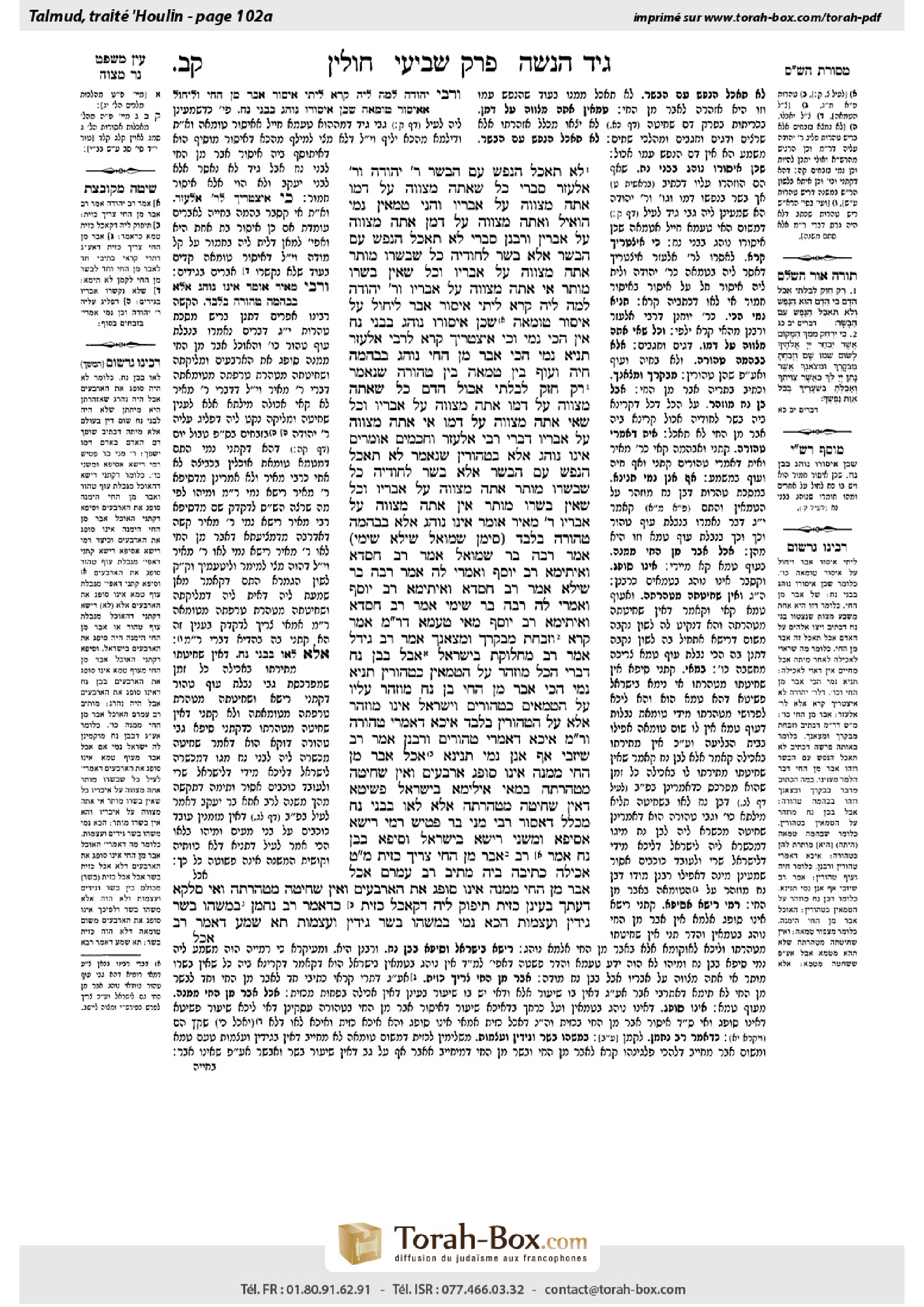
Chullin 102a: Talmud study for Daf Yomi
Daf Yomi is the daily study of one Talmud folio. Explore 37 tractates with scans, Hebrew text, Sefaria English and AI-generated French translations where annotated.
Passage selection and English or AI-generated French translation are available where the scan has annotations. Daf Study is independent of Torah-Box and Sefaria.
Browse Chullin · חולין · All tractatesChullin 102a text and translations
This page of Chullin includes the Aramaic text, an English translation and an AI-generated French translation, alongside the scan above.
חולין ק״ב א · Aramaic and Hebrew text
לֹא תֹאכַל הַנֶּפֶשׁ עִם הַבָּשָׂר״. רַבִּי יְהוּדָה וְרַבִּי אֶלְעָזָר סָבְרִי: כֹּל שֶׁאַתָּה מְצוֶּּוה עַל דָּמוֹ אַתָּה מְצוֶּּוה עַל אֵבָרָיו, וְהָנֵי טְמֵאִין נָמֵי, הוֹאִיל וְאַתָּה מְצוֶּּוה עַל דָּמָן אַתָּה מְצוֶּּוה עַל אֵבָרָין.
וְרַבָּנַן סָבְרִי: ״לֹא תֹאכַל הַנֶּפֶשׁ עִם הַבָּשָׂר״, אֶלָּא בָּשָׂר לְחוֹדֵיהּ, כֹּל שֶׁבְּשָׂרוֹ מוּתָּר – אַתָּה מְצוֶּּוה עַל אֵבָרָיו, וְכֹל שֶׁאֵין בְּשָׂרוֹ מוּתָּר – אִי אַתָּה מְצוֶּּוה עַל אֵבָרָיו.
וְרַבִּי יְהוּדָה, לְמָה לֵיהּ קְרָא? לֵיתֵי אִיסּוּר אֵבֶר לֵיחוּל עַל אִיסּוּר טוּמְאָה, שֶׁכֵּן אִיסּוּרוֹ נוֹהֵג בִּבְנֵי נֹחַ!
אִין הָכִי נָמֵי, וְכִי אִיצְטְרִיךְ קְרָא לְרַבִּי אֶלְעָזָר.
תַּנְיָא נָמֵי הָכִי: אֵבֶר מִן הַחַי נוֹהֵג בִּבְהֵמָה חַיָּה וָעוֹף, בֵּין טְמֵאָה בֵּין טְהוֹרָה, שֶׁנֶּאֱמַר ״רַק חֲזַק לְבִלְתִּי אֲכֹל הַדָּם״.
כֹּל שֶׁאַתָּה מְצוֶּּוה עַל דָּמוֹ – אַתָּה מְצוֶּּוה עַל אֵבָרָיו, וְכֹל שֶׁאִי אַתָּה מְצוֶּּוה עַל דָּמוֹ – אִי אַתָּה מְצוֶּּוה עַל אֵבָרָיו, דִּבְרֵי רַבִּי אֶלְעָזָר.
וַחֲכָמִים אוֹמְרִים: אֵינוֹ נוֹהֵג אֶלָּא בִּטְהוֹרִין, שֶׁנֶּאֱמַר ״לֹא תֹאכַל הַנֶּפֶשׁ עִם הַבָּשָׂר״, אֶלָּא בָּשָׂר לְחוֹדֵיהּ, כֹּל שֶׁבְּשָׂרוֹ מוּתָּר – אַתָּה מְצוֶּּוה עַל אֵבָרָיו, וְכֹל שֶׁאֵין בְּשָׂרוֹ מוּתָּר – אֵין אַתָּה מְצוֶּּוה עַל אֵבָרָיו.
רַבִּי מֵאִיר אוֹמֵר: אֵינוֹ נוֹהֵג אֶלָּא בִּבְהֵמָה טְהוֹרָה בִּלְבַד.
(סִימָן: שְׁמוּאֵל, שֵׁילָא, שִׁימִי).
אָמַר רַבָּה בַּר שְׁמוּאֵל אָמַר רַב חִסְדָּא, וְאִיתֵּימָא רַב יוֹסֵף, וְאָמְרִי לַהּ אָמַר רַבָּה בַּר שֵׁילָא אָמַר רַב חִסְדָּא, וְאִיתֵּימָא רַב יוֹסֵף, וְאָמְרִי לַהּ רַבָּה בַּר שִׁימִי אָמַר רַב חִסְדָּא, וְאִיתֵּימָא רַב יוֹסֵף: מַאי טַעְמָא דְּרַבִּי מֵאִיר?
אָמַר קְרָא ״וְזָבַחְתָּ מִבְּקָרְךָ וּמִצֹּאנְךָ״.
אָמַר רַב גִּידֵּל, אָמַר רַב: מַחְלוֹקֶת בְּיִשְׂרָאֵל, אֲבָל בְּבֶן נֹחַ – דִּבְרֵי הַכֹּל מוּזְהָר עַל הַטְּמֵאִין כַּטְּהוֹרִין.
תַּנְיָא נָמֵי הָכִי: אֵבֶר מִן הַחַי – בֶּן נֹחַ מוּזְהָר עָלָיו עַל הַטְּמֵאִים כַּטְּהוֹרִים, וְיִשְׂרָאֵל אֵינוֹ מוּזְהָר אֶלָּא עַל הַטְּהוֹרִין בִּלְבַד.
אִיכָּא דְּאָמְרִי ״טְהוֹרָה״, וְרַבִּי מֵאִיר. אִיכָּא דְּאָמְרִי ״טְהוֹרִים״, וְרַבָּנַן.
אָמַר רַב שֵׁיזְבִי: אַף אֲנַן נָמֵי תְּנֵינָא, אָכַל אֵבֶר מִן הַחַי מִמֶּנָּה אֵינוֹ סוֹפֵג אַרְבָּעִים, וְאֵין שְׁחִיטָה מְטַהַרְתָּהּ.
בְּמַאי? אִילֵימָא בְּיִשְׂרָאֵל – פְּשִׁיטָא דְּאֵין שְׁחִיטָה מְטַהַרְתָּהּ! אֶלָּא לָאו בִּבְנֵי נֹחַ, מִכְּלָל דְּאָסוּר.
רַבִּי מָנִי בַּר פַּטִּישׁ רָמֵי רֵישָׁא אַסֵּיפָא, וּמְשַׁנֵּי: רֵישָׁא בְּיִשְׂרָאֵל, וְסֵיפָא בְּבֶן נֹחַ.
אָמַר רַב: אֵבֶר מִן הַחַי צָרִיךְ כְּזַיִת, מַאי טַעְמָא? אֲכִילָה כְּתִיבָה בֵּיהּ.
מֵתִיב רַב עַמְרָם: אָכַל אֵבֶר מִן הַחַי מִמֶּנָּה – אֵינוֹ סוֹפֵג אֶת הָאַרְבָּעִים, וְאֵין שְׁחִיטָה מְטַהַרְתָּהּ. וְאִי סָלְקָא דַעְתָּךְ בָּעֵינַן כְּזַיִת – תִּיפּוֹק לֵיהּ דְּקָאָכֵל כְּזַיִת.
כִּדְאָמַר רַב נַחְמָן, בְּמַשֶּׁהוּ בָּשָׂר גִּידִין וַעֲצָמוֹת, הָכָא נָמֵי בְּמַשֶּׁהוּ בָּשָׂר גִּידִין וַעֲצָמוֹת.
תָּא שְׁמַע, דְּאָמַר רַב:
Chullin 102a · English translation
and you shall not eat the life with the flesh” (Deuteronomy 12:23). Rabbi Yehuda and Rabbi Elazar hold that with regard to any animal whose blood you are commanded not to eat, you are commanded with regard to its limbs, i.e., you are prohibited from eating its limbs that were severed while it was still alive. Consequently, with regard to these non-kosher species also, since you are commanded not to eat their blood, you are commanded with regard to their limbs.
And the Rabbis hold that the verse indicates: “And you shall not eat the life with the flesh” (Deuteronomy 12:23), but rather you shall eat the flesh alone, i.e., when the animal is no longer alive. Consequently, with regard to any animal whose flesh is permitted when it is slaughtered, you are commanded with regard to its limbs, i.e., you are prohibited from eating its limbs that were severed while it was still alive. But with regard to any animal whose flesh is not permitted when it is slaughtered, you are not commanded with regard to its limbs, i.e., the prohibition of eating limbs that were severed while it was still alive does not apply.
The Gemara asks: But according to Rabbi Yehuda, who holds that a prohibition takes effect upon an already existing, less stringent prohibition, why does he need to derive this from a verse? Let the prohibition of eating a limb from a living animal come and take effect on the prohibition of eating meat from a non-kosher animal, as it is more stringent since its prohibition applies also to descendants of Noah, i.e., gentiles.
The Gemara responds: Yes, that is indeed so. Rabbi Yehuda does not need to derive this halakha from a verse, and the verse was necessary only according to the opinion of Rabbi Elazar, who holds that a prohibition does not take effect where there is an already existing prohibition, even if the second prohibition is more stringent.
This fact that it is Rabbi Elazar who derives this halakha from the verse, as opposed to Rabbi Yehuda, is also taught in a baraita: The prohibition of eating a limb from a living animal applies with regard to a limb from a domesticated animal, an undomesticated animal, or a bird, and whether it is from a non-kosher species or a kosher species, as it is stated: “Only be steadfast in not eating the blood, for the blood is the life; and you shall not eat the life with the flesh” (Deuteronomy 12:23).
This verse indicates that with regard to any species whose blood you are commanded not to eat, you are commanded with regard to its limbs, i.e., you are prohibited from eating its limbs that were severed while it was still alive. And any species about whose blood you are not commanded, i.e., with regard to which the prohibition of eating blood does not apply, you are not commanded with regard to their limbs. Since the prohibition of eating blood applies even with regard to non-kosher species, the prohibition of eating limbs severed from a living animal also applies; this is the statement of Rabbi Elazar.
And the Rabbis say: The prohibition of eating a limb from a living animal applies only to kosher species, as it is stated in the verse: “And you shall not eat the life with the flesh” (Deuteronomy 12:23), but rather you shall eat the flesh alone, i.e., when the animal is no longer alive. Consequently, with regard to any animal whose flesh is permitted when it is slaughtered, you are commanded with regard to its limbs, i.e., you are prohibited from eating its limbs that were severed while it was still alive. But with regard to any animal whose flesh is not permitted when it is slaughtered, you are not commanded with regard to its limbs, i.e., the prohibition of eating limbs that were severed while it was still alive does not apply.
Rabbi Meir says that the prohibition of eating a limb from a living animal applies only with regard to a kosher species of domesticated animal, but not with regard to undomesticated animals or fowl, even if they are kosher.
The Gemara provides a mnemonic for the different opinions with regard to the name of one of the Sages cited in the upcoming discussion: Shmuel, Sheila, Shimi.
Rabba bar Shmuel said that Rav Ḥisda said, and some say that it was Rav Yosef who said the following statement. And some say the attributions as follows: Rabba bar Sheila said that Rav Ḥisda said, and some say that it was Rav Yosef who said; and some say the attributions as follows: Rabba bar Shimi said that Rav Ḥisda said, and some say that it was Rav Yosef who said: What is the reason for the opinion of Rabbi Meir that the prohibition of eating a limb from a living animal applies only with regard to a kosher species of domesticated animal?
It is that the verse states: “Then you shall slaughter of your cattle and of your sheep” (Deuteronomy 12:21). This verse is closely followed by the verse that serves as the source of the prohibition to eat a limb severed from a living animal (Deuteronomy 12:23), indicating that the prohibition applies only to kosher domesticated animals.
Rav Giddel says that Rav says: The dispute between the Rabbis and Rabbi Yehuda and Rabbi Eliezer about whether the prohibition of eating a limb severed from a living animal applies with regard to non-kosher species is only with regard to Jews. But with regard to descendants of Noah, i.e., gentiles, everyone agrees that they are prohibited from eating a limb from a living non-kosher species of animal just like they are prohibited from eating a limb from a living kosher species.
The Gemara comments that this is also taught in a baraita: A descendant of Noah is prohibited from eating a limb from a living animal from non-kosher species just as from kosher species. But a Jew is prohibited from eating a limb from a living animal of kosher species only.
There are those who say that the correct wording of the baraita is that a Jew is prohibited from eating a limb from a living kosher species, in singular, and it is in accordance with the opinion of Rabbi Meir, who holds that the prohibition is limited to kosher domestic animals. And there are those who say that the correct wording of the baraita is that a Jew is prohibited from eating a limb from living kosher species, in plural, and it is in accordance with the opinion of the Rabbis, who hold that the prohibition also applies to a limb from a living bird or a living undomesticated animal of kosher species.
Rav Sheizvi said: We learn in the mishna as well that a gentile is prohibited from eating a limb from a living being even with regard to non-kosher species (Teharot 1:3): If one ate a limb severed from a living non-kosher bird, he does not incur forty lashes, and slaughter does not purify it, i.e., cause it to become permitted for consumption.
Rav Sheizvi clarifies: With regard to what case does the mishna issue this ruling? If we say that it is referring to a Jew who ate the limb, it is obvious that slaughter does not purify it, because it is a non-kosher species and cannot be made kosher. Rather is it not referring to descendants of Noah and teaching that even after the bird is slaughtered the limb severed while it was alive remains forbidden? By inference, it is clear from the mishna that it is prohibited for a gentile to eat a limb severed from a living being even from a non-kosher species.
Rabbi Mani bar Pattish raises a contradiction between the first clause of that mishna, which states that one does not receive lashes for eating a limb severed from a living non-kosher bird, and the latter clause of the mishna, which states that a limb severed from a living non-kosher bird remains forbidden after the bird is slaughtered. The first clause indicates that the prohibition of eating a limb severed from a living creature applies only to kosher species, while the latter clause indicates that it applies also to non-kosher species. And he answers this contradiction by explaining that the first clause is referring to a Jew and the latter clause is referring to a descendant of Noah.
§ The Gemara continues discussing the prohibition of eating a limb severed from a living creature. Rav says: A limb severed from a living animal requires an olive-bulk in order to render one who eats it liable to receive lashes. What is the reason for this? It is because the term: Eating, is written with regard to the prohibition of a limb severed from a living animal, and the definition of eating is the consumption of at least one olive-bulk.
Rav Amram raises an objection from the mishna cited above (Teharot 1:3): If one ate a limb severed from a living non-kosher bird, he does not incur the forty lashes, and slaughter does not purify it, i.e., cause it to become permitted. But if it enters your mind that we require an olive-bulk in order for one to receive lashes for eating a limb severed from a living creature, that mishna must be referring to such a case; therefore, it should emerge that he is liable to receive lashes because he ate an olive-bulk of a non-kosher bird.
The Gemara answers: This can be explained as Rav Naḥman said with regard to another issue, that it is referring to a case of eating a small amount of meat together with sinews and bones and the total volume is an olive-bulk. Here also, the mishna is referring to a case of eating a small amount of meat together with sinews and bones.
The Gemara raises another challenge to Rav’s statement that one receives lashes for eating a limb severed from a living animal only if he eats an olive-bulk: Come and hear a proof in this regard, as Rav said:
Chullin 102a · Traduction française (IA)
« Et tu ne mangeras pas la vie avec la chair » (Deutéronome 12,23). Rabbi Yehouda et Rabbi Elazar estiment que, pour tout animal dont il est interdit de consommer le sang, il est également interdit de manger les membres qui en ont été coupés alors qu’il était encore vivant. Par conséquent, pour ces espèces non cachères aussi, puisqu’il est interdit d’en consommer le sang, il est interdit d’en manger les membres.
Quant aux Rabbins, ils estiment que le verset indique : « Et tu ne mangeras pas la vie avec la chair » (Deutéronome 12,23), mais que tu mangeras la chair seule, c’est-à-dire lorsque l’animal n’est plus vivant. Par conséquent, pour tout animal dont la chair est permise après l’abattage rituel, il est interdit de manger les membres qui en ont été coupés alors qu’il était encore vivant. En revanche, pour tout animal dont la chair n’est pas permise après l’abattage rituel, il n’est pas interdit d’en manger les membres, c’est-à-dire que l’interdiction de consommer des membres coupés alors que l’animal était encore vivant ne s’applique pas.
La Guemara demande : Mais selon Rabbi Yehouda, qui estime qu’une interdiction peut prendre effet alors qu’une interdiction moins sévère est déjà en vigueur, pourquoi doit-il déduire cela d’un verset ? L’interdiction de manger un membre d’un animal vivant ne peut-elle pas prendre effet sur l’interdiction de manger la chair d’un animal non cachère, puisqu’elle est plus sévère, car elle s’applique également aux descendants de Noé, c’est-à-dire aux non-Juifs ?
La Guemara répond : Oui, c’est effectivement le cas. Rabbi Yehouda n’a pas besoin de déduire cette halakha d’un verset ; le verset n’est nécessaire que selon l’opinion de Rabbi Elazar, qui estime qu’une interdiction ne prend pas effet lorsqu’une autre interdiction est déjà en vigueur, même si la seconde interdiction est plus sévère.
Le fait que ce soit Rabbi Elazar, et non Rabbi Yehouda, qui déduise cette halakha du verset est également enseigné dans une baraïta : l’interdiction de manger un membre d’un animal vivant s’applique à un membre d’un animal domestique, d’un animal sauvage ou d’un oiseau, qu’il s’agisse d’une espèce non cachère ou d’une espèce cachère, comme il est dit : « Seulement, sois ferme pour ne pas manger le sang, car le sang, c’est la vie ; et tu ne mangeras pas la vie avec la chair » (Deutéronome 12,23).
Ce verset indique que, pour toute espèce dont il est interdit de consommer le sang, il est également interdit de manger les membres qui en ont été coupés alors qu’elle était encore vivante. En revanche, pour toute espèce dont le sang n’est pas soumis à cette interdiction, il n’est pas interdit de manger ses membres. Puisque l’interdiction de consommer le sang s’applique même aux espèces non cachères, l’interdiction de manger des membres coupés d’un animal vivant s’applique également à celles-ci. Telle est l’opinion de Rabbi Elazar.
Et les Rabbins disent : l’interdiction de manger un membre d’un animal vivant ne s’applique qu’aux espèces cachères, comme il est dit dans le verset : « Et tu ne mangeras pas la vie avec la chair » (Deutéronome 12,23), mais que tu mangeras la chair seule, c’est-à-dire lorsque l’animal n’est plus vivant. Par conséquent, pour tout animal dont la chair est permise après l’abattage rituel, il est interdit de manger les membres qui en ont été coupés alors qu’il était encore vivant. En revanche, pour tout animal dont la chair n’est pas permise après l’abattage rituel, il n’est pas interdit d’en manger les membres, c’est-à-dire que l’interdiction de consommer des membres coupés alors que l’animal était encore vivant ne s’applique pas.
Rabbi Meïr dit que l’interdiction de manger un membre d’un animal vivant ne s’applique qu’aux espèces cachères d’animaux domestiques, mais pas aux animaux sauvages ni aux oiseaux, même s’ils sont cachères.
La Guemara donne un moyen mnémotechnique pour retenir les différentes versions du nom de l’un des Sages cités dans la discussion qui suit : Shmuel, Sheila, Shimi.
Rabba bar Shmuel dit au nom de Rav Hisda, et certains disent que c’est Rav Yossef qui a formulé la déclaration suivante. Selon une autre version, Rabba bar Sheila dit au nom de Rav Hisda, et certains disent que c’est Rav Yossef qui l’a formulée ; selon une troisième version, Rabba bar Shimi dit au nom de Rav Hisda, et certains disent que c’est Rav Yossef qui l’a formulée : quelle est la raison de l’opinion de Rabbi Meïr, selon laquelle l’interdiction de manger un membre d’un animal vivant ne s’applique qu’aux espèces cachères d’animaux domestiques ?
C’est parce que le verset dit : « Alors tu abattras de ton gros bétail et de ton petit bétail » (Deutéronome 12,21). Ce verset est immédiatement suivi de celui qui sert de source à l’interdiction de manger un membre coupé d’un animal vivant (Deutéronome 12,23), ce qui indique que l’interdiction ne s’applique qu’aux animaux domestiques cachères.
Rav Giddel dit au nom de Rav : le désaccord entre les Rabbins, d’une part, et Rabbi Yehouda et Rabbi Eliezer, d’autre part, sur la question de savoir si l’interdiction de manger un membre coupé d’un animal vivant s’applique aux espèces non cachères ne concerne que les Juifs. Mais pour les descendants de Noé, c’est-à-dire les non-Juifs, tous conviennent qu’il leur est interdit de manger un membre d’un animal vivant provenant d’une espèce non cachère, tout comme il leur est interdit d’en manger un provenant d’une espèce cachère.
La Guemara relève que cela est également enseigné dans une baraïta : il est interdit à un descendant de Noé de manger un membre d’un animal vivant provenant d’une espèce non cachère, tout comme d’une espèce cachère. Mais un Juif n’a l’interdiction de manger un membre d’un animal vivant que si celui-ci provient d’une espèce cachère.
Certains disent que la formulation exacte de la baraïta est qu’il est interdit à un Juif de manger un membre d’un animal vivant d’une espèce cachère, au singulier, conformément à l’opinion de Rabbi Meïr, qui estime que l’interdiction se limite aux animaux domestiques cachères. D’autres disent que la formulation exacte de la baraïta est qu’il est interdit à un Juif de manger un membre d’animaux vivants d’espèces cachères, au pluriel, conformément à l’opinion des Rabbins, qui estiment que l’interdiction s’applique également aux membres d’oiseaux vivants ou d’animaux sauvages vivants d’espèces cachères.
Rav Sheizvi dit : nous apprenons également dans la Michna qu’il est interdit à un non-Juif de manger un membre d’un être vivant, même lorsqu’il s’agit d’une espèce non cachère (Teharot 1,3) : si quelqu’un a mangé un membre coupé d’un oiseau vivant non cachère, il ne reçoit pas les quarante coups de fouet, et l’abattage rituel ne le purifie pas, c’est-à-dire ne le rend pas permis à la consommation.
Rav Sheizvi précise : à quel cas la Michna applique-t-elle cette décision ? Si l’on dit qu’elle parle d’un Juif qui a mangé le membre, il est évident que l’abattage rituel ne le purifie pas, car il provient d’une espèce non cachère et ne peut pas devenir cachère. La Michna ne parle-t-elle pas plutôt des descendants de Noé, enseignant que même après l’abattage rituel de l’oiseau, le membre qui en a été coupé alors qu’il était vivant reste interdit ? On déduit clairement de la Michna qu’il est interdit à un non-Juif de manger un membre coupé d’un être vivant, même s’il provient d’une espèce non cachère.
Rabbi Mani bar Pattish soulève une contradiction entre le début de cette Michna, qui dit qu’on ne reçoit pas les coups de fouet pour avoir mangé un membre coupé d’un oiseau vivant non cachère, et la fin de la Michna, qui dit qu’un membre coupé d’un oiseau vivant non cachère reste interdit après l’abattage rituel de l’oiseau. Le début indique que l’interdiction de manger un membre coupé d’un être vivant ne s’applique qu’aux espèces cachères, tandis que la fin indique qu’elle s’applique aussi aux espèces non cachères. Il résout cette contradiction en expliquant que le début parle d’un Juif et la fin, d’un descendant de Noé.
§ La Guemara poursuit son examen de l’interdiction de manger un membre coupé d’un être vivant. Rav dit : pour que celui qui mange un membre coupé d’un animal vivant soit passible des coups de fouet, ce membre doit avoir le volume d’une olive. Pourquoi ? Parce que le terme « manger » est employé à propos de l’interdiction de manger un membre coupé d’un animal vivant, et que manger signifie consommer au moins le volume d’une olive.
Rav Amram soulève une objection à partir de la Michna citée plus haut (Teharot 1,3) : si quelqu’un a mangé un membre coupé d’un oiseau vivant non cachère, il ne reçoit pas les quarante coups de fouet, et l’abattage rituel ne le purifie pas, c’est-à-dire ne le rend pas permis. Mais si l’on devait comprendre qu’un volume d’une olive est nécessaire pour être passible des coups de fouet pour avoir mangé un membre coupé d’un être vivant, la Michna devrait parler d’un tel cas ; il s’ensuivrait donc qu’il est passible des coups de fouet, puisqu’il a mangé le volume d’une olive provenant d’un oiseau non cachère.
La Guemara répond : on peut l’expliquer comme Rav Nahman l’a dit à propos d’une autre question : il s’agit d’un cas où une petite quantité de chair a été mangée avec des tendons et des os, l’ensemble ayant le volume d’une olive. Ici aussi, la Michna parle d’un cas où une petite quantité de chair a été mangée avec des tendons et des os.
La Guemara soulève une autre difficulté contre la déclaration de Rav, selon laquelle on ne reçoit les coups de fouet pour avoir mangé un membre coupé d’un animal vivant que si l’on en mange le volume d’une olive : viens et entends une preuve à ce sujet, car Rav a dit :
Traduction française générée par IA à partir de l’édition anglaise de Sefaria. Vérifie toujours un passage avec le texte source.
Text from Sefaria: William Davidson Edition - Vocalized Aramaic (unknown); William Davidson Edition - English (CC BY NC).