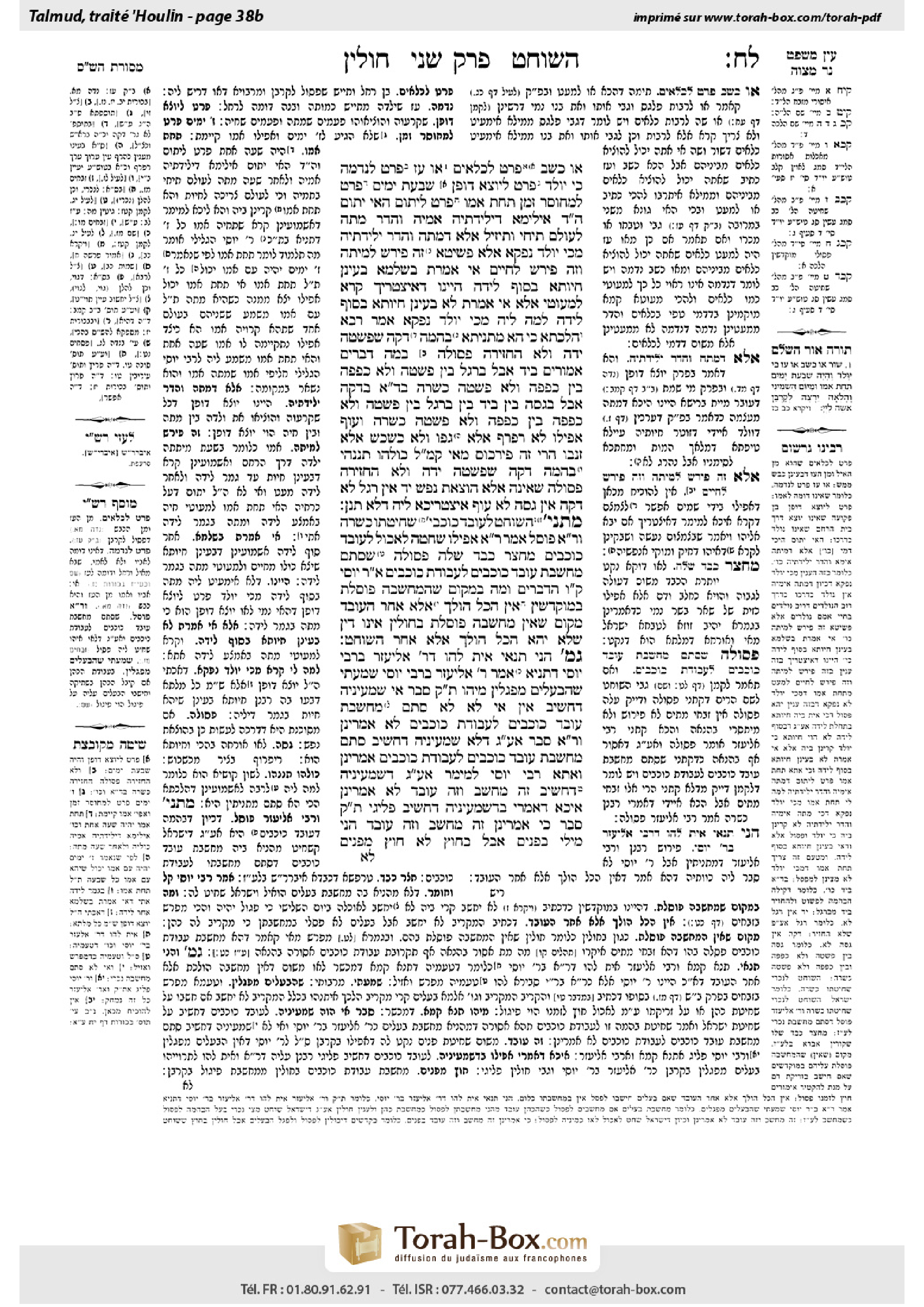
Chullin 38b: Talmud study for Daf Yomi
Daf Yomi is the daily study of one Talmud folio. Explore 37 tractates with scans, Hebrew text, Sefaria English and AI-generated French translations where annotated.
Passage selection and English or AI-generated French translation are available where the scan has annotations. Daf Study is independent of Torah-Box and Sefaria.
Browse Chullin · חולין · All tractatesChullin 38b text and translations
This page of Chullin includes the Aramaic text, an English translation and an AI-generated French translation, alongside the scan above.
חולין ל״ח ב · Aramaic and Hebrew text
אוֹ כֶשֶׂב״ – פְּרָט לְכִלְאַיִם, ״אוֹ עֵז״ – פְּרָט לְנִדְמֶה, ״כִּי יִוָּלֵד״ – פְּרָט לְיוֹצֵא דּוֹפֶן, ״שִׁבְעַת יָמִים״ – פְּרָט לִמְחוּסַּר זְמַן, ״תַּחַת אִמּוֹ״ – פְּרָט לַיָּתוֹם.
הַאי יָתוֹם הֵיכִי דָמֵי? אִילֵּימָא דִּילִידְתֵּיהּ אִמֵּיהּ וַהֲדַר מִתָה, לְעוֹלָם תֵּיחֵי וְתֵיזִיל? אֶלָּא דְּמִתָה וַהֲדַר יְלִידְתֵּיהּ, מִ״כִּי יִוָּלֵד״ נָפְקָא.
אֶלָּא פְּשִׁיטָא, זֶה פֵּירַשׁ לְמִיתָה וְזֶה פֵּירַשׁ לְחַיִּים. אִי אָמְרַתְּ בִּשְׁלָמָא בָּעֵינַן חִיּוּתָא בְּסוֹף לֵידָה – הַיְינוּ דְּאִיצְטְרִיךְ קְרָא לְמַעוֹטֵי, אֶלָּא אִי אָמְרַתְּ לָא בָּעֵינַן חִיּוּתָא בְּסוֹף לֵידָה, לְמָה לֵיהּ? מִ״כִּי יִוָּלֵד״ נָפְקָא!
אָמַר רָבָא: הִלְכְתָא כִּי הָא מַתְנִיתָא – בְּהֵמָה דַּקָּה שֶׁפָּשְׁטָה יָדָהּ וְלֹא הֶחְזִירָה, פְּסוּלָה.
בַּמֶּה דְּבָרִים אֲמוּרִים? בַּיָּד, אֲבָל בָּרֶגֶל, בֵּין פָּשְׁטָה וְלֹא כָּפְפָה, בֵּין כָּפְפָה וְלֹא פָּשְׁטָה – כְּשֵׁרָה. בַּמֶּה דְּבָרִים אֲמוּרִים? בְּדַקָּה, אֲבָל בְּגַסָּה, בֵּין בַּיָּד בֵּין בָּרֶגֶל, בֵּין פָּשְׁטָה וְלֹא כָּפְפָה, בֵּין כָּפְפָה וְלֹא פָּשְׁטָה – כְּשֵׁרָה. וְעוֹף, אֲפִילּוּ לֹא רִפְרֵף אֶלָּא גַּפּוֹ, וְלֹא כִּשְׁכֵּשׁ אֶלָּא זְנָבוֹ – הֲרֵי זֶה פִּירְכּוּס.
מַאי קָא מַשְׁמַע לַן? כּוּלְּהוּ תְּנַנְהִי! בְּהֵמָה דַּקָּה שֶׁפָּשְׁטָה יָדָהּ וְלֹא הֶחְזִירָה – פְּסוּלָה, שֶׁאֵינָהּ אֶלָּא הוֹצָאַת נֶפֶשׁ. יָד – אִין, רֶגֶל – לָא; דַּקָּה – אִין, גַּסָּה – לָא. עוֹף אִיצְטְרִיכָא לֵיהּ, דְּלָא תְּנַן.
מַתְנִי׳ הַשּׁוֹחֵט לְנׇכְרִי – שְׁחִיטָתוֹ כְּשֵׁרָה, וְרַבִּי אֱלִיעֶזֶר פּוֹסֵל. אָמַר רַבִּי אֱלִיעֶזֶר: אֲפִילּוּ שְׁחָטָהּ לֶאֱכוֹל לְנׇכְרִי מֵחֲצַר כָּבֵד שֶׁלָּהּ – פְּסוּלָה, שֶׁסְּתָם מַחְשֶׁבֶת נׇכְרִי לַעֲבוֹדָה זָרָה.
אָמַר רַבִּי יוֹסֵי: קַל וָחוֹמֶר הַדְּבָרִים, וּמָה בִּמְקוֹם שֶׁהַמַּחְשָׁבָה פּוֹסֶלֶת בְּמוּקְדָּשִׁין – אֵין הַכֹּל הוֹלֵךְ אֶלָּא אַחַר הָעוֹבֵד, מְקוֹם שֶׁאֵין מַחְשָׁבָה פּוֹסֶלֶת בְּחוּלִּין – אֵינוֹ דִּין שֶׁלֹּא יְהֵא הַכֹּל הוֹלֵךְ אֶלָּא אַחַר הַשּׁוֹחֵט?
גְּמָ׳ הָנֵי תַּנָּאֵי אִית לְהוּ דְּרַבִּי אֱלִיעֶזֶר בְּרַבִּי יוֹסֵי, דְּתַנְיָא: אָמַר רַבִּי אֱלִיעֶזֶר בְּרַבִּי יוֹסֵי: שָׁמַעְתִּי שֶׁהַבְּעָלִים מְפַגְּלִין.
מִיהוּ תַּנָּא קַמָּא סָבַר: אִי שַׁמְעִינֵיהּ דְּחַשֵּׁיב – אִין, אִי לָא – לָא, סְתָם מַחְשֶׁבֶת נׇכְרִי לַעֲבוֹדָה זָרָה לָא אָמְרִינַן. רַבִּי אֱלִיעֶזֶר סָבַר: אַף עַל גַּב דְּלָא שַׁמְעִינֵיהּ דְּחַשֵּׁיב, סְתָם מַחְשֶׁבֶת נׇכְרִי לַעֲבוֹדָה זָרָה אָמְרִינַן. וַאֲתָא רַבִּי יוֹסֵי לְמֵימַר: אַף עַל גַּב דְּשַׁמְעִינֵיהּ דְּחַשֵּׁיב, זֶה מְחַשֵּׁב וְזֶה עוֹבֵד לָא אָמְרִינַן.
אִיכָּא דְּאָמְרִי: בִּדְשַׁמְעִינֵיהּ דְּחַשֵּׁיב פְּלִיגִי, תַּנָּא קַמָּא סָבַר: כִּי אָמְרִינַן ״זֶה מְחַשֵּׁב וְזֶה עוֹבֵד״ – הָנֵי מִילֵּי בִּפְנִים, אֲבָל בְּחוּץ לֹא, חוּץ מִפְּנִים
Chullin 38b · English translation
or a sheep” is to the exclusion of an animal born to parents of diverse kinds, which may not be brought as an offering. The phrase “or a goat” is to the exclusion of an animal that resembles another species of animal. “When it is born”; this is to the exclusion of an animal born by caesarean section. “It shall be seven days”; this is to the exclusion of an animal whose time has not yet arrived. “Under its mother”; this is to the exclusion of an animal that is an orphan.
Rava elaborates: What are the circumstances of this orphan? If we say that its mother gave birth to it and then died, this is unreasonable. Will the mother continue living forever? Rather, perhaps the reference is to a case where the mother died and then gave birth to it. The Gemara rejects that possibility, as the fact that this animal is disqualified from sacrifice is derived from the phrase: “When it is born,” since after the mother’s death the newborn animal can emerge from the womb only by means of caesarean section.
Rather, it is obvious that the reference is to a case where the mother died at the conclusion of the birth, at which point this mother withdrew for death and that newborn withdrew for life. Granted, if you say that we require life at the conclusion of the birth, that is why a verse was necessary to exclude the orphan. But if you say that we do not require life at the conclusion of the birth, and the verse is excluding only an animal that was born after its mother’s death, why is this verse necessary to exclude it? It can be derived from the phrase: “When it is born.” It may be derived from here that in any situation where the animal must be alive, it must remain alive until the end of the process. That is the case with regard to the slaughter of an animal in danger of imminent death as well. The slaughter is valid only if there is an indication of life at the end of the act of slaughter.
§ The mishna teaches: The slaughter of a small animal in danger of imminent death that during the slaughter extended its foreleg that was bent and did not restore it to the bent position is not valid, as extending the foreleg is only part of the natural course of removal of the animal’s soul from its body and not a convulsion indicating life. Rava says that the halakha is in accordance with the opinion expressed in this baraita: The slaughter of a small animal that extended its foreleg that was bent and did not restore it to the bent position is not valid.
The baraita continues: In what case is this statement said? It is with regard to the foreleg. But with regard to the hind leg, whether the animal extended it and did not restore it to the bent position or the animal bent it but did not extend it, the slaughter is valid. In what case is this statement, about extending the foreleg, said? It is with regard to a small animal. But with regard to a large animal, whether the convulsion involves its foreleg or its hind leg, and whether the animal extended it and did not restore it to the bent position or the animal bent it but did not extend it, the slaughter is valid. And with regard to a bird, even if it fluttered [rifref] only its wing or wagged only its tail, that is a convulsion and an indication of life.
The Gemara asks: What is Rava teaching us in ruling in accordance with the baraita? He is teaching us all of those halakhot we learned in the mishna: The slaughter of a small animal that when being slaughtered extended its foreleg that was bent and did not restore it to the bent position is not valid, as extending the foreleg is only part of the natural course of removal of the animal’s soul from its body and not a convulsion indicating life. It may be inferred from the mishna that with regard to movement of a foreleg alone, yes, it is not an indication of life, but movement of a hind leg, no, it is an indication of life. With regard to a small animal, yes, this is the halakha; with regard to a large animal, no, this is not the halakha, and extending a hind leg does indicate life. The Gemara answers: It was necessary for Rava to teach the halakha in the baraita with regard to a bird, as we did not learn it in the mishna.
MISHNA: In the case of a Jew who slaughters the animal of a gentile for a gentile, his slaughter is valid, and Rabbi Eliezer deems it not valid. Rabbi Eliezer says: Even if the Jew slaughtered the animal with the intent to feed the gentile from its diaphragm [meḥatzar kaved], its slaughter is not valid, as the unspecified intent of a gentile is to slaughter the animal for idol worship, and it is prohibited to derive benefit from it.
Rabbi Yosei says: The matter of the intent of the gentile is irrelevant in this case, as can be derived by means of an a fortiori inference. If in a place where intent while slaughtering the animal invalidates the slaughter, i.e., in sacrificial animals, such as when slaughtering an offering with the intent to sacrifice it beyond its designated time, everything follows only the intent of the priest performing the service and not the intent of the owner, then in a place where intent does not invalidate the slaughter, i.e., in non-sacred animals, is it not right that everything should follow only the intent of the one who slaughters the animal?
GEMARA: In explanation of the dispute between the first tanna and Rabbi Eliezer, the Gemara explains: These tanna’im hold in accordance with the opinion of Rabbi Eliezer, son of Rabbi Yosei, as it is taught in a baraita that Rabbi Eliezer, son of Rabbi Yosei, says: I heard that the owners, and not only the priest, render an offering piggul by means of improper intent. The same is true with regard to non-sacred slaughter, where the owners’ intent for idol worship invalidates the slaughter, even if the slaughterer has no intent for idol worship.
But the first tanna holds that if we heard the gentile say that he intends the animal for idol worship, yes, his intent invalidates the slaughter, and if the gentile did not voice his intent before us, his intent does not invalidate the slaughter, as we do not say that the unspecified intent of a gentile is for idol worship. Rabbi Eliezer holds: Although we did not hear the gentile say that he intends the animal for idol worship, the slaughter is not valid, as we say the unspecified intent of a gentile is for idol worship. And Rabbi Yosei comes to say that even though we heard the gentile say that he intends the animal for idol worship, in a case where this owner has intent for idol worship and that other person is performing the slaughter, we do not say that the intent of the owner invalidates the slaughter.
There are those who say an alternative explanation of the mishna. It is with regard to a case where we heard the gentile say that he intends the animal for idol worship that the tanna’im disagree. The first tanna holds that when we say in a case where this owner has improper intent and that other person is performing the slaughter that the intent of the owner invalidates the slaughter, this statement applies only inside the Temple, in the slaughter of offerings. But with regard to non-sacred slaughter outside the Temple, the intent of the owner does not invalidate the slaughter, as with regard to deriving the halakhot of non-sacred slaughter outside the Temple from the halakhot of slaughter of sacrificial animals inside the Temple,
Chullin 38b · Traduction française (IA)
« Ou un mouton » exclut un animal né de parents d’espèces différentes, qui ne peut pas être apporté en offrande. L’expression « ou une chèvre » exclut un animal qui ressemble à un animal d’une autre espèce. « Lorsqu’il naît » exclut un animal né par césarienne. « Il restera sept jours » exclut un animal dont le moment n’est pas encore venu. « Sous sa mère » exclut un animal orphelin.
Rava précise : dans quelles circonstances s’agit-il d’un orphelin ? Si l’on dit que sa mère lui a donné naissance puis est morte, cela n’est pas raisonnable. La mère continuerait-elle à vivre éternellement ? Peut-être s’agit-il plutôt d’un cas où la mère est morte, puis lui a donné naissance. La Guemara rejette cette possibilité, car le fait que cet animal soit impropre au sacrifice se déduit de l’expression « lorsqu’il naît », puisque, après la mort de sa mère, le nouveau-né ne peut sortir de l’utérus que par césarienne.
Il est donc évident qu’il s’agit d’un cas où la mère est morte au terme de la mise bas : à ce moment-là, cette mère s’est retirée vers la mort, tandis que le nouveau-né s’est retiré vers la vie. Certes, si tu dis que l’animal doit être vivant à la fin de la mise bas, c’est pour cela qu’un verset était nécessaire afin d’exclure l’orphelin. Mais si tu dis qu’il n’est pas nécessaire qu’il soit vivant à la fin de la mise bas et que le verset exclut seulement un animal né après la mort de sa mère, pourquoi ce verset est-il nécessaire pour l’exclure ? Cela peut se déduire de l’expression « lorsqu’il naît ». On peut en déduire que, dans toute situation où l’animal doit être vivant, il doit le rester jusqu’à la fin du processus. Il en va de même pour l’abattage d’un animal en danger de mort imminente : l’abattage n’est valide que si un signe de vie est observable à la fin de l’acte d’abattage.
§ La Michna enseigne : l’abattage d’un petit animal en danger de mort imminente n’est pas valide si, pendant l’abattage, il a tendu sa patte avant repliée et ne l’a pas repliée de nouveau, car le fait de tendre la patte avant fait simplement partie du processus naturel par lequel l’âme quitte le corps de l’animal et ne constitue pas une convulsion indiquant la vie. Rava dit que la halakha est conforme à l’opinion exprimée dans cette baraïta : l’abattage d’un petit animal qui a tendu sa patte avant repliée et ne l’a pas repliée de nouveau n’est pas valide.
La baraïta poursuit : dans quel cas cette affirmation est-elle énoncée ? À propos de la patte avant. Mais, pour la patte arrière, que l’animal l’ait tendue sans la replier de nouveau ou qu’il l’ait repliée sans l’avoir tendue, l’abattage est valide. Dans quel cas cette affirmation concernant le fait de tendre la patte avant est-elle énoncée ? À propos d’un petit animal. Mais, pour un grand animal, que la convulsion concerne sa patte avant ou sa patte arrière, et qu’il l’ait tendue sans la replier de nouveau ou qu’il l’ait repliée sans l’avoir tendue, l’abattage est valide. Quant à un oiseau, même s’il n’a fait que battre [rifref] de l’aile ou remuer de la queue, cela constitue une convulsion et un signe de vie.
La Guemara demande : qu’est-ce que Rava nous enseigne en statuant conformément à la baraïta ? Il nous enseigne toutes les halakhot que nous avons apprises dans la Michna : l’abattage d’un petit animal n’est pas valide si, pendant l’abattage, il a tendu sa patte avant repliée et ne l’a pas repliée de nouveau, car le fait de tendre la patte avant fait simplement partie du processus naturel par lequel l’âme quitte le corps de l’animal et ne constitue pas une convulsion indiquant la vie. On peut déduire de la Michna que, s’agissant du seul mouvement d’une patte avant, il ne s’agit pas d’un signe de vie ; mais que le mouvement d’une patte arrière, en revanche, constitue un signe de vie. Pour un petit animal, telle est la halakha ; pour un grand animal, telle n’est pas la halakha, et le fait de tendre une patte arrière indique bien la vie. La Guemara répond : Rava devait enseigner la halakha de la baraïta concernant un oiseau, car nous ne l’avons pas apprise dans la Michna.
MICHNA : Dans le cas d’un Juif qui abat l’animal d’un non-Juif pour ce dernier, son abattage est valide, mais Rabbi Eliezer le déclare invalide. Rabbi Eliezer dit : même si le Juif a abattu l’animal avec l’intention de nourrir le non-Juif de son diaphragme [meḥatzar kaved], son abattage n’est pas valide, car l’intention implicite d’un non-Juif est d’abattre l’animal pour l’idolâtrie, et il est interdit d’en tirer profit.
Rabbi Yossei dit : l’intention du non-Juif est sans pertinence dans ce cas, comme on peut le déduire par raisonnement a fortiori. Si, là où l’intention lors de l’abattage de l’animal invalide l’abattage — c’est-à-dire pour les animaux consacrés, par exemple lorsqu’on abat une offrande avec l’intention de la sacrifier après le délai qui lui est assigné —, tout dépend uniquement de l’intention du prêtre qui accomplit le service, et non de celle du propriétaire, alors, là où l’intention n’invalide pas l’abattage — c’est-à-dire pour les animaux non consacrés —, n’est-il pas d’autant plus juste que tout dépende uniquement de l’intention de celui qui abat l’animal ?
GUEMARA : Pour expliquer le désaccord entre le premier tanna et Rabbi Eliezer, la Guemara explique : ces tannaïm suivent l’opinion de Rabbi Eliezer, fils de Rabbi Yossei, car il est enseigné dans une baraïta que Rabbi Eliezer, fils de Rabbi Yossei, dit : « J’ai entendu que les propriétaires, et pas seulement le prêtre, rendent une offrande piggoul par une intention incorrecte. » Il en va de même pour l’abattage d’un animal non consacré : l’intention des propriétaires de destiner l’animal à l’idolâtrie invalide l’abattage, même si celui qui abat l’animal n’a pas l’intention de le destiner à l’idolâtrie.
Mais, selon le premier tanna, si nous avons entendu le non-Juif dire qu’il destine l’animal à l’idolâtrie, alors son intention invalide l’abattage ; si le non-Juif n’a pas exprimé son intention devant nous, son intention n’invalide pas l’abattage, car nous ne disons pas que l’intention implicite d’un non-Juif est l’idolâtrie. Rabbi Eliezer, lui, considère que même si nous n’avons pas entendu le non-Juif dire qu’il destine l’animal à l’idolâtrie, l’abattage n’est pas valide, car nous disons que l’intention implicite d’un non-Juif est l’idolâtrie. Et Rabbi Yossei vient enseigner que, même si nous avons entendu le non-Juif dire qu’il destine l’animal à l’idolâtrie, dans le cas où ce propriétaire a l’intention de vouer l’animal à l’idolâtrie et où une autre personne accomplit l’abattage, nous ne disons pas que l’intention du propriétaire invalide l’abattage.
Certains proposent une autre explication de la Michna. Le désaccord entre les tannaïm porte sur un cas où nous avons entendu le non-Juif dire qu’il destine l’animal à l’idolâtrie. Selon le premier tanna, lorsqu’on dit que, dans le cas où ce propriétaire a une intention incorrecte et où une autre personne accomplit l’abattage, l’intention du propriétaire invalide l’abattage, cela ne s’applique qu’à l’intérieur du Temple, pour l’abattage des offrandes. Mais, pour l’abattage d’animaux non consacrés hors du Temple, l’intention du propriétaire n’invalide pas l’abattage, car, lorsqu’on déduit les halakhot de l’abattage des animaux non consacrés hors du Temple des halakhot de l’abattage des animaux consacrés à l’intérieur du Temple,
Traduction française générée par IA à partir de l’édition anglaise de Sefaria. Vérifie toujours un passage avec le texte source.
Text from Sefaria: William Davidson Edition - Vocalized Aramaic (unknown); William Davidson Edition - English (CC BY NC).