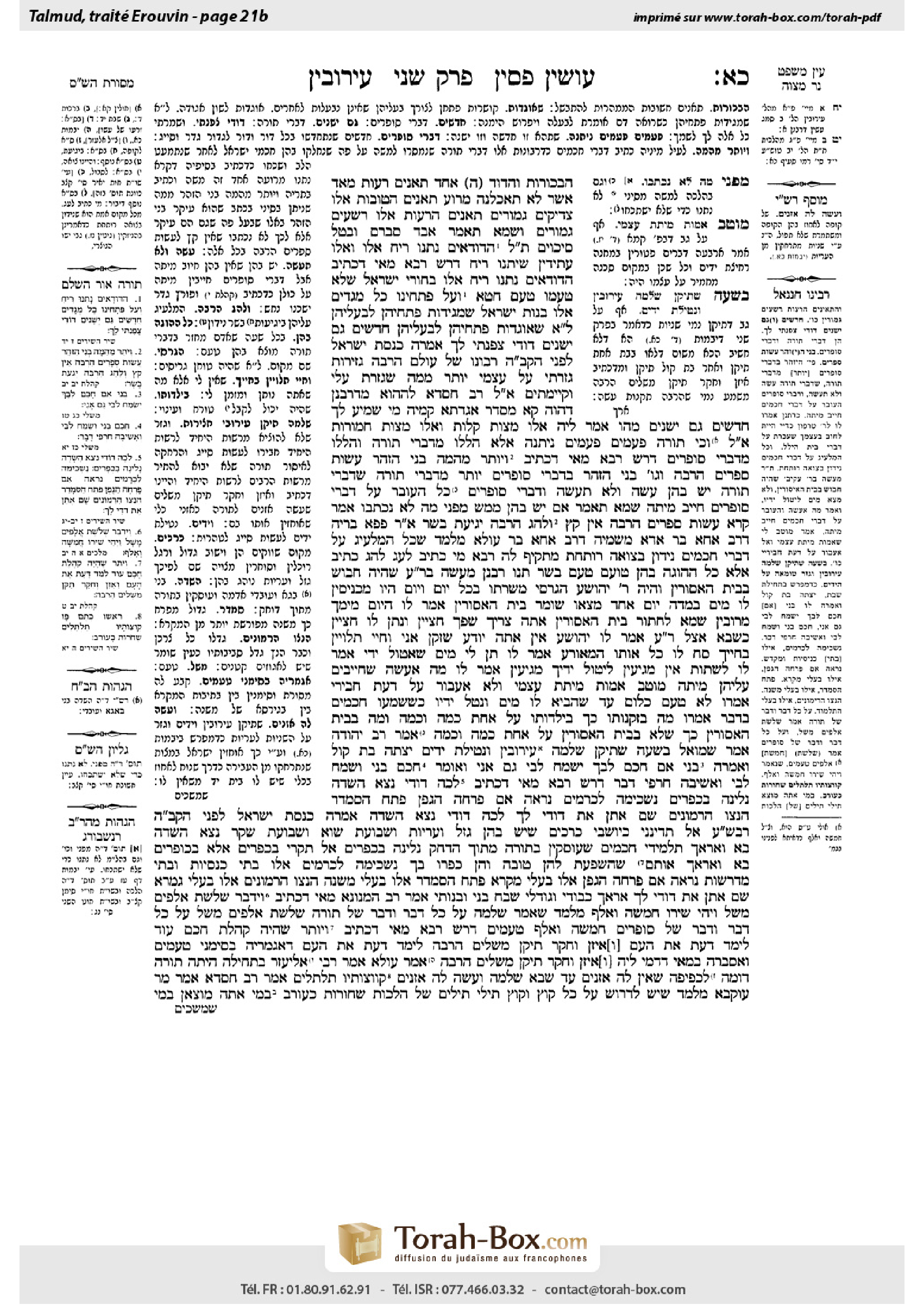
Eruvin 21b: Talmud study for Daf Yomi
Daf Yomi is the daily study of one Talmud folio. Explore 37 tractates with scans, Hebrew text, Sefaria English and AI-generated French translations where annotated.
Passage selection and English or AI-generated French translation are available where the scan has annotations. Daf Study is independent of Torah-Box and Sefaria.
Browse Eruvin · עירובין · All tractatesEruvin 21b text and translations
This page of Eruvin includes the Aramaic text, an English translation and an AI-generated French translation, alongside the scan above.
עירובין כ״א ב · Aramaic and Hebrew text
הַבַּכּוּרוֹת וְהַדּוּד הָאֶחָד תְּאֵנִים רָעוֹת מְאֹד אֲשֶׁר לֹא תֵאָכַלְנָה מֵרוֹעַ״ —
תְּאֵנִים הַטּוֹבוֹת — אֵלּוּ צַדִּיקִים גְּמוּרִים. תְּאֵנִים הָרָעוֹת — אֵלּוּ רְשָׁעִים גְּמוּרִים. וְשֶׁמָּא תֹּאמַר אָבַד סִבְרָם וּבָטַל סִיכּוּיָם? תַּלְמוּד לוֹמַר: ״הַדּוּדָאִים נָתְנוּ רֵיחַ״ — אֵלּוּ וָאֵלּוּ עֲתִידִין שֶׁיִּתְּנוּ רֵיחַ.
דָּרֵשׁ רָבָא, מַאי דִּכְתִיב: ״הַדּוּדָאִים נָתְנוּ רֵיחַ״ — אֵלּוּ בַּחוּרֵי יִשְׂרָאֵל שֶׁלֹּא טָעֲמוּ טַעַם חֵטְא.
״וְעַל פְּתָחֵינוּ כׇּל מְגָדִים״ — אֵלּוּ בְּנוֹת יִשְׂרָאֵל שֶׁמַּגִּידוֹת פִּתְחֵיהֶן לְבַעֲלֵיהֶן. לָשׁוֹן אַחֵר: שֶׁאוֹגְדוֹת פִּתְחֵיהֶן לְבַעֲלֵיהֶן.
״חֲדָשִׁים גַּם יְשָׁנִים דּוֹדִי צָפַנְתִּי לָךְ״ — אָמְרָה כְּנֶסֶת יִשְׂרָאֵל לִפְנֵי הַקָּדוֹשׁ בָּרוּךְ הוּא: רִבּוֹנוֹ שֶׁל עוֹלָם, הַרְבֵּה גְּזֵירוֹת גָּזַרְתִּי עַל עַצְמִי יוֹתֵר מִמַּה שֶּׁגָּזַרְתָּ עָלַי, וְקִיַּימְתִּים.
אֲמַר לֵיהּ רַב חִסְדָּא לְהָהוּא מִדְּרַבָּנַן דַּהֲוָה קָא מְסַדַּר אַגָּדָתָא קַמֵּיהּ: מִי שְׁמִיעַ לָךְ ״חֲדָשִׁים גַּם יְשָׁנִים״ מַהוּ? אֲמַר לֵיהּ: אֵלּוּ מִצְוֹת קַלּוֹת וְאֵלּוּ מִצְוֹת חֲמוּרוֹת.
אֲמַר לֵיהּ: וְכִי תּוֹרָה פְּעָמִים פְּעָמִים נִיתְּנָה? אֶלָּא — הַלָּלוּ מִדִּבְרֵי תוֹרָה, וְהַלָּלוּ מִדִּבְרֵי סוֹפְרִים.
דָּרֵשׁ רָבָא, מַאי דִּכְתִיב: ״וְיוֹתֵר מֵהֵמָּה בְּנִי הִזָּהֵר עֲשׂוֹת סְפָרִים הַרְבֵּה וְגוֹ׳״ — בְּנִי, הִזָּהֵר בְּדִבְרֵי סוֹפְרִים יוֹתֵר מִדִּבְרֵי תוֹרָה. שֶׁדִּבְרֵי תוֹרָה יֵשׁ בָּהֶן עֲשֵׂה וְלֹא תַעֲשֶׂה. וְדִבְרֵי סוֹפְרִים — כׇּל הָעוֹבֵר עַל דִּבְרֵי סוֹפְרִים חַיָּיב מִיתָה.
שֶׁמָּא תֹּאמַר: אִם יֵשׁ בָּהֶן מַמָּשׁ, מִפְּנֵי מָה לֹא נִכְתְּבוּ?! אָמַר קְרָא: ״עֲשׂוֹת סְפָרִים הַרְבֵּה אֵין קֵץ״.
״וְלַהַג הַרְבֵּה יְגִיעַת בָּשָׂר״ — אָמַר רַב פָּפָּא בְּרֵיהּ דְּרַב אַחָא בַּר אַדָּא מִשְּׁמֵיהּ דְּרַב אַחָא בַּר עוּלָּא: מְלַמֵּד שֶׁכׇּל הַמַּלְעִיג עַל דִּבְרֵי חֲכָמִים, נִידּוֹן בְּצוֹאָה רוֹתַחַת.
מַתְקֵיף לַהּ רָבָא: מִי כְּתִיב לַעַג? ״לַהַג״ כְּתִיב! אֶלָּא: כׇּל הַהוֹגֶה בָּהֶן טוֹעֵם טַעַם בָּשָׂר.
תָּנוּ רַבָּנַן: מַעֲשֶׂה בְּרַבִּי עֲקִיבָא שֶׁהָיָה חָבוּשׁ בְּבֵית הָאֲסוּרִין, וְהָיָה רַבִּי יְהוֹשֻׁעַ הַגַּרְסִי מְשָׁרְתוֹ. בְּכׇל יוֹם וָיוֹם הָיוּ מַכְנִיסִין לוֹ מַיִם בְּמִדָּה. יוֹם אֶחָד מְצָאוֹ שׁוֹמֵר בֵּית הָאֲסוּרִין, אָמַר לוֹ: הַיּוֹם מֵימֶךָ מְרוּבִּין, שֶׁמָּא לַחְתּוֹר בֵּית הָאֲסוּרִין אַתָּה צָרִיךְ? שָׁפַךְ חֶצְיָין וְנָתַן לוֹ חֶצְיָין.
כְּשֶׁבָּא אֵצֶל רַבִּי עֲקִיבָא, אָמַר לוֹ: יְהוֹשֻׁעַ, אֵין אַתָּה יוֹדֵעַ שֶׁזָּקֵן אֲנִי וְחַיַּי תְּלוּיִין בְּחַיֶּיךָ?
סָח לוֹ כׇּל אוֹתוֹ הַמְאוֹרָע. אָמַר לוֹ: תֵּן לִי מַיִם שֶׁאֶטּוֹל יָדַי, אָמַר לוֹ: לִשְׁתּוֹת אֵין מַגִּיעִין, לִיטּוֹל יָדֶיךָ מַגִּיעִין?! אָמַר לוֹ: מָה אֶעֱשֶׂה שֶׁחַיָּיבִים עֲלֵיהֶן מִיתָה? מוּטָב אָמוּת מִיתַת עַצְמִי, וְלֹא אֶעֱבוֹר עַל דַּעַת חֲבֵירַי!
אָמְרוּ: לֹא טָעַם כְּלוּם עַד שֶׁהֵבִיא לוֹ מַיִם וְנָטַל יָדָיו, כְּשֶׁשָּׁמְעוּ חֲכָמִים בַּדָּבָר, אָמְרוּ: מָה בְּזִקְנוּתוֹ כָּךְ, בְּיַלְדוּתוֹ עַל אַחַת כַּמָּה וְכַמָּה. וּמָה בְּבֵית הָאֲסוּרִין כָּךְ, שֶׁלֹּא בְּבֵית הָאֲסוּרִין עַל אַחַת כַּמָּה וְכַמָּה.
אָמַר רַב יְהוּדָה אָמַר שְׁמוּאֵל: בְּשָׁעָה שֶׁתִּיקֵּן שְׁלֹמֹה עֵירוּבִין וּנְטִילַת יָדַיִם, יָצְתָה בַּת קוֹל וְאָמְרָה: ״בְּנִי אִם חָכַם לִבֶּךָ יִשְׂמַח לִבִּי גַּם אָנִי״. וְאוֹמֵר: ״חֲכַם בְּנִי וְשַׂמַּח לִבִּי וְאָשִׁיבָה חֹרְפִי דָבָר״.
דָּרֵשׁ רָבָא: מַאי דִּכְתִיב ״לְכָה דוֹדִי נֵצֵא הַשָּׂדֶה נָלִינָה בַּכְּפָרִים נַשְׁכִּימָה לַכְּרָמִים נִרְאֶה אִם פָּרְחָה הַגֶּפֶן פִּתַּח הַסְּמָדַר הֵנֵצוּ הָרִמּוֹנִים שָׁם אֶתֵּן אֶת דּוֹדַי לָךְ״.
״לְכָה דוֹדִי נֵצֵא הַשָּׂדֶה״ — אָמְרָה כְּנֶסֶת יִשְׂרָאֵל לִפְנֵי הַקָּדוֹשׁ בָּרוּךְ הוּא: רִבּוֹנוֹ שֶׁל עוֹלָם, אַל תְּדִינֵנִי כְּיוֹשְׁבֵי כְרַכִּים שֶׁיֵּשׁ בָּהֶן גָּזֵל וַעֲרָיוֹת וּשְׁבוּעַת שָׁוְא וּשְׁבוּעַת שֶׁקֶר, ״נֵצֵא הַשָּׂדֶה״ — בֹּא וְאַרְאֲךָ תַּלְמִידֵי חֲכָמִים, שֶׁעוֹסְקִין בַּתּוֹרָה מִתּוֹךְ הַדְּחָק.
״נָלִינָה בַּכְּפָרִים״ — אַל תִּקְרֵי בַּכְּפָרִים אֶלָּא בַּכּוֹפְרִים: בֹּא וְאַרְאֲךָ אוֹתָם שֶׁהִשְׁפַּעְתָּ לָהֶן טוֹבָה וְהֵן כָּפְרוּ בְּךָ.
״נַשְׁכִּימָה לַכְּרָמִים״ — אֵלּוּ בָּתֵּי כְנֵסִיּוֹת וּבָתֵּי מִדְרָשׁוֹת. ״נִרְאֶה אִם פָּרְחָה הַגֶּפֶן״ — אֵלּוּ בַּעֲלֵי מִקְרָא. ״פִּתַּח הַסְּמָדַר״ — אֵלּוּ בַּעֲלֵי מִשְׁנָה. ״הֵנֵצוּ הָרִמּוֹנִים״ — אֵלּוּ בַּעֲלֵי גְמָרָא. ״שָׁם אֶתֵּן אֶת דּוֹדַי לָךְ״ — אַרְאֲךָ כְּבוֹדִי וְגוֹדְלִי שֶׁבַח בָּנַי וּבְנוֹתַי.
אָמַר רַב הַמְנוּנָא, מַאי דִּכְתִיב: ״וַיְדַבֵּר שְׁלֹשֶׁת אֲלָפִים מָשָׁל וַיְהִי שִׁירוֹ חֲמִשָּׁה וָאָלֶף״ — מְלַמֵּד שֶׁאָמַר שְׁלֹמֹה עַל כׇּל דָּבָר וְדָבָר שֶׁל תּוֹרָה שְׁלֹשֶׁת אֲלָפִים מָשָׁל, עַל כׇּל דָּבָר וְדָבָר שֶׁל סוֹפְרִים חֲמִשָּׁה וְאֶלֶף טְעָמִים.
דָּרֵשׁ רָבָא, מַאי דִּכְתִיב: ״וְיוֹתֵר שֶׁהָיָה קֹהֶלֶת חָכָם עוֹד לִימַּד דַּעַת אֶת הָעָם [וְ]אִיזֵּן וְחִקֵּר תִּיקֵּן מְשָׁלִים הַרְבֵּה״. ״לִימַּד דַּעַת אֶת הָעָם״ — דְּאַגְמְרַיהּ בְּסִימָנֵי טְעָמִים, וְאַסְבְּרַהּ בְּמַאי דְּדָמֵי לַיהּ.
״[וְ]אִיזֵּן וְחִקֵּר תִּיקֵּן מְשָׁלִים הַרְבֵּה״ — אָמַר עוּלָּא אָמַר רַבִּי אֱלִיעֶזֶר: בַּתְּחִילָּה הָיְתָה תּוֹרָה דּוֹמָה לִכְפִיפָה שֶׁאֵין לָהּ אׇזְנַיִם, עַד שֶׁבָּא שְׁלֹמֹה וְעָשָׂה לָהּ אׇזְנַיִם.
״קְווּצּוֹתָיו תַּלְתַּלִּים״, אָמַר רַב חִסְדָּא אָמַר מָר עוּקְבָא: מְלַמֵּד שֶׁיֵּשׁ לִדְרוֹשׁ עַל כׇּל קוֹץ וָקוֹץ תִּילֵּי תִּילִּים שֶׁל הֲלָכוֹת.
״שְׁחוֹרוֹת כָּעוֹרֵב״: בְּמִי אַתָּה מוֹצְאָן — בְּמִי
Eruvin 21b · English translation
that are first ripe, and the other basket [dud] had very bad figs, so bad they could not be eaten” (Jeremiah 24:1–2).
Good figs, these are the full-fledged righteous people; bad figs, these are the full-fledged wicked people. And lest you say that the hope of the wicked is lost and their prospect is void, the verse states, interpreting the word duda’im homiletically: “The baskets [duda’im] yield a fragrance” (Song of Songs 7:14), meaning that both of them, the righteous and the wicked, will eventually yield a fragrance.
Rava interpreted the verse cited above homiletically as follows: What is the meaning of that which is written: “The mandrakes [duda’im] yield a fragrance, and at our doors are all manner of choice fruits, new and old, which I have laid up for you, O my beloved” (Song of Songs 7:14)? “The mandrakes [duda’im] yield a fragrance,” these are the young men of Israel who have never tasted the taste of sin.
“And at our doors [petaḥeinu] are all manner of choice fruits [megadim],” these are the daughters of Israel who inform [maggidot] their husbands about their passageway [pit’ḥeihen], i.e., they tell them when they are menstruating. Another version of this interpretation is: They bind [ogedot] their passageway and save it for their husbands, and do not have relations with others.
“New and old, which I have laid up for you, O my beloved,” the Congregation of Israel said before the Holy One, Blessed be He, and continued: Master of the Universe, I have decreed many decrees upon myself through the enactments and ordinances of the Sages, more than what You decreed upon me in the Torah, and I have fulfilled them. These are the new laws which were added to the old ones stated in the Torah.
It was related that Rav Ḥisda said to one of the Sages who would arrange the traditions of the aggada before him: Did you hear what the meaning of: New and old is? He said to him: These, the new, are the more lenient mitzvot, and these, the old, are the more stringent mitzvot.
Rav Ḥisda said to him: This cannot be so, for was the Torah given on two separate occasions, i.e., were the more lenient and more stringent mitzvot given separately? Rather, these, the old, are mitzvot from the Torah, and these, the new, are from the Sages.
Rava expounded another verse in similar fashion: What is the meaning of that which is written: “And more than these, my son, be careful: of making many books [sefarim] there is no end; and much study is a weariness of the flesh” (Ecclesiastes 12:12)? My son, be careful to fulfill the words of the Sages [soferim] even more than the words of the Torah. For the words of the Torah include positive and negative commandments, and even with regard to the negative commandments, the violation of many of them is punishable only by lashes. Whereas with respect to the words of the Sages, anyone who transgresses the words of the Sages is liable to receive the death penalty, as it is stated: “And whoever breaches through a hedge, a snake shall bite him” (Ecclesiastes 10:8), taking hedges to refer metaphorically to decrees.
Lest you say: If the words of the Sages are of substance and have such great importance, why were they not written in the Torah, therefore, the verse states: “Of making many books there is no end,” meaning that it is impossible to fully commit the Oral Torah to writing, as it is boundless.
What is the meaning of the words: “And much study [lahag] is a weariness of the flesh”? Rav Pappa, son of Rav Aḥa bar Adda, said in the name of Rav Aḥa bar Ulla: This teaches that whoever mocks [malig] the words of the Sages will be sentenced to boiling excrement, which results from the weariness of the flesh of man.
Rava strongly objects to this explanation: Is it written: Mock [la’ag]? “Lahag” is the word that is written. Rather, the verse must be understood in the opposite manner: Whoever meditates [hogeh] upon them, the words of the Sages, experiences enjoyment as if it had the taste of meat.
Concerning the significance of observing the words of the Sages, the Gemara relates: The Sages taught in a baraita: It once happened that Rabbi Akiva was incarcerated in a prison, and Rabbi Yehoshua HaGarsi would come to the prison to attend to his needs. Every day his disciples would bring him water in a measured quantity. One day the prison guard met Rabbi Yehoshua HaGarsi and said to him: The amount of your water today is more than usual; perhaps you need it in order to soften the walls and thus undermine the prison. He then poured out half the water, and gave him the other half to take in to Rabbi Akiva.
When Rabbi Yehoshua came to Rabbi Akiva, and the latter saw the small amount of water he had brought, he said to him: Yehoshua, do you not know that I am old, and my life depends on your life? No one else brings me water, so if you bring me less than I need, my life is endangered.
After Rabbi Yehoshua related to him the entire incident, Rabbi Akiva said to him: Give me water so that I may wash my hands. Rabbi Yehoshua said to him: The water that I brought will not suffice for drinking; how will it suffice for washing your hands? He said to him: What can I do; for transgressing the words of the Sages and eating without first washing hands one is liable to receive the death penalty. And if so, it is better that I should die my own death by thirst, rather than transgress the opinion of my colleagues who enacted that one must wash hands before eating.
They said that he would not taste anything until Rabbi Yehoshua brought him water and he washed his hands. When the Sages heard about this, they said: If in his old age and weakened state he is still so meticulous in his observance of the mitzvot, how much more so must he have been in his youth. And if in prison he is so scrupulous in his behavior, how much more so must he have been when not in prison.
Rav Yehuda said that Shmuel said: At the time that King Solomon instituted the ordinances of eiruv of courtyards and of washing hands to purify them from their impurity, which are added safeguards to the words of the Torah, a Divine Voice emerged and said in his praise: “My son, if your heart is wise, My heart will be glad, even Mine” (Proverbs 23:15). And it states with regard to him: “My son, be wise and make My heart glad, that I may respond to he who taunts Me” (Proverbs 27:11).
The Gemara cites additional teachings that Rava interpreted homiletically: What is the meaning of that which is written: “Come, my beloved, let us go forth into the field; let us lodge in the villages. Let us get up early to the vineyards; let us see if the vine has flowered, if the grape blossoms have opened, if the pomegranates are in flower; there will I give you my loves” (Song of Songs 7:12–13)?
With regard to the words: “Come, my beloved, let us go forth into the field,” the Congregation of Israel said before the Holy One, Blessed be He: Master of the Universe, do not judge me like those who reside in large cities where there is robbery and licentiousness, and vain oaths and false oaths, but rather: “Let us go forth into the field,” come and I will show You Torah scholars who work the land but nonetheless engage in Torah study, in poverty and in distress.
With regard to the words, “Let us lodge in the villages,” do not read the phrase as: In the villages [bakefarim], but rather as: By the deniers [bakoferim], meaning, come and I will show You the nations of the world, whom You showered with good, but yet they have denied You.
“Let us get up early to the vineyards,” these are the synagogues and houses of study. “Let us see if the vine has flowered,” these are the masters of Bible, who are proficient in the first stage of Torah study. “If the grape blossoms have opened,” these are the masters of Mishna. “If the pomegranates are in flower,” these are the masters of Gemara. “There will I give you my loves,” means I will show You my glory and my greatness, the praise of my sons and daughters, how they adhere to sanctity.
The Gemara expounds further concerning King Solomon. Rav Hamnuna said: What is the meaning of that which is written: “And he spoke three thousand proverbs, and his poems were a thousand and five” (i Kings 5:12)? This teaches that Solomon pronounced three thousand proverbs for each and every word of the Torah, and one thousand and five reasons for each and every word of the Scribes.
Rava also taught: What is the meaning of that which is written: “And besides being wise, Koheleth also taught the people knowledge; and he weighed, and sought out, and set in order many proverbs” (Ecclesiastes 12:9). Rava interpreted homiletically: He taught the people knowledge, meaning he taught it with the accentuation marks in the Torah, and he explained each matter by means of something similar to it.
With regard to: “And he weighed [izzen], and sought out, and set in order many proverbs,” Ulla said that Rabbi Eliezer said: At first the Torah was like a basket without handles [oznayim], until Solomon came and made handles for it. By means of his explanations and proverbs he enabled each person to understand and take hold of the Torah, fulfill its mitzvot, and distance himself from transgressions.
With regard to the verse, “His head is as the most fine gold, his locks [kevutzotav] are wavy [taltalim], and black as a raven” (Song of Songs 5:11), Rav Ḥisda said that Mar Ukva said: This teaches that it is possible to expound from each and every stroke [kotz] of the letters in the Torah mounds upon mounds [tilei tilim] of laws.
Black [sheḥorot] as a raven [orev] means: In whom do you find the words of Torah? In him
Eruvin 21b · Traduction française (IA)
qui étaient mûres les premières, tandis que l’autre panier [dud] contenait des figues très mauvaises, si mauvaises qu’elles étaient immangeables » (Jérémie 24:1–2).
Les bonnes figues sont les justes accomplis ; les mauvaises figues, les méchants accomplis. Et de peur que tu ne dises que l’espoir des méchants est perdu et que leur avenir est nul, le verset dit, en interprétant de façon homilétique le mot duda’im : « Les paniers [duda’im] exhalent un parfum » (Cantique des Cantiques 7:14), ce qui signifie que les uns comme les autres, les justes et les méchants, finiront par exhaler un parfum.
Rava interpréta de façon homilétique le verset cité plus haut comme suit : Que signifie ce qui est écrit : « Les mandragores [duda’im] exhalent un parfum, et à nos portes se trouvent toutes sortes de fruits de choix, nouveaux et anciens, que j’ai mis en réserve pour toi, ô mon bien-aimé » (Cantique des Cantiques 7:14) ? « Les mandragores [duda’im] exhalent un parfum » : ce sont les jeunes gens d’Israël qui n’ont jamais goûté au péché.
« Et à nos portes [petaḥeinu] se trouvent toutes sortes de fruits de choix [megadim] » : ce sont les filles d’Israël qui informent [maggidot] leurs maris au sujet de leur passage [pit’ḥeihen], c’est-à-dire qu’elles leur disent quand elles sont menstruées. Selon une autre interprétation, elles lient [ogedot] leur passage et le réservent à leurs maris, sans avoir de relations avec d’autres hommes.
« Des fruits nouveaux et anciens, que j’ai gardés pour toi, ô mon bien-aimé » : l’Assemblée d’Israël dit devant le Saint, béni soit-Il, et poursuivit : « Maître de l’Univers, je me suis imposé de nombreux décrets au moyen des enactements et des ordonnances des Sages, davantage que ce que Tu m’as prescrit dans la Torah, et je les ai observés. » Ce sont les nouvelles lois qui se sont ajoutées aux anciennes, énoncées dans la Torah.
Il a été rapporté que Rav Ḥisda demanda à l’un des Sages qui lui exposaient les traditions de l’aggada : « As-tu entendu quel est le sens de “nouveaux et anciens” ? » Il lui répondit : « Les nouveaux sont les mitsvot les plus permissives, et les anciens, les mitsvot les plus rigoureuses. »
Rav Ḥisda lui dit : Cela ne peut pas être le cas. La Torah aurait-elle été donnée en deux occasions distinctes, c’est-à-dire les mitsvot les moins contraignantes et les plus contraignantes séparément ? Il faut plutôt comprendre que les premières, les anciennes, sont des mitsvot de la Torah, tandis que les secondes, les nouvelles, viennent des Sages.
Rava interpréta un autre verset de la même manière : que signifie ce qui est écrit : « Et plus que tout cela, mon fils, prends garde : faire beaucoup de livres [sefarim] n’a pas de fin, et beaucoup d’étude est une fatigue pour la chair » (Ecclésiaste 12:12) ? Mon fils, prends garde à accomplir les paroles des Sages [soferim] encore plus que celles de la Torah. Car les paroles de la Torah comprennent des commandements positifs et négatifs, et même parmi les commandements négatifs, la transgression de nombreux commandements n’est punie que de coups. En revanche, quiconque transgresse les paroles des Sages est passible de la peine de mort, comme il est dit : « Celui qui franchit une clôture, un serpent le mordra » (Ecclésiaste 10:8), les clôtures désignant métaphoriquement les décrets.
De peur que tu ne dises : « Si les paroles des Sages ont une véritable portée et une si grande importance, pourquoi n’ont-elles pas été écrites dans la Torah ? », le verset dit donc : « Faire beaucoup de livres n’a pas de fin », ce qui signifie qu’il est impossible de consigner intégralement par écrit la Torah orale, car elle est sans limites.
Que signifie l’expression : « Et beaucoup d’étude [lahag] est une fatigue pour la chair » ? Rav Pappa, fils de Rav Aḥa bar Adda, dit au nom de Rav Aḥa bar Ulla : cela enseigne que quiconque se moque [malig] des paroles des Sages sera condamné aux excréments bouillants, qui résultent de la fatigue de la chair de l’homme.
Rava s’oppose vivement à cette explication : Est-il écrit « se moque » [la’ag] ? C’est « lahag » qui est écrit. Le verset doit plutôt être compris en sens inverse : quiconque médite [hogeh] sur les paroles des Sages éprouve un plaisir comparable à celui de goûter de la viande.
À propos de l’importance d’observer les paroles des Sages, la Guemara rapporte : Les Sages ont enseigné dans une baraïta : Il arriva que Rabbi Akiva fut incarcéré, et Rabbi Yehoshua HaGarsi se rendait à la prison pour pourvoir à ses besoins. Chaque jour, ses disciples lui apportaient une quantité d’eau mesurée. Un jour, le gardien de la prison rencontra Rabbi Yehoshua HaGarsi et lui dit : « La quantité d’eau que tu apportes aujourd’hui est supérieure à la normale ; peut-être en as-tu besoin pour ramollir les murs et ainsi fragiliser la prison. » Il versa alors la moitié de l’eau et lui donna l’autre moitié pour qu’il l’apporte à Rabbi Akiva.
Lorsque Rabbi Yehoshua arriva auprès de Rabbi Akiva, celui-ci vit la petite quantité d’eau qu’il avait apportée et lui dit : « Yehoshua, ne sais-tu pas que je suis âgé et que ma vie dépend de la tienne ? Personne d’autre ne m’apporte d’eau ; si tu m’en apportes moins qu’il ne m’en faut, ma vie est en danger. »
Après que Rabbi Yehoshua lui eut raconté toute l’histoire, Rabbi Akiva lui dit : « Donne-moi de l’eau pour que je me lave les mains. » Rabbi Yehoshua lui répondit : « L’eau que j’ai apportée ne suffira pas à boire ; comment suffirait-elle à te laver les mains ? » Il lui dit : « Que puis-je faire ? Celui qui transgresse les paroles des Sages et mange sans s’être d’abord lavé les mains est passible de la peine de mort. Dans ces conditions, mieux vaut que je meure de ma mort naturelle, de soif, plutôt que de transgresser l’avis de mes collègues, qui ont décrété qu’il faut se laver les mains avant de manger. »
On raconte qu’il ne goûta à rien tant que Rabbi Yehoshua ne lui eut pas apporté de l’eau et qu’il ne se fut pas lavé les mains. Lorsque les Sages l’apprirent, ils dirent : « S’il est si scrupuleux dans l’observance des mitsvot alors qu’il est âgé et affaibli, à combien plus forte raison devait-il l’être dans sa jeunesse ! Et s’il se conduit avec tant de rigueur en prison, à combien plus forte raison devait-il le faire lorsqu’il n’y était pas ! »
Rav Yehuda dit au nom de Shmuel : Lorsque le roi Salomon institua les règles de l’érouv des cours et du lavage des mains pour les purifier de leur impureté, mesures de sauvegarde supplémentaires aux paroles de la Torah, une Voix céleste se fit entendre pour faire son éloge : « Mon fils, si ton cœur est sage, mon cœur à moi aussi se réjouira » (Proverbes 23:15). Et il est dit à son sujet : « Mon fils, sois sage et réjouis mon cœur, afin que je puisse répondre à celui qui m’insulte » (Proverbes 27:11).
La Guemara cite d’autres enseignements que Rava interpréta de manière homilétique : que signifie ce qui est écrit : « Viens, mon bien-aimé, sortons dans les champs ; passons la nuit dans les villages. Levons-nous tôt pour aller aux vignes ; voyons si la vigne a bourgeonné, si les fleurs de la vigne se sont ouvertes, si les grenadiers sont en fleur ; là, je te donnerai mes amours » (Cantique des Cantiques 7:12-13) ?
À propos des mots : « Viens, mon bien-aimé, sortons dans les champs », l’Assemblée d’Israël dit devant le Saint, béni soit-Il : « Maître de l’univers, ne me juge pas comme ceux qui habitent dans les grandes villes, où règnent le vol, la débauche, les serments vains et les faux serments. Mais plutôt : “Sortons dans les champs” : viens, et je te montrerai des érudits de la Torah qui travaillent la terre tout en étudiant la Torah, dans la pauvreté et la détresse. »
À propos des mots : « Passons la nuit dans les villages », ne lis pas l’expression « dans les villages » [bakefarim], mais plutôt « auprès des négateurs » [bakoferim]. Autrement dit : viens, et je te montrerai les nations du monde, que tu as comblées de bienfaits, mais qui pourtant t’ont renié.
« Levons-nous tôt pour aller aux vignes » : ce sont les synagogues et les maisons d’étude. « Voyons si la vigne a bourgeonné » : ce sont les maîtres de la Bible, versés dans la première étape de l’étude de la Torah. « Si les fleurs de la vigne se sont ouvertes » : ce sont les maîtres de la Michna. « Si les grenadiers sont en fleur » : ce sont les maîtres de la Guemara. « Là, je te donnerai mes amours » signifie : je te montrerai ma gloire et ma grandeur, les louanges de mes fils et de mes filles, et la manière dont ils s’attachent à la sainteté.
La Guemara développe encore au sujet du roi Salomon. Rav Hamnuna dit : que signifie ce qui est écrit : « Il prononça trois mille proverbes, et ses chants furent au nombre de mille cinq » (I Rois 5:12) ? Cela enseigne que Salomon prononçait trois mille proverbes pour chaque parole de la Torah, et mille cinq explications pour chaque parole des Scribes.
Rava enseigna également : que signifie ce qui est écrit : « Outre qu’il était sage, Kohelet enseigna aussi la connaissance au peuple ; il pesa, rechercha et composa de nombreux proverbes » (Ecclésiaste 12:9) ? Rava l’interpréta de manière homilétique : « Il enseigna la connaissance au peuple » signifie qu’il enseigna la Torah avec ses signes de cantillation et qu’il expliquait chaque sujet au moyen d’une comparaison.
À propos de « il pesa [izzen], rechercha et composa de nombreux proverbes », Ulla dit au nom de Rabbi Eliezer : « À l’origine, la Torah était comme un panier sans anses [oznayim], jusqu’à ce que Salomon vienne lui en faire. » Grâce à ses explications et à ses proverbes, il permit à chacun de comprendre la Torah et de s’en saisir, d’accomplir ses mitsvot et de s’éloigner des transgressions.
À propos du verset : « Sa tête est de l’or le plus pur, ses boucles [kevutzotav] sont ondulées [taltalim] et noires comme un corbeau » (Cantique des Cantiques 5:11), Rav Ḥisda dit au nom de Mar Ukva : cela enseigne qu’il est possible de déduire, de chaque trait [kotz] des lettres de la Torah, des amas sur des amas [tilei tilim] de lois.
« Noires » [sheḥorot] comme un « corbeau » [orev] signifie : chez qui trouve-t-on les paroles de la Torah ? Chez celui…
Traduction française générée par IA à partir de l’édition anglaise de Sefaria. Vérifie toujours un passage avec le texte source.
Text from Sefaria: William Davidson Edition - Vocalized Aramaic (CC BY NC); William Davidson Edition - English (CC BY NC).