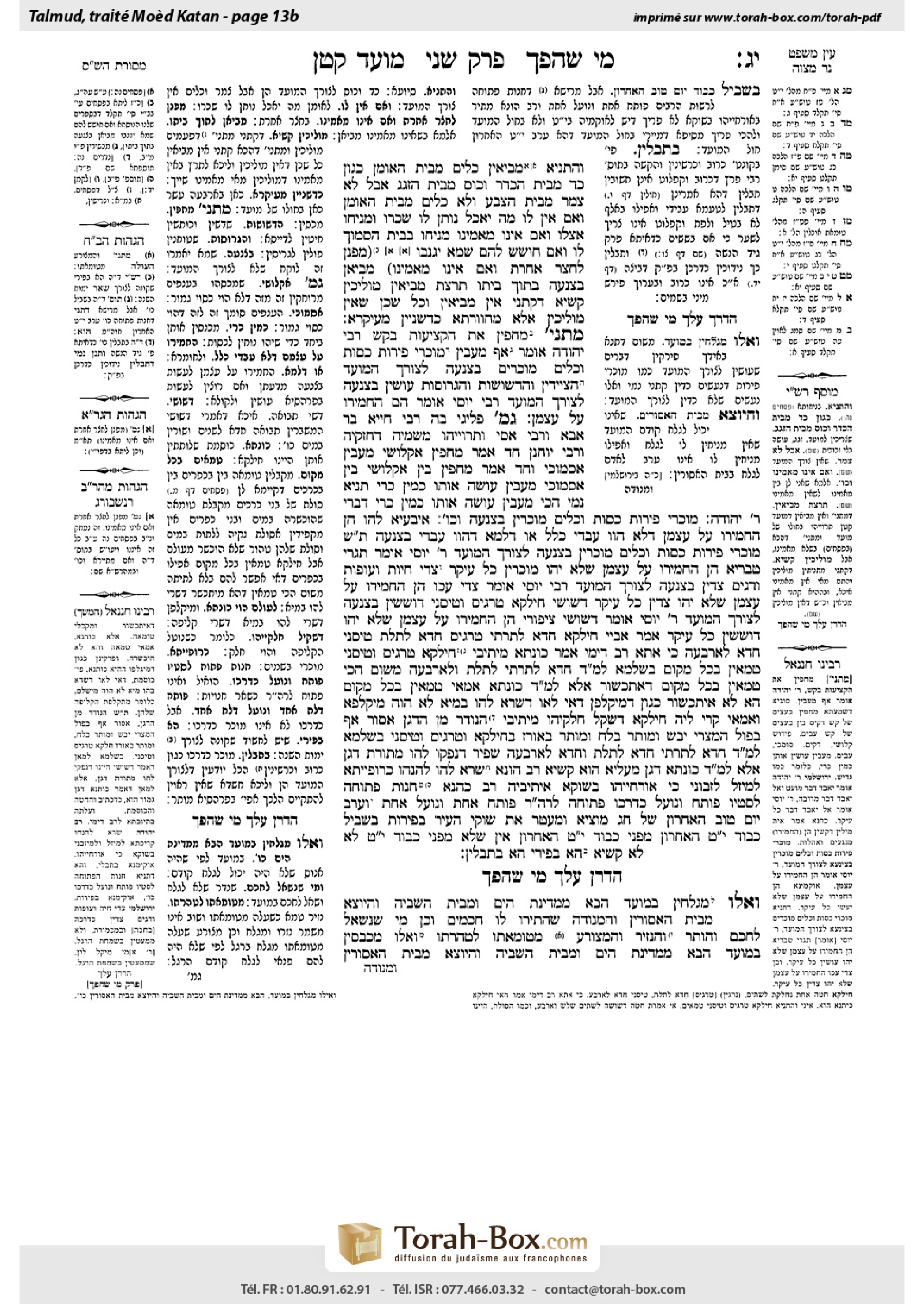
Moed Katan 13b: Talmud study for Daf Yomi
Daf Yomi is the daily study of one Talmud folio. Explore 37 tractates with scans, Hebrew text, Sefaria English and AI-generated French translations where annotated.
Passage selection and English or AI-generated French translation are available where the scan has annotations. Daf Study is independent of Torah-Box and Sefaria.
Browse Moed Katan · מועד קטן · All tractatesMoed Katan 13b text and translations
This page of Moed Katan includes the Aramaic text, an English translation and an AI-generated French translation, alongside the scan above.
מועד קטן י״ג ב · Aramaic and Hebrew text
וְהָתַנְיָא: מְבִיאִין כֵּלִים מִבֵּית הָאוּמָּן, כְּגוֹן כַּד מִבֵּית הַכַּדָּר, וְכוֹס מִבֵּית הַזַּגָּג. אֲבָל לֹא צֶמֶר מִבֵּית הַצַּבָּע, וְלֹא כֵּלִים מִבֵּית הָאוּמָּן. וְאִם אֵין לוֹ מַה יֹּאכַל — נוֹתֵן לוֹ שְׂכָרוֹ וּמַנִּיחוֹ אֶצְלוֹ. וְאִם אֵינוֹ מַאֲמִינוֹ — מַנִּיחוֹ בְּבַיִת הַסָּמוּךְ לוֹ. וְאִם חוֹשֵׁשׁ לָהֶם שֶׁמָּא יִגָּנְבוּ — מְפַנָּן לְחָצֵר אַחֶרֶת, וְאִם אֵינוֹ מַאֲמִינוֹ — מְבִיאָן בְּצִנְעָה בְּתוֹךְ בֵּיתוֹ.
תָּרֵצְתְּ מְבִיאִין, מוֹלִיכִין קַשְׁיָא, דְּקָתָנֵי: אֵין מְבִיאִין, וְכׇל שֶׁכֵּן שֶׁאֵין מוֹלִיכִין! אֶלָּא: מְחַוַּורְתָּא כִּדְשַׁנַּיִין מֵעִיקָּרָא.
מַתְנִי׳ מְחַפִּין אֶת הַקְּצִיעוֹת בְּקַשׁ. רַבִּי יְהוּדָה אוֹמֵר: אַף מְעַבִּין. מוֹכְרֵי פֵירוֹת, כְּסוּת וְכֵלִים — מוֹכְרִים בְּצִנְעָה לְצוֹרֶךְ הַמּוֹעֵד. הַצַּיָּידִין וְהַדָּשׁוֹשׁוֹת וְהַגָּרוֹסוֹת — עוֹשִׂין בְּצִנְעָה לְצוֹרֶךְ הַמּוֹעֵד. רַבִּי יוֹסֵי אוֹמֵר: הֵם הֶחֱמִירוּ עַל עַצְמָן.
גְּמָ׳ פְּלִיגִי בַּהּ רַבִּי חִיָּיא בַּר אַבָּא וְרַבִּי אַסִּי, וְתַרְוַיְיהוּ מִשְּׁמֵיהּ דְּחִזְקִיָּה וְרַבִּי יוֹחָנָן. חַד אָמַר: ״מְחַפִּין״ אַקְלוֹשֵׁי, ״מְעַבִּין״ אַסְמוֹכֵי. וְחַד אָמַר: ״מְחַפִּין״ בֵּין אַקְלוֹשֵׁי בֵּין אַסְמוֹכֵי, ״מְעַבִּין״ — עוֹשֶׂה אוֹתוֹ כְּמִין כְּרִי. תַּנְיָא נָמֵי הָכִי: ״מְעַבִּין״ עוֹשֶׂה אוֹתוֹ כְּמִין כְּרִי, דִּבְרֵי רַבִּי יְהוּדָה.
מוֹכְרֵי פֵירוֹת כְּסוּת וְכֵלִים מוֹכְרִין בְּצִנְעָה וְכוּ׳. אִיבַּעְיָא לְהוּ: הֵן הֶחֱמִירוּ עַל עַצְמָן — דְּלָא הֲווֹ עָבְדִי כְּלָל, אוֹ דִלְמָא דַּהֲווֹ עָבְדִי בְּצִנְעָה?
תָּא שְׁמַע: מוֹכְרֵי פֵירוֹת כְּסוּת וְכֵלִים — מוֹכְרִין בְּצִנְעָה לְצוֹרֶךְ הַמּוֹעֵד, רַבִּי יוֹסֵי אוֹמֵר: תַּגָּרֵי טְבֶרְיָא הֵן הֶחֱמִירוּ עַל עַצְמָן שֶׁלֹּא יְהוּ מוֹכְרִין כׇּל עִיקָּר. צָדֵי חַיּוֹת וְעוֹפוֹת וְדָגִים — צָדִין בְּצִנְעָה לְצוֹרֶךְ הַמּוֹעֵד, רַבִּי יוֹסֵי אוֹמֵר: צָדֵי עַכּוֹ הֵן הֶחֱמִירוּ עַל עַצְמָן שֶׁלֹּא יְהוּ צָדִין כׇּל עִיקָּר. דָּשׁוֹשֵׁי חִילְקָא טַרְגִּיס וְטִיסְנִי — דּוֹשְׁשִׁין בְּצִנְעָה לְצוֹרֶךְ הַמּוֹעֵד, רַבִּי יוֹסֵי אוֹמֵר: דָּשׁוֹשֵׁי צִיפּוֹרִי הֵן הֶחְמִירוּ עַל עַצְמָן שֶׁלֹּא יְהוּ דּוֹשְׁשִׁין כׇּל עִיקָּר.
אָמַר אַבָּיֵי: חִילְקָא — חֲדָא לְתַרְתֵּי, טַרְגִּיס — חֲדָא לִתְלָת, טִיסְנִי — חֲדָא לְאַרְבְּעָה. כִּי אֲתָא רַב דִּימִי, אָמַר: כּוּנָּתָא.
מֵיתִיבִי: חִילְקָא טַרְגִּיס וְטִיסְנִי טְמֵאִין בְּכׇל מָקוֹם. בִּשְׁלָמָא לְמַאן דְּאָמַר חֲדָא לְתַרְתֵּי לִתְלָת וּלְאַרְבְּעָה, מִשּׁוּם הָכִי טְמֵאִין בְּכׇל מָקוֹם — דְּאִתַּכְשׁוּר, אֶלָּא לְמַאן דְּאָמַר כּוּנָּתָא, אַמַּאי טְמֵאִין בְּכׇל מָקוֹם, הָא לָא אִיתַּכְשׁוּר?
כְּגוֹן דְּמִיקַּלְּפָן, דְּאִי לָאו דִּשְׁרָא לְהוּ בְּמַיָּא לָא הֲוָה מִיקַּלְפָא. וְאַמַּאי קָרֵי לֵיהּ ״חִילְקָא״ — דְּשָׁקֵל חִלְקַיְהוּ.
מֵיתִיבִי: הַנּוֹדֵר מִן הַדָּגָן — אָסוּר אַף בְּפוֹל הַמִּצְרִי יָבֵשׁ, וּמוּתָּר בְּלַח, וּמוּתָּר בְּאוֹרֶז בְּחִילְקָא וְטַרְגִּיס וְטִיסְנִי. בִּשְׁלָמָא לְמַאן דְּאָמַר חֲדָא לְתַרְתֵּי חֲדָא לִתְלָת וַחֲדָא לְאַרְבְּעָה — שַׁפִּיר, דִּנְפַקוּ לְהוּ מִתּוֹרַת דָּגָן, אֶלָּא לְמַאן דְּאָמַר כּוּנָּתָא, דָּגָן מְעַלְּיָא הוּא! קַשְׁיָא.
רַב הוּנָא שְׁרָא לְהוּ לְהָנְהוּ כְּרוּפְיָיתָא לְמֵיזַל לְזַבּוֹנֵי כִּי אוֹרְחַיְיהוּ בְּשׁוּקָא. אֵיתִיבֵיהּ רַב כָּהֲנָא: חֲנוּת פְּתוּחָה לִסְטָיו — פּוֹתֵחַ וְנוֹעֵל כְּדַרְכּוֹ,
פְּתוּחָה לִרְשׁוּת הָרַבִּים — פּוֹתֵחַ אַחַת וְנוֹעֵל אַחַת, וְעֶרֶב יוֹם טוֹב הָאַחֲרוֹן שֶׁל חַג מוֹצִיא וּמְעַטֵּר אֶת שׁוּקֵי הָעִיר בְּפֵירוֹת בִּשְׁבִיל כְּבוֹד יוֹם טוֹב הָאַחֲרוֹן. מִפְּנֵי כְּבוֹד יוֹם טוֹב הָאַחֲרוֹן אִין, שֶׁלֹּא מִפְּנֵי כְּבוֹד יוֹם טוֹב לָא!
לָא קַשְׁיָא: הָא בְּפֵירֵי, הָא בְּתַבְלִין.
הֲדַרַן עֲלָךְ מִי שֶׁהָפַךְ
וְאֵלּוּ מְגַלְּחִין בַּמּוֹעֵד: הַבָּא מִמְּדִינַת הַיָּם וּמִבֵּית הַשִּׁבְיָה, וְהַיּוֹצֵא מִבֵּית הָאֲסוּרִין, וְהַמְנוּדֶּה שֶׁהִתִּירוּ לוֹ חֲכָמִים, וְכֵן מִי שֶׁנִּשְׁאַל לְחָכָם וְהוּתַּר, וְהַנָּזִיר וְהַמְּצוֹרָע מִטּוּמְאָתוֹ לְטׇהֳרָתוֹ.
וְאֵלּוּ מְכַבְּסִין בַּמּוֹעֵד: הַבָּא מִמְּדִינַת הַיָּם וּמִבֵּית הַשִּׁבְיָה, וְהַיּוֹצֵא מִבֵּית הָאֲסוּרִין,
Moed Katan 13b · English translation
And so it is taught in a baraita: One may bring home utensils from the house of a craftsman; for example, a jug from the jug-maker's house and a cup from the glass-blower’s house, as they will be used on the Festival itself. But he may not bring home wool from the dyer’s house or utensils from the craftsman’s house, as they are not needed on the Festival. But if the craftsman has nothing to eat, he may give him his wages during the Festival week and leave the utensil with him. And if he does not trust the craftsman to properly safeguard his utensil, he may take the utensil from the craftsman and leave it in a house near him. And if he is concerned about his utensils lest they be stolen, he may move them to another courtyard. And if he does not trust the owner of the other courtyard, he may bring them into his house discreetly.
The Gemara comments: You have adequately explained the contradiction between the mishnayot about whether one may bring home utensils from the house of a craftsman. The mishna that permits it can be understood as referring to a case where the craftsman is not to be trusted. But the mishna in Pesaḥim also states that one may take utensils to the house of a craftsman, and this is difficult, as the mishna above teaches: One may not bring home utensils from the house of a craftsman. And this indicates that all the more so, one may not take utensils from his house to that of the craftsman. Rather, it is clear as we answered initially that one mishna is referring to the eve of Passover and the other to the intermediate days of a Festival.
MISHNA: On the intermediate days of a Festival, figs that were spread out to dry may be covered with straw to protect them from rain and dew. Rabbi Yehuda says: One may even condense the figs. Those who sell produce, clothing, and utensils may sell them in private, for the sake of the Festival. Fishermen, and groats makers [dashoshot], and bean pounders, who pulverize the beans, may ply their trades in private for the sake of the Festival. Rabbi Yosei says: They were stringent with themselves to refrain from this work even with respect to what was needed for the Festival.
GEMARA: Rabbi Ḥiyya bar Abba and Rabbi Asi disagree about the following issue, and both of them assert their opinions in the name of Ḥizkiyya and Rabbi Yoḥanan. One said: Cover the figs means to lightly cover them with straw, and condense means to spread straw over them densely. And the other one said: Cover means to spread straw over them whether lightly or densely, and condense means to amass the figs into a pile, making it as if it were a pile of grain. This is also taught in a baraita: One may condense, i.e., amass the figs into a pile, making it as if it were a pile of grain. This is the statement of Rabbi Yehuda.
§ The mishna states: On the intermediate days of a Festival, those who sell produce, clothing, and utensils may sell them in private, for the sake of the Festival. Fishermen, groats makers, and bean pounders may ply their trades in private for the sake of the Festival. Rabbi Yosei says that they were stringent with themselves. The Sages were asked: When it says that they were stringent with themselves, does it mean that that they did not work at all on the intermediate days of a Festival, or perhaps it means that they did their work in private, though it is permitted to do it publicly?
The Gemara answers based on a baraita. Come and hear: Those who sell produce, clothing, and utensils may sell them in private, for the sake of the Festival. Rabbi Yosei says: The merchants of Tiberias were stringent with themselves not to sell at all, even in private. Hunters of animals, fowlers, and fishermen may hunt their quarry discreetly for the sake of the Festival. Rabbi Yosei says: The hunters of Akko were stringent with themselves not to hunt at all. Groats makers who crack grain into groats called ḥilka, targis, and tisanei, crack the grain in private for the sake of the Festival. Rabbi Yosei says: The groats makers of Tzippori were stringent with themselves not to crack grain at all. According to Rabbi Yosei, the stringencies involve refraining from work entirely.
Abaye said: The term ḥilka means one kernel that is broken into two; the term targis means one kernel that is broken into three; and the term tisanei means one grain that is broken into four. When Rav Dimi came from Eretz Yisrael to Babylonia, he said: Ḥilka is referring to emmer wheat.
The Gemara raises an objection from a baraita: Ḥilka, targis, and tisanei are susceptible to ritual impurity everywhere. Granted, according to the one who said that these are one grain broken into two, into three, and into four, due to that reason they are susceptible to impurity everywhere, as they have already become fit to contract ritual impurity by being rinsed with water in their processing. But according to the one who says that ḥilka is emmer wheat that has not necessarily been processed, why is it susceptible to ritual impurity everywhere, since it has not necessarily become fit to contract impurity by coming into contact with water?
The Gemara answers: The baraita is referring to a case where, for example, the emmer wheat was husked, since if it had not been previously soaked in water, it would not have been possible to husk it. And why, according to this opinion, is it called ḥilka? It is called this because their husks [ḥelkayhu] were removed.
The Gemara raises an objection from a baraita: One who vows to prohibit himself from eating grain [dagan] is prohibited to partake of even dry Egyptian beans, and it is permitted for him to partake of fresh beans. And it is permitted for him to partake of rice, as well as of ḥilka, and targeis, and tisnei. Granted, according to the one who said that these are one grain broken into two, one grain broken into three, and one grain broken into four, it is fine, as when the wheat is crushed into these it leaves the category of grain. But according to the one who says that ḥilka is emmer wheat, it is still a proper grain. The Gemara concludes: Indeed, it is difficult.
§ The Gemara relates that Rav Huna permitted the spice merchants [kerufayata] to go and sell their products in their usual manner in the marketplace on the intermediate days of a Festival. Rav Kahana raised an objection to Rav Huna’s ruling from a baraita: If a store opens into a row of pillars that runs along the street, the storekeeper may open and close it in his usual manner on the intermediate days of a Festival, since it is not in the public’s view.
However, if it is open to the public domain, he may open only one door and must close the other. And on the eve of the last day of the festival of Sukkot, he may take out his wares from the store and adorn the markets of the city with fruit in honor of the last day of the Festival. The Gemara infers: For the honor of the last day of the Festival, yes, it is permitted for him to open the store in order to give people the opportunity to prepare for the holiday, but when not for the honor of the Festival, i.e., during the other intermediate days of the Festival, he is not permitted to do so. How, then, did Rav Huna permit those spice merchants to sell as usual on the intermediate days of the Festival?
The Gemara answers: This is not difficult: This baraita that prohibits selling in the usual manner is referring to the sale of fruit, which is usually bought in large quantities and could have been purchased before the Festival; people might therefore suspect the buyer of purchasing it for use after the Festival. In contrast, this lenient ruling of Rav Huna is referring to the sale of spices, which is permitted because people buy them only in small quantities for the sake of the Festival.
MISHNA: And these may shave and cut their hair on the intermediate days of a Festival: One who comes from a country overseas; and one who is released from a house of captivity; and one who comes out of prison on the intermediate days of a Festival; and one who had been ostracized and therefore prohibited from cutting his hair, and the Sages released him from his decree of ostracism on the intermediate days of the Festival; and similarly, one who had vowed not to cut his hair and then requested of a Sage to dissolve his vow and was released from it on the intermediate days of the Festival; and the nazirite whose term of naziriteship ended on the intermediate days of a Festival; and the leper who needs to purify himself on the intermediate days and must shave his entire body in order to leave his state of ritual impurity and regain his ritual purity. Since these people were not able to cut their hair on the eve of the Festival, they are permitted to do so on the intermediate days of the Festival.
And these may launder their clothes on the intermediate days of a Festival: One who comes from a country overseas; and one who is released from a house of captivity; and one who comes out of prison on the intermediate days of a Festival;
Moed Katan 13b · Traduction française (IA)
Et c’est également ce qu’enseigne une baraïta : on peut rapporter chez soi des ustensiles de chez un artisan, par exemple une cruche de chez un fabricant de cruches et un verre de chez un souffleur de verre, car ils serviront pendant la fête elle-même. Mais on ne peut pas rapporter de laine de chez un teinturier ni des ustensiles de chez un artisan, car ils ne sont pas nécessaires pendant la fête. Toutefois, si l’artisan n’a rien à manger, on peut lui verser son salaire pendant la semaine de fête et laisser l’ustensile chez lui. Si l’on ne fait pas confiance à l’artisan pour garder correctement son ustensile, on peut le reprendre et le laisser dans une maison voisine. Et si l’on craint que ses ustensiles ne soient volés, on peut les déplacer dans une autre cour. Si l’on ne fait pas confiance au propriétaire de l’autre cour, on peut les rapporter chez soi discrètement.
La Guemara commente : Tu as bien résolu la contradiction entre les Michnayot concernant la permission de rapporter chez soi des ustensiles de chez un artisan. La Michna qui l’autorise peut s’expliquer par le fait que l’artisan n’est pas digne de confiance. Mais la Michna de Pessa’him enseigne également qu’on peut apporter des ustensiles chez un artisan, ce qui pose difficulté, car la Michna précédente enseigne : on ne peut pas rapporter chez soi des ustensiles de chez un artisan. Cela implique qu’à plus forte raison, on ne peut pas apporter des ustensiles de chez soi chez l’artisan. Il est donc clair, comme nous l’avons répondu initialement, qu’une Michna parle de la veille de Pessa’h et l’autre des jours intermédiaires d’une fête.
MICHNA : Pendant les jours intermédiaires d’une fête, on peut couvrir de paille les figues mises à sécher afin de les protéger de la pluie et de la rosée. Rabbi Yehouda dit : on peut même tasser les figues. Ceux qui vendent des produits, des vêtements et des ustensiles peuvent le faire en privé, en vue de la fête. Les pêcheurs, les fabricants de gruaux [dashoshot] et ceux qui pilent les haricots pour les réduire en poudre peuvent exercer leur métier en privé, en vue de la fête. Rabbi Yossei dit : ils se sont imposé la rigueur de s’abstenir de ce travail, même pour ce qui était nécessaire à la fête.
GUEMARA : Rabbi Ḥiyya bar Abba et Rabbi Asi sont en désaccord sur la question suivante, et tous deux rapportent leurs opinions au nom de Ḥizkiyya et de Rabbi Yoḥanan. L’un dit : « Couvrir les figues » signifie les recouvrir légèrement de paille, et « tasser » signifie étaler la paille sur elles en couche épaisse. L’autre dit : « Couvrir » signifie étaler de la paille sur elles, légèrement ou en couche épaisse, et « tasser » signifie rassembler les figues en un tas, comme un tas de grain. C’est également ce qu’enseigne une baraïta : on peut tasser, c’est-à-dire rassembler les figues en un tas, comme un tas de grain. Telle est la déclaration de Rabbi Yehouda.
§ La Michna enseigne : pendant les jours intermédiaires d’une fête, ceux qui vendent des produits, des vêtements et des ustensiles peuvent le faire en privé, en vue de la fête. Les pêcheurs, les fabricants de gruaux et ceux qui pilent les haricots peuvent exercer leur métier en privé, en vue de la fête. Rabbi Yossei dit qu’ils se sont imposé la rigueur. Les Sages demandèrent : lorsqu’il est dit qu’ils se sont imposé la rigueur, cela signifie-t-il qu’ils ne travaillaient pas du tout pendant les jours intermédiaires d’une fête, ou peut-être cela signifie-t-il qu’ils travaillaient en privé, bien qu’il soit permis de le faire en public ?
La Guemara répond à partir d’une baraïta. Viens et entends : ceux qui vendent des produits, des vêtements et des ustensiles peuvent le faire en privé, en vue de la fête. Rabbi Yossei dit : les marchands de Tibériade se sont imposé la rigueur de ne rien vendre du tout, même en privé. Les chasseurs d’animaux, les chasseurs d’oiseaux et les pêcheurs peuvent capturer leur gibier discrètement, en vue de la fête. Rabbi Yossei dit : les chasseurs d’Akko se sont imposé la rigueur de ne rien chasser du tout. Les fabricants de gruaux, qui concassent le grain pour produire les gruaux appelés ḥilka, targis et tisanei, peuvent le faire en privé, en vue de la fête. Rabbi Yossei dit : les fabricants de gruaux de Tzippori se sont imposé la rigueur de ne rien concasser du tout. Selon Rabbi Yossei, ces rigueurs consistent à s’abstenir entièrement de travailler.
Abayé dit : le terme ḥilka désigne un grain brisé en deux ; le terme targis désigne un grain brisé en trois ; et le terme tisanei désigne un grain brisé en quatre. Lorsque Rav Dimi vint d’Eretz Israël en Babylonie, il dit : ḥilka désigne le blé amidonnier.
La Guemara soulève une objection à partir d’une baraïta : ḥilka, targis et tisanei sont susceptibles de contracter l’impureté rituelle en tout lieu. Cela se comprend selon celui qui dit qu’il s’agit d’un grain brisé en deux, en trois et en quatre : pour cette raison, ils sont susceptibles de contracter l’impureté en tout lieu, car, au cours de leur préparation, ils ont déjà été rendus aptes à contracter l’impureté par rinçage à l’eau. Mais selon celui qui dit que ḥilka est du blé amidonnier, lequel n’a pas nécessairement été préparé, pourquoi est-il susceptible de contracter l’impureté rituelle en tout lieu, puisqu’il n’a pas nécessairement été rendu apte à contracter l’impureté par contact avec de l’eau ?
La Guemara répond : la baraïta parle d’un cas où, par exemple, le blé amidonnier a été décortiqué, car s’il n’avait pas été auparavant trempé dans l’eau, il n’aurait pas été possible de le décortiquer. Et pourquoi, selon cette opinion, l’appelle-t-on ḥilka ? On l’appelle ainsi parce que leurs enveloppes [ḥelkayhu] ont été enlevées.
La Guemara soulève une objection à partir d’une baraïta : celui qui fait vœu de s’interdire les céréales [dagan] ne peut même pas manger de fèves égyptiennes sèches, mais il lui est permis de manger des fèves fraîches. Il lui est également permis de manger du riz, ainsi que du ḥilka, du targis et du tisnei. Cela se comprend selon celui qui dit qu’il s’agit d’un grain brisé en deux, d’un grain brisé en trois et d’un grain brisé en quatre, car, une fois le blé concassé de cette manière, il ne relève plus de la catégorie des céréales. Mais selon celui qui dit que ḥilka est du blé amidonnier, il s’agit toujours bien d’une céréale. La Guemara conclut : en effet, la difficulté demeure.
§ La Guemara rapporte que Rav Houna autorisa les marchands d’épices [kerufayata] à aller vendre leurs produits comme à l’accoutumée au marché pendant les jours intermédiaires d’une fête. Rav Kahana objecta à la décision de Rav Houna à partir d’une baraïta : si une boutique donne sur une rangée de colonnes qui longe la rue, le commerçant peut l’ouvrir et la fermer comme à l’accoutumée pendant les jours intermédiaires d’une fête, puisqu’elle n’est pas exposée à la vue du public.
Cependant, si elle donne sur le domaine public, il ne peut ouvrir qu’une seule porte et doit fermer l’autre. La veille du dernier jour de la fête de Soukkot, il peut sortir ses marchandises de la boutique et décorer les marchés de la ville avec des fruits, en l’honneur du dernier jour de la fête. La Guemara déduit : en l’honneur du dernier jour de la fête, oui, il lui est permis d’ouvrir sa boutique afin de permettre aux gens de se préparer à la fête ; mais en dehors de cette occasion, c’est-à-dire pendant les autres jours intermédiaires de la fête, cela ne lui est pas permis. Comment Rav Houna a-t-il donc autorisé ces marchands d’épices à vendre comme à l’accoutumée pendant les jours intermédiaires de la fête ?
La Guemara répond : il n’y a pas de difficulté. La baraïta qui interdit de vendre comme à l’accoutumée parle de la vente de fruits, que l’on achète habituellement en grandes quantités et que l’on aurait pu acheter avant la fête ; les gens pourraient donc soupçonner l’acheteur de les avoir achetés pour les utiliser après la fête. En revanche, la décision indulgente de Rav Houna concerne la vente d’épices, qui est permise parce que les gens n’en achètent que de petites quantités, en vue de la fête.
MICHNA : Les personnes suivantes peuvent se raser et se couper les cheveux pendant les jours intermédiaires d’une fête : celui qui revient d’un pays d’outre-mer ; celui qui est libéré d’une maison de captivité ; celui qui sort de prison pendant les jours intermédiaires d’une fête ; celui qui avait été mis au ban et, de ce fait, ne pouvait pas se couper les cheveux, puis que les Sages ont relevé de son ban pendant les jours intermédiaires de la fête ; de même, celui qui avait fait vœu de ne pas se couper les cheveux, puis a demandé à un Sage de délier son vœu et en a été relevé pendant les jours intermédiaires de la fête ; le nazir dont la période de naziréat s’achève pendant les jours intermédiaires de la fête ; et le lépreux qui doit se purifier pendant ces jours et doit se raser tout le corps afin de sortir de son état d’impureté rituelle et de retrouver la pureté rituelle. Puisque ces personnes n’ont pas pu se couper les cheveux la veille de la fête, elles sont autorisées à le faire pendant les jours intermédiaires de la fête.
Et les personnes suivantes peuvent laver leurs vêtements pendant les jours intermédiaires d’une fête : celui qui revient d’un pays d’outre-mer ; celui qui est libéré d’une maison de captivité ; celui qui sort de prison pendant les jours intermédiaires d’une fête ;
Traduction française générée par IA à partir de l’édition anglaise de Sefaria. Vérifie toujours un passage avec le texte source.
Text from Sefaria: William Davidson Edition - Vocalized Aramaic (CC BY NC); William Davidson Edition - English (CC BY NC).