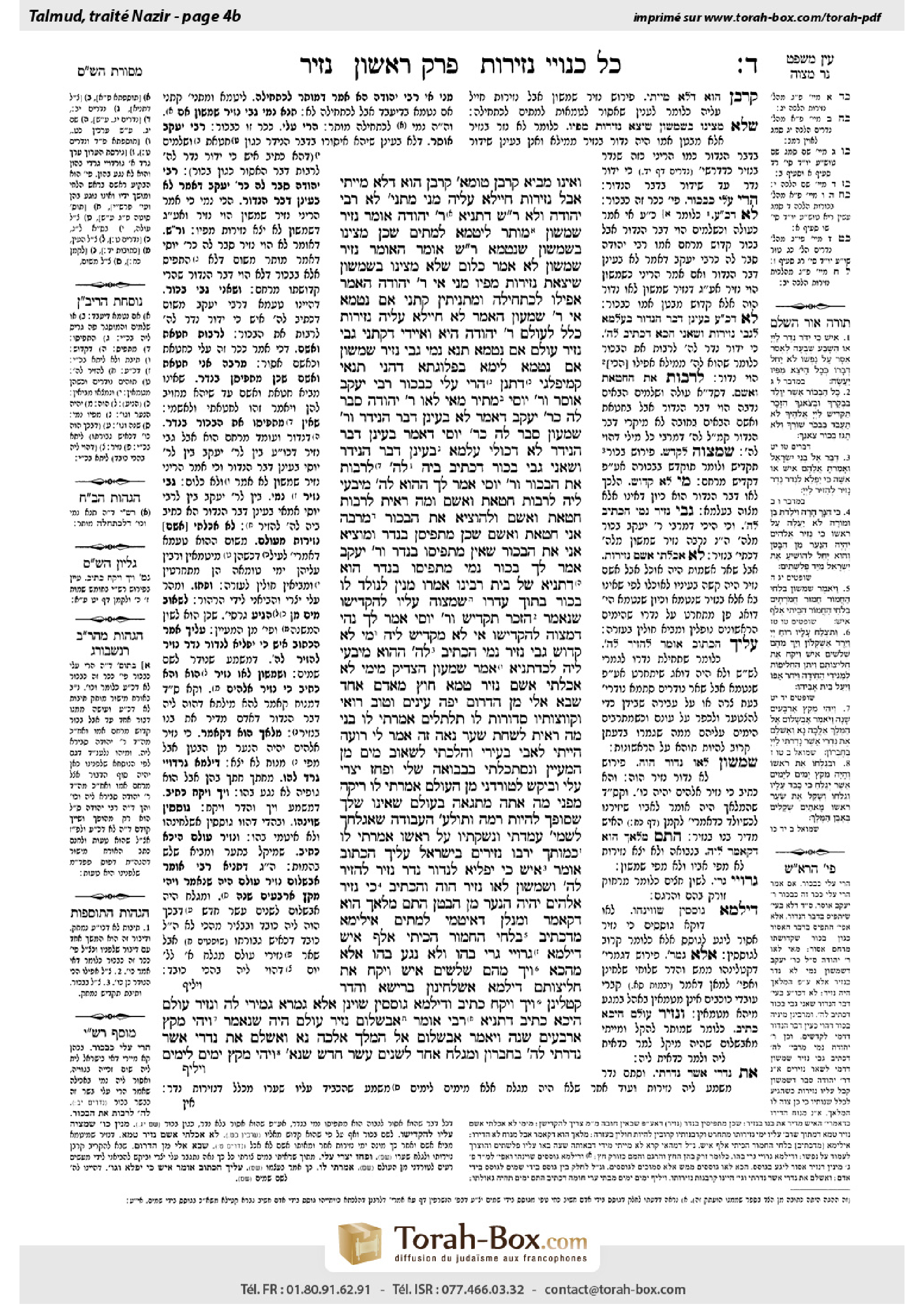
Nazir 4b: Talmud study for Daf Yomi
Daf Yomi is the daily study of one Talmud folio. Explore 37 tractates with scans, Hebrew text, Sefaria English and AI-generated French translations where annotated.
Passage selection and English or AI-generated French translation are available where the scan has annotations. Daf Study is independent of Torah-Box and Sefaria.
Browse Nazir · נזיר · All tractatesNazir 4b text and translations
This page of Nazir includes the Aramaic text, an English translation and an AI-generated French translation, alongside the scan above.
נזיר ד׳ ב · Aramaic and Hebrew text
וְאֵינוֹ מֵבִיא קׇרְבַּן טוּמְאָה.
קׇרְבָּן הוּא דְּלָא מַיְיתֵי, אֲבָל נְזִירוּת חָיְילָא עֲלֵיהּ.
מַנִּי מַתְנִיתִין? לָא רַבִּי יְהוּדָה, וְלָא רַבִּי שִׁמְעוֹן. דְּתַנְיָא, רַבִּי יְהוּדָה אוֹמֵר: נְזִיר שִׁמְשׁוֹן — מוּתָּר לִיטַמֵּא לְמֵתִים, שֶׁכֵּן מָצִינוּ בְּשִׁמְשׁוֹן שֶׁנִּטְמָא. רַבִּי שִׁמְעוֹן אוֹמֵר: הָאוֹמֵר ״נְזִיר שִׁמְשׁוֹן״ — לֹא אָמַר כְּלוּם, שֶׁלֹּא מָצִינוּ בְּשִׁמְשׁוֹן שֶׁיָּצָאת נְזִירוּת מִפִּיו.
מַנִּי? אִי רַבִּי יְהוּדָה — הָאָמַר אֲפִילּוּ לְכַתְּחִילָּה, וּמַתְנִיתִין קָתָנֵי ״אִם נִטְמָא״. אִי רַבִּי שִׁמְעוֹן — הָאָמַר לָא חָיְילָא עֲלֵיהּ נְזִירוּת כְּלָל!
לְעוֹלָם רַבִּי יְהוּדָה הִיא, וְאַיְּידֵי דְּקָתָנֵי גַּבֵּי נְזִיר עוֹלָם ״אִם נִטְמָא״, תְּנָא נָמֵי גַּבֵּי נְזִיר שִׁמְשׁוֹן ״אִם נִטְמָא״.
לֵימָא בִּפְלוּגְתָּא דְהָנֵי תַּנָּאֵי קָמִיפַּלְגִי, דִּתְנַן: ״הֲרֵי עָלַי כִּבְכוֹר״, רַבִּי יַעֲקֹב אוֹסֵר, וְרַבִּי יוֹסֵי מַתִּיר.
מַאי לָאו, רַבִּי יְהוּדָה סָבַר לַהּ כְּרַבִּי יַעֲקֹב, דְּאָמַר: לָא בָּעִינַן דָּבָר הַנִּידָּר. וְרַבִּי שִׁמְעוֹן סָבַר לַהּ כְּרַבִּי יוֹסֵי, דְּאָמַר: בָּעִינַן דָּבָר הַנִּידָּר?
לָא, דְּכוּלֵּי עָלְמָא בָּעִינַן דָּבָר הַנִּידָּר, וְשָׁאנֵי גַּבֵּי בְּכוֹר, דִּכְתִיב בֵּיהּ: ״לַה׳״ — לְרַבּוֹת אֶת הַבְּכוֹר.
וְרַבִּי יוֹסֵי אָמַר לָךְ: הָהוּא ״לַה׳״, מִיבְּעֵי לֵיהּ לְרַבּוֹת חַטָּאת וְאָשָׁם.
וּמָה רָאִיתָ לְרַבּוֹת חַטָּאת וְאָשָׁם וּלְהוֹצִיא אֶת הַבְּכוֹר? מְרַבֶּה אֲנִי חַטָּאת וְאָשָׁם — שֶׁכֵּן מַתְפִּיסָן בְּנֶדֶר, וּמוֹצִיא אֲנִי אֶת הַבְּכוֹר — שֶׁאֵין מַתְפִּיסוֹ בְּנֶדֶר.
וְרַבִּי יַעֲקֹב אָמַר לָךְ: בְּכוֹר נָמֵי מַתְפִּיסוֹ בְּנֶדֶר הוּא. דְּתַנְיָא: שֶׁל בֵּית רַבֵּינוּ אָמְרוּ: מִנַּיִן לְנוֹלַד לוֹ בְּכוֹר בְּתוֹךְ עֶדְרוֹ שֶׁמִּצְוָה עָלָיו לְהַקְדִּישׁוֹ — שֶׁנֶּאֱמַר: ״הַזָּכָר תַּקְדִּישׁ״.
וְרַבִּי יוֹסֵי אָמַר לָךְ: נְהִי דְּמִצְוָה לְהַקְדִּישׁוֹ, אִי לָא מַקְדֵּישׁ לֵיהּ, מִי לָא קָדוֹשׁ?
גַּבֵּי נָזִיר נָמֵי, הָכְתִיב ״לַה׳״!
הַהוּא מִיבְּעֵי לֵיהּ לְכִדְתַנְיָא, אָמַר שִׁמְעוֹן הַצַּדִּיק: מִיָּמַי לֹא אָכַלְתִּי אֲשַׁם נָזִיר טָמֵא, חוּץ מֵאָדָם אֶחָד שֶׁבָּא אֵלַי מִן הַדָּרוֹם, יְפֵה עֵינַיִם וְטוֹב רוֹאִי, וּקְווּצּוֹתָיו סְדוּרוֹת לוֹ תַּלְתַּלִּים. אָמַרְתִּי לוֹ: בְּנִי, מָה רָאִיתָ לְשַׁחֵת שֵׂעָר נָאֶה זֶה?
אָמַר לִי: רוֹעֶה הָיִיתִי לְאָבִי בְּעִירִי, וְהָלַכְתִּי לִשְׁאוֹב מַיִם מִן הַמַּעְיָין, וְנִסְתַּכַּלְתִּי בַּבָּבוּאָה שֶׁלִּי, וּפָחַז יִצְרִי עָלַי, וּבִיקֵּשׁ לְטוֹרְדֵנִי מִן הָעוֹלָם. אָמַרְתִּי לוֹ: רֵיקָה! מִפְּנֵי מָה אַתָּה מִתְגָּאֶה בְּעוֹלָם שֶׁאֵינוֹ שֶׁלְּךָ, שֶׁסּוֹפְךָ לִהְיוֹת רִמָּה וְתוֹלֵעָה? הָעֲבוֹדָה שֶׁאֲגַלֵּחֲךָ לַשָּׁמַיִם.
עָמַדְתִּי וּנְשַׁקְתִּיו עַל רֹאשׁוֹ, אָמַרְתִּי לוֹ: כְּמוֹתְךָ יִרְבּוּ נְזִירִים בְּיִשְׂרָאֵל — עָלֶיךָ הַכָּתוּב אוֹמֵר: ״אִישׁ כִּי יַפְלִא לִנְדֹּר נֶדֶר נָזִיר לְהַזִּיר לַה׳״.
וְשִׁמְשׁוֹן לָאו נָזִיר הֲוָה? וְהָכְתִיב: ״כִּי נְזִיר אֱלֹהִים יִהְיֶה הַנַּעַר מִן הַבֶּטֶן״! הָתָם מַלְאָךְ הוּא דְּקָאָמַר.
וּמְנָלַן דְּאִיטַּמִּי לְמֵתִים? אִילֵּימָא מִדִּכְתִיב ״בִּלְחִי הַחֲמוֹר הִכֵּיתִי אֶלֶף אִישׁ״ — דִּילְמָא גָּרוֹיֵי גָּרִי בְּהוּ וְלָא נְגַע בְּהוּ!
אֶלָּא מֵהָכָא: ״וַיַּךְ מֵהֶם שְׁלֹשִׁים אִישׁ וַיִּקַּח אֶת חֲלִיצוֹתָם״. דִּילְמָא אַשְׁלְחִינּוּן בְּרֵישָׁא וַהֲדַר קַטְלִינֻּן? ״וַיַּךְ ... וַיִּקַּח״ כְּתִיב.
וְדִילְמָא גּוֹסְסִין שַׁוִּינֻן! אֶלָּא: גְּמָרָא גְּמִירִי לַהּ.
וּנְזִיר עוֹלָם הֵיכָא כְּתִיב? דְּתַנְיָא, רַבִּי אוֹמֵר: אַבְשָׁלוֹם נְזִיר עוֹלָם הָיָה, שֶׁנֶּאֱמַר: ״וַיְהִי מִקֵּץ אַרְבָּעִים שָׁנָה וַיֹּאמֶר אַבְשָׁלוֹם אֶל הַמֶּלֶךְ אֵלְכָה נָּא וַאֲשַׁלֵּם אֶת נִדְרִי אֲשֶׁר נָדַרְתִּי לַה׳ בְּחֶבְרוֹן״, וּמְגַלֵּחַ אֶחָד לִשְׁנֵים עָשָׂר חֹדֶשׁ, שֶׁנֶּאֱמַר: ״וַיְהִי מִקֵּץ יָמִים לַיָּמִים״.
Nazir 4b · English translation
but he does not bring the offering for impurity.
The Gemara comments: From the words: But if he becomes impure he does not bring an offering for impurity, one can infer that it is the offering that he does not bring. However, all of the prohibitions of naziriteship apply to him, and it is prohibited for him to become impure from a corpse.
This leads to the following question: Whose opinion is expressed in the mishna? It is not the opinion of Rabbi Yehuda and not the opinion of Rabbi Shimon, as it is taught in a baraita: Rabbi Yehuda says: A nazirite like Samson is permitted to become impure from a corpse ab initio, as we find with Samson that he became impure. Rabbi Shimon says: One who says he will be a nazirite like Samson has not said anything, since we do not find with Samson that an utterance of a vow of naziriteship left his mouth. Samson never took a vow to be a nazirite. He received his status from the angel’s instructions to his mother (see Judges 13:5). Consequently, Rabbi Shimon holds that one who vows to be a nazirite like Samson is not considered to have taken a nazirite vow.
The Gemara explains the question: Whose opinion is expressed in the mishna? If it is the opinion of Rabbi Yehuda, didn’t he say that it is permitted for a nazirite of this kind to become impure from a corpse even ab initio, but the mishna teaches: If he becomes impure, which indicates that he is prohibited from doing so ab initio? However, if you say that the mishna is according to the opinion of Rabbi Shimon, didn’t he say that naziriteship does not apply to him at all?
The Gemara answers: Actually, the mishna is in accordance with the opinion of Rabbi Yehuda, and a nazirite like Samson may become impure from a corpse even ab initio. And since it teaches with regard to a permanent nazirite: If he becomes impure, as it is prohibited for a permanent nazirite to become impure from a corpse ab initio, the tanna also taught the same expression with regard to a nazirite like Samson and used the expression: If he becomes impure.
§ The Gemara suggests: Let us say that Rabbi Yehuda and Rabbi Shimon disagree with regard to the issue that is the subject of the dispute between these tanna’im, as we learned in a baraita: If one says: This object is hereby forbidden to me like a firstborn, Rabbi Ya’akov prohibits the individual from deriving benefit from the object, as he holds that a vow of this sort is valid. And Rabbi Yosei permits it, because the sanctity of a firstborn is not the result of a vow or sanctification. Rather, it is sacred of its own accord, and therefore its forbidden status cannot be extended by means of a vow to other items.
What, is it not the case that Rabbi Yehuda holds in accordance with the opinion of Rabbi Ya’akov, who said that in order for a vow to take effect, we do not require one to extend the forbidden status of an item rendered forbidden by means of a vow? Consequently, just as one can render an object forbidden by extending to it the sanctity of a firstborn animal, one can become a nazirite by accepting upon himself the status of Samson, whose prohibitions were not established by a vow. And Rabbi Shimon holds in accordance with the opinion of Rabbi Yosei, who said that in order for a vow to take effect, we do require one to extend the forbidden status of an item rendered forbidden by means of a vow. Consequently, one cannot become a nazirite by accepting upon himself the status of Samson.
The Gemara responds: No, it can be explained that everyone agrees that we require one to extend the forbidden status of an item rendered forbidden by means of a vow. And according to Rabbi Ya’akov, the halakha is different with regard to a firstborn, as it is written about this in the verse pertaining to vows: “When a man vows a vow to the Lord” (Numbers 30:3). This comes to include the firstborn and teach that since the firstborn is consecrated, its status is comparable to animals designated as offerings by means of a vow, and one can extend its forbidden status to another item.
And Rabbi Yosei could have said to you in response that he needs that expression: “To the Lord,” to include a sin-offering and a guilt-offering. One may not obligate himself to bring these offerings by means of a vow. They are brought only when one becomes liable due to a transgression. Nevertheless, one can take a vow by extending to another item the forbidden status of a sin-offering or guilt-offering.
The Gemara questions Rabbi Yosei’s explanation: And what did you see that indicated to you to include a sin-offering and a guilt-offering and to exclude a firstborn? The Gemara answers: I include a sin-offering and a guilt-offering, as one grants consecrated status to the animals designated for these offerings by means of a vow, i.e., the act of designating specific animals for these offerings is comparable to taking a vow. And I exclude a firstborn, as one does not grant it consecrated status by means of a vow.
And Rabbi Ya’akov could have said to you in response: Also in the case of a firstborn, one grants it consecrated status by means of a vow, as it is taught in a baraita: The Sages of the house of our Rabbi, i.e., Rabbi Yehuda HaNasi, said: From where is it derived that when a firstborn male animal is born in one’s herd, there is a mitzva for him to consecrate it, although it is consecrated from the time it is born? As it is stated: “All firstborns males that are born to your herd and to your flock you shall sanctify” (Deuteronomy 15:19).
And Rabbi Yosei could have said to you in response: Granted that there is a mitzva to consecrate it. But if he does not consecrate it, is it not consecrated of its own accord? Since a firstborn is forbidden principally because of its inherent sanctity and not because of a vow, one cannot express a vow by extending a firstborn’s forbidden status to another item.
The Gemara asks: Both Rabbi Ya’akov and Rabbi Yosei agree that the phrase “to the Lord” indicates that one can take a vow by associating the object of his vow with an item whose prohibition does not stem from a vow. With regard to a nazirite as well, isn’t it written: “Shall clearly utter a vow, the vow of a nazirite, to consecrate himself to the Lord” (Numbers 6:2)? Why doesn’t Rabbi Shimon derive from this verse that one can become a nazirite by accepting the naziriteship of Samson, despite the fact that Samson did not accept his naziriteship by means of a vow?
The Gemara answers: That phrase is required by him for that which is taught in a baraita: Shimon HaTzaddik said: In all my days as a priest, I never ate the guilt-offering of a ritually impure nazirite, apart from the offering of one man who came to me from the South, who had beautiful eyes and a fine countenance, and his locks were arranged in curls. I said to him: My son, what did you see to become a nazirite, which would force you to destroy this beautiful hair, as a nazirite must cut off all his hair at the conclusion of his term?
He said to me: I was a shepherd for my father in my town, and I went to draw water from the spring, and I looked at my reflection in the water. And my evil inclination quickly rose against me and sought to drive me from the world. I said to my evil inclination: Empty one! For what reason are you proud in a world that is not yours, as your end is to be maggots and worms when you die. I swear by the Temple service that I will become a nazirite and shave you for the sake of Heaven.
Shimon HaTzaddik relates: When I heard his response, I arose and kissed him on his head, and said to him: May there be more nazirites like you in Israel, whose intentions are noble, and who would not regret their vow of naziriteship even if they became impure. With regard to you the verse states: “When either a man or a woman shall clearly utter a vow, the vow of a nazirite, to consecrate himself to the Lord” (Numbers 6:2). The verse speaks of a vow that is not undertaken out of anger or spite, but purely for the sake of God. The phrase “to the Lord” in this context means: For the sake of Heaven. It cannot be used to teach that if one declares his intention to become a nazirite like Samson, his statement constitutes a nazirite vow.
The Gemara challenges the assumption that Samson’s naziriteship was not accepted through a vow: And was Samson not a nazirite whose naziriteship was accepted by a vow? Isn’t it written: “For the child shall be a nazirite of God from the womb” (Judges 13:5)? The Gemara answers: There it was the angel who spoke. Samson’s nazirite status did not stem from a vow uttered by a human being.
The Gemara asks: And from where do we derive that Samson became impure from corpses? If we say it is from the fact that it is written: “And Samson said: With the jawbone of an ass, I smote a thousand men” (Judges 15:16), perhaps he thrust the jawbone at them but did not touch them, and he remained pure.
Rather, it is derived from here: “And he smote thirty men of them, and took their garments” (Judges 14:19). Since he stripped the clothes off the dead he must have come into contact with them. The Gemara counters: Perhaps he stripped them first and afterward killed them. The Gemara responds: It is written: “And he smote…and took,” in that order, indicating that first he killed them and then he took their clothing.
The Gemara asks: But perhaps he mortally wounded them and thereby caused them to be in the process of dying, and he then took their clothes before they died so that he would not touch their corpses. Rather, it must be concluded that it is learned as a tradition that Samson would become impure from corpses.
§ The Gemara clarifies a halakha taught in the mishna: And where is the concept of a permanent nazirite written? As it is taught in a baraita: Rabbi Yehuda HaNasi says: Absalom was a permanent nazirite, as it is stated: “And it came to pass at the end of forty years, that Absalom said to the king: I pray to you, let me go and pay my vow, which I have vowed to the Lord, in Hebron” (II Samuel 15:7). And he cut his hair once every twelve months, as it is stated: “And when he polled his head, now it was at every year’s [yamim] end that he polled it; because the hair was heavy on him” (II Samuel 14:26).
Nazir 4b · Traduction française (IA)
mais il n’apporte pas le sacrifice pour impureté.
La Guemara commente : Des mots « mais s’il devient impur, il n’apporte pas de sacrifice pour impureté », on peut déduire que c’est le sacrifice qu’il n’apporte pas. Toutefois, toutes les interdictions liées au naziréat s’appliquent à lui, et il lui est interdit de se rendre impur au contact d’un cadavre.
Cela conduit à la question suivante : De qui la Michna exprime-t-elle l’opinion ? Ce n’est ni l’opinion de Rabbi Yehouda ni celle de Rabbi Shimon, comme il est enseigné dans une baraïta : Rabbi Yehouda dit : Un naziréen comme Samson est autorisé à se rendre impur au contact d’un cadavre a priori, comme nous le voyons dans le cas de Samson, qui s’est rendu impur. Rabbi Shimon dit : Celui qui dit qu’il sera naziréen comme Samson n’a rien dit, car nous ne trouvons pas que Samson ait prononcé un vœu de naziréat. Samson n’a jamais fait le vœu d’être naziréen. Il a reçu son statut des instructions données à sa mère par l’ange (voir Juges 13:5). Par conséquent, selon Rabbi Shimon, celui qui fait vœu d’être naziréen comme Samson n’est pas considéré comme ayant fait un vœu de naziréat.
La Guemara précise la question : De qui la Michna exprime-t-elle l’opinion ? S’il s’agit de celle de Rabbi Yehouda, n’a-t-il pas dit qu’un naziréen de cette sorte est autorisé à se rendre impur au contact d’un cadavre, même a priori ? Or, la Michna enseigne : « S’il devient impur », ce qui indique qu’il lui est interdit de le faire a priori. Mais si tu dis que la Michna suit l’opinion de Rabbi Shimon, n’a-t-il pas dit que le naziréat ne s’applique pas du tout à lui ?
La Guemara répond : En réalité, la Michna est conforme à l’opinion de Rabbi Yehouda, et un naziréen comme Samson peut se rendre impur au contact d’un cadavre, même a priori. Et puisque, au sujet d’un naziréen permanent, elle enseigne : « S’il devient impur », car il est interdit à un naziréen permanent de se rendre impur au contact d’un cadavre a priori, le tanna a également employé la même expression au sujet d’un naziréen comme Samson : « S’il devient impur ».
§ La Guemara propose : Rabbi Yehouda et Rabbi Shimon seraient-ils en désaccord sur la question qui oppose ces tannaïm, comme nous l’avons appris dans une baraïta : Si quelqu’un dit : « Cet objet m’est interdit comme un premier-né », Rabbi Yaakov interdit à cette personne de tirer profit de l’objet, car il estime qu’un vœu de ce genre est valide. Rabbi Yossi le permet, car la sainteté d’un premier-né ne résulte pas d’un vœu ou d’une consécration. Il est plutôt sacré de lui-même ; son statut d’objet interdit ne peut donc pas être étendu à d’autres objets au moyen d’un vœu.
N’est-ce pas que Rabbi Yehouda suit l’opinion de Rabbi Yaakov, qui a dit que, pour qu’un vœu prenne effet, il n’est pas nécessaire que l’interdiction de l’objet que l’on prend pour référence découle elle-même d’un vœu ? Par conséquent, de même qu’on peut rendre un objet interdit en lui étendant la sainteté d’un animal premier-né, on peut devenir naziréen en acceptant sur soi le statut de Samson, dont les interdictions n’ont pas été établies par un vœu. Et Rabbi Shimon suit l’opinion de Rabbi Yossi, qui a dit que, pour qu’un vœu prenne effet, il faut que l’interdiction de l’objet que l’on prend pour référence découle elle-même d’un vœu. Par conséquent, on ne peut pas devenir naziréen en acceptant sur soi le statut de Samson.
La Guemara répond : Non, on peut expliquer que tous s’accordent à dire qu’il faut que l’interdiction de l’objet que l’on prend pour référence découle elle-même d’un vœu. Mais selon Rabbi Yaakov, la halakha est différente en ce qui concerne un premier-né, car il est écrit à ce sujet dans le verset relatif aux vœux : « Lorsqu’un homme fait un vœu à l’Éternel » (Nombres 30:3). Ces mots viennent inclure le premier-né et enseigner que, puisque celui-ci est consacré, son statut est comparable à celui d’animaux désignés comme offrandes au moyen d’un vœu, et que l’on peut étendre son interdiction à un autre objet.
Et Rabbi Yossi aurait pu te répondre qu’il a besoin de l’expression « à l’Éternel » pour inclure le sacrifice expiatoire et le sacrifice de culpabilité. On ne peut pas s’engager à apporter ces sacrifices au moyen d’un vœu. Ils ne sont apportés que lorsqu’on en devient redevable à la suite d’une transgression. Néanmoins, on peut faire un vœu en étendant à un autre objet l’interdiction d’un sacrifice expiatoire ou d’un sacrifice de culpabilité.
La Guemara met en question l’explication de Rabbi Yossi : Qu’as-tu vu qui t’a conduit à inclure le sacrifice expiatoire et le sacrifice de culpabilité, et à exclure le premier-né ? La Guemara répond : J’inclus le sacrifice expiatoire et le sacrifice de culpabilité, car on confère un statut consacré aux animaux destinés à ces sacrifices au moyen d’un vœu ; autrement dit, le fait de désigner des animaux particuliers pour ces sacrifices est comparable à un vœu. Et j’exclus le premier-né, car on ne lui confère pas un statut consacré au moyen d’un vœu.
Et Rabbi Yaakov aurait pu te répondre : Dans le cas d’un premier-né également, on lui confère un statut consacré au moyen d’un vœu, comme il est enseigné dans une baraïta : Les Sages de la maison de notre Rabbi, c’est-à-dire Rabbi Yehouda HaNassi, ont dit : D’où déduit-on que, lorsqu’un mâle premier-né naît dans son troupeau, il a la mitsva de le consacrer, bien qu’il soit consacré dès sa naissance ? Car il est dit : « Tous les mâles premiers-nés qui naîtront de ton gros et de ton petit bétail, tu les sanctifieras » (Deutéronome 15:19).
Et Rabbi Yossi aurait pu te répondre : Il est entendu qu’il y a une mitsva de le consacrer. Mais s’il ne le consacre pas, n’est-il pas consacré de lui-même ? Puisqu’un premier-né est interdit principalement en raison de sa sainteté intrinsèque, et non à cause d’un vœu, on ne peut pas faire un vœu en étendant à un autre objet l’interdiction du premier-né.
La Guemara demande : Rabbi Yaakov et Rabbi Yossi s’accordent tous deux à dire que l’expression « à l’Éternel » indique que l’on peut faire un vœu en associant l’objet de son vœu à un objet dont l’interdiction ne découle pas d’un vœu. Au sujet du naziréat également, n’est-il pas écrit : « Il prononcera clairement un vœu, le vœu de naziréat, pour se consacrer à l’Éternel » (Nombres 6:2) ? Pourquoi Rabbi Shimon ne déduit-il pas de ce verset qu’on peut devenir naziréen en acceptant le naziréat de Samson, bien que Samson n’ait pas accepté son naziréat au moyen d’un vœu ?
La Guemara répond : Cette expression lui est nécessaire pour ce qui est enseigné dans une baraïta : Shimon HaTzaddik a dit : De tous mes jours comme prêtre, je n’ai jamais mangé le sacrifice de culpabilité d’un naziréen impur, à l’exception de celui d’un homme venu me voir du Sud. Il avait de beaux yeux, un beau visage et les cheveux bouclés. Je lui ai dit : Mon fils, qu’as-tu vu pour devenir naziréen, ce qui t’obligerait à détruire cette belle chevelure, puisque le naziréen doit se raser tous les cheveux à la fin de sa période ?
Il m’a dit : J’étais berger pour mon père dans ma ville, et je suis allé puiser de l’eau à la source. J’ai regardé mon reflet dans l’eau. Alors, mon mauvais penchant s’est dressé contre moi et a cherché à me faire disparaître du monde. J’ai dit à mon mauvais penchant : Insensé ! Pourquoi t’enorgueillir dans un monde qui n’est pas le tien, alors qu’à la fin, tu deviendras des asticots et des vers quand tu mourras ? Je jure par le service du Temple que je deviendrai naziréen et que je te raserai pour l’amour du Ciel.
Shimon HaTzaddik rapporte : Lorsque j’ai entendu sa réponse, je me suis levé, je l’ai embrassé sur la tête et je lui ai dit : Puissent-il y avoir davantage de naziréens comme toi en Israël, aux intentions nobles, qui ne regretteraient pas leur vœu de naziréat même s’ils devenaient impurs. À ton sujet, le verset dit : « Lorsqu’un homme ou une femme prononcera clairement un vœu, le vœu de naziréat, pour se consacrer à l’Éternel » (Nombres 6:2). Le verset parle d’un vœu qui n’est pas fait par colère ou par dépit, mais uniquement pour l’amour de Dieu. Dans ce contexte, l’expression « à l’Éternel » signifie : « pour l’amour du Ciel ». Elle ne peut servir à enseigner que, si quelqu’un déclare son intention de devenir naziréen comme Samson, sa déclaration constitue un vœu de naziréat.
La Guemara conteste l’idée que le naziréat de Samson n’ait pas été accepté au moyen d’un vœu : Samson n’était-il donc pas un naziréen dont le naziréat avait été accepté par un vœu ? N’est-il pas écrit : « Car l’enfant sera naziréen de Dieu dès le sein maternel » (Juges 13:5) ? La Guemara répond : Là, c’est l’ange qui a parlé. Le statut de naziréen de Samson ne découlait pas d’un vœu prononcé par un être humain.
La Guemara demande : Et d’où déduit-on que Samson s’est rendu impur au contact de cadavres ? Si l’on dit que cela découle du fait qu’il est écrit : « Et Samson dit : Avec la mâchoire d’un âne, j’ai frappé mille hommes » (Juges 15:16), peut-être leur a-t-il lancé la mâchoire sans les toucher et est-il ainsi resté pur.
Cela découle plutôt de ce verset : « Il en tua trente, puis prit leurs vêtements » (Juges 14:19). Puisqu’il a dépouillé les morts de leurs vêtements, il a dû entrer en contact avec eux. La Guemara objecte : Peut-être les a-t-il d’abord dépouillés, puis tués. La Guemara répond : Il est écrit : « Il tua… et prit », dans cet ordre, ce qui indique qu’il les a d’abord tués, puis a pris leurs vêtements.
La Guemara demande : Mais peut-être les a-t-il blessés mortellement, les mettant ainsi à l’agonie, puis a-t-il pris leurs vêtements avant qu’ils ne meurent, afin de ne pas toucher leurs cadavres. Il faut plutôt conclure qu’une tradition enseigne que Samson se rendait impur au contact de cadavres.
§ La Guemara précise une halakha enseignée dans la Michna : Où le concept de naziréen permanent est-il mentionné ? Comme il est enseigné dans une baraïta : Rabbi Yehouda HaNassi dit : Absalom était un naziréen permanent, comme il est dit : « Au bout de quarante ans, Absalom dit au roi : Je te prie, laisse-moi aller à Hébron acquitter le vœu que j’ai fait à l’Éternel » (II Samuel 15:7). Il se coupait les cheveux une fois tous les douze mois, comme il est dit : « Lorsqu’il se faisait couper les cheveux — or, il se les faisait couper à la fin de chaque année [yamim], car ses cheveux étaient lourds pour lui » (II Samuel 14:26).
Traduction française générée par IA à partir de l’édition anglaise de Sefaria. Vérifie toujours un passage avec le texte source.
Text from Sefaria: William Davidson Edition - Vocalized Aramaic (CC BY NC); William Davidson Edition - English (CC BY NC).