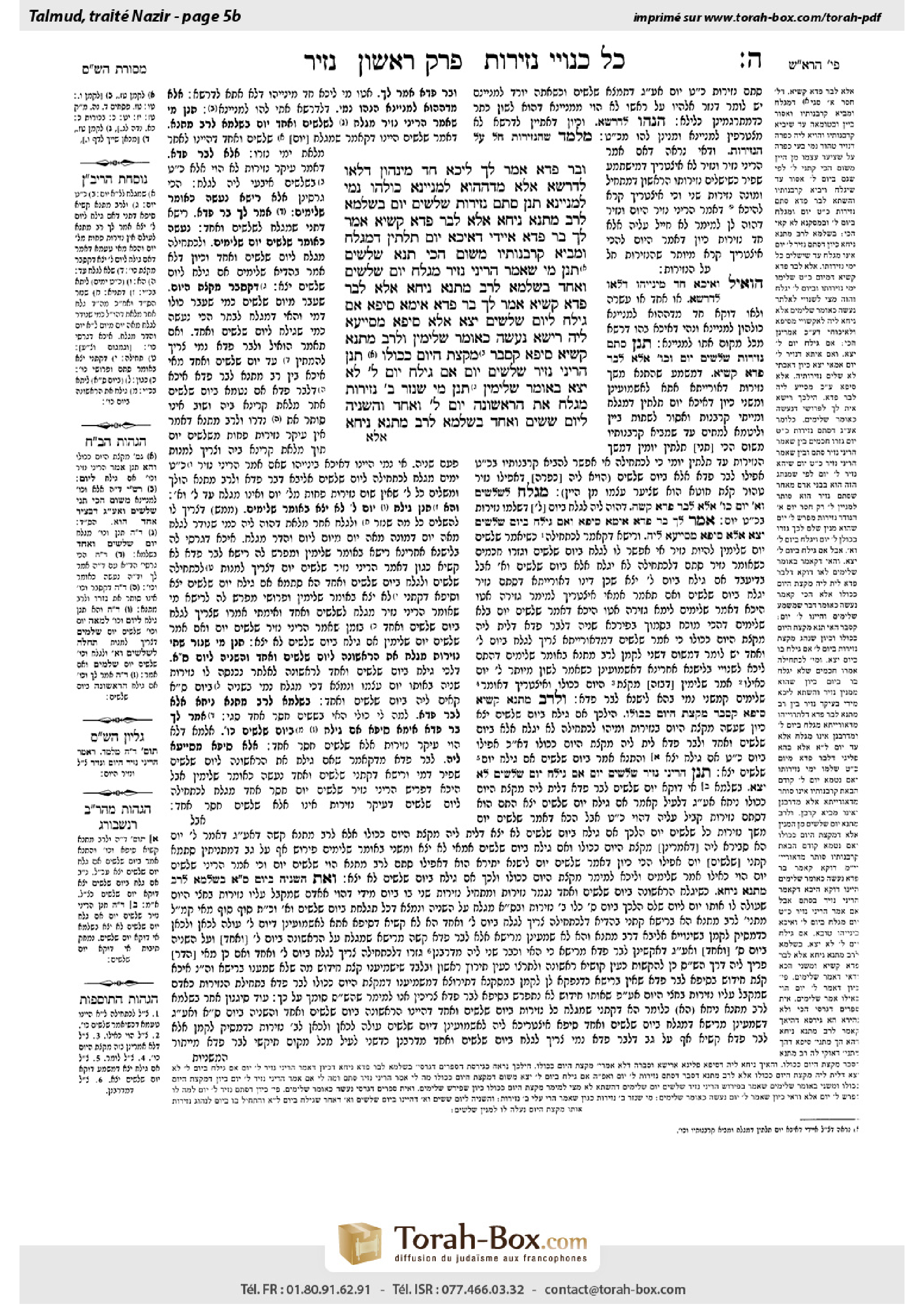
Nazir 5b: Talmud study for Daf Yomi
Daf Yomi is the daily study of one Talmud folio. Explore 37 tractates with scans, Hebrew text, Sefaria English and AI-generated French translations where annotated.
Passage selection and English or AI-generated French translation are available where the scan has annotations. Daf Study is independent of Torah-Box and Sefaria.
Browse Nazir · נזיר · All tractatesNazir 5b text and translations
This page of Nazir includes the Aramaic text, an English translation and an AI-generated French translation, alongside the scan above.
נזיר ה׳ ב · Aramaic and Hebrew text
וּבַר פְּדָא אָמַר לָךְ: לֵיכָּא חַד מִינְּהוֹן דְּלָאו לִדְרָשָׁא? אֶלָּא מִדְּהָהוּא לְמִנְיָינָא, כּוּלְּהוּ נָמֵי לְמִנְיָינָא.
תְּנַן: סְתַם נְזִירוּת שְׁלֹשִׁים יוֹם. בִּשְׁלָמָא לְרַב מַתְנָא — נִיחָא, אֶלָּא לְבַר פְּדָא — קַשְׁיָא!
אָמַר לָךְ בַּר פְּדָא: אַיְּידֵי דְּאִיכָּא יוֹם תְּלָתִין דִּמְגַלֵּחַ וּמֵבִיא קׇרְבְּנוֹתָיו, מִשּׁוּם הָכִי תְּנָא שְׁלֹשִׁים.
תְּנַן: מִי שֶׁאָמַר ״הֲרֵינִי נָזִיר״ — מְגַלֵּחַ יוֹם שְׁלֹשִׁים וְאֶחָד. בִּשְׁלָמָא לְרַב מַתְנָא נִיחָא, אֶלָּא לְבַר פְּדָא קַשְׁיָא!
אָמַר לָךְ בַּר פְּדָא, אֵימָא סֵיפָא: אִם גִּילַּח לְיוֹם שְׁלֹשִׁים — יָצָא. אֶלָּא סֵיפָא מְסַיְּיעָא לֵיהּ, רֵישָׁא — נַעֲשָׂה כְּאוֹמֵר ״שְׁלֵימִין״.
וּלְרַב מַתְנָא קַשְׁיָא סֵיפָא! קָסָבַר מִקְצָת הַיּוֹם כְּכוּלּוֹ.
תְּנַן: ״הֲרֵינִי נָזִיר שְׁלֹשִׁים יוֹם״, אִם גִּילַּח יוֹם שְׁלֹשִׁים — לֹא יָצָא! בְּאוֹמֵר ״שְׁלֵימִין״.
תְּנַן: מִי שֶׁנָּזַר שְׁתֵּי נְזִירוּת — מְגַלֵּחַ אֶת הָרִאשׁוֹנָה יוֹם שְׁלֹשִׁים וְאֶחָד, וְהַשְּׁנִיָּה לְיוֹם שִׁשִּׁים וְאֶחָד. בִּשְׁלָמָא לְרַב מַתְנָא — נִיחָא.
Nazir 5b · English translation
And bar Padda could have said to you that although some of these verses are required for an exposition, is there not at least one of them that is not used for an exposition? Rather, since that usage of the term nazirite is stated to indicate the number of days in an unspecified term of naziriteship, all of the other usages of the term are also stated to indicate the number of days in an unspecified term of naziriteship in addition to the specific halakhot that are derived from them.
The Gemara analyzes the opinions of Rav Mattana and bar Padda in light of the mishna and relevant baraitot. We learned in the mishna: An unspecified naziriteship lasts for thirty days. Granted, according to Rav Mattana it works out well. However, according to bar Padda it is difficult, since in his opinion the mishna should have stated that an unspecified naziriteship lasts for twenty-nine days.
The Gemara answers: Bar Padda could have said to you: The principal days of naziriteship are twenty-nine days. However, since there is the thirtieth day, when the nazirite shaves his hair and brings his offerings, and the prohibitions of naziriteship remain in effect on that day until he has brought these offerings, due to that reason the tanna teaches that an unspecified naziriteship lasts for thirty days.
The Gemara asks: We learned in a mishna (16a): One who said: I am hereby a nazirite, shaves his hair on the thirty-first day. Granted, according to Rav Mattana this works out well, since one must finish his term of naziriteship, which lasts for thirty days, before he can shave his hair. However, according to bar Padda, it is difficult. Why doesn’t he shave his hair on the thirtieth day?
The Gemara answers: Bar Padda could have said to you in response: Say the latter clause of that mishna: If he shaved his hair on the thirtieth day, he has fulfilled his obligation. This indicates that the naziriteship itself lasts only twenty-nine days. Rather, the latter clause of that mishna certainly supports his opinion. As for the first clause, the reason a nazirite must wait until the thirty-first day in order to shave his hair ab initio is as follows: Since one who specifies that he is becoming a nazirite for thirty complete days may shave his hair only on the thirty-first day, the Sages ruled that even one who did not specify a time period becomes like one who said explicitly that he will be a nazirite for thirty complete days. Consequently, he may shave his hair ab initio only after thirty days have passed.
The Gemara asks: And for Rav Mattana, the latter clause of the mishna is difficult, since it states that one who shaves his hair on the thirtieth day has fulfilled his obligation, whereas Rav Mattana claims that his naziriteship is not yet complete at that time. The Gemara answers: He holds that the legal status of part of the day is like that of an entire day. Although the term of naziriteship is thirty days, once the thirtieth day begins it is as though it has been completed, and a nazirite who shaves his hair on that day has fulfilled his obligation.
The Gemara asks further: We learned in that same mishna: In the case of one who says: I am hereby a nazirite for thirty days, if he shaved his hair on the thirtieth day, he has not fulfilled his obligation. This appears to contradict the opinion of Rav Mattana, who holds that part of the day is like an entire day. The Gemara answers: This is referring to one who says that he will be a nazirite for thirty complete days, in which case he certainly does not fulfill his obligation by shaving his hair on the thirtieth day itself.
The Gemara asks further: We learned in that mishna: One who accepted two terms of naziriteship shaves his hair for the first naziriteship on the thirty-first day, and he shaves his hair for the second term on the sixty-first day. Granted, according to Rav Mattana this works out well, since he shaves his head for the first naziriteship after a full thirty days have passed. The second term of naziriteship then commences on that day, which is the thirty-first day since he took his vows. He then shaves for the second time on the thirty-first day of his second naziriteship, which is the sixty-first day since he took his vows.
Nazir 5b · Traduction française (IA)
Et bar Padda aurait pu te répondre que, même si certains de ces versets sont nécessaires à une exégèse, n’y en a-t-il pas au moins un qui ne sert pas à une exégèse ? Au contraire, puisque cet emploi du terme nazir est énoncé pour indiquer le nombre de jours d’un naziréat dont la durée n’est pas précisée, tous les autres emplois de ce terme indiquent eux aussi le nombre de jours d’un naziréat dont la durée n’est pas précisée, en plus des halakhot qu’on en déduit.
La Guemara examine les opinions de Rav Mattana et de bar Padda à la lumière de la Michna et des baraïtot pertinentes. Nous avons appris dans la Michna : un naziréat dont la durée n’est pas précisée dure trente jours. Cela s’accorde bien avec l’opinion de Rav Mattana. En revanche, selon bar Padda, cela pose difficulté, car, à son avis, la Michna aurait dû enseigner qu’un naziréat dont la durée n’est pas précisée dure vingt-neuf jours.
La Guemara répond : bar Padda aurait pu te dire : les jours effectifs du naziréat sont au nombre de vingt-neuf. Toutefois, puisque le trentième jour est celui où le nazir se rase les cheveux et apporte ses offrandes, et que les interdits du naziréat restent en vigueur ce jour-là jusqu’à ce qu’il ait apporté ces offrandes, le tanna enseigne pour cette raison qu’un naziréat dont la durée n’est pas précisée dure trente jours.
La Guemara demande : nous avons appris dans une Michna (16a) : celui qui dit « Me voici nazir » se rase les cheveux le trente et unième jour. Cela s’accorde bien avec l’opinion de Rav Mattana, puisqu’il faut achever son naziréat, qui dure trente jours, avant de pouvoir se raser les cheveux. Mais, selon bar Padda, cela pose difficulté : pourquoi ne se rase-t-il pas les cheveux le trentième jour ?
La Guemara répond : bar Padda aurait pu te répondre : considère la dernière partie de cette Michna : s’il s’est rasé les cheveux le trentième jour, il s’est acquitté de son obligation. Cela indique que le naziréat lui-même ne dure que vingt-neuf jours. Au contraire, la dernière partie de cette Michna confirme assurément son opinion. Quant à la première partie, voici pourquoi un nazir doit attendre le trente et unième jour pour se raser les cheveux a priori : puisque celui qui précise qu’il devient nazir pour trente jours complets ne peut se raser les cheveux que le trente et unième jour, les Sages ont décrété que même celui qui n’a pas précisé de durée serait considéré comme ayant dit explicitement qu’il serait nazir pour trente jours complets. Par conséquent, il ne peut se raser les cheveux a priori qu’une fois les trente jours écoulés.
La Guemara demande : et, pour Rav Mattana, la dernière partie de la Michna pose difficulté, puisqu’elle stipule que celui qui se rase les cheveux le trentième jour s’est acquitté de son obligation, alors que Rav Mattana affirme que son naziréat n’est pas encore achevé à ce moment-là. La Guemara répond : il considère qu’une partie de la journée a le statut d’une journée entière. Bien que le naziréat dure trente jours, dès le début du trentième jour, c’est comme s’il était achevé, et un nazir qui se rase les cheveux ce jour-là s’est acquitté de son obligation.
La Guemara demande encore : nous avons appris dans cette même Michna : dans le cas de celui qui dit « Me voici nazir pour trente jours », s’il s’est rasé les cheveux le trentième jour, il ne s’est pas acquitté de son obligation. Cela semble contredire l’opinion de Rav Mattana, qui considère qu’une partie de la journée a le statut d’une journée entière. La Guemara répond : il s’agit de quelqu’un qui dit qu’il sera nazir pendant trente jours complets ; dans ce cas, il ne s’acquitte assurément pas de son obligation en se rasant les cheveux le trentième jour même.
La Guemara demande encore : nous avons appris dans cette Michna : celui qui a accepté deux périodes de naziréat se rase les cheveux pour la première période le trente et unième jour, et pour la seconde période le soixante et unième jour. Cela s’accorde bien avec l’opinion de Rav Mattana, puisqu’il se rase la tête pour la première période de naziréat après que trente jours complets se sont écoulés. La seconde période de naziréat commence alors ce jour-là, qui est le trente et unième jour depuis qu’il a prononcé ses vœux. Il se rase ensuite une deuxième fois le trente et unième jour de sa seconde période de naziréat, soit le soixante et unième jour depuis qu’il a prononcé ses vœux.
Traduction française générée par IA à partir de l’édition anglaise de Sefaria. Vérifie toujours un passage avec le texte source.
Text from Sefaria: William Davidson Edition - Vocalized Aramaic (CC BY NC); William Davidson Edition - English (CC BY NC).