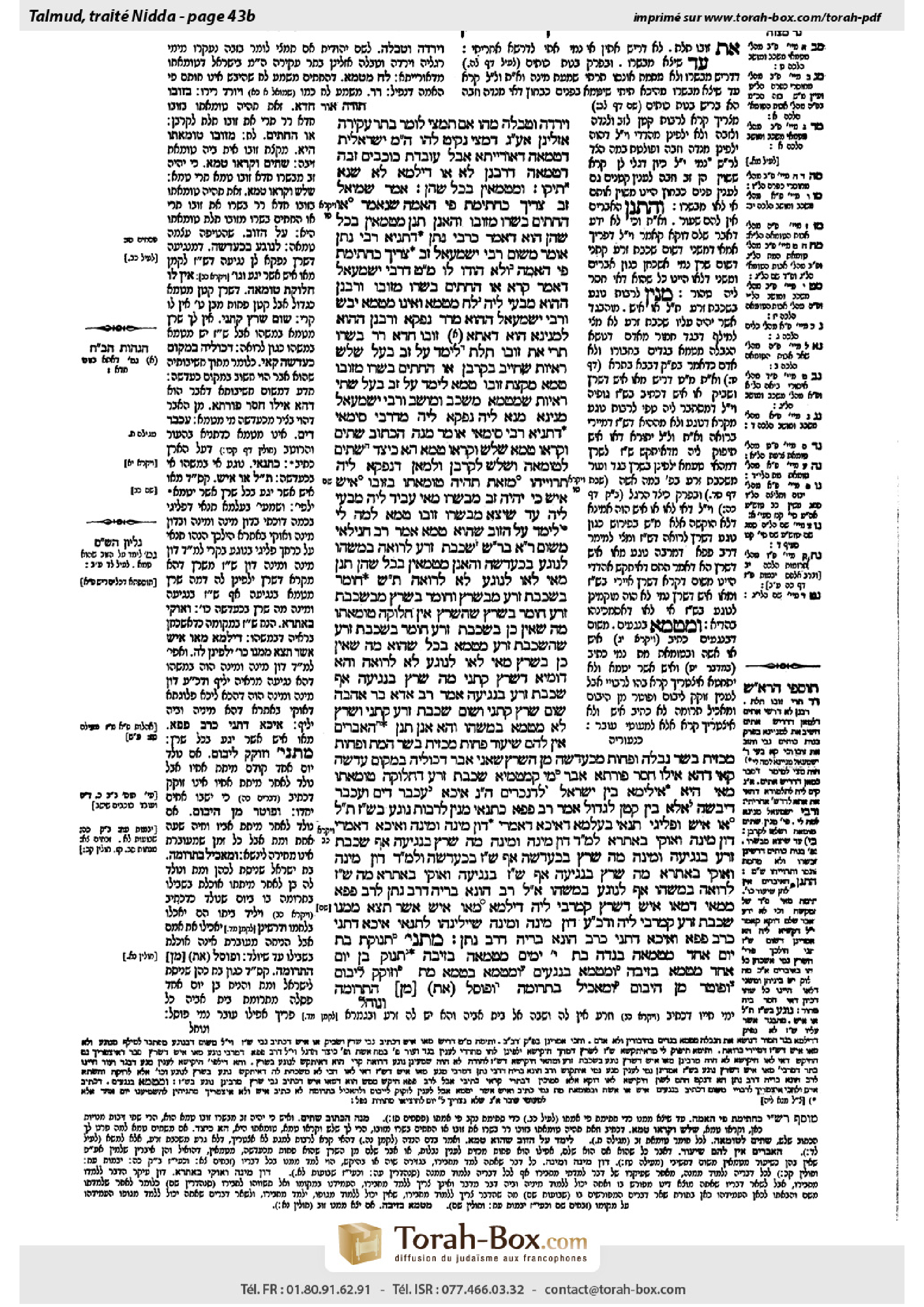
Niddah 43b: Talmud study for Daf Yomi
Daf Yomi is the daily study of one Talmud folio. Explore 37 tractates with scans, Hebrew text, Sefaria English and AI-generated French translations where annotated.
Passage selection and English or AI-generated French translation are available where the scan has annotations. Daf Study is independent of Torah-Box and Sefaria.
Browse Niddah · נידה · All tractatesNiddah 43b text and translations
This page of Niddah includes the Aramaic text, an English translation and an AI-generated French translation, alongside the scan above.
נידה מ״ג ב · Aramaic and Hebrew text
וְיָרְדָה וְטָבְלָה — מַהוּ?
אִם תִּמְצֵי לוֹמַר בָּתַר עֲקִירָה אָזְלִינַן, אַף עַל גַּב דְּמָצֵי נָקֵיט לְהוּ — הָנֵי מִילֵּי יִשְׂרְאֵלִית דִּטְמֵאָה דְּאוֹרָיְיתָא, אֲבָל גּוֹיָה זָבָה דִּטְמֵאָה דְּרַבָּנַן — לָא, אוֹ דִילְמָא לָא שְׁנָא? תֵּיקוּ.
וּמְטַמְּאִין בְּכֹל שֶׁהֵן. אָמַר שְׁמוּאֵל: זָב צָרִיךְ כַּחֲתִימַת פִּי הָאַמָּה, שֶׁנֶּאֱמַר: ״אוֹ הֶחְתִּים בְּשָׂרוֹ מִזּוֹבוֹ״.
וְהָאֲנַן תְּנַן: מְטַמְּאִין בְּכׇל שֶׁהֵן! הוּא דְּאָמַר כְּרַבִּי נָתָן, דְּתַנְיָא: רַבִּי נָתָן אוֹמֵר מִשּׁוּם רַבִּי יִשְׁמָעֵאל: זָב צָרִיךְ כַּחֲתִימַת פִּי הָאַמָּה, וְלֹא הוֹדוּ לוֹ.
מַאי טַעְמָא דְּרַבִּי יִשְׁמָעֵאל? דְּאָמַר קְרָא: ״אוֹ הֶחְתִּים בְּשָׂרוֹ מִזּוֹבוֹ״.
וְרַבָּנַן? הַהוּא מִבָּעֵי לֵיהּ: לַח מְטַמֵּא, וְאֵינוֹ מְטַמֵּא יָבֵשׁ.
וְרַבִּי יִשְׁמָעֵאל? הָהוּא מֵ״רָר״ נָפְקָא.
וְרַבָּנַן? הָהוּא לְמִנְיָנָא הוּא דַּאֲתָא: ״זוֹבוֹ״ — חֲדָא, ״רָר בְּשָׂרוֹ״ — תְּרֵי, ״אֶת זוֹבוֹ״ — תְּלָת, לִימֵּד עַל זָב בַּעַל שָׁלֹשׁ רְאִיּוֹת שֶׁחַיָּיב בְּקׇרְבָּן.
״אוֹ הֶחְתִּים בְּשָׂרוֹ מִזּוֹבוֹ טָמֵא״, מִקְצָת זוֹבוֹ טָמֵא, לִימֵּד עַל זָב בַּעַל שְׁתֵּי רְאִיּוֹת שֶׁמְּטַמֵּא מִשְׁכָּב וּמוֹשָׁב. וְרַבִּי יִשְׁמָעֵאל, מִנְיָנָא מְנָא לֵיהּ? נָפְקָא לֵיהּ מִדְּרַבִּי סִימַאי.
דְּתַנְיָא, רַבִּי סִימַאי אוֹמֵר: מָנָה הַכָּתוּב שְׁתַּיִם וּקְרָאוֹ ״טָמֵא״, שָׁלֹשׁ וּקְרָאוֹ ״טָמֵא״. הָא כֵיצַד? שְׁתַּיִם לַטּוּמְאָה, וְשָׁלֹשׁ לַקׇּרְבָּן.
וּלְמַאן דְּנָפְקָא לֵיהּ תַּרְוַיְיהוּ מִ״זֹּאת תִּהְיֶה טוּמְאָתוֹ בְּזוֹבוֹ״, ״אִישׁ אִישׁ כִּי יִהְיֶה זָב מִבְּשָׂרוֹ״ מַאי עָבֵיד לֵיהּ? מִבָּעֵי לֵיהּ עַד שֶׁיֵּצֵא מִבְּשָׂרוֹ.
״זוֹבוֹ טָמֵא״ לְמָה לִי? לִימֵּד עַל הַזּוֹב שֶׁהוּא טָמֵא.
אָמַר רַב חֲנִילַאי מִשּׁוּם רַבִּי אֶלְעָזָר בְּרַבִּי שִׁמְעוֹן: שִׁכְבַת זֶרַע — לְרוֹאֶה בְּמַשֶּׁהוּ, לְנוֹגֵעַ בְּכַעֲדָשָׁה. וְהָאֲנַן ״מְטַמְּאִין בְּכֹל שֶׁהֵן״ תְּנַן! מַאי לַָאו לְנוֹגֵעַ? לֹא, לְרוֹאֶה.
תָּא שְׁמַע: חוֹמֶר בְּשִׁכְבַת זֶרַע מִבְּשֶׁרֶץ, וָחוֹמֶר בְּשֶׁרֶץ מִבְּשִׁכְבַת זֶרַע. חוֹמֶר בְּשֶׁרֶץ — שֶׁהַשֶּׁרֶץ אֵין חֲלוּקָה טוּמְאָתוֹ, מָה שֶׁאֵין כֵּן בְּשִׁכְבַת זֶרַע. חוֹמֶר בְּשִׁכְבַת זֶרַע — שֶׁהַשִׁכְבַת זֶרַע מְטַמֵּא בְּכֹל שֶׁהוּא, מָה שֶׁאֵין כֵּן בְּשֶׁרֶץ.
מַאי לַָאו לְנוֹגֵעַ? לָא, לְרוֹאֶה.
וְהָא דּוּמְיָא דְּשֶׁרֶץ קָתָנֵי, מָה שֶׁרֶץ בִּנְגִיעָה — אַף שִׁכְבַת זֶרַע בִּנְגִיעָה! אָמַר רַב אַדָּא בַּר אַהֲבָה: שׁוּם שֶׁרֶץ קָתָנֵי, וְשׁוּם שִׁכְבַת זֶרַע קָתָנֵי.
וְשֶׁרֶץ לָא מְטַמֵּא בְּמַשֶּׁהוּ? וְהָא אֲנַן תְּנַן: הָאֵבָרִים אֵין לָהֶם שִׁיעוּר, פָּחוֹת מִכְּזַיִת בְּשַׂר הַמֵּת, וּפָחוֹת מִכְּזַיִת בְּשַׂר נְבֵלָה, וּפָחוֹת מִכַּעֲדָשָׁה מִן הַשֶּׁרֶץ.
שָׁאנֵי אֵבֶר — דְּכוּלֵּיהּ בִּמְקוֹם עֲדָשָׁה קָאֵי, דְּהָא אִילּוּ חָסַר פּוּרְתָּא אֵבֶר — מִי קָמְטַמֵּיא?
שִׁכְבַת זֶרַע דַּחֲלוּקָה טוּמְאָתוֹ — מַאי הִיא? אִילֵימָא בֵּין יִשְׂרָאֵל לִדְגוֹיִם — הָכִי נָמֵי אִיכָּא עַכְבָּר דְּיָם וְעַכְבָּר דְּיַבָּשָׁה!
אֶלָּא, בֵּין קָטָן לְגָדוֹל.
אָמַר רַב פָּפָּא: כְּתַנָּאֵי, מִנַּיִן לְרַבּוֹת נוֹגֵעַ בְּשִׁכְבַת זֶרַע? תַּלְמוּד לוֹמַר ״אוֹ אִישׁ״.
וּפְלִיגִי תַּנָּאֵי בְּעָלְמָא, דְּאִיכָּא דְּאָמְרִי: דּוּן מִינַּהּ וּמִינַּהּ, וְאִיכָּא דְאָמְרִי: דּוּן מִינַּהּ וְאוֹקֵי בְּאַתְרַהּ.
לְמַאן דְּאָמַר דּוּן מִינַּהּ וּמִינַּהּ — מָה שֶׁרֶץ בִּנְגִיעָה, אַף שִׁכְבַת זֶרַע בִּנְגִיעָה; וּמִינַּהּ — מָה שֶׁרֶץ בְּכַעֲדָשָׁה, אַף שִׁכְבַת זֶרַע בְּכַעֲדָשָׁה.
וּלְמַאן דְּאָמַר דּוּן מִינַּהּ וְאוֹקֵי בְּאַתְרַהּ, מָה שֶׁרֶץ בִּנְגִיעָה — אַף שִׁכְבַת זֶרַע בִּנְגִיעָה, וְאוֹקֵי בְּאַתְרַהּ — מָה שִׁכְבַת זֶרַע לָרוֹאֶה בְּמַשֶּׁהוּ, אַף לַנּוֹגֵעַ בְּמַשֶּׁהוּ.
אֲמַר לֵיהּ רַב הוּנָא בְּרֵיהּ דְּרַב נָתָן לְרַב פָּפָּא: מִמַּאי דְּמֵ״אוֹ אִישׁ״ דְּשֶׁרֶץ קָמְרַבֵּי לֵיהּ? דִּילְמָא מֵ״אוֹ אִישׁ אֲשֶׁר תֵּצֵא מִמֶּנּוּ שִׁכְבַת זָרַע״ קָמְרַבֵּי לֵיהּ, וּדְכוּלֵּי עָלְמָא דּוּן מִינַּהּ וּמִינַּהּ?
שַׁיְילִינְהוּ לְתַנָּאֵי, אִיכָּא דְּתָנֵי כְּרַב פָּפָּא, וְאִיכָּא דְּתָנֵי כְּרַב הוּנָא בְּרֵיהּ דְּרַב נָתָן.
מַתְנִי' תִּנוֹקֶת בַּת יוֹם אֶחָד — מִטַּמְּאָה בְּנִדָּה. בַּת עֲשָׂרָה יָמִים — מִטַּמְּאָה בְּזִיבָה.
תִּנוֹק בֶּן יוֹם אֶחָד — מִטַּמֵּא בְּזִיבָה, וּמִטַּמֵּא בִּנְגָעִים, וּמִטַּמֵּא בִּטְמֵא מֵת, וְזוֹקֵק לְיִבּוּם, וּפוֹטֵר מִן הַיִּבּוּם, וּמַאֲכִיל בִּתְרוּמָה, וּפוֹסֵל (אֶת) [מִן] הַתְּרוּמָה,
Niddah 43b · English translation
and she descended to the ritual bath and immersed for the sake of conversion, what is the halakha?
Once again, the Gemara explains the dilemma: If you say that we follow the moment of uprooting even though she can hold in the urine, nevertheless one can claim that this statement applies specifically to a Jewish woman, who is impure by Torah law. But with regard to a gentile zava, who is impure by rabbinic law, it is possible that one does not follow the moment of uprooting. Or perhaps there is no difference in the application of this principle between the case of a Jewish woman and a gentile woman, as in both cases one follows the moment of uprooting. The Gemara again concludes that the dilemma shall stand unresolved.
§ The mishna teaches that the emission of a zav and a seminal emission impart impurity in any amount. Shmuel says: In order for a zav to become ritually impure, he must experience a discharge substantial enough to cause a blockage of the tip of the penis, as it is stated: “And this shall be his impurity in his issue: Whether his flesh run with his issue, or his flesh be stopped from his issue, it is his impurity” (Leviticus 15:3).
The Gemara asks: But didn’t we learn in the mishna that the emission of a zav and a seminal emission impart impurity in any amount? The Gemara answers that Shmuel said his ruling in accordance with the statement of Rabbi Natan, as it is taught in a baraita that Rabbi Natan says in the name of Rabbi Yishmael: In order for a zav to become ritually impure, he must experience a discharge substantial enough to cause a blockage of the tip of the penis, but the Rabbis did not concede to his opinion, as they maintain that any amount is sufficient. The tanna of the mishna agrees with the opinion of the Rabbis, whereas Shmuel agrees with the statement of Rabbi Natan in the name of Rabbi Yishmael.
The Gemara asks: What is the reason for the opinion of Rabbi Yishmael, i.e., what is the source in the Torah for his ruling? The Gemara answers: His source is, as mentioned above, that the verse states: “And this shall be his impurity in his issue: Whether his flesh run with his issue, or his flesh be stopped from his issue, it is his impurity” (Leviticus 15:3). This verse indicates that the emission must be enough to cause a blockage of his penis.
The Gemara asks: And the Rabbis, who disagree with Rabbi Yishmael, what do they derive from this verse? The Gemara explains that according to the Rabbis, that verse is necessary to teach a different halakha with regard to a zav, that it is only a discharge which is moist, and which therefore could cause a blockage of the organ, that imparts impurity, but a dry discharge does not impart impurity.
The Gemara asks: And from where does Rabbi Yishmael derive that only a moist discharge imparts impurity? The Gemara answers: That halakha is derived from the word “run” in the verse “And this shall be his impurity in his issue: Whether his flesh run with his issue.”
The Gemara asks: And what do the Rabbis derive from this word? The Gemara explains that according to the Rabbis, that verse comes to teach the number of emissions by which a zav is rendered impure, as follows: The term “his issue” is one emission, the term “his flesh run” is another emission so that there are two emissions, and the term “with his issue” makes a total of three emissions. The verse thereby teaches with regard to a zav who experienced three emissions that he is obligated to bring an offering as part of his purification process.
The Gemara continues: From the last section of the verse: “Or his flesh be stopped from his issue, it is his impurity,” it is derived that one is impure even by means of part of his issue, i.e., even if he did not experience three emissions. Here the verse teaches with regard to a zav who experienced two emissions that although he is not obligated to bring an offering, he renders a surface designated for lying and a surface designated for sitting ritually impure by lying or sitting on them, even without touching them directly. The Gemara asks: And Rabbi Yishmael, from where does he derive this halakha of the requisite number of emissions? The Gemara answers that he derives it from that which Rabbi Simai said.
As it is taught in a baraita that Rabbi Simai says: The verse enumerated two emissions and called the zav impure: “When any man has an emission out of his flesh, due to his issue he is impure” (Leviticus 15:2). And yet, another verse enumerates three emissions and it too called him impure: “And this shall be his impurity in his emission: Whether his flesh runs with his emission, or his flesh be stopped from his emission, it is his impurity” (Leviticus 15:3). How can these verses be reconciled? If one is impure after two emissions, for what purpose does the Torah mention three? It is to teach that two emissions are necessary to establish impurity, and three are necessary to render a zav liable to bring an offering.
The Gemara asks: And according to the one who derives both the halakha of impurity and the obligation to bring an offering from the single verse: “And this shall be his impurity in his issue,” what do they, i.e., the Rabbis, do with the other verse: “When any man has an emission out of his flesh”? The Gemara answers that this verse is necessary to teach the halakha that a zav is not impure unless the discharge emerges from his flesh.
The Gemara further asks: Why do I need the last part of the previous verse, which can be read as: His issue is impure (Leviticus 15:2)? The Gemara explains that this teaches with regard to the issue itself that it is impure, i.e., not only does it render the man who emitted it impure, but the substance itself is impure and imparts impurity to others by contact.
§ With regard to the statement of the mishna that the issue of the zav and a seminal emission render them impure in any amount, Rav Ḥanilai says in the name of Rabbi Elazar, son of Rabbi Shimon: Semen imparts impurity to the man who emits it in any amount, whereas with regard to one who touches semen, it imparts impurity only in the amount of a lentil-bulk. The Gemara asks: But didn’t we learn in the mishna that the emission of a zav and a seminal emission impart impurity in any amount? What, is it not referring to one who touches semen? The Gemara answers: No, the mishna is referring to the man who emits it.
The Gemara suggests: Come and hear a proof from a baraita: There is an element of stringency which applies to the impurity of semen that does not apply to the impurity of the carcass of a creeping animal, and likewise there is an element of stringency which applies to the impurity of the carcass of a creeping animal that does not apply to the impurity of semen. The baraita elaborates: The stringency which applies to the carcass of a creeping animal but not to semen is that with regard to the carcass of a creeping animal there is no differentiation in its impurity, which is not the case with regard to semen, as certain types of semen impart impurity while others do not. The stringency which applies to semen but not to the carcass of a creeping animal is that semen imparts impurity in any amount, which is not the case with regard to the carcass of a creeping animal, which must be at least a lentil-bulk.
The Gemara analyzes this baraita: What, is it not referring to one who touches semen, and the baraita rules that he is rendered impure by any amount? The Gemara again answers: No, the baraita is speaking of the man who emits semen, whereas one who touches it becomes impure only if it is at least as large as a lentil-bulk.
The Gemara raises a difficulty with regard to this answer: But the baraita teaches the case of semen as similar to that of the carcass of a creeping animal, which indicates that just as the impurity of the carcass of a creeping animal is imparted by contact, so too, the impurity discussed in the baraita with regard to semen is imparted by contact. Rav Adda bar Ahava said in response: The baraita teaches the category of the carcass of a creeping animal, and it likewise teaches the category of semen, i.e., it is referring to these types of impurity in general, but this does not mean that these types of impurity are contracted in the same manner.
The Gemara asks: And does the carcass of a creeping animal not impart impurity in any amount? But didn’t we learn in a mishna (Oholot 1:7): The limbs of impure bodies that are whole have no minimum measure with regard to imparting ritual impurity. Even if a limb is less than an olive-bulk of a human corpse, or less than an olive-bulk of an animal carcass, or less than a lentil-bulk of the carcass of a creeping animal, it imparts ritual impurity. If so, how can the baraita state that there is a minimum measure of a lentil-bulk with regard to the impurity of a creeping animal?
The Gemara answers that the halakha of a limb is different, as when all of it is intact it stands in place of a lentil-bulk, i.e., a whole limb is considered like a lentil-bulk of the carcass of a creeping animal, regardless of its actual size. The proof is that if it were lacking any slight bit, thereby causing this limb of a creeping animal to be less than a lentil-bulk, would it impart impurity? Certainly not. Clearly, then, the impurity of a limb is due to its wholeness, not its size.
The baraita teaches: The stringency that applies to the carcass of a creeping animal but not to semen is that with regard to a creeping animal there is no differentiation concerning its impurity, which is not the case with regard to semen. The Gemara asks: What is the differentiation with regard to the impurity of semen? If we say that this is referring to the difference between the semen of Jews, to which this impurity applies, and the semen of gentiles, to which it does not apply, there is also a differentiation with regard to the impurity of the carcass of a creeping animal between a sea mouse, which is not impure, and a land mouse, which is impure.
Rather, the baraita is referring to the differentiation between the emission of a minor, which is not classified as semen and which does not render him impure, and that of an adult, which does render him impure. By contrast, there is no such differentiation with regard to the impurity of the carcass of a creeping animal, as it imparts impurity regardless of its age and size.
§ Rav Pappa said: The amount of semen which imparts impurity to one who touches it is subject to a dispute between tanna’im, as it is stated in a baraita: From where is it derived that the Torah includes one who touches semen, in addition to one who emits semen, as impure? The verse states with regard to the impurity of the carcass of a creeping animal: “Or whoever touches any creeping animal, whereby he may become impure” (Leviticus 22:5). It is inferred from the inclusive phrase “or whoever” that one who touches semen is also impure.
And in general, tanna’im disagree with regard to the possibility of deriving a halakha in this manner. As some say with regard to a halakha that is inferred from another halakha: Infer from it, and derive the details of the halakha from it as well. And some say with regard to such a halakha: Infer from it, but interpret the halakha according to its own place, i.e., not all aspects of the source case are applied to this halakha.
The Gemara explains how this general dispute applies to the case at hand. According to the one who says that one infers from it and again from it, the derivation is as follows: Just as the carcass of a creeping animal imparts impurity by contact, so too, semen imparts impurity by contact. And one again infers from the impurity of the carcass of a creeping animal that just as the carcass of a creeping animal imparts impurity in the amount of a lentil-bulk, so too, semen imparts impurity in the amount of a lentil-bulk.
And according to the one who says: Infer from it, but interpret the halakha according to its own place, one derives as follows: Just as the carcass of a creeping animal imparts impurity by contact, so too, semen imparts impurity by contact. But one must interpret the halakha according to its own place: Just as semen imparts impurity to the one who emits it in any amount, so too, it imparts impurity to the one who touches it in any amount.
Rav Huna, son of Rav Natan, said to Rav Pappa: From where do you infer that the tanna of the baraita derives the impurity of one who touches semen from the phrase “or whoever” that is stated with regard to the impurity of the carcass of a creeping animal? Perhaps he derives it from the previous verse: “Or from whoever the flow of seed goes out” (Leviticus 22:4), and everyone agrees that when a halakha is derived from a verse dealing with the same matter, one should infer from it and derive the details of the halakha from it as well. If so, the amount of semen that imparts impurity by contact should be derived from the amount that renders the one who emitted it impure, which is any amount.
The Gemara relates that the Sages asked the tanna’im, i.e., those who recite mishnayot and baraitot, whether the derivation of the baraita is from the verse dealing with the carcass of a creeping animal or from the one dealing with semen. They discovered that there are those who teach this halakha in accordance with the assumption of Rav Pappa, that it is derived from a creeping animal, and there are those who teach this halakha in accordance with the opinion of Rav Huna, son of Rav Natan, that the source is the verse referring to semen.
MISHNA: A baby girl, even one who is one day old, who experiences an emission of blood, becomes impure with the impurity of a menstruating woman. A baby girl who is ten days old who experiences an emission of blood for three consecutive days after the conclusion of the seven days fit for menstruation becomes impure with the impurity of ziva, and is therefore obligated to observe seven clean days before immersion.
A baby boy, even one who is one day old, becomes impure with the impurity of ziva; and becomes impure with the impurity of leprous marks; and becomes impure with impurity imparted by a corpse; and he creates a levirate bond requiring the widow of his childless brother to enter into levirate marriage with him; and he exempts his widowed mother from the obligation of levirate marriage, freeing her to marry anyone she chooses; and he enables his mother, an Israelite woman who is no longer married to his father, a priest, to continue to partake of teruma; and he disqualifies his mother, the daughter of a priest who is no longer married to his father, an Israelite man, from continuing to partake of teruma, because the child is unfit to partake of teruma;
Niddah 43b · Traduction française (IA)
et elle descendit au mikvé et s’y immergea en vue de sa conversion : quelle est la halakha ?
La Guemara explique de nouveau le dilemme : si tu dis que l’on suit le moment où l’urine commence à sortir, même si elle peut la retenir, on peut néanmoins soutenir que cette règle s’applique spécifiquement à une femme juive, qui est impure selon la Torah. Mais s’agissant d’une zava non juive, qui est impure selon une loi rabbinique, il est possible que l’on ne suive pas le moment où l’urine commence à sortir. Ou peut-être n’y a-t-il aucune différence dans l’application de ce principe entre le cas d’une femme juive et celui d’une femme non juive, car dans les deux cas, on suit le moment où l’urine commence à sortir. La Guemara conclut de nouveau que le dilemme reste sans réponse.
§ La Michna enseigne que l’écoulement d’un zav et une émission séminale transmettent l’impureté quelle qu’en soit la quantité. Chmouel dit : pour qu’un zav devienne rituellement impur, il doit avoir un écoulement assez abondant pour obstruer l’extrémité du pénis, comme il est dit : « Telle est son impureté dans son écoulement : que sa chair laisse couler son écoulement ou que sa chair soit obstruée par son écoulement, c’est son impureté » (Lévitique 15,3).
La Guemara demande : Mais n’avons-nous pas appris dans la Michna que l’écoulement d’un zav et une émission séminale transmettent l’impureté quelle qu’en soit la quantité ? La Guemara répond que Chmouel a énoncé sa règle conformément à l’opinion de Rabbi Nathan, car il est enseigné dans une baraïta que Rabbi Nathan dit au nom de Rabbi Yichmaël : pour qu’un zav devienne rituellement impur, il doit avoir un écoulement assez abondant pour obstruer l’extrémité du pénis. Mais les Sages n’ont pas accepté son opinion, car ils estiment que n’importe quelle quantité suffit. Le tanna de la Michna partage l’opinion des Sages, tandis que Chmouel suit l’enseignement de Rabbi Nathan au nom de Rabbi Yichmaël.
La Guemara demande : Quelle est la raison de l’opinion de Rabbi Yichmaël, c’est-à-dire quelle en est la source dans la Torah ? La Guemara répond : sa source est, comme indiqué plus haut, le verset qui dit : « Telle est son impureté dans son écoulement : que sa chair laisse couler son écoulement ou que sa chair soit obstruée par son écoulement, c’est son impureté » (Lévitique 15,3). Ce verset indique que l’écoulement doit être assez abondant pour obstruer son pénis.
La Guemara demande : Et que déduisent de ce verset les Sages, qui sont en désaccord avec Rabbi Yichmaël ? La Guemara explique que, selon les Sages, ce verset est nécessaire pour enseigner une autre halakha concernant un zav : seul un écoulement humide, qui peut donc obstruer l’organe, transmet l’impureté, tandis qu’un écoulement sec ne la transmet pas.
La Guemara demande : Et d’où Rabbi Yichmaël déduit-il qu’un écoulement humide transmet l’impureté ? La Guemara répond : cette halakha se déduit du mot « couler » dans le verset : « Telle est son impureté dans son écoulement : que sa chair laisse couler son écoulement. »
La Guemara demande : Et que déduisent les Sages de ce mot ? La Guemara explique que, selon les Sages, ce verset vient enseigner le nombre d’écoulements qui rendent un zav impur, comme suit : l’expression « son écoulement » désigne un écoulement ; l’expression « sa chair laisse couler » en désigne un autre, soit deux écoulements ; et l’expression « avec son écoulement » porte le total à trois écoulements. Le verset enseigne ainsi qu’un zav qui a eu trois écoulements est tenu d’apporter une offrande dans le cadre de son processus de purification.
La Guemara poursuit : de la dernière partie du verset — « ou que sa chair soit obstruée par son écoulement, c’est son impureté » — on déduit qu’il est impur même à cause d’une partie de son écoulement, c’est-à-dire même s’il n’a pas eu trois écoulements. Le verset enseigne ici qu’un zav qui a eu deux écoulements, bien qu’il ne soit pas tenu d’apporter une offrande, rend rituellement impurs une surface destinée à la couche et une surface destinée au siège en s’y couchant ou en s’y asseyant, même sans les toucher directement. La Guemara demande : Et d’où Rabbi Yichmaël déduit-il cette halakha concernant le nombre requis d’écoulements ? La Guemara répond qu’il la déduit de ce qu’a dit Rabbi Simai.
Car il est enseigné dans une baraïta que Rabbi Simai dit : le verset énumère deux écoulements et qualifie le zav d’impur : « Si un homme a un écoulement provenant de sa chair, à cause de son écoulement il est impur » (Lévitique 15,2). Pourtant, un autre verset énumère trois écoulements et le qualifie lui aussi d’impur : « Telle est son impureté dans son écoulement : que sa chair laisse couler son écoulement ou que sa chair soit obstruée par son écoulement, c’est son impureté » (Lévitique 15,3). Comment concilier ces versets ? Si l’on est impur après deux écoulements, pourquoi la Torah en mentionne-t-elle trois ? Pour enseigner que deux écoulements sont nécessaires pour établir l’impureté et que trois sont nécessaires pour rendre un zav redevable d’apporter une offrande.
La Guemara demande : Et selon celui qui déduit à la fois la halakha de l’impureté et l’obligation d’apporter une offrande de l’unique verset « Telle est son impureté dans son écoulement », que font-ils, c’est-à-dire les Sages, de l’autre verset : « Si un homme a un écoulement provenant de sa chair » ? La Guemara répond que ce verset est nécessaire pour enseigner qu’un zav n’est impur que si l’écoulement sort de sa chair.
La Guemara demande encore : Pourquoi ai-je besoin de la dernière partie du verset précédent, qui peut se lire ainsi : « Son écoulement est impur » (Lévitique 15,2) ? La Guemara explique que cela enseigne que l’écoulement lui-même est impur : non seulement il rend impur l’homme qui l’a émis, mais la substance elle-même est impure et transmet l’impureté à autrui par contact.
§ À propos de l’affirmation de la Michna selon laquelle l’écoulement du zav et une émission séminale les rendent impurs quelle qu’en soit la quantité, Rav Ḥanilai dit au nom de Rabbi Elazar, fils de Rabbi Chimon : le sperme rend impur l’homme qui l’émet quelle qu’en soit la quantité, tandis que celui qui touche du sperme ne devient impur que si la quantité atteint le volume d’une lentille. La Guemara demande : Mais n’avons-nous pas appris dans la Michna que l’écoulement d’un zav et une émission séminale transmettent l’impureté quelle qu’en soit la quantité ? Ne s’agit-il pas de celui qui touche du sperme ? La Guemara répond : Non, la Michna parle de l’homme qui l’émet.
La Guemara propose : Viens et entends une preuve tirée d’une baraïta : il existe un aspect plus strict de l’impureté du sperme qui ne s’applique pas à l’impureté de la carcasse d’un animal rampant, et il existe également un aspect plus strict de l’impureté de la carcasse d’un animal rampant qui ne s’applique pas à l’impureté du sperme. La baraïta détaille : l’aspect plus strict qui s’applique à la carcasse d’un animal rampant, mais non au sperme, est que l’impureté de la carcasse d’un animal rampant ne comporte aucune distinction, contrairement au sperme, dont certains types transmettent l’impureté et d’autres non. L’aspect plus strict qui s’applique au sperme, mais non à la carcasse d’un animal rampant, est que le sperme transmet l’impureté quelle qu’en soit la quantité, contrairement à la carcasse d’un animal rampant, dont la quantité doit atteindre au moins le volume d’une lentille.
La Guemara analyse cette baraïta : ne parle-t-elle pas de celui qui touche du sperme, et la baraïta enseigne-t-elle qu’il devient impur quelle qu’en soit la quantité ? La Guemara répond de nouveau : Non, la baraïta parle de l’homme qui émet du sperme, tandis que celui qui le touche ne devient impur que si la quantité atteint au moins le volume d’une lentille.
La Guemara soulève une difficulté à propos de cette réponse : mais la baraïta présente le cas du sperme comme analogue à celui de la carcasse d’un animal rampant, ce qui indique que, de même que l’impureté de la carcasse d’un animal rampant se transmet par contact, de même l’impureté dont parle la baraïta à propos du sperme se transmet par contact. Rav Adda bar Ahava répondit : la baraïta enseigne la catégorie de la carcasse d’un animal rampant et enseigne également la catégorie du sperme ; autrement dit, elle parle de ces types d’impureté en général, mais cela ne signifie pas qu’ils se contractent de la même manière.
La Guemara demande : La carcasse d’un animal rampant ne transmet-elle donc pas l’impureté quelle qu’en soit la quantité ? Mais n’avons-nous pas appris dans une Michna (Oholot 1,7) : les membres entiers de corps impurs n’ont pas de mesure minimale pour transmettre l’impureté rituelle. Même si un membre représente moins que le volume d’une olive d’un cadavre humain, moins que le volume d’une olive d’une carcasse animale ou moins que le volume d’une lentille de la carcasse d’un animal rampant, il transmet l’impureté rituelle. Si tel est le cas, comment la baraïta peut-elle affirmer qu’il existe une mesure minimale, le volume d’une lentille, pour l’impureté d’un animal rampant ?
La Guemara répond que la halakha concernant un membre est différente, car, lorsqu’il est entièrement intact, il tient lieu du volume d’une lentille ; autrement dit, un membre entier est considéré comme équivalant au volume d’une lentille de la carcasse d’un animal rampant, quelle que soit sa taille réelle. La preuve en est que, s’il lui manquait le moindre petit morceau, de sorte que ce membre d’un animal rampant soit inférieur au volume d’une lentille, transmettrait-il l’impureté ? Certainement pas. Il est donc clair que l’impureté d’un membre tient à son intégrité, et non à sa taille.
La baraïta enseigne : l’aspect plus strict qui s’applique à la carcasse d’un animal rampant, mais non au sperme, est que l’impureté de la carcasse d’un animal rampant ne comporte aucune distinction, contrairement au sperme. La Guemara demande : Quelle est cette distinction concernant l’impureté du sperme ? Si l’on dit qu’il s’agit de la différence entre le sperme des Juifs, auquel cette impureté s’applique, et celui des non-Juifs, auquel elle ne s’applique pas, alors il existe aussi une distinction concernant l’impureté de la carcasse d’un animal rampant entre la souris de mer, qui n’est pas impure, et la souris terrestre, qui est impure.
La baraïta parle plutôt de la distinction entre l’émission d’un mineur, qui n’est pas considérée comme du sperme et ne le rend pas impur, et celle d’un adulte, qui le rend impur. En revanche, il n’existe pas de distinction de ce genre concernant l’impureté de la carcasse d’un animal rampant, car elle transmet l’impureté indépendamment de son âge et de sa taille.
§ Rav Pappa dit : la quantité de sperme qui transmet l’impureté à celui qui le touche fait l’objet d’un désaccord entre les tannaïm, comme il est enseigné dans une baraïta : d’où déduit-on que la Torah inclut celui qui touche du sperme, en plus de celui qui en émet, parmi ceux qui sont impurs ? Le verset dit au sujet de l’impureté de la carcasse d’un animal rampant : « Ou quiconque touche un animal rampant, par lequel il peut devenir impur » (Lévitique 22,5). On déduit de l’expression inclusive « ou quiconque » que celui qui touche du sperme est lui aussi impur.
De manière générale, les tannaïm sont en désaccord sur la possibilité de déduire une halakha de cette façon. Certains disent, à propos d’une halakha déduite d’une autre halakha : « Déduis-la de celle-ci, et déduis-en également les détails de la halakha. » D’autres disent, à propos d’une telle halakha : « Déduis-la de celle-ci, mais interprète la halakha selon son propre contexte », c’est-à-dire sans appliquer à cette halakha tous les aspects du cas servant de source.
La Guemara explique comment ce désaccord général s’applique au cas présent. Selon celui qui dit qu’on déduit de celle-ci, puis qu’on déduit encore de celle-ci, la déduction est la suivante : de même que la carcasse d’un animal rampant transmet l’impureté par contact, de même le sperme transmet l’impureté par contact. Puis on déduit à nouveau de l’impureté de la carcasse d’un animal rampant que, de même que la carcasse d’un animal rampant transmet l’impureté à partir du volume d’une lentille, de même le sperme transmet l’impureté à partir du volume d’une lentille.
Et selon celui qui dit : « Déduis-la de celle-ci, mais interprète la halakha selon son propre contexte », on déduit comme suit : de même que la carcasse d’un animal rampant transmet l’impureté par contact, de même le sperme transmet l’impureté par contact. Mais il faut interpréter la halakha selon son propre contexte : de même que le sperme rend impur celui qui l’émet quelle qu’en soit la quantité, de même il rend impur celui qui le touche quelle qu’en soit la quantité.
Rav Houna, fils de Rav Nathan, dit à Rav Pappa : d’où déduis-tu que le tanna de la baraïta déduit l’impureté de celui qui touche du sperme de l’expression « ou quiconque », qui figure à propos de l’impureté de la carcasse d’un animal rampant ? Peut-être la déduit-il du verset précédent : « Ou celui de qui sort un écoulement de semence » (Lévitique 22,4), et tous s’accordent à dire que lorsqu’une halakha est déduite d’un verset traitant du même sujet, il faut la déduire de celui-ci et en déduire également les détails de la halakha. Si tel est le cas, la quantité de sperme qui transmet l’impureté par contact devrait être déduite de la quantité qui rend impur celui qui l’émet, laquelle est n’importe quelle quantité.
La Guemara rapporte que les Sages interrogèrent les tannaïm, c’est-à-dire ceux qui récitent les Michnayot et les baraïtot, afin de savoir si la déduction de la baraïta provient du verset traitant de la carcasse d’un animal rampant ou de celui qui traite du sperme. Ils découvrirent que certains enseignent cette halakha conformément à l’hypothèse de Rav Pappa, selon laquelle elle est déduite du cas d’un animal rampant, tandis que d’autres l’enseignent conformément à l’opinion de Rav Houna, fils de Rav Nathan, selon laquelle la source est le verset qui fait référence au sperme.
MICHNA : Une fillette, même âgée d’un seul jour, qui a un écoulement de sang devient impure de l’impureté d’une femme menstruée. Une fillette âgée de dix jours qui a un écoulement de sang pendant trois jours consécutifs après la fin des sept jours prévus pour la menstruation devient impure de l’impureté de ziva ; elle est donc tenue d’observer sept jours de pureté avant l’immersion.
Un garçon, même âgé d’un seul jour, devient impur de l’impureté de ziva ; il devient impur de l’impureté des lésions de lèpre ; il devient impur de l’impureté transmise par un cadavre ; il crée un lien de lévirat, qui oblige la veuve de son frère sans enfant à contracter un mariage léviratique avec lui ; il dispense sa mère veuve de l’obligation du lévirat, la libérant afin qu’elle puisse épouser qui elle veut ; il permet à sa mère, une femme israélite qui n’est plus mariée à son père, un prêtre, de continuer à consommer la terouma ; et il rend sa mère, fille de prêtre qui n’est plus mariée à son père, un homme israélite, inapte à continuer à consommer la terouma, car l’enfant n’est pas autorisé à consommer la terouma ;
Traduction française générée par IA à partir de l’édition anglaise de Sefaria. Vérifie toujours un passage avec le texte source.
Text from Sefaria: William Davidson Edition - Vocalized Aramaic (CC BY NC); William Davidson Edition - English (CC BY NC).