Avoda Zara 26a en français · עבודה זרה כ״ו א
Traduction française du daf 26a du traité Avoda Zara (Avodah Zarah 26a en anglais), avec le texte araméen, l’anglais de Sefaria et le scan de la page, pour étudier le Daf Yomi.
Ouvrir dans le lecteur interactifLire le daf du jour
Traduction française de Avoda Zara 26a
Les traductions françaises de Daf Study sont générées par IA à partir de l’édition anglaise de Sefaria. Elles peuvent contenir des erreurs : vérifie toujours un passage avec le texte source.
à Bei Torta. En chemin, des voleurs le rencontrèrent et lui demandèrent : « Où vas-tu ? » Rav Menashe leur répondit : « À Pumbedita », qui était plus éloignée que Bei Torta. Lorsqu’il arriva à Bei Torta, il se sépara des voleurs, qui avaient prévu de le dépouiller. Ils lui dirent : « Tu es un élève de Yehuda l’escroc ! » Rav Menashe leur répondit : « Le connaissez-vous si bien que vous puissiez l’accuser d’escroquer les autres ? Puisse Dieu faire que ces gens soient soumis à l’excommunication prononcée par Rav Yehuda. »
La Guemara poursuit : cette malédiction eut son effet, car les voleurs continuèrent ensuite à commettre des vols pendant vingt-deux ans, mais sans succès. Lorsqu’ils virent que leurs efforts étaient vains, ils allèrent tous réclamer leur malédiction, c’est-à-dire demander pardon et solliciter qu’elle soit levée. Mais l’un d’eux, un tisserand, ne vint pas faire lever sa malédiction, et un lion le dévora. La Guemara relève que cela explique le dicton : à propos d’un tisserand [girdana] qui n’est pas timide [taizan], mais insolent, une année est retranchée du nombre d’années qui lui étaient assignées.
À propos de ces deux récits, la Guemara commente : venez et voyez quelle différence il y a entre les voleurs de Babylonie et les brigands d’Erets Israël. Bien que les voleurs soient généralement moins violents que les brigands, ceux de Babylonie réagirent à l’action de Rav Menashe en dénonçant Rav Yehuda, tandis que les brigands d’Erets Israël louèrent la sagesse de Rabbi Akiva.
Michna : Une femme juive ne peut pas accoucher une femme non juive, car elle met ainsi au monde un enfant qui pratiquera le culte idolâtre. Mais on peut permettre à une femme non juive d’accoucher une femme juive. De même, une femme juive ne peut pas allaiter l’enfant d’une femme non juive, mais on peut permettre à une femme non juive d’allaiter l’enfant d’une femme juive, à condition qu’elle se trouve sur la propriété de cette dernière.
Guemara : La Guemara cite une controverse liée à la décision de la Michna. Les Sages ont enseigné : une femme juive ne peut pas accoucher une femme non juive, car elle met ainsi au monde un enfant qui pratiquera le culte idolâtre. Et on ne peut pas permettre à une femme non juive d’accoucher une femme juive, car les non-Juifs sont soupçonnés de meurtre ; telle est la déclaration de Rabbi Meïr.
Et les Rabbins disent : on peut permettre à une femme non juive d’accoucher une femme juive lorsque d’autres femmes se tiennent auprès d’elle et surveillent ses actes, mais pas lorsqu’elles sont seules ensemble. Rabbi Meïr dit : même lorsque d’autres femmes se tiennent auprès d’elle, on ne peut pas permettre à une femme non juive d’accoucher une femme juive, car il arrive que la sage-femme pose la main sur la tempe du nouveau-né et le tue en exerçant une pression à cet endroit, sans que son geste soit vu.
La Guemara rapporte un récit qui confirme cette crainte. C’est comme l’incident d’une certaine femme non juive qui dit à une autre femme non juive : « Tu es la sage-femme des femmes juives, la fille d’une sage-femme des femmes juives. » C’était une insulte. L’autre femme non juive lui répondit : « Que tous les maux qui pourraient s’abattre sur moi s’abattent sur toi, à la mesure du nombre de nourrissons juifs que j’ai tués, car je leur fais couler le sang comme l’écume [ufeya] d’un fleuve. » Cette sage-femme non juive prétendait avoir causé la mort de nombreux enfants juifs.
La Guemara précise l’opinion des Rabbins : les Rabbins, qui ne sont pas aussi inquiets que Rabbi Meïr, vous diraient : il n’en est rien ; la sage-femme non juive ne faisait que se vanter. Autrement dit, elle fanfaronnait afin d’intimider son adversaire, alors qu’en réalité elle n’avait tué aucun nourrisson.
§ La Michna enseigne qu’une femme juive ne peut pas allaiter l’enfant d’une femme non juive. Les Sages ont enseigné : une femme juive ne peut pas allaiter l’enfant d’une femme non juive, car elle élève ainsi un enfant qui pratiquera le culte idolâtre. Et on ne peut pas permettre à une femme non juive d’allaiter l’enfant d’une femme juive, car elle est soupçonnée de meurtre ; telle est la déclaration de Rabbi Meïr. Et les Rabbins disent : on peut permettre à une femme non juive d’allaiter l’enfant d’une femme juive lorsque d’autres femmes se tiennent auprès d’elle, mais pas lorsque la femme non juive est seule avec l’enfant. Rabbi Meïr dit : même lorsque d’autres femmes se tiennent auprès d’elle, on ne peut pas permettre à une femme non juive d’allaiter l’enfant, car il arrive qu’elle enduise son sein de poison destiné à l’enfant alors qu’elle est hors de la maison, puis qu’elle le tue avec ce poison en l’allaitant.
La Guemara fait remarquer qu’il est nécessaire d’énoncer la controverse entre Rabbi Meïr et les Rabbins à propos des deux cas, celui de la sage-femme et celui de la nourrice. En effet, si le tanna nous avait enseigné uniquement la halakha concernant la sage-femme, on aurait pu supposer que les Rabbins n’ont autorisé la femme non juive à accoucher un nouveau-né juif que dans ce cas, parce qu’elle ne peut pas le tuer puisque d’autres femmes la voient. Mais, concernant une nourrice, puisqu’il est possible qu’elle enduise son sein de poison alors qu’elle est encore hors de la maison, puis qu’elle tue l’enfant avec ce poison, on aurait pu dire que les Rabbins admettent l’avis de Rabbi Meïr et qu’une femme non juive ne peut en aucun cas être autorisée à allaiter le fils d’une femme juive.
Et si le tanna nous avait enseigné uniquement la halakha concernant une nourrice, on aurait pu supposer que Rabbi Meïr n’a interdit à une femme non juive d’allaiter un nourrisson juif que dans ce cas, parce qu’elle pourrait enduire son sein de poison alors qu’elle est hors de la maison et le tuer avec ce poison. Mais, concernant une sage-femme, puisqu’il lui est impossible de tuer l’enfant lorsque d’autres femmes se tiennent auprès d’elle, on aurait pu dire que Rabbi Meïr admet l’avis des Rabbins. La Guemara conclut : il est donc nécessaire d’énoncer cette controverse à propos des deux cas.
§ À la lumière de la discussion précédente, tous conviennent qu’une femme juive ne peut pas accoucher une femme non juive. La Guemara soulève une contradiction à partir d’une baraïta : une femme juive peut accoucher une femme araméenne contre rémunération, mais pas gratuitement. Rav Yossef répondit : cela est permis contre rémunération en raison de l’hostilité qui naîtrait si les Juifs refusaient d’accoucher les femmes non juives alors même qu’on leur propose de l’argent.
Rav Yossef pensa dire : accoucher une femme non juive pendant Chabbat contre rémunération est permis en raison de l’hostilité. Abayé lui dit : la crainte de l’hostilité ne s’applique pas ici, car elle peut dire à la non-Juive : « Pour nos propres femmes, qui observent Chabbat, nous profanons Chabbat pour elles ; pour vos femmes, qui n’observent pas Chabbat, nous ne profanons pas Chabbat pour elles. »
Rav Yossef pensa aussi dire : allaiter l’enfant d’une femme non juive contre rémunération est permis en raison de l’hostilité. Abayé lui dit : la crainte de l’hostilité ne s’applique pas, car elle peut dire, si elle n’est pas mariée : « Je souhaite me marier. » Et si elle est mariée, elle peut dire : « Je ne souhaite pas devenir repoussante aux yeux de mon mari. » Puisqu’elle peut fournir une excuse raisonnable pour refuser d’allaiter un enfant non juif, la crainte de l’hostilité ne s’applique pas.
Rav Yossef pensa proposer une idée semblable à propos de ce qui est enseigné dans une baraïta : concernant les non-Juifs et les bergers de petits animaux domestiques, on ne peut pas les faire remonter d’une fosse ni les y faire descendre. Rav Yossef suggéra que, malgré cela, il est permis de les faire remonter de la fosse contre rémunération, en raison de l’hostilité.
Abayé lui dit : il est interdit de faire remonter un non-Juif d’une fosse, même contre rémunération, car on peut lui donner une excuse, par exemple : « Mon fils est sur le toit et je dois aller utiliser cette échelle pour l’aider à en descendre. » Ou bien on peut lui dire : « J’ai été convoqué au tribunal [bei davar] et je dois m’occuper de cette affaire. » Puisque le Juif peut fournir une excuse légitime pour refuser d’aider le non-Juif, il n’est pas nécessaire de le tirer de la fosse.
À propos de l’idée de faire remonter quelqu’un d’une fosse ou de l’y faire descendre, la Guemara relève que Rabbi Abbahou enseigna ce qui suit en se tenant devant Rabbi Yoḥanan : concernant les non-Juifs et les bergers d’animaux domestiques, on ne peut pas les faire remonter d’une fosse,
Texte source et traduction anglaise
עבודה זרה כ״ו א · texte araméen et hébreu
לְבֵי תוֹרְתָּא, פְּגַעוּ בֵּיהּ גַּנָּבֵי, אֲמַרוּ לֵיהּ: לְאָן קָאָזְלַתְּ? אָמַר לָהֶן: לְפוּמְבְּדִיתָא. כִּי מְטָא לְבֵי תוֹרְתָּא, פָּרֵישׁ. אֲמַרוּ לֵיהּ: תַּלְמִידָא דִּיהוּדָה רַמָּאָה אַתְּ! אֲמַר לְהוּ: יָדְעִיתוּ לֵיהּ? יְהֵא רַעֲוָא דְּלִיהְווֹ הָנְהוּ אִינָשֵׁי בְּשַׁמְתֵּיהּ.
אֲזַלוּ עֲבַדוּ גְּנֵיבָתָא עֶשְׂרִין וְתַרְתֵּין שְׁנִין וְלָא אַצְלַחוּ, כֵּיוָן דַּחֲזוֹ, אֲתוֹ כּוּלְּהוּ תְּבַעוּ שַׁמְתַּיְיהוּ, וַהֲוָה בְּהוּ חַד גִּירְדְּנָא דְּלָא אֲתָא לְשָׁרוֹיֵה שַׁמְּתֵיהּ, אַכְלֵיהּ אַרְיָא. הַיְינוּ דְּאָמְרִי אִינָשֵׁי: גִּירְדָּנָא דְּלָא טַיְיזָן, שַׁתָּא (בציר משני) [בְּצִירָא מִשְּׁנֵיהּ].
תָּא חֲזִי, מָה בֵּין גַּנָּבֵי בָבֶל וְלִסְטִין דְּאֶרֶץ יִשְׂרָאֵל.
מַתְנִי׳ בַּת יִשְׂרָאֵל לֹא תְּיַילֵּד אֶת הַנׇּכְרִית, מִפְּנֵי שֶׁמְּיַלֶּדֶת בֵּן לַעֲבוֹדָה זָרָה, אֲבָל נׇכְרִית מְיַלֶּדֶת בַּת יִשְׂרָאֵל. בַּת יִשְׂרָאֵל לֹא תָּנִיק בְּנָהּ שֶׁל נׇכְרִית, אֲבָל נׇכְרִית מְנִיקָה בְּנָהּ שֶׁל יִשְׂרָאֵל בִּרְשׁוּתָהּ.
גְּמָ׳ תָּנוּ רַבָּנַן: בַּת יִשְׂרָאֵל לֹא תְּיַילֵּד אֶת הַנׇּכְרִית, מִפְּנֵי שֶׁמְּיַלֶּדֶת בֵּן לַעֲבוֹדָה זָרָה, וְנׇכְרִית לֹא תְּיַילֵּד אֶת בַּת יִשְׂרָאֵל, מִפְּנֵי שֶׁחֲשׁוּדִין עַל שְׁפִיכוּת דָּמִים — דִּבְרֵי רַבִּי מֵאִיר.
וַחֲכָמִים אוֹמְרִים: נׇכְרִית מְיַלֶּדֶת אֶת בַּת יִשְׂרָאֵל בִּזְמַן שֶׁאֲחֵרוֹת עוֹמְדוֹת עַל גַּבָּהּ, אֲבָל לֹא בֵּינָהּ לְבֵינָהּ. וְרַבִּי מֵאִיר אוֹמֵר: אֲפִילּוּ אֲחֵרוֹת עוֹמְדוֹת עַל גַּבָּהּ נָמֵי לָא, דְּזִימְנִין דְּמַנְּחָא לֵיהּ יְדָא אַפּוּתֵאּ וְקָטְלָא לֵיהּ, וְלָא מִתְחֲזֵי.
כִּי הָהִיא אִיתְּתָא דַּאֲמַרָה לַחֲבֶרְתַּהּ: מוֹלְדָא יְהוּדַיָּיתָא בַּת מוֹלְדָא יְהוּדַיָּיתָא! אֲמַרָה לַהּ: נְפִישִׁין בִּישָׁתָא דְּהַהִיא אִיתְּתָא, דְּקָא מַשְׁפֵּילְנָא מִינַּיְיהוּ דְּמָא כִּי אוּפְיָא דְּנַהֲרָא.
וְרַבָּנַן אֲמַרוּ לָךְ: לָא הִיא, בְּמִילְּתָא בְּעָלְמָא הוּא דְּאוֹקֵימְתַּהּ.
בַּת יִשְׂרָאֵל לֹא תָּנִיק. תָּנוּ רַבָּנַן: בַּת יִשְׂרָאֵל לֹא תָּנִיק בְּנָהּ שֶׁל נׇכְרִית, מִפְּנֵי שֶׁמְּגַדֶּלֶת בֵּן לַעֲבוֹדָה זָרָה, וְנׇכְרִית לֹא תָּנִיק אֶת בְּנָהּ שֶׁל בַּת יִשְׂרָאֵל, מִפְּנֵי שֶׁחֲשׁוּדָה עַל שְׁפִיכוּת דָּמִים, דִּבְרֵי רַבִּי מֵאִיר. וַחֲכָמִים אוֹמְרִים: נׇכְרִית מְנִיקָה אֶת בְּנָהּ שֶׁל בַּת יִשְׂרָאֵל בִּזְמַן שֶׁאֲחֵרוֹת עוֹמְדוֹת עַל גַּבָּהּ, אֲבָל לֹא בֵּינוֹ לְבֵינָהּ. וְרַבִּי מֵאִיר אוֹמֵר: אֲפִילּוּ אֲחֵרוֹת עוֹמְדוֹת עַל גַּבָּהּ נָמֵי לָא, דְּזִימְנִין דְּשָׁיְיפָא לֵיהּ סַמָּא לְדַד מֵאַבָּרַאי וְקָטְלָא לֵיהּ.
וּצְרִיכָא, דְּאִי אַשְׁמְעִינַן מְיַלֶּדֶת, בְּהַהִיא קָאָמְרִי רַבָּנַן דִּשְׁרֵי, דְּלָא אֶפְשָׁר מִשּׁוּם דַּאֲחֵרוֹת רוֹאוֹת אוֹתָהּ, אֲבָל מְנִיקָה דְּאֶפְשָׁר דְּשָׁיְיפָא לֵיהּ סַם לְדַד מֵאַבָּרַאי וְקָטְלָא לֵיהּ — אֵימָא מוֹדֵי לֵיהּ לְרַבִּי מֵאִיר.
וְאִי אַשְׁמְעִינַן מְנִיקָה, בְּהַהִיא קָאָמַר רַבִּי מֵאִיר דְּאָסוּר, מִשּׁוּם דְּשָׁיְיפָא לֵיהּ סַם לְדַד מֵאַבָּרַאי וְקָטְלָא לֵיהּ, אֲבָל מְיַלֶּדֶת, דְּלָא אֶפְשָׁר הֵיכָא דַּאֲחֵרוֹת עוֹמְדוֹת עַל גַּבָּהּ, אֵימָא מוֹדֵי לְהוּ לְרַבָּנַן — צְרִיכָא.
וּרְמִינְהוּ: יְהוּדִית מְיַלֶּדֶת אֲרַמִּית בְּשָׂכָר, אֲבָל לֹא בְּחִנָּם! אָמַר רַב יוֹסֵף: בְּשָׂכָר שְׁרֵי מִשּׁוּם אֵיבָה.
סָבַר רַב יוֹסֵף לְמֵימַר: אוֹלוֹדֵי נׇכְרִית בְּשַׁבְּתָא בְּשָׂכָר שְׁרֵי, מִשּׁוּם אֵיבָה. אֲמַר לֵיהּ אַבָּיֵי: יָכְלָה לְמֵימַר לַהּ — דִּידַן, דִּמְינַטְּרִי שַׁבְּתָא — מְחַלְּלִינַן עֲלַיְיהוּ; דִּידְכוּ, דְּלָא מְינַטְּרִי שַׁבְּתָא — לָא מְחַלְּלִינַן.
סָבַר רַב יוֹסֵף לְמֵימַר: אוֹנוֹקֵי בְּשָׂכָר שְׁרֵי מִשּׁוּם אֵיבָה. אֲמַר לֵיהּ אַבָּיֵי: יָכְלָה לְמֵימַר, אִי פְּנוּיָה הִיא — ״בָּעֵינָא לְאִינְּסוֹבֵי״, אִי אֵשֶׁת אִישׁ הִיא — ״לָא קָא מִזְדַּהַמְנָא בְּאַפֵּי גַּבְרַאי״.
סָבַר רַב יוֹסֵף לְמֵימַר, הָא דְּתַנְיָא: הַגּוֹיִם וְרוֹעֵי בְּהֵמָה דַּקָּה לֹא מַעֲלִין וְלֹא מוֹרִידִין — אַסּוֹקֵי בְּשָׂכָר שְׁרֵי, מִשּׁוּם אֵיבָה.
אֲמַר לֵיהּ אַבָּיֵי: יָכוֹל לוֹמַר לוֹ ״קָאֵי בְּרִי אַאִיגָּרָא״, אִי נָמֵי ״נְקִיטָא לִי זִימְנָא לְבֵי דַוָּאר״.
תָּנֵי רַבִּי אֲבָהוּ קַמֵּיהּ דְּרַבִּי יוֹחָנָן: הַגּוֹיִם וְרוֹעֵי בְּהֵמָה דַּקָּה — לֹא מַעֲלִין
Avodah Zarah 26a · traduction anglaise de Sefaria
to Bei Torta. Along the way, thieves encountered him, and said to him: Where are you going? Rav Menashe said to them: To Pumbedita, which was farther away than Bei Torta. When he arrived at Bei Torta, he separated from the thieves, who had planned to steal from him. They said to him: You are a student of Yehuda the swindler! Rav Menashe said to them: Do you know him so well that you can accuse him of swindling others? May it be God’s will that these people be subject to Rav Yehuda’s ban of excommunication.
The Gemara continues: This curse was effective, as the thieves subsequently went and carried out thefts for twenty-two years, but they were unsuccessful. Once they saw that their efforts were for naught, they all went and claimed their curse, i.e., they asked forgiveness and requested that the curse be lifted. But there was one weaver among them who did not come to lift his curse, and a lion ate him. The Gemara notes that this explains the adage that people say: With regard to a weaver [girdana] who is not shy [taizan] but impudent, a year is deducted from his allotted years.
With regard to these two anecdotes, the Gemara comments: Come and see what the difference is between the thieves of Babylonia and the bandits of Eretz Yisrael. Although thieves are typically less violent than bandits, the thieves in Babylonia reacted to Rav Menashe’s action by denouncing Rav Yehuda, whereas the bandits in Eretz Yisrael praised the wisdom of Rabbi Akiva.
MISHNA: A Jewish woman may not deliver the child of a gentile woman, because in doing so she is delivering a child who will engage in idol worship. But one may allow a gentile woman to deliver the child of a Jewish woman. Similarly, a Jewish woman may not nurse the child of a gentile woman, but one may allow a gentile woman to nurse the child of a Jewish woman while the gentile woman is on the Jewish woman’s property.
GEMARA: The Gemara cites a dispute related to the ruling of the mishna. The Sages taught: A Jewish woman may not deliver the child of a gentile woman because in doing so she is delivering a child who will engage in idol worship. And one may not allow a gentile woman to deliver the child of a Jewish woman because gentiles are suspected of bloodshed; this is the statement of Rabbi Meir.
And the Rabbis say: One may allow a gentile woman to deliver the child of a Jewish woman when other women are standing over her watching her actions, but not when they are alone together. And Rabbi Meir says: Even when other women are standing over her one may not allow a gentile woman to deliver the child of a Jewish woman, because there are times when the midwife places her hand on the infant’s temple and kills him by applying pressure to the area, and the act is not seen.
The Gemara relates a story that validates this concern. This is like that incident involving a certain gentile woman who said to her fellow gentile: You are the midwife of Jewish women, the daughter of a midwife of Jewish women. This was meant as an insult. In response, the other gentile said to her: May as many evils befall that woman, i.e., you, as the number of Jewish infants that I have killed, as I extract blood from them like the foam [ufeya] of a river. This gentile midwife claimed to have caused the deaths of many Jewish children.
The Gemara clarifies the opinion of the Rabbis: And the Rabbis, who are not concerned to the same extent as Rabbi Meir, would say to you: That is not so; it was merely through words that the gentile midwife was establishing herself. In other words, she was bragging in order to intimidate her antagonist, whereas in reality she did not kill any infants.
§ The mishna teaches that a Jewish woman may not nurse the child of a gentile woman. The Sages taught: A Jewish woman may not nurse the child of a gentile woman because in doing so she is effectively raising a child who will engage in idol worship. And one may not allow a gentile woman to nurse the child of a Jewish woman because she is suspected of bloodshed; this is the statement of Rabbi Meir. And the Rabbis say: One may allow a gentile woman to nurse the child of a Jewish woman when other women are standing over her, but not when the gentile woman is alone together with the child. And Rabbi Meir says: Even when other women are standing over her one may not allow a gentile woman to nurse the child, because there are times when she smears poison intended for him upon her breast when she is outside the house, and subsequently kills him with it while nursing.
The Gemara remarks: And it is necessary for the dispute between Rabbi Meir and the Rabbis to be stated with regard to both the case of a midwife and that of a wet nurse. The reason is that if the tanna had taught us only the halakha of a midwife, one might assume that it is only in that case that the Rabbis said that it is permitted to allow the gentile to deliver a Jewish infant, because it is not possible for her to kill him, due to the fact that other women see her. But with regard to a wet nurse, as it is possible that she might smear poison upon her breast while she is still outside the house and then kill him with it, one might say that the Rabbis concede to Rabbi Meir that a gentile woman may not be allowed to nurse the son of a Jewish woman under any circumstances.
And if the tanna had taught us only the halakha of a wet nurse, one might assume that it is only in that case that Rabbi Meir said that it is prohibited for a gentile to nurse a Jewish infant, due to the fact that she might smear poison upon her breast while outside the house and kill him with it. But with regard to a midwife, since it is not possible for her to kill him where other women are standing over her, one might say that Rabbi Meir concedes to the Rabbis. The Gemara concludes: It is therefore necessary for this dispute to be stated with regard to both cases.
§ Based on the above discussion, all agree that a Jewish woman may not deliver the child of a gentile woman. And the Gemara raises a contradiction from a baraita: A Jewish woman may deliver the child of an Aramean woman in exchange for payment, but not for free. Rav Yosef said in response: It is permitted in exchange for payment due to the enmity that would be engendered if Jews refused to deliver gentile infants despite being offered money to do so.
Rav Yosef thought to say: Delivering the child of a gentile woman on Shabbat in exchange for payment is permitted due to enmity. Abaye said to him: The concern of enmity does not apply here, because she can say to the gentile: With regard to our own women, who keep Shabbat, we desecrate Shabbat for them; with regard to your women, who do not keep Shabbat, we do not desecrate Shabbat for them.
Rav Yosef also thought to say: Nursing the child of a gentile woman in exchange for payment is permitted due to enmity. Abaye said to him: The concern of enmity does not apply, because she can say, if she is unmarried: I wish to get married. And if she is a married woman, she may say: I do not wish to become repulsive to my husband. Since she can provide a reasonable excuse for refusing to nurse a gentile child, the concern of enmity does not apply.
Rav Yosef thought to say a similar idea concerning that which is taught in a baraita: With regard to gentiles and shepherds of small domesticated animals, one may not raise them out of a pit and one may not lower them into a pit. Rav Yosef suggested that even so, it is permitted to raise them from the pit in exchange for payment, due to enmity.
Abaye said to him: It is prohibited to raise a gentile from a pit even in exchange for payment, because one can say an excuse to him, such as: My son is standing on the roof and I must go use this ladder to help him down from the roof. Alternatively, he can say to him: A time has been appointed for me to appear in the courthouse [bei davar] and I must attend to this matter. Since the Jew can provide a legitimate excuse for refusing to aid the gentile, there is no need to extract him from the pit.
Apropos the notion of raising someone from or lowering him into a pit, the Gemara notes that Rabbi Abbahu taught the following while standing before Rabbi Yoḥanan: With regard to gentiles and shepherds of domesticated animals, one may not raise them from a pit,
Texte de Sefaria : William Davidson Edition - Vocalized Aramaic (CC BY NC) ; William Davidson Edition - English (CC BY NC).
Scan de Avoda Zara 26a
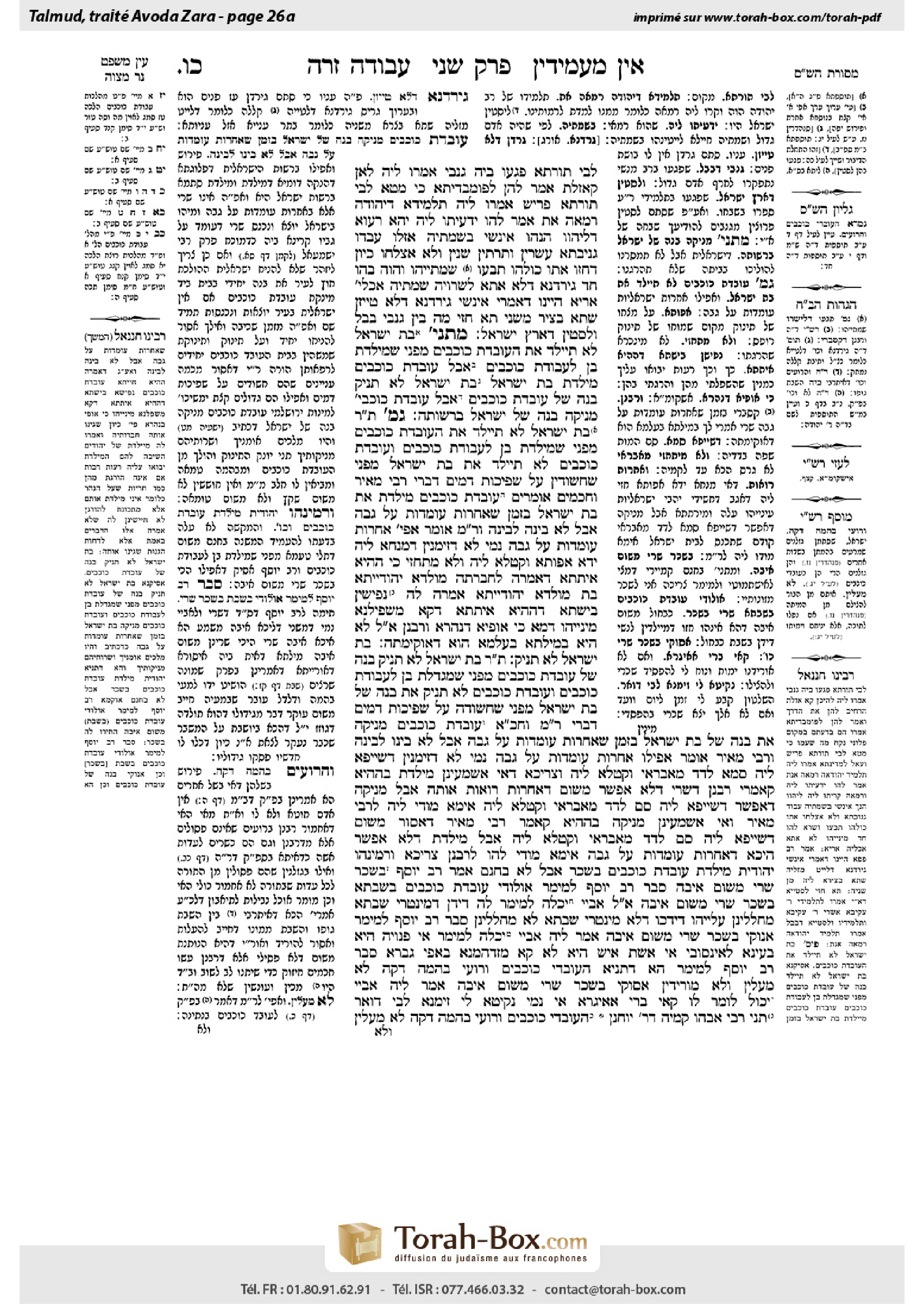
Scan : Torah-Box. Daf Study est un projet indépendant, sans affiliation ni approbation de Torah-Box ou de Sefaria.