Baba Batra 132b en français · בבא בתרא קל״ב ב
Traduction française du daf 132b du traité Baba Batra (Bava Batra 132b en anglais), avec le texte araméen, l’anglais de Sefaria et le scan de la page, pour étudier le Daf Yomi.
Ouvrir dans le lecteur interactifLire le daf du jour
Traduction française de Baba Batra 132b
Les traductions françaises de Daf Study sont générées par IA à partir de l’édition anglaise de Sefaria. Elles peuvent contenir des erreurs : vérifie toujours un passage avec le texte source.
Les Sages enseignent ici l’un des assouplissements applicables à la kétouba. Cette façon dont l’épouse perd son droit au paiement de sa kétouba constitue un assouplissement en faveur du mari, car un créancier ordinaire ne perd pas ainsi la somme qui lui est due.
La Guemara objecte : nous avons appris dans la même Michna que Rabbi Yossei dit que si elle a accepté le partage, même si le mari ne lui a pas rédigé de document lui attribuant une quelconque part de terrain, elle a perdu son droit au paiement de sa kétouba. On peut en déduire que, selon le premier tanna, il faut à la fois que le mari lui rédige un document lui attribuant une parcelle de terrain et qu’elle accepte le partage pour qu’elle perde son droit. Cela contredit l’interprétation des trois amoraïm, à savoir Rav, Chmouel et Rabbi Yossei, fils de Rabbi Ḥanina, qui ont tous supposé qu’elle n’a pas besoin d’accepter expressément le partage et que son silence suffit.
Et si tu dis que toute la Michna exprime l’opinion de Rabbi Yossei, selon qui il suffit soit que le mari rédige un acte de donation, soit que l’épouse accepte le partage, n’est-il pas enseigné dans une baraïta que Rabbi Yehouda a dit : « Selon le premier tanna, dans quel cas perd-elle son droit au paiement de sa kétouba ? Lorsqu’elle était présente au moment du partage et qu’elle l’a accepté. Mais si elle était présente sans l’accepter, ou si elle l’a accepté sans être présente, elle n’a pas perdu son droit au paiement de sa kétouba, car elle peut prétendre que son acquiescement ne visait qu’à faire plaisir à son mari et n’était pas sincère. » La Guemara conclut : la réfutation de toutes les interprétations des amoraïm est bel et bien définitive.
Rava dit à Rav Naḥman : « Telle est l’opinion de Rav, telle est celle de Chmouel et telle est celle de Rabbi Yossei, fils de Rabbi Ḥanina. Quelle est votre opinion à ce sujet, Maître ? » Rav Naḥman lui répondit : « Selon moi, dès lors qu’il l’a associée aux fils dans la propriété, elle a perdu son droit au paiement de sa kétouba. »
L’opinion de Rav Naḥman fut également rapportée comme décision halakhique : Rav Yossef bar Minyumi dit que Rav Naḥman dit que, dès lors qu’il l’a associée aux fils dans la propriété, elle a perdu son droit au paiement de sa kétouba.
Rava soulève une question : quelle est la halakha dans le cas d’un homme en bonne santé ? Dit-on que l’épouse ne perd son droit au paiement de sa kétouba que dans le cas d’un homme à l’article de la mort, puisqu’elle savait qu’il ne possédait pas d’autres biens et qu’elle a néanmoins renoncé au paiement de sa kétouba ; tandis que, dans le cas d’un homme en bonne santé, elle a pu penser qu’il acquerrait plus tard d’autres biens sur lesquels elle pourrait recouvrer le paiement de sa kétouba, et que c’est pourquoi elle a accepté le partage des biens ? Dans ce cas, elle n’a pas renoncé à son droit au paiement de sa kétouba. Ou bien faut-il peut-être considérer que, puisqu’il ne possède de toute façon pas d’autres biens à présent, son acceptation doit être interprétée comme une renonciation à son droit ? La Guemara conclut : la question reste sans réponse.
§ Un homme à l’article de la mort dit aux personnes qui l’entouraient : « Donnez la moitié de mon patrimoine à ma fille, la moitié à mon autre fille et un tiers des fruits à mon épouse. » Rav Naḥman arriva par hasard à Soura. Il entra à la maison d’étude pour voir Rav Ḥisda, qui lui demanda : « Dans un cas comme celui-ci, quelle est la halakha ? » Rav Naḥman lui répondit : « Voici ce que dit Chmouel : même s’il ne lui a transféré la propriété que d’un seul palmier, pour qu’elle en perçoive les fruits, elle a perdu son droit au paiement de sa kétouba. »
Rav Ḥisda lui dit : « Considère que Chmouel a dit qu’elle perd son droit dans le cas où il lui a donné un palmier pour qu’elle en perçoive les fruits, parce qu’il lui a transféré des droits de propriété sur le terrain lui-même, puisque le palmier est enraciné dans le sol. Mais ici, il ne lui a donné que des fruits, sans aucune part dans le terrain lui-même. Peut-être ne perd-elle donc pas son droit au paiement de sa kétouba. » Rav Naḥman lui dit : « Tu veux dire qu’il ne lui a donné que des biens mobiliers ? Je n’ai certainement pas voulu dire qu’elle perd son droit même s’il ne lui a donné que des biens mobiliers, comme des fruits. Au contraire, elle reçoit le paiement de sa kétouba. »
Un homme à l’article de la mort dit aux personnes qui l’entouraient : « Donnez un tiers de mes biens à ma fille, un tiers à mon autre fille et un tiers à mon épouse. » L’une de ses filles mourut avant lui, et sa part revint donc en sa possession. Rav Pappi envisagea de dire que l’épouse ne reçoit qu’un tiers. Elle ne peut pas recevoir le paiement de sa kétouba sur les deux tiers légués aux filles, car, en devenant copropriétaire des biens avec elles, elle a renoncé au paiement de sa kétouba.
Texte source et traduction anglaise
בבא בתרא קל״ב ב · texte araméen et hébreu
וּמִקּוּלֵּי כְתוּבָּה שָׁנוּ כָּאן.
תְּנַן, רַבִּי יוֹסֵי אוֹמֵר: אִם קִבְּלָה עָלֶיהָ, אַף עַל פִּי שֶׁלֹּא כָּתַב לָהּ – אִבְּדָה כְּתוּבָּתָהּ. מִכְּלָל דְּתַנָּא קַמָּא סָבַר: כְּתִיבָה וְקַבָּלָה בָּעֵי!
וְכִי תֵּימָא: כּוּלַּהּ רַבִּי יוֹסֵי הִיא; וְהָא תַנְיָא, אָמַר רַבִּי יְהוּדָה: אֵימָתַי – שֶׁהָיְתָה שָׁם וְקִבְּלָה עָלֶיהָ; אֲבָל הָיְתָה שָׁם וְלֹא קִבְּלָה עָלֶיהָ, קִבְּלָה עָלֶיהָ וְלֹא הָיְתָה שָׁם – לֹא אִבְּדָה כְּתוּבָּתָהּ! תְּיוּבְתָּא דְכוּלְּהוּ! תְּיוּבְתָּא.
אֲמַר לֵיהּ רָבָא לְרַב נַחְמָן: הָא רַב, הָא שְׁמוּאֵל, הָא רַבִּי יוֹסֵי בְּרַבִּי חֲנִינָא. מָר – מַאי סְבִירָא לֵיהּ? אֲמַר לֵיהּ, שֶׁאֲנִי אוֹמֵר: כֵּיוָן שֶׁעֲשָׂאָהּ שׁוּתָּף בֵּין הַבָּנִים – אִבְּדָה כְּתוּבָּתָהּ.
אִיתְּמַר נָמֵי, אָמַר רַב יוֹסֵף בַּר מִנְיוֹמֵי אָמַר רַב נַחְמָן: כֵּיוָן שֶׁעֲשָׂאָהּ שׁוּתָּף בֵּין הַבָּנִים – אִבְּדָה כְּתוּבָּתָהּ.
בָּעֵי רָבָא: בְּבָרִיא הֵיאַךְ? מִי אָמְרִינַן: בִּשְׁכִיב מְרַע הוּא דְּיָדְעָה דְּלֵית לֵיהּ – וְקָמָחֲלָה, אֲבָל בְּבָרִיא – סָבְרָה הָדַר קָנֵי; אוֹ דִלְמָא, הַשְׁתָּא מִיהַת לֵית לֵיהּ? תֵּיקוּ.
הַהוּא דַּאֲמַר לְהוּ: ״פַּלְגָא לִבְרַת, וּפַלְגָא לִבְרַת, וְתִילְתָּא לְאִיתַּת בְּפֵירֵי״. אִיקְּלַע רַב נַחְמָן לְסוּרָא, עוּל לְגַבֵּי רַב חִסְדָּא, אֲמַר לֵיהּ: כִּי הַאי גַוְונָא מַאי? אֲמַר לֵיהּ, הָכִי אָמַר שְׁמוּאֵל: אֲפִילּוּ לֹא הִקְנָה לָהּ אֶלָּא דֶּקֶל אֶחָד לְפֵירוֹתָיו – אִבְּדָה כְּתוּבָּתָהּ.
אֲמַר לֵיהּ: אֵימוֹר דְּאָמַר שְׁמוּאֵל הָתָם – דְּאַקְנִי לַהּ בְּגוּפַהּ דְּאַרְעָא; הָכָא – פֵּירָא הוּא! אֲמַר לֵיהּ: מִטַּלְטְלִי קָא אָמְרַתְּ? מִטַּלְטְלִי וַדַּאי לָא קָא אָמֵינָא.
הַהוּא דַּאֲמַר לְהוּ: ״תִּלְתָּא לִבְרַת, וְתִלְתָּא לִבְרַת, וְתִלְתָּא לְאִיתַּת״. שְׁכִיבָא חֲדָא מִבְּנָתֵיהּ. סְבַר רַב פַּפֵּי לְמֵימַר: לָא שָׁקְלָא אֶלָּא תְּלָתָא.
Bava Batra 132b · traduction anglaise de Sefaria
And the Sages taught here one of the leniencies that apply to a marriage contract. This manner in which the wife loses her right to receive payment of her marriage contract is a leniency for the husband, as an ordinary creditor does not lose money he is owed in this fashion.
The Gemara questions this statement: We learned in the same mishna that Rabbi Yosei says that if she accepted the distribution upon herself, even if he did not write a document granting her any amount of land, she has lost her right to receive payment of her marriage contract. By inference, it can be stated that the first tanna holds that both his writing a document granting her a piece of land and her acceptance of the distribution are necessary for her to lose her right, contrary to the interpretation of all three amora’im, i.e., Rav, Shmuel, and Rabbi Yosei, son of Rabbi Ḥanina, all of whom assumed that she need not affirmatively accept the distribution and that her silence is sufficient.
And if you would say that the entire mishna is the opinion of Rabbi Yosei, who holds that either the husband’s writing a deed of gift or the wife’s acceptance of the distribution is sufficient, but isn’t it taught in a baraita that Rabbi Yehuda said: According to the first tanna, when does she lose her right to receive payment of her marriage contract? In a case where she was there at the time of the distribution and accepted it; but if she was there but did not accept it, or accepted it but was not there, she has not lost her right to receive payment of her marriage contract, as she can claim that her acquiescence was only to please her husband and was not sincere. The Gemara concludes: The refutation of the opinions of all the interpretations of the amora’im is indeed a conclusive refutation.
Rava said to Rav Naḥman: This is the opinion of Rav; this is the opinion of Shmuel; and this is the opinion of Rabbi Yosei, son of Rabbi Ḥanina. What does the Master hold in this matter? Rav Naḥman said to him: As I say, that once he rendered her a partner in the property among the sons, she lost her right to receive payment of her marriage contract.
Rav Naḥman’s opinion was also stated as a halakhic ruling: Rav Yosef bar Minyumi says that Rav Naḥman says that once he rendered her a partner in the property among the sons, she lost her right to receive payment of her marriage contract.
Rava raises a dilemma: In the case of a healthy person, what is the halakha? Do we say that the wife loses her right to receive payment of her marriage contract only in the case of a person on his deathbed, as she knew that he had no other property and nevertheless waived payment of the marriage contract, but in the case of a healthy person, she might have reasoned that he will then acquire other property from which she will be able to collect payment of her marriage contract, and that is why she accepted the distribution of the property? If so, she did not waive her right to receive payment of her marriage contract. Or perhaps, should it be reasoned that since in any event, now he has no other property, her acceptance should be interpreted as waiving her right? The Gemara concludes: The dilemma shall stand unresolved.
§ There was a certain man on his deathbed who said to the people surrounding him: Give one-half of my estate to my daughter, and one-half to my other daughter, and one-third of the produce to my wife. Rav Naḥman happened to come to Sura. He entered the study hall to see Rav Ḥisda, who said to him: In a case like this, what is the halakha? Rav Naḥman said to him that this is what Shmuel says: Even if he transferred to her ownership only one palm tree for its produce, she has lost her right to receive payment of her marriage contract.
Rav Ḥisda said to him: Say that Shmuel said his statement that she loses her right there, in a case where he gave her a palm tree for its produce, because he transferred rights in the land itself to her ownership, as the palm tree is connected to the ground. But here, in this case, it is only produce that he gave her, without any share in the land itself. Perhaps she does not lose payment of her marriage contract. Rav Naḥman said to him: You say that he gave her only movable property? I certainly did not mean to say that she loses her right even if he gave her only movable property such as produce. Rather, she receives payment of her marriage contract.
There was a certain man on his deathbed who said to the people surrounding him: Give one-third of my property to my daughter, and one-third to my other daughter, and one-third to my wife. One of his daughters died before he did, and her portion consequently returned to his possession. Rav Pappi thought to say that the wife takes only one-third. She cannot receive payment of her marriage contract from the two-thirds bequeathed to the daughters, as by entering a partnership with the daughters in ownership of the property, she waived payment of her marriage contract.
Texte de Sefaria : William Davidson Edition - Vocalized Aramaic (CC BY NC) ; William Davidson Edition - English (CC BY NC).
Scan de Baba Batra 132b
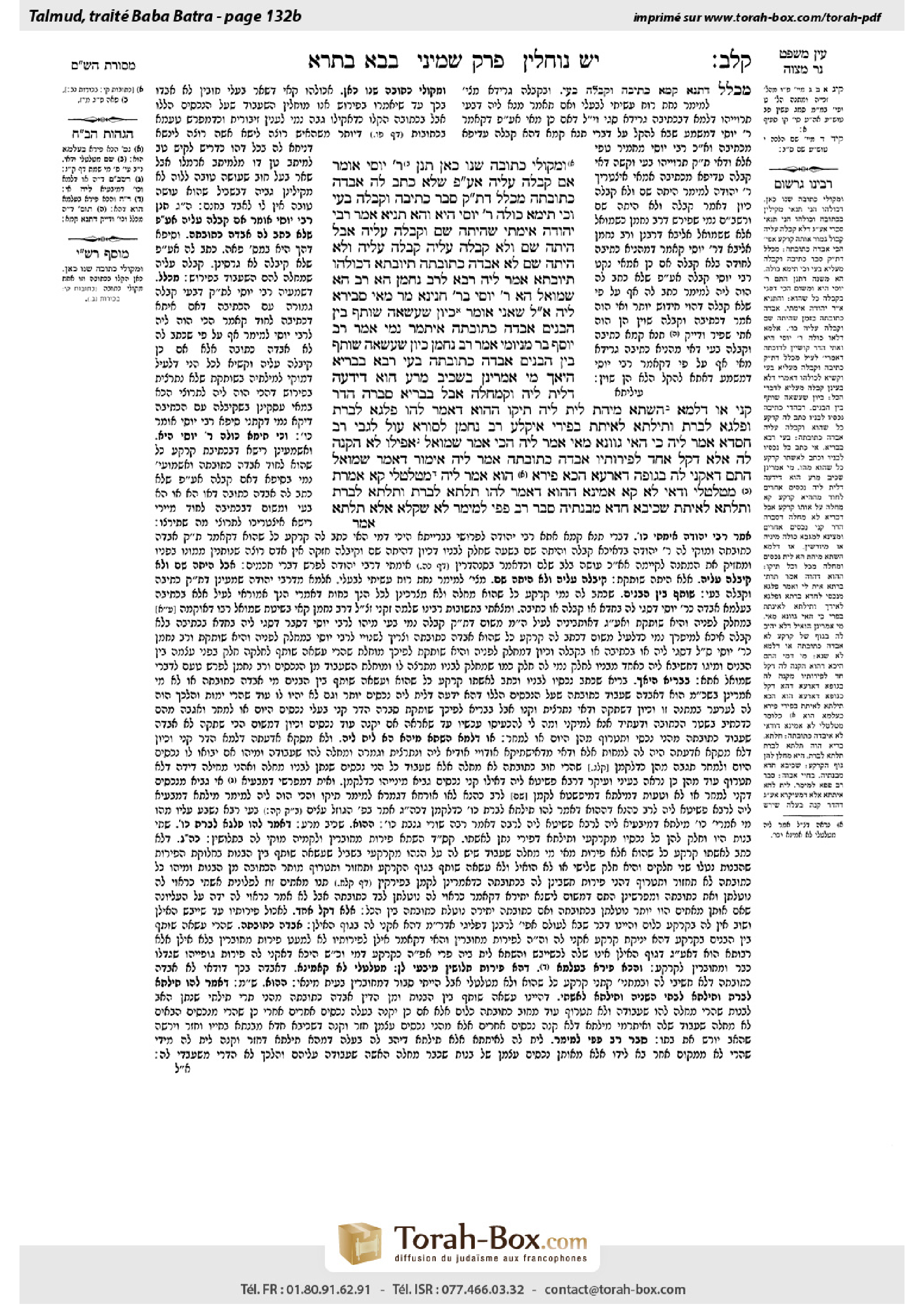
Scan : Torah-Box. Daf Study est un projet indépendant, sans affiliation ni approbation de Torah-Box ou de Sefaria.