Baba Batra 82a en français · בבא בתרא פ״ב א
Traduction française du daf 82a du traité Baba Batra (Bava Batra 82a en anglais), avec le texte araméen, l’anglais de Sefaria et le scan de la page, pour étudier le Daf Yomi.
Ouvrir dans le lecteur interactifLire le daf du jour
Traduction française de Baba Batra 82a
Les traductions françaises de Daf Study sont générées par IA à partir de l’édition anglaise de Sefaria. Elles peuvent contenir des erreurs : vérifie toujours un passage avec le texte source.
Le passage n’est récité que lorsque la cueillette et l’apport des prémices sont accomplis par une seule et même personne, ce qui n’est pas le cas ici. Rav Aḥa, fils de Rav Avya, dit à Rav Ashi : Puisque le passage est composé de versets, qu’il les lise. Qu’y a-t-il de répréhensible à réciter des versets de la Torah ?
Rav Ashi lui dit : Le problème est que cette pratique donne l’apparence d’un mensonge, car il fait devant Dieu une déclaration qui est peut-être fausse, puisqu’il se peut qu’il ne soit pas propriétaire du terrain. Rav Mesharshiyya, fils de Rav Ḥiyya, dit : La déclaration n’est pas récitée de peur qu’il ne soustraie les fruits à leur obligation de terouma et de dîmes, s’ils sont considérés entièrement comme des prémices. C’est pourquoi on ne récite pas le passage, afin de préserver leur statut particulier.
§ La Michna enseigne : Celui qui achète deux arbres dans le champ d’autrui, si les arbres poussent, le propriétaire du champ ne peut pas couper leurs branches. La Michna enseigne également : Ce qui pousse à partir du tronc appartient au propriétaire de l’arbre, tandis que ce qui pousse à partir des racines appartient au propriétaire du terrain. La Guemara demande : Dans quelles circonstances considère-t-on qu’une pousse vient du tronc, et dans quelles circonstances considère-t-on qu’elle vient des racines ?
Rabbi Yoḥanan dit : Tout ce qui voit la face du soleil, c’est-à-dire ce qui est visible et se trouve au-dessus du sol, est considéré comme poussant à partir du tronc. Quant à ce qui ne voit pas la face du soleil, mais est enfoui dans la terre, cela est considéré comme poussant à partir des racines.
La Guemara demande : Mais si tout ce qui est visible appartient au propriétaire de l’arbre, quelle que soit sa proximité avec le sol, ne faut-il pas craindre que le terrain soit recouvert de sédiments charriés par l’eau, de sorte qu’une partie du tronc de l’arbre soit ensevelie ? Les branches qui poussent à partir du tronc sembleraient alors être des arbres distincts, et le propriétaire des arbres pourrait dire au propriétaire du champ : « En réalité, tu m’as vendu trois arbres, et j’ai donc acquis des droits sur le terrain. » Rav Naḥman dit plutôt : Ce qui pousse à partir du tronc appartient au propriétaire de l’arbre, mais celui-ci doit le couper. Rabbi Yoḥanan lui-même dit également : Le propriétaire de l’arbre doit le couper.
Rav Naḥman dit : Nous avons reçu par tradition qu’un palmier acheté à autrui n’a pas de tronc. Rav Zevid envisagea d’expliquer que cela signifie que le propriétaire du palmier n’a aucun droit sur ce qui pousse à partir du tronc. En effet, puisque l’arbre est destiné à être déterré et arraché — car, lorsque l’arbre meurt, son propriétaire n’a pas le droit d’en planter un autre à sa place —, il ne tient pas compte de ce qui pousse à partir du tronc.
Rav Pappa objecte : Mais cela est comparable au cas de celui qui achète deux arbres dans le champ d’autrui : ces arbres sont destinés à être déterrés et arrachés, puisque leur propriétaire n’a pas le droit d’en planter de nouveaux à leur place lorsqu’ils meurent ; pourtant, la Michna enseigne qu’il a droit à ce qui pousse à partir du tronc. Rav Pappa dit plutôt : La déclaration de Rav Naḥman signifie que le propriétaire d’un palmier, contrairement aux propriétaires d’autres types d’arbres, n’a pas droit à ce qui pousse à partir du tronc, car un palmier ne produit pas de branches à partir de son tronc.
La Guemara demande : Mais selon l’avis de Rav Zevid, qui soutient que Rav Naḥman parle de toutes les espèces d’arbres, la Michna pose problème. La Guemara répond : Rav Zevid interprète la Michna comme se référant à une situation où le propriétaire des arbres les a achetés pour cinq ans et a stipulé qu’il pourrait planter de nouveaux arbres à la place des arbres d’origine si ceux-ci étaient abattus.
§ La Michna enseigne : Celui qui a acheté trois arbres a acquis le terrain avec eux. La Guemara demande : Quelle superficie du champ acquiert-il ? Rabbi Ḥiyya bar Abba dit au nom de Rabbi Yoḥanan : Cet acheteur acquiert le terrain situé sous les arbres et l’espace entre eux ; quant à l’espace à l’extérieur des arbres et de leurs branches,
Texte source et traduction anglaise
בבא בתרא פ״ב א · texte araméen et hébreu
עַד שֶׁתְּהֵא לְקִיחָה וַהֲבָאָה כְּאֶחָד; וְהָא לֵיכָּא. אֲמַר לֵיהּ רַב אַחָא בְּרֵיהּ דְּרַב אַוְיָא לְרַב אָשֵׁי: מִכְּדֵי פְּסוּקֵי נִינְהוּ, לִיקְרֵי!
אֲמַר לֵיהּ: מִשּׁוּם דְּמִחֲזֵי כְּשִׁיקְרָא. רַב מְשַׁרְשְׁיָא בְּרֵיהּ דְּרַב חִיָּיא אָמַר: דִּלְמָא אָתֵי לְאַפְקוּעִינְהוּ מִתְּרוּמָה וּמַעֲשֵׂר.
הִגְדִּילוּ – לֹא יְשַׁפֶּה כּוּ׳. הֵיכִי דָּמֵי מִן הַגֶּזַע, וְהֵיכִי דָּמֵי מִן הַשׇּׁרָשִׁין?
אָמַר רַבִּי יוֹחָנָן: כֹּל שֶׁרוֹאֶה פְּנֵי חַמָּה – זֶהוּ מִן הַגֶּזַע, וְשֶׁאֵינוֹ רוֹאֶה פְּנֵי חַמָּה – זֶהוּ מִן הַשׇּׁרָשִׁין.
וְלֵיחוּשׁ דִּלְמָא מַסְּקָא אַרְעָא שִׂירְטוֹן, וְאָמַר לֵיהּ: תְּלָתָא זַבֵּינְתְּ לִי, וְאִית לִי אַרְעָא! אֶלָּא אָמַר רַב נַחְמָן: יָקוֹץ. וְכֵן אָמַר רַבִּי יוֹחָנָן: יָקוֹץ.
אָמַר רַב נַחְמָן: נְקִיטִינַן, דֶּקֶל אֵין לוֹ גֶּזַע. סָבַר רַב זְבִיד לְמֵימַר: אֵין לוֹ גֶּזַע לְבַעַל דֶּקֶל, דְּכֵיוָן דִּלְמִחְפַּר וּלְשָׁרֵשׁ קָאֵי – אַסּוֹחֵי מַסַּח דַּעְתֵּיהּ.
מַתְקֵיף לַהּ רַב פָּפָּא: וְהָא קוֹנֶה שְׁנֵי אִילָנוֹת – דִּלְמִחְפַּר וּלְמִשְׁרַשׁ קָיְימִי, וְקָתָנֵי דְּיֵשׁ לוֹ גֶּזַע! אֶלָּא אָמַר רַב פָּפָּא: אֵין לוֹ גֶּזַע לְבַעַל דֶּקֶל, לְפִי שֶׁאֵין מוֹצִיא גֶּזַע.
וּלְרַב זְבִיד, קַשְׁיָא מַתְנִיתִין! דְּזַבֵּין לַחֲמֵשׁ שְׁנִין.
קָנָה שְׁלֹשָׁה – קָנָה קַרְקַע. וְכַמָּה? אָמַר רַבִּי חִיָּיא בַּר אַבָּא אָמַר רַבִּי יוֹחָנָן: הֲרֵי זֶה קָנָה תַּחְתֵּיהֶן וּבֵינֵיהֶן, וְחוּצָה לָהֶן
Bava Batra 82a · traduction anglaise de Sefaria
The passage is not recited until the taking and the bringing of the first fruits are performed by one person, and that is not the case here. Rav Aḥa, son of Rav Avya, said to Rav Ashi: Since the passage is composed of verses, let him read them. What is objectionable about reciting verses from the Torah?
Rav Ashi said to him: The problem is due to the fact that this practice has the appearance of falsehood, because he issues a declaration before God that is possibly untrue, as he might not own the ground. Rav Mesharshiyya, son of Rav Ḥiyya, said: The declaration is not recited lest he come to remove the fruits from their obligation of teruma and tithes, if they are treated entirely as first fruits. For this reason one does not recite the passage, to ensure that their unique status is maintained.
§ The mishna teaches: With regard to one who buys two trees in the field of another, if the trees grew, the owner of the field may not cut down their branches. The mishna further teaches: That which grows out of the trunk belongs to the owner of the tree, but that which grows out of the roots belongs to the owner of the ground. The Gemara asks: What are the circumstances in which something is considered to be growing out of the trunk, and what are the circumstances in which it is considered to be growing out of the roots?
Rabbi Yoḥanan said: With regard to anything that sees the face of the sun, i.e., which is visible and aboveground, this is considered to be growing out of the trunk. And with regard to that which does not see the face of the sun but is concealed in the earth, this is considered to be growing out of the roots.
The Gemara asks: But if everything that is visible belongs to the owner of the tree, no matter how close it is to the ground, let us be concerned that perhaps the land is covered with sediment from flowing water, and some of the tree’s trunk will be covered, in which case the branches that grow from the trunk will appear as though they are separate trees; and the owner of the trees will say to the owner of the field: You actually sold me three trees and I therefore have ownership over the ground. Rather, Rav Naḥman said: That which grows from the trunk belongs to the owner of the tree, but he must cut it down. And Rabbi Yoḥanan himself likewise said: The owner of the tree must cut it down.
Rav Naḥman said: We hold by tradition that a palm tree bought from another has no trunk. Rav Zevid thought to say this means that the owner of the palm tree has no right to that which grows from the trunk. The reason is that since it stands ready to be dug up and uprooted, as when the tree dies its owner is not entitled to plant another in its place, he diverts his mind from that which grows from the trunk.
Rav Pappa objects to this: But this is comparable to one who buys two trees in a field belonging to another, as the trees stand ready to be dug up and uprooted because their owner has no right to plant new trees in their place when they die; and yet it is taught in the mishna that he has the right to that which grows from the trunk. Rather, Rav Pappa said: The statement of Rav Naḥman means that the owner of a palm tree, in contrast to owners of other types of trees, has no right to that which grows from the trunk, since a palm tree does not produce branches from its trunk.
The Gemara asks: But according to the opinion of Rav Zevid, who maintains that Rav Naḥman is referring to all types of trees, the mishna is difficult. The Gemara answers: Rav Zevid interprets the mishna as referring to a situation where the owner of the trees bought the trees for five years and stipulated that he may plant new trees in place of the original trees in the event the original ones are cut down.
§ The mishna teaches: If one bought three trees he has acquired the ground along with them. The Gemara asks: And how much of the field does he acquire? Rabbi Ḥiyya bar Abba says that Rabbi Yoḥanan says: This buyer has acquired the ground that is located underneath the trees, and the area between them, and with regard to the space outside of the trees and their branches,
Texte de Sefaria : William Davidson Edition - Vocalized Aramaic (CC BY NC) ; William Davidson Edition - English (CC BY NC).
Scan de Baba Batra 82a
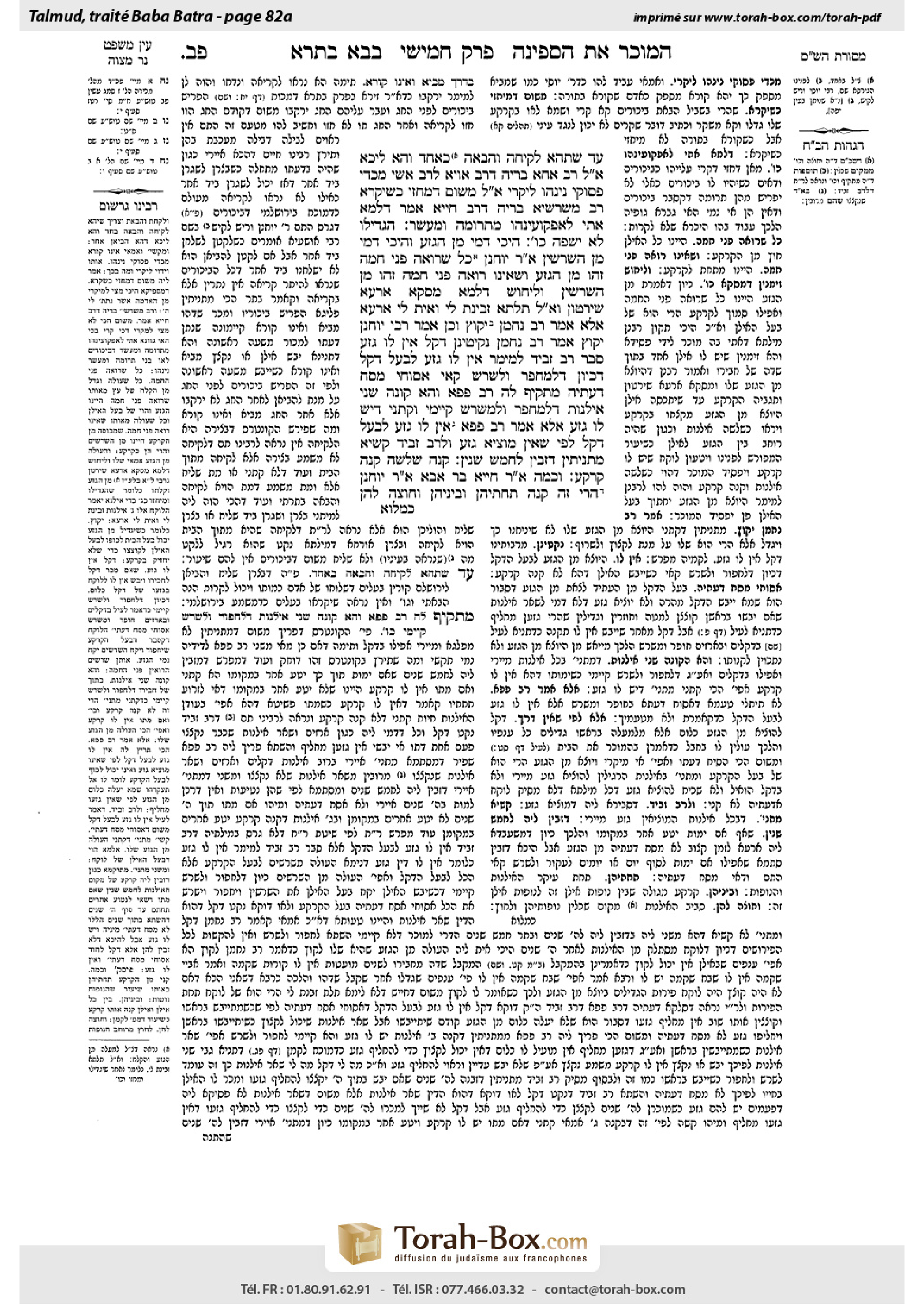
Scan : Torah-Box. Daf Study est un projet indépendant, sans affiliation ni approbation de Torah-Box ou de Sefaria.