Baba Kama 41b en français · בבא קמא מ״א ב
Traduction française du daf 41b du traité Baba Kama (Bava Kamma 41b en anglais), avec le texte araméen, l’anglais de Sefaria et le scan de la page, pour étudier le Daf Yomi.
Ouvrir dans le lecteur interactifLire le daf du jour
Traduction française de Baba Kama 41b
Les traductions françaises de Daf Study sont générées par IA à partir de l’édition anglaise de Sefaria. Elles peuvent contenir des erreurs : vérifie toujours un passage avec le texte source.
uniquement dans le cas où il a examiné un éclat de silex tranchant et, constatant qu’il ne présentait aucun défaut, a égorgé le taureau avec. Dans ce cas, on pourrait dire qu’en l’égorgeant avec une pierre, il a accompli l’équivalent de la lapidation. Il est donc interdit de le consommer. En revanche, s’il l’a égorgé avec un couteau de métal, il n’est pas interdit de le consommer.
Les Sages répondirent : Est-il donc écrit dans la Torah que l’égorgement doit être effectué spécifiquement avec un couteau, ce qui justifierait une distinction entre l’égorgement avec une pierre et celui avec un couteau ? Pourtant, n’avons-nous pas appris dans la Michna (Houllin 15b) : Celui qui égorge avec une faucille à main, un éclat de silex ou un roseau, si ces instruments conviennent à l’égorgement, son égorgement est valide ?
La Guemara demande : Et selon Rabbi Abbahou, maintenant qu’il déduit du verset l’interdiction de consommer et celle de tirer profit, pourquoi faut-il la déclaration : « Le propriétaire du taureau sera quitte » ? La Guemara répond : Cette déclaration vient interdire de tirer profit de sa peau après qu’il a été tué. En effet, on aurait pu penser que seule sa chair est interdite à la consommation, comme le dit le verset : « Sa chair ne sera pas consommée », tandis qu’il serait permis de tirer profit de sa peau. La Torah nous enseigne donc, par ces mots « le propriétaire du taureau sera quitte », qu’il est interdit de tirer profit de toutes les parties du taureau.
La Guemara demande : Et selon ces tannaïm qui interprètent le verset « Le propriétaire du taureau sera quitte » dans un autre sens, comme nous le verrons plus loin, d’où déduisent-ils l’interdiction de tirer profit de la peau du taureau ?
La Guemara répond : Ils la déduisent de la formulation : « Sa chair ne pourra pas être consommée [velo ye’akhel et besaro]. » Le verset aurait pu être formulé ainsi : Velo ye’akhel besaro, ce qui signifie déjà : « Et sa chair ne sera pas consommée. » L’ajout du mot « et » enseigne que l’interdiction s’applique également à ce qui est secondaire à la chair. Et de quoi s’agit-il ? De sa peau.
La Guemara ajoute : Ce tanna, qui déduit cette halakha de la déclaration « Le propriétaire du taureau sera quitte », n’interprète pas le mot « et » comme un moyen de déduire de nouvelles halakhot. Il considère que le mot « et » fait simplement partie de la structure ordinaire de la phrase et ne constitue pas une source d’interprétation exégétique.
Comme il est enseigné dans une baraïta : Shimon HaAmasoni — certains disent qu’il s’agissait de Neḥemya HaAmasoni — interprétait toutes les occurrences du mot « et » dans la Torah, en déduisant des halakhot supplémentaires concernant le sujet considéré. Lorsqu’il arriva au verset « Tu craindras le Seigneur ton Dieu » (Deutéronome 6,13), où figure le mot « et » ajouté, il renonça à cette méthode d’interprétation, car la crainte de qui pourrait s’ajouter à la crainte de Dieu ? Ses élèves lui dirent : « Notre maître, qu’adviendra-t-il de toutes les occurrences du mot “et” que tu as interprétées jusqu’à présent ? » Il leur répondit : « De même que j’ai reçu une récompense pour l’interprétation, j’ai reçu une récompense pour avoir renoncé à cette méthode d’interprétation. »
Le mot « et » dans ce verset ne fut expliqué que lorsque Rabbi Akiva vint et l’interpréta ainsi : « Tu craindras le Seigneur ton Dieu » : le mot « et » inclut les sages de la Torah, c’est-à-dire qu’il est commandé de les craindre comme on craint Dieu. Quoi qu’il en soit, Shimon HaAmasoni ne déduisit plus de halakhot supplémentaires du mot « et ».
§ Les Sages ont enseigné au sujet du verset « Mais le propriétaire du taureau sera quitte » que Rabbi Eliezer dit : Cela signifie qu’il sera quitte du paiement d’une demi-rançon. Bien que le propriétaire d’un taureau inoffensif qui cause un dommage soit tenu de payer la moitié du montant du dommage, si un taureau tue une personne, son propriétaire n’est tenu de verser aucune rançon.
Rabbi Akiva lui dit : Pourquoi le verset doit-il enseigner cela ? L’indemnisation du dommage causé par un taureau inoffensif n’est-elle pas de toute façon payée uniquement sur la valeur de son corps ? Ici aussi, son propriétaire peut dire au demandeur : « Amène-le au tribunal et il te paiera », c’est-à-dire que tu seras payé sur sa valeur. Puisque le taureau est lapidé, il ne reste rien sur quoi le demandeur puisse être payé. Par conséquent, selon ton interprétation, le verset n’enseigne aucune halakha qui ne pourrait être déduite par la logique ; il est donc superflu.
Rabbi Eliezer lui dit : Est-ce ainsi que tu me vois, comme si ma déduction du verset concernait ce cas, celui d’un taureau passible de la peine de mort ? Il va de soi qu’aucun verset ne serait nécessaire pour enseigner cette halakha dans un tel cas. Ma déduction concerne uniquement un cas où l’on présume que le taureau a tué une personne sur la foi du témoignage d’un seul témoin ou de l’aveu du propriétaire. Une telle preuve ne suffit pas pour que le taureau soit condamné à la lapidation, mais on aurait pu penser qu’elle suffit pour obliger son propriétaire à payer une rançon.
La Guemara demande : Si cela repose sur l’aveu du propriétaire, celui-ci ne serait manifestement pas tenu de payer une rançon, puisqu’il avouerait un acte passible d’une amende, et qu’une personne qui avoue un tel acte est dispensée de payer l’amende. Pourquoi le verset aurait-il donc besoin de préciser cette exemption ?
La Guemara répond : Rabbi Eliezer considère que la rançon sert à l’expiation et n’est pas considérée comme une amende. On aurait donc pu supposer que même en l’absence d’un témoignage concluant, le propriétaire doit payer une rançon pour expier le meurtre. Le verset enseigne donc que, dans le cas d’un taureau inoffensif, son propriétaire n’est pas tenu de payer une demi-rançon.
Une autre baraïta enseigne que Rabbi Eliezer lui dit : « Akiva, est-ce ainsi que tu me vois, comme si ma déduction du verset concernait ce cas, celui d’un taureau passible de la peine de mort ? Ma déduction concerne uniquement un cas où le taureau avait l’intention de tuer un animal, mais a tué une personne à la place ; ou bien où il avait l’intention de tuer un non-Juif, mais a tué un Juif ; ou encore où il avait l’intention de tuer un bébé non viable, mais a tué une personne viable. Un taureau n’est pas mis à mort s’il avait l’intention de donner un coup de corne dans des circonstances qui ne le rendraient pas passible de la peine de mort, même s’il a effectivement donné un coup de corne dans ces circonstances. Dans un tel cas, le propriétaire du taureau doit payer une rançon. Le verset enseigne donc que, s’il s’agit d’un taureau inoffensif, son propriétaire est dispensé de payer une demi-rançon. »
Ces deux baraïtot citent des réponses différentes que Rabbi Eliezer a données à Rabbi Akiva. Laquelle de ces explications lui a-t-il donnée en premier ? Rav Kahana dit au nom de Rava : Il lui a d’abord donné l’explication concernant le taureau qui avait l’intention de tuer quelqu’un dans des circonstances où il ne serait pas passible de la peine de mort, puis il lui a donné la seconde explication, concernant le témoignage d’un seul témoin ou l’aveu du propriétaire. Rav Tavyumei dit au nom de Rava : Il lui a d’abord donné l’explication selon laquelle il s’agit d’un cas où l’on présumait que le taureau avait tué sur la foi d’un seul témoin ou de l’aveu de son propriétaire.
La Guemara explique le raisonnement qui sous-tend les deux opinions : Rav Kahana dit au nom de Rava qu’il lui a d’abord donné l’explication concernant l’intention du taureau, car cette opinion est préférable à l’autre, contre laquelle une difficulté avait été soulevée plus haut. Cela ressemble à un pêcheur qui retire des poissons de la mer.
Texte source et traduction anglaise
בבא קמא מ״א ב · texte araméen et hébreu
הֵיכָא דְּבָדַק צוּר וְשָׁחַט בּוֹ – דְּעַבְדֵיהּ כְּעֵין סְקִילָה, אֲבָל הֵיכָא דְּשַׁחְטֵיהּ בְּסַכִּין – לָא!
אָמְרִי: אַטּוּ סַכִּין כְּתִיבָא בְּאוֹרָיְיתָא? וְהָתְנַן: הַשּׁוֹחֵט בְּמַגַּל יָד, בְּצוֹר וּבְקָנֶה – שְׁחִיטָתוֹ כְּשֵׁירָה.
וְהַשְׁתָּא דְּנָפְקָא לֵיהּ אִיסּוּר אֲכִילָה וְאִיסּוּר הֲנָאָה מִ״לֹּא יֵאָכֵל אֶת בְּשָׂרוֹ״, ״בַּעַל הַשּׁוֹר נָקִי״ לְמָה לִי? לַהֲנָאַת עוֹרוֹ. דְּסָלְקָא דַּעְתָּךְ אָמֵינָא: בְּשָׂרוֹ הוּא דְּאָסוּר בַּהֲנָאָה, עוֹרוֹ נִשְׁתְּרֵי בַּהֲנָאָה; קָמַשְׁמַע לַן ״בַּעַל הַשּׁוֹר נָקִי״.
וּלְהָנָךְ תַּנָּאֵי דְּמַפְּקִי לֵיהּ לְהַאי ״בַּעַל הַשּׁוֹר נָקִי״ לִדְרָשָׁה אַחֲרִינָא [כִּדְבָעֵינַן לְמֵימַר קַמַּן], הֲנָאַת עוֹרוֹ מְנָא לְהוּ?
נָפְקָא לְהוּ מֵ״אֶת בְּשָׂרוֹ״ – אֶת הַטָּפֵל לִבְשָׂרוֹ, מַאי נִיהוּ – עוֹרוֹ.
וְהַאי תַּנָּא – ״אֶת״ לָא דָּרֵישׁ.
כִּדְתַנְיָא: שִׁמְעוֹן הָעַמְסוֹנִי, וְאָמְרִי לַהּ נְחֶמְיָה הָעַמְסוֹנִי, הָיָה דּוֹרֵשׁ כׇּל ״אֶתִּין״ שֶׁבַּתּוֹרָה. כֵּיוָן שֶׁהִגִּיעַ לְ״אֶת ה׳ אֱלֹהֶיךָ תִּירָא״, פֵּירַשׁ. אָמְרוּ לוֹ תַּלְמִידָיו: רַבִּי, כׇּל ״אֶתִּין״ שֶׁדָּרַשְׁתָּ – מָה תְּהֵא עֲלֵיהֶן? אָמַר לָהֶם: כְּשֵׁם שֶׁקִּבַּלְתִּי שָׂכָר עַל הַדְּרִישָׁה, כָּךְ קִבַּלְתִּי שָׂכָר עַל הַפְּרִישָׁה.
עַד שֶׁבָּא רַבִּי עֲקִיבָא, וְלִימֵּד: ״אֶת ה׳ אֱלֹהֶיךָ תִּירָא״ – לְרַבּוֹת תַּלְמִידֵי חֲכָמִים.
תָּנוּ רַבָּנַן: ״וּבַעַל הַשּׁוֹר נָקִי״ – רַבִּי אֱלִיעֶזֶר אוֹמֵר: נָקִי מֵחֲצִי כוֹפֶר.
אָמַר לוֹ רַבִּי עֲקִיבָא: וַהֲלֹא הוּא עַצְמוֹ אֵין מִשְׁתַּלֵּם אֶלָּא מִגּוּפוֹ, ״הֲבִיאֵהוּ לְבֵית דִּין, וִישַׁלֶּם לָךְ״!
אָמַר לוֹ רַבִּי אֱלִיעֶזֶר: כָּךְ אֲנִי בְּעֵינֶיךָ, שֶׁדִּינִי בָּזֶה שֶׁחַיָּיב מִיתָה? אֵין דִּינִי אֶלָּא כְּשֶׁהֵמִית אֶת הָאָדָם עַל פִּי עֵד אֶחָד, אוֹ עַל פִּי בְעָלִים.
עַל פִּי בְעָלִים?! מוֹדֶה בִּקְנָס הוּא!
קָסָבַר כּוּפְרָא – כַּפָּרָה.
תַּנְיָא אִידַּךְ, אָמַר לוֹ רַבִּי אֱלִיעֶזֶר: עֲקִיבָא, כָּךְ אֲנִי בְּעֵינֶיךָ, שֶׁדִּינִי בָּזֶה שֶׁחַיָּיב מִיתָה? אֵין דִּינִי אֶלָּא בְּמִתְכַּוֵּון לַהֲרוֹג אֶת הַבְּהֵמָה וְהָרַג אֶת הָאָדָם; לְגוֹי וְהָרַג יִשְׂרָאֵל; לִנְפָלִים וְהָרַג בֶּן קַיָּימָא.
הֵי אֲמַר לֵיהּ בְּרֵישָׁא? רַב כָּהֲנָא מִשְּׁמֵיהּ דְּרָבָא אָמַר: ״מִתְכַּוֵּון״ אֲמַר לֵיהּ בְּרֵישָׁא. רַב טָבְיוֹמֵי מִשְּׁמֵיהּ דְּרָבָא אָמַר: ״הֵמִית״ אֲמַר לֵיהּ בְּרֵישָׁא.
רַב כָּהֲנָא מִשְּׁמֵיהּ דְּרָבָא אָמַר ״מִתְכַּוֵּון״ אֲמַר לֵיהּ בְּרֵישָׁא – מָשָׁל לְצַיָּד שֶׁשּׁוֹלֶה דָּגִים מִן הַיָּם,
Bava Kamma 41b · traduction anglaise de Sefaria
only in a case where he checked a sharp piece of flint, and, seeing that it did not have any defects, slaughtered the ox with it. In that case, one could say that by slaughtering it with a stone, he performed the equivalent to stoning. Therefore, it is prohibited to eat it. But in a case where he slaughtered it with a knife made of metal, one is not prohibited from eating it.
The Sages said in response: Is that to say that it is written in the Torah that slaughter must performed specifically with a knife, which would justify a distinction between slaughtering with a stone and a knife? But didn’t we learn in the mishna (Ḥullin 15b): With regard to one who slaughters with a hand-sickle, with a piece of flint, or with a reed, if these implements were suitable to be used for slaughter, his slaughter is valid?
The Gemara asks: And according to Rabbi Abbahu, now that he derives the prohibition of eating and the prohibition of deriving benefit from the verse “Its flesh shall not be eaten,” why do I require the statement: “The owner of the ox shall be clear”? The Gemara answers: This is stated to prohibit deriving benefit from its hide after it has been killed; as it could enter your mind to say that it is specifically its flesh from which it is prohibited to derive benefit, as the verse states: “Its flesh shall not be eaten,” but deriving benefit from its hide will be permitted. Therefore, the Torah teaches us that the owner of the ox shall be clear, to indicate it is prohibited to derive benefit from any part of the ox.
The Gemara asks: And according to those tanna’im who expound this verse: “The owner of the ox shall be clear,” for another interpretation, as we wish to state below, from where do they derive this prohibition against deriving benefit from the ox’s hide?
The Gemara answers: They derive it from the wording: “Its flesh may not be eaten [velo ye’akhel et besaro].” The verse could have been formulated: Velo ye’akhel besaro, which already means: And its flesh shall not be eaten. The addition of the word “et” teaches that the prohibition applies also to that which is secondary to the flesh. And what is that? That is its hide.
The Gemara adds: And this tanna, who derives it from the statement: “The owner of the ox shall be clear,” does not interpret the word “et” as a means to derive new halakhot. He considers the word “et” to be an ordinary part of the sentence structure and not a source for exegetical exposition.
As it is taught in a baraita: Shimon HaAmasoni, and some say that it was Neḥemya HaAmasoni, would interpret all occurrences of the word “et” in the Torah, deriving additional halakhot with regard to the particular subject matter. Once he reached the verse: “You shall fear the Lord your God” (Deuteronomy 6:13), which is written with the added word “et,” he withdrew from this method of exposition, as whose fear could be an extension of the fear of God? His students said to him: Our teacher, what will be with all the occurrences of the word “et” that you interpreted until now? He said to them: Just as I received reward for the exposition, so I received reward for my withdrawal from using this method of exposition.
The word “et” in this verse was not explained until Rabbi Akiva came and expounded: “You shall fear the Lord your God”: The word “et” serves to include Torah scholars, i.e., that one is commanded to fear them just as one fears God. In any event, Shimon HaAmasoni no longer derived additional halakhot from the word et.
§ The Sages taught with regard to the verse: “But the owner of the ox shall be clear,” that Rabbi Eliezer says: It means that he shall be clear from paying half a ransom. Although the owner of an innocuous ox that causes damage is liable to pay half the cost of the damage, if an ox kills a person its owner is not liable to pay any ransom.
Rabbi Akiva said to him: Why is it necessary for the verse to teach this? But isn’t compensation for damage caused by an innocuous ox itself anyway paid only from the value of its body? Here too, its owner can say to the claimant: Bring it to court and it will pay you, i.e., you will be paid from its value. Since the ox is stoned, there is nothing from which he can receive payment. Therefore, according to your interpretation, the verse does not introduce any halakha that could not have been inferred by logic, and is therefore superfluous.
Rabbi Eliezer said to him: Is this how I appear in your eyes, that my derivation from the verse is in reference to this case, that of an ox that is liable to be put to death? Obviously no verse would be required to teach this halakha in such a case. My derivation is only with regard to a case where the assumption that the ox killed a person is based on the testimony of one witness, or is based on the admission of the owner. Such proof is not sufficient for the ox to be put to death by stoning, but one might have thought that it is sufficient to require its owner to pay ransom.
The Gemara asks: If it is based on the admission of the owner, he clearly would not be liable to pay ransom, since he would be admitting to an act that results in a fine, in which case a person is exempt from paying the fine; so why would it be necessary for the verse to state this exemption?
The Gemara answers: Rabbi Eliezer holds that ransom is for the purpose of atonement, and is not considered a fine. Accordingly, one might have assumed that even in a case where there is not conclusive testimony, the owner must pay ransom to atone for the killing. Therefore, the verse states that in the case of an innocuous ox, the owner is not liable to pay half a ransom.
It is taught in another baraita that Rabbi Eliezer said to him: Akiva, is this how I appear in your eyes, that my derivation from the verse is in reference to this case, that of an ox that is liable to be put to death? My derivation is only with regard to a case where the ox intended to kill an animal but killed a person instead; or where it intended to kill a gentile but killed a Jew; or where it intended to kill a non-viable baby but killed a viable person. An ox is not put to death if it intended to gore in a manner which would not render it liable to be put to death, even if it did gore in such a manner. In such a case, the owner of the ox must pay ransom. Therefore, the verse states that if it is an innocuous ox, the owner is exempt from paying half a ransom.
These two baraitot cite different responses that Rabbi Eliezer gave Rabbi Akiva. Which one of these explanations did he say to him first? Rav Kahana said in the name of Rava: He first said to him the explanation referring to the ox’s intention to kill someone for which it would not be liable to be put to death, and subsequently gave him the second explanation with regard to the testimony of a single witness, or the owner’s admission. Rav Tavyumei said in the name of Rava: He first said to him the explanation that it is a case where the assumption that the ox killed was based on one witness or its owner’s admission.
The Gemara explains the reasoning behind the two opinions: Rav Kahana said in the name of Rava that first he said to him the explanation involving the ox’s intention, since this opinion is preferable to the other one, against which a difficulty was raised earlier. This is analogous to a fisherman pulling fish from the sea.
Texte de Sefaria : William Davidson Edition - Vocalized Aramaic (CC BY NC) ; William Davidson Edition - English (CC BY NC).
Scan de Baba Kama 41b
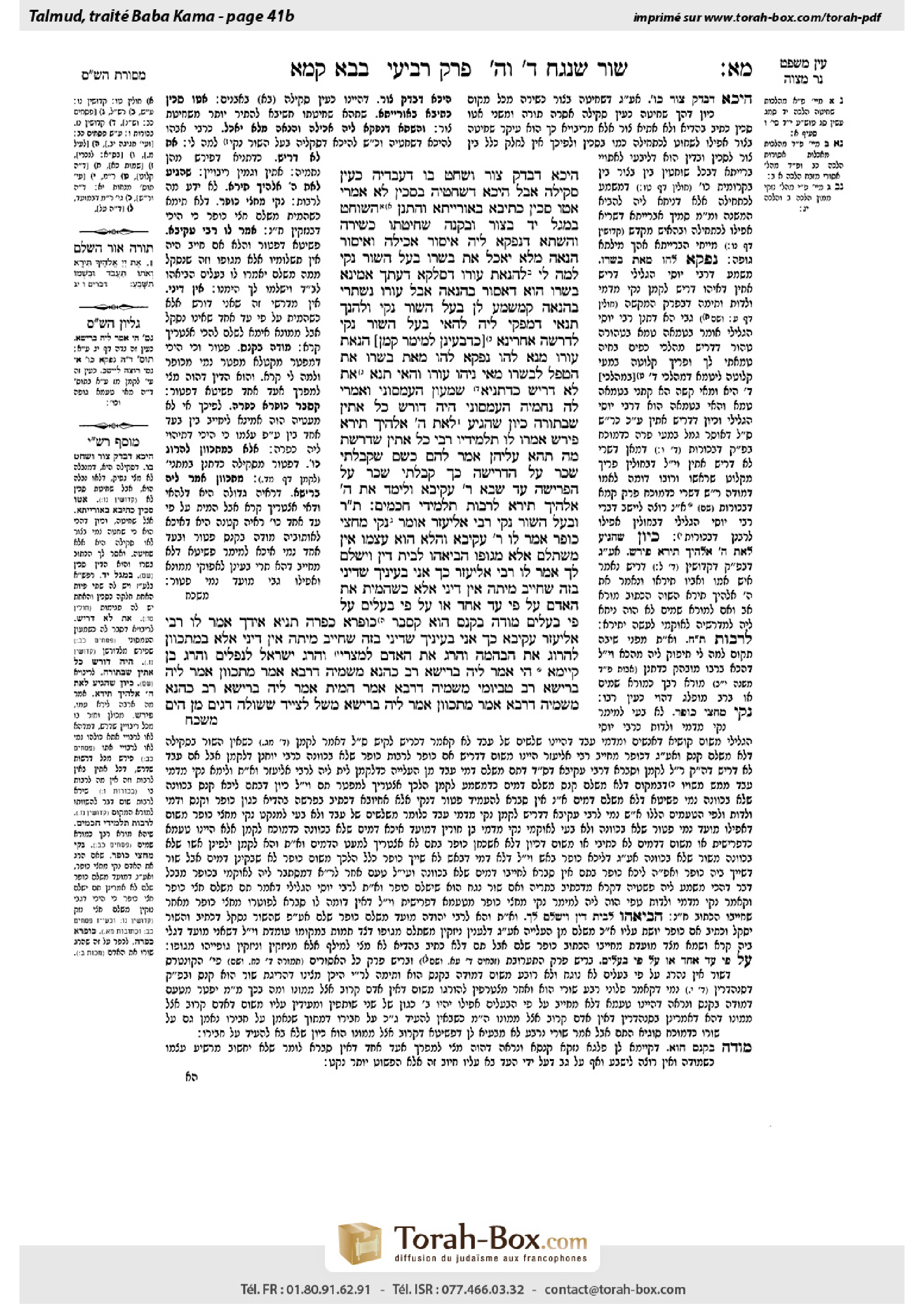
Scan : Torah-Box. Daf Study est un projet indépendant, sans affiliation ni approbation de Torah-Box ou de Sefaria.