Baba Metsia 4b en français · בבא מציעא ד׳ ב
Traduction française du daf 4b du traité Baba Metsia (Bava Metzia 4b en anglais), avec le texte araméen, l’anglais de Sefaria et le scan de la page, pour étudier le Daf Yomi.
Ouvrir dans le lecteur interactifLire le daf du jour
Traduction française de Baba Metsia 4b
Les traductions françaises de Daf Study sont générées par IA à partir de l’édition anglaise de Sefaria. Elles peuvent contenir des erreurs : vérifie toujours un passage avec le texte source.
Si un acte de prêt indique qu’une personne a emprunté un nombre indéterminé de selaïm ou de dinars, et que le créancier dit : « Je t’ai prêté cinq sela », tandis que le débiteur dit : « Tu ne m’en as prêté que trois », Rabbi Shimon ben Elazar dit : Puisque le débiteur a reconnu une partie de la créance, il doit prêter serment. Rabbi Akiva dit : Puisque la formulation de l’acte indique seulement qu’il doit deux dinars, le minimum que désigne le pluriel, en reconnaissant en devoir trois, il équivaut simplement à celui qui restitue un objet perdu et est dispensé de prêter serment.
En tout état de cause, la baraïta enseigne que Rabbi Shimon ben Elazar dit : Puisque le débiteur a reconnu une partie de la créance, il doit prêter serment. Cela indique que la raison pour laquelle il est tenu de prêter serment tient précisément au fait qu’il a dit devoir trois dinars ; mais s’il avait reconnu n’en devoir que deux, il aurait été dispensé de prêter serment. Quant à l’obligation minimale inscrite dans cet acte de prêt, qu’il reconnaît, à savoir deux dinars, c’est comme s’il avait dit : « Les voici. » Une obligation inscrite dans un acte de prêt équivaut à une obligation au sujet de laquelle le défendeur dit : « Les voici. » Il faut donc en conclure que celui qui dit : « Les voici » est dispensé de prêter serment au sujet de la partie de la créance qu’il nie.
La Guemara rejette cette déduction : Non, en réalité, je te dirai que même s’il a reconnu devoir deux dinars, il est tenu de prêter serment ; si la baraïta enseigne le désaccord précisément dans le cas de trois dinars, ce n’est pas pour exclure le cas où il reconnaît n’en devoir que deux, mais pour exclure l’opinion de Rabbi Akiva, qui dit qu’il équivaut à celui qui restitue un objet perdu et est donc dispensé de prêter serment. Rabbi Shimon ben Elazar nous enseigne ainsi qu’il est considéré comme ayant reconnu une partie de la créance et qu’il doit prêter serment.
La Guemara demande : Si tel est le cas, la baraïta aurait dû être formulée autrement. Si le défendeur est tenu de prêter serment même lorsqu’il reconnaît devoir deux dinars, au lieu d’indiquer que Rabbi Shimon ben Elazar dit : « Puisque le débiteur a reconnu une partie de la créance, il doit prêter serment », la baraïta aurait dû dire : « Celui-ci aussi, qui reconnaît devoir trois dinars, doit prêter serment », en plus de celui qui reconnaît devoir deux dinars.
Il faut plutôt rejeter cette explication. En réalité, s’il reconnaît devoir deux dinars, il est dispensé de prêter serment ; néanmoins, celui qui dit : « Les voici » est tenu de prêter serment. Cette distinction s’explique par le fait qu’ici, l’acte de prêt appuie sa position, c’est-à-dire qu’il indique qu’il doit deux dinars. Il est donc dispensé de prêter serment au sujet du reste.
Autre explication : s’il reconnaît devoir deux dinars, il est dispensé pour une autre raison : un acte de prêt grève les terres du débiteur d’un droit de gage, et le principe est qu’on ne fait pas prêter serment au sujet de la négation, par un débiteur, d’une dette garantie par un droit de gage sur des terres. On ne fait prêter serment que lorsqu’une personne nie devoir de l’argent ou des biens mobiliers.
Certains soulèvent une objection à l’opinion de Rav Sheshet à partir de la dernière partie de cette baraïta, qui enseigne que Rabbi Akiva dit : « Il équivaut simplement à celui qui restitue un objet perdu et est dispensé de prêter serment. » La Guemara déduit que la raison de cette dispense est qu’il a dit devoir trois dinars. Mais s’il avait reconnu devoir seulement deux dinars, il aurait été tenu de prêter serment. Quant à l’obligation minimale inscrite dans cet acte de prêt, qu’il reconnaît, à savoir deux dinars, c’est comme s’il avait dit : « Les voici. » Il faut en conclure que celui qui dit : « Les voici » est tenu de prêter serment.
La Guemara rejette cette déduction : Non, en réalité, je te dirai que s’il reconnaît devoir deux dinars, il est lui aussi dispensé de prêter serment ; si la baraïta enseigne le désaccord précisément dans le cas de trois dinars, c’est pour exclure l’opinion de Rabbi Shimon ben Elazar, qui dit qu’il est considéré comme ayant reconnu une partie de la créance et doit prêter serment. Rabbi Akiva nous enseigne donc que, selon lui, le défendeur équivaut à celui qui restitue un objet perdu et est dispensé de prêter serment.
La Guemara fait remarquer : Il est également raisonnable d’expliquer la baraïta comme on vient de le faire. En effet, si tu envisages qu’une personne qui reconnaît devoir deux dinars est tenue de prêter serment, comment Rabbi Akiva pourrait-il la dispenser de prêter serment lorsqu’elle reconnaît devoir trois dinars ? Peut-être ce débiteur use-t-il d’un stratagème, en se disant : « Si je dis que j’en dois deux, je serai tenu de prêter serment. Je vais donc dire que j’en dois trois, afin d’être considéré comme celui qui restitue un objet perdu et d’être dispensé de prêter serment. » Il faut plutôt en conclure que même s’il reconnaît ne devoir que deux dinars, il est également dispensé de prêter serment.
La Guemara demande : Mais cette explication pose une difficulté à l’opinion de Rabbi Ḥiyya, selon laquelle un défendeur est tenu de prêter serment lorsqu’il dit : « Les voici. » Autrement dit, le cas de celui qui reconnaît ne devoir que deux dinars, où il est dispensé de prêter serment, réfute l’opinion de Rabbi Ḥiyya. La Guemara répond : Le cas présent est différent, car l’acte de prêt appuie sa position. Il n’est donc pas tenu de prêter serment. Autre réponse : il est dispensé parce qu’un acte de prêt grève les terres du débiteur d’un droit de gage, et que le principe est qu’on ne fait pas prêter serment au sujet de la négation, par un débiteur, d’une dette garantie par un droit de gage sur des terres.
Mar Zutra, fils de Rav Naḥman, soulève une objection à l’opinion de Rav Sheshet à partir d’une Michna (Shevouot 38b) : Si quelqu’un prétend qu’un autre lui doit des ustensiles et des terres, et que le défendeur reconnaît lui devoir les ustensiles mais nie lui devoir les terres, ou, inversement, reconnaît lui devoir les terres mais nie lui devoir les ustensiles, il est dispensé de prêter serment au sujet de ce qu’il nie. S’il reconnaît lui devoir une partie des terres, il est dispensé. S’il reconnaît lui devoir une partie des ustensiles, il doit prêter serment au sujet du reste.
La Guemara déduit : La raison pour laquelle il est dispensé dans les premiers cas est que la créance porte sur des ustensiles et des terres, car une créance portant sur des terres n’est pas soumise au serment. Mais si la créance porte sur des ustensiles et des ustensiles, c’est-à-dire deux ensembles d’ustensiles, comme dans le cas d’une créance portant sur des ustensiles et des terres, il est tenu de prêter serment. Dans quelles circonstances cela peut-il se produire ? N’est-ce pas le cas où il lui a dit : « Les voici » ? Il faut donc apprendre de la Michna que celui qui dit : « Les voici » est tenu de prêter serment.
La Guemara répond : Non, en réalité, je te dirai que si la créance porte sur des ustensiles et des ustensiles, il est également dispensé. Si la Michna enseigne le cas des ustensiles et des terres, c’est pour nous apprendre cette autre halakha : s’il a reconnu devoir une partie des ustensiles et qu’il est donc tenu de prêter serment, il est également tenu de prêter serment au sujet des terres dont il nie devoir quelque chose à son créancier, bien qu’en elles-mêmes, les terres ne soient pas soumises au serment.
La Guemara demande : Que nous enseigne-t-on ici ? La halakha du rattachement, selon laquelle celui qui est tenu de prêter serment en réponse à une réclamation peut être obligé de prêter serment au sujet d’une réclamation supplémentaire portant sur des terres ? Cela ne peut pas être, car nous avons déjà appris cette halakha dans une Michna du traité Kiddouchin (26a) : lorsqu’une personne fait l’objet d’une réclamation portant sur des biens mobiliers et des terres, et qu’elle est tenue de prêter serment au sujet des biens qui ne servent pas de garantie, c’est-à-dire les biens mobiliers, cette obligation s’étend aux biens qui servent de garantie, c’est-à-dire les terres, de sorte qu’elle est également contrainte de prêter serment à leur sujet. Pourquoi cette halakha est-elle répétée dans le traité Shevouot ?
La Guemara répond : La Michna présentée ici, dans Shevouot, est la référence principale pour cette halakha, car elle traite des lois relatives aux serments, tandis que la Michna de là-bas, dans le traité Kiddouchin, la mentionne de manière incidente, dans le cadre d’un aperçu plus général des différences entre ces deux types de biens.
Texte source et traduction anglaise
בבא מציעא ד׳ ב · texte araméen et hébreu
סְלָעִים, דִּינָרִין. מַלְוֶה אוֹמֵר חָמֵשׁ, וְלֹוֶה אוֹמֵר שָׁלֹשׁ. רַבִּי שִׁמְעוֹן בֶּן אֶלְעָזָר אוֹמֵר: הוֹאִיל וְהוֹדָה מִקְצָת הַטְּעָנָה – יִשָּׁבַע. רַבִּי עֲקִיבָא אוֹמֵר: אֵינוֹ אֶלָּא כְּמֵשִׁיב אֲבֵידָה, וּפָטוּר.
קָתָנֵי מִיהַת: רַבִּי שִׁמְעוֹן בֶּן אֶלְעָזָר אוֹמֵר, הוֹאִיל וְהוֹדָה מִקְצָת הַטְּעָנָה – יִשָּׁבַע. טַעְמָא דְּאָמַר שָׁלֹשׁ, הָא שְׁתַּיִם פָּטוּר, וְהַאי שְׁטָר דְּקָמוֹדֵי בֵּיהּ הֵילָךְ הוּא, וּשְׁמַע מִינַּהּ הֵילָךְ פָּטוּר!
לָא, לְעוֹלָם אֵימָא לָךְ שְׁתַּיִם חַיָּיב, וְהַאי דְּקָתָנֵי שָׁלֹשׁ, לְאַפּוֹקֵי מִדְּרַבִּי עֲקִיבָא, דְּאָמַר: מֵשִׁיב אֲבֵידָה הָוֵי וּפָטוּר, קָא מַשְׁמַע לַן דְּמוֹדֶה מִקְצָת הַטְּעָנָה הָוֵי, וְחַיָּיב.
אִי הָכִי: רַבִּי שִׁמְעוֹן בֶּן אֶלְעָזָר אוֹמֵר: הוֹאִיל וְהוֹדָה מִקְצָת הַטְּעָנָה יִשָּׁבַע, ״אַף זֶה יִשָּׁבַע״ מִבְּעֵי לֵיהּ!
אֶלָּא: לְעוֹלָם שְׁתַּיִם פָּטוּר, וְהֵילָךְ חַיָּיב. וְשָׁאנֵי הָכָא, דְּקָא מְסַיַּיע לֵיהּ שְׁטָרָא.
אִי נָמֵי: מִשּׁוּם דְּהָוֵה לֵיהּ שְׁטָר שִׁעְבּוּד קַרְקָעוֹת, וְאֵין נִשְׁבָּעִין עַל כְּפִירַת שִׁעְבּוּד קַרְקָעוֹת.
אִיכָּא דְּמוֹתֵיב מִסֵּיפָא, רַבִּי עֲקִיבָא אוֹמֵר: אֵינוֹ אֶלָּא כְּמֵשִׁיב אֲבֵידָה וּפָטוּר. טַעְמָא דְּאָמַר שָׁלֹשׁ, הָא שְׁתַּיִם חַיָּיב. וְהָא שְׁטָר, כֵּיוָן דְּקָא מוֹדֵי בֵּיהּ כְּ״הֵילָךְ״ דָּמֵי, שְׁמַע מִינַּהּ ״הֵילָךְ״ חַיָּיב!
לָא, לְעוֹלָם אֵימָא לָךְ שְׁתַּיִם נָמֵי פָּטוּר, וְהַאי דְּקָתָנֵי שָׁלֹשׁ, לְאַפּוֹקֵי מִדְּרַבִּי שִׁמְעוֹן בֶּן אֶלְעָזָר, דְּאָמַר מוֹדֶה מִקְצָת הַטַּעֲנָה הָוֵי – וְחַיָּיב, קָא מַשְׁמַע לַן דְּמֵשִׁיב אֲבֵידָה הָוֵי – וּפָטוּר.
הָכִי נָמֵי מִסְתַּבְּרָא. דְּאִי סָלְקָא דַעְתָּךְ: שְׁתַּיִם חַיָּיב, בְּשָׁלֹשׁ הֵיכִי פָּטַר לֵיהּ רַבִּי עֲקִיבָא, הַאי אִעָרוֹמֵי קָא מַעֲרִים! סָבַר: אִי אָמֵינָא שְׁתַּיִם בָּעֵינָא אִשְׁתְּבוֹעֵי, אֵימָא שָׁלֹשׁ דְּאֶהְוֵי כְּמֵשִׁיב אֲבֵידָה, וְאִיפָּטֵר. אֶלָּא שְׁמַע מִינַּהּ: שְׁתַּיִם נָמֵי פָּטוּר.
אֶלָּא קַשְׁיָא לְרַבִּי חִיָּיא! שָׁאנֵי הָתָם דְּקָא מְסַיַּיע לֵיהּ שְׁטָרָא. אִי נָמֵי מִשּׁוּם דְּהָוֵה לֵיהּ שְׁטָר שִׁעְבּוּד קַרְקָעוֹת, וְאֵין נִשְׁבָּעִין עַל כְּפִירַת שִׁעְבּוּד קַרְקָעוֹת.
מֵתִיב מַר זוּטְרָא בְּרֵיהּ דְּרַב נַחְמָן: טְעָנוֹ כֵּלִים וְקַרְקָעוֹת, הוֹדָה בַּכֵּלִים וְכָפַר בַּקַּרְקָעוֹת, הוֹדָה בַּקַּרְקָעוֹת וְכָפַר בַּכֵּלִים – פָּטוּר. הוֹדָה מִקְצָת קַרְקָעוֹת – פָּטוּר, מִקְצָת כֵּלִים – חַיָּיב.
טַעְמָא דְּכֵלִים וְקַרְקָעוֹת, דְּקַרְקַע לָאו בַּת שְׁבוּעָה הִיא, הָא כֵּלִים וְכֵלִים דּוּמְיָא דְּכֵלִים וְקַרְקָעוֹת חַיָּיב. הֵיכִי דָּמֵי? לָאו דְּאָמַר לֵיהּ הֵילָךְ, וּשְׁמַע מִינַּהּ הֵילָךְ חַיָּיב!
לָא, לְעוֹלָם אֵימָא לָךְ כֵּלִים וְכֵלִים נָמֵי פָּטוּר, וְהָא דְּקָתָנֵי כֵּלִים וְקַרְקָעוֹת, הָא קָא מַשְׁמַע לַן: הוֹדָה בְּמִקְצָת כֵּלִים – חַיָּיב אַף עַל הַקַּרְקָעוֹת.
מַאי קָא מַשְׁמַע לַן – זוֹקְקִין? תְּנֵינָא: זוֹקְקִין הַנְּכָסִים שֶׁאֵין לָהֶן אַחְרָיוּת אֶת הַנְּכָסִים שֶׁיֵּשׁ לָהֶן אַחְרָיוּת לִישָּׁבַע עֲלֵיהֶם.
הָכָא עִיקָּר, הָתָם אַגַּב גְּרָרָא נַסְבַהּ.
Bava Metzia 4b · traduction anglaise de Sefaria
If it is written in a promissory note that one borrowed an unspecified amount of sela’im, or that one borrowed an unspecified amount of dinars, and the creditor says: I lent you five sela, and the debtor says: You lent me only three, in this case Rabbi Shimon ben Elazar says: Since the debtor admitted to part of the claim, he takes an oath. Rabbi Akiva says: Since the wording of the note indicates only that he owes two dinars, the minimum plural amount, by admitting that he owes three he is merely the equivalent of one returning a lost item, and he is exempt from taking an oath.
In any event, the baraita teaches that Rabbi Shimon ben Elazar says: Since the debtor admitted to part of the claim, he takes an oath. This indicates that the reason that he is obligated to take an oath is specifically because he said that he owes three dinars, but had he admitted to owing only two, he would have been exempt from taking an oath. And concerning the minimal obligation recorded in this promissory note, to which he admits, which is two dinars, it is as though he said: Here you are. An obligation recorded in a promissory note is tantamount to an obligation concerning which the defendant says: Here you are. And therefore, conclude from it that one who says: Here you are, is exempt from taking an oath with regard to the part of the claim he denies.
The Gemara rejects this: No, actually I will say to you that even if he admitted that he owes two dinars he is obligated to take an oath, and the reason that the baraita teaches the dispute specifically with regard to the case of three dinars is not to exclude a case where he admits that he owes only two, but rather it is to exclude the opinion of Rabbi Akiva, who says that he is the equivalent of one returning a lost item, and he is therefore exempt. Therefore, Rabbi Shimon ben Elazar teaches us that he is considered like one who admits to part of the claim, and he is obligated to take an oath.
The Gemara asks: If so, the baraita should have been phrased differently. If the defendant is obligated to take an oath even in a case where he admits that he owes two dinars, rather than stating that Rabbi Shimon ben Elazar says: Since the debtor admitted to part of the claim, he takes an oath, the baraita should have stated: Even this one, who admits to owing three dinars, takes an oath, in addition to one who admits to owing two dinars.
Rather, that explanation should be rejected. Actually, if he admits that he owes two dinars, he is exempt from taking an oath, but nevertheless, one who says: Here you are, is obligated to take an oath. And the reason for this distinction is that here, the case is different, as the note supports him, i.e., it indicates that he owes two dinars. Therefore, he is exempt from taking an oath with regard to the rest.
Alternatively, if he admits to owing two dinars he is exempt for a different reason: Because a promissory note creates a lien on the debtor’s land, and there is a principle that one does not take an oath with regard to a debtor’s denial of a debt that is secured with a lien on land. Oaths are administered only when one denies owing money or movable property.
There are those who raise an objection to Rav Sheshet’s opinion from the latter clause of this baraita, which teaches that Rabbi Akiva says: He is merely the equivalent of one returning a lost item and is exempt from taking an oath. The Gemara infers: The reason he is exempt is that he said that he owes three dinars. But had he admitted to owing only two, he would have been obligated to take an oath. And concerning the minimal obligation recorded in this promissory note, to which he admits, which is two dinars, it is as though he said: Here you are. Learn from it that one who says: Here you are, is obligated to take an oath.
The Gemara rejects this: No, actually I will say to you that if he admits that he owes two dinars he is also exempt from taking an oath, and the reason that the baraita teaches the dispute specifically with regard to the case of three dinars is to exclude the opinion of Rabbi Shimon ben Elazar, who says that he is considered one who admits to part of the claim and he is obligated to take an oath. Rabbi Akiva, therefore, teaches us that in his opinion, the defendant is the equivalent of one returning a lost item, and he is exempt from taking an oath.
The Gemara comments: So too, it is reasonable to explain the baraita as just explained, as, if it enters your mind that one who admits that he owes two dinars is obligated to take an oath, how does Rabbi Akiva deem him exempt in a case where he admits that he owes three dinars? Perhaps this debtor is employing artifice, thinking: If I say that I owe two, I will be required to take an oath. Therefore, I will say that I owe three so that I will be considered equivalent to one returning a lost item and will be exempt from taking an oath. Rather, learn from it that even if he admits that he owes only two dinars, he is also exempt from taking an oath.
The Gemara asks: But this explanation poses a difficulty to the opinion of Rabbi Ḥiyya, that a defendant is obligated to take an oath in a case where he says: Here you are. In other words, Rabbi Ḥiyya’s opinion is negated by the case of one who admits that he owes only two dinars, where he is exempt from taking an oath. The Gemara answers: The case there is different, as the note supports him. Therefore, he is not required to take an oath. Alternatively, he is exempt because a promissory note creates a lien on the debtor’s land, and there is a principle that one does not take an oath with regard to a debtor’s denial of a debt that is secured with a lien on land.
Mar Zutra, son of Rav Naḥman, raises an objection to the opinion of Rav Sheshet from a mishna (Shevuot 38b): If one claimed that another owed him vessels and land, and the defendant admitted to owing him vessels but denied that he owes him land, or conversely, if he admitted to owing him land but denied that he owes him vessels, he is exempt from taking an oath with regard to what he denies. If he admitted that he owes him part of the land, he is exempt. If he admitted to owing some of the vessels, he is obligated to take an oath with regard to the remainder.
The Gemara infers: The reason he is exempt in the first cases is because the claim is for vessels and land, as a claim with regard to land is not subject to an oath. But if the claim is for vessels and vessels, i.e., two sets of vessels, in a manner similar to the case of a claim for vessels and land, he is obligated to take an oath. What are the circumstances of such a case? Is it not a case where he said to him: Here you are? And learn from the mishna that one who says: Here you are, is obligated to take an oath.
The Gemara answers: No, actually I will say to you that if the claim is for vessels and vessels he is also exempt. And the fact that the mishna teaches the case of vessels and land teaches us this different halakha: If he admitted that he owes some of the vessels, and is therefore obligated to take an oath, he is also obligated to take an oath with regard to the land that he denied owing his creditor, although in and of itself one does not take an oath with regard to land.
The Gemara asks: What is this teaching us? Is this teaching the halakha of binding? According to this halakha, one who is obligated to take an oath in response to a claim can be required to take an oath with regard to an additional claim of land. This cannot be, as we already learned this halakha in a mishna in tractate Kiddushin (26a): When there is a claim brought against a person for movable property and land, and he is obligated to take an oath with regard to the property that does not serve as a guarantee, i.e., the movable property, it binds the property that serves as a guarantee, i.e., the land, so that he is forced to take an oath with regard to it too. Why is this halakha repeated in tractate Shevuot?
The Gemara answers: The mishna here, in Shevuot, is the main reference to this halakha, as it discusses the halakhot of oaths, whereas the mishna there, in tractate Kiddushin, cites it incidentally, in the context of a broader survey of the difference between these two types of property.
Texte de Sefaria : William Davidson Edition - Vocalized Aramaic (CC BY NC) ; William Davidson Edition - English (CC BY NC).
Scan de Baba Metsia 4b
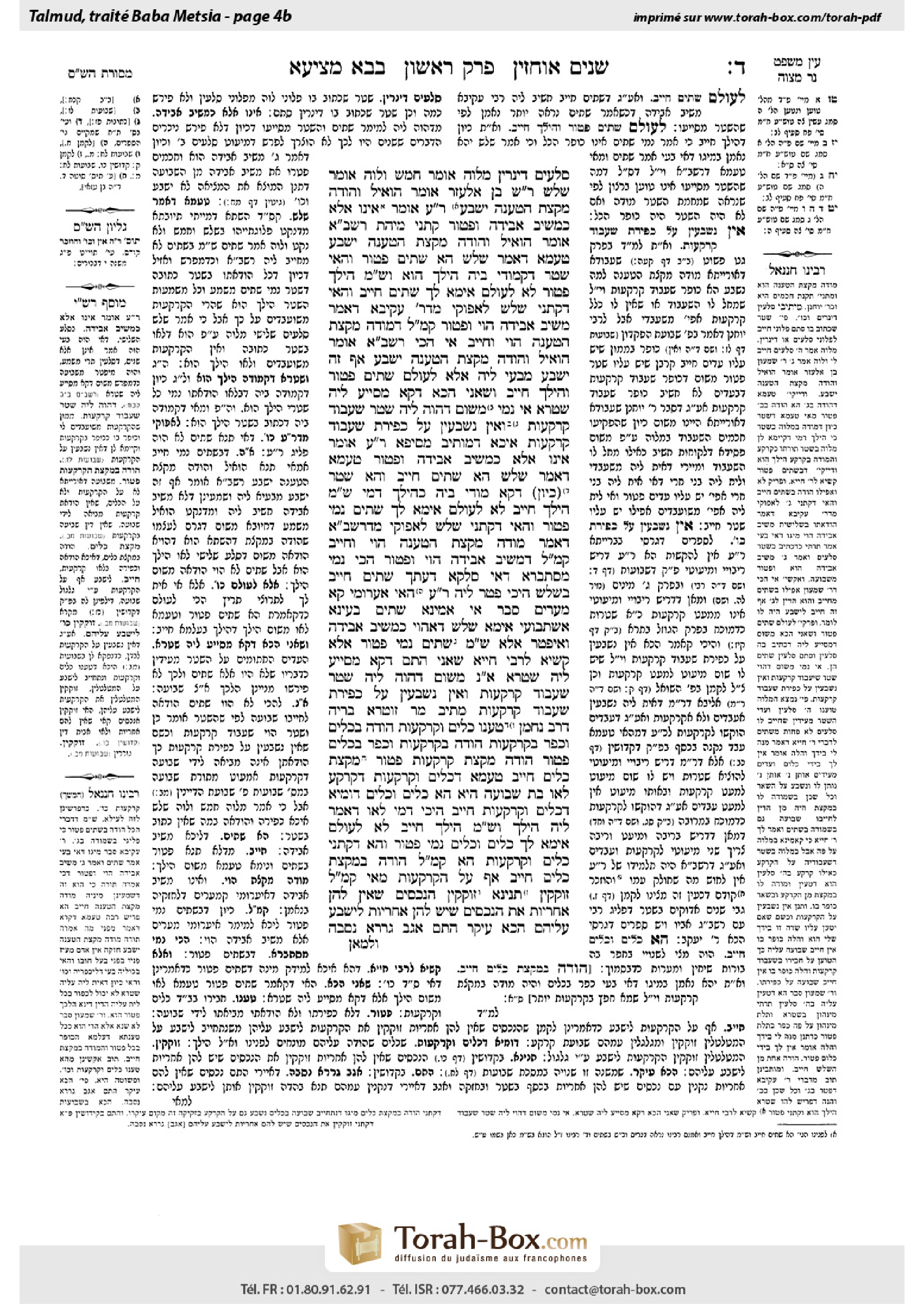
Scan : Torah-Box. Daf Study est un projet indépendant, sans affiliation ni approbation de Torah-Box ou de Sefaria.