Beitsa 39a en français · ביצה ל״ט א
Traduction française du daf 39a du traité Beitsa (Beitzah 39a en anglais), avec le texte araméen, l’anglais de Sefaria et le scan de la page, pour étudier le Daf Yomi.
Ouvrir dans le lecteur interactifLire le daf du jour
Traduction française de Beitsa 39a
Les traductions françaises de Daf Study sont générées par IA à partir de l’édition anglaise de Sefaria. Elles peuvent contenir des erreurs : vérifie toujours un passage avec le texte source.
Et Rav Ashi donna une autre explication à la raison pour laquelle les épices, l’eau et le sel ne sont pas annulés : chacun de ces ingrédients est un élément dont l’interdiction est temporaire, car l’interdiction de les faire sortir des limites du Chabbat cesse une fois la fête passée. Or, le principe général veut que tout élément dont l’interdiction est temporaire ne puisse être annulé, même dans une proportion d’une part pour mille.
§ Il est enseigné dans une Michna que Rabbi Yehouda exempte l’eau des limites de déplacement. La Guemara demande : Faut-il en déduire que Rabbi Yehouda exempte l’eau, mais pas le sel ? Pourtant, n’est-il pas enseigné dans une baraïta que Rabbi Yehouda dit : « L’eau et le sel sont tous deux annulés, que ce soit dans une pâte ou dans une marmite contenant un plat cuit » ? La Guemara répond : Il n’y a pas de contradiction. Dans le cas de la Michna, il s’agit du sel de Sodome, qui est assez grossier et ne se mélange pas facilement à la pâte ; comme il reste reconnaissable dans le produit final, il n’est pas annulé. Dans le cas de la baraïta, il s’agit d’un type de sel fin appelé sel isterokanit. Par conséquent, il n’est pas reconnaissable dans le produit final et peut être annulé.
La Michna indique que, selon Rabbi Yehouda, l’eau mélangée à la pâte — et, vraisemblablement, à un plat cuit également — est considérée comme annulée. La Guemara objecte : Pourtant, n’est-il pas enseigné dans une baraïta que Rabbi Yehouda dit : « L’eau et le sel sont annulés dans la pâte, mais pas dans une marmite, à cause de sa sauce » ? Contrairement au pain, la marmite contient finalement du liquide ; l’eau empruntée y reste donc reconnaissable. La Guemara répond : Il n’y a pas de contradiction. Dans le cas de la Michna, où Rabbi Yehouda dit que l’eau est annulée dans le plat cuit, il s’agit d’un plat épais, sans sauce liquide. Dans le cas de la baraïta, où Rabbi Yehouda dit que l’eau n’est pas annulée, il s’agit d’un plat liquide avec une sauce.
MICHNA : Un charbon emprunté à quelqu’un pendant la fête est soumis aux limites de déplacement de son propriétaire ; on peut donc le transporter pendant la fête jusqu’en tout lieu où son propriétaire est autorisé à se rendre. Comme il a une substance, il est rattaché à son propriétaire. Mais une flamme allumée à partir de celle d’autrui peut être emportée partout, car elle n’a pas de substance. Cette différence fondamentale entre un charbon et une flamme a d’autres conséquences halakhiques : celui qui utilise un charbon appartenant au Temple à des fins profanes est passible d’un délit d’usage illicite d’un bien consacré, car le charbon a une substance. Mais celui qui utilise une flamme consacrée n’est pas passible d’un délit d’usage illicite s’il en a tiré profit, bien que, selon le droit rabbinique, il soit interdit d’en tirer profit a priori, car la flamme n’a pas de substance. De même, celui qui transporte un charbon d’un domaine privé vers le domaine public pendant Chabbat est passible de la transgression de transporter, tandis que celui qui transporte une flamme en est exempt.
GUEMARA : Les Sages ont enseigné dans une Tosefta (Beitza 4:7) : Cinq différences pratiques halakhiques ont été énoncées entre un charbon et une flamme : (1) Quant au lieu où ils peuvent se trouver pendant la fête, le charbon est soumis aux limites de déplacement de son propriétaire, tandis qu’une flamme peut être emportée partout. (2) Celui qui utilise un charbon consacré au Temple est passible d’un délit d’usage illicite d’un bien consacré ; quant à une flamme consacrée, le droit rabbinique interdit d’en tirer profit, mais on n’est pas passible d’un tel délit. (3) Il est interdit de tirer profit d’un charbon utilisé pour l’idolâtrie, tandis qu’il est permis de tirer profit d’une flamme de ce type. (4) Celui qui transporte un charbon vers le domaine public est passible, tandis que celui qui y transporte une flamme est exempt. (5) Celui qui, par un vœu, s’interdit de tirer profit d’autrui ne peut pas utiliser son charbon, mais peut tirer profit de sa flamme.
À propos des halakhot citées dans la baraïta ci-dessus, la Guemara demande : Quelle différence y a-t-il entre une flamme liée à l’idolâtrie, dont l’usage est permis même a priori, puisque la baraïta emploie à son sujet le terme « permis », et une flamme consacrée, dont l’usage est interdit a priori, comme l’indique la baraïta : « On ne peut pas en tirer profit, mais on n’est pas passible d’un délit d’usage illicite » ? La Guemara explique : Dans le cas de l’idolâtrie, qui inspire le dégoût aux Juifs et dont ils se tiennent spontanément à l’écart, les Sages n’ont pas décrété de restrictions supplémentaires. En revanche, s’agissant des biens consacrés, qui n’inspirent pas le dégoût et dont les gens ne se tiennent pas spontanément à l’écart, les Sages ont décrété qu’il était interdit d’utiliser la flamme afin d’empêcher tout usage illicite.
§ La baraïta enseigne que celui qui transporte un charbon vers le domaine public est passible, tandis que celui qui y transporte une flamme est exempt. La Guemara demande : Pourtant, n’est-il pas enseigné dans une autre baraïta que celui qui transporte une flamme, quelle que soit sa taille, pendant Chabbat est passible ? Rav Sheshet dit : La seconde baraïta parle d’un cas où l’on a transporté la flamme avec une brindille de bois. Puisque la flamme est attachée à un objet matériel, elle est considérée comme ayant de l’importance.
La Guemara soulève une objection : Dans ce cas, qu’on en déduise que l’on est passible d’avoir transporté la brindille, et que la présence de la flamme est sans importance. La Guemara répond : Cette baraïta parle d’une brindille qui n’atteint pas la mesure minimale requise pour être passible d’avoir transporté, comme nous l’avons appris dans une Michna (Chabbat 89b) : pour le bois, la mesure déterminant la responsabilité est une quantité suffisante pour cuire un œuf de l’espèce la plus facile à cuire, à savoir un œuf de poule. Comme la brindille est trop petite pour cuire un œuf, on n’est pas passible de l’avoir transportée, mais on est passible d’avoir transporté la flamme qui y est attachée.
Abayé propose une autre situation : la Michna parle d’un cas où l’on a enduit un récipient d’huile, allumé un feu dessus, puis transporté cette flamme. La Guemara demande : Dans ce cas, qu’on en déduise que l’on est passible d’avoir transporté le récipient lui-même, et que la flamme est sans importance. La Guemara répond : La Michna parle d’un feu allumé sur un tesson de terre cuite, et non dans un récipient intact.
La Guemara objecte : Malgré cela, qu’on en déduise que l’on est passible d’avoir transporté le tesson de terre cuite lui-même. La Guemara répond : Il s’agit d’un tesson qui n’atteint pas la mesure minimale requise pour être passible d’avoir transporté, comme nous l’avons appris dans une Michna (Chabbat 82a) : pour la terre cuite, la mesure déterminant la responsabilité est une quantité suffisante pour être placée entre deux encadrements de fenêtre, car de petits tessons de terre cuite étaient parfois placés entre les encadrements des fenêtres lors de la construction. Telle est la déclaration de Rabbi Yehouda.
La Guemara demande : Mais dans ce cas, si l’on est passible d’avoir transporté une flamme dès lors qu’elle est attachée à un objet ayant une substance, dans quelles circonstances peut se présenter le cas enseigné ici dans la Michna : celui qui transporte une flamme est exempt ? La Guemara répond : La Michna parle d’un cas où l’on a attisé le feu de la main, de sorte qu’il s’est propagé dans le domaine public sans être attaché à aucun récipient.
MICHNA : L’eau puisée dans la citerne d’un particulier est soumise aux limites de déplacement de ce particulier, propriétaire de la citerne ; cette eau ne peut être transportée que vers les lieux où son propriétaire est autorisé à se rendre. L’eau puisée dans une citerne appartenant conjointement à tous les habitants d’une ville est soumise aux limites de déplacement des habitants de cette ville. Quant à l’eau puisée dans la citerne de ceux qui montent de Babylonie vers la Terre d’Israël, c’est-à-dire une citerne publique, elle est soumise aux limites de déplacement de celui qui remplit son récipient avec cette eau ; l’eau n’a pas de limites propres définies, puisqu’elle est mise à la disposition de tous.
GUEMARA : Rava souleva une contradiction devant Rav Naḥman : Nous avons appris dans la Michna que l’eau d’une citerne appartenant à un particulier est soumise aux limites de déplacement de ce particulier ; or, Rava souleva une contradiction à partir de la Tosefta (Beitza 4:8) : l’eau puisée dans les rivières et les sources qui coulent est soumise aux limites de déplacement de tous. Rava dit : De quoi parle-t-on ici dans la Michna ? De citernes contenant de l’eau recueillie, et non d’eau courante. Il fut également dit que Rabbi Ḥiyya bar Avin a dit au nom de Shmuel : La Michna s’applique uniquement à de l’eau recueillie.
§ La Michna enseigne : L’eau puisée dans la citerne de ceux qui montent de Babylonie vers la Terre d’Israël, c’est-à-dire une citerne publique, est soumise aux limites de déplacement de celui qui remplit son récipient avec cette eau. Les amoraïm ont divergé sur cette question : lorsqu’une personne remplit un récipient avec de l’eau d’une citerne publique pour le compte d’une autre personne et lui remet l’eau, Rav Naḥman dit : l’eau est soumise aux limites de déplacement de la personne pour laquelle elle a été puisée ; Rav Sheshet dit : elle est soumise aux limites de déplacement de celui qui l’a puisée.
La Guemara demande : Sur quel principe porte leur désaccord ? La Guemara explique : L’un des Sages, Rav Sheshet, considère qu’une citerne publique est sans propriétaire, et la halakha veut qu’on ne puisse pas acquérir un bien sans propriétaire pour le compte de quelqu’un d’autre. L’eau appartient donc à celui qui l’a puisée ; elle est soumise à ses limites de déplacement, et ce statut ne change pas même s’il la remet ensuite à quelqu’un d’autre. L’autre Sage, Rav Naḥman, considère qu’une citerne publique est réputée appartenir conjointement à tous ses associés, c’est-à-dire à tout le peuple juif. Il est donc possible qu’un associé puise de l’eau pour le compte d’un autre associé, et l’eau puisée appartient immédiatement à la personne pour laquelle elle a été puisée.
Rava souleva une objection contre Rav Naḥman à partir d’une Michna (Nedarim 47b) : celui qui dit à autrui : « Je te suis désormais interdit par la force du ḥerem », une sorte de vœu d’interdiction — les objets déclarés ḥerem étant généralement consacrés au Temple — interdit à la personne visée par le vœu, c’est-à-dire son destinataire, de tirer profit de celui qui a prononcé le vœu ou de ses biens, car le but du vœu était d’interdire au destinataire de tirer le moindre profit de celui qui l’a prononcé.
Texte source et traduction anglaise
ביצה ל״ט א · texte araméen et hébreu
וְרַב אָשֵׁי אָמַר: מִשּׁוּם דְּהָוֵי לֵיהּ דָּבָר שֶׁיֵּשׁ לוֹ מַתִּירִין, וְכׇל דָּבָר שֶׁיֵּשׁ לוֹ מַתִּירִין — אֲפִילּוּ בְּאֶלֶף לֹא בָּטֵיל.
רַבִּי יְהוּדָה פּוֹטֵר בַּמַּיִם. מַיִם אִין, מֶלַח לָא? וְהָא תַּנְיָא, רַבִּי יְהוּדָה אוֹמֵר: מַיִם וָמֶלַח בְּטֵלִין בֵּין בָּעִיסָּה בֵּין בַּקְּדֵרָה! לָא קַשְׁיָא: הָא — בְּמֶלַח סְדוֹמִית, הָא — בְּמֶלַח אִסְתְּרוֹקָנִית.
וְהָתַנְיָא, רַבִּי יְהוּדָה אוֹמֵר: מַיִם וָמֶלַח בְּטֵלִין בָּעִיסָּה, וְאֵין בְּטֵלִין בַּקְּדֵרָה מִפְּנֵי רוֹטְבָּהּ! לָא קַשְׁיָא: הָא — בְּעָבָה, הָא — בְּרַכָּה.
מַתְנִי׳ הַגַּחֶלֶת כְּרַגְלֵי הַבְּעָלִים, וְשַׁלְהֶבֶת בְּכׇל מָקוֹם. גַּחֶלֶת שֶׁל הֶקְדֵּשׁ — מוֹעֲלִין בָּהּ, וְשַׁלְהֶבֶת — לֹא נֶהֱנִין, וְלֹא מוֹעֲלִין. הַמּוֹצִיא גַּחֶלֶת לִרְשׁוּת הָרַבִּים — חַיָּיב, וְשַׁלְהֶבֶת — פָּטוּר.
גְּמָ׳ תָּנוּ רַבָּנַן: חֲמִשָּׁה דְּבָרִים נֶאֶמְרוּ בַּגַּחֶלֶת: הַגַּחֶלֶת כְּרַגְלֵי הַבְּעָלִים, וְשַׁלְהֶבֶת בְּכׇל מָקוֹם. גַּחֶלֶת שֶׁל הֶקְדֵּשׁ — מוֹעֲלִין בָּהּ, וְשַׁלְהֶבֶת — לֹא נֶהֱנִין וְלֹא מוֹעֲלִין. גַּחֶלֶת שֶׁל עֲבוֹדָה זָרָה — אֲסוּרָה, וְשַׁלְהֶבֶת — מוּתֶּרֶת. הַמּוֹצִיא גַּחֶלֶת לִרְשׁוּת הָרַבִּים — חַיָּיב, וְשַׁלְהֶבֶת — פָּטוּר. הַמּוּדָּר הֲנָאָה מֵחֲבֵירוֹ — אָסוּר בְּגַחַלְתּוֹ, וּמוּתָּר בְּשַׁלְהַבְתּוֹ.
מַאי שְׁנָא שַׁלְהֶבֶת עֲבוֹדָה זָרָה דְּשַׁרְיָא, וּמַאי שְׁנָא דְּהֶקְדֵּשׁ דַּאֲסִירָא? עֲבוֹדָה זָרָה, דִּמְאִיסָה וּבְדִילִי אִינָשֵׁי מִינַּהּ — לָא גְּזַרוּ בַּהּ רַבָּנַן. הֶקְדֵּשׁ, דְּלָא מְאִיס וְלָא בְּדִילִי אִינָשֵׁי מִינֵּיהּ — גְּזַרוּ בֵּיהּ רַבָּנַן.
הַמּוֹצִיא גַּחֶלֶת לִרְשׁוּת הָרַבִּים — חַיָּיב, וְשַׁלְהֶבֶת — פָּטוּר. וְהָא תַּנְיָא: הַמּוֹצִיא שַׁלְהֶבֶת כׇּל שֶׁהוּא — חַיָּיב! אָמַר רַב שֵׁשֶׁת: כְּגוֹן שֶׁהוֹצִיאוֹ בְּקֵיסָם.
וְתִיפּוֹק לֵיהּ מִשּׁוּם קֵיסָם! בִּדְלֵית לֵיהּ שִׁעוּרָא. דִּתְנַן: הַמּוֹצִיא עֵצִים — כְּדֵי לְבַשֵּׁל בֵּיצָה קַלָּה.
אַבָּיֵי אָמַר: כְּגוֹן דְּשַׁיְיפֵיהּ [לְ]מָנָא מִשְׁחָא וְאַתְלִי בֵּיהּ נוּרָא. וְתִיפּוֹק לֵיהּ מִשּׁוּם מָנָא? בְּחַסְפָּא.
וְתִיפּוֹק לֵיהּ מִשּׁוּם חַסְפָּא! בִּדְלֵית לֵיהּ שִׁעוּרָא. דִּתְנַן: חֶרֶס — כְּדֵי לִיתֵּן בֵּין פַּצִּים לַחֲבֵירוֹ, דִּבְרֵי רַבִּי יְהוּדָה.
אֶלָּא הָא דִּתְנַן: הַמּוֹצִיא שַׁלְהֶבֶת פָּטוּר, הֵיכִי מַשְׁכַּחַתְּ לַהּ? כְּגוֹן דְּאַדְּיֵיהּ אַדּוֹיֵי לִרְשׁוּת הָרַבִּים.
מַתְנִי׳ בּוֹר שֶׁל יָחִיד — כְּרַגְלֵי הַיָּחִיד, וְשֶׁל אַנְשֵׁי אוֹתָהּ הָעִיר — כְּרַגְלֵי אַנְשֵׁי אוֹתָהּ הָעִיר, וְשֶׁל עוֹלֵי בָבֶל — כְּרַגְלֵי הַמְמַלֵּא.
גְּמָ׳ רָמֵי לֵיהּ רָבָא לְרַב נַחְמָן, תְּנַן: בּוֹר שֶׁל יָחִיד — כְּרַגְלֵי הַיָּחִיד, וּרְמִינְהוּ: נְהָרוֹת הַמּוֹשְׁכִין וּמַעֲיָנוֹת הַנּוֹבְעִין — הֲרֵי הֵן כְּרַגְלֵי כׇּל אָדָם! אָמַר (רָבָא): הָכָא בְּמַאי עָסְקִינַן — בִּמְכוּנָּסִין. וְאִתְּמַר נָמֵי, אָמַר רַבִּי חִיָּיא בַּר אָבִין אָמַר שְׁמוּאֵל: בִּמְכוּנָּסִין.
וְשֶׁל עוֹלֵי בָבֶל — כְּרַגְלֵי הַמְמַלֵּא. אִתְּמַר: מִילֵּא וְנָתַן לַחֲבֵירוֹ, רַב נַחְמָן אָמַר: כְּרַגְלֵי מִי שֶׁנִּתְמַלְּאוּ לוֹ, רַב שֵׁשֶׁת אָמַר: כְּרַגְלֵי הַמְמַלֵּא.
בְּמַאי קָא מִיפַּלְגִי? מָר סָבַר: בֵּירָא דְהֶפְקֵרָא הוּא, וּמָר סָבַר: בֵּירָא דְשׁוּתָּפֵי הוּא.
אֵיתִיבֵיהּ רָבָא לְרַב נַחְמָן: הֲרֵינִי עָלֶיךָ חֵרֶם — הַמּוּדָּר אָסוּר.
Beitzah 39a · traduction anglaise de Sefaria
And Rav Ashi said a different explanation as to why the spices, water, and salt are not subject to nullification: It is because any one of these ingredients is an object whose prohibition is temporary, as the prohibition against their being taken out of the Shabbat limits lapses once the Festival has passed, and the general principle is that anything whose prohibition is temporary cannot become nullified, even by one part in one thousand.
§ It is taught in a mishna: Rabbi Yehuda exempts one from travel limitations in the case of water. The Gemara asks: Does this mean to imply that water, yes, it is exempted by Rabbi Yehuda, but salt, no, it is not? But isn’t it taught in a baraita: Rabbi Yehuda says: Water and salt are both nullified, whether in a dough or in a pot of cooked food. The Gemara answers: This is not difficult. In this case of the mishna, the reference is to salt of Sodom, which is quite coarse and does not blend in easily with the dough, and, being noticeable in the final product, is not nullified. In that case of the baraita, the reference is to a type of fine salt known as isterokanit salt. Consequently, it is not noticeable in the final product and can be nullified.
The mishna states that according to Rabbi Yehuda water mixed into dough, and presumably into a cooked dish as well, is considered nullified. The Gemara challenges this: But isn’t it taught in a baraita that Rabbi Yehuda says: Water and salt are nullified in dough but not in a pot, due to its sauce. The pot, unlike bread, ends up with liquid in it, so the borrowed water is still recognizable. The Gemara replies: This is not difficult. This case of the mishna, where Rabbi Yehuda says that the water is nullified in the cooked food, is referring to a thick dish that has no liquid sauce. That case of the baraita, in which Rabbi Yehuda said the water is not nullified, is referring to a thin dish with liquid sauce.
MISHNA: A coal that one borrowed from another on the Festival is as the feet of the owner, and it may be carried on the Festival to any place where its owner may walk. Since it has substance, it is associated with its owner. But a flame that one lit from another’s flame may be taken anywhere, as it has no substance. This essential difference between a coal and a flame has additional halakhic ramifications: If one uses a coal of consecrated property for a non-consecrated purpose, he is liable for misuse of consecrated property, since it has substance. But if one uses a consecrated flame, although according to rabbinic law one may not derive benefit from it ab initio, if one did benefit from it, he is not liable for misuse, since it does not have substance. Similarly, one who takes out a coal from a private domain to the public domain on Shabbat is liable for the prohibited labor of carrying, but one who takes out a flame is exempt.
GEMARA: The Sages taught in a Tosefta (Beitza 4:7): Five things were stated with regard to a coal, in relation to the practical halakhic differences between a coal and a flame: (1) Coal is as the feet of the owner with regard to its Festival resting place, whereas a flame may be carried anywhere. (2) One is liable for misusing property consecrated to the Temple with a consecrated coal, whereas with regard to a flame, according to rabbinic law one may not benefit from it, but he is not liable for misusing property consecrated to the Temple. (3) Coal used for idol worship is prohibited for one to benefit from it, whereas from a flame of this sort it is permitted to benefit. (4) One who carries out a coal to the public domain is liable, whereas one who carries out a flame is exempt. (5) One who is prohibited by a vow from deriving benefit from another is prohibited from using his coal, but he is permitted to derive benefit from his flame.
With regard to the halakhot cited in the baraita above, the Gemara asks: What is different in the case of a flame of idol worship, that one is permitted to use it even ab initio, as the baraita uses the term permitted in that case; and what is different in the case of a consecrated flame, in that it is prohibited to be used ab initio, as the baraita states: One may not benefit from it, but he is not liable for misuse? The Gemara explains: In the case of idol worship, which is repulsive to Jews and from which Jewish people inherently maintain separation, the Sages did not decree additional restrictions with regard to it. However, concerning consecrated property, which is not repulsive and from which people do not inherently maintain separation, in order to prevent its misuse, the Sages did decree with regard to it that it is prohibited to use the flame.
§ It is taught in the baraita that one who carries out a coal to the public domain is liable, whereas one who carries out a flame is exempt. The Gemara asks: But isn’t it taught in another baraita: One who carries out a flame of any size on Shabbat is liable? Rav Sheshet said: The second baraita is referring to a case where one carried out the flame along with a wooden chip. Since the flame is attached to a physical object, it is considered significant.
The Gemara raises an objection: But if so, let it derive that one is liable for carrying out in this case due to the wooden chip, and the presence of the flame is irrelevant. The Gemara responds: That baraita speaks of a chip that does not have the minimum measure that determines liability for carrying out, as we learned in a mishna (Shabbat 89b): In the case of one who carries out wood on Shabbat, the measure that determines liability is enough wood to cook an egg of the kind that is the easiest to cook, which is the egg of a chicken. Because the chip is too small to cook an egg, one is not liable for carrying it out, but one is liable for carrying out the flame attached to it.
Abaye said a different scenario: The mishna is referring to a case where one smeared a vessel with oil, and lit a fire on it, and carried out that flame. The Gemara asks: If so, let it derive that one is liable for carrying out in this case due to the vessel itself, and the flame is irrelevant. The Gemara replies: The mishna is referring to a fire lit in an earthenware shard, not in a whole vessel.
The Gemara challenges: And nevertheless, let it derive that one is liable for carrying due to the earthenware shard itself. The Gemara answers: It deals with a shard that is not of the minimum measure that determines liability for carrying out, as we learned in a mishna (Shabbat 82a): The measure that determines liability for carrying out earthenware is enough to place between one window frame and another, as small shards of earthenware were sometimes placed between window frames during construction. This is the statement of Rabbi Yehuda.
The Gemara asks: But if so, if one is liable for carrying it out whenever the flame is attached to an object of substance, that which we learned in the mishna here: One who carries out a flame is exempt, under what circumstances can this case be found? The Gemara answers: The mishna is speaking of a case where one fanned the fire with his hand so that it spread into the public domain without its being attached to any vessel.
MISHNA: With regard to a cistern of an individual, water drawn from it is as the feet of the individual who owns the cistern, and the water may be carried only to those places where its owner is permitted to walk. And water drawn from a cistern belonging jointly to all the people dwelling in a particular town is as the feet of the people of that town. And water drawn from a cistern of those who come up to Eretz Yisrael from Babylonia, i.e., a public cistern, is as the feet of whoever fills his vessel with its water; the water has no defined boundary of its own since it is made available to all.
GEMARA: Rava raised a contradiction to Rav Naḥman: We learned in the mishna that the water of a cistern of an individual is as the feet of the individual; and Rava raised a contradiction from the Tosefta (Beitza 4:8): Water drawn from flowing rivers and flowing springs are as the feet of all people. Rava said: With what are we dealing here in the mishna? With cisterns that contain collected water, not flowing water. And it was also said that Rabbi Ḥiyya bar Avin said that Shmuel said: The mishna applies only to collected water.
§ The mishna states: And water drawn from a cistern of those who come up to Eretz Yisrael from Babylonia, i.e., a public cistern, is as the feet of whoever fills his vessel with its water. It was stated that amora’im disagreed with regard to this issue: In the case of one who filled a vessel with water from a public cistern on behalf of another and gave the water to him, Rav Naḥman said: The water is as the feet of the one for whom they were filled; Rav Sheshet said: It is as the feet of the one who filled it.
The Gemara asks: With regard to what principle do they disagree? The Gemara explains: One Sage, Rav Sheshet, holds that a public cistern is ownerless, and the halakha is that one cannot take possession of ownerless property on behalf of someone else. Therefore, the water belongs to the one who drew it; it is as his feet, and this status does not change even if he subsequently gave it to anyone else. And one Sage, Rav Naḥman, holds that a public cistern is considered jointly owned by all its partners, namely, all of the Jewish people. Therefore, it is possible for one partner to draw water on behalf of another partner, and the drawn water immediately belongs to the person for whom it was drawn.
Rava raised a challenge to Rav Naḥman from a mishna (Nedarim 47b): One who says to another: I am hereby prohibited to you by force of ḥerem, a kind of vow of prohibition, as objects declared as ḥerem are generally consecrated to the Temple, the one prohibited by the vow, the addressee, is prohibited to derive benefit from the person who made the vow or from his property, as the point of the vow was to prohibit the addressee from deriving any benefit from the one who made the vow.
Texte de Sefaria : William Davidson Edition - Vocalized Aramaic (CC BY NC) ; William Davidson Edition - English (CC BY NC).
Scan de Beitsa 39a
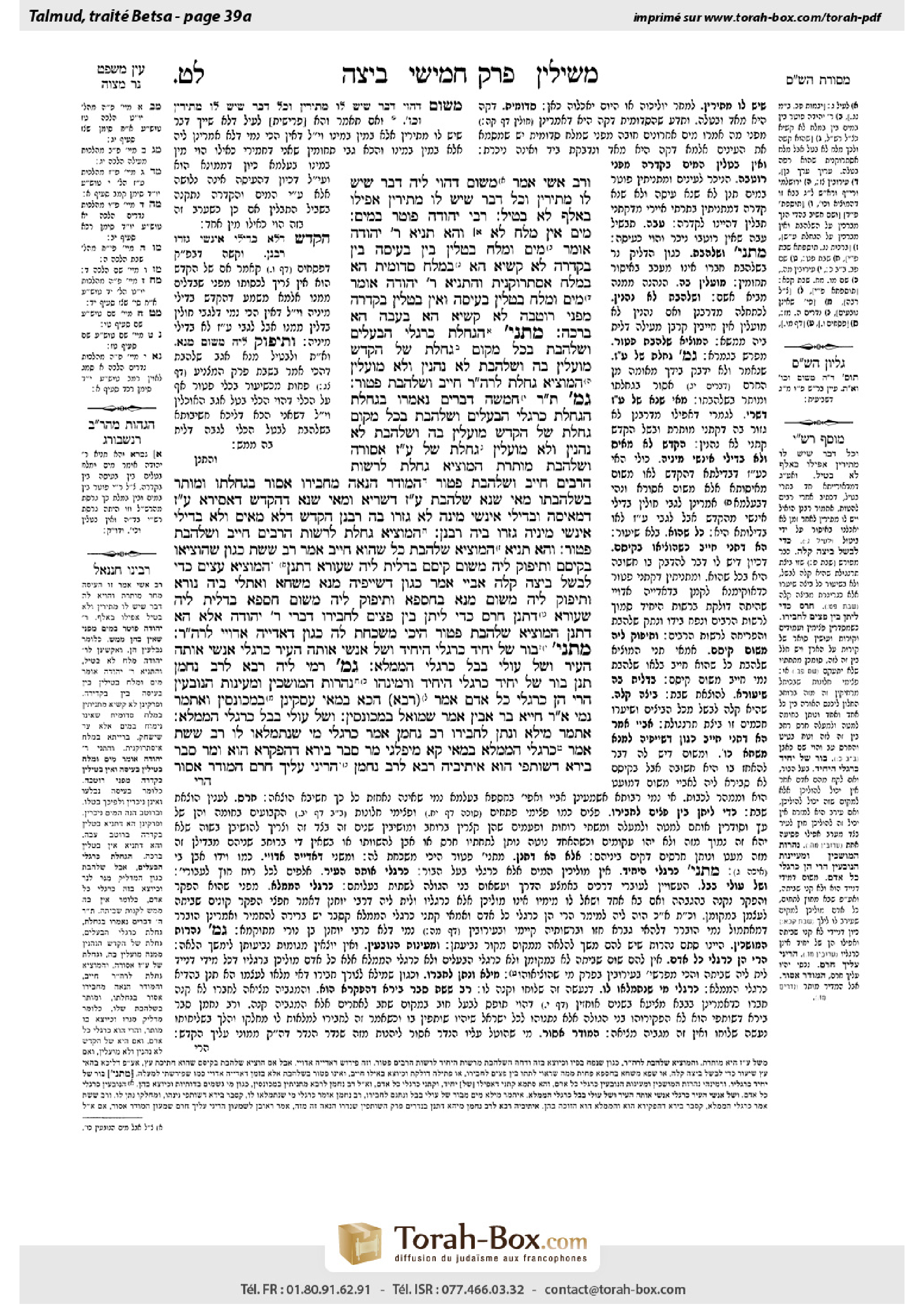
Scan : Torah-Box. Daf Study est un projet indépendant, sans affiliation ni approbation de Torah-Box ou de Sefaria.