Beitsa 3b en français · ביצה ג׳ ב
Traduction française du daf 3b du traité Beitsa (Beitzah 3b en anglais), avec le texte araméen, l’anglais de Sefaria et le scan de la page, pour étudier le Daf Yomi.
Ouvrir dans le lecteur interactifLire le daf du jour
Traduction française de Beitsa 3b
Les traductions françaises de Daf Study sont générées par IA à partir de l’édition anglaise de Sefaria. Elles peuvent contenir des erreurs : vérifie toujours un passage avec le texte source.
À propos de la contradiction soulevée par Rabbi Yoḥanan, qui l’avait conduit à proposer d’inverser les opinions, Ravina dit qu’il existe une autre façon de la résoudre : en réalité, n’inversons pas les opinions. Dans le cas des deux jours de fête, on peut plutôt dire que Rabbi Yehuda s’est exprimé en accord avec l’opinion des Rabbins, et non qu’il présentait sa propre opinion.
Il faut donc comprendre ainsi la déclaration de Rabbi Yehuda : « À mon avis, l’œuf est également permis même le premier jour de fête, puisqu’il s’agit d’un aliment qui a été détaché. Mais, selon votre opinion, qui consiste à interdire le liquide provenant d’un aliment, concédez-moi au moins qu’il est permis le deuxième jour, car il s’agit de deux saintetés. Les premier et deuxième jours de Roch Hachana ne forment pas une seule unité, mais deux entités distinctes. Il est donc possible que le premier jour soit saint, tandis que le second soit un jour ordinaire. Par conséquent, un élément interdit le premier jour peut être permis le second. » Les Rabbins lui répondirent : « Non, les deux jours relèvent d’une seule sainteté, c’est-à-dire qu’ils sont considérés comme une seule unité continue. L’incertitude s’applique également aux deux jours. »
Ravina, fils de Rav Ulla, dit : il existe une autre façon de résoudre la contradiction soulevée par Rabbi Yoḥanan. Ici, dans le cas de l’œuf pondu pendant une fête, Rabbi Yehuda interdit de manger l’œuf parce qu’il ne provient pas d’une poule destinée à l’alimentation, dont le statut juridique est celui d’un aliment. Il s’agit plutôt d’une poule destinée à pondre des œufs, et Rabbi Yehuda suit son raisonnement habituel, puisqu’il considère qu’il existe une interdiction de mouktse. Comme l’œuf est produit par un élément mouktse, il est lui-même certainement mouktse ; la halakha relative à un aliment qui a été détaché ne s’applique donc pas à ce cas.
§ La Guemara soulève une objection à partir d’une baraïta, qui présente une autre explication : un œuf pondu pendant Chabbat et un œuf pondu pendant une fête sont tous deux considérés comme mouktse. Dans les deux cas, il est donc interdit de déplacer l’œuf, que ce soit pour s’en servir comme aliment ou à toute autre fin : ni pour couvrir un récipient, ni pour soutenir les pieds d’un lit.
Toutefois, si l’on souhaite éviter que l’œuf ne se brise si quelqu’un marche dessus par inadvertance, on peut le couvrir avec un récipient sans toucher à l’œuf lui-même. Bien qu’il soit interdit de déplacer l’œuf, il est néanmoins permis de déplacer un récipient pour le protéger. Même si l’on ne sait pas si cet œuf a été pondu pendant une fête, il est interdit de le déplacer. En outre, s’il s’est mélangé à mille œufs permis, ils sont tous interdits.
La Guemara fait remarquer : certes, selon l’opinion de Rabba, qui dit qu’un œuf est interdit faute de préparation, il s’agit ici d’une incertitude concernant le statut juridique d’un élément interdit par la Torah. Or, en cas d’incertitude sur le statut juridique d’un élément interdit par la Torah, la décision est rigoureuse. L’œuf est donc interdit même si l’on ne sait pas s’il a été pondu pendant une fête.
Cependant, selon Rav Yosef et Rabbi Yitzḥak, qui disent qu’un œuf est interdit en vertu d’un décret, il s’agit ici d’une incertitude concernant le statut juridique d’un élément interdit par décret rabbinique. Or, en cas d’incertitude sur le statut juridique d’un élément interdit par décret rabbinique, la décision est indulgente.
La Guemara répond : dans la dernière partie de la baraïta, il s’agit d’un autre cas. Il n’est pas question de l’interdiction d’un œuf pondu pendant une fête, mais d’un œuf pondu par une poule dont on ne sait pas si elle est atteinte d’une lésion qui entraînera sa mort dans les douze mois [tereifa], ce qui est interdit par la Torah. L’incertitude concernant le statut de la poule a une incidence sur celui de l’œuf.
La Guemara soulève une difficulté à propos de cette réponse : si tel est le cas, que signifie la dernière partie de cette même baraïta, selon laquelle, si l’œuf s’est mélangé à mille autres œufs, ils sont tous interdits ? Certes, si l’on dit qu’on ne sait pas si l’œuf a été pondu pendant une fête ou un jour ordinaire, son interdiction est temporaire, puisque l’œuf sera permis le lendemain. Or, le principe est le suivant : tout élément dont l’interdiction est temporaire n’est pas annulé, même parmi mille éléments permis. Puisque l’interdiction prendra fin d’elle-même, il n’est pas nécessaire de recourir à l’annulation.
Cependant, si l’on dit que l’œuf dont parle la baraïta provient d’une tereifa incertaine, son interdiction n’est pas temporaire, puisqu’il n’existe aucun moyen de lever l’interdiction d’une tereifa ; il devrait donc être annulé par une simple majorité.
La Guemara ajoute : si l’on dit qu’un œuf est un élément important qui ne peut être annulé — car l’annulation ne s’applique qu’aux éléments dépourvus d’importance intrinsèque, tandis qu’un élément important ne peut être annulé —, cela convient selon celui qui dit que nous avons appris : tout élément qui est aussi vendu à l’unité, c’est-à-dire qui est parfois vendu à l’unité plutôt qu’au poids ou au volume, est considéré comme important. L’œuf entre dans cette catégorie, puisqu’il est parfois vendu à l’unité.
Cependant, que peut-on répondre selon celui qui dit que nous avons appris : seul un élément qui est exclusivement vendu à l’unité, c’est-à-dire toujours à l’unité, est considéré comme important ? Bien que les œufs soient souvent vendus à l’unité, ils le sont également souvent au poids ou au volume.
La Guemara cite la Michna où figure la controverse mentionnée plus haut. En effet, nous avons appris (Orla 3:6–7) : celui qui possède des gerbes de trèfle, une sorte de légumineuse, qui sont des cultures alimentaires d’espèces mélangées ayant poussé dans une vigne, dont il est interdit de tirer profit, doit les brûler. Si ces gerbes se sont mélangées à d’autres, puis que ces autres se sont mélangées à d’autres encore, il faut toutes les brûler. Telle est l’opinion de Rabbi Meir. Les Rabbins disent : elles peuvent être annulées dans une proportion d’une part pour deux cents parts semblables. Lorsque la part interdite représente moins d’un demi pour cent de la part permise, l’interdiction est annulée.
La Michna poursuit : Rabbi Meir dit qu’il faut tout brûler, car il disait : tout élément qui est exclusivement vendu à l’unité est considéré comme important et ne peut être annulé. Il rend donc tout le mélange interdit, et il faut le brûler. Les Rabbins disent que seuls six éléments sont suffisamment importants pour rendre tout le mélange interdit. Rabbi Akiva en compte sept : les noix de qualité supérieure de Perekh, les grenades de Badan, les tonneaux de vin scellés, les branches d’épinards, les tiges de chou et les citrouilles grecques. Rabbi Akiva ajoute : même les miches de pain d’un particulier.
Ces sept éléments sont soumis à différentes interdictions. Ce qui peut être interdit au titre de l’orla — les fruits qui poussent pendant les trois premières années suivant la plantation d’un arbre — est interdit au titre de l’orla. Ce qui peut être interdit en raison de cultures alimentaires d’espèces mélangées ayant poussé dans une vigne est interdit au titre des espèces mélangées dans une vigne (Avoda Zara 74a). La formulation de cette Michna a fait l’objet d’un désaccord entre amoraïm. Rabbi Yoḥanan dit que nous avons appris : seul un élément exclusivement vendu à l’unité est important et ne peut être annulé ; c’est pourquoi Rabbi Meir l’interdit. Rabbi Shimon ben Lakish dit que nous avons appris : tout élément également vendu à l’unité est important et ne peut être annulé.
Revenant à la question de l’œuf, la Guemara reprend son interrogation : cela convient selon l’opinion de Rabbi Shimon ben Lakish, mais que peut-on répondre selon Rabbi Yoḥanan ? Puisqu’un œuf n’est pas vendu exclusivement à l’unité, il n’est pas considéré comme important. L’œuf d’une tereifa devrait donc être annulé par une simple majorité.
Rav Pappa dit : selon Rabbi Yoḥanan, le tanna qui a dit qu’un œuf ne peut pas être annulé est celui de la halakha concernant une litra de figues sèches. Il dit, en se fondant sur son enseignement : tout élément vendu à l’unité ne peut pas être annulé, même si son interdiction relève d’un décret rabbinique ; à plus forte raison en va-t-il ainsi des éléments interdits par la Torah, comme l’œuf d’une tereifa.
En effet, nous avons appris dans une Michna : au sujet d’une litra de figues sèches dont on a retiré les pédoncules, que l’on a fait sécher et pressées dans différents récipients, puis façonnées en galettes, l’obligation de prélever la dîme sur les fruits relève du droit rabbinique. Si quelqu’un a oublié de prélever la dîme sur les figues, puis se souvient les avoir mises dans un tonneau et, lors de la confection d’une galette, les avoir pressées contre l’ouverture de l’un des moules circulaires dans lesquels les galettes sont formées, sans savoir lequel ; ou s’il se souvient les avoir pressées contre l’ouverture d’un tonneau, mais sans savoir lequel ; ou encore s’il se souvient les avoir pressées contre l’ouverture d’un récipient en paille, mais sans savoir lequel, Rabbi Meir dit que, dans tous ces cas, il existe un désaccord entre les tannaïm de la génération précédente : Rabbi Eliezer
Texte source et traduction anglaise
ביצה ג׳ ב · texte araméen et hébreu
רָבִינָא אָמַר: לְעוֹלָם לָא תֵּיפוֹךְ, וְרַבִּי יְהוּדָה לְדִבְרֵיהֶם דְּרַבָּנַן קָאָמַר לְהוּ:
לְדִידִי אֲפִילּוּ בָּרִאשׁוֹן נָמֵי שַׁרְיָא, דְּאוּכְלָא דְאִפְּרַת הוּא. אֶלָּא לְדִידְכוּ — אוֹדוֹ לִי מִיהַת דְּבַשֵּׁנִי שַׁרְיָא, דִּשְׁתֵּי קְדוּשּׁוֹת הֵן. וְאָמְרִי לֵיהּ רַבָּנַן: לָא, קְדוּשָּׁה אַחַת הִיא.
רָבִינָא בְּרֵיהּ דְּרַב עוּלָּא אָמַר: הָכָא בְּתַרְנְגוֹלֶת הָעוֹמֶדֶת לְגַדֵּל בֵּיצִים, וְרַבִּי יְהוּדָה לְטַעְמֵיהּ, דְּאִית לֵיהּ מוּקְצֶה.
מֵיתִיבִי: אֶחָד בֵּיצָה שֶׁנּוֹלְדָה בְּשַׁבָּת וְאֶחָד בֵּיצָה שֶׁנּוֹלְדָה בְּיוֹם טוֹב — אֵין מְטַלְטְלִין אוֹתָהּ, לֹא לְכַסּוֹת בָּהּ אֶת הַכְּלִי, וְלֹא לִסְמוֹךְ בָּהּ כַּרְעֵי הַמִּטָּה.
אֲבָל כּוֹפֶה עָלֶיהָ אֶת הַכְּלִי בִּשְׁבִיל שֶׁלֹּא תִּשָּׁבֵר. וּסְפֵיקָא אֲסוּרָה, וְאִם נִתְעָרְבָה בְּאֶלֶף — כּוּלָּן אֲסוּרוֹת.
בִּשְׁלָמָא לְרַבָּה, דְּאָמַר מִשּׁוּם הֲכָנָה, הָוֵי סְפֵיקָא דְאוֹרָיְיתָא — וְכׇל סְפֵיקָא דְאוֹרָיְיתָא לְחוּמְרָא.
אֶלָּא לְרַב יוֹסֵף וּלְרַבִּי יִצְחָק, דְּאָמְרִי מִשּׁוּם גְּזֵרָה, סְפֵיקָא דְרַבָּנַן הִיא — וְכׇל סְפֵיקָא דְרַבָּנַן לְקוּלָּא!
(אֲמַר לֵיהּ:) סֵיפָא אֲתָאן לִסְפֵק טְרֵפָה.
אִי הָכִי, אֵימָא סֵיפָא: נִתְעָרְבָה בְּאֶלֶף — כּוּלָּן אֲסוּרוֹת. אִי אָמְרַתְּ בִּשְׁלָמָא סָפֵק יוֹם טוֹב סָפֵק חוֹל, הָוֵי דָּבָר שֶׁיֵּשׁ לוֹ מַתִּירִין, וְכׇל דָּבָר שֶׁיֵּשׁ לוֹ מַתִּירִין — אֲפִילּוּ בְּאֶלֶף לֹא בָּטֵיל.
אֶלָּא אִי אָמְרַתְּ סְפֵק טְרֵפָה, דָּבָר שֶׁאֵין לוֹ מַתִּירִין הִיא, וְתִבְטַל בְּרוּבָּא!
וְכִי תֵּימָא בֵּיצָה חֲשׁוּבָה וְלֹא בָּטְלָה, הָנִיחָא לְמַאן דְּאָמַר: כׇּל שֶׁדַּרְכּוֹ לִימָּנוֹת שָׁנִינוּ.
אֶלָּא לְמַאן דְּאָמַר: אֶת שֶׁדַּרְכּוֹ לִימָּנוֹת שָׁנִינוּ, מַאי אִיכָּא לְמֵימַר!
דִּתְנַן: מִי שֶׁהָיוּ לוֹ חֲבִילֵי תִּלְתָּן שֶׁל כִּלְאֵי הַכֶּרֶם — יִדְלְקוּ. נִתְעָרְבוּ בַּאֲחֵרוֹת, וַאֲחֵרוֹת בַּאֲחֵרוֹת — כּוּלָּן יִדָּלְקוּ, דִּבְרֵי רַבִּי מֵאִיר. וַחֲכָמִים אוֹמְרִים: יַעֲלוּ בְּאַחַת וּמָאתַיִם.
שֶׁהָיָה רַבִּי מֵאִיר אוֹמֵר: אֶת שֶׁדַּרְכּוֹ לִמָּנוֹת — מְקַדֵּשׁ; וַחֲכָמִים אוֹמְרִים: אֵינוֹ מְקַדֵּשׁ אֶלָּא שִׁשָּׁה דְּבָרִים בִּלְבַד; רַבִּי עֲקִיבָא אוֹמֵר: שִׁבְעָה. וְאֵלּוּ הֵן: אֱגוֹזֵי פֶּרֶךְ, וְרִמּוֹנֵי בָּאדָן, וְחָבִיּוֹת סְתוּמוֹת, וְחִלְפֵי תְרָדִין, וְקִלְחֵי כְרוּב, וְדַלַּעַת יְוָנִית. רַבִּי עֲקִיבָא מוֹסִיף אַף כִּכָּרוֹת שֶׁל בַּעַל הַבַּיִת.
הָרָאוּי לְעׇרְלָה — עׇרְלָה. הָרָאוּי לְכִלְאֵי הַכֶּרֶם — כִּלְאֵי הַכֶּרֶם. וְאִתְּמַר עֲלַהּ, רַבִּי יוֹחָנָן אָמַר: אֶת שֶׁדַּרְכּוֹ לִמָּנוֹת שָׁנִינוּ. וְרַבִּי שִׁמְעוֹן בֶּן לָקִישׁ אָמַר: כׇּל שֶׁדַּרְכּוֹ לִמָּנוֹת שָׁנִינוּ.
הָנִיחָא לְרַבִּי שִׁמְעוֹן בֶּן לָקִישׁ, אֶלָּא לְרַבִּי יוֹחָנָן — מַאי אִיכָּא לְמֵימַר?
אָמַר רַב פָּפָּא: הַאי תַּנָּא — תַּנָּא דְּלִיטְרָא קְצִיעוֹת הוּא, דְּאָמַר: כׇּל דָּבָר שֶׁבְּמִנְיָן, אֲפִילּוּ בִּדְרַבָּנַן לֹא בָּטֵיל, וְכׇל שֶׁכֵּן בִּדְאוֹרָיְיתָא.
דִּתְנַן: לִיטְרָא קְצִיעוֹת שֶׁדְּרָסָהּ עַל פִּי עִגּוּל, וְאֵינוֹ יוֹדֵעַ בְּאֵיזֶה עִגּוּל דְּרָסָהּ, עַל פִּי חָבִית, וְאֵינוֹ יוֹדֵעַ בְּאֵיזוֹ חָבִית דְּרָסָהּ, עַל פִּי כַּוֶּרֶת, וְאֵינוֹ יוֹדֵעַ בְּאֵיזוֹ כַּוֶּרֶת דְּרָסָהּ. רַבִּי מֵאִיר אוֹמֵר, רַבִּי אֱלִיעֶזֶר
Beitzah 3b · traduction anglaise de Sefaria
With regard to the contradiction presented by Rabbi Yoḥanan, which led him to suggest that the opinions should be reversed, Ravina said that this is not the only possible resolution: Actually, do not reverse the opinions. Rather, in the case of the two Festival days, one could claim that Rabbi Yehuda spoke to them in accordance with the statement of the Rabbis, rather than presenting his own opinion.
If so, Rabbi Yehuda’s statement should be understood as follows: In my opinion, even on the first Festival day, the egg is also permitted, as it is food that was separated. However, according to your opinion, which is that you prohibit liquid that comes from food, at least agree with me that it is permitted on the second day, as they are two sanctities. The first and second days of Rosh HaShana are not one unit, but two separate entities. Therefore, it is possible that the first day is sacred, while the second is a weekday. Consequently, an item prohibited on the first day might be permitted on the second. And the Rabbis said to him: No, the two days are one sanctity, i.e., they are viewed as a single continuous unit. The uncertainty applies equally to both of them.
Ravina, son of Rav Ulla, said: There is an alternative resolution to the contradiction raised by Rabbi Yoḥanan. Here, in the case of the egg laid on a Festival, Rabbi Yehuda prohibited eating the egg since it is not from a chicken designated for food, whose legal status is that of food. Rather, the case refers to a chicken designated for laying eggs, and Rabbi Yehuda conforms to his standard line of reasoning, as he holds that there is a prohibition of muktze. Since the egg is produced by something muktze, it is certainly muktze itself, which means that the halakha of food that was separated is inapplicable to this case.
§ The Gemara raises an objection from a baraita, which clarifies the issue differently: Both an egg that was laid on Shabbat and an egg that was laid on a Festival are considered to be muktze, and therefore in both cases, one may not move the egg, neither for the sake of food nor for any other purpose: Not to cover a vessel with it, nor to support the legs of a bed with it.
However, if one wishes, he may cover the egg with a vessel, without handling the egg itself, so that it does not break from being accidentally trodden upon. Although it is prohibited to move the egg itself, it is nevertheless permitted to move a vessel for its sake. And even if there is uncertainty with regard to whether this egg was laid on a Festival, it is prohibited to move it. And, furthermore, if it became intermingled with a thousand permitted eggs, they are all prohibited.
The Gemara notes: Granted, according to the opinion of Rabba, who said that an egg is prohibited due to the lack of preparation, this case involves an uncertainty with regard to the legal status of an item prohibited by Torah law; and in any case of an uncertainty with regard to the legal status of an item prohibited by Torah law, the ruling is stringent. Therefore, the egg is prohibited even if there is uncertainty whether it was laid on a Festival.
However, according to the opinions of Rav Yosef and Rabbi Yitzḥak, who say that an egg is prohibited due to a decree, this case involves an uncertainty with regard to the legal status of an item prohibited by rabbinic law, and in any case of an uncertainty with regard to the legal status of an item prohibited by rabbinic law, the ruling is lenient.
The Gemara answers: In the latter clause of the baraita, we have arrived at a different case. The case does not involve the prohibition of an egg laid on a Festival; the case involves an egg laid by a chicken with regard to which there is uncertainty whether it is an animal with a condition that will cause it to die within twelve months [tereifa], which is prohibited by Torah law. The uncertainty with regard to the legal status of the chicken is relevant to the egg.
The Gemara raises a difficulty with this response: If so, say the latter clause of that same baraita: If it became intermingled with a thousand other eggs, they are all prohibited. Granted, if you say that there is uncertainty whether the egg was laid on a Festival and uncertainty whether it was laid on a weekday, then it is an object whose prohibition is temporary, as the egg will be permitted on the following day, and the principle is: Any object whose prohibition is temporary is not nullified, even by a thousand permitted items. Since its prohibition will lapse on its own, there is no need to make use of the option of nullification.
However, if you say that the egg referred to in the baraita is an uncertain tereifa, it is an object whose prohibition is not temporary, as there is no way to permit the prohibition of tereifa, and it should therefore be nullified by a simple majority.
The Gemara adds: And if you say that an egg is significant and is not nullified, as nullification applies only to items that have no intrinsic significance, while a significant object cannot be nullified, that works out well according to the one who said that we learned: Any item whose manner is also to be counted, i.e., that is sometimes sold by unit, rather than by weight or volume, is considered significant. An egg falls into that category, as it is sometimes sold by unit.
However, according to the one who said that we learned: That item whose manner is exclusively to be counted, i.e., that is always sold by unit, is considered significant, what can be said? Although eggs are often sold by unit, they are also often sold by weight or volume.
The Gemara cites the mishna where the dispute cited above appears. As we learned (Orla 3:6–7): With regard to one who had bundles of clover, a type of legume, that were diverse kinds of food crops that grew in a vineyard, from which it is prohibited to derive benefit, those bundles must be burned. If the bundles were intermingled with others, and those others were intermingled with others, they must all be burned. This is the statement of Rabbi Meir. And the Rabbis say: They may be nullified by one part in two hundred similar parts. When the prohibited portion is less than one-half of one percent of the permitted portion, the prohibition is nullified.
The mishna continues: Rabbi Meir says that they must all be burned, as Rabbi Meir would say: That whose manner is exclusively to be counted, is considered significant and cannot be nullified. Therefore, it renders the entire mixture forbidden, and it must be burned. And the Rabbis say: Only six items are sufficiently significant to render the entire mixture forbidden. Rabbi Akiva says: There are seven. And they are: High-quality nuts from Perekh, and pomegranates from Badan, and sealed barrels of wine, and branches of spinach, and cabbage stalks, and Greek pumpkin. Rabbi Akiva adds: Even loaves of a homeowner.
Different prohibitions apply to these seven items. That which is fit to be forbidden due to orla, fruit that grows during the first three years after a tree is planted, is forbidden due to orla. That which is fit to be forbidden due to diverse kinds of food crops that grew in a vineyard is forbidden due to diverse kinds in a vineyard (Avoda Zara 74a). And it was stated about the wording of this mishna that there is an amoraic dispute. Rabbi Yoḥanan said that we learned: Only that whose manner is exclusively to be counted is significant and cannot be nullified, and it is therefore prohibited by Rabbi Meir. And Rabbi Shimon ben Lakish said that we learned: Any item whose manner is also to be counted, is significant and cannot be nullified.
Returning to the matter of the egg, the Gemara reprises its question: This works out well according to the opinion of Rabbi Shimon ben Lakish, but according to Rabbi Yoḥanan, what can be said? Since an egg is not sold exclusively by unit, it is not significant. Therefore, the egg of a tereifa should be nullified by a simple majority.
Rav Pappa said: According to Rabbi Yoḥanan, this tanna, who said that an egg cannot be nullified, is the tanna of the halakha concerning a litra of dried figs, who, based on his statement, said: Any item that is counted, even if it is prohibited by rabbinic law, cannot be nullified, and all the more so items prohibited by Torah law, e.g., the egg of a tereifa.
As we learned in a mishna: With regard to a litra of dried figs, whose stems were removed, and were dried and pressed in different vessels and shaped into circles, the obligation to tithe fruits is by rabbinic law. If one forgot to tithe the figs, and later remembered that he placed the figs into a barrel, and during the process of producing a circle he pressed the figs onto the mouth of one of the circular vessels in which the circles are formed, and does not know into which circular vessel he pressed it; or, if he recalls that he pressed it on the mouth of a barrel, but does not know in which barrel he pressed it, or if he recalls that he pressed it on the mouth of a straw receptacle, but does not know in which receptacle he pressed it, Rabbi Meir says that in all these cases there is a dispute between the tanna’im of the previous generation: Rabbi Eliezer
Texte de Sefaria : William Davidson Edition - Vocalized Aramaic (CC BY NC) ; William Davidson Edition - English (CC BY NC).
Scan de Beitsa 3b
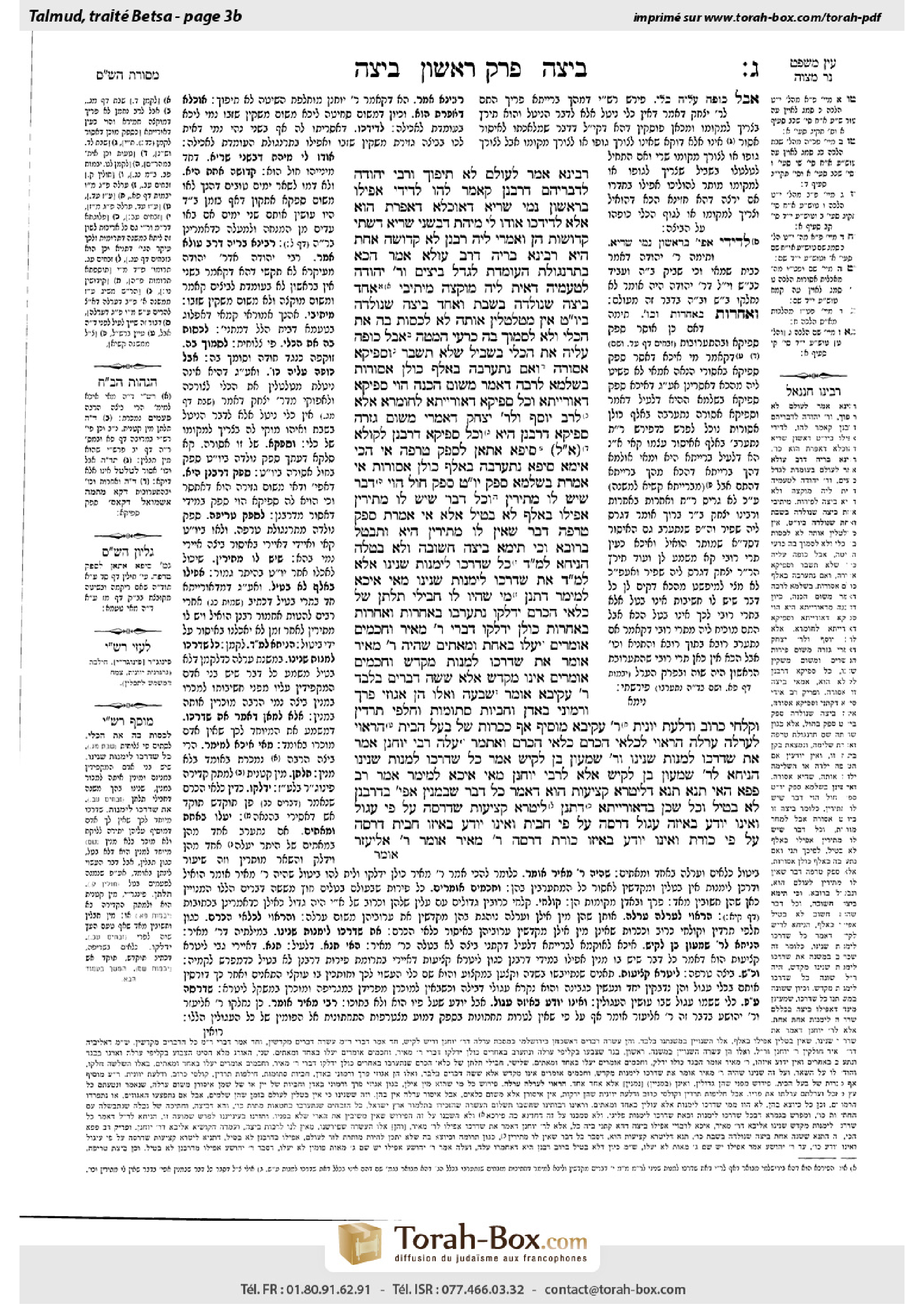
Scan : Torah-Box. Daf Study est un projet indépendant, sans affiliation ni approbation de Torah-Box ou de Sefaria.