Berakhot 41a en français · ברכות מ״א א
Traduction française du daf 41a du traité Berakhot, avec le texte araméen, l’anglais de Sefaria et le scan de la page, pour étudier le Daf Yomi.
Ouvrir dans le lecteur interactifLire le daf du jour
Traduction française de Berakhot 41a
Les traductions françaises de Daf Study sont générées par IA à partir de l’édition anglaise de Sefaria. Elles peuvent contenir des erreurs : vérifie toujours un passage avec le texte source.
Admettons que, selon celui qui dit que les novelot temara sont des dattes tombées sous l’effet du vent, cela explique pourquoi ici, lorsque notre Michna parle de dattes abîmées, elle les appelle simplement novelot, tandis que là, lorsqu’elle parle de celles qui sont tombées à cause du vent, elle les appelle novelot temara. Cependant, selon celui qui dit que les novelot temara sont des dattes brûlées par la chaleur du soleil, la Michna aurait dû enseigner ici comme là, dans la Michna du traité Demai, novelot temara ; ou bien enseigner dans les deux cas novelot, sans autre précision. L’emploi de termes différents indique que les Michnayot traitent de produits différents. Aucune réponse n’a été trouvée à cette question, et la Guemara note qu’en effet, selon celui qui dit que les novelot temara sont des dattes brûlées par la chaleur du soleil, la difficulté demeure.
La Michna citait une controverse concernant l’ordre dans lequel on doit réciter les bénédictions lorsque plusieurs sortes d’aliments se trouvent devant soi. Rabbi Yehouda dit : s’il y a parmi eux l’une des sept espèces pour lesquelles la terre d’Israël a été louée, on récite d’abord la bénédiction sur celle-ci. Les Sages disent : on récite une bénédiction sur celle que l’on veut. Oulla dit : cette controverse porte précisément sur un cas où les bénédictions à réciter sur chaque sorte d’aliment sont les mêmes. Dans ce cas, Rabbi Yehouda estime que l’espèce faisant partie des sept espèces a priorité, tandis que les Sages estiment que l’espèce préférée a priorité et que l’on récite d’abord une bénédiction sur elle. En revanche, lorsque les bénédictions sont différentes, tous conviennent qu’il faut réciter la bénédiction appropriée sur l’un des aliments, puis sur l’autre, afin que chacun reçoive la bénédiction qui lui convient.
La Guemara soulève une objection à partir de ce qui a été enseigné dans une baraïta : si un radis et une olive se trouvent devant lui, il récite une bénédiction sur le radis, et celle-ci le dispense de l’obligation de réciter une bénédiction sur l’olive, bien que les bénédictions soient différentes. La Guemara répond : de quoi s’agit-il ici ? D’un cas où le radis est l’élément principal pour celui qui les mange, et où l’olive ne sert qu’à en atténuer le goût. Par conséquent, il ne doit réciter une bénédiction que sur le radis.
La Guemara poursuit et demande : si tel est le cas, examinons la dernière partie de la baraïta, où Rabbi Yehouda dit : on récite une bénédiction sur l’olive, car l’olive fait partie des sept espèces. Rabbi Yehouda n’accepte-t-il donc pas le principe que nous avons appris dans une Michna : pour tout aliment qui est l’élément principal et qui est consommé avec un aliment secondaire, on récite une bénédiction sur l’aliment principal, et cette bénédiction dispense l’aliment secondaire de l’obligation de réciter une bénédiction avant de le manger ? Et si tu dis qu’en effet, il ne considère pas que l’aliment principal dispense le secondaire, n’a-t-il pas été enseigné dans une baraïta : Rabbi Yehouda dit : si l’olive est consommée à cause du radis, on récite une bénédiction sur le radis, et celle-ci dispense l’olive. Si tel est le cas, la controverse sur la question de savoir s’il faut réciter une bénédiction sur le radis ou sur l’olive doit porter sur un cas où le radis n’est pas l’élément principal. Cela semble contredire la déclaration d’Oulla.
La Guemara répond : en réalité, il s’agit d’un cas où le radis est l’élément principal du repas ; lorsque Rabbi Yehouda et les Sages sont en désaccord, c’est à propos d’un autre cas, et cette baraïta est incomplète. Elle enseigne ce qui suit : si un radis et une olive se trouvent devant lui, il récite une bénédiction sur le radis, et celle-ci dispense l’olive. Dans quelles circonstances cela s’applique-t-il ? Précisément lorsque le radis est l’élément principal. Mais lorsque le radis n’est pas l’élément principal, tous conviennent qu’on récite la bénédiction appropriée sur l’un, puis de nouveau la bénédiction appropriée sur l’autre. En général, toutefois, si deux sortes d’aliments dont les bénédictions sont identiques se trouvent devant lui, il récite une bénédiction sur celle qu’il veut. Rabbi Yehouda dit : il récite une bénédiction sur l’olive, car l’olive fait partie des sept espèces.
Rabbi Ami et Rabbi Yitsḥak Nappaḥa sont en désaccord à ce sujet. L’un dit : la controverse porte sur un cas où les bénédictions sont identiques, car Rabbi Yehouda estime qu’une espèce faisant partie des sept espèces a priorité et que l’on récite d’abord une bénédiction sur elle. Les Sages estiment, quant à eux, que l’espèce préférée a priorité et que l’on récite d’abord une bénédiction sur elle. En revanche, lorsque les bénédictions ne sont pas identiques, tous conviennent que l’on récite la bénédiction appropriée sur l’un, puis de nouveau la bénédiction appropriée sur l’autre. L’autre dit : même lorsque les bénédictions ne sont pas identiques, il y a également une controverse.
La Guemara examine cette question : admettons que, selon celui qui dit que la controverse porte sur un cas où les bénédictions sont identiques, tout s’explique. Mais selon celui qui dit qu’ils sont en désaccord dans un cas où les bénédictions ne sont pas identiques, sur quoi porte leur désaccord ? Il faut de toute façon réciter deux bénédictions. Rabbi Yirmeya dit : leur désaccord porte sur l’ordre dans lequel les bénédictions doivent être récitées.
Car Rav Yossef — et certains disent Rabbi Yitsḥak — a dit : chaque aliment dont l’importance est manifeste du fait qu’il précède les autres dans ce verset, qui chante les louanges de la terre d’Israël, a également priorité sur les autres pour la bénédiction, comme il est dit : « Un pays de blé et d’orge, de vignes, de figuiers et de grenadiers, un pays d’oliviers à huile et de miel » (Deutéronome 8, 8).
La Guemara note que cette opinion est en désaccord avec celle de Rabbi Ḥanan. Rabbi Ḥanan a dit : le verset tout entier a été énoncé afin d’enseigner les mesures relatives à différentes halakhot de la Torah.
Le blé a été mentionné comme base de calcul du temps nécessaire pour devenir rituellement impur en entrant dans une maison atteinte de la lèpre, comme nous l’avons appris dans une Michna : celui qui entre dans une maison atteinte de la lèpre (voir Lévitique 14, 33-53), ses vêtements posés sur les épaules, et ses sandales et ses anneaux dans les mains, devient immédiatement rituellement impur, ainsi que ces objets — les vêtements, les sandales et les anneaux. En revanche, s’il portait ses vêtements, avait ses sandales aux pieds et ses anneaux aux doigts, il devient immédiatement rituellement impur en entrant dans la maison, mais eux — les vêtements, les sandales et les anneaux — restent purs jusqu’à ce qu’il séjourne dans la maison assez longtemps pour manger une demi-miche de pain. Ce calcul se fait avec du pain de blé, qui se mange plus vite que le pain d’orge, et en supposant que la personne est allongée et mange le pain avec un condiment, ce qui accélère la consommation. Il existe donc une mesure de la Torah spécifiquement liée au blé.
L’orge sert également de base à une mesure, comme nous l’avons appris dans une Michna : un os provenant d’un mort, de la taille d’un grain d’orge, transmet l’impureté rituelle par contact et par transport, mais ne la transmet pas sous une tente ; c’est-à-dire que si l’os se trouve à l’intérieur d’une maison, il ne rend pas impurs tous les objets qui s’y trouvent.
La mesure halakhique déterminée par les vignes est la quantité d’un quart de log de vin pour un nazir, et non la quantité de vin équivalant à un quart de log d’eau, qui est légèrement différente. Les figues servent de base à la mesure du volume d’une figue sèche, généralement la plus petite quantité d’aliment pour laquelle une personne est tenue responsable du transport d’un domaine à un autre pendant Chabbat. Les grenades enseignent également une mesure particulière, comme nous l’avons appris dans une Michna : tous les ustensiles en bois rituellement impurs appartenant à des particuliers deviennent purs lorsque l’ustensile est brisé,
Texte source et traduction anglaise
ברכות מ״א א · texte araméen et hébreu
בִּשְׁלָמָא לְמַאן דְּאָמַר תַּמְרֵי דְזִיקָא, הַיְינוּ דְּהָכָא קָרֵי לַהּ ״נוֹבְלוֹת״ סְתָמָא, וְהָתָם קָרֵי לַהּ ״תְּמָרָה״, אֶלָּא לְמַאן דְּאָמַר בּוּשְׁלֵי כַמְרָא, נִיתְנֵי אִידֵּי וְאִידֵּי ״נוֹבְלוֹת תְּמָרָה״, אוֹ אִידֵּי וְאִידֵּי ״נוֹבְלוֹת״ סְתָמָא. קַשְׁיָא.
הָיוּ לְפָנָיו מִינִין הַרְבֵּה וְכוּ׳. אָמַר עוּלָּא: מַחֲלוֹקֶת בְּשֶׁבִּרְכוֹתֵיהֶן שָׁווֹת, דְּרַבִּי יְהוּדָה סָבַר מִין שִׁבְעָה עָדִיף, וְרַבָּנַן סָבְרִי מִין חָבִיב עָדִיף. אֲבָל בְּשֶׁאֵין בִּרְכוֹתֵיהֶן שָׁווֹת — דִּבְרֵי הַכֹּל מְבָרֵךְ עַל זֶה, וְחוֹזֵר וּמְבָרֵךְ עַל זֶה.
מֵיתִיבִי: הָיוּ לְפָנָיו צְנוֹן וְזַיִת — מְבָרֵךְ עַל הַצְּנוֹן וּפוֹטֵר אֶת הַזַּיִת! הָכָא בְּמַאי עָסְקִינַן — כְּשֶׁהַצְּנוֹן עִקָּר.
אִי הָכִי, אֵימָא סֵיפָא: רַבִּי יְהוּדָה אוֹמֵר מְבָרֵךְ עַל הַזַּיִת, שֶׁהַזַּיִת מִמִּין שִׁבְעָה. לֵית לֵיהּ לְרַבִּי יְהוּדָה, הָא דִּתְנַן: כׇּל שֶׁהוּא עִיקָּר וְעִמּוֹ טְפֵלָה — מְבָרֵךְ עַל הָעִיקָּר וּפוֹטֵר אֶת הַטְּפֵלָה? וְכִי תֵּימָא: הָכִי נָמֵי דְּלֵית לֵיהּ, וְהָתַנְיָא: רַבִּי יְהוּדָה אוֹמֵר: אִם מֵחֲמַת צְנוֹן בָּא הַזַּיִת — מְבָרֵךְ עַל הַצְּנוֹן וּפוֹטֵר אֶת הַזַּיִת.
לְעוֹלָם בִּצְנוֹן עִיקָּר עָסְקִינַן, וְכִי פְּלִיגִי רַבִּי יְהוּדָה וְרַבָּנַן — בְּמִילְּתָא אַחֲרִיתִי פְּלִיגִי, וְחַסּוֹרֵי מְחַסְּרָא, וְהָכִי קָתָנֵי: הָיוּ לְפָנָיו צְנוֹן וְזַיִת — מְבָרֵךְ עַל הַצְּנוֹן וּפוֹטֵר אֶת הַזַּיִת. בַּמֶּה דְּבָרִים אֲמוּרִים — כְּשֶׁהַצְּנוֹן עִיקָּר, אֲבָל אֵין הַצְּנוֹן עִיקָּר — דִּבְרֵי הַכֹּל מְבָרֵךְ עַל זֶה וְחוֹזֵר וּמְבָרֵךְ עַל זֶה. וּשְׁנֵי מִינִין בְּעָלְמָא שֶׁבִּרְכוֹתֵיהֶן שָׁווֹת — מְבָרֵךְ עַל אֵיזֶה מֵהֶן שֶׁיִּרְצֶה. רַבִּי יְהוּדָה אוֹמֵר: מְבָרֵךְ עַל הַזַּיִת, שֶׁהַזַּיִת מִמִּין שִׁבְעָה.
פְּלִיגִי בַּהּ רַבִּי אַמֵּי וְרַבִּי יִצְחָק נַפָּחָא. חַד אָמַר: מַחֲלוֹקֶת בְּשֶׁבִּרְכוֹתֵיהֶן שָׁווֹת, דְּרַבִּי יְהוּדָה סָבַר מִין שִׁבְעָה עָדִיף, וְרַבָּנַן סָבְרִי מִין חָבִיב עָדִיף. אֲבָל בְּשֶׁאֵין בִּרְכוֹתֵיהֶן שָׁווֹת — דִּבְרֵי הַכֹּל מְבָרֵךְ עַל זֶה וְחוֹזֵר וּמְבָרֵךְ עַל זֶה. וְחַד אָמַר: אַף בְּשֶׁאֵין בִּרְכוֹתֵיהֶן שָׁווֹת נָמֵי מַחֲלוֹקֶת.
בִּשְׁלָמָא לְמַאן דְּאָמַר בְּשֶׁבִּרְכוֹתֵיהֶן שָׁווֹת מַחֲלוֹקֶת — שַׁפִּיר, אֶלָּא לְמַאן דְּאָמַר בְּשֶׁאֵין בִּרְכוֹתֵיהֶן שָׁווֹת פְּלִיגִי, בְּמַאי פְּלִיגִי! אָמַר רַבִּי יִרְמְיָה: לְהַקְדִּים.
דְּאָמַר רַב יוֹסֵף וְאִיתֵּימָא רַבִּי יִצְחָק: כׇּל הַמּוּקְדָּם בְּפָסוּק זֶה, מוּקְדָּם לִבְרָכָה, שֶׁנֶּאֱמַר: ״אֶרֶץ חִטָּה וּשְׂעֹרָה וְגֶפֶן וּתְאֵנָה וְרִמּוֹן אֶרֶץ זֵית שֶׁמֶן וּדְבָשׁ״.
וּפְלִיגָא דְּרַבִּי חָנָן. דְּאָמַר רַבִּי חָנָן: כׇּל הַפָּסוּק כּוּלּוֹ לְשִׁיעוּרִין נֶאֱמַר.
״חִטָּה״, דִּתְנַן: הַנִּכְנָס לַבַּיִת הַמְנוּגָּע, וְכֵלָיו עַל כְּתֵפָיו, וְסַנְדָּלָיו וְטַבְּעוֹתָיו בְּיָדָיו — הוּא וָהֵן טְמֵאִין מִיָּד. הָיָה לָבוּשׁ כֵּלָיו, וְסַנְדָּלָיו בְּרַגְלָיו, וְטַבְּעוֹתָיו בְּאֶצְבְּעוֹתָיו — הוּא טָמֵא מִיָּד, וְהֵן טְהוֹרִין עַד שֶׁיִּשְׁהֶא בִּכְדֵי אֲכִילַת פְּרָס. פַּת חִטִּין וְלֹא פַּת שְׂעוֹרִין, מֵיסֵב וְאוֹכְלָן בְּלִפְתָּן.
״שְׂעֹרָה״, דִּתְנַן: עֶצֶם כִּשְׂעוֹרָה מְטַמֵּא בְּמַגָּע וּבְמַשָּׂא, וְאֵינוֹ מְטַמֵּא בְּאֹהֶל.
״גֶּפֶן״, כְּדֵי רְבִיעִית יַיִן לְנָזִיר. ״תְּאֵנָה״, כִּגְרוֹגֶרֶת לְהוֹצָאַת שַׁבָּת. ״רִמּוֹן״, כְּדִתְנַן: כׇּל כְּלֵי בַּעֲלֵי בָתִּים
Berakhot 41a · traduction anglaise de Sefaria
Granted, according to the one who said that novelot temara are dates felled by the wind, that is why here, when our mishna speaks of ruined dates, it calls them novelot, unmodified and there, when it speaks of those that fell because of the wind, it calls them novelot temara. However, according to the one who said that novelot temara are dates burned by the heat of the sun, it should have taught in this mishna here and that, the mishna in tractate Demai, novelot temara; or taught in this and that novelot, unmodified. The use of different terms indicates that the mishnayot are discussing different items. No answer was found to this question, and the Gemara notes that indeed, according to the one who said that novelot temara are dates burned by the heat of the sun, it is difficult.
The mishna cited a dispute with regard to the order in which one is supposed to recite the blessings when there were many types of food before him. Rabbi Yehuda says: If there is one of the seven species for which Eretz Yisrael was praised among them, he recites the first blessing over it. And the Rabbis say: He recites a blessing over whichever of them he wants. Ulla said: This dispute is specifically in a case where the blessings to be recited over each type of food are the same, as in that case Rabbi Yehuda holds: The type of the seven species takes precedence, and the Rabbis hold: The preferred type takes precedence, and a blessing is recited over it first. However, when their blessings are not the same, everyone agrees that one must recite a blessing over this type of food and then recite another blessing over that, ensuring that the appropriate blessing is recited over each type of food.
The Gemara raises an objection to this based on what was taught in a baraita: If a radish and an olive were before him, he recites a blessing over the radish and exempts the olive from the requirement of a blessing, although their blessings are different. The Gemara answers: With what are we dealing here? With a case where the radish is the primary component for the one partaking of them, and the olive serves only to temper the taste of the radish. Therefore, he need recite a blessing only over the radish.
The Gemara continues and asks: If so, say the latter clause of the baraita where Rabbi Yehuda says: One recites a blessing over the olive, as the olive is a type of the seven species. Does Rabbi Yehuda not accept that principle which we learned in a mishna: Any food that is primary, and is eaten with food that is secondary, one recites a blessing over the primary food, and that blessing exempts the secondary from the requirement to recite a blessing before eating it? And if you say: Indeed, he does not hold that the primary food exempts the secondary, wasn’t it taught in a baraita: Rabbi Yehuda says: If it is due to the radish that the olive comes, one recites a blessing over the radish and exempts the olive. If so, the dispute whether to recite a blessing over the radish or the olive must be in a case where the radish is not primary. This is an apparent contradiction of Ulla’s statement.
The Gemara responds: Actually, we are dealing with a case where the radish is the primary component of the meal, and when Rabbi Yehuda and the Rabbis disagree, it is with regard to a different case that they disagree, and this baraita is incomplete and it teaches the following: If a radish and an olive were before him, he recites a blessing over the radish and exempts the olive. In what circumstances does this apply? Specifically when the radish is primary, but when the radish is not primary, everyone agrees that one recites the appropriate blessing over this one and then he again recites the appropriate blessing over that one. However, in general, if two types of food whose blessings are identical were before him, he recites a blessing over whichever of them that he wants. Rabbi Yehuda says: He recites a blessing over the olive, as the olive is a type of the seven species.
Rabbi Ami and Rabbi Yitzḥak Nappaḥa disagreed with regard to this subject. One said: The dispute is in a case where their blessings are identical, as Rabbi Yehuda held: A type of the seven species takes precedence and the blessing is recited over it first. And the Rabbis held: The preferred type takes precedence, and a blessing is recited over it first; however, when their blessings are not identical, everyone agrees that one recites the appropriate blessing over this one and then he again recites the appropriate blessing over that one. And one said: Even when their blessings are not identical, there is also a dispute.
The Gemara discusses this: Granted, according to the one who said that the dispute is in a case where their blessings are identical, it works out well. However, according to the one who says that they disagree in a case where their blessings are not identical, then about what do they disagree? One must recite two blessings in any case. Rabbi Yirmeya said: They disagree with regard to which blessing precedes the other.
As Rav Yosef, and some say Rabbi Yitzḥak, said: Each food whose significance is manifest in that it precedes the others in this verse, which sings the praises of Eretz Yisrael, takes precedence over the others in terms of blessing as well, as it is stated: “A land of wheat and barley, vines, figs and pomegranates, a land of olive oil and honey” (Deuteronomy 8:8).
The Gemara notes: And this opinion disagrees with the opinion of Rabbi Ḥanan. As Rabbi Ḥanan said: The entire verse was stated for the purpose of teaching measures with regard to different halakhot in the Torah.
Wheat was mentioned as the basis for calculating the time required for one to become ritually impure by entering a house afflicted with leprosy, as we learned in a mishna: One who enters a house afflicted with leprosy of the house (see Leviticus 14:33–53) with his clothes resting on his shoulders, and his sandals and his rings are in his hands, both he and they, the clothes, sandals, and rings, immediately become ritually impure. However, if he was dressed in his clothes, and his sandals were on his feet and his rings on his fingers, he immediately becomes ritually impure upon entering the house, but they, the clothes, sandals, and rings, remain pure until he stays in the house long enough to eat half a loaf of bread. This calculation is made with wheat bread, which takes less time to eat, and not with barley bread, and with one who is reclining and eating the bread with a relish, which hastens the eating. There is, then, a Torah measurement that is connected specifically to wheat.
Barley is also used as the basis for a measure, as we learned in a mishna: A bone from a corpse that is the size of a grain of barley imparts ritual impurity through contact and by being carried, but it does not impart impurity by means of a tent, i.e., if the bone was inside a house, it does not defile all of the articles in the house.
The halakhic measure determined by vines is the quantity of a quarter log of wine for a Nazirite and not the wine equivalent of a quarter log of water, which is a slightly different measure. Figs serve as the basis for the measure of a dried fig-bulk, typically the smallest unit of food for which someone will be held liable for carrying out on Shabbat from one domain to another. Pomegranates teach us a particular measurement as well, as we learned in a mishna: All ritually impure wooden utensils belonging to ordinary homeowners become pure through breaking the utensil,
Texte de Sefaria : William Davidson Edition - Vocalized Aramaic (CC BY NC) ; William Davidson Edition - English (CC BY NC).
Scan de Berakhot 41a
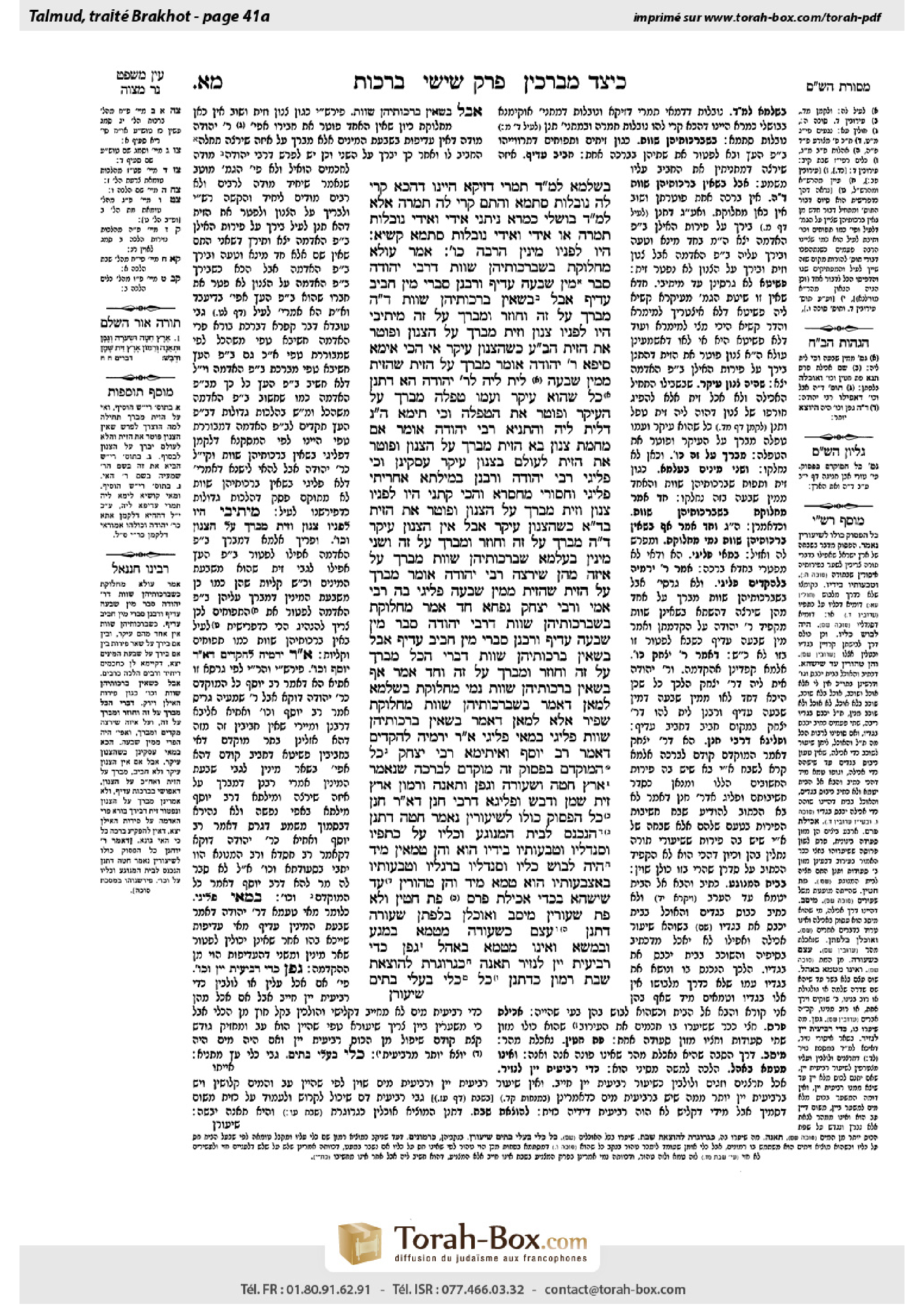
Scan : Torah-Box. Daf Study est un projet indépendant, sans affiliation ni approbation de Torah-Box ou de Sefaria.