Houlin 135b en français · חולין קל״ה ב
Traduction française du daf 135b du traité Houlin (Chullin 135b en anglais), avec le texte araméen, l’anglais de Sefaria et le scan de la page, pour étudier le Daf Yomi.
Ouvrir dans le lecteur interactifLire le daf du jour
Traduction française de Houlin 135b
Les traductions françaises de Daf Study sont générées par IA à partir de l’édition anglaise de Sefaria. Elles peuvent contenir des erreurs : vérifie toujours un passage avec le texte source.
La Guemara demande encore : Et que répondent les Rabbins à l’argument de Rabbi Ilai ? La Guemara répond : Les Rabbins n’admettent pas que la conjonction « et » renvoie à ce qui précède pour réunir les deux éléments. Car, si tel était le cas, que le Miséricordieux n’écrive ni « et » ni « le premier ».
La Guemara demande : Et que répond Rabbi Ilai à cet argument ? La Guemara répond que Rabbi Ilai dirait que la première laine tondue et la terouma correspondent à des obligations fondamentalement différentes : la première laine tondue n’est qu’une obligation pécuniaire, dépourvue de sainteté intrinsèque. En revanche, il est interdit aux non-prêtres de consommer la terouma. Puisque la première laine tondue ne relève que d’une sainteté inhérente à sa valeur, tandis que la terouma mentionnée au début du verset relève d’une sainteté intrinsèque, le verset les a séparées par la répétition du terme « le premier », puis les a réunies par le terme « et », afin que leurs halakhot puissent être déduites l’une de l’autre.
La Guemara propose une autre explication au fait que les Rabbins ne déduisent pas du cas de la terouma l’exemption des moutons appartenant en partenariat à un non-Juif. Si tu veux, dis plutôt qu’en matière de terouma, les Rabbins considèrent que celui qui possède des produits en partenariat avec un non-Juif est effectivement soumis à l’obligation, comme l’enseigne une baraïta : Si un Juif et un non-Juif ont acheté un champ en partenariat, les produits qui y poussent sont considérés comme un mélange de produits non prélevés, soumis aux lois de la terouma et des dîmes, et de produits profanes, exemptés de ces obligations ; telle est la déclaration de Rabbi Yehouda HaNassi. Rabban Shimon ben Gamliel dit : La part du Juif est soumise à l’obligation de terouma et de dîmes, mais la part du non-Juif en est exemptée.
La Guemara explique ce qu’on peut en déduire. Leur désaccord porte uniquement sur le point suivant : Rabban Shimon ben Gamliel considère qu’il y a clarification rétroactive, c’est-à-dire qu’au moment du partage des produits, il sera établi qui en était propriétaire dès le départ ; Rabbi Yehouda HaNassi considère, lui, qu’il n’y a pas de clarification rétroactive et que, comme les produits ont poussé alors qu’ils étaient mélangés, ils conservent ce statut même après leur partage. En revanche, tous conviennent que des produits possédés en partenariat par un Juif et un non-Juif sont soumis à l’obligation de terouma.
La Guemara propose une autre explication de l’opinion de Rabbi Ilai : Si tu veux, dis plutôt que Rabbi Ilai déduit les deux exemptions du terme « ton troupeau » : celle des moutons appartenant en partenariat à un Juif comme celle des moutons appartenant en partenariat à un non-Juif, et non pas la première de « ton troupeau » et la seconde de « ton grain ».
La Guemara explique pourquoi les deux exemptions peuvent se déduire d’une seule expression : pour quelle raison est-on exempté de l’obligation de la première laine tondue en cas de partenariat avec un non-Juif ? Parce que le mouton ne lui appartient pas exclusivement. Dans le cas d’un partenariat avec un Juif également, le mouton ne lui appartient pas exclusivement. La Guemara demande : Et que répondent les Rabbins à cet argument de Rabbi Ilai ? La Guemara répond : Les Rabbins considèrent qu’on ne peut pas comparer un partenariat avec un Juif à un partenariat avec un non-Juif, car un non-Juif n’est pas soumis à la mitsva de la première laine tondue, tandis qu’un Juif y est soumis.
§ Rava dit au sujet du désaccord entre les Rabbins et Rabbi Ilai : bien que Rabbi Ilai considère que deux associés possédant un mouton sont exemptés de l’obligation de la première laine tondue, il reconnaît que les produits possédés conjointement sont soumis à l’obligation de terouma. C’est la halakha, bien qu’il soit écrit au sujet de la terouma : « Ton grain » (Deutéronome 18:4), avec un pronom au singulier, ce qui permettrait de déduire que pour ce qui t’appartient, oui, on est soumis à l’obligation, tandis que les associés ne le sont pas pour ce qu’ils possèdent en partenariat.
La Guemara explique que les copropriétaires de produits sont néanmoins soumis à l’obligation de terouma, car le Miséricordieux écrit : « Là, j’exigerai vos teroumot » (Ézéchiel 20:40). Le pronom pluriel employé dans ce verset indique que même des associés qui possèdent des produits sont soumis à l’obligation de terouma. La Guemara demande : Mais alors, pourquoi faut-il le terme « ton grain », avec un pronom au singulier ? La Guemara répond : Cela sert à exclure les produits possédés en partenariat avec un non-Juif.
De même, en ce qui concerne la ḥalla, la part de pâte qu’il faut prélever pour la donner à un prêtre, Rabbi Ilai reconnaît que les copropriétaires sont soumis à cette mitsva, bien qu’on puisse soutenir le contraire, car il est écrit : « Sur les prémices de votre pâte, vous prélèverez un gâteau en offrande » (Nombres 15:20). On pourrait établir une analogie verbale entre le terme « le premier » dans ce contexte et le terme « le premier » au sujet de la première laine tondue : de même que, dans le cas de la première laine tondue, les propriétaires ne sont pas soumis à l’obligation lorsque les moutons leur appartiennent en partenariat, de même, dans le cas de la ḥalla, les associés ne seraient pas soumis à l’obligation lorsque la pâte leur appartient en partenariat. Néanmoins, le Miséricordieux écrit : « Votre pâte », avec un pronom pluriel, ce qui indique que même les copropriétaires d’une pâte sont soumis à l’obligation de prélever la ḥalla.
La Guemara objecte : Mais selon cet argument, les copropriétaires d’une pâte sont soumis à l’obligation de prélever la ḥalla parce qu’il est écrit « votre pâte », avec un pronom pluriel. On peut en déduire que, sans cela, j’aurais dit qu’ils en sont exemptés, par analogie verbale entre le terme « le premier » mentionné au sujet de la ḥalla et le terme « le premier » au sujet de la première laine tondue. Au contraire, il faudrait établir une analogie verbale entre le terme « le premier » au sujet de la ḥalla et le terme « le premier » au sujet de la terouma : de même que l’obligation de prélever la terouma s’applique aux produits possédés en partenariat, de même l’obligation de prélever la ḥalla s’applique à une pâte possédée en partenariat. Il est préférable de comparer la ḥalla à la terouma, car leur statut halakhique est similaire : toutes deux sont interdites aux non-prêtres. Dans ce cas, la déduction à partir du terme « votre pâte » est superflue.
La Guemara explique : C’est effectivement ainsi ; l’obligation concernant une pâte possédée en partenariat dans le cas de la ḥalla se déduit du cas de la terouma. Mais alors, pourquoi faut-il le terme « votre pâte » ? Il enseigne que la quantité de pâte soumise à l’obligation de ḥalla équivaut à celle de votre pâte, c’est-à-dire à la quantité que le peuple juif pétrissait chaque jour dans le désert du Sinaï, au moment où la mitsva fut donnée. Il s’agit d’un omer par personne (voir Exode 16:16), soit un dixième d’épha (voir Exode 16:36).
De même, en ce qui concerne la pe’a, les produits laissés au bord du champ pour les pauvres, Rabbi Ilai reconnaît que les copropriétaires de produits sont soumis à l’obligation, bien qu’il soit écrit dans le verset cité ci-dessous : « Ton champ [sadekha] », avec un pronom au singulier, ce qui permettrait de déduire que pour ton champ, oui, on est soumis à l’obligation, tandis qu’on ne l’est pas pour ce qui est possédé en partenariat. La raison en est que le Miséricordieux écrit : « Quand vous moissonnerez [uvekutzrekhem] la moisson de votre terre, tu ne moissonneras pas entièrement le bord de ton champ » (Lévitique 19:9). Le terme « quand vous moissonnerez » emploie le pronom pluriel, ce qui indique que même les associés propriétaires d’un champ sont soumis à l’obligation de pe’a. La Guemara demande : Mais alors, pourquoi faut-il le terme « ton champ », au singulier ? La Guemara répond : Cela sert à exclure de l’obligation de pe’a les terres possédées en partenariat avec un non-Juif.
De même, en ce qui concerne le statut de premier-né d’un animal pur mâle, Rabbi Ilai reconnaît que les animaux possédés conjointement sont consacrés, bien qu’il soit écrit : « Tous les premiers-nés mâles nés de ton gros bétail [bivkarekha] et de ton petit bétail [tzonekha], tu les consacreras à l’Éternel ton Dieu » (Deutéronome 15:19). Là encore, on aurait pu déduire du pronom au singulier dans les termes « ton gros bétail » et « ton petit bétail » que tes premiers-nés, oui, sont consacrés, mais pas les premiers-nés possédés en partenariat.
Le Miséricordieux écrit donc : « Là, tu apporteras tes holocaustes, tes sacrifices de paix, tes dîmes, le don de ta main, tes vœux, tes offrandes volontaires, ainsi que les premiers-nés de votre gros bétail [bekarkhem] et de votre petit bétail [tzonekhem] » (Deutéronome 12:6). Les pronoms des termes « votre gros bétail » et « votre petit bétail » sont au pluriel, ce qui indique que les animaux premiers-nés possédés en partenariat sont consacrés. La Guemara demande : Mais alors, pourquoi faut-il les termes « ton gros bétail » et « ton petit bétail » (Deutéronome 15:19), où les pronoms sont au singulier ? La Guemara répond de nouveau : Cela sert à exclure de la consécration les animaux possédés en partenariat avec un non-Juif.
De même, en ce qui concerne la mezouza, Rabbi Ilai reconnaît que la maison de deux associés est soumise à l’obligation, bien qu’il soit écrit : « Tu les inscriras sur les montants de ta maison [beitekha] » (Deutéronome 6:9), avec un pronom au singulier, ce qui aurait pu laisser déduire que ta maison, oui, est soumise à l’obligation, mais pas une maison possédée en partenariat par deux personnes. Par conséquent, le Miséricordieux écrit au sujet de la mitsva de mezouza : « Afin que vos jours et les jours de vos enfants se multiplient » (Deutéronome 11:21). Les pronoms pluriels des termes « vos jours » et « vos enfants » dans ce verset indiquent que les associés sont soumis à la mitsva de mezouza. La Guemara demande : Mais alors, à quoi sert le terme « ta maison [beitekha] » ? La Guemara répond : Il est nécessaire pour ce que Rabba a déduit, car Rabba a dit :
Texte source et traduction anglaise
חולין קל״ה ב · texte araméen et hébreu
וְרַבָּנַן: לָא נִכְתּוֹב רַחֲמָנָא לָא וָי״ו וְלָא ״רֵאשִׁית״.
וְרַבִּי אִלְעַאי, אַיְּידֵי דְּהַאי קְדוּשַּׁת דָּמִים, וְהַאי קְדוּשַּׁת הַגּוּף, פָּסֵיק לְהוּ, וַהֲדַר עָרְבִי לְהוּ.
וְאִיבָּעֵית אֵימָא: שׁוּתָּפוּת גּוֹי בִּתְרוּמָה, רַבָּנַן חַיּוֹבֵי מְחַיְּיבִי, דְּתַנְיָא: יִשְׂרָאֵל וְגוֹי שֶׁלָּקְחוּ שָׂדֶה בְּשׁוּתָּפוּת – טֶבֶל וְחוּלִּין מְעוֹרָבִים זֶה בָּזֶה, דִּבְרֵי רַבִּי. רַבָּן שִׁמְעוֹן בֶּן גַּמְלִיאֵל אוֹמֵר: שֶׁל יִשְׂרָאֵל חַיָּיב, וְשֶׁל גּוֹי פָּטוּר.
עַד כָּאן לָא פְּלִיגִי, אֶלָּא דְּמָר סָבַר יֵשׁ בְּרֵירָה, וּמַר סָבַר אֵין בְּרֵירָה, אֲבָל שׁוּתָּפוּת דְּגוֹי – דִּבְרֵי הַכֹּל חַיֶּיבֶת.
וְאִי בָּעֵית אֵימָא, תַּרְוַיְיהוּ לְרַבִּי אִלְעַאי מִ״צֹּאנְךָ״ נָפְקָא.
שׁוּתָּפוּת דְּגוֹי מַאי טַעְמָא? דְּלָא מְיַיחֲדָא לֵיהּ, לְיִשְׂרָאֵל נָמֵי לָא מְיַיחֲדָא לֵיהּ. וְרַבָּנַן? גּוֹי לָאו בַּר חִיּוּבָא הוּא, יִשְׂרָאֵל בַּר חִיּוּבָא הוּא.
אָמַר רָבָא: מוֹדֶה רַבִּי אִלְעַאי בִּתְרוּמָה, אַף עַל גַּב דִּכְתִיב ״דְּגָנְךָ״ – דִּידָךְ אִין, דְּשׁוּתָּפוּת לָא.
כְּתַב רַחֲמָנָא ״תְּרוּמֹתֵיכֶם״, אֶלָּא ״דְּגָנְךָ״ לְמָה לִי? לְמַעוֹטֵי שׁוּתָּפוּת גּוֹי.
חַלָּה, אַף עַל גַּב דִּכְתִיב ״רֵאשִׁית״, וְאִיכָּא לְמֵימַר: נֵילַף ״רֵאשִׁית״ ״רֵאשִׁית״ מֵרֵאשִׁית הַגֵּז – מָה לְהַלָּן דְּשׁוּתָּפוּת לָא, אַף כָּאן דְּשׁוּתָּפוּת לָא. כְּתַב רַחֲמָנָא ״עֲרִיסוֹתֵיכֶם״.
אֶלָּא טַעְמָא דִּכְתִיב ״עֲרִיסוֹתֵיכֶם״, הָא לָאו הָכִי הֲוָה אָמֵינָא נֵילַף ״רֵאשִׁית״ ״רֵאשִׁית״ מֵרֵאשִׁית הַגֵּז? אַדְּרַבָּה, נֵילַף מִתְּרוּמָה!
הָכִי נָמֵי, אֶלָּא ״עֲרִיסוֹתֵיכֶם״ לְמָה לִי? כְּדֵי עֲרִיסוֹתֵיכֶם.
פֵּאָה, אַף עַל גַּב דִּכְתִיב ״שָׂדְךָ״ – דִּידָךְ אִין, שׁוּתָּפוּת לָא – כְּתַב רַחֲמָנָא ״וּבְקֻצְרְכֶם אֶת קְצִיר אַרְצְכֶם״. אֶלָּא ״שָׂדְךָ״ לְמָה לִי? לְמַעוֹטֵי שׁוּתָּפוּת גּוֹי.
בְּכוֹרָה, אַף עַל גַּב דִּכְתִיב ״כׇּל הַבְּכוֹר אֲשֶׁר יִוָּלֵד בִּבְקָרְךָ וּבְצֹאנְךָ״, דִּידָךְ – אִין, דְּשׁוּתָּפוּת – לָא.
כְּתַב רַחֲמָנָא: ״וּבְכֹרֹת בְּקַרְכֶם וְצֹאנְכֶם״, אֶלָּא ״בְּקָרְךָ וְצֹאנְךָ״ לְמָה לִי? לְמַעוֹטֵי שׁוּתָּפוּת גּוֹי.
מְזוּזָה, אַף עַל גַּב דִּכְתִיב ״בֵּיתֶךָ״ – דִּידָךְ אִין, שׁוּתָּפוּת לָא, כְּתַב רַחֲמָנָא ״לְמַעַן יִרְבּוּ יְמֵיכֶם וִימֵי בְנֵיכֶם״. וְאֶלָּא ״בֵּיתֶךָ״ לְמַאי אֲתָא? לְכִדְרַבָּה, דְּאָמַר רַבָּה:
Chullin 135b · traduction anglaise de Sefaria
The Gemara asks further: And how do the Rabbis respond to Rabbi Ilai’s claim? The Gemara answers: The Rabbis do not accept that the conjunction “and” goes back and combines the two matters together, as, if that were so, let the Merciful One write neither “and” nor “the first.”
The Gemara asks: And how does Rabbi Ilai respond to this contention? The Gemara answers that Rabbi Ilai would say that the first sheared wool and teruma are essentially different obligations, as the first sheared wool is merely a monetary obligation with no inherent sanctity. By contrast, it is prohibited for non-priests to partake of teruma. Since this case of the first sheared wool involves only sanctity that inheres in its value, and that case of teruma referred to in the beginning of the verse involves inherent sanctity, the verse separated them through the repetition of the term “the first,” and then the verse went back and combined them through the term “and,” so that their halakhot could be derived from one another.
The Gemara provides an alternative explanation as to why the Rabbis do not derive the exemption of sheep owned in partnership with a gentile from the case of teruma. If you wish, say instead that with regard to teruma, the Rabbis hold that one who owns produce in partnership with a gentile is in fact obligated, as it is taught in a baraita: If there were a Jew and a gentile who purchased a field in partnership, the produce grown in that field is considered to be untithed produce, which is subject to the halakhot of terumot and tithes, and non-sacred produce, which is exempt from the requirements of terumot and tithes, mixed together; this is the statement of Rabbi Yehuda HaNasi. Rabban Shimon ben Gamliel says: The portion of the Jew is obligated in teruma and tithes, but the portion of the gentile is exempt.
The Gemara explains the inference. They disagree only with regard to the following issue: That one Sage, Rabban Shimon ben Gamliel, holds that there is retroactive clarification, which means that when they divide the produce it will be clarified who owned which produce from the outset; and one Sage, Rabbi Yehuda HaNasi, holds that there is no retroactive clarification, and because it grew in a mixed state, it retains that status even after they divide the produce. But with regard to produce that a Jew owns in partnership with a gentile, everyone agrees that it is obligated in teruma.
The Gemara presents an alternative explanation of Rabbi Ilai’s opinion: If you wish, say instead that Rabbi Ilai does not derive only the exemption of sheep owned in partnership with a Jew from the term “your flock” while he derives the exemption of sheep owned in partnership with a gentile from the term “your grain.” Rather, according to Rabbi Ilai both exemptions are derived from the term “your flock.”
The Gemara explains why both exemptions can be derived from a single phrase: With regard to partnership with a gentile, what is the reason that one is exempted from the obligation of the first sheared wool? It is due to the fact that the sheep is not exclusively his. In the case of a partnership with a Jew too, the sheep is not exclusively his. The Gemara asks: And what do the Rabbis reply to this claim of Rabbi Ilai? The Gemara answers: The Rabbis hold that partnership with a Jew cannot be compared to partnership with a gentile, as a gentile is not obligated in the mitzva of the first sheared wool, whereas a Jew is obligated.
§ Rava said with regard to the dispute between the Rabbis and Rabbi Ilai: Although Rabbi Ilai holds that two partners who own a sheep are exempt from the first sheared wool, he concedes that jointly owned produce is obligated in teruma. This is the halakha even though it is written with regard to teruma: “Your grain” (Deuteronomy 18:4), using the singular pronoun, from which one may infer that with regard to yours, yes, one is obligated, whereas with regard to that which is owned in partnership, the partners are not obligated.
The Gemara explains that the joint owners of produce are nevertheless obligated in teruma, as the Merciful One writes: “There will I require your terumot” (Ezekiel 20:40). The use of the plural pronoun in this verse indicates that even partners who own produce are obligated in teruma. The Gemara asks: But if so, why do I need the term: “Your grain,” using the singular pronoun? The Gemara answers: This serves to exclude produce owned in partnership with a gentile.
Similarly, with regard to ḥalla, the portion of dough that one is required to separate and give to a priest, Rabbi Ilai concedes that joint owners are obligated in this mitzva, even though one could claim otherwise, as it is written: “Of the first of your dough you shall set apart a cake for a gift” (Numbers 15:20), and it is possible to say that one should derive a verbal analogy between the term “the first” in this context and the term “the first” from the first sheared wool: Just as there, with regard to the first sheared wool, if the sheep are owned in partnership the owners are not obligated, so too here, with regard to ḥalla, if the dough is owned in partnership they are not obligated. Nevertheless, the Merciful One writes: “Your dough,” using a plural pronoun, indicating that even joint owners of dough are obligated to separate ḥalla.
The Gemara challenges: But according to this claim, the reason joint owners of dough are obligated to separate ḥalla is that it is written “your dough,” using a plural pronoun. It can be inferred from here that were that not the case I would say that they are exempt, as derived by a verbal analogy between the term “the first” mentioned with regard to ḥalla and the term “the first” from the first sheared wool. On the contrary, one should derive a verbal analogy between the term “the first” with regard to ḥalla and the term “the first” from teruma: Just as the obligation to separate teruma applies to produce owned in partnership, so too, the obligation to separate ḥalla applies to dough owned in partnership. It is preferable to compare ḥalla to teruma, because their halakhic status is similar in that they are both prohibited to non-priests. If so, the inference from the term “your dough” is unnecessary.
The Gemara explains: It is indeed so; the obligation of produce owned in partnership in the case of ḥalla is derived from the case of teruma. But if so, why do I need the term “your dough”? This teaches that the quantity of dough to which the obligation of ḥalla applies is equivalent to the quantity of your dough, i.e., the quantity of dough kneaded daily by the Jewish people when they were in the Sinai Desert, when the mitzva was given. This is one omer for each person (see Exodus 16:16), which is a tenth of an ephah (see Exodus 16:36).
Likewise, with regard to pe’a, produce in the corner of the field that is left for the poor, Rabbi Ilai concedes that the joint owners of produce are obligated, even though it is written in the verse cited below: “Your field [sadekha],” using a singular pronoun, from which it can be inferred that with regard to your field, yes, one is obligated, whereas with regard to that which is owned in partnership, one is not obligated. The reason is that the Merciful One writes: “And when you reap [uvekutzrekhem] the harvest of your land, you shall not entirely reap the corner of your field” (Leviticus 19:9). The term “when you reap” uses the plural pronoun, which indicates that even partners of land are obligated in pe’a. The Gemara asks: But if so, why do I need the term “your field” in the singular? The Gemara answers: This serves to exclude land owned in partnership with a gentile from the obligation of pe’a.
Similarly, with regard to the firstborn status of a male firstborn kosher animal, Rabbi Ilai concedes that jointly owned animals are sanctified, even though it is written: “All the firstborn that are born of your herd [bivkarekha] and of your flock [tzonekha] that are male you shall sanctify to the Lord your God” (Deuteronomy 15:19). Once again it might have been inferred from the singular pronoun in the terms “your herd” and “your flock” that your firstborn, yes, are sanctified, but the firstborn that is owned in partnership is not sanctified.
Therefore, the Merciful One writes: “And there you shall bring there your burnt offerings, and your peace offerings, and your tithes, and the gift of your hand, and your vows, and your gift offerings, and the firstborn of your herd [bekarkhem] and of your flock [tzonekhem]” (Deuteronomy 12:6). The pronouns in the terms “your herd” and “your flock” in this verse are in the plural, which indicates that firstborn animals owned in partnership are sanctified. The Gemara asks: But if so, why do I need the terms “your herd” and “your flock” (Deuteronomy 15:19), where the pronouns are in the singular? The Gemara again answers: This serves to exclude animals owned in partnership with a gentile, which are not sanctified.
Likewise, with regard to a mezuza, Rabbi Ilai concedes that the house of two partners is obligated, even though it is written: “And you shall write them upon the doorposts of your house [beitekha]” (Deuteronomy 6:9), with a singular pronoun, from which one might have inferred that with regard to your house, yes, it is obligated, whereas a house owned by two people in partnership is not obligated. Consequently, the Merciful One writes with regard to the mitzva of mezuza: “So that your days may be multiplied, and the days of your children” (Deuteronomy 11:21). The use of the plural pronoun in the terms “your days” and “your children” in this verse indicates that partners are obligated in the mitzva of mezuza. The Gemara asks: But if so, for what purpose does the term “your house [beitekha]” come? The Gemara answers: It is necessary for that which Rabba derived, as Rabba said:
Texte de Sefaria : William Davidson Edition - Vocalized Aramaic (unknown) ; William Davidson Edition - English (CC BY NC).
Scan de Houlin 135b
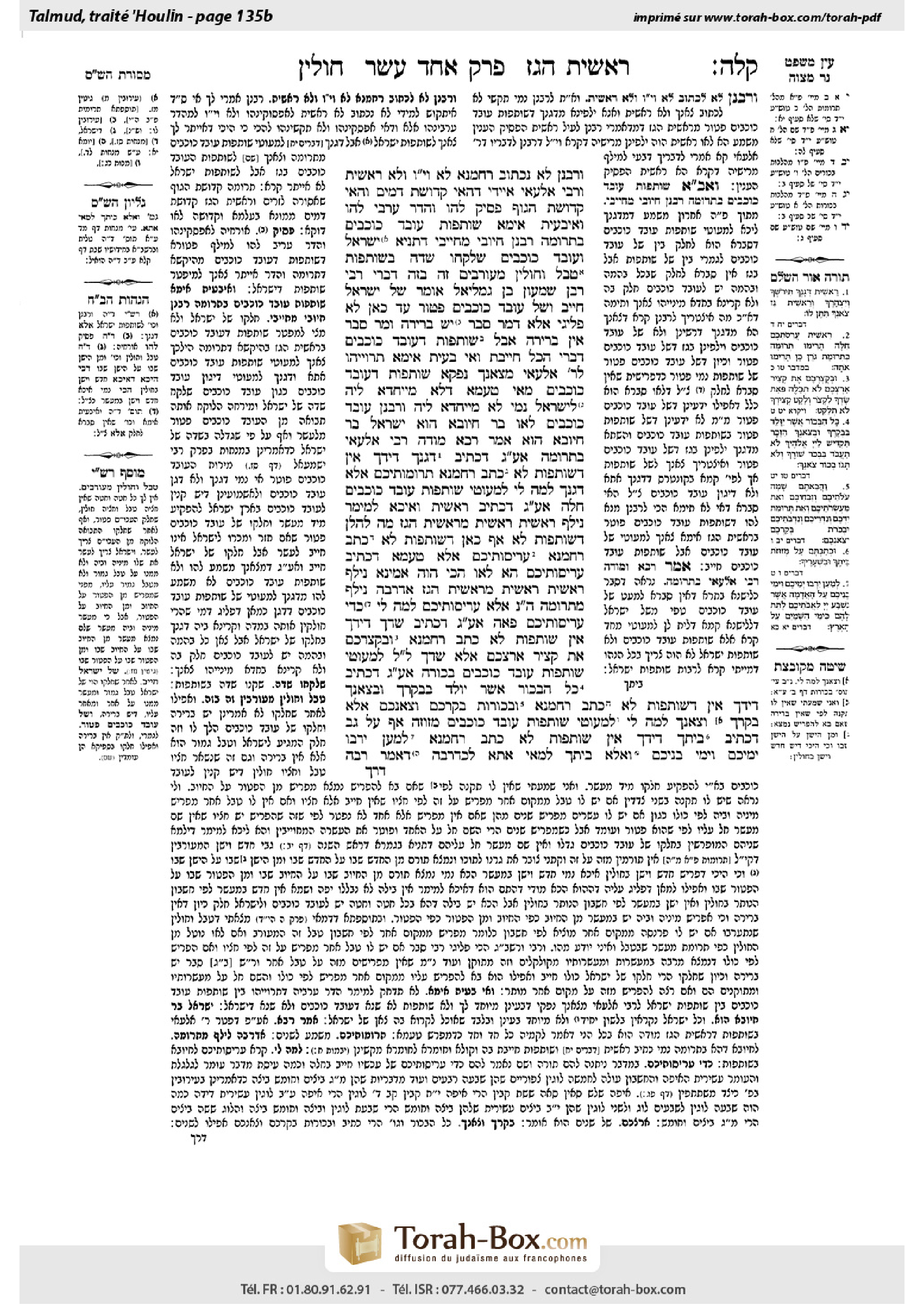
Scan : Torah-Box. Daf Study est un projet indépendant, sans affiliation ni approbation de Torah-Box ou de Sefaria.