Erouvin 56b en français · עירובין נ״ו ב
Traduction française du daf 56b du traité Erouvin (Eruvin 56b en anglais), avec le texte araméen, l’anglais de Sefaria et le scan de la page, pour étudier le Daf Yomi.
Ouvrir dans le lecteur interactifLire le daf du jour
Traduction française de Erouvin 56b
Les traductions françaises de Daf Study sont générées par IA à partir de l’édition anglaise de Sefaria. Elles peuvent contenir des erreurs : vérifie toujours un passage avec le texte source.
Les Sages ont enseigné : Celui qui met une ville au carré afin de déterminer son périmètre sabbatique la considère comme une tablette carrée ; il met ensuite également au carré les limites du Chabbat et les considère comme une tablette carrée. Par conséquent, après avoir mis la ville au carré, il ajoute des carrés supplémentaires de deux mille coudées à chacun de ses côtés.
Lorsqu’il mesure la limite du Chabbat, il ne doit pas mesurer les deux mille coudées en diagonale à partir du milieu de chaque angle de la ville, car, s’il le faisait, il perdrait les angles : autrement dit, la limite ne s’étendrait que de deux mille coudées en diagonale à partir de chacun des angles. Il mesure plutôt la limite comme s’il prenait une tablette carrée de deux mille coudées sur deux mille et la plaçait en diagonale à chaque angle.
Il s’ensuit que la ville gagne quatre cents coudées à cet angle et quatre cents autres coudées à l’angle opposé. À supposer que la ville elle-même soit ronde et ait un diamètre de deux mille coudées, comme cela sera expliqué plus loin, lorsque ses limites sont mises au carré, environ quatre cents coudées sont ajoutées à la ville à chaque angle. Puis, lorsque les limites du Chabbat sont mises au carré, celles-ci gagnent huit cents coudées à cet angle et huit cents coudées à l’angle opposé. Par conséquent, en mettant au carré à la fois la ville elle-même et ses limites du Chabbat, la ville et les limites du Chabbat gagnent ensemble mille deux cents coudées à cet angle et mille deux cents coudées à l’angle opposé.
Abayé dit : Cette projection des ajouts aux limites de la ville et aux limites du Chabbat se vérifie dans le cas d’une ville ronde de deux mille coudées sur deux mille.
La Guemara cite une discussion analogue au sujet des villes des Lévites, les quarante-huit villes données aux Lévites en Eretz Israël en remplacement d’un héritage tribal. Une baraïta rapporte que Rabbi Eliezer, fils de Rabbi Yossi, a dit : La limite des villes des Lévites s’étend de deux mille coudées dans chaque direction au-delà de la partie habitée de la ville. Retranchez-en mille coudées d’espace libre juste au-delà de la zone habitée, qui doit rester vacante. Par conséquent, l’espace libre représente un quart de la superficie étendue, et le reste est constitué de champs et de vignobles.
La Guemara demande : De quoi s’agit-il ? D’où déduit-on que l’espace libre entourant les villes des Lévites mesurait mille coudées ? Rava dit : Comme l’indique le verset : « Les espaces libres des villes que vous donnerez aux Lévites seront, à partir du mur de la ville et vers l’extérieur, de mille coudées tout autour » (Nombres 35, 4). La Torah ordonne d’entourer la ville de mille coudées de tous côtés pour en faire un espace libre. Par conséquent, cet espace libre représente un quart de la superficie.
La Guemara demande : Un quart ? C’est une moitié. Mille coudées correspondent exactement à la moitié des deux mille coudées comprises dans la limite des villes des Lévites. Rava dit : Bar Adda, le géomètre, m’a expliqué le calcul ainsi : Cela se vérifie dans une ville de deux mille coudées sur deux mille. Quelle est la superficie, en coudées carrées, de la limite étendue de la ville elle-même, sans les angles ? Seize millions de coudées carrées. Des carrés de deux mille coudées sur deux mille sont ajoutés à chacun des quatre côtés de la ville. La superficie de chacun de ces carrés est de quatre millions de coudées carrées, et la superficie totale des carrés supplémentaires est de seize millions de coudées carrées. Quelle est la superficie des angles ? Seize millions de coudées carrées, car des carrés supplémentaires de deux mille coudées sur deux mille sont ajoutés aux angles des limites extérieures des villes. Retranchez huit millions de coudées carrées de la superficie de la limite étendue pour obtenir l’espace libre autour de la ville : les premières mille coudées au-delà de la partie habitée doivent rester libres, ce qui correspond à des zones de mille coudées sur deux mille de chacun des quatre côtés de la ville, soit un total de huit millions de coudées carrées. Retranchez aussi quatre millions de coudées carrées des angles, car certaines parties des angles sont parallèles aux espaces libres. Quelle est la superficie totale des espaces libres ? Douze millions de coudées carrées.
La Guemara demande : Selon ce calcul, comment l’espace libre peut-il représenter un quart de la superficie ? Il en représente plus d’un tiers. La superficie totale de la limite étendue est de trente-deux millions de coudées carrées, et l’espace libre occupe douze millions de coudées carrées, soit plus d’un tiers de la superficie totale de la limite étendue.
La Guemara explique : Ajoutez les quatre millions de coudées carrées de la ville elle-même à la superficie de la limite, et vous obtiendrez la bonne proportion. La Guemara demande : L’espace libre représente toujours un tiers, puisque la superficie totale de la ville et de sa limite étendue est de trente-six millions de coudées carrées, et que l’espace libre en couvre douze millions.
La Guemara répond : Pensez-vous que cette halakha a été énoncée à propos d’une ville carrée ? En réalité, elle a été énoncée à propos d’une ville ronde. L’espace libre au-delà de la ville est lui aussi rond ; toutefois, la limite étendue totale est mise au carré, de sorte que la superficie totale d’une ville ronde de deux mille coudées de diamètre et de sa limite étendue est de trente-six millions de coudées carrées.
La Guemara explique le calcul : De combien la superficie d’un carré dépasse-t-elle celle d’un cercle ? D’un quart. Retranchez un quart des douze millions de coudées carrées d’espace libre : il reste neuf millions de coudées carrées, et neuf millions représentent précisément un quart de trente-six millions.
Abayé dit : Vous constaterez également que l’espace libre représente un quart de la superficie totale dans une ville de mille coudées sur mille. Quelle est la superficie, en coudées carrées, de la limite étendue de la ville sans les angles ? Elle est de huit millions de coudées carrées. Des zones supplémentaires sont ajoutées le long de chaque côté de la ville et s’étendent de deux mille coudées au-delà de la ville elle-même. Chacune de ces zones mesure deux mille coudées sur mille, soit une superficie de deux millions de coudées carrées. Comme il y a quatre zones de ce type, leur superficie totale est de huit millions de coudées carrées. Quelle est la superficie des angles ? Elle est de seize millions de coudées carrées, puisque des carrés de deux mille coudées sur deux mille sont ajoutés à chacun des quatre angles.
Texte source et traduction anglaise
עירובין נ״ו ב · texte araméen et hébreu
תָּנוּ רַבָּנַן: הַמְרַבֵּעַ אֶת הָעִיר, עוֹשֶׂה אוֹתָהּ כְּמִין טַבְלָא מְרוּבַּעַת. וְחוֹזֵר וּמְרַבֵּעַ אֶת הַתְּחוּמִין, וְעוֹשֶׂה אוֹתָן כְּמִין טַבְלָא מְרוּבַּעַת.
וּכְשֶׁהוּא מוֹדֵד, לֹא יִמְדּוֹד מֵאֶמְצַע הַקֶּרֶן אַלְפַּיִם אַמָּה מִפְּנֵי שֶׁהוּא מַפְסִיד אֶת הַזָּוִיּוֹת. אֶלָּא מֵבִיא טַבְלָא מְרוּבַּעַת שֶׁהִיא אַלְפַּיִם אַמָּה עַל אַלְפַּיִם אַמָּה, וּמַנִּיחָהּ בְּקֶרֶן בַּאֲלַכְסוֹנָהּ.
נִמְצֵאתָ הָעִיר מִשְׂתַּכֶּרֶת אַרְבַּע מֵאוֹת אַמּוֹת לְכָאן וְאַרְבַּע מֵאוֹת אַמּוֹת לְכָאן. נִמְצְאוּ תְּחוּמִין מִשְׂתַּכְּרִין שְׁמוֹנֶה מֵאוֹת אַמּוֹת לְכָאן וּשְׁמוֹנֶה מֵאוֹת לְכָאן. נִמְצְאוּ הָעִיר וּתְחוּמִין מִשְׂתַּכְּרִין אֶלֶף וּמָאתַיִם לְכָאן וְאֶלֶף וּמָאתַיִם לְכָאן.
אָמַר אַבָּיֵי: וּמַשְׁכַּחַתְּ לַהּ בְּמָתָא דְּהָוְיָא תְּרֵי אַלְפֵי אַתְּרֵי אַלְפֵי.
תַּנְיָא, אָמַר רַבִּי אֱלִיעֶזֶר בְּרַבִּי יוֹסֵי: תְּחוּם עָרֵי לְוִיִּם אַלְפַּיִם אַמָּה. צֵא מֵהֶן אֶלֶף אַמָּה מִגְרָשׁ — נִמְצָא מִגְרָשׁ רְבִיעַ, וְהַשְּׁאָר שָׂדוֹת וּכְרָמִים.
מְנָא הָנֵי מִילֵּי? אָמַר רָבָא: דְּאָמַר קְרָא: ״מִקִּיר הָעִיר וָחוּצָה אֶלֶף אַמָּה סָבִיב״, אָמְרָה תּוֹרָה: סַבֵּב אֶת הָעִיר בְּאֶלֶף, נִמְצָא מִגְרָשׁ רְבִיעַ.
רְבִיעַ?! פַּלְגָא הָוֵי! אָמַר רָבָא: בַּר אַדָּא מָשׁוֹחָאָה אַסְבְּרַהּ לִי — מַשְׁכַּחַתְּ לַהּ בְּמָתָא דְּהָוְיָא תְּרֵי אַלְפֵי אַתְּרֵי אַלְפֵי. תְּחוּם כַּמָּה הָוְיָא? שִׁיתְּסַר. קְרָנוֹת כַּמָּה הָוְיָין? שִׁיתְּסַר. דַּל תְּמָנְיָא דִתְחוּמִין וְאַרְבְּעָה דִקְרָנוֹת, כַּמָּה הָוֵי? תְּרֵיסַר.
נִמְצָא מִגְרָשׁ רְבִיעַ? טְפֵי מִתִּלְתָּא נִינְהוּ!
אַיְיתִי אַרְבְּעָה דְמָתָא, שְׁדִי עֲלַיְיהוּ. אַכַּתִּי תִּילְתָּא הָוֵי!
מִי סָבְרַתְּ בְּרִיבּוּעָא קָאָמַר? בְּעִיגּוּלָא קָאָמַר.
כַּמָּה מְרוּבָּע יָתֵר עַל הֶעָגוֹל? רְבִיעַ, דַּל רְבִיעַ מִינַּיְיהוּ — פָּשׁוּ לְהוּ תִּשְׁעָה. וְתִשְׁעָה מִתְּלָתִין וְשִׁיתָּא, רִיבְעָא הָוֵי.
אַבָּיֵי אָמַר: מַשְׁכַּחַתְּ לַהּ נָמֵי בְּמָתָא דְּהָוְיָא אַלְפָא בְּאַלְפָא. תְּחוּמִין כַּמָּה הָווּ? תְּמָנְיָא. קְרָנוֹת כַּמָּה הָוֵי? שִׁיתְּסַר.
Eruvin 56b · traduction anglaise de Sefaria
The Sages taught: One who squares a city in order to determine its Shabbat limit renders it like a square tablet, and then he also squares the Shabbat boundaries and renders them like a square tablet. Consequently, after squaring the city, he adds additional squares of two thousand cubits to each of its sides.
And when he measures the Shabbat limit, he should not measure the two thousand cubits diagonally from the middle of each corner of the city, because if he were to do so, he would lose the corners, i.e., the limit would extend only two thousand cubits on the diagonal from each of the corners. Rather, he measures the boundary as though he brought a square tablet that is two thousand cubits by two thousand cubits, and places it at each corner at its diagonal.
As a result, it will be found that the city gains four hundred cubits in this corner and another four hundred cubits in the opposite corner. Assuming that the city itself is round and has a diameter of two thousand cubits, as will be explained below, when the borders of the city are squared, approximately four hundred cubits are added to the city at each corner. When one then squares the Shabbat boundaries, it is found that the Shabbat boundaries gain eight hundred cubits in this corner and eight hundred cubits in the opposite corner. Consequently, by squaring both the city itself and its Shabbat boundaries, it is found that the city and the Shabbat boundaries together gain 1,200 cubits in this corner and 1,200 cubits in the opposite corner.
Abaye said: And you find this projection of the additions to the city’s borders and Shabbat boundaries to be correct in the case of a round city that is two thousand cubits by two thousand cubits.
The Gemara cites a similar discussion with regard to the Levite cities, the forty-eight cities given to the Levites in Eretz Yisrael instead of a tribal inheritance. It was taught in a baraita that Rabbi Eliezer, son of Rabbi Yosei, said: The boundary of the cities of the Levites extends two thousand cubits in each direction beyond the inhabited section of the city. Remove from them a thousand cubits of open space just beyond the inhabited area, which must be left vacant. Consequently, the open space is one quarter of the extended area, and the rest is fields and vineyards.
The Gemara asks: From where are these matters? From where is it derived that the open space surrounding the cities of the Levites measured a thousand cubits? Rava said: As the verse states: “And the open spaces of the cities, that you shall give to the Levites, shall be from the wall of the city and outward a thousand cubits round about” (Numbers 35:4). The Torah states: Surround the city with a thousand cubits on all sides to serve as an open space. Consequently, the open space is one quarter of the area.
The Gemara asks: Is it one quarter? It is one half. One thousand cubits is exactly half of the two thousand cubits incorporated into the boundary of the cities of the Levites. Rava said: Bar Adda the surveyor explained the calculation to me: You will find this in a city that is two thousand cubits by two thousand cubits. How many cubits is the extended boundary of the city itself, without the corners? Sixteen million square cubits. Squares measuring two thousand by two thousand cubits are appended to each of the four sides of the city. The area of each of these squares is four million square cubits, and the total area of all the additional squares is sixteen million square cubits. How many cubits are the corners? Sixteen million square cubits, as additional squares of two thousand by two thousand cubits are appended to the corners of the outer boundaries of the cities. Subtract eight million square cubits from the area of the extended boundary for the open space around the city; the first thousand cubits beyond the inhabited part of the city must be left as open space, which amounts to areas measuring one thousand by two thousand cubits on each of the four sides of the city, for a total of eight million square cubits. And subtract another four million square cubits from the corners, as sections of the corners are parallel to the open spaces. How much is the sum total of the area of the open spaces? Twelve million square cubits.
The Gemara asks: According to this calculation, how is the open space found to be one quarter of the area? It is more than one-third. The entire area of the extended boundary is thirty-two million square cubits and the open space occupies twelve million square cubits, which is more than one-third of the total area of the extended boundary.
The Gemara explains: Bring the four million square cubits of the city itself and add them to the area of the limit, and you will arrive at the correct ratio. The Gemara asks: The opens space is still one-third, as the total area of the city and its extended boundary is thirty-six million square cubits, and the area of the open space is twelve million square cubits.
The Gemara answers: Do you think that this halakha was stated with regard to a square city? It was in fact stated with regard to a round city. The open space beyond the city is also round; however, the total extended boundary is squared, so that the total area of a round city with a diameter of two thousand cubits and its extended boundary is thirty-six million square cubits.
The Gemara explains the calculation: How much larger is the area of a square than the area of the circle? One quarter. Subtract one quarter from the twelve million square cubits of open space, and nine million square cubits are left; and nine is precisely one quarter of thirty-six.
Abaye said: You will also find that the open space is one quarter of the total area in a city that is a thousand cubits by a thousand cubits. How many cubits is the extended boundary of the city without the corners? It is eight million square cubits. Additional areas are appended along each side of the city and extending two thousand cubits beyond the city itself. Each of these areas is two thousand cubits by one thousand cubits, for a total area of two million square cubits. Since there are four of these zones, their total area is eight million square cubits. How many cubits are the corners? They are sixteen million square cubits, as squares of two thousand cubits by two thousand cubits are added to each of the four corners.
Texte de Sefaria : William Davidson Edition - Vocalized Aramaic (CC BY NC) ; William Davidson Edition - English (CC BY NC).
Scan de Erouvin 56b
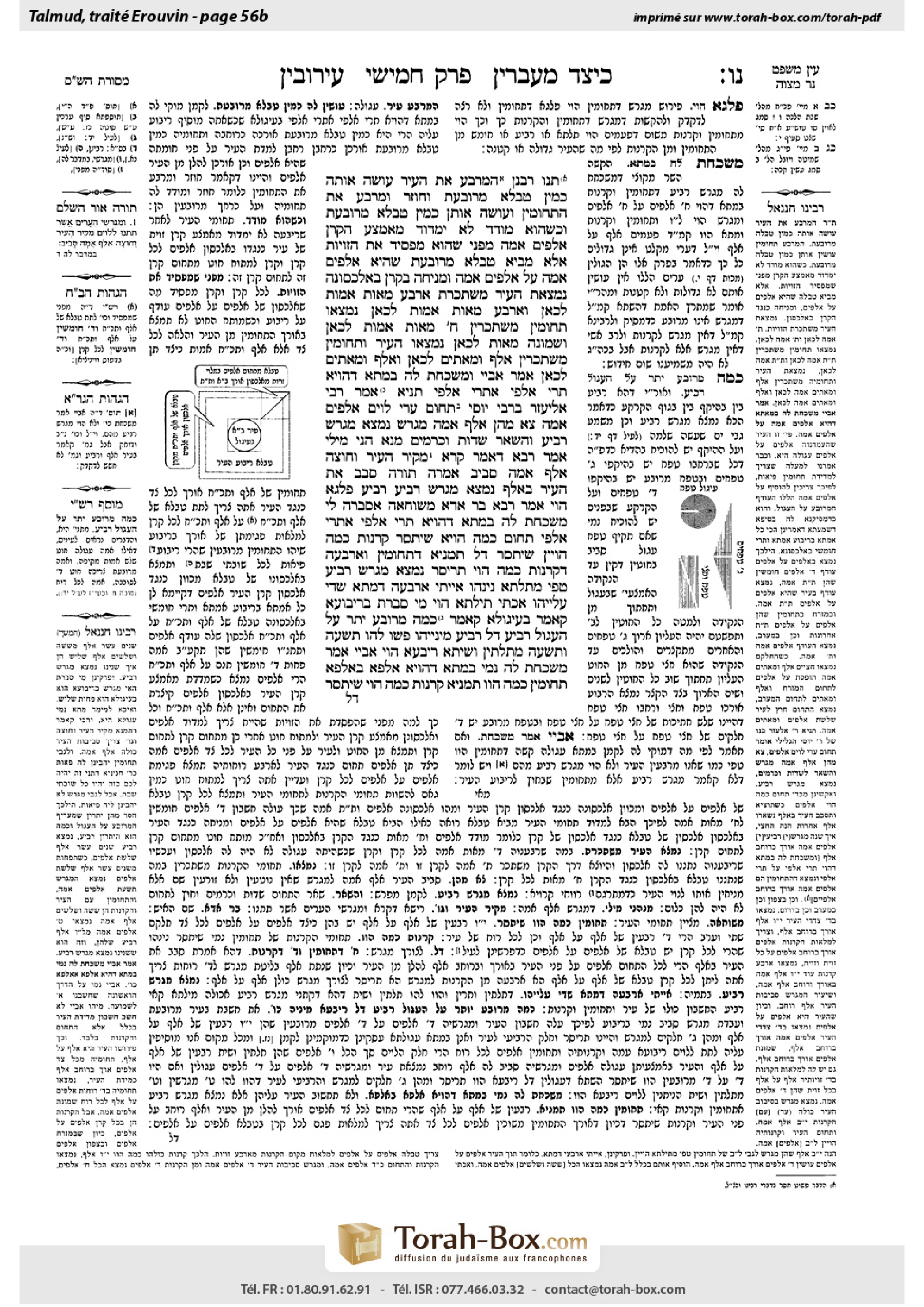
Scan : Torah-Box. Daf Study est un projet indépendant, sans affiliation ni approbation de Torah-Box ou de Sefaria.