Erouvin 68b en français · עירובין ס״ח ב
Traduction française du daf 68b du traité Erouvin (Eruvin 68b en anglais), avec le texte araméen, l’anglais de Sefaria et le scan de la page, pour étudier le Daf Yomi.
Ouvrir dans le lecteur interactifLire le daf du jour
Traduction française de Erouvin 68b
Les traductions françaises de Daf Study sont générées par IA à partir de l’édition anglaise de Sefaria. Elles peuvent contenir des erreurs : vérifie toujours un passage avec le texte source.
Que le Maître reste à sa place, c’est-à-dire dans la chambre des hommes, et qu’il renonce à ses droits sur sa cour en faveur des habitants de la cour du bébé, afin qu’ils puissent transporter l’eau d’une cour à l’autre. Ensuite, une fois l’eau déplacée, qu’ils renoncent à leurs droits en faveur du Maître, afin qu’il puisse de nouveau transporter des objets dans sa cour. En effet, Rav a dit : Si deux personnes qui habitent dans la même cour ont oublié d’établir un érouv, l’une peut renoncer à ses droits en faveur de l’autre quand elle en a besoin, puis la seconde peut renoncer à ses droits en faveur de la première quand elle en a besoin.
Rava répondit : À cet égard, je suis l’opinion de Shmuel, qui a dit : Une personne ne peut pas renoncer à ses droits en faveur de l’autre, puis la seconde renoncer à ses droits en faveur de la première.
Ravina souleva une difficulté : La raison de ces deux halakhot n’est-elle pas une seule et même chose ? Pourquoi ne peut-on pas renoncer à ses droits en faveur de l’autre, puis faire renoncer la seconde à ses droits en faveur de la première ? N’est-ce pas parce qu’on considère que, dès lors qu’il a renoncé à ses droits sur la cour, c’est comme s’il s’était complètement retiré de cet endroit et qu’il était désormais considéré comme l’habitant d’une autre cour, et que Shmuel tient qu’il n’y a pas de renonciation de droits d’une cour à une autre ? Dans ce cas, le Maître ne devrait pas non plus renoncer à ses droits sur sa cour. Si tu acceptes l’opinion de Shmuel concernant une renonciation ultérieure, tu devrais également accepter son opinion concernant la renonciation de droits d’une cour à une autre.
Rava répondit : Telle n’est pas la raison pour laquelle Shmuel interdit les renonciations successives. En l’occurrence, voici le fondement de son opinion : il s’agit d’éviter que les paroles des Sages ne deviennent un sujet de rire et de moquerie. S’il était permis à l’un de renoncer à ses droits en faveur de l’autre, puis au second de renoncer à ses droits en faveur du premier, le décret des Sages perdrait tout son sens.
La Guemara examine plus en détail la question soulevée dans la discussion précédente. Revenons au sujet lui-même : Rav a dit que si deux personnes qui habitent dans la même cour ont oublié d’établir un érouv, l’une peut renoncer à ses droits en faveur de l’autre, puis la seconde peut renoncer à ses droits en faveur de la première. Shmuel a dit : L’une ne peut pas renoncer à ses droits en faveur de l’autre, puis la seconde renoncer à ses droits en faveur de la première.
La Guemara propose : Rav et Shmuel sont-ils en désaccord sur le même point que les Sages et Rabbi Eliezer ? Il est enseigné ailleurs que Rabbi Eliezer et les Sages sont en désaccord sur la halakha dans le cas où l’un des habitants d’une cour a oublié de participer à l’érouv, puis renonce à ses droits sur la cour pendant Chabbat. Leur controverse porte sur le statut de la maison de cet habitant. Rabbi Eliezer estime qu’il lui est interdit de transporter des objets de sa maison vers la cour et de la cour vers sa maison, tandis que les autres habitants de la cour en ont le droit. Les Sages, en revanche, estiment qu’il est également interdit aux autres habitants de transporter des objets de sa maison vers la cour et de la cour vers sa maison.
La proposition est que Rav a formulé sa décision conformément à l’opinion des Sages, qui estiment que même celui qui renonce à ses droits sur sa cour ne renonce pas à ses droits sur sa maison. Puisqu’il ne s’est pas complètement retiré de la cour, les autres habitants peuvent ensuite renoncer à leurs droits en sa faveur. Shmuel, quant à lui, a formulé sa décision conformément à l’opinion de Rabbi Eliezer. Selon lui, cet habitant s’est complètement retiré de la cour. Par conséquent, les autres ne peuvent pas ensuite renoncer à leurs droits en sa faveur, puisqu’il n’est plus considéré comme un habitant de la cour.
La Guemara rejette cette comparaison : Rav aurait pu te dire : Ce que j’ai dit est également conforme à l’opinion de Rabbi Eliezer. Rabbi Eliezer a exprimé là son opinion — celui qui renonce à ses droits sur sa cour renonce aussi à ses droits sur sa maison — uniquement parce que les gens n’habitent pas dans une maison sans cour ; il est donc évident qu’il a également renoncé à ses droits sur sa maison. Mais a-t-il dit quoi que ce soit sur la question de savoir si la personne elle-même est considérée comme complètement retirée de la cour, au point que les autres ne pourraient ensuite renoncer à leurs droits en sa faveur ? Selon cette explication, l’opinion de Rav peut donc concorder avec la déclaration de Rabbi Eliezer.
Et Shmuel aurait pu dire : Ce que j’ai dit est également conforme à l’opinion des Sages. Les Sages n’ont exprimé leur opinion que dans ce cas, où ils ont statué : Ce à quoi il a renoncé, c’est-à-dire ses droits sur sa cour, est abandonné ; et ce à quoi il n’a pas renoncé, c’est-à-dire ses droits dans sa maison, ne l’est pas. Cependant, en ce qui concerne ce à quoi il a renoncé, il s’est complètement retiré. Par conséquent, tous reconnaissent que celui qui renonce à ses droits sur sa cour n’est plus considéré comme un habitant de cet endroit.
Rav Aḥa bar Ḥana a dit au nom de Rav Sheshet : Ce désaccord entre Rav et Shmuel correspond à un ancien désaccord entre tannaïm. Nous avons appris ailleurs dans une Michna : Si quelqu’un a renoncé à ses droits sur sa part de la cour en faveur des autres habitants, après avoir oublié la veille d’établir un érouv avec eux, puis transporte un objet de sa maison dans la cour, que ce soit involontairement, parce qu’il a oublié qu’il avait renoncé à ses droits, ou intentionnellement, il interdit de nouveau le transport à tous les habitants de la cour, car son acte annule sa renonciation. Telle est la déclaration de Rabbi Meïr. Rabbi Yehouda dit : S’il l’a fait intentionnellement, il interdit le transport aux autres habitants ; mais s’il l’a fait involontairement, il ne le leur interdit pas.
N’est-il pas vrai qu’ils sont en désaccord sur le point suivant : Rabbi Meïr estime que celui qui renonce à ses droits ne se retire pas complètement de son domaine ; par conséquent, l’un peut renoncer à ses droits en faveur de l’autre, puis le second peut renoncer à ses droits en faveur du premier. Il s’ensuit que même un transport involontaire annule la renonciation. Rabbi Yehouda, quant à lui, estime que celui qui renonce à ses droits se retire complètement de son domaine ; par conséquent, l’un ne peut pas renoncer à ses droits en faveur de l’autre, puis le second renoncer à ses droits en faveur du premier. Dans ce cas, seul un transport intentionnel peut annuler la renonciation.
Rav Aḥa bar Taḥalifa a dit au nom de Rava : Non, tous reconnaissent que celui qui renonce à ses droits se retire complètement de son domaine ; par conséquent, l’un ne peut pas renoncer à ses droits en faveur de l’autre, puis le second renoncer à ses droits en faveur du premier. Ici, ils sont en désaccord sur la question suivante : Les Sages ont-ils sanctionné celui qui transgresse involontairement à cause de celui qui transgresse intentionnellement ? Rabbi Meïr, qui affirme que cet habitant interdit toujours le transport aux autres, estime qu’ils ont sanctionné celui qui transgresse involontairement à cause de celui qui transgresse intentionnellement. Rabbi Yehouda, qui affirme que cet habitant n’interdit le transport aux autres que s’il a agi intentionnellement, estime qu’ils n’ont pas sanctionné celui qui transgresse involontairement à cause de celui qui transgresse intentionnellement.
Rav Ashi, contestant la réfutation de la Guemara, dit : Rav et Shmuel sont en désaccord comme le sont Rabbi Eliezer et les Sages.
Il a été dit dans la Michna que Rabban Gamliel a déclaré : Il y eut un incident concernant un certain Sadducéen qui habitait avec nous dans la même ruelle à Jérusalem et qui renonça à ses droits sur la ruelle avant Chabbat. La Michna poursuit en discutant de la manière dont la ruelle peut être utilisée pendant Chabbat et de la possibilité de l’utiliser. La Guemara pose d’abord une question : Un Sadducéen ? Qui l’a mentionné ? Jusqu’ici, la Michna ne parlait que d’un non-Juif ; pourquoi Rabban Gamliel évoque-t-il donc un incident impliquant un Sadducéen ?
La Guemara répond : La Michna est incomplète. Il lui manque un élément important, et voici ce qu’elle enseigne : Le statut juridique d’un Sadducéen est semblable à celui d’un non-Juif, et Rabban Gamliel dit : Le statut juridique d’un Sadducéen n’est pas semblable à celui d’un non-Juif. Rabban Gamliel a ajouté : Il y eut un incident concernant un certain Sadducéen qui habitait avec nous dans la même ruelle à Jérusalem et qui renonça à ses droits sur la ruelle avant Chabbat ; notre père nous dit alors : Dépêchez-vous de sortir vos ustensiles dans la ruelle afin d’en prendre possession avant qu’il ne change d’avis et ne sorte ses ustensiles ; dans ce cas, il vous interdirait d’utiliser toute la ruelle.
De même, n’a-t-il pas été enseigné dans une baraïta que le statut du Sadducéen fait l’objet d’un désaccord entre tannaïm ? Si quelqu’un habite dans la même ruelle qu’un non-Juif, un Sadducéen ou un Boéthusien, ils lui interdisent de transporter des objets. Rabban Gamliel dit : Un Sadducéen ou un Boéthusien n’interdit pas le transport. Il y eut un incident concernant un certain Sadducéen qui habitait avec Rabban Gamliel dans la même ruelle à Jérusalem et qui renonça à ses droits sur la ruelle avant Chabbat. Rabban Gamliel dit à ses fils : Dépêchez-vous de sortir les ustensiles que vous voulez sortir et de rentrer ceux que vous voulez rentrer, avant que cet individu répugnant ne rétracte sa renonciation, sorte ses ustensiles et vous interdise d’utiliser la ruelle, puisqu’il avait renoncé à ses droits en votre faveur. Telle est la déclaration de Rabbi Meïr.
Rabbi Yehouda dit : Rabban Gamliel leur parla en employant une formulation différente : Dépêchez-vous de faire dans la ruelle tout ce que vous avez à faire avant Chabbat, avant la tombée de la nuit, car il vous interdira alors d’utiliser la ruelle.
La Guemara poursuit l’analyse de cette baraïta. Le Maître a dit précédemment : Sortez les ustensiles que vous voulez sortir et rentrez ceux que vous voulez rentrer, avant que cet individu répugnant ne sorte ses ustensiles et ne vous interdise d’utiliser la ruelle. La Guemara pose une question : Faut-il en conclure que, selon Rabbi Meïr, s’ils ont sorti leurs ustensiles et qu’ensuite, pendant Chabbat, le non-Juif ou le Sadducéen a sorti ses ustensiles, il ne leur interdit pas de transporter des objets ?
Texte source et traduction anglaise
עירובין ס״ח ב · texte araméen et hébreu
נִיתֵּיב מָר בְּדוּכְתֵּיהּ, וְנִיבַטֵּיל לְהוּ לְדִידְהוּ, וְנִיהְדְּרוּ אִינְהוּ וְנִיבַטְּלוּ לֵיהּ לְמָר, דְּהָא אָמַר רַב: מְבַטְּלִין, וְחוֹזְרִין וּמְבַטְּלִין.
אֲנָא בְּהָא כִּשְׁמוּאֵל סְבִירָא לִי, דְּאָמַר: אֵין מְבַטְּלִין וְחוֹזְרִין וּמְבַטְּלִין.
וְלָאו חַד טַעְמָא הוּא? מַאי טַעְמָא אֵין מְבַטְּלִין וְחוֹזְרִין וּמְבַטְּלִין — לָאו מִשּׁוּם דְּכֵיוָן דְּבַטְּלֵיהּ לִרְשׁוּתֵיהּ, אִסְתַּלַּק לֵיהּ מֵהָכָא לִגְמָרֵי, וְהָוֵה לֵיהּ כְּבֶן חָצֵר אַחֶרֶת, וְאֵין בִּיטּוּל רְשׁוּת מֵחָצֵר לְחָצֵר. מָר נָמֵי, לָא נִיבַטֵּיל.
הָתָם הַיְינוּ טַעְמָא: כִּי הֵיכִי דְּלָא לֶיהֱוֵי מִלְּתָא דְּרַבָּנַן כְּחוּכָא וְאִטְלוּלָא.
גּוּפָא, רַב אָמַר: מְבַטְּלִין וְחוֹזְרִין וּמְבַטְּלִין, וּשְׁמוּאֵל אָמַר: אֵין מְבַטְּלִין וְחוֹזְרִין וּמְבַטְּלִין.
לֵימָא רַב וּשְׁמוּאֵל בִּפְלוּגְתָּא דְּרַבָּנַן וְרַבִּי אֱלִיעֶזֶר קָא מִיפַּלְגִי.
דְּרַב דְּאָמַר כְּרַבָּנַן וּשְׁמוּאֵל דְּאָמַר כְּרַבִּי אֱלִיעֶזֶר.
אָמַר לְךָ רַב, אֲנָא דַּאֲמַרִי אֲפִילּוּ לְרַבִּי אֱלִיעֶזֶר: עַד כָּאן לָא קָאָמַר רַבִּי אֱלִיעֶזֶר הָתָם הַמְּבַטֵּל רְשׁוּת חֲצֵירוֹ — רְשׁוּת בֵּיתוֹ בִּיטֵּל, מִשּׁוּם דִּבְבַיִת בְּלָא חָצֵר לָא דָּיְירִי אִינָשֵׁי. אֲבָל לְעִנְיַן אִיסְתַּלּוֹקֵי, מִי אָמַר?
וּשְׁמוּאֵל אָמַר: אֲנָא דַּאֲמַרִי אֲפִילּוּ כְּרַבָּנַן, עַד כָּאן לָא קָאָמְרִי רַבָּנַן הָתָם אֶלָּא מַאי דְּבַטֵּיל בַּטֵּיל, וּדְלָא בַּטֵּיל לָא בַּטֵּיל. אֲבָל מַאי דְּבַטֵּיל — מִיהָא אִיסְתַּלַּק לִגְמָרֵי.
אָמַר רַב אַחָא בַּר חָנָא אָמַר רַב שֵׁשֶׁת, כְּתַנָּאֵי: מִי שֶׁנָּתַן רְשׁוּתוֹ, וְהוֹצִיא, בֵּין בְּשׁוֹגֵג בֵּין בְּמֵזִיד — אוֹסֵר, דִּבְרֵי רַבִּי מֵאִיר. רַבִּי יְהוּדָה אוֹמֵר: בְּמֵזִיד — אוֹסֵר, בְּשׁוֹגֵג — אֵינוֹ אוֹסֵר.
מַאי לָאו, בְּהָא קָמִיפַּלְגִי: דְּמָר סָבַר מְבַטְּלִין וְחוֹזְרִין וּמְבַטְּלִין, וּמַר סָבַר אֵין מְבַטְּלִין וְחוֹזְרִין וּמְבַטְּלִין.
אָמַר רַב אַחָא בַּר תַּחְלִיפָא מִשְּׁמֵיהּ דְּרָבָא: לָא, דְּכוּלֵּי עָלְמָא אֵין מְבַטְּלִין וְחוֹזְרִין וּמְבַטְּלִין, וְהָכָא בְּקָנְסוּ שׁוֹגֵג אַטּוּ מֵזִיד קָא מִיפַּלְגִי. מָר סָבַר: קָנְסוּ שׁוֹגֵג אַטּוּ מֵזִיד, וּמָר סָבַר: לֹא קָנְסוּ שׁוֹגֵג אַטּוּ מֵזִיד.
רַב אָשֵׁי אָמַר: רַב וּשְׁמוּאֵל בִּפְלוּגְתָּא דְּרַבִּי אֱלִיעֶזֶר וְרַבָּנַן קָא מִיפַּלְגִי.
אָמַר רַבָּן גַּמְלִיאֵל: מַעֲשֶׂה בְּצַדּוּקִי אֶחָד שֶׁהָיָה דָּר עִמָּנוּ. צַדּוּקִי מַאן דְּכַר שְׁמֵיהּ?
חַסּוֹרֵי מִיחַסְּרָא וְהָכִי קָתָנֵי: צַדּוּקִי הֲרֵי הוּא כְּגוֹי, וְרַבָּן גַּמְלִיאֵל אוֹמֵר: צַדּוּקִי אֵינוֹ כְּגוֹי. וְאָמַר רַבָּן גַּמְלִיאֵל: מַעֲשֶׂה בְּצַדּוּקִי אֶחָד שֶׁהָיָה דָּר עִמָּנוּ בְּמָבוֹי בִּירוּשָׁלַיִם, וְאָמַר לָנוּ אַבָּא: מַהֲרוּ וְהוֹצִיאוּ אֶת הַכֵּלִים לַמָּבוֹי, עַד שֶׁלֹּא יוֹצִיא וְיֶאֱסֹר עֲלֵיכֶם.
וְהָתַנְיָא: הַדָּר עִם הַנׇּכְרִי, צַדּוּקִי, וּבַיְתּוֹסִי — הֲרֵי אֵלּוּ אוֹסְרִין עָלָיו. (רַבָּן גַּמְלִיאֵל אוֹמֵר: צַדּוּקִי וּבַיְתּוֹסִי אֵינָן אוֹסְרִין.) וּמַעֲשֶׂה בְּצַדּוּקִי אֶחָד שֶׁהָיָה דָּר עִם רַבָּן גַּמְלִיאֵל בְּמָבוֹי בִּירוּשָׁלַיִם, וְאָמַר לָהֶם רַבָּן גַּמְלִיאֵל לְבָנָיו: בָּנַי, מַהֲרוּ וְהוֹצִיאוּ מַה שֶּׁאַתֶּם מוֹצִיאִין וְהַכְנִיסוּ מַה שֶּׁאַתֶּם מַכְנִיסִין, עַד שֶׁלֹּא יוֹצִיא הַתּוֹעֵב הַזֶּה וְיֶאֱסֹר עֲלֵיכֶם, שֶׁהֲרֵי בִּיטֵּל רְשׁוּתוֹ לָכֶם, דִּבְרֵי רַבִּי מֵאִיר.
רַבִּי יְהוּדָה אוֹמֵר: בְּלָשׁוֹן אַחֶרֶת — מַהֲרוּ וַעֲשׂוּ צוֹרְכֵיכֶם בַּמָּבוֹי, עַד שֶׁלֹּא תֶּחְשַׁךְ וְיֶאֱסֹר עֲלֵיכֶם.
אָמַר מָר: הוֹצִיאוּ מַה שֶּׁאַתֶּם מוֹצִיאִין, וְהַכְנִיסוּ מַה שֶּׁאַתֶּם מַכְנִיסִין, עַד שֶׁלֹּא יוֹצִיא הַתּוֹעֵב הַזֶּה וְיֶאֱסֹר עֲלֵיכֶם. לְמֵימְרָא דְּכִי מַפְּקִי אִינְהוּ וַהֲדַר מַפֵּיק אִיהוּ לָא אָסַר?!
Eruvin 68b · traduction anglaise de Sefaria
let the Master remain in his place, i.e., in the men’s chamber, and renounce his rights to his courtyard in favor of the residents of the baby’s courtyard, so that they may transfer the water from one courtyard to the other. And then, after the water has been moved, let them renounce their rights in favor of the Master, so that he may once again carry in his courtyard. As Rav said: If two people who live in the same courtyard forgot to establish an eiruv, one person may renounce his rights in favor of the other when he needs it, and the second person may then renounce his rights in favor of the first when he needs it.
Rava replied: In this regard, I hold in accordance with the opinion of Shmuel, who said: One person may not renounce his rights in favor of the other and then subsequently have the second person renounce his rights in favor of the first.
Ravina raised a difficulty: Isn’t the reason for both halakhot one and the same? What is the reason that one may not renounce his rights in favor of the other and then subsequently have the other renounce his rights in favor of the first? Is it not because it is assumed that since he renounced his rights to the courtyard, it is as if he has completely removed himself from here, and he is now considered like the resident of a different courtyard, and Shmuel holds that there is no renouncing of rights from one courtyard to another? If so, the Master should likewise not renounce his rights to his courtyard. If you accept Shmuel’s opinion with regard to subsequent renouncing, you should likewise accept his opinion with regard to renunciation of rights from one courtyard to another.
Rava responded: That is not Shmuel’s reason for prohibiting subsequent renunciations. There, this is the rationale for his opinion: So that the words of the Sages should not be a subject of laughter and mockery. If it is permitted for one person to renounce his rights in favor of another and then for the second person to renounce his rights in favor of the first, the Sages’ enactment will lose all meaning.
The Gemara proceeds to examine in greater detail the issue raised in the previous discussion. Returning to the matter itself, Rav said: If two people who live in the same courtyard forgot to establish an eiruv, one may renounce his rights in favor of the other, and then the second person may renounce his rights in favor of the first. And Shmuel said: One may not renounce his rights in favor of the other and then subsequently have the second person renounce his rights in favor of the first.
The Gemara suggests: Let us say that Rav and Shmuel disagree about the same point of dispute as the Rabbis and Rabbi Eliezer. Elsewhere it is taught that Rabbi Eliezer and the Rabbis disagree with regard to the halakha in a case where one of the residents of a courtyard forgot to join in the eiruv, but subsequently renounced his rights to the courtyard on Shabbat. The dispute revolves around the status of this resident’s house. Rabbi Eliezer holds that it is prohibited for him to carry in and out of his house, while the other residents of the courtyard are permitted to do so. However, the Rabbis hold that the other residents are prohibited from carrying in and out of his house as well.
The suggestion is that Rav stated his ruling in accordance with the opinion of the Rabbis, who hold that even one who renounces his rights to his courtyard does not renounce his rights to his house. As he has not completely removed himself from the courtyard, the other residents may later go back and renounce their rights in his favor. And Shmuel stated his ruling in accordance with the opinion of Rabbi Eliezer. He maintains that this resident has completely removed himself from the courtyard. Therefore, there is no possibility of others subsequently renouncing their rights in his favor, as he is no longer considered a resident of the courtyard.
The Gemara rejects this comparison: Rav could have said to you: What I said is even in accordance with the opinion of Rabbi Eliezer. Rabbi Eliezer stated his opinion there, that one who renounces his rights to his courtyard also renounces his rights to his house, only because people do not live in a house without a courtyard, and therefore it is evident that he has renounced his rights to his house as well. However, with regard to whether or not the person himself is considered entirely removed from the courtyard to the extent that the others would be unable to then renounce their rights in his favor, did he state this? According to this explanation, it is possible that Rav’s opinion concurs with Rabbi Eliezer’s statement.
And Shmuel could have said: What I said is even in accordance with the opinion of the Rabbis. The Rabbis stated their opinion only there, where they ruled: That which he has renounced, i.e., his rights to his courtyard, is renounced; and that which he has not renounced, i.e., his rights in his house, is not renounced. However, from that which he has renounced, he has removed himself completely. Consequently, all agree that one who renounces his rights to his courtyard is no longer considered a resident of that place.
Rav Aḥa bar Ḥana said that Rav Sheshet said: This dispute between Rav and Shmuel is like an earlier dispute between tanna’im. We learned elsewhere in a mishna: If one gave away his rights to his share of the courtyard to the other residents of the courtyard by renouncing them after having forgotten to establish an eiruv with the other residents on the previous day, and then he carried something out from his house into the courtyard, whether he did so unwittingly, forgetting that he had renounced his rights, or intentionally, he once again renders carrying prohibited for all the residents of the courtyard, as his action cancels his renunciation. This is the statement of Rabbi Meir. Rabbi Yehuda says: If he did so intentionally, he renders carrying prohibited for the other residents; but if he did it unwittingly, he does not render carrying prohibited for them.
What, is it not that they disagree with regard to this: One Sage, Rabbi Meir, holds that a person who renounces his rights does not remove himself completely from his domain, and therefore one person may renounce his rights in favor of another, and the second person may then renounce his rights in favor of the first. As a result, even an inadvertent act of carrying serves to cancel the renunciation. And one Sage, Rabbi Yehuda, holds that one who renounces his rights removes himself completely from his domain, and therefore one person may not renounce his rights in favor of another and then subsequently have the second person renounce his rights in favor of the first. In that case, only an intentional act of carrying can cancel the renunciation.
Rav Aḥa bar Taḥalifa said in the name of Rava: No, everyone agrees that a person who renounces his rights removes himself completely from his domain, and therefore one person may not renounce his rights in favor of another and then subsequently have the second person renounce his rights in favor of the first. And here, they disagree with regard to the question: Did the Sages penalize an unwitting offender due to an intentional offender? One Sage, Rabbi Meir, who states that the resident always renders carrying prohibited for the others, holds that they penalized an unwitting offender due to an intentional offender. And one Sage, Rabbi Yehuda, who states that the resident renders carrying prohibited for the others only if he acted intentionally, holds that they did not penalize an unwitting offender due to an intentional offender.
Rav Ashi, disagreeing with the Gemara’s refutation, said: Rav and Shmuel disagree in the same dispute as do Rabbi Eliezer and the Rabbis.
It was stated in the mishna that Rabban Gamliel said: There was an incident involving a certain Sadducee who lived with us in the same alleyway in Jerusalem, who renounced his rights in the alleyway before Shabbat. The mishna then continues with a discussion about how and whether the alleyway may be used on Shabbat. The Gemara first poses a question: A Sadducee; who mentioned his name? The mishna had thus far spoken only of a gentile, so why does Rabban Gamliel invoke an incident involving a Sadducee?
The Gemara answers: The mishna is incomplete. It is missing an important element, and this is what it is teaching: The legal status of a Sadducee is like that of a gentile, and Rabban Gamliel says: The legal status of a Sadducee is not like that of a gentile. And Rabban Gamliel further said: There was an incident involving a certain Sadducee who lived with us in the same alleyway in Jerusalem, who renounced his rights in the alleyway before Shabbat, and Father said to us: Hurry and take out your utensils to the alleyway to establish possession of it before he changes his mind and takes out his utensils, in which case he would render it prohibited for you to use the entire alleyway.
And similarly, wasn’t it taught in a baraita that the status of a Sadducee is a matter of dispute between tanna’im: If one lives with a gentile, a Sadducee, or a Boethusian in the same alleyway, they render carrying prohibited for him. Rabban Gamliel says: A Sadducee or a Boethusian do not prohibit one from carrying. There was an incident involving a certain Sadducee who lived with Rabban Gamliel in the same alleyway in Jerusalem, and he renounced his rights to the alleyway before Shabbat. Rabban Gamliel said to his sons: Hurry and take out those utensils that you wish to take out, and bring in those utensils that you wish to bring in, before that loathsome person retracts his renunciation and takes out his utensils and prohibits you from using the alleyway, as he renounced his rights in your favor; this is the statement of Rabbi Meir.
Rabbi Yehuda says: Rabban Gamliel spoke to them with a different formulation, saying: Hurry and do whatever you must do in the alleyway prior to Shabbat, before night falls and he prohibits you from using the alleyway.
The Gemara proceeds to analyze this baraita. The Master said previously: Take out those utensils that you wish to take out, and bring in those utensils that you wish to bring in, before that loathsome person takes out his utensils and prohibits you from using the alleyway. The Gemara poses a question: Is that to say that, according to Rabbi Meir, if they took out their utensils and then afterward the gentile or Sadducee took out his utensils on Shabbat, he does not render carrying prohibited for them?
Texte de Sefaria : William Davidson Edition - Vocalized Aramaic (CC BY NC) ; William Davidson Edition - English (CC BY NC).
Scan de Erouvin 68b
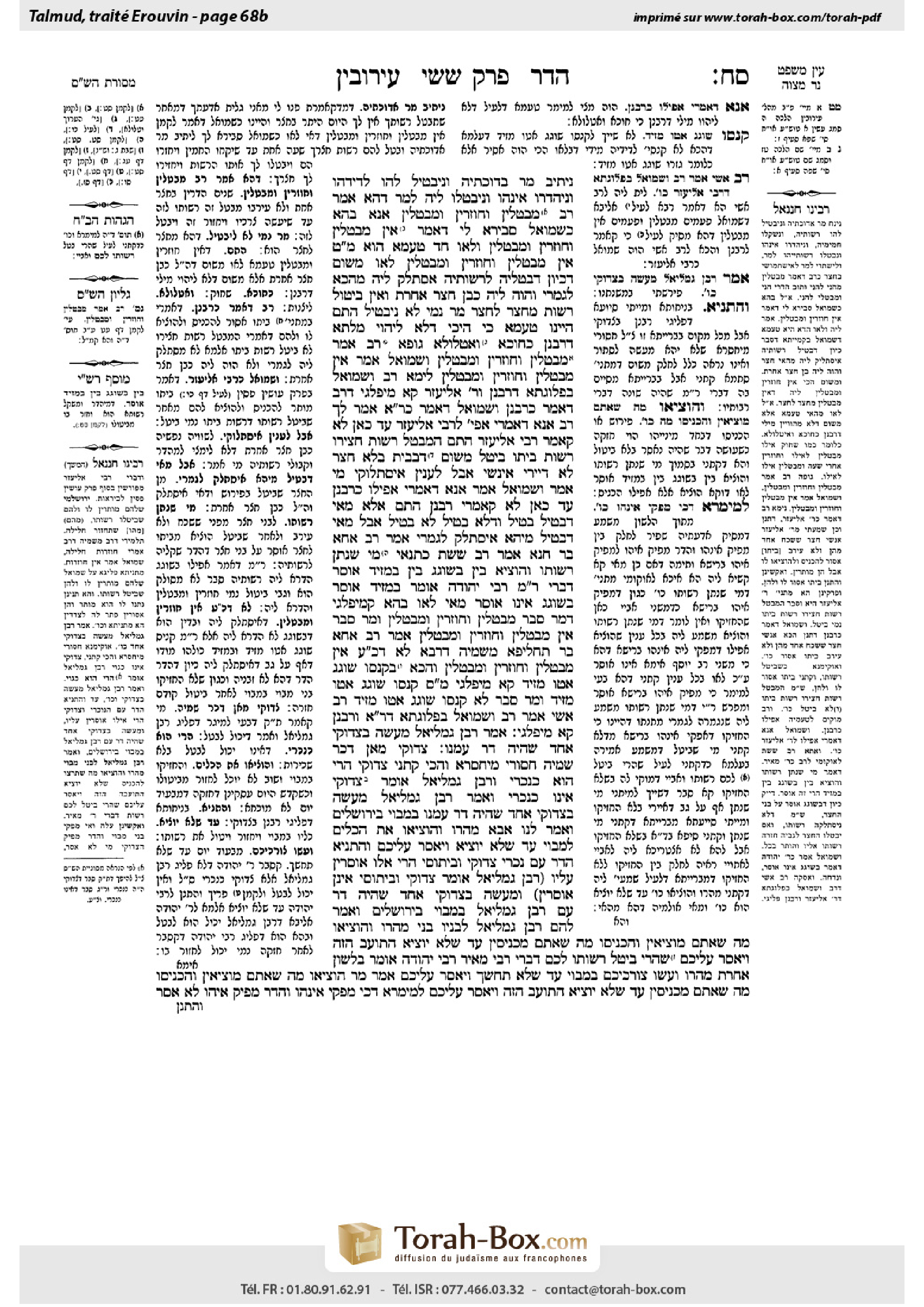
Scan : Torah-Box. Daf Study est un projet indépendant, sans affiliation ni approbation de Torah-Box ou de Sefaria.