Guittin 19a en français · גיטין י״ט א
Traduction française du daf 19a du traité Guittin (Gittin 19a en anglais), avec le texte araméen, l’anglais de Sefaria et le scan de la page, pour étudier le Daf Yomi.
Ouvrir dans le lecteur interactifLire le daf du jour
Traduction française de Guittin 19a
Les traductions françaises de Daf Study sont générées par IA à partir de l’édition anglaise de Sefaria. Elles peuvent contenir des erreurs : vérifie toujours un passage avec le texte source.
Rabbi Shimon, qui a autorisé l’utilisation d’un acte de divorce rédigé le jour et signé la nuit, mérite que l’on s’appuie sur lui en cas d’urgence. Par conséquent, dès qu’un tel acte de divorce a été rédigé et remis, la femme est divorcée.
La Guemara objecte : Mais Reish Lakish n’a-t-il pas dit que Rabbi Shimon ne reconnaît la validité d’un tel acte de divorce que s’il est signé immédiatement, mais pas si l’on attend jusqu’à dix jours à partir de maintenant ? La Guemara répond : Sur cette question, à savoir si les autres doivent signer immédiatement, Rabbi Yehoshua ben Levi suit l’opinion de Rabbi Yoḥanan, qui estime qu’ils peuvent signer après un délai.
La Guemara objecte : Mais Rabbi Yoḥanan n’a-t-il pas dit que deux d’entre eux font office de témoins et que tous les autres ne signent l’acte de divorce qu’en raison de la stipulation ? Il est clair que Rabbi Yehoshua ben Levi ne suit pas l’opinion de Rabbi Yoḥanan, puisqu’il se soucie des autres témoins et ne reconnaît la validité de l’acte de divorce qu’en cas d’urgence. La Guemara répond : Sur ce point, c’est-à-dire pour expliquer pourquoi les personnes supplémentaires doivent signer, il suit l’opinion de Reish Lakish, selon laquelle tous font office de témoins.
Michna : On peut rédiger un acte de divorce avec toute matière permettant d’écrire : avec du deyo, de la peinture [sam], du sikra, du komos, du kankantom ou toute matière qui produit une écriture indélébile. Toutefois, on ne peut pas écrire avec d’autres liquides, ni avec du jus de fruit, ni avec une matière qui ne produit pas une écriture indélébile.
De même, concernant le support lui-même, on peut écrire sur n’importe quel matériau, même sur une feuille d’olivier ou sur la corne d’une vache. Dans ce dernier cas, l’acte est valide s’il lui donne la vache entière. De même, on peut rédiger un acte de divorce sur la main d’un esclave, et l’acte est valide s’il lui donne l’esclave. Rabbi Yosei HaGelili est en désaccord et dit : On ne peut rédiger un acte de divorce sur aucun être vivant, ni l’écrire sur un aliment.
Guemara : La Guemara commence par expliquer les termes employés dans la Michna : deyo désigne ce qu’on appelle deyota, « encre », en araméen. Sam désigne samma, « arsenic ». Concernant le sikra, Rabba bar bar Ḥana dit : En araméen, on l’appelle sikreta, « colorant rouge », dérivé du minium, également connu sous le nom de plomb rouge. Le komos, une résine d’arbre, s’appelle kuma en araméen. Concernant le kankantom, Rabba bar bar Ḥana rapporte que Shmuel a dit : C’est la substance noire utilisée par les cordonniers, le sulfate de fer.
La Michna enseigne qu’on peut rédiger un acte de divorce avec toute matière qui produit une écriture indélébile. La Guemara demande : Qu’ajoute cette déclaration ? La Guemara répond : Elle ajoute ce que Rabbi Ḥanina a enseigné : si quelqu’un l’a écrit avec du mei teriya ou avec de l’eau dans laquelle des noix de galle [aftza] ont trempé, l’acte est valide, car l’écriture est indélébile. Rabbi Ḥiyya enseigne : S’il l’a écrit avec du plomb, du charbon ou de la peinture noire, l’acte est valide.
§ Une discussion connexe sur différentes formes d’écriture a été rapportée : dans le cas de celui qui repasse à l’encre des lettres écrites avec un colorant rouge pendant Chabbat, Rabbi Yoḥanan et Reish Lakish disent tous deux qu’il est passible de deux sacrifices expiatoires : l’un pour avoir enfreint l’interdiction d’écrire pendant Chabbat, puisqu’il écrit alors les lettres à l’encre, et l’autre pour avoir enfreint l’interdiction d’effacer pendant Chabbat, puisqu’en écrivant il efface ce qui est écrit avec le colorant rouge. Ils conviennent aussi que, dans le cas d’une écriture à l’encre repassée à l’encre, ou d’un colorant rouge repassé avec le même colorant, tout le monde s’accorde à dire qu’il est exempt, car son écriture n’a rien changé. Cependant, s’il repasse au colorant rouge une écriture à l’encre, certains disent qu’il est passible et d’autres qu’il est exempt.
La Guemara explique ces opinions : certains disent qu’il est passible, car il efface l’écriture originale, de meilleure qualité. D’autres disent qu’il est exempt, car il détruit, et celui qui agit de manière destructrice est exempt, puisqu’il n’a pas accompli pendant Chabbat un travail constructif et intentionnel.
Ce désaccord porte sur les halakhot de Chabbat. Concernant la signature de documents, Reish Lakish posa à Rabbi Yoḥanan la question suivante : si des témoins ne savent pas signer leurs noms, quelle est la halakha ? Peut-on écrire leurs noms pour eux avec du colorant rouge, puis les laisser repasser dessus à l’encre ? La question est de savoir si l’écriture supérieure, qui n’est pas directement sur le document mais au-dessus d’une autre écriture, est considérée comme une écriture ou non. Il lui répondit : Ce n’est pas une écriture. Par conséquent, on ne peut pas procéder ainsi pour des témoins qui ne savent pas signer.
Reish Lakish lui dit : Notre maître, c’est-à-dire Rabbi Yoḥanan, ne nous a-t-il pas enseigné que l’écriture supérieure est considérée comme une écriture au regard des halakhot de Chabbat ? Rabbi Yoḥanan lui répondit : Et parce que nous établissons une analogie entre les halakhot relatives aux actes de divorce et celles de Chabbat, allons-nous agir ainsi et enseigner qu’un acte de divorce peut être rédigé de cette manière ?
§ Un désaccord a été rapporté sur la question suivante : que faut-il faire pour des témoins qui ne savent pas signer ? Rav dit : On découpe du papier vierge pour eux ; autrement dit, on confectionne un pochoir de leurs noms dans du papier vierge et on le place sur l’acte de divorce. Les témoins remplissent alors les vides à l’encre, de sorte que leurs noms apparaissent sur le document. Shmuel dit : On écrit d’abord leurs noms sur le document avec du plomb, puis les témoins repassent sur ces lettres.
La Guemara demande : Peut-on vraiment penser qu’on écrit leurs noms pour eux avec du plomb ? Mais Rabbi Ḥiyya n’a-t-il pas enseigné que si quelqu’un a écrit l’acte avec du plomb, du charbon ou de la peinture noire, l’acte est valide ? Il ressort de cette baraïta que l’écriture au plomb est considérée comme une forme d’écriture valide et, comme l’a enseigné Rabbi Yoḥanan, si l’on écrit par-dessus une autre écriture, la seconde écriture n’est pas acceptée pour la signature de documents. La Guemara répond : Il n’y a pas de difficulté. Le cas où Shmuel a autorisé les témoins à signer par-dessus une écriture au plomb s’applique uniquement lorsque la première écriture a été faite avec du plomb lui-même, lequel n’est pas considéré comme une écriture à part entière. La déclaration de Rabbi Ḥiyya, selon laquelle l’écriture est valable pour rédiger un acte de divorce, s’applique uniquement lorsque la première écriture a été faite avec de l’eau plombée, c’est-à-dire de l’eau noircie avec du plomb.
Rabbi Abbahu dit : Une solution consisterait à écrire les noms de ces témoins avec de l’eau de galle [mei milin], puis à les faire repasser sur leurs noms à l’encre. La Guemara objecte : Mais Rabbi Ḥanina n’a-t-il pas enseigné que si quelqu’un a rédigé un acte de divorce avec du mei teriya ou avec de l’eau dans laquelle des noix de galle ont trempé, l’acte est valide ? Puisqu’il en est ainsi, toute écriture supplémentaire par-dessus l’écriture à l’eau de galle ne devrait pas être acceptée comme une signature valide.
La Guemara répond : Il n’y a pas de difficulté. La proposition de Rabbi Abbahu, selon laquelle on prépare le document en écrivant les noms des témoins avec de l’eau de galle, concerne un cas où le parchemin a été traité avec des noix de galle. La déclaration de Rabbi Ḥanina, selon laquelle l’eau de galle peut être utilisée seule pour rédiger un acte de divorce, concerne un cas où le parchemin n’a pas été traité avec des noix de galle. La raison de cette différence est que l’eau de galle n’est pas indélébile lorsqu’elle est appliquée sur de l’eau de galle, c’est-à-dire sur un parchemin traité avec des noix de galle. Par conséquent, si le parchemin a été traité avec des noix de galle, les noms des témoins écrits à l’eau de galle ne seront pas indélébiles, et les témoins pourront signer par-dessus. Lorsque la baraïta indique que les témoins peuvent signer leurs noms à l’eau de galle, elle se réfère à un cas où le parchemin n’a pas été traité avec des noix de galle ; la signature à l’eau de galle sera donc indélébile.
Rav Pappa dit : Une solution consisterait à écrire les noms de ces témoins avec de la salive, puis à les faire repasser à l’encre. Rav Pappa donna cette instruction à Pappa le bouvier, qui ne savait pas signer son nom : le tribunal devait écrire son nom avec de la salive, puis il devait le repasser à l’encre. La Guemara précise : Cette mesure, qui permet aux témoins de repasser sur leurs noms, ne s’applique qu’aux actes de divorce, car on craint que les témoins ne soient pas retrouvés et que la femme ne puisse pas se remarier. En revanche, les Sages n’ont pas autorisé cette mesure pour les documents financiers ; il faut plutôt trouver des témoins qui savent signer leurs noms.
Il est rapporté qu’un certain homme mit cette pratique en œuvre et autorisa des témoins à repasser sur leurs noms dans le cas d’autres documents, qui n’étaient pas des actes de divorce ; Rav Kahana ordonna qu’il soit flagellé pour cela.
Texte source et traduction anglaise
גיטין י״ט א · texte araméen et hébreu
כְּדַאי הוּא רַבִּי שִׁמְעוֹן לִסְמוֹךְ עָלָיו בִּשְׁעַת הַדְּחָק.
וְהָאָמַר רֵישׁ לָקִישׁ: לֹא הִכְשִׁיר רַבִּי שִׁמְעוֹן אֶלָּא לְאַלְתַּר, אֲבָל מִכָּאן וְעַד עֲשָׂרָה יָמִים – לָא! בְּהַהִיא, כְּרַבִּי יוֹחָנָן סְבִירָא לֵיהּ.
וְהָאָמַר רַבִּי יוֹחָנָן: שְׁנַיִם מִשּׁוּם עֵדִים, וְכוּלָּן מִשּׁוּם תְּנַאי! בְּהָהִיא, כְּרֵישׁ לָקִישׁ סְבִירָא לֵיהּ.
מַתְנִי׳ בַּכֹּל כּוֹתְבִים – בִּדְיוֹ, בְּסַם, בְּסִיקְרָא, וּבְקוֹמוֹס, וּבְקַנְקַנְתּוֹם, וּבְכׇל דָּבָר שֶׁהוּא שֶׁל קַיָּימָא. אֵין כּוֹתְבִין לֹא בְּמַשְׁקִין, וְלֹא בְּמֵי פֵירוֹת, וְלֹא בְּכׇל דָּבָר שֶׁאֵינוֹ מִתְקַיֵּים.
עַל הַכֹּל כּוֹתְבִין – עַל הֶעָלֶה שֶׁל זַיִת; וְעַל הַקֶּרֶן שֶׁל פָּרָה – וְנוֹתֵן לָהּ אֶת הַפָּרָה; עַל יָד שֶׁל עֶבֶד – וְנוֹתֵן לָהּ אֶת הָעֶבֶד. רַבִּי יוֹסֵי הַגְּלִילִי אוֹמֵר: אֵין כּוֹתְבִין לֹא עַל דָּבָר שֶׁיֵּשׁ בּוֹ רוּחַ חַיִּים, וְלֹא עַל הָאוֹכָלִים.
גְּמָ׳ דְּיוֹ – דְּיוֹתָא. סַם – סַמָּא. סִיקְרָא – אָמַר רַבָּה בַּר בַּר חָנָה: סְקַרְתָּא שְׁמַהּ. קוֹמוֹס – קוֹמָא. קַנְקַנְתּוֹם – אָמַר רַבָּה בַּר בַּר חָנָה אָמַר שְׁמוּאֵל: חַרְתָּא דְאוּשְׁכָּפֵי.
וּבְכׇל דָּבָר שֶׁהוּא מִתְקַיֵּים וְכוּ׳: לְאֵתוֹיֵי מַאי? לְאֵתוֹיֵי הָא דְתָנֵי רַבִּי חֲנִינָא: כְּתָבוֹ בְּמֵי טַרְיָא וְאַפְצָא – כָּשֵׁר. תָּנֵי רַבִּי חִיָּיא: כְּתָבוֹ בַּאֲבָר, בִּשְׁחוֹר וּבְשִׁיחוֹר – כָּשֵׁר.
אִיתְּמַר: הַמַּעֲבִיר דְּיוֹ עַל גַּבֵּי סִיקְרָא, בַּשַּׁבָּת; רַבִּי יוֹחָנָן וְרֵישׁ לָקִישׁ דְּאָמְרִי תַּרְוַיְיהוּ – חַיָּיב שְׁתַּיִם: אַחַת מִשּׁוּם כּוֹתֵב, וְאַחַת מִשּׁוּם מוֹחֵק. דְּיוֹ עַל גַּבֵּי דְּיוֹ, סִיקְרָא עַל גַּבֵּי סִיקְרָא – פָּטוּר. סִיקְרָא עַל גַּבֵּי דְּיוֹ – אָמְרִי לַהּ: חַיָּיב, וְאָמְרִי לַהּ: פָּטוּר.
אָמְרִי לַהּ חַיָּיב – מוֹחֵק הוּא. אָמְרִי לַהּ פָּטוּר – מְקַלְקֵל הוּא.
בְּעָא מִינֵּיהּ רֵישׁ לָקִישׁ מֵרַבִּי יוֹחָנָן: עֵדִים שֶׁאֵין יוֹדְעִים לַחְתּוֹם; מַהוּ שֶׁיִּכְתְּבוּ לָהֶם בְּסִיקְרָא, וְיַחְתְּמוּ כְּתָב עֶלְיוֹן? כְּתָב, אוֹ אֵינוֹ כְּתָב? אֲמַר לֵיהּ: אֵינוֹ כְּתָב.
אֲמַר לֵיהּ: וַהֲלֹא לִימַּדְתָּנוּ רַבֵּינוּ, כְּתָב עֶלְיוֹן – כְּתָב לְעִנְיַן שַׁבָּת! אֲמַר לֵיהּ: וְכִי מִפְּנֵי שֶׁאָנוּ מְדַמִּין נַעֲשֶׂה מַעֲשֶׂה?!
אִיתְּמַר: עֵדִים שֶׁאֵין יוֹדְעִים לַחְתּוֹם; רַב אָמַר: מְקָרְעִין לָהֶם נְיָיר חָלָק, וּמְמַלְּאִים אֶת הַקְּרָעִים דְּיוֹ. וּשְׁמוּאֵל אָמַר: בַּאֲבָר.
בַּאֲבָר סָלְקָא דַּעְתָּךְ?! וְהָתָנֵי רַבִּי חִיָּיא: כְּתָבוֹ בַּאֲבָר, בִּשְׁחוֹר וּבְשִׁיחוֹר – כָּשֵׁר! לָא קַשְׁיָא: הָא – בַּאֲבָרָא, הָא – בְּמַיָּא דַאֲבָרָא.
רַבִּי אֲבָהוּ אָמַר: בְּמֵי מֵילִין. וְהָתָנֵי רַבִּי חֲנִינָא: כְּתָבוֹ בְּמֵי טַרְיָא וְאַפְצָא – כָּשֵׁר!
לָא קַשְׁיָא: הָא דַּאֲפִיץ, הָא דְּלָא אֲפִיץ; שֶׁאֵין מֵי מֵילִין עַל גַּבֵּי מֵי מֵילִין.
רַב פָּפָּא אָמַר: בְּרוֹק. וְכֵן אוֹרִי לֵיהּ רַב פָּפָּא לְפָפָּא תּוֹרָאָה: בְּרוֹק. וְהָנֵי מִילֵּי בְּגִיטִּין, אֲבָל בִּשְׁטָרוֹת – לָא,
דְּהָהוּא דַּעֲבַד עוֹבָדָא בִּשְׁאָר שְׁטָרוֹת, וְנַגְּדֵיהּ רַב כָּהֲנָא.
Gittin 19a · traduction anglaise de Sefaria
Rabbi Shimon, who permitted using a bill of divorce that was written during the day and signed at night, is worthy of being relied upon in exigent circumstances. Therefore, once such a bill of divorce has been written and given, the woman is divorced.
The Gemara challenges: But didn’t Reish Lakish say: Rabbi Shimon deemed such a bill of divorce valid only if it was signed immediately, but after a delay from now until ten days, no. The Gemara answers: With regard to that question, whether the others must sign immediately, Rabbi Yehoshua ben Levi holds in accordance with the opinion of Rabbi Yoḥanan, who holds that they may sign after a delay.
The Gemara challenges: But didn’t Rabbi Yoḥanan say: Two of them function as witnesses, and all the rest of them sign the bill of divorce only due to the stipulation? It is clear that Rabbi Yehoshua ben Levi does not hold in accordance with the opinion of Rabbi Yoḥanan, as Rabbi Yehoshua ben Levi is concerned about the other witnesses and deems the bill of divorce valid only due to exigent circumstances. The Gemara answers: With regard to this, i.e., why the additional people must sign, he holds in accordance with the opinion of Reish Lakish that all of them function as witnesses.
MISHNA: One may write a bill of divorce with any material that can be used for writing: With deyo, with paint [sam], with sikra, with komos, with kankantom or with anything that produces permanent writing. However, one may not write with other liquids, nor with fruit juice, nor with anything that does not produce permanent writing.
Similarly, with regard to the document itself, one may write on anything, even on an olive leaf, or on the horn of a cow. And the latter is valid if he gives her the entire cow. Likewise, one may write a bill of divorce on the hand of a slave, and that is valid if he gives her the slave. Rabbi Yosei HaGelili disagrees and says: One may not write a bill of divorce on any living thing, nor may it be written on food.
GEMARA: The Gemara begins by explaining the terms used in the mishna: Deyo refers to what is called deyota, ink, in Aramaic. Sam refers to samma, arsenic. With regard to sikra, Rabba bar bar Ḥana said: Its name in Aramaic is sikreta, red dye, derived from minium, which is also known as red lead. Komos, tree resin, is known as kuma in Aramaic. With regard to kankantom, Rabba bar bar Ḥana said that Shmuel said: This is the black substance used by cobblers, iron sulfate.
The mishna taught that one is allowed to write a bill of divorce with anything that produces permanent writing. The Gemara asks: This statement is meant to add what? The Gemara answers: To add what Rabbi Ḥanina taught: If he wrote it with mei teriya or water in which gallnuts [aftza] were soaked, then it is valid, as the writing is permanent. Rabbi Ḥiyya teaches: If he wrote it with lead, with coals, or with black paint then it is valid.
§ It was stated that there was a related discussion about different types of writing: In the case of one who passes ink over letters written in red dye on Shabbat, Rabbi Yoḥanan and Reish Lakish both say that he is liable to bring two sin-offerings for this: One due to violating the prohibition against writing on Shabbat, because he is now writing letters in ink, and one due to violating the prohibition against erasing on Shabbat, because as he writes he erases what is written in red dye. They also agree in the case of ink written on top of ink, or red dye on top of red dye, that according to everyone he is exempt, because he changed nothing with his writing. However, if he wrote with red dye on top of ink, then some say that he is liable and some say that he is exempt.
The Gemara explains these opinions: Some say that he is liable because it is erasing, as he erases the higher-quality, original writing. Some say that he is exempt because he is destroying and one who acts destructively is exempt, as he has not performed planned, constructive labor on Shabbat.
This dispute pertains to the halakhot of Shabbat. With regard to the signing of documents, Reish Lakish raised a dilemma before Rabbi Yoḥanan: If there are witnesses who do not know how to sign their names, what is the halakha: May their names be written for them with red dye, and afterward they will sign on top of it in ink? The question is: Is the upper writing, which was not directly on the document but on top of other ink, considered to be writing, or is it not writing? He said to him: It is not writing. Consequently, this may not be done for witnesses who do not know how to sign.
Reish Lakish said to him: Didn’t our master, i.e., Rabbi Yoḥanan, teach us that the upper writing is considered to be writing with regard to the halakhot of Shabbat? Rabbi Yoḥanan said to him: And because we compare the halakhot pertaining to bills of divorce to the halakhot of Shabbat, shall we perform an action and teach that a bill of divorce may be written in this manner?
§ It was stated that there was a dispute with regard to the following question: What should be done for witnesses who do not know how to sign? Rav says: One tears blank paper for them, meaning that a stencil of their names is fashioned from blank paper and placed on the bill of divorce. The witnesses then fill in the gaps with ink so that their names appear on the document. And Shmuel says: One first writes their names on the document with lead, and the witnesses write over those letters.
The Gemara asks: Would it enter your mind to say that they actually write for them with lead? But didn’t Rabbi Ḥiyya teach: If he wrote it with lead, with coals, or with black paint, then it is valid? It can be seen from this baraita that writing with lead is considered to be a valid form of writing, and, as Rabbi Yoḥanan taught, if one writes on top of other writing then the second writing is not accepted for the signing of documents. The Gemara answers: This is not difficult: This, that Shmuel allowed the witnesses to sign on top of lead writing, applies only when the first writing was done with lead itself, which is not considered to be writing on its own. That, Rabbi Ḥiyya’s statement that it is valid for writing a bill of divorce, applies only when the first writing was done using lead water, i.e., water colored black with lead.
Rabbi Abbahu said: A solution would be to write the names for these witnesses with gall water [mei milin] and have them trace their names with ink. The Gemara challenges: But didn’t Rabbi Ḥanina teach that if he wrote a bill of divorce with mei teriya or water in which gallnuts were soaked it is valid? As this is so, any additional writing over the writing in gall water should not be accepted as a valid signature.
The Gemara answers: This is not difficult. This suggestion of Rabbi Abbahu, that the document be prepared with the names of the witnesses written with gall water, refers to a case where the parchment was processed with gallnuts. That statement of Rabbi Ḥanina, that gall water may be used on its own to write a bill of divorce, refers to a case where the parchment was not processed with gallnuts. The reason for the difference is because gall water is not permanent when applied on top of gall water, i.e., on parchment that was processed with gallnuts. Therefore, if the parchment was processed using gallnuts, the writing of the names of the witnesses, done with gall water, will not be permanent, and the witnesses may sign their names on top of that writing. When the baraita states that witnesses may sign their names with gall water, it is referring to a case where the parchment was not processed with gallnuts, so the gall water signature will be permanent.
Rav Pappa said: A solution would be to write the names for these witnesses with saliva and have them trace their names with ink. And so Rav Pappa instructed Pappa the ox herder, who did not know how to sign his name, that the court should write his name with saliva and he should trace it with ink. The Gemara comments: This matter, the leniency to have the witnesses trace their names, applies only to bills of divorce, as there is a concern that witnesses will not be found, and the woman will be unable to remarry. However, for financial documents, the Sages did not allow this, and one must instead find witnesses who know how to sign their names.
It is told that there was a certain person who performed an action and allowed witnesses to trace their names in a case of other documents, which were not bills of divorce, and Rav Kahana ordered that he be flogged for doing so.
Texte de Sefaria : William Davidson Edition - Vocalized Aramaic (CC BY NC) ; William Davidson Edition - English (CC BY NC).
Scan de Guittin 19a
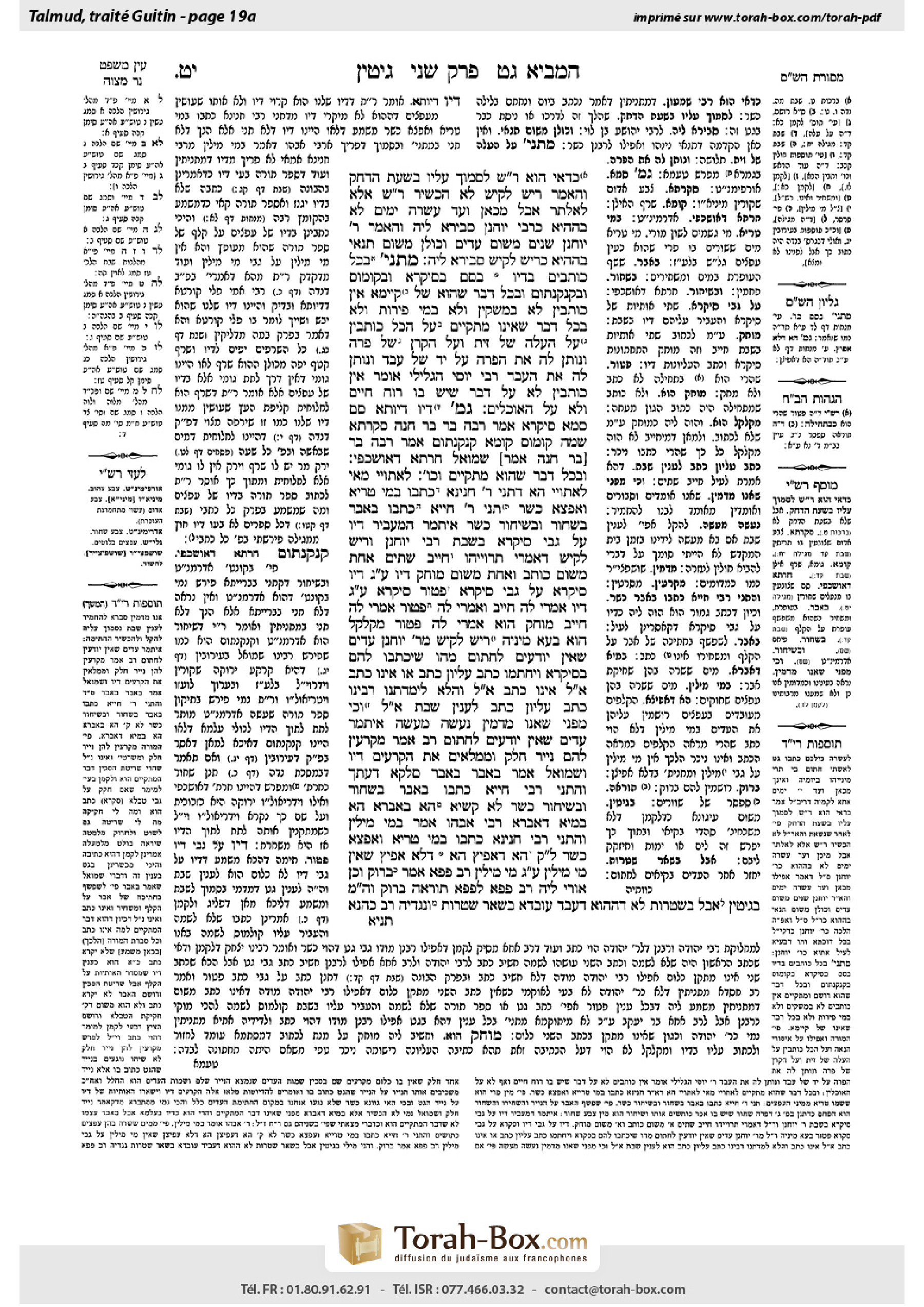
Scan : Torah-Box. Daf Study est un projet indépendant, sans affiliation ni approbation de Torah-Box ou de Sefaria.