Guittin 23a en français · גיטין כ״ג א
Traduction française du daf 23a du traité Guittin (Gittin 23a en anglais), avec le texte araméen, l’anglais de Sefaria et le scan de la page, pour étudier le Daf Yomi.
Ouvrir dans le lecteur interactifLire le daf du jour
Traduction française de Guittin 23a
Les traductions françaises de Daf Study sont générées par IA à partir de l’édition anglaise de Sefaria. Elles peuvent contenir des erreurs : vérifie toujours un passage avec le texte source.
Et cela n’est le cas que lorsqu’un adulte se tenait auprès de lui. Si l’adulte surveille la rédaction et lui ordonne de l’écrire pour elle, le guet est valide.
Rav Naḥman lui dit : Si c’est ainsi, si toute personne inapte à rédiger un guet peut le faire sous la surveillance d’un adulte, alors, si celui qui le rédige est un non-Juif et qu’un Juif se tient auprès de lui et lui ordonne de l’écrire pour elle, dirais-tu également qu’il est valide ? Et si tu dis qu’il est également valide, n’est-il pas enseigné dans une baraïta qu’un non-Juif est de toute façon inapte à rédiger un guet ? Rav Houna répondit : Un non-Juif agit selon sa propre volonté. Puisqu’il est juridiquement apte, il aura ses propres intentions en écrivant et on ne peut pas compter sur lui pour suivre les intentions du surveillant. Dans le cas de la Michna, puisque ceux qui rédigent ne sont pas juridiquement aptes, ils écriront conformément aux instructions du surveillant.
Rav Naḥman dit alors : Ce que j’ai dit lorsque j’ai soulevé une objection à partir d’un cas impliquant un non-Juif n’est pas exact, car du fait que la Michna disqualifie ensuite un non-Juif comme agent chargé d’apporter le guet, on peut déduire par inférence qu’il est apte à le rédiger, puisqu’il ne figure pas parmi ceux qui sont inaptes à cette tâche.
La Guemara demande : Mais n’est-il pas enseigné dans une baraïta qu’un non-Juif est inapte à rédiger un guet ? La Guemara répond : Cette baraïta suit l’opinion de Rabbi Elazar, qui dit que ce sont les témoins de la remise du guet qui produisent le divorce. Lorsque le verset dit : « Et il lui écrit » (Deutéronome 24, 1), source de la halakha selon laquelle l’écriture doit être faite pour elle, il s’agit de la rédaction du guet et non de sa signature. Il faut donc que le guet soit rédigé pour elle ; à plus forte raison, un non-Juif agit selon sa propre volonté et on ne peut pas compter sur lui pour rédiger le guet conformément aux instructions d’un surveillant.
Au sujet de l’exigence qu’un guet soit rédigé pour elle, Rav Naḥman dit que Rabbi Meïr aurait dit ceci : même si le mari a trouvé le guet dans une décharge et que les noms qui y sont inscrits se trouvent par hasard être les mêmes que les siens et ceux de sa femme, s’il le fait signer par des témoins et le lui remet, il est valide, car l’exigence essentielle est que les signatures soient apposées pour elle.
Rava objecta à l’affirmation de Rav Naḥman : Le verset dit : « Et il lui écrit », ce qui est interprété comme signifiant que le guet doit être rédigé pour elle. N’est-ce pas la rédaction même du guet qui est visée, de sorte qu’il doit être rédigé avec l’intention de mettre fin à ce mariage précis ? La Guemara rejette cette interprétation : Non, il s’agit de la signature des témoins.
Rava lui opposa une autre objection, fondée sur une Michna (24a) : Tout guet qui n’a pas été rédigé pour une femme précise est invalide. Il répondit : Dis plutôt que, selon Rabbi Meïr, la Michna enseigne ceci : tout guet qui n’a pas été signé pour une femme précise est invalide.
Rava lui opposa une autre objection, fondée sur une autre baraïta : Lorsqu’il le rédige, c’est comme s’il l’avait rédigé pour elle, ce qui signifie que rédiger une partie pour elle revient à rédiger le document entier pour elle. N’est-il pas question ici du fait que, lorsqu’il rédige pour elle la partie essentielle du document — qui comprend les noms des époux, la date de rédaction et la formule « Voici, tu es permise à tout homme » —, c’est comme s’il avait rédigé pour elle la partie conventionnelle du guet, qui contient le reste des informations ? Cette baraïta indique qu’il faut que le guet lui-même, et pas seulement les signatures, soit rédigé pour elle.
Rav Naḥman rejette cette interprétation : Non, Rabbi Meïr expliquerait que cette baraïta traite d’un cas où il fait signer le document par des témoins pour elle ; c’est comme s’il l’avait rédigé pour elle. Et si tu préfères, dis plutôt : Qui est le tanna de ces baraïtot que tu as invoquées pour soulever des objections ? Elles suivent l’opinion de Rabbi Elazar, qui a dit que ce sont les témoins de la remise du guet qui produisent le divorce. Selon lui, le verset porte sur la rédaction du guet et non sur sa signature, et la rédaction doit être faite pour elle.
Rav Yehouda dit au nom de Chmouel : L’affirmation de la Michna selon laquelle une personne juridiquement inapte peut rédiger un guet ne vaut que si elle laisse non rédigée la partie essentielle du document, qui sera écrite ensuite par une personne juridiquement apte, car seule cette partie essentielle doit être rédigée pour elle. De même, Rabbi Ḥagga dit au nom d’Oula : Cette halakha ne vaut que si la partie essentielle du document est laissée non rédigée, et la Michna suit l’opinion de Rabbi Elazar, selon laquelle la partie essentielle doit être rédigée pour elle.
Rabbi Zerika dit au nom de Rabbi Yoḥanan : Ce n’est pas la Torah. La Guemara précise : Que signifie l’expression « Ce n’est pas la Torah » ? Rabbi Abba dit : Ici, Rabbi Yoḥanan vous informe qu’il n’y a pas d’obligation que le guet soit rédigé pour elle, car seule la signature doit être faite pour elle. Cela suit l’opinion de Rabbi Meïr, qui dit que les témoins signataires du guet produisent le divorce.
La Guemara demande : Mais Rabba bar bar Ḥana n’a-t-il pas dit précédemment que Rabbi Yoḥanan avait déclaré que la Michna suit l’opinion de Rabbi Elazar ? Comment Rabbi Abba peut-il donc dire que, selon Rabbi Yoḥanan, la Michna suit l’opinion de Rabbi Meïr ? La Guemara répond : Ce sont des amoraïm qui sont en désaccord sur l’opinion de Rabbi Yoḥanan : explique-t-il la Michna conformément à l’opinion de Rabbi Meïr ou à celle de Rabbi Elazar ?
MICHNA : Toute personne peut servir d’agent pour apporter un guet à une femme, à l’exception d’un sourd-muet, d’un déficient intellectuel, d’un mineur, d’un aveugle ou d’un non-Juif.
Si un mineur a reçu le guet puis atteint l’âge de la majorité, si quelqu’un l’a reçu alors qu’il était sourd-muet puis a recouvré l’ouïe, s’il l’a reçu alors qu’il était aveugle puis a recouvré la vue, s’il l’a reçu alors qu’il était déficient intellectuel puis est devenu juridiquement apte, ou s’il l’a reçu alors qu’il était non-Juif puis s’est converti, dans tous ces cas, il est inapte à apporter le guet.
En revanche, si quelqu’un l’a reçu alors qu’il entendait, puis est devenu sourd-muet et a ensuite recouvré l’ouïe ; ou s’il l’a reçu alors qu’il voyait, puis est devenu aveugle et a ensuite recouvré la vue ; ou s’il l’a reçu alors qu’il était juridiquement apte, puis est devenu déficient intellectuel et est ensuite redevenu juridiquement apte, dans tous ces cas, il est apte à apporter le guet. Voici le principe : toute personne juridiquement apte au début et à la fin est apte, même s’il y a eu un moment entre les deux où elle était inapte.
GUEMARA : À propos des personnes que la Michna énumère comme inaptes à apporter un guet, la Guemara demande : Il est compréhensible qu’un sourd-muet, un déficient intellectuel et un mineur soient inaptes, car ils ne sont pas juridiquement aptes, et seule une personne apte peut être désignée comme agent. De plus, un non-Juif est également inapte, car il n’est pas soumis aux halakhot qui permettent à une femme de se remarier grâce à un guet. Une personne ne peut pas servir d’agent pour une affaire qui ne la concerne pas. Mais pourquoi un aveugle ne serait-il pas apte à apporter un guet ? Rav Chéchet dit : Parce qu’il ne sait pas de qui il le reçoit ni à qui il le remet et que, puisqu’il ne le sait pas, il ne pourra pas en témoigner.
Rav Yossef objecte : S’il est à craindre qu’un aveugle ne puisse distinguer les personnes, comment un aveugle peut-il avoir des relations conjugales avec sa femme ? Comment sait-il qu’elle est bien son épouse ? De même, comment les autres peuvent-ils avoir des relations conjugales avec leurs femmes la nuit ? Dans l’obscurité, ils ne peuvent pas les voir. Il faut plutôt dire qu’ils en sont capables grâce à la reconnaissance par la voix [teviut eina dekala]. Ils se reconnaissent à leurs voix. Ici aussi, dans le cas d’un aveugle, celui-ci peut reconnaître la personne qui lui remet le guet et celle qui le reçoit grâce à la reconnaissance par la voix.
Rav Yossef dit plutôt : Ici, nous sommes dans le cas d’un mari qui envoie un guet à sa femme depuis l’extérieur d’Eretz Israël, où l’agent doit dire : « Il a été rédigé en ma présence et il a été signé en ma présence », et un aveugle ne peut pas le dire puisqu’il ne peut pas voir le guet être rédigé ou signé.
Abayé lui dit : Cependant, si c’est ainsi, une personne qui voyait lorsqu’elle a reçu le guet, puis est devenue aveugle et peut dire : « Il a été rédigé et signé en ma présence », puisqu’elle pouvait le voir lorsqu’il a été rédigé et signé, serait-elle également apte à apporter le guet ? Or, il est enseigné dans la Michna que si quelqu’un l’a reçu alors qu’il voyait, puis est devenu aveugle et a ensuite recouvré la vue, il est apte à apporter le guet. On peut en déduire que c’est seulement s’il a recouvré la vue qu’il peut l’apporter. Mais s’il ne l’a pas recouvrée, alors non, il ne peut pas l’apporter.
La Guemara répond à cette question : En réalité, pour un aveugle, il en va de même : même s’il n’a pas recouvré la vue, il peut servir d’agent pour apporter le guet et témoigner qu’il a été rédigé et signé en sa présence. Pourquoi la Michna enseigne-t-elle alors que l’aveugle a recouvré la vue ? Parce qu’elle enseigne aussi que celui qui a reçu le guet alors qu’il était juridiquement apte, puis est devenu déficient intellectuel et est ensuite redevenu juridiquement apte, est apte à apporter le guet. Dans ce cas, il n’est apte que parce qu’il est redevenu juridiquement apte ; s’il ne l’était pas redevenu, il ne serait pas apte. C’est pourquoi la Michna enseigne également, au sujet de celui qui voyait, qu’il est devenu aveugle puis a recouvré la vue.
Rav Achi dit : La formulation de la Michna est également précise, car elle enseigne ce principe : toute personne juridiquement apte au début et à la fin est apte ; elle n’enseigne pas : toute personne apte au début et à la fin est apte. On en déduit qu’il n’est pas nécessaire que la personne soit apte au début et à la fin, car il arrive qu’être apte au début suffise, comme dans le cas de celui qui est devenu aveugle après avoir été témoin de la rédaction et de la signature du guet. Cependant, il est clair qu’elle doit être juridiquement apte au début comme à la fin, condition qu’un aveugle remplit.
§ On souleva une question devant Rabbi Ami : Qu’en est-il d’un esclave ? Peut-il être désigné comme agent pour recevoir le guet d’une femme des mains de son mari ? Est-il apte à servir d’agent ou non ? Il leur dit : Du fait que la Michna a déclaré un non-Juif inapte,
Texte source et traduction anglaise
גיטין כ״ג א · texte araméen et hébreu
וְהוּא שֶׁהָיָה גָּדוֹל עוֹמֵד עַל גַּבָּיו.
אֲמַר לֵיהּ רַב נַחְמָן: אֶלָּא מֵעַתָּה, גּוֹי – וְיִשְׂרָאֵל עוֹמֵד עַל גַּבָּיו, הָכִי נָמֵי דְּכָשֵׁר?! וְכִי תֵּימָא הָכִי נָמֵי, וְהָתַנְיָא: גּוֹי פָּסוּל! גּוֹי, לְדַעְתֵּיהּ דְּנַפְשֵׁיהּ עָבֵד.
הֲדַר אָמַר רַב נַחְמָן: לָאו מִילְּתָא הִיא דַּאֲמַרִי; דְּמִדְּקָא פָּסֵיל לֵיהּ לְגוֹי לְעִנְיַן הֲבָאָה, מִכְּלָל דִּלְעִנְיַן כְּתִיבָה – כָּשֵׁר.
וְהָתַנְיָא: גּוֹי פָּסוּל! הַהִיא רַבִּי אֶלְעָזָר הִיא, דְּאָמַר: עֵדֵי מְסִירָה כָּרְתִי, וּבָעֵינַן כְּתִיבָה לִשְׁמָהּ; וְהָא וַדַּאי גּוֹי אַדַּעְתֵּיהּ דְּנַפְשֵׁיהּ קָעָבֵיד.
אָמַר רַב נַחְמָן, אוֹמֵר הָיָה רַבִּי מֵאִיר: אֲפִילּוּ מְצָאוֹ בְּאַשְׁפָּה, חֲתָמוֹ, וּנְתָנוֹ לָהּ – כָּשֵׁר.
אֵיתִיבֵיהּ רָבָא לְרַב נַחְמָן: ״וְכָתַב לָהּ״ – לִשְׁמָהּ; מַאי, לָאו כְּתִיבַת הַגֵּט?! לֹא, חֲתִימַת עֵדִים.
אֵיתִיבֵיהּ רָבָא: כׇּל גֵּט שֶׁנִּכְתַּב שֶׁלֹּא לְשׁוּם אִשָּׁה – פָּסוּל! אֵימָא: שֶׁנֶּחְתַּם שֶׁלֹּא לְשׁוּם אִשָּׁה – פָּסוּל.
אֵיתִיבֵיהּ: כְּשֶׁהוּא כּוֹתְבוֹ – כְּאִילּוּ כּוֹתְבוֹ לִשְׁמָהּ. מַאי, לָאו כְּשֶׁהוּא כּוֹתְבוֹ לַתּוֹרֶף לִשְׁמָהּ – כְּאִילּוּ כּוֹתְבוֹ לַטּוֹפֶס לִשְׁמָהּ?!
לֹא; כְּשֶׁהוּא חוֹתְמוֹ לִשְׁמָהּ – כְּאִילּוּ כּוֹתְבוֹ לִשְׁמָהּ. וְאִיבָּעֵית אֵימָא: הָנֵי מַתְנִיתִין מַנִּי? רַבִּי אֶלְעָזָר הִיא, דְּאָמַר: עֵדֵי מְסִירָה כָּרְתִי.
וְרַב יְהוּדָה אָמַר שְׁמוּאֵל: וְהוּא שֶׁשִּׁיֵּיר מְקוֹם הַתּוֹרֶף. וְכֵן אָמַר רַבִּי חַגָּא מִשְּׁמֵיהּ דְּעוּלָּא: וְהוּא שֶׁשִּׁיֵּיר מְקוֹם הַתּוֹרֶף, וְרַבִּי אֶלְעָזָר הִיא.
וְרַבִּי זְרִיקָא אָמַר רַבִּי יוֹחָנָן: אֵינָהּ תּוֹרָה. מַאי ״אֵינָהּ תּוֹרָה״? אָמַר רַבִּי אַבָּא: כָּאן הוֹדִיעֲךָ שֶׁאֵין כֹּחַ לִשְׁמָהּ; וְרַבִּי מֵאִיר הִיא, דְּאָמַר: עֵדֵי חֲתִימָה כָּרְתִי.
וְהָאָמַר רַבָּה בַּר בַּר חָנָה, אָמַר רַבִּי יוֹחָנָן: רַבִּי אֶלְעָזָר הִיא! אָמוֹרָאֵי נִינְהוּ וְאַלִּיבָּא דְּרַבִּי יוֹחָנָן.
מַתְנִי׳ הַכֹּל כְּשֵׁרִין לְהָבִיא אֶת הַגֵּט, חוּץ מֵחֵרֵשׁ, שׁוֹטֶה, וְקָטָן, וְסוֹמֵא, וְגוֹי.
קִיבֵּל הַקָּטָן וְהִגְדִּיל; חֵרֵשׁ וְנִתְפַּקֵּחַ; סוֹמֵא וְנִתְפַּתֵּחַ; שׁוֹטֶה וְנִשְׁתַּפָּה; גּוֹי וְנִתְגַּיֵּיר – פָּסוּל.
אֲבָל פִּקֵּחַ וְנִתְחָרֵשׁ וְחָזַר וְנִתְפַּקֵּחַ; פָּתוּחַ וְנִסְתַּמֵּא וְחָזַר וְנִתְפַּתֵּחַ; שָׁפוּי וְנִשְׁתַּטָּה וְחָזַר וְנִשְׁתַּפָּה – כָּשֵׁר. זֶה הַכְּלָל: כׇּל שֶׁתְּחִילָּתוֹ וְסוֹפוֹ בְּדַעַת – כָּשֵׁר.
גְּמָ׳ בִּשְׁלָמָא חֵרֵשׁ, שׁוֹטֶה וְקָטָן – דְּלָאו בְּנֵי דֵּיעָה נִינְהוּ; גּוֹי נָמֵי – דְּלָאו בַּר הֶיתֵּירָא הוּא; אֶלָּא סוֹמֵא, אַמַּאי לָא? אָמַר רַב שֵׁשֶׁת: לְפִי שֶׁאֵינוֹ יוֹדֵעַ מִמִּי נוֹטְלוֹ וּלְמִי נוֹתְנוֹ.
מַתְקֵיף לַהּ רַב יוֹסֵף: הֵיאַךְ סוֹמֵא מוּתָּר בְּאִשְׁתּוֹ? הֵיאַךְ בְּנֵי אָדָם מוּתָּרִים בִּנְשׁוֹתֵיהֶם בַּלַּיְלָה? אֶלָּא בִּטְבִיעוּת עֵינָא דְּקָלָא, הָכָא נָמֵי בִּטְבִיעוּת עֵינָא דְּקָלָא!
אֶלָּא אָמַר רַב יוֹסֵף: הָכָא בְּחוּצָה לָאָרֶץ עָסְקִינַן; דְּבָעֵי לְמֵימַר: ״בְּפָנַי נִכְתַּב וּבְפָנַי נֶחְתַּם״, וְלָא מָצֵי לְמֵימַר.
אֲמַר לֵיהּ אַבָּיֵי: אֶלָּא מֵעַתָּה, פָּתוּחַ וְנִסְתַּמֵּא, דְּמָצֵי אָמַר, הָכִי נָמֵי דְּכָשֵׁר?! וְהָא קָתָנֵי: פָּתוּחַ וְנִסְתַּמֵּא וְחָזַר וְנִתְפַּתֵּחַ, כָּשֵׁר – חָזַר וְנִתְפַּתֵּחַ, אִין; לֹא חָזַר וְנִתְפַּתֵּחַ, לֹא!
הוּא הַדִּין דְּאַף עַל גַּב דְּלֹא חָזַר וְנִתְפַּתֵּחַ; וְאַיְּידֵי דְּקָתָנֵי שָׁפוּי וְנִשְׁתַּטָּה וְחָזַר וְנִשְׁתַּפָּה – טַעְמָא דְּחָזַר וְנִשְׁתַּפָּה, הָא לֹא חָזַר וְנִשְׁתַּפָּה – לָא; תְּנָא נָמֵי פָּתוּחַ וְנִסְתַּמֵּא וְחָזַר וְנִתְפַּתֵּחַ.
אָמַר רַב אָשֵׁי: דַּיְקָא נָמֵי – דְּקָתָנֵי, זֶה הַכְּלָל: כׇּל שֶׁתְּחִילָּתוֹ וְסוֹפוֹ בְּדַעַת – כָּשֵׁר; וְלָא קָתָנֵי: כׇּל שֶׁתְּחִילָּתוֹ וְסוֹפוֹ בְּכַשְׁרוּת – כָּשֵׁר; שְׁמַע מִינַּהּ.
בְּעוֹ מִינֵּיהּ מֵרַבִּי אַמֵּי: עֶבֶד, מַהוּ שֶׁיֵּעָשֶׂה שָׁלִיחַ לְקַבֵּל גֵּט אִשָּׁה מִיַּד בַּעְלָהּ? אֲמַר לְהוּ: מִדְּקָא פָּסֵיל לֵיהּ לְגוֹי,
Gittin 23a · traduction anglaise de Sefaria
And that is the case only when there was an adult standing over him. When the adult supervises the writing, and instructs him to write it for her sake, it will be valid.
Rav Naḥman said to him: If that is so, that anyone who is disqualified from writing a bill of divorce may do so with an adult supervising him, then if the one writing is a gentile, and a Jew stands over him and instructs him to write it for her sake, would you also say that it is valid? And if you would say that it is also valid, but isn’t it taught in a baraita: A gentile is disqualified from writing a bill of divorce in any event? Rav Huna answered: A gentile acts based on his own will. Since he is halakhically competent, he will have his own intentions while writing and may not be relied upon to carry out the intentions of the supervisor. In the case of the mishna, since those doing the writing are not halakhically competent, they will write according to the instructions of the supervisor.
Rav Naḥman then said: What I said when I raised a challenge from a case involving a gentile is not correct, as from the fact that the mishna later disqualifies a gentile with regard to acting as an agent in the bringing of the bill of divorce, one can learn by inference that he is qualified with regard to writing, where he is not listed among those who are disqualified.
The Gemara asks: But isn’t it taught in a baraita that a gentile is disqualified from writing a bill of divorce? The Gemara answers: That baraita is in accordance with the opinion of Rabbi Elazar, who says: Witnesses of the transmission of the bill of divorce effect the divorce, and when the verse states: “And he writes her” (Deuteronomy 24:1), which is the source for the halakha that the writing needs to be done for her sake, it is referring to the writing of the bill of divorce and not to its signing. Therefore, we need the writing to be for her sake, and certainly a gentile acts based on his own will and may not be relied upon to write the bill of divorce according to the instructions of a supervisor.
With regard to the requirement that a bill of divorce be written for her sake, Rav Naḥman says that Rabbi Meir would have said: Even if the husband found the bill of divorce in the garbage dump, and the names written on it happened to be the same as his and his wife’s names, if he had it signed by witnesses and he gave it to her, then it is valid, because the essential requirement is that it be signed for her sake.
Rava raised an objection to the statement of Rav Naḥman: The verse states: “And he writes her,” which is interpreted to mean that it must be written for her sake. What, is it not referring to the actual writing of the bill of divorce, that it must be written with the intent that it be used to sever this particular marriage? The Gemara rejects this: No, it is referring to the signing of the witnesses.
Rava raised another objection to him based on what was taught in a mishna (24a): Any bill of divorce that was not written for the sake of a specific woman is invalid. He responded: Say that according Rabbi Meir the mishna teaches: Any bill of divorce that was not signed for the sake of a specific woman is invalid.
Rava raised another objection to him based on another baraita: When he writes it, it is as though he writes it for her sake, meaning that writing one part for her sake makes it as if the entire document were written for her sake. What, it is not stating that when he writes the essential part of the document, which includes the names of the spouses; the date on which it was written; and the expression: Behold you are permitted to any man, for her sake, then is it as though he writes the standard part of the bill of divorce, containing the rest of the information, for her sake? This baraita indicates that there is a requirement that the bill of divorce, not just the signatures, be written for her sake.
Rav Naḥman rejects this: No, Rabbi Meir would explain that this baraita is referring to a case where he has witnesses sign it for her sake; it is as though he wrote it for her sake. And if you wish, say: Who is the tanna of these baraitot from which you raised challenges? They are in accordance with the opinion of Rabbi Elazar, who said: Witnesses of the transmission of the bill of divorce effect the divorce. According to him, the verse is referring to the writing and not the signing of the bill of divorce, and the writing must be for her sake.
And Rav Yehuda says that Shmuel says: And the statement of the mishna that one who is not halakhically competent is qualified to write a bill of divorce is the halakha only when he left unwritten the essential part of the document, which will be written later by a halakhically competent person, as only the essential part must be written for her sake. And so Rabbi Ḥagga says in the name of Ulla: And this is the halakha only when he left the essential part of the document unwritten, and the mishna is in accordance with the opinion of Rabbi Elazar, that the writing of the essential part must be done for her sake.
And Rabbi Zerika says that Rabbi Yoḥanan says: It is not Torah. The Gemara clarifies: What is meant by the expression: It is not Torah? Rabbi Abba says: Here Rabbi Yoḥanan informs you that there is no force to a requirement that a bill of divorce be written for her sake, as only the signing needs to be done for her sake. And it is in accordance with the opinion of Rabbi Meir, who says: Signatory witnesses on the bill of divorce effect the divorce.
The Gemara asks: But didn’t Rabba bar bar Ḥana say earlier that Rabbi Yoḥanan said that the mishna is in accordance with the opinion of Rabbi Elazar? How, then, can Rabbi Abba say that according to Rabbi Yoḥanan, the mishna is in accordance with the opinion of Rabbi Meir? The Gemara answers: They are amora’im and disagree with regard to the opinion of Rabbi Yoḥanan, whether he explains the mishna in accordance with the opinion of Rabbi Meir or that of Rabbi Elazar.
MISHNA: Anyone is fit to serve as an agent to bring a bill of divorce to a woman except for a deaf-mute, an imbecile, or a minor, or a blind person, or a gentile.
If a minor received the bill of divorce and then reached the age of majority, or one received it when he was a deaf-mute and then became able to hear, or one received it when he was blind and then became able to see, or one received it when he was an imbecile and then became halakhically competent, or one received it when he was a gentile and then converted, in all of these cases he is unfit to bring the bill of divorce.
However, if one received it when he was able to hear, and then became a deaf-mute, and then again became able to hear; or if one received it when he was able to see, and then became blind, and then again became able to see; or one received it when he was halakhically competent, and then became an imbecile, and then again became halakhically competent, in all of these cases he is fit to bring the bill of divorce. This is the principle: Anyone who is halakhically competent in the beginning and in the end is fit, even if there was time in the interim when he was unfit.
GEMARA: The Gemara asks with regard to those the mishna lists as not being qualified to bring a bill of divorce: Granted, a deaf-mute, an imbecile, and a minor are not qualified because they are not halakhically competent, and only one who is competent can be appointed as an agent. Additionally, a gentile also is not qualified, as he is not subject to the halakhot that permit a woman to remarry via a bill of divorce. A person cannot serve as an agent for a matter that does not apply to him. But why isn’t a blind person qualified to bring a bill of divorce? Rav Sheshet says: Because he does not know from whom he takes it and to whom he gives it, and since he is unaware of this he will not be able to testify about it.
Rav Yosef objects to this: If there is a concern that a blind person cannot distinguish between different people, then how is a blind man permitted to have sexual relations with his wife? How does he know that she is in fact his wife? Similarly, how are all people permitted to have sexual relations with their wives at night? If it is dark, they cannot see them. Rather, you must say that they are permitted through voice recognition [teviut eina dekala]. They can recognize each other based on their voices. Here too, with regard to a blind person, he can recognize the giver and receiver of the bill of divorce through voice recognition.
Rather, Rav Yosef says: Here we are dealing with a husband who sends a bill of divorce to his wife outside of Eretz Yisrael, where the agent needs to say: It was written in my presence and it was signed in my presence, and a blind man cannot say this because he is unable to see it being written or signed.
Abaye said to him: However, if that is so, then a person who is able to see when he receives the bill of divorce and then becomes blind, who can say: It was written and signed in my presence, as he was able to see when it was written and signed, would you say that he is also fit to bring the bill of divorce? But it is taught in the mishna: If one received it when he was able to see, and then became blind, and then again became able to see, then he is fit to bring the bill of divorce. It can be inferred from here that only when he again became able to see, yes, he may bring it. But if he did not again become able to see, then no, he may not bring it.
The Gemara answers this question: In fact, with regard to a blind person, the same is true, that although he did not again become able to see he can serve as an agent to bring the bill of divorce and testify that it was written and signed in his presence. And why does it teach that the blind man became able to see again? Since the mishna teaches that one who received the bill of divorce when he was halakhically competent, and then became an imbecile, and then again became halakhically competent is qualified to bring the bill of divorce. And in that case, the reason why he is qualified is specifically that he again became halakhically competent, but if he did not again become halakhically competent, then he is not qualified. Therefore, the mishna also teaches with regard to one who was able to see that he then became blind and then again became able to see.
Rav Ashi said: The language of the mishna is also precise, as it teaches that this is the principle: Anyone who is halakhically competent in the beginning and in the end is fit, and it does not teach: Anyone who is fit in the beginning and the end is fit. Learn from the mishna that it is not necessary for him to be fit in the beginning and the end, as there are times that being fit in the beginning is sufficient, as in the case of one who became blind after witnessing the writing and signing of the bill of divorce. However, it is clear that he must be halakhically competent both in the beginning and the end, which a blind person is.
§ They raised a dilemma before Rabbi Ami: With regard to a slave, what is the halakha? Can he be made an agent to receive a woman’s bill of divorce from the hand of her husband? Is he qualified to act as an agent or not? He said to them: From the fact that the mishna disqualified a gentile,
Texte de Sefaria : William Davidson Edition - Vocalized Aramaic (CC BY NC) ; William Davidson Edition - English (CC BY NC).
Scan de Guittin 23a
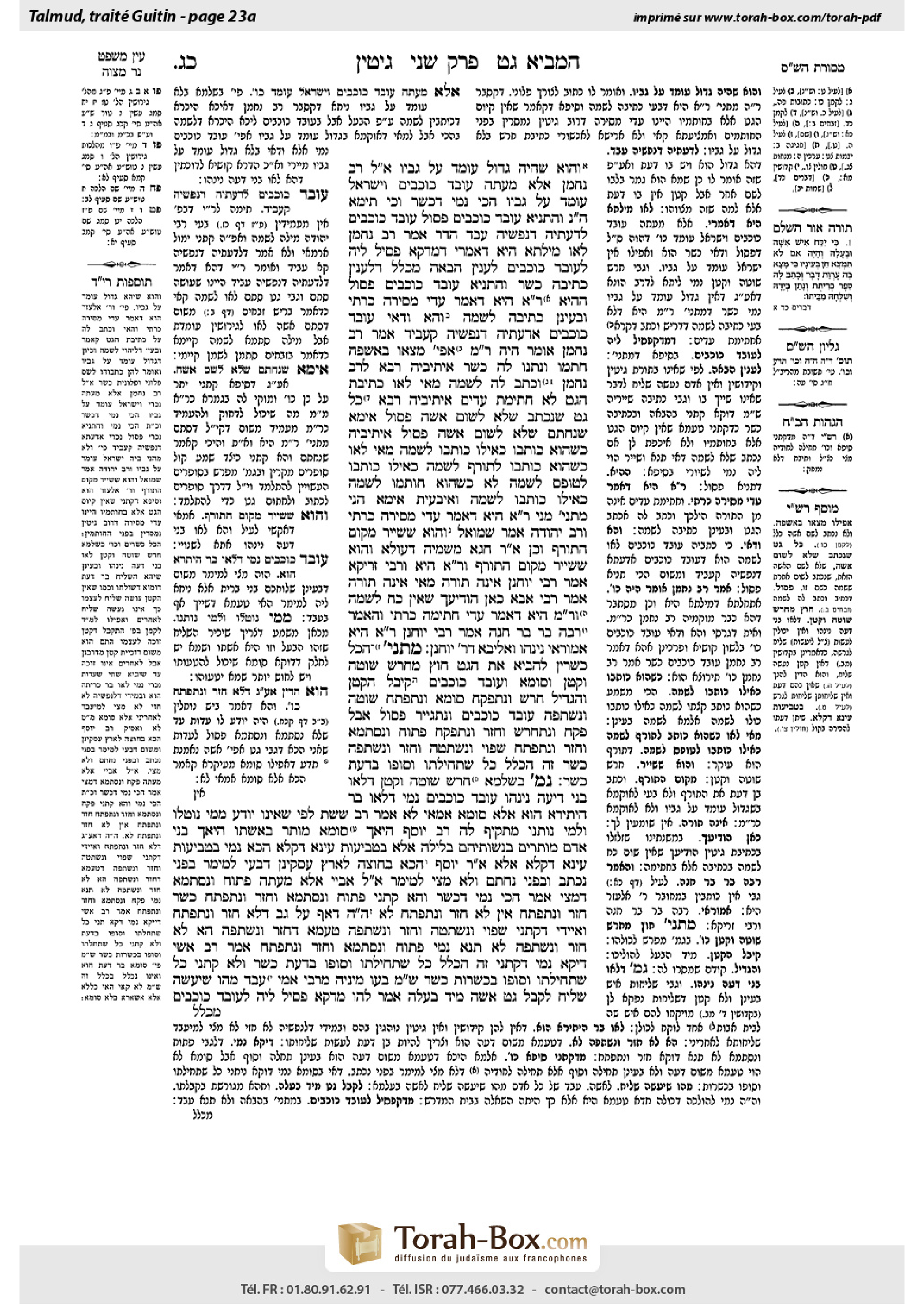
Scan : Torah-Box. Daf Study est un projet indépendant, sans affiliation ni approbation de Torah-Box ou de Sefaria.