Guittin 44a en français · גיטין מ״ד א
Traduction française du daf 44a du traité Guittin (Gittin 44a en anglais), avec le texte araméen, l’anglais de Sefaria et le scan de la page, pour étudier le Daf Yomi.
Ouvrir dans le lecteur interactifLire le daf du jour
Traduction française de Guittin 44a
Les traductions françaises de Daf Study sont générées par IA à partir de l’édition anglaise de Sefaria. Elles peuvent contenir des erreurs : vérifie toujours un passage avec le texte source.
Et si tu le souhaites, dis plutôt : même si le moment était venu de prendre l’esclave ou le champ en garantie, il y a ici un élément nouveau dans le cas où il a emprunté à condition que les créanciers se remboursent sur ce bien, c’est-à-dire l’esclave ou le champ, mais qu’ils ne l’ont pas encore saisi. Puisque le Juif n’avait pas encore pris le champ au gentil en paiement de la dette, celui-ci reste exempt de dîmes ; mais le simple fait que le Juif ait accepté que son esclave soit saisi suffit pour que la sanction rabbinique s’applique et que l’esclave soit affranchi.
§ Les Sages ont enseigné (Tossefta, Avoda Zara 3:16) : Si un gentil a saisi un esclave en paiement de sa dette, ou si l’esclave a été pris par un sicarius, c’est-à-dire quelqu’un qui recourait à la violence et à l’intimidation pour contraindre les gens à lui remettre leurs biens, l’esclave n’est pas affranchi. La Guemara demande : Est-il donc vrai que si un gentil a saisi un esclave en paiement de sa dette, les Sages n’ont pas institué de sanction et que l’esclave n’est pas affranchi ?
La Guemara soulève une contradiction à partir de ce qui a été enseigné dans une baraïta : Si les gens de la maison du roi se sont emparés de force de l’aire de battage de quelqu’un et l’ont prise en paiement de sa dette envers le roi, il est tenu de prélever la dîme afin de rendre consommable le grain saisi. En effet, s’il ne prélevait pas la dîme, cela reviendrait à payer une dette avec de la dîme. Si, en revanche, ils ont procédé à une saisie injuste [anparot], il est exempt de prélever la dîme. Cette baraïta indique qu’un bien pris en paiement d’une dette équivaut à une vente ; pourquoi donc l’esclave pris en paiement de la dette ne serait-il pas affranchi ?
La Guemara répond : Le cas est différent, car il tire profit du fait qu’une partie de sa dette est remboursée avec de la dîme. S’ils avaient pris des produits ordinaires, sa perte financière aurait été plus importante. Il doit donc prélever la dîme sur le grain saisi. Dans le cas de l’esclave, il n’a tiré aucun profit de la saisie. Les Sages ne l’ont donc pas sanctionné.
La Guemara propose : Viens et entends une preuve, car Rav dit : Celui qui vend son esclave à un fonctionnaire du gouvernement gentil [parhang] voit son esclave affranchi, même si son maître n’a accepté la vente que parce que le fonctionnaire l’y a contraint. Là aussi, il ne souhaitait pas la vente et n’en a tiré aucun profit. La Guemara répond : Dans ce cas, le maître aurait dû apaiser le fonctionnaire d’une autre manière afin qu’il ne prenne pas l’esclave, mais il ne l’a pas apaisé ; il convient donc de le sanctionner.
La Guemara examine le sujet lui-même. Rav dit : Celui qui vend son esclave à un fonctionnaire du gouvernement gentil voit son esclave affranchi. La Guemara demande : Qu’aurait-il pu faire ? Le fonctionnaire du gouvernement gentil l’a contraint à accepter la vente. La Guemara répond : Il aurait dû apaiser le fonctionnaire d’une autre manière, mais il ne l’a pas fait.
Rabbi Yirmeya soulève un dilemme : S’il a vendu l’esclave à un gentil pour trente jours, quelle est la halakha ? Est-ce considéré comme une vente, de sorte que l’esclave est affranchi, ou bien n’est-ce pas une vente ? La Guemara propose : Viens et entends une preuve, car Rav dit : Celui qui vend son esclave à un fonctionnaire du gouvernement gentil voit son esclave affranchi. On suppose que l’esclave a été vendu au fonctionnaire pour travailler pendant une durée limitée ou accomplir une tâche précise ; pourtant, il est affranchi. La Guemara répond : Dans ce cas, il a été vendu à un fonctionnaire du gouvernement gentil, et cette vente n’est pas annulée. On ne peut donc pas en tirer de preuve quant à la halakha d’une vente qui ne prend effet que pour une durée limitée.
Rabbi Yirmeya pose plusieurs questions sur l’étendue de l’application de cette sanction : S’il a vendu l’esclave à un gentil tout en lui réservant le travail de l’esclave, c’est-à-dire que le gentil sera propriétaire de l’esclave, mais que celui-ci continuera à travailler pour son maître juif, quelle est la halakha ? S’il l’a vendu à un gentil tout en lui réservant les mitsvot, c’est-à-dire en stipulant que l’esclave pourrait continuer à accomplir les mitsvot, quelle est la halakha ? S’il l’a vendu en réservant les Chabbat et les fêtes, quelle est la halakha ? S’il l’a vendu à un gentil qui réside en Eretz Yisrael et observe les sept mitsvot noahides [ger toshav], ou à un apostat juif, quelle est la halakha ? S’il l’a vendu à un Samaritain, quelle est la halakha ? La Guemara propose : On peut au moins résoudre l’une de ces questions, car il a été enseigné : Un ger toshav est comme un gentil. Quant au Samaritain et à l’apostat juif, certains disent qu’ils sont comme des gentils, et d’autres disent qu’ils sont comme des Juifs.
On posa un dilemme à Rabbi Ami : Si un esclave s’est enfui de chez son maître et s’est livré à une armée étrangère pour servir comme soldat, et que son maître ne peut le récupérer ni selon la loi juive ni selon les lois des nations du monde, quelle est la halakha ? Le maître a-t-il le droit de recevoir au moins sa valeur de l’armée, ou cela serait-il considéré comme s’il vendait l’esclave ?
Rabbi Yirmeya dit à Rabbi Zerika : Va examiner tes Michnayot afin d’y trouver une réponse. Il partit, les examina et trouva une réponse, car il est enseigné dans une baraïta (Tossefta, Avoda Zara 6:2) : Celui qui vend sa maison en Eretz Yisrael à un gentil ne peut pas garder l’argent reçu pour la vente de la maison. Mais si un gentil s’est emparé de force de la maison d’un Juif et que son propriétaire ne peut la récupérer, ni selon la loi juive ni selon les lois des nations du monde, il est autorisé à en recevoir la valeur du gentil ; il peut même rédiger un acte et faire enregistrer la vente dans leurs tribunaux, car il est comme quelqu’un qui récupère de l’argent qui se trouvait en leur possession. Bien qu’il soit interdit à un Juif de vendre sa maison en Eretz Yisrael à un gentil, si elle lui a été prise de force, il est autorisé à en recevoir le prix. De même, si l’esclave ne peut être récupéré des mains d’un gentil, il devrait être permis de recevoir de l’argent en échange.
La Guemara rejette cette comparaison : Mais peut-être cette règle ne s’applique-t-elle qu’à une maison, car, puisqu’il lui est impossible de vivre sans maison, il ne la vendrait pas de son plein gré. Il n’y a donc aucune raison de le sanctionner lorsqu’elle lui est prise de force. Mais, s’agissant d’un esclave, puisqu’il peut vivre sans esclave, on craint qu’il ne finisse aussi par le vendre de son plein gré ; il faudrait donc également le sanctionner dans ce cas. Ou bien cette distinction ne s’applique peut-être pas.
Rabbi Ami adressa le message suivant aux autres Sages : De moi, Ami bar Natan, la Torah se répand dans tout Israël : Si un esclave s’est enfui de chez son maître et s’est livré à une armée étrangère pour servir comme soldat, et que son maître ne peut le récupérer ni selon la loi juive ni selon les lois des nations du monde, il est autorisé à recevoir la valeur de l’esclave ; il rédige un acte de vente et fait enregistrer cette transaction dans les tribunaux des gentils, car il est comme quelqu’un qui récupère de l’argent qui se trouvait en leur possession.
Rabbi Yehoshua ben Levi dit : Celui qui vend son esclave à un gentil, même s’il ne peut plus le réduire en esclavage, est sanctionné et contraint de racheter l’esclave au gentil jusqu’à cent fois sa valeur.
La Guemara demande : Ce montant est-il précis ou non ? Peut-être ce nombre est-il exagéré. La Guemara propose : Viens et entends une réponse à partir de ce que dit Reish Lakish : Celui qui vend à un gentil un grand animal domestique est sanctionné et contraint de le racheter au gentil jusqu’à dix fois sa valeur. On voit ici que celui qui enfreint une ordonnance des Sages en procédant à une vente interdite ne doit payer que jusqu’à dix fois la valeur du bien pour le racheter ; on pourrait donc supposer qu’il en va de même dans le cas de l’esclave.
La Guemara rejette cette conclusion : Mais peut-être le cas de l’esclave est-il différent, car chaque jour, en le vendant à un gentil, son maître le dispense d’accomplir les mitsvot ; la sanction pourrait donc être plus lourde.
Et certains rapportent une autre version de cette discussion : Rabbi Yehoshua ben Levi dit que celui qui vend son esclave à un gentil, même s’il ne peut plus le réduire en esclavage, est sanctionné et contraint de le racheter au gentil jusqu’à dix fois sa valeur. La Guemara demande : Ce montant est-il précis ou non ? La sanction est-elle limitée à dix fois la valeur de l’esclave ? La Guemara propose : Viens et entends une réponse à partir de ce que dit Reish Lakish : Celui qui vend à un gentil un grand animal domestique est sanctionné et contraint de le racheter au gentil jusqu’à cent fois sa valeur ; la sanction dans le cas de l’esclave devrait donc être au moins aussi élevée que celle appliquée dans le cas de l’animal.
La Guemara rejette cette conclusion : Le cas de l’esclave est différent, car il ne revient pas à son maître. Puisque l’esclave est affranchi dès que le maître le rachète, il se peut que les Sages ne le sanctionnent pas aussi lourdement.
La Guemara objecte : Alors, pourquoi la sanction est-elle plus lourde dans le cas de l’animal que dans celui de l’esclave ? Parce que l’animal lui revient ? Si c’est le cas, il ne devrait être sanctionné que d’un montant supplémentaire. Si la différence tient au fait que l’animal revient à son propriétaire, contrairement à l’esclave, l’écart entre les sanctions devrait en tenir compte, et il ne devrait avoir à racheter l’animal qu’à onze fois sa valeur au maximum. La Guemara propose plutôt une autre distinction : La vente d’un esclave est un cas rare, et les Sages n’ont pas décrété de sanction pour un cas rare. On ne peut donc pas comparer la sanction prévue pour la vente d’un esclave à celle prévue pour la vente d’un animal.
Rabbi Yirmeya posa un dilemme à Rabbi Asi : Si quelqu’un a vendu son esclave à un gentil et qu’il est mort, quelle est la halakha ? Son fils est-il sanctionné après lui ? Le fils doit-il lui aussi racheter l’esclave, ou bien la sanction ne s’applique-t-elle qu’au vendeur ? La Guemara compare ce cas à d’autres sanctions imposées par les Sages. Si tu dis, conformément à l’avis selon lequel celui qui a fendu l’oreille d’un animal premier-né et l’a ainsi intentionnellement rendu infirme afin de pouvoir le manger, puis est mort, son fils est sanctionné après lui et ne peut ni l’abattre ni le manger, peut-être est-ce parce qu’il s’agit d’une interdiction de la Torah. Ici, en revanche, concernant la vente d’un esclave, il ne s’agit que d’une interdiction rabbinique ; peut-être le fils n’est-il donc pas sanctionné.
Texte source et traduction anglaise
גיטין מ״ד א · texte araméen et hébreu
וְאִי בָּעֵית אֵימָא: בְּשֶׁלָּוָה עַל מְנָת לְמַשְׁכְּנוֹ, וְלֹא מִשְׁכְּנוֹ.
תָּנוּ רַבָּנַן: גְּבָאוֹ בְּחוֹבוֹ אוֹ שֶׁלְּקָחוֹ סִיקָרִיקוֹן, לֹא יָצָא לְחֵירוּת. וּבְחוֹבוֹ לֹא?!
וּרְמִינְהִי: הֲרֵי שֶׁאָנְסוּ בֵּית הַמֶּלֶךְ גּוֹרְנוֹ, אִם בְּחוֹבוֹ – חַיָּיב לְעַשֵּׂר, אִם בָּאַנְפָּרוֹת – פָּטוּר מִלְּעַשֵּׂר!
שָׁאנֵי הָתָם, דְּקָא מִשְׁתָּרְשִׁי לֵיהּ.
תָּא שְׁמַע, דְּאָמַר רַב: הַמּוֹכֵר עַבְדּוֹ לְפַרְהַנְגְּ גּוֹי – יָצָא לְחֵירוּת! הָתָם, הֲוָה לֵיהּ לְפַיֵּיס וְלֹא פִּיֵּיס.
גּוּפָא – אָמַר רַב: הַמּוֹכֵר עַבְדּוֹ לְפַרְהַנְגְּ גּוֹי – יָצָא לְחֵירוּת. מַאי הֲוָה לֵיהּ לְמֶעְבַּד? הֲוָה לֵיהּ לְפַיֵּיס, וְלֹא פִּיֵּיס.
בָּעֵי רַבִּי יִרְמְיָה: מְכָרוֹ לִשְׁלשִׁים יוֹם, מַהוּ? תָּא שְׁמַע, דְּאָמַר רַב: הַמּוֹכֵר עַבְדּוֹ לְפַרְהַנְגְּ גּוֹי – יָצָא לְחֵירוּת! הָתָם בְּפַרְהַנְגְּ גּוֹי שֶׁאֵינָהּ חוֹזֶרֶת.
מְכָרוֹ חוּץ מִמְּלַאכְתּוֹ, מַהוּ? חוּץ מִן הַמִּצְוֹת, מַהוּ? חוּץ מִשַּׁבָּתוֹת וְיָמִים טוֹבִים, מַהוּ? לְגֵר תּוֹשָׁב, לְיִשְׂרָאֵל מְשׁוּמָּד, מַהוּ? לְכוּתִי, מַהוּ? פְּשׁוֹט מִיהָא חֲדָא: גֵּר תּוֹשָׁב הֲרֵי הוּא כְּגוֹי. כּוּתִי וְיִשְׂרָאֵל מְשׁוּמָּד – אָמְרִי לַהּ כְּגוֹי, וְאָמְרִי לַהּ כְּיִשְׂרָאֵל.
בְּעוֹ מִינֵּיהּ מֵרַבִּי אַמֵּי: עֶבֶד שֶׁהִפִּיל עַצְמוֹ לִגְיָיסוֹת, וְאֵין רַבּוֹ יָכוֹל לְהוֹצִיאוֹ – לֹא בְּדִינֵי יִשְׂרָאֵל וְלֹא בְּדִינֵי אוּמּוֹת הָעוֹלָם, מַהוּ שֶׁיִּטּוֹל אֶת דָּמָיו?
אֲמַר לֵיהּ רַבִּי יִרְמְיָה לְרַבִּי זְרִיקָא: פּוֹק עַיֵּין בִּמְכִילָתָיךְ. נְפַק דָּק וְאַשְׁכַּח, דְּתַנְיָא: הַמּוֹכֵר בֵּיתוֹ לְגוֹי – דָּמָיו אֲסוּרִין. וְגוֹי שֶׁאָנַס בֵּיתוֹ שֶׁל יִשְׂרָאֵל, וְאֵין בְּעָלָיו יָכוֹל לְהוֹצִיאוֹ – לֹא בְּדִינֵי יִשְׂרָאֵל וְלֹא בְּדִינֵי אוּמּוֹת הָעוֹלָם, מוּתָּר לִיטּוֹל אֶת דָּמָיו, וְכוֹתֵב וּמַעֲלֶה בְּעַרְכָּאוֹת שֶׁלָּהֶן – מִפְּנֵי שֶׁהוּא כְּמַצִּיל מִיָּדָם.
וְדִילְמָא הָנֵי מִילֵּי בַּיִת – דְּכֵיוָן דְּלָא סַגִּי לֵיהּ בְּלֹא בַּיִת, לָא אָתֵי לְזַבּוֹנֵיהּ; אֲבָל עַבְדָּא – דְּסַגִּי לֵיהּ בְּלָא עַבְדָּא, אָתֵי לְזַבּוֹנֵיהּ – אוֹ לָא.
שְׁלַח לְהוּ רַבִּי אַמֵּי: ״מִינַּי אַמֵּי בַּר נָתָן, תּוֹרָה יוֹצְאָה לְכׇל יִשְׂרָאֵל: עֶבֶד שֶׁהִפִּיל עַצְמוֹ לִגְיָיסוֹת, וְאֵין רַבּוֹ יָכוֹל לְהוֹצִיאוֹ – לֹא בְּדִינֵי יִשְׂרָאֵל וְלֹא בְּדִינֵי אוּמּוֹת הָעוֹלָם, מוּתָּר לִיטּוֹל אֶת דָּמָיו, וְכוֹתֵב וּמַעֲלֶה בְּעַרְכָּאוֹת שֶׁל גּוֹיִם – מִפְּנֵי שֶׁהוּא כְּמַצִּיל מִיָּדָם.
אָמַר רַבִּי יְהוֹשֻׁעַ בֶּן לֵוִי: הַמּוֹכֵר עַבְדּוֹ לְגוֹי – קוֹנְסִים אוֹתוֹ עַד מֵאָה בְּדָמָיו.
דַּוְקָא, אוֹ לָאו דַּוְקָא? תָּא שְׁמַע, דְּאָמַר רֵישׁ לָקִישׁ: הַמּוֹכֵר בְּהֵמָה גַּסָּה לְגוֹי – קוֹנְסִים אוֹתוֹ עַד עֲשָׂרָה בְּדָמֶיהָ!
וְדִלְמָא שָׁאנֵי עֶבֶד, דְּכֹל יוֹמָא וְיוֹמָא מַפְקַע לֵיהּ מִמִּצְוֹת.
וְאִיכָּא דְאָמְרִי, אָמַר רַבִּי יְהוֹשֻׁעַ בֶּן לֵוִי: הַמּוֹכֵר עַבְדּוֹ לְגוֹי – קוֹנְסִין אוֹתוֹ עַד עֲשָׂרָה בְּדָמָיו. דַּוְקָא אוֹ לָאו דַּוְקָא? תָּא שְׁמַע, דְּאָמַר רֵישׁ לָקִישׁ: הַמּוֹכֵר בְּהֵמָה גַּסָּה לְגוֹי – קוֹנְסִין אוֹתוֹ עַד מֵאָה בְּדָמֶיהָ!
שָׁאנֵי עֶבֶד, דְּלָא הָדַר לֵיהּ.
אֶלָּא בְּהֵמָה טַעְמָא מַאי – מִשּׁוּם דְּהָדְרָא לֵיהּ?! לִקְנְסֵיהּ טְפֵי חַד! אֶלָּא עֶבֶד מִילְּתָא דְלָא שְׁכִיחָא, וּמִלְּתָא דְלָא שְׁכִיחָא לָא גָּזְרִי בַּהּ רַבָּנַן.
בְּעָא מִינֵּיהּ רַבִּי יִרְמְיָה מֵרַבִּי אַסִּי: מָכַר עַבְדּוֹ וָמֵת, מַהוּ שֶׁיִּקְנְסוּ אֶת בְּנוֹ אַחֲרָיו? אִם תִּימְצֵי לוֹמַר: ״צָרַם אוֹזֶן בְּכוֹר, וָמֵת – קָנְסוּ בְּנוֹ אַחֲרָיו״ – מִשּׁוּם דְּאִיסּוּרָא דְּאוֹרָיְיתָא הִיא, אֲבָל הָכָא אִיסּוּרָא דְרַבָּנַן.
Gittin 44a · traduction anglaise de Sefaria
And if you wish, say instead: Even if the time for the slave or the field to be taken as collateral had arrived, there is something novel about this in a case where he borrowed on the condition that the creditors collect from it, i.e., the slave or field, but they did not yet collect from it. Since the field had not yet been collected from the gentile by the Jew as payment of the debt, it remains exempt from tithes, but the mere fact that the Jew agreed to have his slave be collected suffices for the rabbinic penalty to take effect, and the slave is emancipated.
§ The Sages taught (Tosefta, Avoda Zara 3:16): If a gentile collected a slave for payment of his debt, or the slave was taken by a Sicarius, i.e., one who would use violence and intimidation to force people to give them their property, then he is not emancipated. The Gemara asks: And is it so that if a gentile collected a slave for payment of his debt, the Sages did not institute a penalty and the slave is not emancipated?
And the Gemara raises a contradiction based on what was taught in a baraita: With regard to a case where the household of the king seized one’s threshing floor by force, if they took it for payment of his debt to the king, then he is obligated to tithe in order to render fit for consumption the grain that they seized. The reason for this is because if he were not to tithe it, it would be considered as if he paid a debt using tithe. If they engaged in unjust seizure [anparot] then he is exempt from tithing. This baraita indicates that an item taken for payment of a debt is akin to a sale, so why should the slave taken in payment of the debt not be emancipated?
The Gemara answers: It is different there, because he profits by repaying a portion of his debt with tithe. If they would have taken regular produce, it would have been more of a financial loss for him. Therefore, he must separate tithe for the seized grain. In the case of the slave, he did not profit from the seizure. Therefore, the Sages did not penalize him.
The Gemara suggests: Come and hear a proof, as Rav says: One who sells his slave to a gentile government official [parhang], then the slave is emancipated even though the owner agreed to the sale only because he was pressured by the official. There too, he neither desired nor profited from the sale. The Gemara answers: There, the owner should have appeased the official in some other way so that he would not take the slave, and he did not appease him, therefore it is appropriate to penalize him.
The Gemara discusses the matter itself. Rav says: One who sells his slave to a gentile government official, then the slave is emancipated. The Gemara asks: What could he have done; the gentile government official forced him to agree to the sale. The Gemara answers: He should have appeased the official in some other way, and he did not appease him.
Rabbi Yirmeya raises a dilemma: If he sold the slave to a gentile for thirty days, then what is the halakha; is this considered to be a sale and he is emancipated as a result, or is it not a sale? The Gemara suggests: Come and hear a proof, as Rav says: With regard to one who sells his slave to a gentile government official, the slave is emancipated. The assumption is that he would be sold to the official in order to work for a limited amount of time or perform a specific task, yet he is emancipated. The Gemara answers: There, he was sold to a gentile government official, as this sale is not reversed. No proof can be brought from here with regard to the halakha of a sale that is in effect for a limited duration.
Rabbi Yirmeya asks several questions with regard to the extent of the application of this penalty: If he sold the slave to a gentile aside from his labor, i.e., the gentile will own the slave but he will still perform labor for the Jewish master, what is the halakha? If he sold him to a gentile aside from the mitzvot, i.e., he stipulated that the slave would be able to continue observing the mitzvot, what is the halakha? If he sold him aside from Shabbatot and Festivals, what is the halakha? If he sold him to a gentile who resides in Eretz Yisrael and observes the seven Noahide mitzvot [ger toshav], or to a Jewish apostate, what is the halakha? If he sold him to a Samaritan, what is the halakha? The Gemara suggests: You can resolve at least one of these questions, as it was taught: A ger toshav is like a gentile. With regard to a Samaritan and a Jewish apostate, some say they are like gentiles and some say they are like Jews.
They raised a dilemma before Rabbi Ami: If a slave fled from his master and gave himself over to a foreign army to serve as a solider, and his master cannot remove him, neither through Jewish law nor through the laws of the nations of the world, what is the halakha? Is it permitted for the master to at least take his value from the army, or would this be considered as if he is selling the slave?
Rabbi Yirmeya said to Rabbi Zerika: Go out and examine your mishnayot to find an answer. He went out, examined, and discovered an answer, as it is taught in a baraita (Tosefta, Avoda Zara 6:2): One who sells his house in Eretz Yisrael to a gentile, the monies received from the sale of the house are forbidden to him. And if there was a gentile who seized a Jew’s house by force and its owner cannot remove it, i.e., get it back, neither through Jewish law nor through the laws of the nations of the world, then he is permitted to take the house’s value from the gentile, and he may even write a document and register the sale in their courts, because he is like one who rescues the money from their possession. Although it is prohibited for a Jew to sell his house in Eretz Yisrael to a gentile, if it was taken from him by force he is permitted to take payment for it. Similarly, if the slave cannot be retrieved from a gentile, it should be permitted for him to take money in return.
The Gemara rejects this comparison: But perhaps this matter applies only to a house, that since it is not sufficient, i.e., not possible, for him to live without a house, he would not sell it willingly. Therefore, there is no reason to penalize him when it is taken by force. But with regard to a slave, as it is sufficient for him to live without a slave, there is a concern that he will also come to sell him willingly, and therefore there should be a penalty in this case as well. Or it is possible that this distinction is not made.
Rabbi Ami sent the following message to the other Sages: From me, Ami bar Natan, Torah emerges to all of Israel: If a slave fled his master and gave himself to a foreign army to serve as a solider, and his master cannot remove him, neither through Jewish law nor through the laws of the nations of the world, then he is permitted to take the slave’s value, and he writes a deed of sale and registers this transaction in gentile courts, because he is like one who rescues the money from their possession.
Rabbi Yehoshua ben Levi says: With regard to one who sells his slave to a gentile, even though he can no longer enslave him, he is penalized and is forced to redeem the slave from the gentile for up to one hundred times the slave’s value.
The Gemara asks: Is this amount stated specifically or not specifically? Perhaps this number is an exaggeration? The Gemara suggests: Come and hear an answer from that which Reish Lakish says: One who sells a large domesticated animal to a gentile, he is penalized and is forced to purchase the animal back from the gentile for up to ten times its value. It can be seen here that one who violates an ordinance of the Sages by engaging in a prohibited sale must pay up to only ten times the item’s value to purchase it back, and the same would presumably apply to the case of the slave.
The Gemara rejects this: But perhaps a slave is different, as each and every day the owner releases him from the fulfillment of mitzvot by selling him to a gentile, so there may be a greater penalty as a result.
And there are those who say a different version of this discussion: Rabbi Yehoshua ben Levi says that with regard to one who sells his slave to a gentile, even though he can no longer enslave him, he is penalized and is forced to redeem the slave from the gentile for up to ten times the slave’s value. The Gemara asks: Is this amount stated specifically or not specifically; is his penalty limited to up to ten times the value of the slave? The Gemara suggests: Come and hear an answer from that which Reish Lakish says: With regard to one who sells a large domesticated animal to a gentile, he is penalized and is forced to purchase the animal back from the gentile for up to one hundred times its value, and the penalty in the case of the slave should be at least as large as in the case of the animal.
The Gemara rejects this: A slave is different, as he does not return to him. Since the slave will be emancipated once the master redeems him, it may be that the Sages would not penalize him to such a great extent.
The Gemara challenges: Rather, what is the reason that he is penalized in the case of an animal more so than in the case of a slave; because of the fact that it returns to him? If so, he should be penalized only one additional amount. If the difference is that an animal returns to its owners and a slave does not, then the difference in penalties should be reflective of this, and he should have to purchase the animal for no more than eleven times its value. Rather, the Gemara offers a different distinction: The sale of a slave is an uncommon matter, and the Sages did not decree with regard to an uncommon matter. Therefore, one cannot compare the penalty in the case of selling a slave to the penalty in the case of selling an animal.
Rabbi Yirmeya raised a dilemma before Rabbi Asi: If one sold his slave to a gentile and died, what is the halakha: Is his son penalized after him? Is the son also required to redeem the slave, or does the penalty apply only to the seller? The Gemara compares this to other penalties assessed by the Sages. If you say, in accordance with the opinion that holds that if one slit the ear of a firstborn animal and by doing so intentionally blemishes it so that it may be eaten, and then that person died, then his son is penalized after him and his son may not slaughter and eat it, perhaps this is because it is a prohibition by Torah law. Here, however, with regard to the sale of a slave, it is a prohibition only by rabbinic law and perhaps the son is not penalized.
Texte de Sefaria : William Davidson Edition - Vocalized Aramaic (CC BY NC) ; William Davidson Edition - English (CC BY NC).
Scan de Guittin 44a
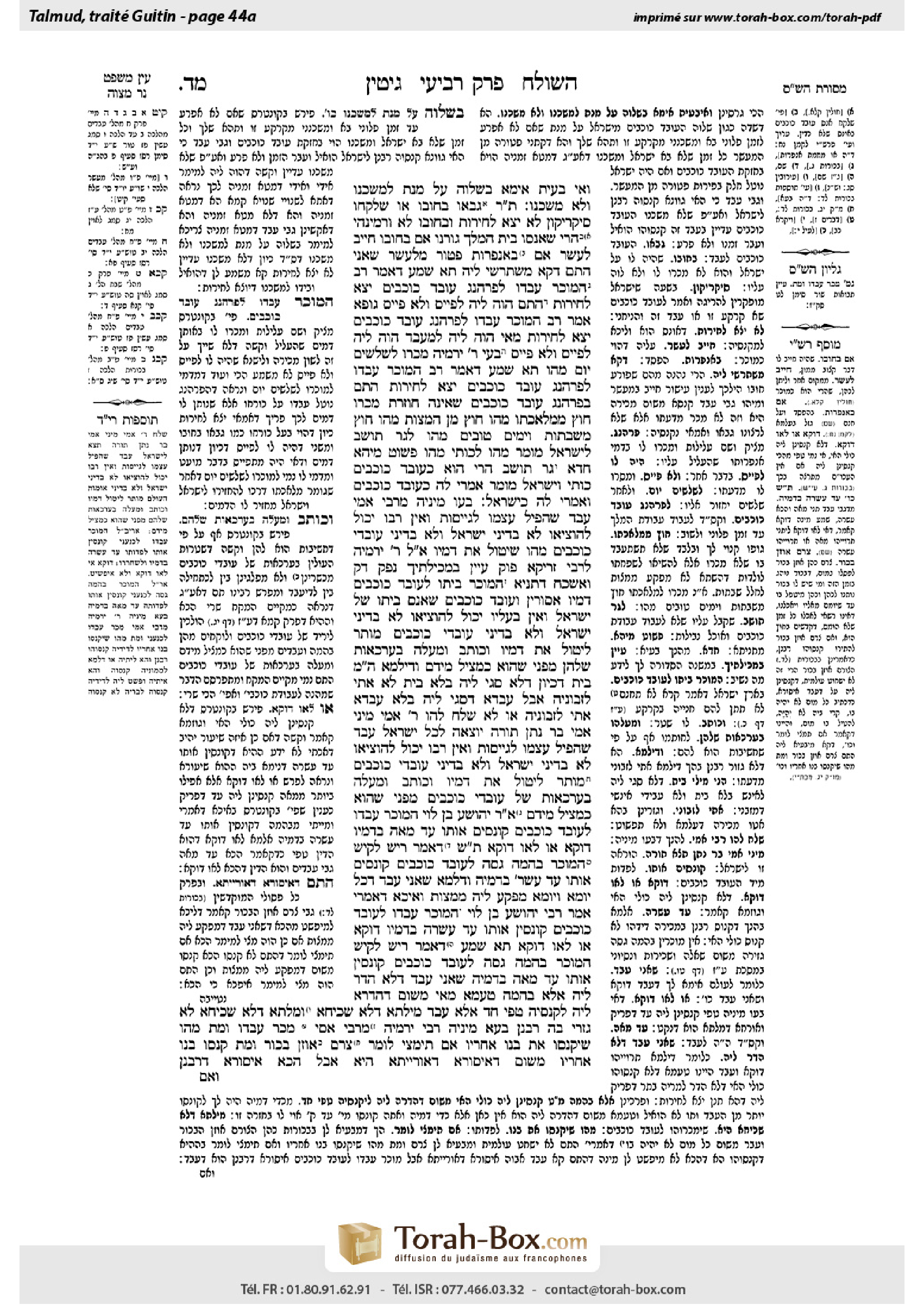
Scan : Torah-Box. Daf Study est un projet indépendant, sans affiliation ni approbation de Torah-Box ou de Sefaria.