Guittin 62b en français · גיטין ס״ב ב
Traduction française du daf 62b du traité Guittin (Gittin 62b en anglais), avec le texte araméen, l’anglais de Sefaria et le scan de la page, pour étudier le Daf Yomi.
Ouvrir dans le lecteur interactifLire le daf du jour
Traduction française de Guittin 62b
Les traductions françaises de Daf Study sont générées par IA à partir de l’édition anglaise de Sefaria. Elles peuvent contenir des erreurs : vérifie toujours un passage avec le texte source.
MICHNA : Celui qui dit à un autre : « Reçois cet acte de divorce pour mon épouse » ou : « Remets cet acte de divorce à mon épouse en qualité de mandataire », peut revenir sur sa désignation et annuler le mandat jusqu’à ce que le document parvienne entre les mains de son épouse. En revanche, dans le cas d’une femme qui a dit à un mandataire : « Reçois mon acte de divorce pour moi », si le mari lui remet l’acte de divorce et cherche ensuite à revenir sur sa décision de divorcer, il ne peut pas le faire. Dès que l’acte de divorce est remis à son mandataire, il a le même statut que s’il avait été remis directement à la femme, et le divorce prend effet immédiatement.
Par conséquent, si le mari dit au mandataire que la femme a désigné pour recevoir l’acte de divorce : « Je ne veux pas [ee ifshi] que tu reçoives l’acte de divorce pour elle ; remets-le plutôt et donne-le-lui », alors, s’il veut revenir sur sa désignation et annuler le mandat, il peut le faire jusqu’à ce que le document parvienne entre les mains de son épouse. Puisque le mari n’accepte pas que le divorce prenne effet dès que le mandataire de son épouse reçoit l’acte, il modifie la désignation du mandataire et le désigne comme son propre mandataire chargé de remettre l’acte. Par conséquent, le divorce ne prend effet que lorsque l’acte de divorce parvient entre les mains de son épouse.
Rabban Chimon ben Gamliel dit : Même une femme qui n’a pas dit au mandataire : « Reçois mon acte de divorce pour moi », mais lui a dit : « Prends mon acte de divorce pour moi », le désigne ainsi comme mandataire chargé de recevoir l’acte en son nom. Par conséquent, si, après que le mari a remis l’acte de divorce au mandataire, il cherche à revenir sur sa décision et à annuler le mandat, il ne peut pas le faire.
GUEMARA : La Michna enseigne qu’un mari qui désigne un mandataire en disant : « Reçois un acte de divorce pour mon épouse » ou : « Remets un acte de divorce à mon épouse » peut revenir sur cette désignation. Rav Aḥa, fils de Rav Avya, dit à Rav Ashi qu’on peut en déduire que la raison pour laquelle il peut revenir sur sa désignation est que la femme n’a pas désigné le mandataire comme mandataire chargé de recevoir l’acte. En revanche, si elle l’a désigné comme tel, même si le mari lui a dit : « Remets cet acte de divorce à mon épouse », il ne peut revenir sur sa déclaration. Rav Aḥa propose d’apprendre de la Michna que dire « remets » équivaut à dire « acquiers ». Par conséquent, même si le mari a dit au mandataire : « Remets l’acte de divorce à mon épouse », le mandataire l’acquiert au nom de l’épouse et le divorce prend effet immédiatement.
La Guemara rejette cette conclusion : Non, il n’y a pas de preuve, car je pourrais en réalité te dire que dire « remets » n’équivaut pas à dire « acquiers » et que, si l’épouse a désigné un mandataire chargé de recevoir l’acte et que le mari lui a ordonné de le remettre, le mari peut revenir sur sa désignation. La Michna parle plutôt d’un cas où la femme n’a pas désigné de mandataire chargé de recevoir l’acte. C’est le cas où le mari a dit : « Reçois cet acte de divorce pour mon épouse » que le tanna devait enseigner, car il comporte un élément nouveau.
En effet, on aurait pu penser que, puisque le mari n’est habilité à désigner qu’un mandataire chargé de remettre l’acte, et non un mandataire chargé de le recevoir, lorsqu’il dit au mandataire : « Reçois cet acte de divorce pour mon épouse », l’acte n’est pas valide, même s’il parvient entre les mains de la femme. Puisque le mari a désigné le mandataire par une formule qui convient à un mandataire chargé de recevoir l’acte, fonction pour laquelle il n’est pas habilité à le désigner, on aurait pu conclure qu’il n’a désigné aucun mandataire. En outre, la femme, qui est habilitée à désigner un mandataire chargé de recevoir l’acte, ne l’a pas fait. Il n’existe donc aucun mécanisme permettant au divorce de prendre effet. C’est pourquoi le tanna nous enseigne que, lorsque le mari ordonne au mandataire : « Reçois cet acte de divorce pour mon épouse », cela revient à dire : « Reçois et remets l’acte de divorce ». Il a désigné un mandataire chargé de remettre l’acte, et le divorce prend effet lorsque celui-ci parvient à la femme.
La Guemara cite une autre preuve que l’ordre donné à quelqu’un de « remettre » a le même statut que l’ordre de « prendre possession ». La Michna enseigne que, dans le cas d’une femme qui a dit à un mandataire : « Reçois mon acte de divorce pour moi », si le mari cherche à revenir sur sa décision de divorcer après que le mandataire a reçu l’acte, il ne peut pas le faire. N’est-ce pas que, lorsque le mari remet l’acte de divorce au mandataire, il ne fait aucune différence qu’il emploie une formule de réception ou une formule de remise : dans les deux cas, il ne peut revenir sur sa décision ? Apparemment, dire « remets » équivaut à dire « acquiers ».
La Guemara rejette cette conclusion : Non, cette règle selon laquelle le mari ne peut revenir sur sa décision ne s’applique que dans le cas d’une réception, c’est-à-dire si le mari a dit au mandataire : « Reçois cet acte de divorce pour mon épouse ». En revanche, s’il lui a dit : « Remets cet acte de divorce à mon épouse », il peut revenir sur sa décision.
La Guemara dit : Viens et entends une autre preuve tirée de la Michna. Par conséquent, si le mari dit au mandataire chargé de recevoir l’acte pour la femme : « Je ne veux pas que tu reçoives l’acte de divorce pour elle ; remets-le plutôt et donne-le-lui », s’il veut revenir sur sa désignation, il peut le faire jusqu’à ce que le document parvienne entre les mains de son épouse. La Guemara en déduit qu’il peut revenir sur sa désignation parce qu’il a dit : « Je ne veux pas », annulant ainsi le statut du mandataire comme mandataire chargé de recevoir l’acte. En revanche, s’il n’a pas dit : « Je ne veux pas », mais seulement : « Remets cet acte de divorce », il ne peut pas revenir sur sa décision. La Guemara propose d’apprendre de la Michna que dire « remets » équivaut à dire « acquiers ».
La Guemara rejette cette proposition. Peut-être la Michna ne parle-t-elle pas d’un cas où le mari a dit : « Remets » [holekh], mais d’un cas où il a dit : « Tiens » [heilakh]. Le mari dit ainsi : « Le voici, il est à toi », ce qui constitue assurément une formule d’acquisition.
§ La Guemara poursuit l’examen de la halakha fondamentale concernant le mandat relatif à un acte de divorce. Il est évident qu’un homme peut être désigné comme mandataire chargé de remettre l’acte, puisque le mari remet à son épouse l’acte de divorce. De même, il est évident qu’une femme peut être désignée comme mandataire chargée de recevoir l’acte, puisqu’une femme reçoit son acte de divorce des mains de son mari. Mais quelle est la halakha concernant la désignation d’un homme comme mandataire chargé de recevoir l’acte et celle d’une femme comme mandataire chargée de le remettre ?
La Guemara dit : Viens et entends une preuve tirée de la Michna. Celui qui dit à un autre : « Reçois cet acte de divorce pour mon épouse » ou : « Remets cet acte de divorce à mon épouse en qualité de mandataire », peut revenir sur sa désignation. En revanche, dans le cas d’une femme qui a dit à un mandataire : « Reçois mon acte de divorce pour moi », si le mari remet l’acte à ce mandataire puis cherche à revenir sur sa décision, il ne le peut pas. N’est-ce pas qu’il s’agit d’un seul et même mandataire dans les deux cas ? On pourrait alors en conclure que le mandataire habilité à recevoir l’acte est également habilité à le remettre. La Guemara rejette cette conclusion : Non, on peut expliquer que la Michna parle de deux mandataires différents : un homme chargé de remettre l’acte et une femme chargée de le recevoir.
La Guemara dit : Viens et entends une autre preuve tirée de la Michna : par conséquent, si le mari dit au mandataire chargé de recevoir l’acte pour la femme : « Je ne veux pas que tu reçoives l’acte de divorce pour elle ; remets-le plutôt et donne-le-lui », s’il veut revenir sur sa désignation, il peut le faire. Or, ne s’agit-il pas ici d’un seul mandataire dont le mari modifie le rôle, le faisant passer de mandataire chargé de recevoir l’acte à mandataire chargé de le remettre ? On pourrait alors conclure de la Michna qu’un mandataire habilité à recevoir l’acte est également habilité à le remettre.
La Guemara reconnaît que cette preuve permet de trancher en partie : Déduis de la Michna qu’un homme peut être mandataire chargé de recevoir l’acte ; cela est logique, puisque le père reçoit un acte de divorce au nom de sa fille mineure, car celle-ci n’a pas la capacité juridique de le recevoir elle-même. Cependant, la question de savoir si une femme peut être mandataire chargée de remettre l’acte reste en suspens : quelle est la halakha ? Rav Mari dit : Viens et entends une réponse tirée de la Michna (23b) : même les femmes qui ne sont pas jugées dignes de confiance lorsqu’elles affirment qu’un mari est mort, parce qu’on les soupçonne de vouloir nuire à cette femme, sont jugées dignes de confiance pour lui apporter son acte de divorce. Or, dans le cas évoqué par cette Michna, la femme est un mandataire chargé de remettre l’acte.
Rav Ashi dit : Déduis également une réponse à ce dilemme de la dernière partie de cette Michna, car elle enseigne : La femme elle-même peut apporter son propre acte de divorce, à condition que le tribunal lui demande de déclarer en sa présence : « Il a été écrit en ma présence et il a été signé en ma présence », et nous avons établi que la femme agit alors comme mandataire chargée de remettre l’acte. La Guemara conclut : Déduis de la dernière partie de cette Michna qu’une femme peut être désignée comme mandataire chargée de remettre l’acte.
§ Il a été enseigné que, lorsqu’une femme dit à un mandataire : « Apporte-moi mon acte de divorce », puis que le mandataire dit à son mari : « Votre épouse a dit : “Reçois mon acte de divorce pour moi” », et que le mari lui remet l’acte en disant : « Le voici, comme elle l’a dit », les amoraïm sont en désaccord sur la halakha. Faut-il déterminer la halakha d’après les paroles de son épouse, auquel cas le divorce ne prend effet que lorsque l’acte de divorce parvient entre les mains de la femme, ou d’après les paroles du mandataire, auquel cas le divorce prend effet dès que l’acte lui est remis ?
Rav Naḥman dit au nom de Rabba bar Avuh, qui dit au nom de Rav : Dans ce cas, même si l’acte de divorce parvient entre ses mains, elle n’est pas divorcée. La Guemara conclut de cette déclaration que le mari se fie aux paroles du mandataire quant à son statut et lui remet l’acte de divorce comme à un mandataire chargé de le recevoir. Cependant, puisque la femme ne l’a pas désigné comme mandataire chargé de recevoir l’acte et que le mari n’a pas le pouvoir de le désigner comme tel, il n’y a pas de mandat et le divorce ne prend pas effet. En effet, si c’était le contraire, c’est-à-dire si, en remettant l’acte de divorce au mandataire, le mari se fiait aux paroles de son épouse quant au statut du mandataire, alors, au moins lorsque l’acte de divorce parvient entre ses mains, elle devrait être divorcée, puisqu’elle avait désigné le mandataire comme mandataire chargé de remettre l’acte pour son mari.
Rav Ashi dit : Comment peut-on comparer ces cas ?
Texte source et traduction anglaise
גיטין ס״ב ב · texte araméen et hébreu
הָאוֹמֵר ״הִתְקַבֵּל גֵּט זֶה לְאִשְׁתִּי״, אוֹ ״הוֹלֵךְ גֵּט זֶה לְאִשְׁתִּי״, אִם רָצָה לַחְזוֹר – יַחְזוֹר. הָאִשָּׁה שֶׁאָמְרָה: ״הִתְקַבֵּל לִי גִּיטִּי״, אִם רָצָה לַחְזוֹר – לֹא יַחְזוֹר.
לְפִיכָךְ, אִם אָמַר לוֹ הַבַּעַל: ״אִי אֶיפְשִׁי שֶׁתְּקַבֵּל לָהּ, אֶלָּא הוֹלֵךְ וְתֵן לָהּ״, אִם רָצָה לַחְזוֹר, יַחְזוֹר.
רַבָּן שִׁמְעוֹן בֶּן גַּמְלִיאֵל אוֹמֵר: אַף הָאוֹמֶרֶת: ״טוֹל לִי גִּיטִּי״, אִם רָצָה לַחְזוֹר – לֹא יַחְזוֹר.
גְּמָ׳ אֲמַר לֵיהּ רַב אַחָא בְּרֵיהּ דְּרַב אַוְיָא לְרַב אָשֵׁי: טַעְמָא דְּלָא שַׁוֵּיתֵיהּ אִיהִי שָׁלִיחַ לְִקַבָּלָה, הָא שַׁוֵּיתֵיהּ אִיהִי שָׁלִיחַ לְִקַבָּלָה, רָצָה לַחְזוֹר – לֹא יַחְזוֹר. שְׁמַע מִינַּהּ – ״הוֹלֵךְ״ כִּ״זְכִי״ דָּמֵי!
לָא; לְעוֹלָם אֵימָא לָךְ: ״הוֹלֵךְ״ לָאו כִּ״זְכִי״ דָּמֵי, וְ״הִתְקַבֵּל גֵּט לְאִשְׁתִּי״ אִיצְטְרִיכָא לֵיהּ –
דְּסָלְקָא דַּעְתָּךְ אָמֵינָא, הוֹאִיל וּבַעַל לָאו בַּר שַׁוּוֹיֵי שָׁלִיחַ לְִקַבָּלָה הוּא, אַף עַל גַּב דִּמְטָא גִּיטָּא לִידֵהּ – לָא לֶהֱוֵי גִּיטָּא; קָא מַשְׁמַע לַן, דְּ״הִתְקַבֵּל וְהוֹלֵךְ״ קָאָמַר.
תְּנַן, הָאִשָּׁה שֶׁאָמְרָה: ״הִתְקַבֵּל לִי גִּיטִּי״, אִם רָצָה לַחְזוֹר – לֹא יַחְזוֹר. מַאי, לָאו לָא שְׁנָא אַקַּבָּלָה, לָא שְׁנָא אַהוֹלָכָה?
לָא, אַקַּבָּלָה.
תָּא שְׁמַע: לְפִיכָךְ, אִם אָמַר לוֹ הַבַּעַל: ״אִי אֶיפְשִׁי שֶׁתְּקַבֵּל לָהּ, אֶלָּא הוֹלֵךְ וְתֵן לָהּ״, אִם רָצָה לַחְזוֹר – יַחְזוֹר. טַעְמָא דְּאָמַר ״אִי אֶיפְשִׁי״; הָא לָא אָמַר ״אִי אֶיפְשִׁי״, אִם רָצָה לַחְזוֹר – לֹא יַחְזוֹר; שְׁמַע מִינַּהּ – ״הוֹלֵךְ״ כִּ״זְכִי״ דָּמֵי!
דִּילְמָא בְּ״הֵילָךְ״.
פְּשִׁיטָא – אִישׁ הָוֵי שָׁלִיחַ לְהוֹלָכָה, שֶׁכֵּן בַּעַל מוֹלִיךְ גֵּט אִשְׁתּוֹ; וְאִשָּׁה הָוְיָא שָׁלִיחַ לְִקַבָּלָה, שֶׁכֵּן אִשָּׁה מְקַבֶּלֶת גִּיטָּהּ מִיַּד בַּעְלָהּ. אִישׁ – לְקַבָּלָה, וְהָאִשָּׁה – לְהוֹלָכָה, מַאי?
תָּא שְׁמַע, הָאוֹמֵר: ״הִתְקַבֵּל גֵּט זֶה לְאִשְׁתִּי״, אוֹ ״הוֹלֵךְ גֵּט זֶה לְאִשְׁתִּי״, אִם רָצָה לַחְזוֹר – יַחְזוֹר. הָאִשָּׁה שֶׁאָמְרָה: ״הִתְקַבֵּל לִי גִּיטִּי״, אִם רָצָה לַחְזוֹר – לֹא יַחְזוֹר. מַאי, לָאו בְּחַד שָׁלִיחַ – וּשְׁמַע מִינַּהּ כָּשֵׁר לְקַבָּלָה כָּשֵׁר לְהוֹלָכָה? לָא, בִּשְׁנֵי שְׁלוּחִין.
תָּא שְׁמַע: לְפִיכָךְ, אִם אָמַר לוֹ הַבַּעַל: ״אִי אֶיפְשִׁי שֶׁתְּקַבֵּל לָהּ, אֶלָּא הוֹלֵךְ וְתֵן לָהּ״, אִם רָצָה לַחְזוֹר – יַחְזוֹר. וְהָא הָכָא, דְּחַד שָׁלִיחַ הוּא, וּשְׁמַע מִינַּהּ כָּשֵׁר לְקַבָּלָה כָּשֵׁר לְהוֹלָכָה!
פְּשׁוֹט מִינַּהּ אִישׁ הָוֵי שָׁלִיחַ לְקַבָּלָה – שֶׁכֵּן אָב מְקַבֵּל גֵּט לְבִתּוֹ קְטַנָּה; אִשָּׁה לְהוֹלָכָה – תִּיבְּעֵי לָךְ, מַאי? אָמַר רַב מָרִי, תָּא שְׁמַע: אַף הַנָּשִׁים שֶׁאֵין נֶאֱמָנוֹת לוֹמַר מֵת בַּעְלָהּ, נֶאֱמָנוֹת לְהָבִיא אֶת גִּיטָּהּ – וְהָתָם הוֹלָכָה הִיא.
אָמַר רַב אָשֵׁי: מִסֵּיפָא נָמֵי שְׁמַע מִינַּהּ – דְּקָתָנֵי סֵיפָא: הָאִשָּׁה עַצְמָהּ מְבִיאָה אֶת גִּיטָּהּ, וּבִלְבַד שֶׁהִיא צְרִיכָה לוֹמַר: ״בְּפָנַי נִכְתַּב וּבְפָנַי נֶחְתַּם״; וְאוֹקֵימְנָא בְּהוֹלָכָה; שְׁמַע מִינַּהּ.
אִיתְּמַר: ״הָבֵא לִי גִּיטִּי״, וְ״אִשְׁתְּךָ אָמְרָה הִתְקַבֵּל לִי גִּיטִּי״, וְהוּא אָמַר: ״הֵילָךְ כְּמָה שֶׁאָמְרָה״;
אָמַר רַב נַחְמָן אָמַר רַבָּה בַּר אֲבוּהּ אָמַר רַב: אֲפִילּוּ הִגִּיעַ גֵּט לְיָדָהּ – אֵינָהּ מְגוֹרֶשֶׁת. שְׁמַע מִינַּהּ אַדִּיבּוּרָא דִידֵיהּ קָא סָמֵיךְ – דְּאִי אַדִּיבּוּרָא דִידַהּ קָא סָמֵיךְ, מִכִּי מָטֵי גִּיטָּא לִידַהּ מִיהָא תִּיגָּרַשׁ!
אָמַר רַב אָשֵׁי: הָכִי הַשְׁתָּא?!
Gittin 62b · traduction anglaise de Sefaria
MISHNA: With regard to one who says to another: Receive this bill of divorce for my wife, or: Deliver this bill of divorce to my wife as my agent, if the husband seeks to retract his designation and cancel the agency, he can retract it until the document reaches his wife’s possession. However, in the case of a woman who said to an agent: Receive my bill of divorce for me, and the husband handed the bill of divorce to her agent, if the husband seeks to retract his decision to divorce his wife upon receipt of the bill of divorce by the agent, he cannot retract it. Once the bill of divorce is transferred to her agent, its legal status is like that of a bill of divorce that was handed directly to her, and the divorce takes effect immediately.
Therefore, if the husband said to the agent whom the woman designated to receive the bill of divorce: I do not want [ee ifshi] for you to receive the bill of divorce for her; rather, deliver it and give it to her, then if the husband seeks to retract his designation and cancel the agency, he can retract it until it reaches his wife’s possession. Since the husband does not agree to have the divorce take effect upon receipt by his wife’s agent, he changes the designation of the agent and designates him as his own agent for delivery. Therefore, the divorce takes effect only when the bill of divorce reaches his wife’s possession.
Rabban Shimon ben Gamliel says: Even a woman who did not instruct the agent: Receive my bill of divorce for me but says: Take my bill of divorce for me, thereby designates the agent as an agent of receipt on her behalf. Therefore, if after handing the bill of divorce to the agent the husband seeks to retract his decision and cancel the agency, he cannot retract it.
GEMARA: The mishna stated that a husband who designates an agent, saying: Receive a bill of divorce for my wife, or: Deliver a bill of divorce to my wife, can retract that designation. Rav Aḥa, son of Rav Avya, said to Rav Ashi that one may infer: The reason that he may retract the designation is that the woman did not designate the agent as an agent for receipt. However, in a case where she designated him as an agent for receipt, then even if the husband said to that agent for receipt: Deliver this bill of divorce to my wife, if the husband seeks to retract his statement, he cannot retract it. Rav Aḥa suggests: Learn from the mishna that saying: Deliver, is like saying: Acquire. Therefore, even though the husband said to the agent: Deliver the bill of divorce to my wife, the agent acquires it on behalf of the wife and the divorce takes effect immediately.
The Gemara rejects this conclusion: No, there is no proof, as actually I could say to you that saying: Deliver, is not like saying: Acquire, and in a case where the wife appointed an agent for receipt and the husband instructed him: Deliver the bill of divorce, the husband can retract the designation. Rather, the mishna is referring to a case where the woman did not appoint an agent for receipt, and it is the case where the husband said: Receive this bill of divorce on behalf of my wife, that was necessary for the tanna to teach, as there is a novel element in that case.
This is as it might enter your mind to say that since the husband is not eligible to designate an agent for receipt, but only an agent for delivery, when he says to the agent: Receive this bill of divorce on behalf of my wife, even though the bill of divorce reached her possession, it is not a valid bill of divorce. Since the husband designated the agent with language appropriate for an agent of receipt, which he is not eligible to designate, one might conclude that the husband did not designate an agent at all. In addition, the woman, who is eligible to designate an agent of receipt, did not do so. Consequently, there is no mechanism in place to facilitate the divorce. Therefore, the tanna teaches us that when the husband instructed the agent: Receive this bill of divorce on behalf of my wife, it is as though he said: Receive and deliver the bill of divorce. He designated an agent for delivery, and the divorce takes effect when the bill of divorce reaches the woman.
The Gemara cites an additional proof that the legal status of one who instructs another: Deliver, is like one who instructs another: Acquire. We learned in the mishna that in the case of a woman who said to an agent: Receive my bill of divorce for me, if the husband seeks to retract his decision to divorce his wife upon receipt of the bill of divorce by the agent, he cannot retract it. What, is it not that when the husband handed the bill of divorce to the agent, it is no different whether he employed an expression of receipt and it is no different whether he employed an expression of delivery, and in both cases he cannot retract his decision? Apparently, saying: Deliver, is like saying: Acquire.
The Gemara rejects this conclusion: No, this ruling that he cannot retract his decision applies only in the case of receipt, i.e., if the husband said to the agent: Receive this bill of divorce on behalf of my wife. However, if he said: Deliver this bill of divorce to my wife, he can retract his decision.
The Gemara states: Come and hear an additional proof from the mishna. Therefore, if the husband said to the woman’s agent of receipt: I do not want you to receive the bill of divorce on her behalf; rather, deliver it and give it to her, if the husband seeks to retract his designation, he can retract it until it reaches his wife’s possession. The Gemara infers: The reason he can retract his designation is due to the fact that he said: I do not want, thereby canceling the agent’s status as an agent of receipt. However, if he did not say: I do not want, but he said: Deliver this bill of divorce, if the husband seeks to retract his decision he cannot retract it. The Gemara suggests: Learn from the mishna that saying: Deliver, is like saying: Acquire.
The Gemara rejects that suggestion. Perhaps the mishna is not referring to a case where the husband said: Deliver [holekh]; rather, the mishna is referring to a case where the husband said: Here you are [heilakh]. The husband is thereby saying: Here you are and it is yours, which is certainly an expression of acquisition.
§ The Gemara proceeds to discuss the fundamental halakha of agency with regard to a bill of divorce. It is obvious that a man can be designated an agent for delivery, as a husband delivers his wife’s bill of divorce. And similarly, it is obvious that a woman can be designated an agent for receipt, as a woman receives her bill of divorce from the hand of her husband. However, with regard to designating a man as an agent for receipt and designating a woman as an agent for delivery, what is the halakha?
The Gemara states: Come and hear a proof from the mishna. With regard to one who says to another: Receive this bill of divorce for my wife, or: Deliver this bill of divorce to my wife as my agent, if the husband seeks to retract his designation, he can retract it. However, in the case of a woman who said to an agent: Receive my bill of divorce for me, if the husband gives that agent the bill of divorce and then seeks to retract his decision he cannot retract it. What, is it not referring to one and the same agent in both cases, and conclude from it that the agent who is valid for receipt is valid for delivery as well? The Gemara rejects this: No, it is possible to explain that the reference in the mishna is to two different agents, an agent for delivery who is a man and an agent for receipt who is a woman.
The Gemara states: Come and hear an additional proof from the mishna: Therefore, if the husband said to the woman’s agent of receipt: I do not want you to receive the bill of divorce on her behalf; rather, deliver it and give it to her, if the husband seeks to retract his designation, he can retract it. And isn’t the case here one where it is one agent whose designation the husband changes from an agent of receipt to an agent of delivery, and conclude from the mishna that an agent who is valid for receipt is valid for delivery as well?
The Gemara concedes that this proof is partially effective: Resolve from the mishna that a man can be an agent for receipt, and that is reasonable, as a father receives a bill of divorce on behalf of his daughter who is a minor because she lacks the halakhic competence to receive it herself. However, with regard to whether a woman can be an agent for delivery, raise the dilemma: What is the halakha? Rav Mari said: Come and hear a resolution based on the mishna (23b): Even the women who are not deemed credible to say that a woman’s husband died, because they are suspected of seeking to harm her, are deemed credible to bring her bill of divorce to her. And there, in the case in that mishna, the woman is an agent for delivery.
Rav Ashi said: Learn a resolution to that dilemma from the latter clause of that mishna as well, as the latter clause of that mishna teaches: The woman herself may bring her own bill of divorce, provided that she is required by the court to state in its presence: It was written in my presence and it was signed in my presence, and we established that the woman acts as an agent for delivery. The Gemara concludes: Learn from the latter clause of that mishna that a woman can be designated as an agent for delivery.
§ It was stated that if a woman says to an agent: Bring my bill of divorce to me, and the agent then says to her husband: Your wife said receive my bill of divorce for me, and the husband hands him the bill of divorce and says: Here you are, as she said; that the amora’im engage in a dispute as to the halakha. Is the halakha determined by what his wife said, in which case the divorce takes effect only when the bill of divorce reaches the woman’s possession, or is it determined by what the agent said, in which case the divorce takes effect when the bill of divorce is handed to the agent?
Rav Naḥman says that Rabba bar Avuh says that Rav says: In that case, even if the bill of divorce reached her possession, she is not divorced. The Gemara concludes: Learn from this statement that the husband relies on the agent’s statement as to what his status is, and hands him the bill of divorce as an agent for receipt. However, since the woman did not designate him as an agent for receipt and the husband lacks the authority to designate him as an agent of receipt, there is no agency and the divorce does not take effect. As, if the contrary were the case, that when he hands the bill of divorce to the agent the husband relies on his wife’s statement as to what the agent’s status is, then at least when the bill of divorce reaches her possession let her be divorced, as she designated the agent as an agent of delivery for her husband.
Rav Ashi said: How can these cases be compared?
Texte de Sefaria : William Davidson Edition - Vocalized Aramaic (CC BY NC) ; William Davidson Edition - English (CC BY NC).
Scan de Guittin 62b
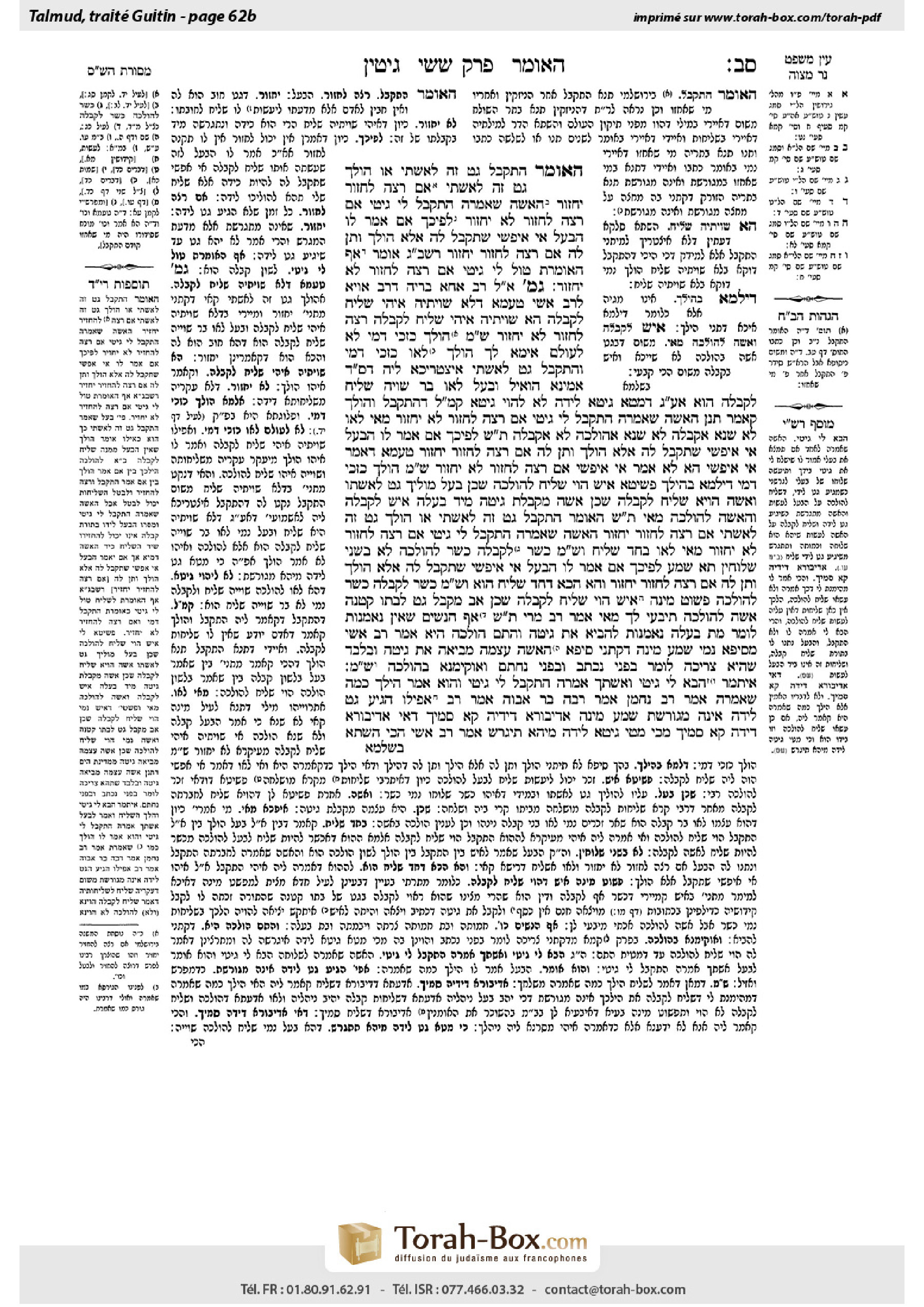
Scan : Torah-Box. Daf Study est un projet indépendant, sans affiliation ni approbation de Torah-Box ou de Sefaria.