Guittin 63b en français · גיטין ס״ג ב
Traduction française du daf 63b du traité Guittin (Gittin 63b en anglais), avec le texte araméen, l’anglais de Sefaria et le scan de la page, pour étudier le Daf Yomi.
Ouvrir dans le lecteur interactifLire le daf du jour
Traduction française de Guittin 63b
Les traductions françaises de Daf Study sont générées par IA à partir de l’édition anglaise de Sefaria. Elles peuvent contenir des erreurs : vérifie toujours un passage avec le texte source.
Quoi ? La Michna ne traite-t-elle pas d’un cas où le mari a dit à l’agent : « Tiens », conformément à l’opinion de Rabbi Natan, qui semble considérer que, lorsque le mari dit « Tiens », cela n’équivaut pas à dire « Acquiers » ? La Guemara rejette cette interprétation : non, la Michna traite d’un cas où le mari a dit à l’agent : « Remets », conformément à l’opinion de Rabbi Yehuda HaNasi, selon laquelle, même dans ce cas, le mari ne peut pas revenir sur sa décision.
La Guemara dit : « Viens entendre » une preuve supplémentaire tirée de la Michna. Par conséquent, si le mari a dit à l’agent de réception de la femme : « Je ne veux pas que tu reçoives l’acte de divorce pour elle ; remets-le-lui plutôt », alors, si le mari cherche à revenir sur sa désignation, il peut le faire jusqu’à ce que l’acte parvienne à sa femme. La Guemara déduit que s’il peut revenir sur sa désignation, c’est parce qu’il a dit : « Je ne veux pas », annulant ainsi le statut de l’agent en tant qu’agent de réception. Mais s’il n’avait pas dit : « Je ne veux pas », et avait seulement dit : « Remets-lui cet acte de divorce », alors il ne pourrait pas revenir sur sa décision.
Quoi ? La Michna ne traite-t-elle pas d’un cas où le mari a dit à l’agent : « Tiens », conformément à l’opinion de Rabbi Natan, qui semble considérer que le fait que le mari dise « Tiens » n’équivaut pas à ce qu’il dise « Acquiers » ? La Guemara rejette cette interprétation : non, la Michna traite d’un cas où le mari a dit à l’agent : « Remets », conformément à l’opinion de Rabbi Yehuda HaNasi.
La Guemara dit : « Viens entendre » une preuve concernant l’opinion de Rabbi Natan, tirée d’une baraïta. Si le mari a dit : « Remets cet acte de divorce à ma femme », il peut revenir sur sa décision. S’il a dit : « Tiens, cet acte de divorce est pour ma femme », il ne peut pas revenir sur sa décision. Qui a-t-on entendu dire, au sujet du cas où le mari a dit : « Remets », qu’il peut revenir sur sa décision ? C’est Rabbi Natan ; et il dit, au sujet du mari qui dit : « Tiens », qu’il ne peut pas revenir sur sa décision. Déduis de la baraïta que, selon l’opinion de Rabbi Natan, dire « Tiens » équivaut à dire « Acquiers ». La Guemara conclut : déduis de la baraïta qu’il en est bien ainsi.
§ À propos d’une femme qui dit à son agent : « Reçois mon acte de divorce pour moi », puis de l’agent qui dit à son mari : « Votre femme a dit : “Reçois mon acte de divorce pour moi” », et du mari qui répond à l’agent : « Remets-le-lui », Rabbi Abba dit au nom de Rav Huna, qui le dit au nom de Rav : l’agent devient à la fois l’agent du mari chargé de remettre l’acte de divorce et l’agent de la femme chargé de le recevoir. Par conséquent, si le mari meurt sans enfant après avoir remis l’acte de divorce à l’agent, mais avant qu’il ne parvienne à sa femme, celle-ci accomplit la ḥalitsa avec le frère de son mari, car il est possible que l’agent ait été un agent de remise et qu’elle n’ait donc pas encore été divorcée. Toutefois, le frère de son mari ne peut pas contracter avec elle un mariage léviratique, car il est possible que l’agent ait été un agent de réception, auquel cas elle était divorcée et lui était interdite.
La Guemara demande : Faut-il en déduire que Rav ne savait pas si le cas où le mari dit : « Remets » équivaut à celui où il dit : « Acquiers », ou s’il n’y équivaut pas ? Or, n’a-t-il pas été enseigné que, lorsqu’une personne dit à son agent : « Remets cent dinars à untel, car je lui dois cette somme », Rav dit que la personne qui a désigné l’agent est responsable de cet argent et que, s’il est perdu, elle doit payer la dette à son créancier ? Pourtant, si cette personne cherche à revenir sur sa désignation et à reprendre l’argent à l’agent, elle ne peut pas le faire, car le créancier acquiert l’argent dès que le débiteur l’a remis à son agent de remise. Apparemment, selon Rav, dire : « Remets » équivaut à dire : « Acquiers ».
La Guemara rejette cette preuve. Il y a une différence entre l’agent chargé de remettre un acte de divorce et celui chargé de remettre le remboursement d’un prêt. Dans le cas du remboursement d’un prêt, puisqu’il y a une incertitude en matière de droit pécuniaire, la décision est indulgente, car on ne prélève pas d’argent à autrui en cas d’incertitude dans ce domaine. Ici, en revanche, dans le cas du divorce, l’incertitude relève du droit rituel et la décision est stricte.
§ Rav dit : une femme ne peut pas désigner un agent pour recevoir son acte de divorce des mains de l’agent de son mari. Rabbi Ḥanina dit : une femme peut désigner un agent pour recevoir son acte de divorce des mains de l’agent de son mari.
La Guemara demande : Quelle est la raison de l’opinion de Rav, selon laquelle elle ne peut pas désigner un agent pour recevoir un acte de divorce d’un agent ? La Guemara répond : si tu veux, dis que c’est parce que son refus de recevoir le document directement de l’agent de son mari pourrait être interprété comme une marque de mépris envers son mari.
Si tu veux, dis plutôt qu’il s’agit d’un décret établi à cause du cas où sa cour entre en sa possession par la suite. Si un mari dépose un acte de divorce dans une cour qui n’appartient pas à sa femme, puis que celle-ci achète la cour, le divorce ne prend pas effet, car le mari n’a remis l’acte ni directement à sa femme ni dans un bien lui appartenant. L’achat ultérieur de la cour par la femme équivaut à ce qu’elle trouve et prenne le document. Dans le cas présent aussi, la femme a désigné son agent de réception après que son mari a remis l’acte de divorce à son agent de remise ; en ce sens, cet agent est comparable à son bien ou à sa cour. Si le divorce était valide dans ce cas, on pourrait en conclure par erreur qu’il est également valide lorsque le mari dépose le document dans une cour qu’elle acquiert par la suite.
La Guemara demande : Quelle est la différence entre ces deux raisons ? La Guemara répond : la différence concerne le cas où elle a désigné un agent dès le départ, avant que le mari ne désigne son agent de remise. Ce cas n’est nullement comparable à celui d’une cour qu’une femme achète après que le document y a été déposé. Toutefois, la crainte demeure que cela puisse être interprété comme une marque de mépris envers son mari.
La Guemara rapporte : un homme envoya un acte de divorce à sa femme. L’agent partit et la trouva assise, en train de pétrir. Il lui dit : « Tiens, prends ton acte de divorce. » Elle lui répondit : « Mes mains sont couvertes de pâte ; que l’acte de divorce reste donc en ta possession », c’est-à-dire : « Sois mon agent de réception. » Rav Naḥman dit : si la halakha suit l’opinion de Rabbi Ḥanina et qu’elle peut désigner un agent pour recevoir un acte de divorce de l’agent de son mari, je trancherais en faveur de cette femme et statuerais que le divorce prend effet.
Rava lui dit : si la halakha suit l’opinion de Rabbi Ḥanina, agirais-tu en faveur de cette femme ? Dans ce cas, puisque l’agent ne lui a pas effectivement remis l’acte de divorce, sa mission n’a pas été menée à bien et, par conséquent, il n’est pas retourné auprès du mari pour lui annoncer qu’il avait accompli la tâche qui lui avait été confiée. En le désignant comme son agent avant qu’il ait achevé la mission pour le compte du mari, la femme a annulé le mandat de l’agent du mari. Le divorce ne prend donc pas effet.
Rav Naḥman et Rava soumirent cette question à Rabbi Ami. Il leur répondit : l’agent n’est pas retourné auprès du mari, et le divorce ne prend pas effet. Rabbi Ḥiyya bar Abba dit : nous allons examiner la question, puis nous vous répondrons.
Plus tard, ils soumirent de nouveau cette question à Rabbi Ḥiyya bar Abba. Il dit : « Vont-ils donc continuer à envoyer cette question encore et encore ? De même que la question est incertaine pour eux, elle l’est aussi pour nous, et je n’ai pas de solution à cette incertitude. »
La Guemara conclut : il s’agit d’un cas d’incertitude concernant une interdiction liée aux relations conjugales, c’est-à-dire la question de savoir si la femme est toujours mariée. En cas d’incertitude concernant une telle interdiction, elle accomplit la ḥalitsa. La décision est stricte dans ce cas d’incertitude. Par conséquent, si son mari meurt sans enfant, elle ne peut pas se remarier, car il est possible qu’elle n’ait pas été divorcée. Toutefois, le frère de son mari ne peut pas contracter avec elle un mariage léviratique, car il est possible qu’elle ait été divorcée et qu’elle lui soit donc interdite.
La Guemara dit : un incident se produisit et Rav Yitzḥak bar Shmuel bar Marta exigea que la femme reçoive un autre acte de divorce et accomplisse la ḥalitsa. La Guemara demande : les deux à la fois ? Ces deux exigences s’excluent mutuellement. Le second acte de divorce rend la ḥalitsa inutile. La Guemara explique : il exigea un acte de divorce si le mari était encore vivant et, si le mari ne lui donnait pas d’acte de divorce, il exigea la ḥalitsa après la mort du mari.
La Guemara rapporte : une femme nommée Nefata avait un mari qui avait ordonné à des témoins d’écrire et de signer un acte de divorce afin de la divorcer. Les témoins partirent et écrivirent par erreur Tefata sur l’acte de divorce. Rav Yitzḥak bar Shmuel bar Marta dit au nom de Rav : l’acte de divorce est invalide, car le nom est erroné. Cependant, les témoins ne peuvent pas rédiger un autre acte de divorce correctement, car ils ont déjà accompli leur mission et ne sont donc plus les agents du mari.
Rabba conteste cette décision. Le mari leur a-t-il dit : « Écrivez un tesson d’argile sans valeur et remettez-le-lui » ? Il leur a ordonné d’écrire un acte de divorce valide ; tant qu’ils n’en ont pas écrit un de valide, ils n’ont pas accompli leur mission. Rabba dit plutôt : bien sûr, si les témoins avaient rédigé un acte de divorce conforme et qu’il avait été perdu, on dirait qu’ils ont accompli leur mission et qu’ils ne sont pas autorisés à en rédiger un autre. Mais ce n’est pas le cas s’ils ont rédigé un acte de divorce invalide.
Rav Naḥman conteste cette décision de Rabba. Le mari leur a-t-il dit : « Écrivez-le et mettez-le dans vos poches » ? Il leur a ordonné de rédiger le document et de divorcer sa femme avec celui-ci. Ils n’ont pas accompli leur mission en rédigeant simplement un acte de divorce valide. Rav Naḥman dit plutôt : dans chaque cas de ce type, les témoins rédigent un acte de divorce et le remettent à la femme, même cent fois.
Rava soumit une question à Rav Naḥman : dans le cas où le mari a dit aux témoins : « Écrivez un acte de divorce et remettez-le à un agent », quelle est la halakha ? Le mari les a-t-il déchargés de leur mission dès qu’ils ont remis l’acte de divorce à l’agent, de sorte qu’ils ne sont plus autorisés à en rédiger un autre ? Ou peut-être le mari voulait-il seulement leur épargner des efforts et leur a-t-il ordonné de remettre le document à un agent plutôt que de le remettre eux-mêmes ? Dans ce cas, leur mission reste en vigueur et, si nécessaire, ils peuvent continuer à rédiger des actes de divorce jusqu’à ce que le divorce prenne effet.
Ravina dit à Rav Ashi, développant la question précédente : si le mari a dit aux témoins : « Écrivez un acte de divorce et remettez-le à un agent, et celui-ci le lui remettra », quelle est la halakha ? L’expression supplémentaire « et celui-ci le lui remettra » indique-t-elle que leur mission reste en vigueur jusqu’à ce que l’agent lui remette effectivement l’acte de divorce ? Ou cette expression n’a-t-elle peut-être pas ce sens, et leur mission prend-elle fin au moment de la rédaction ? La Guemara conclut : la question reste sans réponse.
§ La Michna enseigne que Rabban Shimon ben Gamliel dit : même si une femme dit à son agent : « Prends mon acte de divorce pour moi », le mari ne peut pas revenir sur sa décision. L’agent est un agent de réception, et la femme est divorcée dès que l’acte de divorce parvient en sa possession. Les Sages ont enseigné (Tosefta 6:4) : si la femme dit à un agent : « Prends mon acte de divorce pour moi », ou : « Soulève mon acte de divorce pour moi », ou : « Que l’acte de divorce soit en ta possession pour moi », toutes ces expressions signifient que l’agent le reçoit pour elle, et le divorce prend effet dès que l’acte de divorce parvient en sa possession.
MICHNA : Une femme qui dit à un agent : « Reçois mon acte de divorce pour moi » doit faire appel à deux paires de témoins pour établir qu’elle a été divorcée lorsque l’agent a reçu l’acte de divorce. Il lui faut deux témoins qui déclarent : « En notre présence, elle a dit à l’agent : “Reçois mon acte de divorce pour moi” », et deux témoins qui déclarent : « En notre présence, l’agent a reçu l’acte de divorce et l’a déchiré. » Ce témoignage est recevable même si les mêmes deux personnes constituent la première paire et la seconde paire de témoins,
Texte source et traduction anglaise
גיטין ס״ג ב · texte araméen et hébreu
מַאי, לָאו בְּ״הֵילָךְ״ – וְרַבִּי נָתָן? לָא; בְּ״הוֹלֵךְ״ – וְרַבִּי.
תָּא שְׁמַע: לְפִיכָךְ, אִם אָמַר לוֹ הַבַּעַל: ״אִי אֶפְשִׁי שֶׁתְּקַבֵּל לָהּ, אֶלָּא הוֹלֵךְ וְתֵן לָהּ״, רָצָה לַחְזוֹר – יַחְזוֹר. טַעְמָא דְּאָמַר: ״אִי אֶפְשִׁי״; הָא לָא אָמַר: ״אִי אֶפְשִׁי״, רָצָה לַחְזוֹר – לֹא יַחְזוֹר;
מַאי, לָאו בְּ״הֵילָךְ״ – וְרַבִּי נָתָן? לָא; בְּ״הוֹלֵךְ״ – וְרַבִּי.
תָּא שְׁמַע: ״הוֹלֵךְ גֵּט זֶה לְאִשְׁתִּי״ – רָצָה לַחְזוֹר, יַחְזוֹר. ״הֵילָךְ גֵּט זֶה לְאִשְׁתִּי״ – רָצָה לַחְזוֹר, לֹא יַחְזוֹר. מַאן שָׁמְעַתְּ לֵיהּ דְּאָמַר בְּ״הוֹלֵךְ״ – רָצָה לַחְזוֹר, יַחְזוֹר – רַבִּי נָתָן; וְקָאָמַר בְּ״הֵילָךְ״ – רָצָה לַחְזוֹר, לֹא יַחְזוֹר; שְׁמַע מִינַּהּ – ״הֵילָךְ״ כִּ״זְכֵי״ דָּמֵי; שְׁמַע מִינַּהּ.
אִתְּמַר: ״הִתְקַבֵּל לִי גִּיטִּי״, וְ״אִשְׁתְּךָ אָמְרָה הִתְקַבֵּל לִי גִּיטִּי״, וְהוּא אוֹמֵר: ״הוֹלֵךְ וְתֵן לָהּ״ – אָמַר רַבִּי אַבָּא אָמַר רַב הוּנָא אָמַר רַב: נַעֲשָׂה שְׁלוּחוֹ וּשְׁלוּחָהּ – וְחוֹלֶצֶת.
לְמֵימְרָא דִּמְסַפְּקָא לֵיהּ לְרַב אִי ״הוֹלֵךְ״ כִּ״זְכֵי״ דָּמֵי, אִי לָאו כִּ״זְכֵי״ דָּמֵי?! וְהָא אִתְּמַר: ״הוֹלֵךְ מָנֶה לִפְלוֹנִי שֶׁאֲנִי חַיָּיב לוֹ״, אָמַר רַב: חַיָּיב בְּאַחְרָיוּתוֹ, וְאִם בָּא לַחְזוֹר – אֵינוֹ חוֹזֵר!
הָתָם – סְפֵק מָמוֹנָא לְקוּלָּא, הָכָא – סְפֵק אִיסּוּרָא לְחוּמְרָא.
אָמַר רַב: אֵין הָאִשָּׁה עוֹשָׂה שָׁלִיחַ לְקַבֵּל לָהּ גִּיטָּהּ מִיַּד שְׁלִיחַ בַּעְלָהּ. וְרַבִּי חֲנִינָא אָמַר: אִשָּׁה עוֹשָׂה שָׁלִיחַ לְקַבֵּל לָהּ גִּיטָּהּ מִיַּד שְׁלִיחַ בַּעְלָהּ.
מַאי טַעְמָא דְּרַב? אִיבָּעֵית אֵימָא: מִשּׁוּם בִּזָּיוֹן דְּבַעַל;
אִיבָּעֵית אֵימָא: מִשּׁוּם חֲצֵרָהּ הַבָּא לְאַחַר מִיכָּן.
מַאי בֵּינַיְיהוּ? אִיכָּא בֵּינַיְיהוּ דִּקְדַמָה אִיהִי, וְשַׁוִּיָּה שָׁלִיחַ מֵעִיקָּרָא.
הָהוּא גַּבְרָא דְּשַׁדַּר לַהּ גִּיטָּא לִדְבֵיתְהוּ, אֲזַל שְׁלִיחָא אַשְׁכְּחַהּ כִּי יָתְבָה וְקָא לָיְשָׁא, אֲמַר לַהּ: ״הֵילָךְ גִּיטָּךְ״, אֲמַרָה לֵיהּ: ״לֶיהֱוֵי בִּידָךְ״. אָמַר רַב נַחְמָן: אִם אִיתָא לִדְרַבִּי חֲנִינָא, עֲבַדִי בַּהּ עוֹבָדָא.
אֲמַר לֵיהּ רָבָא: וְאִם אִיתָא לִדְרַבִּי חֲנִינָא, עֲבַדְתְּ בַּהּ עוֹבָדָא?! הָא לֹא חָזְרָה שְׁלִיחוּת אֵצֶל הַבַּעַל!
שַׁלְחוּהָ לְקַמֵּיהּ דְּרַבִּי אַמֵּי, שְׁלַח לְהוּ: לֹא חָזְרָה שְׁלִיחוּת אֵצֶל הַבַּעַל. וְרַבִּי חִיָּיא בַּר אַבָּא אָמַר: נִתְיַישֵּׁב בַּדָּבָר.
הֲדוּר שַׁלְחוּהָ קַמֵּיהּ דְּרַבִּי חִיָּיא בַּר אַבָּא, אָמַר: כֹּל הָנֵי שָׁלְחוּ לַהּ וְאָזְלִי? כִּי הֵיכִי דִּמְסַפְּקָא לְהוּ לְדִידְהוּ, הָכִי נָמֵי מְסַפְּקָא לַן לְדִידַן;
הָוֵי דָּבָר שֶׁבָּעֶרְוָה, וְדָבָר שֶׁבָּעֶרְוָה – חוֹלֶצֶת.
הֲוָה עוֹבָדָא, וְאַצְרְכַהּ רַב יִצְחָק בַּר שְׁמוּאֵל בַּר מָרְתָּא גֵּט וַחֲלִיצָה. תַּרְתֵּי?! גֵּט מֵחַיִּים, וַחֲלִיצָה לְאַחַר מִיתָה.
הָהִיא דַּהֲווֹ קָרוּ לַהּ ״נַפְאָתָה״, אֲזוּל סָהֲדֵי כְּתוּב ״תַּפְאָתָה״. אָמַר רַב יִצְחָק בַּר שְׁמוּאֵל בַּר מָרְתָּא מִשְּׁמֵיהּ דְרַב: עָשׂוּ עֵדִים שְׁלִיחוּתָן.
מַתְקֵיף לַהּ רַבָּה: מִי קָאָמַר לְהוּ ״כְּתוּבוּ חַסְפָּא וְהַבוּ לַהּ״?! אֶלָּא אָמַר רַבָּה: וַדַּאי, אִי כְּתוּב סָהֲדֵי גִּיטָּא מְעַלְּיָא, וַאֲבַד, עָשׂוּ עֵדִים שְׁלִיחוּתָן.
מַתְקֵיף לַהּ רַב נַחְמָן: מִי קָאָמַר לְהוּ ״כְּתֻבוּ וְאַנְּחוּהּ בְּכִיסַיְיכוּ״?! אֶלָּא אָמַר רַב נַחְמָן: כּוֹתְבִין וְנוֹתְנִין, אֲפִילּוּ מֵאָה פְּעָמִים.
בְּעָא מִינֵּיהּ רָבָא מֵרַב נַחְמָן: ״כִּתְבוּ, וּתְנוּ לְשָׁלִיחַ״, מַהוּ? סַלּוֹקֵי סַלֵּיק לְהוּ, אוֹ דִילְמָא לְטִירְחָא דִּידְהוּ חָיֵישׁ?
אֲמַר לֵיהּ רָבִינָא לְרַב אָשֵׁי: ״וְיוֹלִיךְ לָהּ״, מַהוּ? תֵּיקוּ.
רַבָּן שִׁמְעוֹן בֶּן גַּמְלִיאֵל אוֹמֵר: אַף הָאוֹמֶרֶת ״טוֹל לִי גִּיטִּי״, אִם רָצָה לַחְזוֹר – לֹא יַחְזוֹר. תָּנוּ רַבָּנַן: ״טוֹל לִי״, וְ״שָׂא לִי״, וִ״יהֵא לִי בְּיָדֶךָ״ – כּוּלָּן לְשׁוֹן קַבָּלָה הֵן.
מַתְנִי׳ הָאִשָּׁה שֶׁאָמְרָה: ״הִתְקַבֵּל לִי גִּיטִּי״, צְרִיכָה שְׁתֵּי כִּיתֵּי עֵדִים – שְׁנַיִם שֶׁאוֹמְרִים: ״בְּפָנֵינוּ אָמְרָה״, וּשְׁנַיִם שֶׁאוֹמְרִים: ״בְּפָנֵינוּ קִבֵּל, וְקָרַע״; אֲפִילּוּ הֵן הָרִאשׁוֹנִים וְהֵן הָאַחֲרוֹנִים,
Gittin 63b · traduction anglaise de Sefaria
What, is the reference in the mishna not to a case where the husband said to the agent: Here you are, and it is in accordance with the opinion of Rabbi Natan, who apparently holds that if the husband says: Here you are, it is not comparable to a case where the husband said: Acquire? The Gemara rejects this: No, the reference in the mishna is to a case where the husband said to the agent: Deliver, and it is the opinion of Rabbi Yehuda HaNasi that even in that case the husband cannot retract his decision.
The Gemara states: Come and hear an additional proof from the mishna. Therefore, if the husband said to the woman’s agent of receipt: I do not want you to receive the bill of divorce for her; rather, deliver and give it to her, then if the husband seeks to retract his designation, he can retract it until it reaches his wife’s possession. The Gemara infers: The reason that he can retract his designation is due to the fact that he said: I do not want, thereby canceling the agent’s status as an agent of receipt. However, if he did not say: I do not want, but he said: Deliver this bill of divorce, then if the husband seeks to retract his decision he cannot retract it.
What, is the reference in the mishna not to a case where the husband said to the agent: Here you are, and it is in accordance with the opinion of Rabbi Natan, who apparently holds that the husband’s saying: Here you are, is not comparable to his saying: Acquire? The Gemara rejects this: No, the reference in the mishna is to a case where the husband said to the agent: Deliver, and it is the opinion of Rabbi Yehuda HaNasi.
The Gemara states: Come and hear proof with regard to the opinion of Rabbi Natan from a baraita. If the husband said: Deliver this bill of divorce to my wife, if he seeks to retract his decision he can retract it. If he said: Here you are; this bill of divorce is for my wife, if the husband seeks to retract his decision he cannot retract it. Whom did you hear who said with regard to a case where the husband said: Deliver, that if the husband seeks to retract his decision he can retract it? It is Rabbi Natan; and he says in the case of a husband who says: Here you are, that if the husband seeks to retract his decision he cannot retract it. Learn from the baraita that according to the opinion of Rabbi Natan, if the husband says: Here you are, it is comparable to a case where the husband said: Acquire. The Gemara concludes: Learn from the baraita that it is so.
§ It was stated with regard to a woman who says to her agent: Receive my bill of divorce for me, and the agent says to her husband: Your wife said: Receive my bill of divorce for me, and the husband says to the agent: Deliver and give it to her, that Rabbi Abba says that Rav Huna says that Rav says: The agent becomes both the husband’s agent for delivery of the bill of divorce and the wife’s agent for receipt. Therefore, if the husband dies childless after handing the bill of divorce to the agent but before it reaches his wife’s possession, she performs ḥalitza with the husband’s brother due to the possibility that the agent was an agent of delivery and she was therefore not yet divorced. However, her husband’s brother may not enter into levirate marriage with her, due to the possibility that the agent was an agent of receipt, in which case she was divorced and is forbidden to the brother.
The Gemara asks: Is this to say that Rav was uncertain whether a case where the husband said: Deliver, is comparable to a case where the husband said: Acquire, or whether it is not comparable to a case where he said: Acquire? But wasn’t it stated that in a case where one said to his agent: Deliver one hundred dinars to so-and-so, as I owe him that sum, Rav says: The person who designated the agent bears financial responsibility for this money, and if it is lost he is required to pay the debt to his creditor. Nevertheless, if the person who designated the agent seeks to retract his designation and take the money back from the agent, then he cannot retract it, because the creditor acquires the money from the moment that the debtor handed it to his agent of delivery. Apparently, according to Rav, saying: Deliver, is like saying: Acquire.
The Gemara rejects this proof. There is a distinction between the agent for delivery of a bill of divorce and the agent for delivery of the repayment of a loan. There, in the case of repayment of a loan, because there is uncertainty with regard to monetary law, the ruling is lenient, as one does not extract money from another in cases of uncertainty with regard to monetary law. However, here, in the case of divorce there is uncertainty with regard to ritual law and the ruling is stringent.
§ Rav says: A woman cannot appoint an agent to receive her bill of divorce from the hand of her husband’s agent, and Rabbi Ḥanina says: A woman can appoint an agent to receive her bill of divorce from the hand of her husband’s agent.
The Gemara asks: What is the reason for the opinion of Rav, who said that she cannot appoint an agent to receive a bill of divorce from an agent? The Gemara answers: If you wish, say: It is due to the fact that her unwillingness to receive the document directly from his agent could be construed as a display of contempt for her husband.
If you wish, say instead that it is a decree issued due to her courtyard that comes into her possession thereafter. If a husband places a bill of divorce in a courtyard that does not belong to his wife, and his wife then purchases the courtyard, the divorce does not take effect, because the husband neither gave the bill of the divorce directly to his wife nor did he place it in her property. Her subsequent purchase of the courtyard is tantamount to her finding and taking the document. In this case too, the woman designated her agent for receipt, who in this sense is comparable to her property or her courtyard, subsequent to her husband’s handing the bill of divorce to his agent of delivery. Were the divorce valid in that case, one might mistakenly conclude that divorce is likewise valid in a case where he placed the document in a courtyard that she subsequently acquired.
The Gemara asks: What is the difference between these two reasons? The Gemara answers: The difference between them is in a case where she first appointed an agent from the outset, before the husband designated his agent for delivery. That case is not at all comparable to the case of a courtyard that a woman purchases after the document is placed there. However, the concern remains that it could be construed as a display of contempt for her husband.
The Gemara relates: There was a certain man who sent a bill of divorce to his wife. The agent went and found her while she was sitting and kneading. He said to her: Here you are, take your bill of divorce. She said to him: My hands are covered with dough and therefore let the bill of divorce be in your hand, i.e., serve as my agent for receipt. Rav Naḥman said: If it is so that the halakha is in accordance with the opinion of Rabbi Ḥanina and she can designate an agent to receive a bill of divorce from her husband’s agent, then I would perform an action with regard to this woman and rule that the divorce takes effect.
Rava said to him: And if it is so that the halakha is in accordance with the opinion of Rabbi Ḥanina, would you perform an action with regard to this woman? In this case, as the agent did not actually hand her the bill of divorce, the agency was not completed and consequently the agent did not return to the husband and report that he performed the task for which he was designated. By designating him as her agent before he completed the agency on behalf of the husband, the wife nullified the agency of the husband. Therefore, the divorce does not take effect.
Rav Naḥman and Rava sent this issue before Rabbi Ami. He sent a response to them: The agency did not return to the husband, and the divorce does not take effect. And Rabbi Ḥiyya bar Abba says: We will consider the matter and then respond.
Later they again sent this issue before Rabbi Ḥiyya bar Abba. He said: All these times they continue to send questions? Just as the matter is uncertain to them, so too, it is uncertain to us, and I do not have a resolution to the uncertainty.
The Gemara concludes: This is a case of uncertainty with regard to a matter of forbidden relations, i.e., a question of whether the woman is still married. And in cases of uncertainty with regard to a matter of forbidden relations, she performs ḥalitza. The ruling is stringent in this case of uncertainty. Therefore, if her husband died childless she may not remarry, due to the possibility that she was not divorced. However, her husband’s brother may not enter into levirate marriage with her, due to the possibility that she was divorced and is therefore forbidden to him.
The Gemara says: There was an incident and Rav Yitzḥak bar Shmuel bar Marta required the woman to receive both an additional bill of divorce and ḥalitza. The Gemara asks: Two of them? They are mutually exclusive. The second bill of divorce obviates the need for ḥalitza. The Gemara explains: He required a bill of divorce in a case where the husband was alive, and if the husband did not give her a bill of divorce, he required ḥalitza after the husband’s death.
The Gemara relates: There was a certain woman who was named Nefata whose husband instructed witnesses to write and sign a bill of divorce and to divorce her. The witnesses went and mistakenly wrote Tefata in the bill of divorce. Rav Yitzḥak bar Shmuel bar Marta says in the name of Rav: The bill of divorce is invalid because the name is wrong. However, the witnesses cannot write another bill of divorce in the correct manner because the witnesses already performed their agency and are no longer agents of the husband.
Rabba objects to this ruling. Does the husband say to them: Write a worthless earthenware shard and give it to her? He instructed them to write a valid bill of divorce; as long as they did not write a valid bill of divorce they did not perform their agency. Rather, Rabba said: Certainly, if the witnesses wrote a proper bill of divorce and it was lost, one would say that the witnesses performed their agency, and they are not authorized to write another bill of divorce. That is not the case if they wrote an invalid bill of divorce.
Rav Naḥman objects to this ruling of Rabba. Does the husband say to them: Write it and place it in your pockets? He instructed them to write the document and divorce her with it. They did not perform their agency by merely writing a valid bill of divorce. Rather, Rav Naḥman said: In every case of this type, the witnesses write a bill of divorce and give it to the wife even one hundred times.
Rava raised a dilemma before Rav Naḥman: In a case where the husband said to witnesses: Write a bill of divorce and give it to an agent, what is the halakha? Did the husband exclude them once they gave the bill of divorce to the agent, and they are no longer eligible to write another bill of divorce? Or perhaps the husband was concerned only about sparing them from their exertions, and that is why he instructed them to hand the document to an agent rather than deliver it themselves. Therefore, their agency remains in effect, and if necessary they can continue writing bills of divorce until the divorce takes effect.
Ravina said to Rav Ashi, elaborating on the previous dilemma: If the husband said to the witnesses: Write a bill of divorce and give it to an agent and he will deliver it to her, what is the halakha? Does the added expression: And he will deliver it to her, indicate that their agency remains in effect until the agent actually delivers the bill of divorce to her? Or perhaps that is not the meaning of the phrase, and their agency ends with the writing? The Gemara concludes: The dilemma shall stand unresolved.
§ The mishna teaches that Rabban Shimon ben Gamliel says: Even with regard to a woman who says to her agent: Take my bill of divorce for me, if the husband seeks to retract his decision, he cannot retract it. He is an agent for receipt and she is divorced once the bill of divorce reaches his possession. The Sages taught (Tosefta 6:4): If the woman said to an agent: Take my bill of divorce for me, or: Lift my bill of divorce for me, or: The bill of divorce will be in your possession for me, all of them are expressions of receipt, and the divorce takes effect as soon as the bill of divorce reaches the possession of the agent.
MISHNA: A woman who said to an agent: Receive my bill of divorce for me, requires two sets of witnesses to confirm that she was divorced when the agent received the bill of divorce. She requires two witnesses who say: In our presence she said to the agent: Receive my bill of divorce on my behalf, and two who say: In our presence the agent received the bill of divorce and tore it. This testimony is effective even if two people are the first pair of witnesses and the same two are the latter pair of witnesses,
Texte de Sefaria : William Davidson Edition - Vocalized Aramaic (CC BY NC) ; William Davidson Edition - English (CC BY NC).
Scan de Guittin 63b
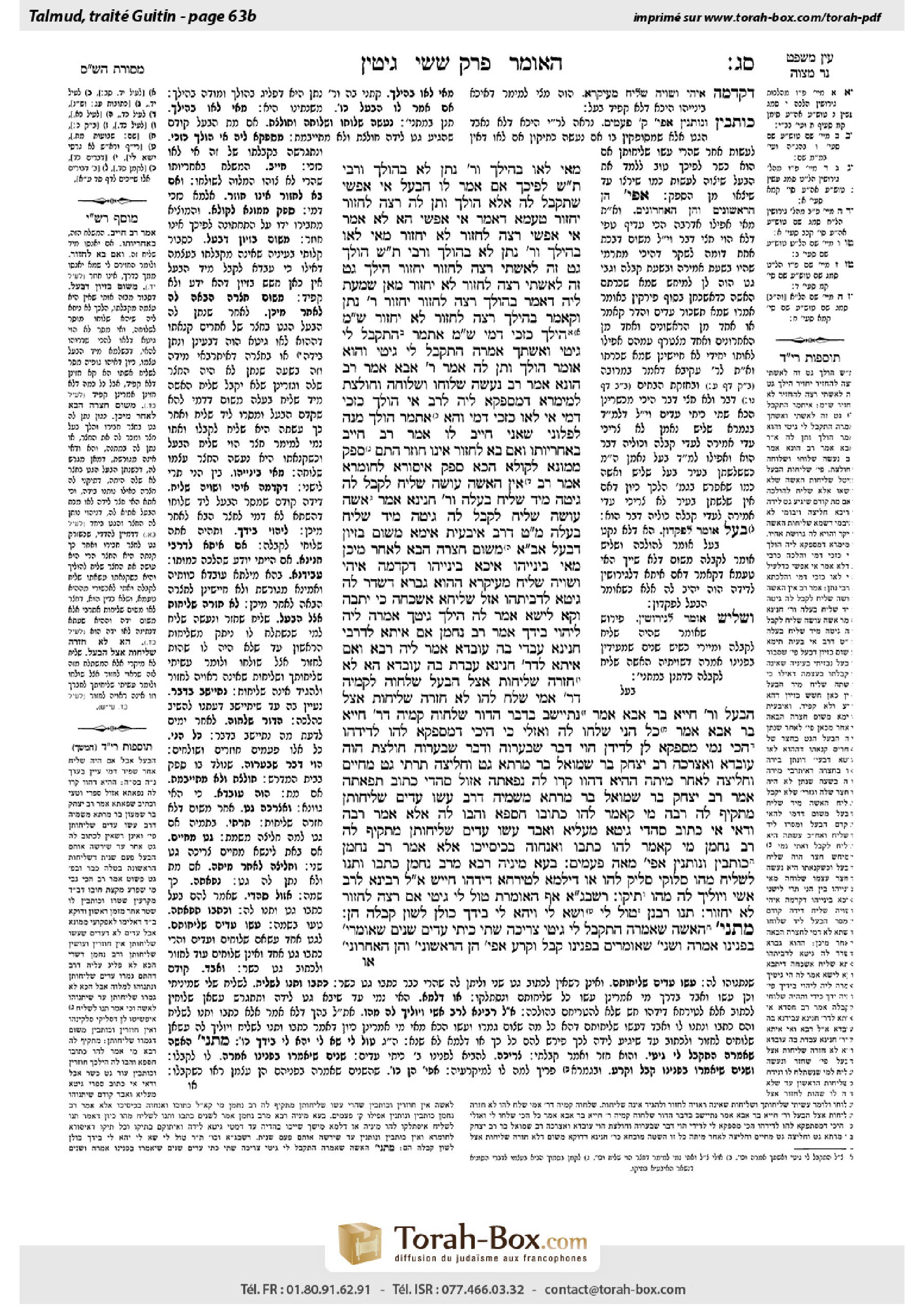
Scan : Torah-Box. Daf Study est un projet indépendant, sans affiliation ni approbation de Torah-Box ou de Sefaria.