Guittin 7a en français · גיטין ז׳ א
Traduction française du daf 7a du traité Guittin (Gittin 7a en anglais), avec le texte araméen, l’anglais de Sefaria et le scan de la page, pour étudier le Daf Yomi.
Ouvrir dans le lecteur interactifLire le daf du jour
Traduction française de Guittin 7a
Les traductions françaises de Daf Study sont générées par IA à partir de l’édition anglaise de Sefaria. Elles peuvent contenir des erreurs : vérifie toujours un passage avec le texte source.
les leur dire avec calme, afin qu’ils acceptent ses remontrances. Rav Ashi dit : Je n’avais pas entendu cette déclaration de Rabba bar bar Ḥana, et pourtant, je l’ai mise en pratique de mon propre chef.
Rabbi Abbahu dit : Une personne ne doit jamais inspirer une peur excessive aux membres de sa maisonnée, car un grand homme inspira une peur excessive à sa maisonnée, et ils lui servirent quelque chose qui constituait une grave transgression.
La Guemara demande : Et qui était cet homme ? La Guemara répond : Rabbi Ḥanina ben Gamliel. La Guemara demande : Peut-on penser qu’ils lui ont réellement servi un aliment interdit ? Or, le Saint, béni soit-Il, ne fait pas commettre d’erreur aux animaux des justes. À plus forte raison ne fait-Il pas commettre d’erreur aux justes eux-mêmes. Comment peux-tu dire que Rabbi Ḥanina ben Gamliel a mangé un aliment interdit ?
Il faut plutôt comprendre qu’ils cherchèrent à lui servir quelque chose qui constituait une grave transgression. De quoi s’agissait-il ? D’un membre prélevé sur un animal vivant. Un jour, l’animal qu’on lui apporta avait un membre manquant et, comme les membres de sa maisonnée le craignaient beaucoup, ils prélevèrent un membre sur un animal vivant pour que son repas paraisse complet ; il faillit le manger.
§ Après avoir évoqué les lettres envoyées d’Erets Israël en Babylonie et la question de l’incision du parchemin, la Guemara rapporte : Mar Ukva, l’exilarque de Babylonie, envoya une lettre à Rabbi Elazar, qui se trouvait en Erets Israël. Il y écrivait : « Que dit la halakha au sujet de ceux qui se dressent contre moi et me tourmentent, et que j’ai le pouvoir de livrer aux mains du gouvernement ? Puis-je les livrer aux autorités ou non ? »
Rabbi Elazar incisa le parchemin et lui écrivit le verset suivant : « J’ai dit : Je veillerai sur mes voies, afin de ne pas pécher par ma langue ; je mettrai un frein à ma bouche, tant que le méchant sera devant moi » (Psaumes 39:2). Rabbi Elazar cita ce verset pour faire allusion à la réponse suivante : même si « le méchant est devant moi », « je mettrai un frein à ma bouche ».
Mar Ukva lui fit de nouveau savoir : « Ils me tourmentent beaucoup et je ne peux pas les supporter. » Rabbi Elazar lui répondit : « Remets-toi à l’Éternel et attends patiemment [hitḥolel] en Lui ; ne t’irrite pas à cause de celui qui réussit dans sa voie, à cause de l’homme qui met à exécution ses mauvais desseins » (Psaumes 37:7). Ce verset signifie : « Remets-toi à l’Éternel », c’est-à-dire ne fais rien, et Il les frappera, les transformant en cadavres [ḥalalim]. Rends-toi à la maison d’étude avant eux et quitte-la après eux ; ils disparaîtront d’eux-mêmes. La Guemara rapporte : La parole sortit de la bouche de Rabbi Elazar, et Geneiva, celui qui tourmentait Mar Ukva, fut placé dans un carcan [kolar], comme un homme condamné par le gouvernement.
La Guemara rapporte encore : On envoya à Mar Ukva la question suivante : « D’où déduisons-nous qu’il est interdit de chanter à l’époque actuelle, après la destruction du Temple ? » Il incisa le parchemin et leur écrivit : « Ne te réjouis pas, Israël, jusqu’à l’exultation, comme les peuples » (Osée 9:1).
La Guemara demande : Pourquoi ne leur répond-il pas en citant ce verset : « Ils ne boivent pas de vin en chantant ; la boisson forte est amère à ceux qui la boivent » (Isaïe 24:9), ce qui indique que le chant n’est plus permis ? La Guemara répond : S’il leur avait répondu en citant ce verset, j’aurais dit que cette règle ne concerne que la musique instrumentale, conformément au verset précédent : « La joie des tambourins cesse, le bruit de ceux qui se réjouissent prend fin, la joie de la harpe cesse » (Isaïe 24:8) ; le chant vocal, en revanche, serait permis. Mar Ukva nous enseigne donc que toutes les formes de chant sont interdites.
À propos de l’incident où l’on conseilla à Mar Ukva de ne pas se venger de ceux qui le tourmentaient, la Guemara rapporte des discussions semblables. Rav Huna bar Natan dit à Rav Ashi : « Quel est le sens de ce qui est écrit : “Kina, Dimona et Adada” (Josué 15:22) ? » Rav Ashi lui répondit : « Le verset énumère les villes d’Erets Israël. »
Rav Huna lui dit : « Crois-tu que je ne sache pas que le verset énumère les villes d’Erets Israël ? C’est assurément le sens littéral du verset. » Rav Geviha d’Argiza donna plutôt une explication de ce verset, suggérant qu’il fait allusion à l’idée suivante : quiconque éprouve de la jalousie [kina] envers autrui, mais garde le silence [domem], verra Celui qui demeure pour toute l’éternité [adei ad] rendre justice en sa faveur.
Rav Ashi lui dit : « Si tel est le cas, tu devrais également interpréter de la même manière le verset : “Tsiklag, Madmanna et Sansanna” (Josué 15:31). » Rav Huna lui répondit : « Si Rav Geviha de Bei Argiza était ici, il en donnerait une explication. » La Guemara rapporte : Rav Aḥa de Bei Ḥoza’a dit à propos de ce verset : quiconque a un grief contre autrui pour une gorgée [tza’akat legima], c’est-à-dire qu’il prétend que quelqu’un ne lui a pas donné à manger, mais garde le silence [domem], verra Celui qui réside dans le buisson ardent [seneh] rendre justice en sa faveur.
L’exilarque dit à Rav Huna : « D’où déduisons-nous qu’il est interdit de mettre une guirlande sur la tête d’un marié ? » Rav Huna lui répondit : « Cette interdiction relève d’un décret rabbinique, comme nous l’avons appris dans une Michna (Sota 49a) : pendant la guerre [pulmus] de Vespasien, ils décrétèrent l’interdiction des guirlandes des mariés, c’est-à-dire que les mariés ne pouvaient plus en porter ; ils décrétèrent également l’interdiction du tambour [irus], c’est-à-dire qu’ils en interdirent aussi l’usage. »
Entre-temps, Rav Huna se leva pour se soulager. Après son départ, Rav Ḥisda, qui n’avait jusque-là rien dit par respect pour son maître Rav Huna, dit à l’exilarque : « Un verset traite de cette question : “Ainsi parle le Seigneur Dieu : Que le turban soit ôté et la guirlande retirée ; cela ne sera plus comme avant ; ce qui est bas sera élevé et ce qui est élevé sera abaissé” » (Ézéchiel 21:31).
Mais quel rapport y a-t-il entre un turban et une guirlande ? Ces deux objets ne sont pas portés sur la tête par le même type de personne. Ce verset vient plutôt t’enseigner que lorsque le turban est sur la tête du grand prêtre, c’est-à-dire lorsque le Temple est debout, une guirlande peut être portée par tout homme à son mariage. En revanche, une fois le turban ôté de la tête du grand prêtre, la guirlande est retirée de la tête de tout homme.
Entre-temps, Rav Huna revint et les trouva assis, en train de discuter de cette question. Il dit à Rav Ḥisda en jurant : « Par Dieu ! Cette interdiction relève d’un décret rabbinique. Cependant, ton nom est Ḥisda et tes paroles trouvent faveur [ḥisda’in], car tu as trouvé une belle source pour cette halakha. »
La Guemara rapporte : Ravina trouva Mar bar Rav Ashi en train de tresser une guirlande pour sa fille à l’occasion de son mariage. Il lui dit : « Le Maître ne se conforme-t-il pas à la halakha susmentionnée, déduite du verset : “Que le turban soit ôté et la guirlande retirée” ? » Il lui répondit : « Cette interdiction a été énoncée à propos de celui qui ressemble au grand prêtre et ne s’applique qu’aux hommes. En revanche, les Sages n’ont pas décrété cette interdiction à l’égard des femmes. »
À propos du verset cité plus haut, la Guemara demande : « Quel est le sens de l’expression : “Cela ne sera plus comme avant” ? » Rabbi Avira interpréta ce verset de manière homilétique. Tantôt il le rapportait au nom de Rav Ami, tantôt au nom de Rav Asi : lorsque le Saint, béni soit-Il, dit au peuple juif, au moment de la destruction du Temple : « Que le turban soit ôté et la guirlande retirée », les anges de service dirent devant le Saint, béni soit-Il : « Maître de l’Univers, est-ce là le traitement qui convient au peuple juif, qui, lors du don de la Torah au Sinaï, fit précéder “Nous ferons” à “Nous écouterons” (Exode 24:7) ? »
Dieu leur dit : « N’est-ce pas là un traitement approprié pour le peuple juif, qui a abaissé ce qui était élevé et élevé ce qui était bas, c’est-à-dire qui ne M’a pas servi et a adoré des idoles en installant une idole dans le Sanctuaire ? » C’est à cela que fait allusion le verset : « Cela ne sera plus comme avant. »
La Guemara cite une autre déclaration des mêmes Sages. Rav Avira interpréta un verset de manière homilétique. Tantôt il le rapportait au nom de Rav Ami, tantôt au nom de Rav Asi : « Quel est le sens de ce qui est écrit : “Ainsi parle l’Éternel : Même s’ils sont en pleine force [shelemim] et nombreux, ils seront tout de même fauchés et disparaîtront ; et bien que Je t’aie affligé, Je ne t’affligerai plus” (Nahum 1:12) ? » Cela signifie que si une personne constate que ses moyens de subsistance sont limités, elle doit en consacrer une part à la charité, et à plus forte raison lorsqu’ils sont abondants. Autrement dit, si ses moyens de subsistance sont épuisés [nishlam], elle doit faire la charité, et elle doit assurément agir ainsi si ses ressources sont abondantes.
La Guemara demande : « Quel est le sens de l’expression : “Ils seront tout de même fauchés [nagozzu], et il disparaîtra” ? » Un Sage de l’école de Rabbi Yishmael enseigna : quiconque retranche [gozez] une part de ses biens et la consacre à la charité sera sauvé du jugement de la Géhenne. La Guemara propose une parabole comparant ce cas à celui de deux moutons qui traversaient l’eau. L’un avait été tondu et l’autre ne l’avait pas été. Le mouton tondu atteignit l’autre rive, mais le mouton non tondu ne put la rejoindre, car sa laine absorba l’eau et il se noya. De même, celui qui retranche une part de ses biens et la donne en charité ne descendra pas dans la Géhenne.
Texte source et traduction anglaise
גיטין ז׳ א · texte araméen et hébreu
לְמֵימְרִינְהוּ בְּנִיחוּתָא, כִּי הֵיכִי דְּלִיקַבְּלוּ מִינֵּיהּ. אָמַר רַב אָשֵׁי: אֲנָא לָא שְׁמִיעָא לִי הָא דְּרַבָּה בַּר בַּר חָנָה, וְקִיַּימְתִּיהָ מִסְּבָרָא.
אָמַר רַבִּי אֲבָהוּ: לְעוֹלָם אַל יָטִיל אָדָם אֵימָה יְתֵירָה בְּתוֹךְ בֵּיתוֹ, שֶׁהֲרֵי אָדָם גָּדוֹל הֵטִיל אֵימָה יְתֵירָה בְּתוֹךְ בֵּיתוֹ וְהֶאֱכִילוּהוּ דָּבָר גָּדוֹל.
וּמַנּוּ? רַבִּי חֲנִינָא בֶּן גַּמְלִיאֵל. הֶאֱכִילוּהוּ סָלְקָא דַּעְתָּךְ?! הַשְׁתָּא בְּהֶמְתָּן שֶׁל צַדִּיקִים אֵין הַקָּדוֹשׁ בָּרוּךְ הוּא מֵבִיא תַּקָּלָה עַל יָדָם, צַדִּיקִים עַצְמָן לֹא כׇּל שֶׁכֵּן?
אֶלָּא בִּקְּשׁוּ לְהַאֲכִילוֹ דָּבָר גָּדוֹל. וּמַאי נִיהוּ? אֵבֶר מִן הַחַי.
שְׁלַח לֵיהּ מָר עוּקְבָא לְרַבִּי אֶלְעָזָר: בְּנֵי אָדָם הָעוֹמְדִים עָלַי, וּבְיָדִי לְמׇסְרָם לַמַּלְכוּת, מַהוּ?
שִׂרְטֵט וּכְתַב לֵיהּ: ״אָמַרְתִּי אֶשְׁמְרָה דְרָכַי מֵחֲטוֹא בִלְשׁוֹנִי אֶשְׁמְרָה לְפִי מַחְסוֹם בְּעוֹד רָשָׁע לְנֶגְדִּי״ – אַף עַל פִּי שֶׁרָשָׁע לְנֶגְדִּי, אֶשְׁמְרָה לְפִי מַחְסוֹם.
שְׁלַח לֵיהּ: קָא מְצַעֲרִי לִי טוּבָא, וְלָא מָצֵינָא דְּאֵיקוּם בְּהוּ. שְׁלַח לֵיהּ: ״דּוֹם לַה׳ וְהִתְחוֹלֵל לוֹ״ – דּוֹם לַה׳, וְהוּא יַפִּילֵם לְךָ חֲלָלִים חֲלָלִים; הַשְׁכֵּם וְהַעֲרֵב עֲלֵיהֶן לְבֵית הַמִּדְרָשׁ, וְהֵן כָּלִין מֵאֵילֵיהֶן. הַדָּבָר יָצָא מִפִּי רַבִּי אֶלְעָזָר, וּנְתָנוּהוּ לִגְנִיבָא בְּקוֹלָר.
שְׁלַחוּ לֵיהּ לְמָר עוּקְבָא: זִמְרָא מְנָא לַן דַּאֲסִיר? שִׂרְטֵט וּכְתַב לְהוּ: ״אַל תִּשְׂמַח יִשְׂרָאֵל אֶל גִּיל בְּעַמִּים״.
וְלִישְׁלַח לְהוּ מֵהָכָא: ״בַּשִּׁיר לֹא יִשְׁתּוּ יָיִן יֵמַר שֵׁכָר לְשׁוֹתָיו״! אִי מֵהָהוּא, הֲוָה אָמֵינָא הָנֵי מִילֵּי זִמְרָא דְמָנָא, אֲבָל דְּפוּמָּא שְׁרֵי, קָא מַשְׁמַע לַן.
אֲמַר לֵיהּ רַב הוּנָא בַּר נָתָן לְרַב אָשֵׁי: מַאי דִּכְתִיב ״קִינָה וְדִימוֹנָה וְעַדְעָדָה״? אֲמַר לֵיהּ: מָתְוָותָא דְּאֶרֶץ יִשְׂרָאֵל קָחָשֵׁיב.
אֲמַר לֵיהּ: אַטּוּ אֲנָא לָא יָדַעְנָא דְּמָתְוָותָא דְּאֶרֶץ יִשְׂרָאֵל קָא חָשֵׁיב?! אֶלָּא רַב גְּבִיהָא מֵאָרַגִּיזָא אָמַר בָּהּ טַעְמָא: כֹּל שֶׁיֵּשׁ לוֹ קִנְאָה עַל חֲבֵירוֹ וְדוֹמֵם, שׁוֹכֵן עֲדֵי עַד עוֹשֶׂה לוֹ דִּין.
אֲמַר לֵיהּ: אֶלָּא מֵעַתָּה, ״צִקְלָג וּמַדְמֵנָה וְסַנְסַנָּהּ״ הָכִי נָמֵי?! אֲמַר לֵיהּ: אִי הֲוָה רַב גְּבִיהָא מִבֵּי אָרַגִּיזָא הָכָא, הֲוָה אָמַר בָּהּ טַעְמָא. רַב אַחָא מִבֵּי חוֹזָאָה אָמַר בַּהּ הָכִי: כָּל מִי שֶׁיֵּשׁ לוֹ צַעֲקַת לְגִימָא עַל חֲבֵירוֹ, וְדוֹמֵם, שׁוֹכֵן בַּסְּנֶה עוֹשֶׂה לוֹ דִּין.
אֲמַר לֵיהּ רֵישׁ גָּלוּתָא לְרַב הוּנָא: כְּלִילָא מְנָא לַן דְּאָסוּר? אֲמַר לֵיהּ: מִדְּרַבָּנַן, דִּתְנַן: בַּפּוּלְמוּס שֶׁל אַסְפַּסְיָינוּס גָּזְרוּ עַל עַטְרוֹת חֲתָנִים וְעַל הָאִירוּס.
אַדְּהָכִי קָם רַב הוּנָא לְאִפְּנוֹיֵי, אֲמַר לֵיהּ רַב חִסְדָּא, קְרָא כְּתִיב: ״כֹּה אָמַר ה׳ אֱלֹהִים הָסִר הַמִּצְנֶפֶת וְהָרִם הָעֲטָרָה זֹאת לֹא זֹאת הַשָּׁפָלָה הַגְבֵּהַּ וְהַגָּבוֹהַּ הַשְׁפִּיל״ –
וְכִי מָה עִנְיַן מִצְנֶפֶת אֵצֶל עֲטָרָה? אֶלָּא לוֹמַר לָךְ: בִּזְמַן שֶׁמִּצְנֶפֶת בְּרֹאשׁ כֹּהֵן גָּדוֹל – עֲטָרָה בְּרֹאשׁ כׇּל אָדָם, נִסְתַּלְּקָה מִצְנֶפֶת מֵרֹאשׁ כֹּהֵן גָּדוֹל – נִסְתַּלְּקָה עֲטָרָה מֵרֹאשׁ כׇּל אָדָם.
אַדְּהָכִי אֲתָא רַב הוּנָא, אַשְׁכְּחִינְהוּ דַּהֲוֵי יָתְבִי, אֲמַר לֵיהּ: הָאֱלֹהִים! מִדְּרַבָּנַן, אֶלָּא חִסְדָּא שְׁמָךְ וְחִסְדָּאִין מִילָּךְ.
רָבִינָא אַשְׁכְּחֵיהּ לְמָר בַּר רַב אָשֵׁי דַּהֲוָה גָּדֵיל כְּלִילָא לִבְרַתֵּיהּ, אֲמַר לֵיהּ: לָא סָבַר לַהּ מָר: ״הָסִר הַמִּצְנֶפֶת וְהָרִם הָעֲטָרָה״?! אֲמַר לֵיהּ: דּוּמְיָא דְּכֹהֵן גָּדוֹל – בְּגַבְרֵי, אֲבָל בִּנְשֵׁי – לָא.
מַאי ״זֹאת לֹא זֹאת״? דָּרֵשׁ רַבִּי עַוִּירָא, זִימְנִין אָמַר לַהּ מִשְּׁמֵיהּ דְּרַב אַמֵּי, וְזִימְנִין אָמַר לַהּ מִשְּׁמֵיהּ דְּרַב אַסִּי: בְּשָׁעָה שֶׁאָמַר הַקָּדוֹשׁ בָּרוּךְ הוּא לְיִשְׂרָאֵל: ״הָסִר הַמִּצְנֶפֶת וְהָרִם הָעֲטָרָה״, אָמְרוּ מַלְאֲכֵי הַשָּׁרֵת לִפְנֵי הַקָּדוֹשׁ בָּרוּךְ הוּא: רִבּוֹנוֹ שֶׁל עוֹלָם, זֹאת לָהֶן לְיִשְׂרָאֵל, שֶׁהִקְדִּימוּ לְפָנֶיךָ בְּסִינַי ״נַעֲשֶׂה״ לְ״נִשְׁמָע״?!
אָמַר לָהֶן: לֹא זֹאת לָהֶן לְיִשְׂרָאֵל, שֶׁהִשְׁפִּילוּ אֶת הַגָּבוֹהַּ וְהִגְבִּיהוּ אֶת הַשָּׁפֵל, וְהֶעֱמִידוּ צֶלֶם בַּהֵיכָל?!
דָּרֵשׁ רַב עַוִּירָא, זִימְנִין אָמַר לַהּ מִשְּׁמֵיהּ דְּרַב אַמֵּי, וְזִימְנִין אָמַר לַהּ מִשְּׁמֵיהּ דְּרַב אַסִּי – מַאי דִּכְתִיב: ״כֹּה אָמַר ה׳ אִם שְׁלֵמִים וְכֵן רַבִּים וְכֵן נָגוֹזּוּ וְעָבָר וְגוֹ׳״? אִם רוֹאֶה אָדָם שֶׁמְּזוֹנוֹתָיו מְצוּמְצָמִין – יַעֲשֶׂה מֵהֶן צְדָקָה. וְכׇל שֶׁכֵּן כְּשֶׁהֵן מְרוּבִּין.
מַאי ״וְכֵן נָגוֹזּוּ וְעָבַר״? תָּנָא דְּבֵי רַבִּי יִשְׁמָעֵאל: כָּל הַגּוֹזֵז מִנְּכָסָיו וְעוֹשֶׂה מֵהֶן צְדָקָה – נִיצָּל מִדִּינָהּ שֶׁל גֵּיהִנָּם. מָשָׁל לִשְׁתֵּי רְחֵילוֹת שֶׁהָיוּ עוֹבְרוֹת בְּמַיִם, אַחַת גְּזוּזָה וְאַחַת אֵינָהּ גְּזוּזָה; גְּזוּזָה עָבְרָה, וְשֶׁאֵינָהּ גְּזוּזָה לֹא עָבְרָה.
Gittin 7a · traduction anglaise de Sefaria
say them with calmness so that they will accept instruction from him. Rav Ashi said: I did not hear this statement of Rabba bar bar Ḥana, and yet I fulfilled it through my own reasoning.
Rabbi Abbahu says: A person should never impose excessive fear upon the members of his household, as a great man imposed excessive fear upon his household and they fed him something that carried a great prohibition.
The Gemara asks: And who was this individual? The Gemara answers: Rabbi Ḥanina ben Gamliel. The Gemara asks: Would it enter your mind to say that they actually fed him forbidden food? Now consider that the Holy One, Blessed be He, does not cause an error to be performed through the animals of the righteous. With regard to the righteous themselves is it not all the more so? How can you say that Rabbi Ḥanina ben Gamliel ate forbidden food?
Rather, it means that they sought to feed him something that carried a great prohibition. And what was this? A limb from a living animal. One day the animal they brought him was missing a limb, and as the members of his household were very fearful they severed a limb from a living animal to make his meal appear whole, and he almost ate it.
§ After mentioning letters sent from Eretz Yisrael to Babylonia and the issue of scoring parchment, the Gemara relates: Mar Ukva, the Exilarch in Babylonia, sent a letter to Rabbi Elazar, who was in Eretz Yisrael, in which the following was written: With regard to people who stand over and torment me, and I have the power to deliver them into the hands of the government, what is the halakha? May I hand them over to the authorities or not?
Rabbi Elazar scored parchment and wrote to him the following verse: “I said: I will take heed to my ways, that I do not sin with my tongue; I will keep a curb upon my mouth, while the wicked is before me” (Psalms 39:2). Rabbi Elazar quoted this verse to allude to the following response: Even though “the wicked is before me,” “I will keep a curb upon my mouth.”
Mar Ukva sent word to him again: They are tormenting me a great deal and I cannot stand them. Rabbi Elazar sent to him in response: “Resign yourself to the Lord, and wait patiently [hitḥolel] for Him; do not fret yourself because of he who prospers in his way, because of the man who brings wicked devices to pass” (Psalms 37:7). This verse indicates: “Resign yourself to the Lord,” i.e., do not do anything, and He will strike them down as many corpses [ḥalalim]. Rise before and stay later than them in your visits to the study hall, and they will disappear on their own. The Gemara relates: The matter emerged from the mouth of Rabbi Elazar, and Geneiva, Mar Ukva’s tormentor, was placed in a neck iron [kolar], as one sentenced by the government.
The Gemara further relates: They sent the following question to Mar Ukva: From where do we derive that song is forbidden in the present, following the destruction of the Temple? He scored parchment and wrote to them: “Rejoice not, O Israel, to exultation, like the peoples” (Hosea 9:1).
The Gemara asks: And let him send them a response from here: “They do not drink wine with a song; strong drink is bitter to them who drink it” (Isaiah 24:9), indicating that song is no longer allowed. The Gemara answers: If he had answered by citing that verse, I would say that this matter applies only to instrumental music, in accordance with the previous verse: “The mirth of tabrets ceases, the noise of them who rejoice ends, the joy of the harp ceases” (Isaiah 24:8); however, vocal song is permitted. Therefore, Mar Ukva teaches us that all types of song are forbidden.
In connection to the incident in which Mar Ukva was instructed not to take revenge against his tormentors, the Gemara relates similar discussions. Rav Huna bar Natan said to Rav Ashi: What is the meaning of that which is written: “Kina, and Dimonah, and Adadah” (Joshua 15:22)? He said to him: The verse is listing the cities of Eretz Yisrael.
Rav Huna said to him: Is that to say that you think I don’t know that the verse is listing the cities of Eretz Yisrael? This is certainly the straightforward meaning of the verse. Rather, Rav Geviha from Argiza said an explanation of this verse, suggesting that it is an allusion to the following idea: Anyone who harbors jealousy [kina] toward another, and yet remains silent [domem], He who dwells for all eternity [adei ad] performs judgment on his behalf.
Rav Ashi said to him: If that is so, you should also expound the verse: “Ziklag, and Madmannah, and Sansannah” (Joshua 15:31), in a similar manner. Rav Huna said to him: If Rav Geviha from Bei Argiza was here, he would say an explanation for it. The Gemara relates: Rav Aḥa from Bei Ḥoza’a said this about that verse: Anyone who has a complaint against another over a sip [tza’akat legima], i.e., he has a claim that someone did not give him food, and remains silent [domem], the One who dwells in the burning bush [seneh] performs judgment on his behalf.
The Exilarch said to Rav Huna: From where do we derive that it is prohibited to place a garland on a groom’s head? Rav Huna said to him: It is prohibited by rabbinic law, as we learned in a mishna (Sota 49a): In the war [pulmus] of Vespasian they decreed upon the garlands of bridegrooms, meaning that bridegrooms may no longer wear garlands, and they decreed upon the drum [irus], meaning they also banned the playing of drums.
In the meantime Rav Huna stood to relieve himself, and after he left, Rav Ḥisda, who had not spoken up to that point out of reverence for his teacher, Rav Huna, said to the Exilarch: A verse is written with regard to this matter: “Thus says the Lord God: The mitre shall be removed, and the garland taken off; this shall no more be the same; that which is low shall be exalted, and that which is high abased” (Ezekiel 21:31).
But in what way is a mitre connected to a garland? These two are not placed on the head of the same type of person. Rather, this verse serves to say to you: When the mitre is found on the head of the High Priest, i.e., when the Temple is standing, then a garland may be found on the head of every man at his wedding. However, once the mitre is removed from the head of the High Priest, the garland is removed from the head of every man.
In the meantime, Rav Huna came back and he found them sitting and discussing this matter. He said to Rav Ḥisda in the form of an oath: By God! This prohibition applies by rabbinic law. However, your name is Ḥisda and your words find favor [ḥisda’in], as you have discovered a fine source for this halakha.
The Gemara relates: Ravina found Mar bar Rav Ashi braiding a garland for his daughter upon her marriage. He said to him: Doesn’t the Master hold in accordance with the aforementioned halakha derived from the verse: “The mitre shall be removed and the garland taken off”? He said to him: This prohibition was stated in reference to one who is similar to a High Priest, and is only applicable with regard to men. However, with regard to women, the Sages did not issue this decree.
With regard to the above verse, the Gemara asks: What is the meaning of the expression: “This shall no more be the same”? Rabbi Avira interpreted this verse homiletically. Sometimes he would say it in the name of Rav Ami, and sometimes he would say it in the name of Rav Asi: When the Holy One, Blessed be He, said to the Jewish people at the time of the destruction of the Temple: “Remove the mitre and take off the garland,” the ministering angels said before the Holy One, Blessed be He: Master of the Universe, is this the appropriate treatment for the Jewish people, who, at the giving of the Torah at Sinai, preceded the statement of: “We will do” to the statement: “We will hear” (Exodus 24:7)?
God said to them: Is this not appropriate for the Jewish people, who lowered the exalted and who exalted the lowly, i.e., they did not serve God, and instead worshiped idols when they established an idol in the Sanctuary? This response is alluded to in the verse: “This shall no more be the same.”
The Gemara cites another statement by the same Sages. Rav Avira interpreted a verse homiletically. Sometimes he would say it in the name of Rav Ami, and sometimes he would say it in the name of Rav Asi: What is the meaning of that which is written: “Thus says the Lord: Though they be in full strength [shelemim], and likewise many, even so shall they be cut down, and he shall pass away; and though I have afflicted you, I will afflict you no more” (Nahum 1:12). This means: If a person sees that his sustenance is limited he should use it for charity, and all the more so when it is plentiful. In other words, if his livelihood has finished [nishlam] he should perform charity, and he should certainly act in this manner if his means are plentiful.
The Gemara asks: What is the meaning of the phrase: “Even so shall they be cut down [nagozzu], and he shall pass away”? A Sage from the school of Rabbi Yishmael taught: Anyone who shears off [gozez] some of his property and performs charity with it will be saved from the judgment of Gehenna. The Gemara offers a parable that compares this case to two sheep that were passing through the water. One of them was shorn and the other one was unshorn. The shorn sheep crossed to the other side, but the unshorn sheep did not cross, as its wool absorbed the water and it drowned. Similarly, one who shears off his property and gives it as charity will not descend to Gehenna.
Texte de Sefaria : William Davidson Edition - Vocalized Aramaic (CC BY NC) ; William Davidson Edition - English (CC BY NC).
Scan de Guittin 7a
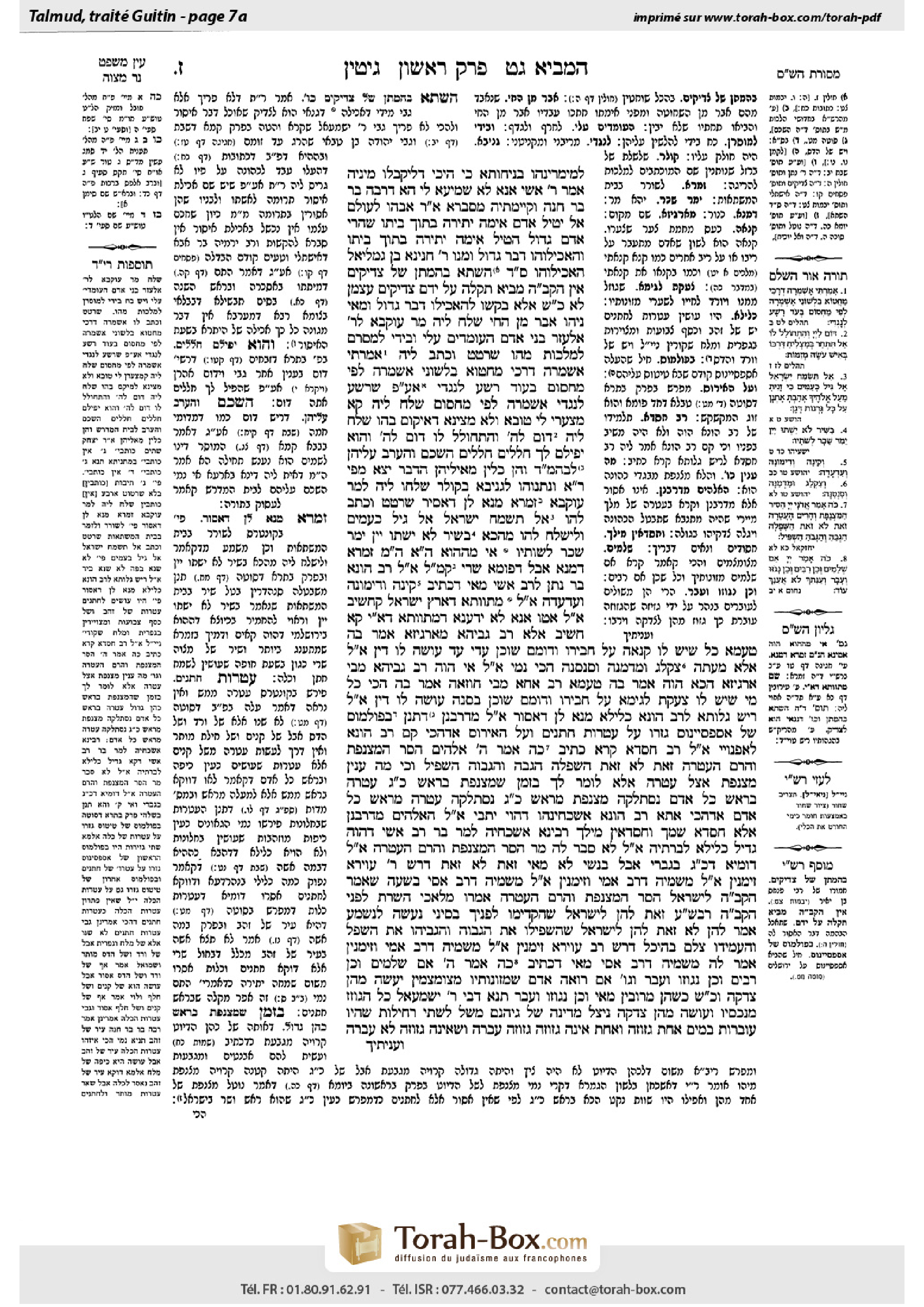
Scan : Torah-Box. Daf Study est un projet indépendant, sans affiliation ni approbation de Torah-Box ou de Sefaria.