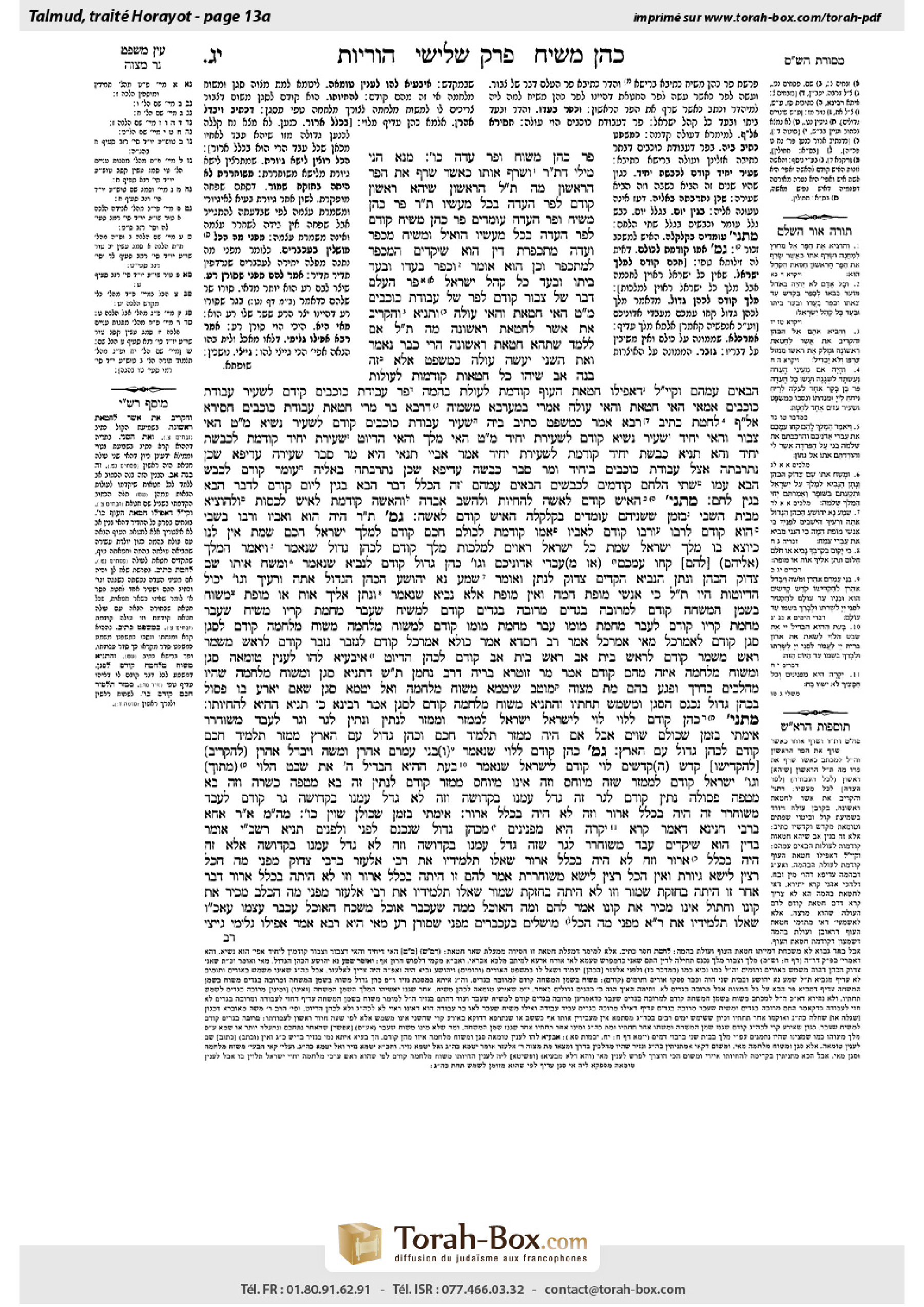
Horayot 13a: Talmud study for Daf Yomi
Daf Yomi is the daily study of one Talmud folio. Explore 37 tractates with scans, Hebrew text, Sefaria English and AI-generated French translations where annotated.
Passage selection and English or AI-generated French translation are available where the scan has annotations. Daf Study is independent of Torah-Box and Sefaria.
Browse Horayot · הוריות · All tractatesHorayot 13a text and translations
This page of Horayot includes the Aramaic text, an English translation and an AI-generated French translation, alongside the scan above.
הוריות י״ג א · Aramaic and Hebrew text
פַּר כֹּהֵן מָשׁוּחַ וּפַר עֵדָה כּוּ׳. מְנָא הָנֵי מִילֵּי? דְּתָנוּ רַבָּנַן: ״וְשָׂרַף אוֹתוֹ כַּאֲשֶׁר שָׂרַף אֵת הַפָּר הָרִאשׁוֹן״, מָה תַּלְמוּד לוֹמַר ״הָרִאשׁוֹן״? שֶׁיְּהֵא רִאשׁוֹן, קוֹדֵם לְפַר הָעֵדָה בְּכׇל מַעֲשָׂיו.
תָּנוּ רַבָּנַן: פַּר כֹּהֵן מָשִׁיחַ וּפַר הָעֵדָה עוֹמְדִים – פַּר כֹּהֵן מָשִׁיחַ קוֹדֵם לְפַר הָעֵדָה בְּכׇל מַעֲשָׂיו. הוֹאִיל וּמָשִׁיחַ מְכַפֵּר, וְעֵדָה מִתְכַּפֶּרֶת – דִּין הוּא שֶׁיַּקְדִּים הַמְכַפֵּר לַמִּתְכַּפֵּר, וְכֵן הוּא אוֹמֵר: ״וְכִפֶּר בַּעֲדוֹ וּבְעַד בֵּיתוֹ וּבְעַד כׇּל קְהַל יִשְׂרָאֵל״.
פַּר הֶעְלֵם דָּבָר שֶׁל צִבּוּר קוֹדֵם לְפַר שֶׁל עֲבוֹדָה זָרָה. מַאי טַעְמָא? הַאי חַטָּאת וְהַאי עוֹלָה, וְתַנְיָא: ״וְהִקְרִיב אֶת אֲשֶׁר לְחַטָּאת רִאשׁוֹנָה״, מָה תַּלְמוּד לוֹמַר? אִם לְלַמֵּד שֶׁתְּהֵא חַטָּאת רִאשׁוֹנָה, הֲרֵי כְּבָר נֶאֱמַר: ״וְאֶת הַשֵּׁנִי יַעֲשֶׂה עוֹלָה כַּמִּשְׁפָּט״! אֶלָּא זֶה בָּנָה אָב שֶׁיְּהוּ כׇּל חַטָּאוֹת קוֹדְמוֹת לְעוֹלוֹת הַבָּאִים עִמָּהֶם, וְקַיְימָא לַן דַּאֲפִילּוּ חַטַּאת הָעוֹף קוֹדֶמֶת לְעוֹלַת בְּהֵמָה.
פַּר עֲבוֹדָה זָרָה קוֹדֵם לִשְׂעִיר עֲבוֹדָה זָרָה, אַמַּאי? הַאי חַטָּאת, וְהַאי עוֹלָה! אָמְרִי בְּמַעְרְבָא מִשְּׁמֵיהּ דְּרָבָא בַּר מָרִי: חַטַּאת עֲבוֹדָה זָרָה חַסִּירָא אָלֶף, ״לְחַטָּת״ כְּתִיב. רָבָא אָמַר: ״כַּמִּשְׁפָּט״ כְּתִיב בֵּיהּ.
שְׂעִיר עֲבוֹדָה זָרָה קוֹדֵם לִשְׂעִיר נָשִׂיא. מַאי טַעְמָא? הַאי צִבּוּר וְהַאי יָחִיד. שְׂעִיר נָשִׂיא קוֹדֵם לִשְׂעִירַת יָחִיד. מַאי טַעְמָא? הַאי מֶלֶךְ וְהַאי הֶדְיוֹט.
שְׂעִירַת יָחִיד קוֹדֶמֶת לְכִבְשַׂת יָחִיד. וְהָא תַּנְיָא: כִּבְשַׂת יָחִיד קוֹדֶמֶת לִשְׂעִירַת יָחִיד! אָמַר אַבָּיֵי: תַּנָּאֵי הִיא, מָר סָבַר: שְׂעִירָה עֲדִיפָא, שֶׁכֵּן נִתְרַבְּתָה אֵצֶל עֲבוֹדָה זָרָה בְּיָחִיד. וּמָר סָבַר: כִּבְשָׂה עֲדִיפָא, שֶׁכֵּן נִתְרַבְּתָה בְּאַלְיָה.
עוֹמֶר קוֹדֵם לְכֶבֶשׂ הַבָּא עִמּוֹ, שְׁתֵּי הַלֶּחֶם קוֹדְמִים לִכְבָשִׂים הַבָּאִים עִמָּהֶם. זֶה הַכְּלָל: דָּבָר הַבָּא בְּגִין (לַ)יוֹם קוֹדֵם לְדָבָר הַבָּא בְּגִין לֶחֶם.
מַתְנִי׳ הָאִישׁ קוֹדֵם לָאִשָּׁה לְהַחֲיוֹת וּלְהָשֵׁב אֲבֵדָה. וְהָאִשָּׁה קוֹדֶמֶת לָאִישׁ לִכְסוּת וּלְהוֹצִיא מִבֵּית הַשְּׁבִי. בִּזְמַן שֶׁשְּׁנֵיהֶם עוֹמְדִים בְּקַלְקָלָה – הָאִישׁ קוֹדֵם לָאִשָּׁה.
גְּמָ׳ תָּנוּ רַבָּנַן: הָיָה הוּא וְאָבִיו וְרַבּוֹ בַּשֶּׁבִי – הוּא קוֹדֵם לְרַבּוֹ, וְרַבּוֹ קוֹדֵם לְאָבִיו. אִמּוֹ קוֹדֶמֶת לְכוּלָּם.
חָכָם קוֹדֵם לְמֶלֶךְ יִשְׂרָאֵל: חָכָם שֶׁמֵּת – אֵין לָנוּ כַּיּוֹצֵא בּוֹ. מֶלֶךְ יִשְׂרָאֵל שֶׁמֵּת – כׇּל יִשְׂרָאֵל רְאוּיִם לַמַּלְכוּת.
מֶלֶךְ קוֹדֵם לְכֹהֵן גָּדוֹל, שֶׁנֶּאֱמַר: ״וַיֹּאמֶר הַמֶּלֶךְ (אֲלֵיהֶם) [לָהֶם] קְחוּ עִמָּכֶם (אוֹ מֵעַבְדֵי) [אֶת עַבְדֵי] אֲדֹנֵיכֶם וְגוֹ׳״.
כֹּהֵן גָּדוֹל קוֹדֵם לְנָבִיא, שֶׁנֶּאֱמַר: ״וּמָשַׁח אֹתוֹ שָׁם צָדוֹק הַכֹּהֵן וְנָתָן הַנָּבִיא״. הִקְדִּים צָדוֹק לְנָתָן. וְאוֹמֵר: ״שְׁמַע נָא יְהוֹשֻׁעַ הַכֹּהֵן הַגָּדוֹל אַתָּה וְרֵעֶיךָ וְגוֹ׳״. יָכוֹל הֶדְיוֹטוֹת הָיוּ? תַּלְמוּד לוֹמַר: ״כִּי אַנְשֵׁי מוֹפֵת הֵמָּה״, וְאֵין ״מוֹפֵת״ אֶלָּא נָבִיא, שֶׁנֶּאֱמַר: ״וְנָתַן אֵלֶיךָ אוֹת אוֹ מוֹפֵת״.
מָשׁוּחַ בְּשֶׁמֶן הַמִּשְׁחָה קוֹדֵם לִמְרוּבֵּה בְגָדִים. מְרוּבֵּה בְגָדִים קוֹדֵם לְמָשִׁיחַ שֶׁעָבַר מֵחֲמַת קִרְיוֹ. מָשִׁיחַ שֶׁעָבַר מֵחֲמַת קִרְיוֹ קוֹדֵם לְעָבַר מֵחֲמַת מוּמוֹ. עָבַר מֵחֲמַת מוּמוֹ קוֹדֵם לִמְשׁוּחַ מִלְחָמָה. מְשׁוּחַ מִלְחָמָה קוֹדֵם לִסְגָן.
סְגָן קוֹדֵם לַאֲמַרְכָּל. מַאי אֲמַרְכָּל? אָמַר רַב חִסְדָּא: אָמַר כּוֹלָּא. אֲמַרְכָּל קוֹדֵם לְגִזְבָּר, גִּזְבָּר קוֹדֵם לְרֹאשׁ מִשְׁמָר, רֹאשׁ מִשְׁמָר קוֹדֵם לְרֹאשׁ בֵּית אָב, רֹאשׁ בֵּית אָב קוֹדֵם לְכֹהֵן הֶדְיוֹט.
אִיבַּעְיָא לְהוּ: לְעִנְיַן טוּמְאָה, סְגָן וּמְשׁוּחַ מִלְחָמָה אֵיזֶה מֵהֶם קוֹדֵם?
אָמַר מָר זוּטְרָא בְּרֵיהּ דְּרַב נַחְמָן: תָּא שְׁמַע, דְּתַנְיָא: סְגָן וּמְשׁוּחַ מִלְחָמָה שֶׁהָיוּ מְהַלְּכִים בַּדֶּרֶךְ וּפָגַע בָּהֶם מֵת מִצְוָה, מוּטָב שֶׁיִּטַּמֵּא מְשׁוּחַ מִלְחָמָה וְאַל יִטַּמֵּא סְגָן, שֶׁאִם יֶאֱרַע בּוֹ פְּסוּל בְּכֹהֵן גָּדוֹל, נִכְנָס הַסְּגָן וּמְשַׁמֵּשׁ תַּחְתָּיו. וְהָתַנְיָא: מְשׁוּחַ מִלְחָמָה קוֹדֵם לַסְּגָן! אָמַר רָבִינָא, כִּי תַּנְיָא הָהִיא לְהַחְיוֹתוֹ.
מַתְנִי׳ כֹּהֵן קוֹדֵם לְלֵוִי, לֵוִי לְיִשְׂרָאֵל, יִשְׂרָאֵל לְמַמְזֵר, וּמַמְזֵר לְנָתִין, וְנָתִין לְגֵר, וְגֵר לְעֶבֶד מְשׁוּחְרָר. אֵימָתַי? בִּזְמַן שֶׁכּוּלָּם שָׁוִים. אֲבָל אִם הָיָה מַמְזֵר תַּלְמִיד חָכָם וְכֹהֵן גָּדוֹל עַם הָאָרֶץ – מַמְזֵר תַּלְמִיד חָכָם קוֹדֵם לְכֹהֵן גָּדוֹל עַם הָאָרֶץ.
גְּמָ׳ כֹּהֵן קוֹדֵם לְלֵוִי – שֶׁנֶּאֱמַר: ״(וּבְנֵי) [בְּנֵי] עַמְרָם אַהֲרֹן וּמֹשֶׁה וַיִּבָּדֵל אַהֲרֹן (לְהַקְרִיב) [לְהַקְדִּישׁוֹ] קֹדֶשׁ (הַקֳּדָשִׁים) [קָדָשִׁים]״. לֵוִי קוֹדֵם לְיִשְׂרָאֵל – שֶׁנֶּאֱמַר: ״בָּעֵת הַהִיא הִבְדִּיל ה׳ אֶת שֵׁבֶט הַלֵּוִי (מִתּוֹךְ) וְגוֹ׳״.
יִשְׂרָאֵל קוֹדֵם לְמַמְזֵר – שֶׁזֶּה מְיוּחָס, וְזֶה אֵינוֹ מְיוּחָס. מַמְזֵר קוֹדֵם לְנָתִין – זֶה בָּא מִטִּפָּה כְּשֵׁרָה, וְזֶה בָּא מִטִּפָּה פְּסוּלָה. נָתִין קוֹדֵם לְגֵר – זֶה גָּדַל עִמָּנוּ בִּקְדוּשָּׁה, וְזֶה לֹא גָּדַל עִמָּנוּ בִּקְדוּשָּׁה. גֵּר קוֹדֵם לְעֶבֶד מְשׁוּחְרָר – זֶה הָיָה בִּכְלַל אָרוּר, וְזֶה לֹא הָיָה בִּכְלַל אָרוּר.
אֵימָתַי? בִּזְמַן שֶׁכּוּלָּן שָׁוִין כּוּ׳. מְנָא הָנֵי מִילֵּי? אָמַר רַב אַחָא בְּרַבִּי חֲנִינָא, דְּאָמַר קְרָא: ״יְקָרָה הִיא מִפְּנִינִים״, מִכֹּהֵן גָּדוֹל שֶׁנִּכְנָס לִפְנַי וְלִפְנִים.
תַּנְיָא, רַבִּי שִׁמְעוֹן בַּר יוֹחַאי אוֹמֵר: בַּדִּין הוּא שֶׁיַּקְדִּים עֶבֶד מְשׁוּחְרָר לְגֵר, שֶׁזֶּה גָּדַל עִמָּנוּ בִּקְדוּשָּׁה, וְזֶה לֹא גָּדַל עִמָּנוּ בִּקְדוּשָּׁה. אֶלָּא זֶה הָיָה בִּכְלַל אָרוּר, וְזֶה לֹא הָיָה בִּכְלַל אָרוּר.
שָׁאֲלוּ תַּלְמִידָיו אֶת רַבִּי אֶלְעָזָר בְּרַבִּי צָדוֹק: מִפְּנֵי מָה הַכֹּל רָצִין לִישָּׂא גִּיּוֹרֶת, וְאֵין הַכֹּל רָצִין לִישָּׂא מְשׁוּחְרֶרֶת? אָמַר לָהֶם: זוֹ הָיְתָה בִּכְלַל אָרוּר, וְזוֹ לֹא הָיְתָה בִּכְלַל אָרוּר. דָּבָר אַחֵר: זוֹ הָיְתָה בְּחֶזְקַת שָׁמוּר, וְזוֹ לֹא הָיְתָה בְּחֶזְקַת שָׁמוּר.
שָׁאֲלוּ תַּלְמִידָיו אֶת רַבִּי אֶלְעָזָר: מִפְּנֵי מָה הַכֶּלֶב מַכִּיר אֶת קוֹנוֹ, וְחָתוּל אֵינוֹ מַכִּיר אֶת קוֹנוֹ? אָמַר לָהֶם: וּמָה הָאוֹכֵל מִמַּה שֶּׁעַכְבָּר אוֹכֵל – מְשַׁכֵּחַ, הָאוֹכֵל עַכְבָּר עַצְמוֹ – עַל אַחַת כַּמָּה וְכַמָּה.
שָׁאֲלוּ תַּלְמִידָיו אֶת רַבִּי אֱלִיעֶזֶר: מִפְּנֵי מָה הַכֹּל מוֹשְׁלִים בָּעַכְבָּרִים? מִפְּנֵי שֶׁסּוּרַן רַע. מַאי הִיא? רָבָא אָמַר: אֲפִילּוּ גְּלִימֵי גָּיְיצִי.
Horayot 13a · English translation
§ The mishna teaches: If the bull of the anointed priest and the bull of the congregation, which are brought for absence of awareness of the matter, are pending, the bull of the anointed priest precedes the bull of the congregation in all its actions. The Gemara asks: From where are these matters derived? It is as the Sages taught: “And he shall burn it as he burned the first bull” (Leviticus 4:21). Why must the verse state “the first”? The verse could simply state that he shall burn it as he burned the bull. It is in order to establish that the first offering precedes the bull of the congregation in all its actions.
The Sages taught in a baraita: If the bull of the anointed priest and the bull of the congregation are pending, the bull of the anointed priest precedes the bull of the congregation in all its actions. Since the anointed priest atones for the entire Jewish people, and the congregation gains atonement, it is logical that the one who atones will precede the one who gains atonement. And so the verse states: “And he shall atone for himself, and for his household, and for all the congregation of Israel” (Leviticus 16:17).
The baraita continues: A bull for an unwitting communal sin precedes a bull for idol worship. What is the reason for this halakha? This, i.e., the bull for an unwitting communal sin, is a sin-offering, and that, i.e., the bull for idol worship, is a burnt-offering, and it is taught in a baraita: “And he shall sacrifice that which is for the sin-offering first” (Leviticus 5:8); why must the verse state this? If it is to teach that the sin-offering will be first, it is already stated: “And the second he shall prepare as a burnt-offering according to the ordinance” (Leviticus 5:10). Rather, this established a paradigm from which all similar cases may be derived, teaching that all sin-offerings precede the burnt-offerings that accompany them, and we maintain that even bird sin-offerings precede animal burnt-offerings.
A bull for idol worship brought by the entire congregation precedes a goat for idol worship brought by the entire congregation. The Gemara asks: Why is this so; this, i.e., the goat is a sin-offering, and that, i.e., the bull is a burnt-offering? In the West, Eretz Yisrael, they say in the name of Rava bar Mari: In the verse: “If it is performed unwittingly by the congregation, being hidden from their eyes, the entire congregation shall bring one young bull for a burnt-offering, for a pleasing aroma to the Lord, with its meal-offering, and its libation, according to the ordinance, and one goat as a sin-offering [leḥattat]” (Numbers 15:24), the sin-offering for idol worship is lacking an alef, i.e., “leḥattat” is written without an alef. This indicates that not all the halakhot of sin-offerings apply to it. Rava said: “According to the ordinance” is written concerning it, indicating that the service must be performed in accordance with the order stated in the verse, i.e., the bull is sacrificed before the goat.
The goat for idol worship of the congregation precedes the goat of the king. What is the reason for this? The reason is that this goat is brought by the general public and that goat is brought by an individual, and the communal precedes the individual even if that individual is the king. The male goat of the king precedes the female goat of the individual. What is the reason for this? This male goat is brought by a king, and that female goat is brought by a commoner.
The female goat of an individual brought as a standard sin-offering precedes the ewe of an individual brought as a standard sin-offering. The Gemara asks: But isn’t it taught in a baraita: The ewe of an individual precedes the female goat of an individual? Abaye said: It is a dispute between tanna’im. One Sage holds that a female goat is preferable and takes precedence, as it has an increased applicability in that it is brought for idol worship by an individual, in which case one must bring a female goat, not a female sheep. And one Sage holds that the ewe is preferable and takes precedence, as it has more sacrificial portions than a female goat, as its tail is also included, which indicates that it is a preferable offering.
The omer offering precedes the lamb that accompanies it; the two loaves, i.e., the public offering on Shavuot of two loaves of bread from the new wheat, precede the sheep that accompany them. This is the principle: A matter that comes due to a mitzva of the day precedes a matter that comes due to the bread. The omer and two loaves are meal-offerings brought due to the day. The accompanying sheep are brought due to the meal-offerings.
MISHNA: The man precedes the woman when there is uncertainty with regard to which of them to rescue or to return a lost item to first. And the woman precedes the man with regard to which of them to provide with a garment first, because her humiliation is great, or to release from captivity first, due to the concern that she will be raped. When they are both subject to degradation, i.e., there is also concern that the man will be raped in captivity, the release of the man precedes the release of the woman.
GEMARA: Apropos precedence, the Sages taught in a baraita: If one and his father and his teacher were in captivity, his release precedes his teacher’s because one’s own life takes precedence, and his teacher’s release precedes his father’s release. His mother’s release precedes the release of all of them.
A Torah scholar precedes the king of Israel, because in the case of a Sage who dies, we have no one like him, but in the case of a king of Israel who dies, all of Israel are fit for royalty.
A king precedes a High Priest, as it is stated: “And the king said unto them: Take with you the servants of your lord” (I Kings 1:33). King David was referring to himself as lord when speaking to Zadok the priest.
A High Priest precedes a prophet, as it is stated: “And let Zadok the priest and Nathan the prophet anoint him there” (I Kings 1:34); Zadok is written before Natan. And similarly, the prophet says: “Hear now, Joshua the High Priest, you and your colleagues who sit before you, for they are men that are a sign; for behold, I will bring forth My servant Zemah” (Zechariah 3:8). One might have thought that these colleagues were laymen. Therefore, the verse states: “For they are men that are a sign,” and “sign” means nothing other than a prophet, as it is stated: “And he gives you a sign or a wonder” (Deuteronomy 13:2).
A High Priest anointed with anointing oil precedes a priest consecrated by donning multiple garments. A High Priest consecrated by donning multiple garments precedes an anointed High Priest who stepped down, even if he did so due to his seminal emission. An anointed High Priest who stepped down due to his seminal emission precedes an anointed High Priest who stepped down due to his blemish. An anointed High Priest who stepped down due to his blemish precedes a priest anointed for war. A priest anointed for war precedes a deputy High Priest, who replaces the High Priest when he is unable to serve in the Temple.
The baraita concludes: A deputy High Priest precedes the overseer [la’amarkal], one of the seven appointed officials in the Temple. The Gemara asks: What is the meaning of amarkal? Rav Ḥisda said: Amarkal is a contraction for amar kulla, meaning: He says it all. The overseer of the Temple has the final word in matters concerning the administration of the Temple. The overseer precedes the Temple treasurer. The treasurer precedes the head of the priestly watch that would serve in the Temple for a period of one week at a time. The head of the priestly watch precedes the head of the patrilineal family. Each patrilineal family performed the Temple service for one day during the week of its priestly watch. The head of the patrilineal family precedes an ordinary priest.
A dilemma was raised before the Sages: With regard to the matter of ritual impurity, when there is a corpse with no one to bury it [met mitzva], which even a priest and a nazirite are commanded to bury, and the deputy High Priest and the priest anointed for war are available to bury it, which of them precedes the other and becomes impure?
Mar Zutra, son of Rav Naḥman, said: Come and hear a resolution, as it is taught in a baraita: In the case of a deputy High Priest and a priest anointed for war who were walking along the path and they encountered a met mitzva and one of them must bury him and become ritually impure, it is preferable that the priest anointed for war will become ritually impure and the deputy High Priest will not become ritually impure. The reason is that if disqualification befalls the High Priest, the deputy enters and performs the Temple service in his stead. Therefore, one must ensure to every possible extent that the deputy High Priest remain ritually pure. The Gemara asks: But isn’t it taught in a baraita: A priest anointed for war precedes a deputy High Priest? Ravina said: When that baraita is taught, it is not with regard to ritual impurity; rather, it is taught with regard to rescuing him, as the standing of the priest anointed for war is higher than that of the deputy High Priest.
MISHNA: A priest precedes a Levite. A Levite precedes an Israelite. An Israelite precedes a son born from an incestuous or adulterous relationship [mamzer], and a mamzer precedes a Gibeonite, and a Gibeonite precedes a convert, and a convert precedes an emancipated slave. When do these halakhot of precedence take effect? In circumstances when they are all equal in terms of wisdom. But if there were a mamzer who is a Torah scholar and a High Priest who is an ignoramus, a mamzer who is a Torah scholar precedes a High Priest who is an ignoramus, as Torah wisdom surpasses all else.
GEMARA: A priest precedes a Levite, as it is stated: “The sons of Amram: Aaron and Moses, and Aaron was separated that he should be sanctified as the most sacred” (I Chronicles 23:13). A Levite precedes an Israelite, as it is stated: “At that time the Lord separated the tribe of Levi, to bear the Ark of the Covenant of the Lord, to stand before the Lord to minister unto Him, and to bless in His name, unto this day” (Deuteronomy 10:8).
An Israelite precedes a mamzer because this Israelite is of legitimate lineage and that mamzer is not of legitimate lineage and is disqualified from entering into the congregation of Israel. A mamzer precedes a Gibeonite because this mamzer comes from a fit drop of semen, i.e., from Jewish parentage, and that Gibeonite comes from an unfit drop of semen, from gentile parentage. A Gibeonite precedes a convert, as this Gibeonite grew among us in sanctity and conducted his life as a Jew, and that convert did not grow among us in sanctity. A convert precedes an emancipated Canaanite slave as this emancipated Canaanite slave was included in the category of the curse while he was enslaved, and that convert was not included in the category of the curse.
The mishna teaches: When do these halakhot of precedence take effect? In circumstances when they are all equal in terms of wisdom. The Gemara asks: From where are these matters derived? Rav Aḥa, son of Rabbi Ḥanina, said: This is derived from a verse, as the verse states: “She is more precious than rubies [mipeninim]” (Proverbs 3:15). The Torah is more precious than the High Priest who enters the innermost sanctum [lifnai velifnim], the Holy of Holies.
It is taught in a baraita that Rabbi Shimon bar Yoḥai says: By right, an emancipated Canaanite slave should have preceded a convert, because this emancipated Canaanite slave grew among us in sanctity, and that convert did not grow among us in sanctity. But the convert precedes the Canaanite slave because this Canaanite slave was in the category of the curse, and that convert was not in the category of the curse.
The students of Rabbi Elazar, son of Rabbi Tzadok, asked him: For what reason does everyone, i.e., do many people, run to marry a female convert, and not everyone runs to marry an emancipated Canaanite maidservant? He said to them: This Canaanite maidservant was in the category of the curse, and that convert was not in the category of the curse. Alternatively, the reason is that this convert has the presumptive status of chastity, and that Canaanite maidservant does not have the presumptive status of chastity.
The students of Rabbi Elazar asked him: For what reason does a dog recognize its master, while a cat does not recognize its master? Rabbi Elazar said to them: If it is established that with regard to one who eats from that which a mouse eats, eating that item causes him to forget, with regard to the cat, who eats the mouse itself, all the more so does eating it cause it to forget.
The students of Rabbi Eliezer asked him: For what reason do all predators dominate mice and prey on them? He said to them: Because concerning mice, their inclination [shesuran] is evil. The Gemara asks: What is the indication of this? Rava said: They gnaw even at cloaks, despite the fact that cloaks do not provide nourishment for them.
Horayot 13a · Traduction française (IA)
§ La Michna enseigne : Si le taureau du prêtre oint et celui de la communauté, offerts pour une faute commise par ignorance, sont en attente, le taureau du prêtre oint précède celui de la communauté pour toutes les étapes du rituel. La Guemara demande : D’où ces règles sont-elles tirées ? C’est ce que les Sages ont enseigné : « Il le brûlera comme il a brûlé le premier taureau » (Lévitique 4:21). Pourquoi le verset précise-t-il « le premier » ? Il aurait pu simplement dire qu’il le brûlera comme il a brûlé le taureau. Cette précision vise à établir que le premier sacrifice précède celui de la communauté pour toutes les étapes du rituel.
Les Sages ont enseigné dans une baraïta : Si le taureau du prêtre oint et celui de la communauté sont en attente, le taureau du prêtre oint précède celui de la communauté pour toutes les étapes du rituel. Puisque le prêtre oint expie pour l’ensemble du peuple juif et que la communauté reçoit l’expiation, il est logique que celui qui expie passe avant ceux qui reçoivent l’expiation. Ainsi, le verset dit : « Il fera expiation pour lui-même, pour sa maison et pour toute l’assemblée d’Israël » (Lévitique 16:17).
La baraïta poursuit : Un taureau offert pour une faute collective commise par inadvertance précède un taureau offert pour l’idolâtrie. Pour quelle raison cette halakha s’applique-t-elle ? Celui-ci, c’est-à-dire le taureau offert pour une faute collective commise par inadvertance, est un sacrifice expiatoire, tandis que celui-là, c’est-à-dire le taureau offert pour l’idolâtrie, est un holocauste. Or, une baraïta enseigne : « Il offrira d’abord ce qui est destiné au sacrifice expiatoire » (Lévitique 5:8). Pourquoi le verset doit-il le préciser ? S’il s’agit d’enseigner que le sacrifice expiatoire doit être offert en premier, cela est déjà dit : « Il préparera le second en holocauste, selon la règle » (Lévitique 5:10). Ce verset établit plutôt un principe dont on peut déduire tous les cas semblables : tous les sacrifices expiatoires précèdent les holocaustes qui les accompagnent. Et nous considérons que même les sacrifices expiatoires d’oiseaux précèdent les holocaustes d’animaux.
Le taureau offert pour l’idolâtrie par toute la communauté précède le bouc offert pour l’idolâtrie par toute la communauté. La Guemara demande : Pourquoi en est-il ainsi ? Celui-ci, c’est-à-dire le bouc, est un sacrifice expiatoire, tandis que celui-là, c’est-à-dire le taureau, est un holocauste. En Occident, c’est-à-dire en Eretz Israël, on dit au nom de Rava bar Mari : Dans le verset « Si cela est fait par inadvertance par la communauté, sans que cela ait été aperçu par elle, toute la communauté offrira un jeune taureau en holocauste, en odeur agréable pour le Seigneur, avec son offrande de farine et sa libation, selon la règle, ainsi qu’un bouc en sacrifice expiatoire [leḥattat] » (Nombres 15:24), le terme désignant le sacrifice expiatoire pour l’idolâtrie est privé d’un aleph : leḥattat est écrit sans aleph. Cela indique que toutes les règles des sacrifices expiatoires ne s’appliquent pas à celui-ci. Rava a dit : L’expression « selon la règle » est écrite à son sujet, ce qui indique que le service doit être accompli dans l’ordre énoncé dans le verset, c’est-à-dire que le taureau est sacrifié avant le bouc.
Le bouc offert pour l’idolâtrie par la communauté précède le bouc du roi. Pour quelle raison ? Ce bouc est offert par le public, tandis que celui-là est offert par un particulier ; le sacrifice de la communauté précède celui d’un particulier, même si celui-ci est le roi. Le bouc mâle du roi précède la chèvre femelle d’un particulier. Pour quelle raison ? Ce bouc mâle est offert par un roi, tandis que cette chèvre femelle est offerte par un homme du peuple.
La chèvre femelle d’un particulier, offerte en sacrifice expiatoire ordinaire, précède la brebis d’un particulier offerte en sacrifice expiatoire ordinaire. La Guemara demande : Mais n’enseigne-t-on pas dans une baraïta que la brebis d’un particulier précède la chèvre femelle d’un particulier ? Abaye a dit : C’est une controverse entre tannaïm. Un Sage estime que la chèvre femelle est préférable et passe en premier, car son champ d’application est plus large : un particulier doit apporter une chèvre femelle, et non une brebis, pour l’idolâtrie. Un autre Sage estime que la brebis est préférable et passe en premier, car elle comporte davantage de parties offertes sur l’autel que la chèvre femelle, puisque sa queue est également incluse, ce qui indique qu’elle constitue une offrande préférable.
L’offrande de l’omer précède l’agneau qui l’accompagne ; les deux pains, c’est-à-dire l’offrande publique de Chavouot constituée de deux pains faits de blé nouveau, précèdent les moutons qui les accompagnent. Voici le principe : ce qui est apporté en raison d’une mitsva du jour précède ce qui est apporté en raison du pain. L’omer et les deux pains sont des offrandes de farine apportées en raison du jour. Les moutons qui les accompagnent sont apportés en raison des offrandes de farine.
Michna : L’homme passe avant la femme lorsqu’il faut déterminer lequel des deux sauver en premier ou à qui restituer d’abord un objet perdu. La femme passe avant l’homme lorsqu’il faut déterminer à laquelle des deux fournir d’abord un vêtement, car son humiliation est plus grande, ou laquelle libérer d’abord de captivité, par crainte qu’elle ne soit violée. Lorsque tous deux risquent d’être dégradés, c’est-à-dire qu’il existe également une crainte que l’homme soit violé en captivité, la libération de l’homme précède celle de la femme.
Guemara : À propos de l’ordre de priorité, les Sages ont enseigné dans une baraïta : Si un homme, son père et son maître sont captifs, sa propre libération précède celle de son maître, car sa propre vie est prioritaire ; celle de son maître précède celle de son père. La libération de sa mère précède celle de tous les autres.
Un érudit en Torah passe avant le roi d’Israël, car lorsqu’un Sage meurt, nous n’avons personne qui lui soit égal, tandis que lorsqu’un roi d’Israël meurt, tous les membres d’Israël sont aptes à la royauté.
Un roi passe avant un Grand Prêtre, comme il est dit : « Le roi leur dit : Prenez avec vous les serviteurs de votre seigneur » (I Rois 1:33). Le roi David se désignait lui-même comme leur seigneur lorsqu’il s’adressait au prêtre Tsadok.
Un Grand Prêtre passe avant un prophète, comme il est dit : « Que le prêtre Tsadok et le prophète Nathan l’oignent là » (I Rois 1:34) ; Tsadok est mentionné avant Nathan. De même, le prophète dit : « Écoute maintenant, Josué, Grand Prêtre, toi et tes compagnons qui siègent devant toi, car ce sont des hommes qui servent de signe ; voici, je ferai venir mon serviteur Zemah » (Zacharie 3:8). On aurait pu penser que ces compagnons étaient des laïcs. Le verset précise donc : « car ce sont des hommes qui servent de signe » ; et « signe » ne désigne rien d’autre qu’un prophète, comme il est dit : « Il te donne un signe ou un prodige » (Deutéronome 13:2).
Un Grand Prêtre oint avec l’huile d’onction passe avant un prêtre consacré par le port des vêtements sacerdotaux supplémentaires. Un Grand Prêtre consacré par le port des vêtements sacerdotaux supplémentaires passe avant un Grand Prêtre oint qui a cessé ses fonctions, même s’il l’a fait en raison d’une émission séminale. Un Grand Prêtre oint qui a cessé ses fonctions en raison d’une émission séminale passe avant un Grand Prêtre oint qui a cessé ses fonctions à cause d’un défaut physique. Un Grand Prêtre oint qui a cessé ses fonctions à cause d’un défaut physique passe avant un prêtre oint pour la guerre. Un prêtre oint pour la guerre passe avant un Grand Prêtre adjoint, qui remplace le Grand Prêtre lorsqu’il ne peut pas officier dans le Temple.
La baraïta conclut : Un Grand Prêtre adjoint passe avant le surveillant [la’amarkal], l’un des sept responsables nommés du Temple. La Guemara demande : Que signifie amarkal ? Rav Ḥisda a dit : Amarkal est une contraction de amar kulla, qui signifie : « Il dit tout. » Le surveillant du Temple a le dernier mot dans les questions relatives à l’administration du Temple. Le surveillant passe avant le trésorier du Temple. Le trésorier passe avant le chef de la garde sacerdotale qui officie au Temple pendant une semaine à la fois. Le chef de la garde sacerdotale passe avant le chef de la famille patrilinéaire. Chaque famille patrilinéaire assurait le service du Temple pendant une journée au cours de la semaine de sa garde sacerdotale. Le chef de la famille patrilinéaire passe avant un prêtre ordinaire.
Un dilemme fut posé aux Sages : En matière d’impureté rituelle, lorsqu’il y a un mort sans personne pour l’enterrer [met mitsva], que même un prêtre et un nazir sont tenus d’enterrer, et que le Grand Prêtre adjoint et le prêtre oint pour la guerre sont disponibles pour l’enterrer, lequel des deux a priorité et devient impur ?
Mar Zutra, fils de Rav Naḥman, a dit : Venez et écoutez une réponse, car une baraïta enseigne : Si un Grand Prêtre adjoint et un prêtre oint pour la guerre marchaient sur la route et rencontraient un mort sans personne pour l’enterrer [met mitsva], que l’un d’eux doit enterrer et devenir rituellement impur, il est préférable que le prêtre oint pour la guerre devienne rituellement impur et que le Grand Prêtre adjoint ne le devienne pas. En effet, si le Grand Prêtre est déclaré inapte, son adjoint entre dans le Temple et y officie à sa place. Il faut donc veiller autant que possible à ce que le Grand Prêtre adjoint reste en état de pureté rituelle. La Guemara demande : Mais n’enseigne-t-on pas dans une baraïta qu’un prêtre oint pour la guerre passe avant un Grand Prêtre adjoint ? Ravina a dit : Cette baraïta ne traite pas de l’impureté rituelle ; elle traite plutôt du cas où il faut le sauver, car le statut du prêtre oint pour la guerre est supérieur à celui du Grand Prêtre adjoint.
Michna : Un prêtre passe avant un lévite. Un lévite passe avant un Israélite. Un Israélite passe avant un enfant né d’une union incestueuse ou adultère [mamzer], un mamzer passe avant un Gabaonite, un Gabaonite passe avant un converti, et un converti passe avant un esclave affranchi. Quand ces règles de priorité s’appliquent-elles ? Lorsque tous sont égaux en sagesse. Mais si un mamzer est un érudit en Torah et qu’un Grand Prêtre est un ignorant, le mamzer érudit en Torah passe avant le Grand Prêtre ignorant, car la sagesse de la Torah surpasse tout le reste.
Guemara : Un prêtre passe avant un lévite, comme il est dit : « Fils d’Amram : Aaron et Moïse ; Aaron fut mis à part pour être sanctifié comme très saint » (I Chroniques 23:13). Un lévite passe avant un Israélite, comme il est dit : « En ce temps-là, le Seigneur mit à part la tribu de Lévi pour porter l’Arche de l’alliance du Seigneur, se tenir devant le Seigneur afin de le servir et de bénir en son nom, jusqu’à ce jour » (Deutéronome 10:8).
Un Israélite passe avant un mamzer, car cet Israélite est de filiation légitime, tandis que ce mamzer ne l’est pas et est exclu de l’assemblée d’Israël. Un mamzer passe avant un Gabaonite, car ce mamzer est issu d’une semence apte, c’est-à-dire de parents juifs, tandis que ce Gabaonite est issu d’une semence inapte, de parents non juifs. Un Gabaonite passe avant un converti, car ce Gabaonite a grandi parmi nous dans la sainteté et a mené sa vie comme un Juif, tandis que ce converti n’a pas grandi parmi nous dans la sainteté. Un converti passe avant un esclave cananéen affranchi, car cet esclave cananéen affranchi était inclus dans la catégorie de la malédiction lorsqu’il était asservi, tandis que ce converti n’était pas inclus dans cette catégorie.
La Michna enseigne : Quand ces règles de priorité s’appliquent-elles ? Lorsque tous sont égaux en sagesse. La Guemara demande : D’où ces règles sont-elles tirées ? Rav Aḥa, fils de Rabbi Ḥanina, a dit : On le déduit d’un verset, comme il est dit : « Elle est plus précieuse que les rubis [mipeninim] » (Proverbes 3:15). La Torah est plus précieuse que le Grand Prêtre qui pénètre dans le sanctuaire le plus intérieur [lifnai velifnim], le Saint des Saints.
Une baraïta enseigne que Rabbi Shimon bar Yoḥai dit : En toute justice, un esclave cananéen affranchi aurait dû passer avant un converti, car cet esclave cananéen affranchi a grandi parmi nous dans la sainteté, tandis que ce converti n’a pas grandi parmi nous dans la sainteté. Mais le converti passe avant l’esclave cananéen parce que cet esclave cananéen appartenait à la catégorie de la malédiction, tandis que ce converti n’appartenait pas à cette catégorie.
Les disciples de Rabbi Elazar, fils de Rabbi Tsadok, lui demandèrent : Pour quelle raison beaucoup de gens se pressent-ils d’épouser une convertie, alors que beaucoup ne se pressent pas d’épouser une servante cananéenne affranchie ? Il leur répondit : Cette servante cananéenne appartenait à la catégorie de la malédiction, tandis que cette convertie n’y appartenait pas. Autre explication : cette convertie bénéficie d’une présomption de chasteté, tandis que cette servante cananéenne ne bénéficie pas d’une telle présomption.
Les disciples de Rabbi Elazar lui demandèrent : Pour quelle raison un chien reconnaît-il son maître, tandis qu’un chat ne le reconnaît pas ? Rabbi Elazar leur répondit : S’il est établi que celui qui mange ce qu’une souris a mangé oublie, alors, à plus forte raison, le chat, qui mange la souris elle-même, oublie en la mangeant.
Les disciples de Rabbi Eliezer lui demandèrent : Pour quelle raison tous les prédateurs dominent-ils les souris et s’en nourrissent-ils ? Il leur répondit : Parce que l’inclination [shesuran] des souris est mauvaise. La Guemara demande : Quel indice le montre ? Rava a dit : Elles rongent même les manteaux, bien que ceux-ci ne leur procurent aucune nourriture.
Traduction française générée par IA à partir de l’édition anglaise de Sefaria. Vérifie toujours un passage avec le texte source.
Text from Sefaria: William Davidson Edition - Vocalized Aramaic (CC BY NC); William Davidson Edition - English (CC BY NC).