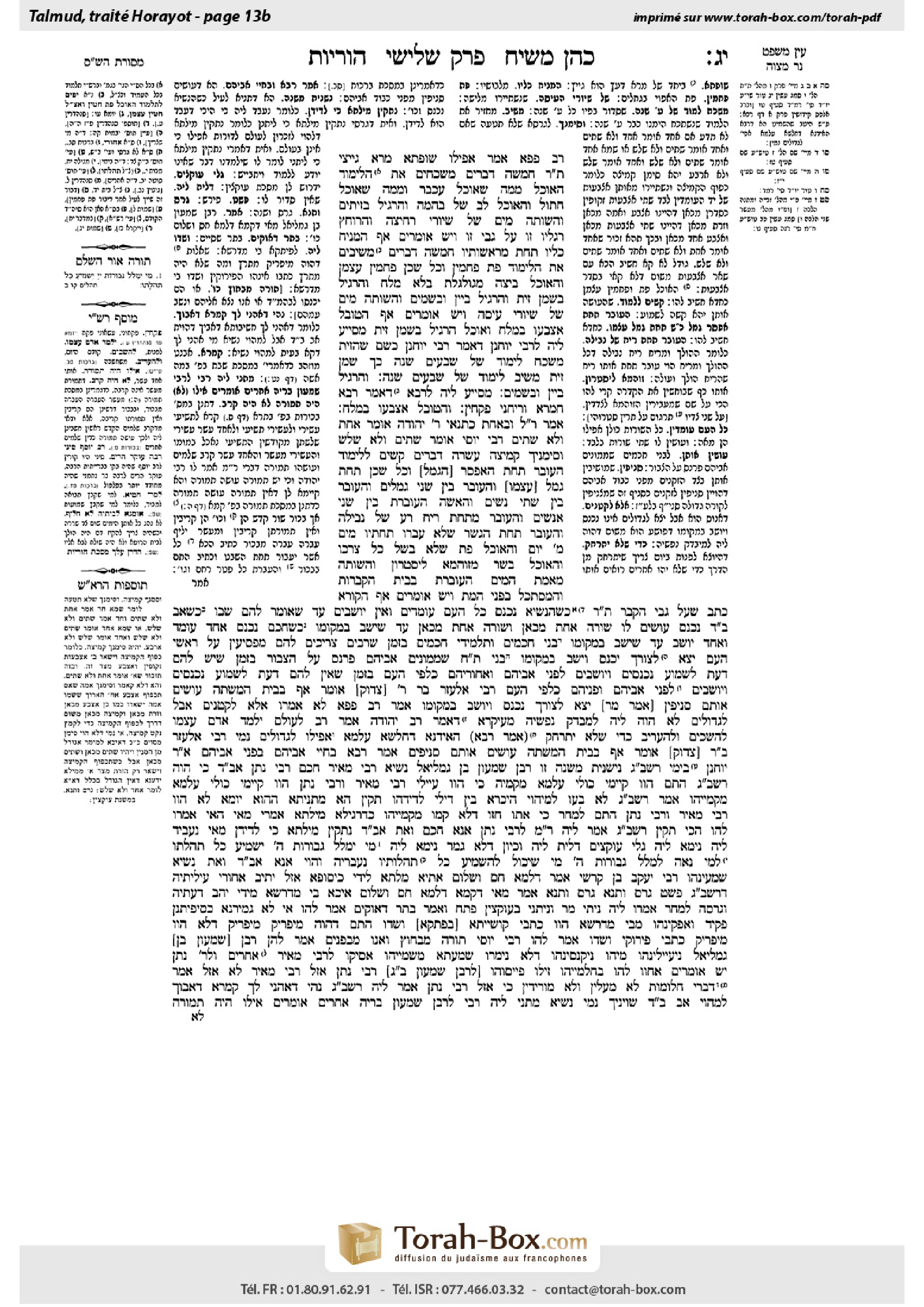
Horayot 13b: Talmud study for Daf Yomi
Daf Yomi is the daily study of one Talmud folio. Explore 37 tractates with scans, Hebrew text, Sefaria English and AI-generated French translations where annotated.
Passage selection and English or AI-generated French translation are available where the scan has annotations. Daf Study is independent of Torah-Box and Sefaria.
Browse Horayot · הוריות · All tractatesHorayot 13b text and translations
This page of Horayot includes the Aramaic text, an English translation and an AI-generated French translation, alongside the scan above.
הוריות י״ג ב · Aramaic and Hebrew text
רַב פָּפָּא אָמַר: אֲפִילּוּ שׁוּפְתָּא [דְּ]מָרָא גָּיְיצִי.
תָּנוּ רַבָּנַן. חֲמִשָּׁה דְּבָרִים מְשַׁכְּחִים אֶת הַתַּלְמוּד: הָאוֹכֵל מִמַּה שֶּׁאוֹכֵל עַכְבָּר וּמִמַּה שֶּׁאוֹכֵל חָתוּל, וְהָאוֹכֵל לֵב שֶׁל בְּהֵמָה, וְהָרָגִיל בְּזֵיתִים, וְהַשּׁוֹתֶה מַיִם שֶׁל שִׁיּוּרֵי רְחִיצָה, וְהָרוֹחֵץ רַגְלָיו זוֹ עַל גַּבֵּי זוֹ. וְיֵשׁ אוֹמְרִים: אַף הַמַּנִּיחַ כֵּלָיו תַּחַת מְרַאֲשׁוֹתָיו. חֲמִשָּׁה דְּבָרִים מְשִׁיבִים אֶת הַתַּלְמוּד: פַּת פֶּחָמִין וְכׇל שֶׁכֵּן פֶּחָמִין עַצְמָן, וְהָאוֹכֵל בֵּיצָה מְגוּלְגֶּלֶת בְּלֹא מֶלַח, וְהָרָגִיל בְּשֶׁמֶן זַיִת, וְהָרָגִיל בְּיַיִן וּבְשָׂמִים, וְהַשּׁוֹתֶה מַיִם שֶׁל שִׁיּוּרֵי עִיסָּה. וְיֵשׁ אוֹמְרִים: אַף הַטּוֹבֵל אֶצְבָּעוֹ בְּמֶלַח וְאוֹכֵל.
״הָרָגִיל בְּשֶׁמֶן זַיִת״. מְסַיַּיע לֵיהּ לְרַבִּי יוֹחָנָן, דְּאָמַר רַבִּי יוֹחָנָן: כְּשֵׁם שֶׁהַזַּיִת מְשַׁכֵּחַ תַּלְמוּד שֶׁל שִׁבְעִים שָׁנָה, כָּךְ שֶׁמֶן זַיִת מֵשִׁיב תַּלְמוּד שֶׁל שִׁבְעִים שָׁנָה.
״וְהָרָגִיל בְּיַיִן וּבְשָׂמִים״. מְסַיַּיע לֵיהּ לְרָבָא, דְּאָמַר רָבָא: חַמְרָא וְרֵיחָנֵי פַּקַּחִין.
״וְהַטּוֹבֵל אֶצְבָּעוֹ בְּמֶלַח״, אָמַר רֵישׁ לָקִישׁ: וּבְאַחַת. כְּתַנָּאֵי, רַבִּי יְהוּדָה אוֹמֵר: אַחַת וְלֹא שְׁתַּיִם, רַבִּי יוֹסֵי אוֹמֵר: שְׁתַּיִם וְלֹא שָׁלֹשׁ. וְסִימָנָיךְ: קְמִיצָה.
עֲשָׂרָה דְּבָרִים קָשִׁים לַתַּלְמוּד: הָעוֹבֵר תַּחַת הָאַפְסָר [הַגָּמָל] וְכׇל שֶׁכֵּן תַּחַת גָּמָל [עַצְמוֹ], וְהָעוֹבֵר בֵּין שְׁנֵי גְּמַלִּים, וְהָעוֹבֵר בֵּין שְׁתֵּי נָשִׁים, וְהָאִשָּׁה הָעוֹבֶרֶת בֵּין שְׁנֵי אֲנָשִׁים, וְהָעוֹבֵר מִתַּחַת רֵיחַ רַע שֶׁל נְבֵילָה, וְהָעוֹבֵר תַּחַת הַגֶּשֶׁר שֶׁלֹּא עָבְרוּ תַּחְתָּיו מַיִם אַרְבָּעִים יוֹם, וְהָאוֹכֵל פַּת שֶׁלֹּא בָּשַׁל כׇּל צָרְכּוֹ, וְהָאוֹכֵל בָּשָׂר מִזּוּהֲמָא לִיסְטְרוֹן, וְהַשּׁוֹתֶה מֵאַמַּת הַמַּיִם הָעוֹבֶרֶת בְּבֵית הַקְּבָרוֹת, וְהַמִּסְתַּכֵּל בִּפְנֵי הַמֵּת. וְיֵשׁ אוֹמְרִים: אַף הַקּוֹרֵא כְּתָב שֶׁעַל גַּבֵּי הַקֶּבֶר.
תָּנוּ רַבָּנַן: כְּשֶׁהַנָּשִׂיא נִכְנָס, כׇּל הָעָם עוֹמְדִים, וְאֵין יוֹשְׁבִים עַד שֶׁאוֹמֵר לָהֶם: שֵׁבוּ. כְּשֶׁאַב בֵּית דִּין נִכְנָס, עוֹשִׂים לוֹ שׁוּרָה אַחַת מִכָּאן וְשׁוּרָה אַחַת מִכָּאן, עַד שֶׁיֵּשֵׁב בִּמְקוֹמוֹ. כְּשֶׁחָכָם נִכְנָס, אֶחָד עוֹמֵד וְאֶחָד יוֹשֵׁב, עַד שֶׁיֵּשֵׁב בִּמְקוֹמוֹ. בְּנֵי חֲכָמִים וְתַלְמִידֵי חֲכָמִים, בִּזְמַן שֶׁרַבִּים צְרִיכִים לָהֶם – מַפְסִיעִין עַל רָאשֵׁי הָעָם. יָצָא לְצוֹרֶךְ – יִכָּנֵס וְיֵשֵׁב בִּמְקוֹמוֹ.
בְּנֵי תַּלְמִידֵי חֲכָמִים שֶׁמְּמוּנִּים אֲבִיהֶם פַּרְנָס עַל הַצִּבּוּר, בִּזְמַן שֶׁיֵּשׁ לָהֶם דַּעַת לִשְׁמוֹעַ – נִכְנָסִים וְיוֹשְׁבִים לִפְנֵי אֲבִיהֶם וַאֲחוֹרֵיהֶם כְּלַפֵּי הָעָם. בִּזְמַן שֶׁאֵין לָהֶם דַּעַת לִשְׁמוֹעַ – נִכְנָסִים וְיוֹשְׁבִים לִפְנֵי אֲבִיהֶם וּפְנֵיהֶם כְּלַפֵּי הַעָם. רַבִּי אֶלְעָזָר בַּר רַבִּי [צָדוֹק] אוֹמֵר: אַף בְּבֵית הַמִּשְׁתֶּה עוֹשִׂים אוֹתָם סְנִיפִין.
[אָמַר מָר] יָצָא לְצוֹרֶךְ – נִכְנָס וְיוֹשֵׁב בִּמְקוֹמוֹ. אָמַר רַב פָּפָּא: לֹא אָמְרוּ אֶלָּא לִקְטַנִּים, אֲבָל לִגְדוֹלִים – לָא, הֲוָה לֵיהּ לְמִבְדַּק נַפְשֵׁיהּ מֵעִיקָּרָא. דְּאָמַר רַב יְהוּדָה אָמַר רַב: לְעוֹלָם יְלַמֵּד אָדָם עַצְמוֹ לְהַשְׁכִּים וּלְהַעֲרִיב, כְּדֵי שֶׁלֹּא יִתְרַחֵק. אָמַר רָבָא: הָאִידָּנָא דַּחֲלַשׁא עָלְמָא – אֲפִילּוּ לִגְדוֹלִים נָמֵי.
רַבִּי אֶלְעָזָר בַּר רַבִּי [צָדוֹק] אוֹמֵר: אַף בְּבֵית הַמִּשְׁתֶּה עוֹשִׂים אוֹתָם סְנִיפִים. אָמַר רָבָא: בְּחַיֵּי אֲבִיהֶם בִּפְנֵי אֲבִיהֶם.
אָמַר רַבִּי יוֹחָנָן: בִּימֵי רַבָּן שִׁמְעוֹן בֶּן גַּמְלִיאֵל נִישְׁנֵית מִשְׁנָה זוֹ. רַבָּן שִׁמְעוֹן בֶּן גַּמְלִיאֵל נָשִׂיא, רַבִּי מֵאִיר חָכָם, רַבִּי נָתָן אַב בֵּית דִּין. כִּי הֲוָה רַבָּן שִׁמְעוֹן בֶּן גַּמְלִיאֵל הָתָם, הֲווֹ קָיְימִי כּוּלֵּי עָלְמָא מִקַּמֵּיהּ. כִּי הֲווֹ עָיְילִי רַבִּי מֵאִיר וְרַבִּי נָתָן, הֲווֹ קָיְימִי כּוּלֵּי עָלְמָא מִקַּמַּיְיהוּ. אָמַר רַבָּן שִׁמְעוֹן בֶּן גַּמְלִיאֵל: לָא בָּעוּ לְמִיהְוֵי הֶיכֵּרָא בֵּין דִּילִי לְדִידְהוּ? תַּקֵּין הָא מַתְנִיתָא.
הָהוּא יוֹמָא לָא הֲווֹ רַבִּי מֵאִיר וְרַבִּי נָתָן הָתָם, לִמְחַר כִּי אֲתוֹ חֲזוֹ דְּלָא קָמוּ מִקַּמַּיְיהוּ כְּדִרְגִילָא מִילְּתָא, אָמְרִי: מַאי הַאי? אֲמַרוּ לְהוּ: הָכִי תַּקֵּין רַבָּן שִׁמְעוֹן בֶּן גַּמְלִיאֵל.
אֲמַר לֵיהּ רַבִּי מֵאִיר לְרַבִּי נָתָן: אֲנָא חָכָם וְאַתְּ אַב בֵּית דִּין, נְתַקֵּין מִילְּתָא כִּי לְדִידַן. מַאי נַעֲבֵיד לֵיהּ? נֵימָא לֵיהּ: גַּלִּי עוּקְצִים, דְּלֵית לֵיהּ. וְכֵיוָן דְּלָא גְּמִר, נֵימָא לֵיהּ: ״מִי יְמַלֵּל גְּבוּרוֹת ה׳ יַשְׁמִיעַ כׇּל תְּהִלָּתוֹ״, לְמִי נָאֶה לְמַלֵּל גְּבוּרוֹת ה׳ – מִי שֶׁיָּכוֹל לְהַשְׁמִיעַ כׇּל תְּהִלּוֹתָיו. נְעַבְּרֵיהּ, וְהָוֵי אֲנָא אַב בֵּית דִּין וְאַתְּ נָשִׂיא.
שַׁמְעִינְהוּ רַבִּי יַעֲקֹב בֶּן קֻדְשַׁי, אֲמַר: דִּלְמָא חַס וְשָׁלוֹם אָתְיָא מִלְּתָא לִידֵי כִּיסּוּפָא, אֲזַל יְתֵיב אֲחוֹרֵי עִילִּיתֵיהּ דְּרַבָּן שִׁמְעוֹן בֶּן גַּמְלִיאֵל, פְּשַׁט, גְּרַס וּתְנָא, גְּרַס וּתְנָא.
אָמַר: מַאי דְּקַמָּא? דִּלְמָא חַס וְשָׁלוֹם אִיכָּא בֵּי מִדְרְשָׁא מִידֵּי, יְהַב דַּעְתֵּיהּ וְגַרְסַהּ. לִמְחַר אֲמַרוּ לֵיהּ: נֵיתֵי מָר וְנִיתְנֵי בְּעוּקְצִין, פְּתַח וַאֲמַר. בָּתַר דְּאוֹקֵים, אֲמַר לְהוּ: אִי לָא גְּמִירְנָא, כַּסֵּיפְיתֻּנַן.
פַּקֵּיד וְאַפְּקִינְהוּ מִבֵּי מִדְרְשָׁא. הֲווֹ כָּתְבִי קוּשְׁיָיתָא [בְּפִתְקָא] וְשָׁדוּ הָתָם. דַּהֲוָה מִיפְּרִיק – מִיפְּרִיק, דְּלָא הֲווֹ מִיפְּרִיק – כָּתְבִי פֵּירוּקֵי וְשָׁדוּ. אֲמַר לְהוּ רַבִּי יוֹסֵי: תּוֹרָה מִבַּחוּץ וְאָנוּ מִבִּפְנִים?
אָמַר לָהֶן רַבָּן [שִׁמְעוֹן בֶּן] גַּמְלִיאֵל: נִיעַיְּילִינְהוּ, מִיהוּ נִיקְנְסִינְהוּ דְּלָא נֵימְרוּ שְׁמַעְתָּא מִשְּׁמַיְיהוּ. אַסִּיקוּ לְרַבִּי מֵאִיר אֲחֵרִים, וּלְרַבִּי נָתָן יֵשׁ אוֹמְרִים. אַחְווֹ לְהוּ בְּחֶלְמַיְיהוּ: זִילוּ פַּיְּיסוּהוּ [לְרַבָּן שִׁמְעוֹן בֶּן גַּמְלִיאֵל], רַבִּי נָתָן אֲזַל, רַבִּי מֵאִיר לָא אֲזַל, אֲמַר: דִּבְרֵי חֲלוֹמוֹת לֹא מַעֲלִין וְלֹא מוֹרִידִין. כִּי אֲזַל רַבִּי נָתָן, אֲמַר לֵיהּ רַבָּן שִׁמְעוֹן בֶּן גַּמְלִיאֵל: נְהִי דְּאַהֲנִי לָךְ קַמְרָא דַּאֲבוּךְ לְמֶהֱוֵי אַב בֵּית דִּין, שַׁוִּינָיךְ נָמֵי נָשִׂיא?!
מַתְנֵי לֵיהּ רַבִּי לְרַבָּן שִׁמְעוֹן בְּרֵיהּ, אֲחֵרִים אוֹמְרִים: אִילּוּ הָיָה תְּמוּרָה
Horayot 13b · English translation
Rav Pappa said: They gnaw even on the handle of a hoe.
§ The Sages taught in a baraita: There are five factors that cause one to forget his Torah study: One who eats from that which a mouse eats and from that which a cat eats, and one who eats the heart of an animal, and one who is accustomed to eating olives, and one who drinks water that remains from washing, and one who washes his feet with this foot atop that foot. And some say: Also one who places his garments under his head. Correspondingly, there are five factors that restore forgotten Torah study: Eating bread baked on coals and all the more so one who warms himself with the heat of the coals themselves, and one who eats a hard-boiled egg [beitza megulgelet] without salt, and one who is accustomed to eating olive oil, and one who is accustomed to drinking wine and smelling spices, and one who drinks water that remains from kneading dough. And some say: Also one who dips his finger in salt and eats it.
The Gemara elaborates on the baraita: One who is accustomed to eating olive oil restores forgotten Torah study. The Gemara notes: This supports the opinion of Rabbi Yoḥanan, as Rabbi Yoḥanan said: Just as eating an olive causes one to forget seventy years’ worth of Torah study, olive oil restores seventy years’ worth of Torah study.
The baraita continues: And one who is accustomed to drinking wine and smelling spices restores forgotten Torah study. The Gemara notes: This supports the opinion of Rava, as Rava said: Wine and spices rendered me wise.
The baraita continues: One who dips his finger in salt and eats it restores forgotten Torah study. Reish Lakish says: And that is the case with regard to one finger. The Gemara notes: This is parallel to a dispute between tanna’im. Rabbi Yehuda says: One finger but not two. Rabbi Yosei says: Two fingers but not three. And your mnemonic for the fact that the dispute is between one and two fingers is kemitza, i.e., the ring finger. When one presses his ring finger to his palm, there remain two straight fingers on one side and one on the other.
Ten factors are detrimental for Torah study: One who passes beneath the bit of the camel, and all the more so one who passes beneath a camel itself; and one who passes between two camels; and one who passes between two women; and a woman who passes between two men; and one who passes beneath a place where there is the foul odor of an animal carcass; and one who passes under a bridge beneath which water has not passed for forty days; and one who eats bread that was not sufficiently baked; and one who eats meat from zuhama listeron, a utensil consisting of a spoon and a fork, used to remove the film on the surface of soup; and one who drinks from an aqueduct that passes through a cemetery; and one who gazes at the face of the dead. And some say: Also one who reads the writing that is on the stone of a grave.
§ The Sages taught in a baraita: When the Nasi of the Sanhedrin enters, all the people stand and they do not sit until he says to them: Sit. When the deputy Nasi of the Sanhedrin enters, the people form for him one row from here, on this side of the path that he takes, and one row from there, on the other side of it, in a display of deference, until he sits in his place, and then they may be seated. When the Ḥakham, who is ranked third among the members of the Sanhedrin, enters, one person stands when he is within four cubits of the Ḥakham, and another sits, i.e., when one is no longer within four cubits of the Ḥakham he may sit. And all those whom the Ḥakham passes do this, until he sits in his place. When the multitudes require their services, i.e., they serve a public role, sons of the Sages and Torah scholars may step over the heads of the people seated on the ground in order to reach their places in the Sanhedrin. If one of the Sages left for the purpose of relieving himself, when he is finished he may enter and sit in his place in the Sanhedrin, and he need not be concerned that he is imposing upon those assembled.
When they have the wisdom to hear and to study, the sons of Torah scholars, whose fathers are appointed as leaders of the congregation, enter and sit before their fathers, and their backs are directed toward the people. When they do not have the wisdom to hear and to study they enter and sit before their fathers, and their faces are directed toward the people, so everyone sees that they are seated there in deference to their fathers but not as students. Rabbi Elazar, son of Rabbi Tzadok, says: Even at a wedding party one renders them attachments [senifin] and seats them adjacent to their fathers.
The Master said: If one of the Sages left for the purpose of relieving himself, when he is finished he may enter and sit in his place. Rav Pappa said: The Sages said this only with regard to one who leaves for minor bodily functions, i.e., to urinate. But with regard to one who leaves for major bodily functions, i.e., to defecate, no, he may not return to his place, because he should have examined himself initially so that he would not need to leave. His failure to do so constitutes negligence and he may not impose upon others when he returns, as Rav Yehuda says that Rav says: A person should always accustom himself to relieving himself in the morning and in the evening so that he will not need to distance himself during the daylight hours to find an appropriate place. Rava said: Today, when the world is weak and people are not as healthy as they once were, one may even return after he leaves for major bodily functions.
Rabbi Elazar, son of Rabbi Tzadok, says: Even at a wedding party one renders them attachments. Rava said: This applies during the lifetime of their fathers and in the presence of their fathers.
§ Rabbi Yoḥanan says: This mishna, i.e., the preceding baraita, was taught during the days of Rabban Shimon ben Gamliel. Rabban Shimon ben Gamliel was the Nasi, Rabbi Meir was the Ḥakham, and Rabbi Natan was the deputy Nasi. When Rabban Shimon ben Gamliel was there, everyone would arise before him. When Rabbi Meir and Rabbi Natan would enter, everyone would arise before them. Rabban Shimon ben Gamliel said: Shouldn’t there be a conspicuous distinction between me and them in terms of the manner in which deference is shown? Rabban Shimon ben Gamliel instituted the provisions delineated in this baraita that distinguish between the Nasi and his subordinates with regard to the deference shown them.
That day, when Rabban Shimon ben Gamliel instituted these provisions, Rabbi Meir and Rabbi Natan were not there. The following day when they came to the study hall, they saw that the people did not stand before them as the matter was typically done. They said: What is this? The people said to them: This is what Rabban Shimon ben Gamliel instituted.
Rabbi Meir said to Rabbi Natan: I am the Ḥakham and you are the deputy Nasi. Let us devise a matter and do to him as he did to us. What shall we do to him? Let us say to him: Reveal to us tractate Okatzim, which he does not know. And once it is clear to all that he did not learn, he will not have anything to say. Then we will say to him: “Who can express the mighty acts of the Lord, shall make all His praises heard?” (Psalms 106:2), indicating: For whom is it becoming to express the mighty acts of the Lord? It is becoming for one who is capable of making all His praises heard, and not for one who does not know one of the tractates. We will remove him from his position as Nasi, and I will be deputy Nasi and you will be Nasi.
Rabbi Ya’akov ben Korshei heard them talking, and said: Perhaps, Heaven forfend, this matter will come to a situation of humiliation for Rabban Shimon ben Gamliel. He did not wish to speak criticism or gossip about Rabbi Meir and Rabbi Natan, so he went and sat behind the upper story where Rabban Shimon ben Gamliel lived. He explained tractate Okatzin; he studied it aloud and repeated it, and studied it aloud and repeated it.
Rabban Shimon ben Gamliel said to himself: What is this that is transpiring before us? Perhaps, Heaven forfend, there is something transpiring in the study hall. He suspected that Rabbi Meir and Rabbi Natan were planning something. He concentrated and studied tractate Okatzin. The following day Rabbi Meir and Rabbi Natan said to him: Let the Master come and teach a lesson in tractate Okatzin. He began and stated the lesson he had prepared. After he completed teaching the tractate, he said to them: If I had not studied the tractate, you would have humiliated me.
Rabban Shimon ben Gamliel commanded those present and they expelled Rabbi Meir and Rabbi Natan from the study hall as punishment. Rabbi Meir and Rabbi Natan would write difficulties on a scrap of paper [pitka] and would throw them there into the study hall. Those difficulties that were resolved were resolved; as for those that were not resolved, Rabbi Meir and Rabbi Natan wrote resolutions on a scrap of paper and threw them into the study hall. Rabbi Yosei said to the Sages: How is it that the Torah, embodied in the preeminent Torah scholars, is outside and we are inside?
Rabban Shimon ben Gamliel said to them: Let us admit them into the study hall. But we will penalize them in that we will not cite halakha in their names. They cited statements of Rabbi Meir in the name of Aḥerim, meaning: Others, and they cited statements of Rabbi Natan in the name of yesh omerim, meaning: Some say. Rabbi Meir and Rabbi Natan were shown a message in their dreams: Go, appease Rabban Shimon ben Gamliel. Rabbi Natan went. Rabbi Meir did not go. He said in his heart: Matters of dreams are insignificant. When Rabbi Natan went, Rabban Shimon ben Gamliel said to him: Although the ornate belt, i.e., the importance, of your father was effective in enabling you to become deputy Nasi, as Rabbi Natan’s father was the Babylonian Exilarch, will it render you Nasi as well?
Years later, Rabbi Yehuda HaNasi taught Rabban Shimon his son that Aḥerim say: If it was considered a substitute,
Horayot 13b · Traduction française (IA)
Rav Pappa dit : Ils rongent même le manche d’une houe.
§ Les Sages enseignent dans une baraïta : Cinq facteurs font oublier l’étude de la Torah : manger ce qu’a mangé une souris ou un chat, manger le cœur d’un animal, avoir l’habitude de manger des olives, boire l’eau qui reste après le lavage et se laver les pieds en posant un pied sur l’autre. Certains disent : également placer ses vêtements sous sa tête. À l’inverse, cinq facteurs font retrouver l’étude de la Torah oubliée : manger du pain cuit sur des braises — et, à plus forte raison, se réchauffer à la chaleur des braises elles-mêmes —, manger un œuf dur [beitza megulgelet] sans sel, avoir l’habitude de consommer de l’huile d’olive, avoir l’habitude de boire du vin et de sentir des épices, et boire l’eau qui reste après avoir pétri la pâte. Certains disent : également tremper son doigt dans du sel et le manger.
La Guemara développe l’enseignement de la baraïta : celui qui a l’habitude de consommer de l’huile d’olive retrouve l’étude de la Torah oubliée. La Guemara relève que cela confirme l’opinion de Rabbi Yoḥanan, car Rabbi Yoḥanan a dit : de même que manger une olive fait oublier soixante-dix années d’étude de la Torah, l’huile d’olive fait retrouver soixante-dix années d’étude de la Torah.
La baraïta poursuit : celui qui a l’habitude de boire du vin et de sentir des épices retrouve l’étude de la Torah oubliée. La Guemara relève que cela confirme l’opinion de Rava, car Rava a dit : « Le vin et les épices m’ont rendu sage. »
La baraïta poursuit : celui qui trempe son doigt dans du sel et le mange retrouve l’étude de la Torah oubliée. Reish Lakish dit : cela vaut pour un seul doigt. La Guemara relève que cela correspond à une controverse entre tannaïm. Rabbi Yehuda dit : un doigt, mais pas deux. Rabbi Yosei dit : deux doigts, mais pas trois. Le moyen mnémotechnique pour retenir que la controverse porte sur un ou deux doigts est kemitza, c’est-à-dire l’annulaire. Lorsqu’on appuie l’annulaire contre la paume, il reste deux doigts tendus d’un côté et un de l’autre.
Dix facteurs nuisent à l’étude de la Torah : passer sous le mors d’un chameau — et, à plus forte raison, passer sous un chameau lui-même —, passer entre deux chameaux, passer entre deux femmes, une femme qui passe entre deux hommes, passer sous un endroit où règne la puanteur d’une carcasse d’animal, passer sous un pont sous lequel l’eau n’a pas coulé depuis quarante jours, manger du pain insuffisamment cuit, manger de la viande prélevée avec un zuhama listeron, ustensile composé d’une cuillère et d’une fourchette servant à retirer la pellicule à la surface de la soupe, boire l’eau d’un aqueduc qui traverse un cimetière et regarder le visage d’un mort. Certains disent : également lire l’inscription gravée sur la pierre d’une tombe.
§ Les Sages enseignent dans une baraïta : lorsque le Nassi du Sanhédrin entre, tout le monde se lève et ne s’assoit pas avant qu’il leur dise : « Asseyez-vous. » Lorsque le vice-Nassi du Sanhédrin entre, les gens se rangent en deux files, l’une de ce côté du chemin qu’il emprunte et l’autre de l’autre côté, en signe de déférence, jusqu’à ce qu’il s’assoie à sa place ; alors ils peuvent s’asseoir. Lorsque le Ḥakham, qui occupe le troisième rang parmi les membres du Sanhédrin, entre, une personne se lève lorsqu’il se trouve à moins de quatre coudées d’elle, tandis qu’une autre peut s’asseoir dès qu’elle ne se trouve plus à moins de quatre coudées de lui. Tous ceux que le Ḥakham dépasse font de même, jusqu’à ce qu’il s’assoie à sa place. Lorsque la multitude a besoin de leurs services, c’est-à-dire qu’ils remplissent une fonction publique, les fils des Sages et les érudits de la Torah peuvent enjamber les têtes des gens assis à terre afin de rejoindre leur place au Sanhédrin. Si l’un des Sages est sorti pour se soulager, il peut, à son retour, entrer et s’asseoir à sa place au Sanhédrin, sans craindre d’importuner les personnes réunies.
Lorsque les fils des érudits de la Torah, dont les pères sont nommés dirigeants de la communauté, ont la sagesse nécessaire pour écouter et étudier, ils entrent et s’assoient devant leurs pères, le dos tourné vers les gens. Lorsqu’ils n’ont pas la sagesse nécessaire pour écouter et étudier, ils entrent et s’assoient devant leurs pères, le visage tourné vers les gens, afin que tous voient qu’ils sont assis là par déférence envers leurs pères, et non en qualité d’élèves. Rabbi Elazar, fils de Rabbi Tzadok, dit : même lors d’un festin de mariage, on leur attribue des places [senifin] et on les installe près de leurs pères.
Le Maître a dit : si l’un des Sages est sorti pour se soulager, il peut, à son retour, entrer et s’asseoir à sa place. Rav Pappa dit : les Sages n’ont dit cela qu’à propos de celui qui sort pour ses petits besoins, c’est-à-dire pour uriner. Mais celui qui sort pour ses grands besoins, c’est-à-dire pour déféquer, non, il ne peut pas reprendre sa place, car il aurait dû se soulager auparavant afin de ne pas avoir à sortir. Son omission constitue une négligence, et il ne peut pas importuner les autres à son retour, comme Rav Yehuda dit au nom de Rav : une personne doit toujours s’habituer à se soulager le matin et le soir, afin de ne pas avoir à s’éloigner pendant la journée pour trouver un endroit convenable. Rava dit : aujourd’hui, alors que le monde est affaibli et que les gens sont moins robustes qu’autrefois, on peut même revenir après être sorti pour ses grands besoins.
Rabbi Elazar, fils de Rabbi Tzadok, dit : même lors d’un festin de mariage, on leur attribue des places. Rava dit : cela s’applique du vivant de leurs pères et en leur présence.
§ Rabbi Yoḥanan dit : cette Michna, c’est-à-dire la baraïta précédente, fut enseignée à l’époque de Rabban Shimon ben Gamliel. Rabban Shimon ben Gamliel était le Nassi, Rabbi Meir était le Ḥakham et Rabbi Natan était le vice-Nassi. Lorsque Rabban Shimon ben Gamliel était présent, tout le monde se levait devant lui. Lorsque Rabbi Meir et Rabbi Natan entraient, tout le monde se levait devant eux. Rabban Shimon ben Gamliel dit : « Ne devrait-il pas y avoir une distinction manifeste entre eux et moi dans la manière de témoigner de la déférence ? » Rabban Shimon ben Gamliel institua les dispositions énoncées dans cette baraïta, qui distinguent le Nassi de ses subordonnés quant aux marques de déférence qui leur sont témoignées.
Le jour où Rabban Shimon ben Gamliel institua ces dispositions, Rabbi Meir et Rabbi Natan n’étaient pas présents. Le lendemain, lorsqu’ils arrivèrent à la maison d’étude, ils constatèrent que les gens ne se levaient pas devant eux comme ils le faisaient habituellement. Ils dirent : « Qu’est-ce que cela ? » Les gens leur répondirent : « Voilà ce que Rabban Shimon ben Gamliel a institué. »
Rabbi Meir dit à Rabbi Natan : « Je suis le Ḥakham et toi, le vice-Nassi. Trouvons quelque chose à faire et traitons-le comme il nous a traités. Que lui ferons-nous ? Disons-lui : “Expose-nous le traité Okatzim”, qu’il ne connaît pas. Dès qu’il sera clair pour tous qu’il ne l’a pas étudié, il n’aura plus rien à dire. Alors nous lui dirons : “Qui peut raconter les actes puissants de l’Éternel, faire entendre toutes ses louanges ?” (Psaumes 106, 2), ce qui signifie : à qui convient-il de raconter les actes puissants de l’Éternel ? Cela convient à celui qui est capable de faire entendre toutes ses louanges, et non à celui qui ne connaît pas l’un des traités. Nous le destituerons de sa fonction de Nassi ; je serai vice-Nassi et toi, tu seras Nassi. »
Rabbi Ya’akov ben Korshei les entendit parler et dit : « Peut-être, à Dieu ne plaise, cette affaire va-t-elle aboutir à humilier Rabban Shimon ben Gamliel. » Ne voulant ni critiquer Rabbi Meir et Rabbi Natan ni colporter des propos à leur sujet, il alla s’asseoir derrière l’étage supérieur où habitait Rabban Shimon ben Gamliel. Il expliqua le traité Okatzim : il l’étudia à voix haute et le répéta, puis l’étudia à voix haute et le répéta.
Rabban Shimon ben Gamliel se dit : « Que se passe-t-il donc ici ? Peut-être, à Dieu ne plaise, quelque chose se trame-t-il à la maison d’étude. » Il soupçonna Rabbi Meir et Rabbi Natan de préparer quelque chose. Il se concentra et étudia le traité Okatzim. Le lendemain, Rabbi Meir et Rabbi Natan lui dirent : « Que le Maître vienne donner un cours sur le traité Okatzim. » Il commença et exposa le cours qu’il avait préparé. Après avoir terminé d’enseigner le traité, il leur dit : « Si je n’avais pas étudié ce traité, vous m’auriez humilié. »
Rabban Shimon ben Gamliel donna l’ordre aux personnes présentes, qui expulsèrent Rabbi Meir et Rabbi Natan de la maison d’étude en guise de punition. Rabbi Meir et Rabbi Natan écrivaient leurs questions sur un bout de papier [pitka] et les lançaient dans la maison d’étude. Certaines questions recevaient une réponse ; quant à celles qui restaient sans réponse, Rabbi Meir et Rabbi Natan écrivaient des solutions sur un bout de papier et les lançaient dans la maison d’étude. Rabbi Yosei dit aux Sages : « Comment se fait-il que la Torah, incarnée par les érudits éminents de la Torah, soit dehors, tandis que nous sommes à l’intérieur ? »
Rabban Shimon ben Gamliel leur dit : « Faisons-les entrer dans la maison d’étude. Mais nous les punirons en ne citant pas la halakha en leur nom. » On cita les enseignements de Rabbi Meir au nom de Aḥerim, c’est-à-dire « d’autres », et ceux de Rabbi Natan au nom de yesh omerim, c’est-à-dire « certains disent ». Rabbi Meir et Rabbi Natan reçurent en rêve le message suivant : « Allez, apaisez Rabban Shimon ben Gamliel. » Rabbi Natan y alla. Rabbi Meir n’y alla pas. Il se dit : « Les affaires des rêves sont insignifiantes. » Lorsque Rabbi Natan se rendit auprès de Rabban Shimon ben Gamliel, celui-ci lui dit : « Même si la ceinture ornée de ton père, c’est-à-dire son prestige, t’a permis de devenir vice-Nassi — car le père de Rabbi Natan était l’exilarque de Babylonie —, te permettra-t-elle aussi de devenir Nassi ? »
Des années plus tard, Rabbi Yehuda HaNasi enseigna à son fils Rabban Shimon que Aḥerim disent : « Si cela était considéré comme un substitut, »
Traduction française générée par IA à partir de l’édition anglaise de Sefaria. Vérifie toujours un passage avec le texte source.
Text from Sefaria: William Davidson Edition - Vocalized Aramaic (CC BY NC); William Davidson Edition - English (CC BY NC).