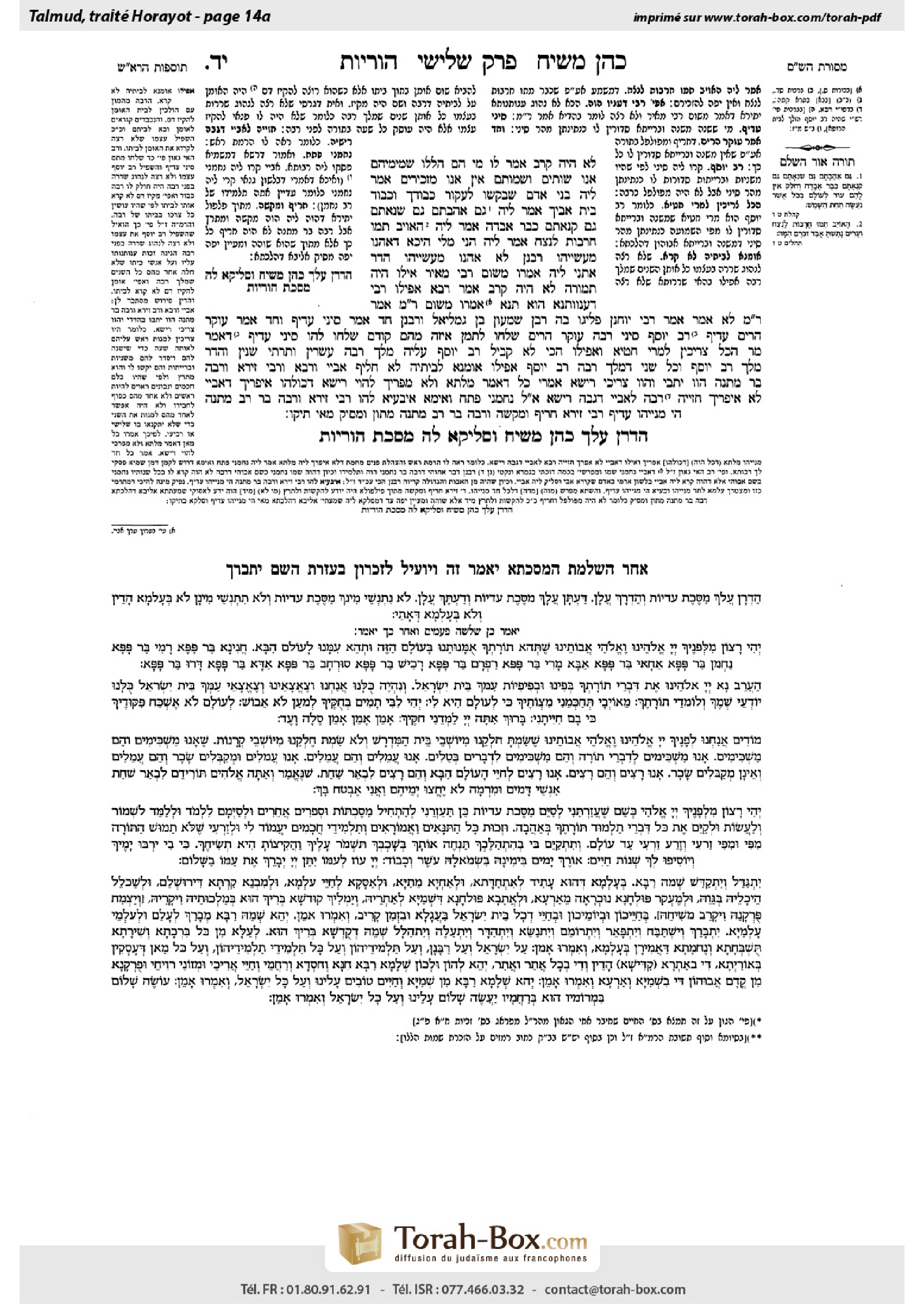
Horayot 14a: Talmud study for Daf Yomi
Daf Yomi is the daily study of one Talmud folio. Explore 37 tractates with scans, Hebrew text, Sefaria English and AI-generated French translations where annotated.
Passage selection and English or AI-generated French translation are available where the scan has annotations. Daf Study is independent of Torah-Box and Sefaria.
Browse Horayot · הוריות · All tractatesHorayot 14a text and translations
This page of Horayot includes the Aramaic text, an English translation and an AI-generated French translation, alongside the scan above.
הוריות י״ד א · Aramaic and Hebrew text
לֹא הָיָה קָרֵב. אָמַר לוֹ: מִי הֵם הַלָּלוּ שֶׁמֵּימֵיהֶם אָנוּ שׁוֹתִים וּשְׁמוֹתָם אֵין אָנוּ מַזְכִּירִים? אֲמַר לֵיהּ: בְּנֵי אָדָם שֶׁבִּקְּשׁוּ לַעֲקוֹר כְּבוֹדְךָ וּכְבוֹד בֵּית אָבִיךָ.
אֲמַר לֵיהּ: ״גַּם אַהֲבָתָם גַּם שִׂנְאָתָם גַּם קִנְאָתָם כְּבָר אָבָדָה״! אֲמַר לֵיהּ: ״הָאוֹיֵב תַּמּוּ חֳרָבוֹת לָנֶצַח״. אֲמַר לֵיהּ: הָנֵי מִלֵּי הֵיכָא דְּאַהֲנוֹ מַעֲשַׂיְיהוּ, רַבָּנַן לָא אַהֲנוֹ מַעֲשַׂיְיהוּ! הֲדַר אַתְנִי לֵיהּ, אָמְרוּ מִשּׁוּם רַבִּי מֵאִיר: אִילּוּ הָיָה תְּמוּרָה לֹא הָיָה קָרֵב. אָמַר רָבָא: אֲפִילּוּ רַבִּי דְּעִנְוְותָנָא הוּא (תְּנָא), ״אָמְרוּ מִשּׁוּם רַבִּי מֵאִיר״. ״אָמַר רַבִּי מֵאִיר״ לָא אָמַר.
אָמַר רַבִּי יוֹחָנָן: פְּלִיגוּ בַּהּ רַבָּן שִׁמְעוֹן בֶּן גַּמְלִיאֵל וְרַבָּנַן, חַד אָמַר: סִינַי עֲדִיף, וְחַד אָמַר: עוֹקֵר הָרִים עֲדִיף.
רַב יוֹסֵף סִינַי, רַבָּה עוֹקֵר הָרִים. שְׁלַחוּ לְתַמָּן: אֵיזֶה מֵהֶם קוֹדֵם? שְׁלַחוּ לְהוּ: סִינַי עֲדִיף, דְּאָמַר מָר: הַכֹּל צְרִיכִין לְמָרֵי חִטַּיָּא, וַאֲפִילּוּ הָכִי לָא קַבֵּיל רַב יוֹסֵף עֲלֵיהּ. מְלַךְ רַבָּה עֶשְׂרִין וְתַרְתֵּי שְׁנִין, וַהֲדַר מְלַךְ רַב יוֹסֵף. וְכֹל שְׁנֵי דִּמְלַךְ רַבָּה, רַב יוֹסֵף אֲפִילּוּ אוּמָּנָא לְבֵיתֵיהּ לָא (חֲלֵיף).
אַבָּיֵי וְרָבָא וְרַבִּי זֵירָא וְרַבָּה בַּר מַתְנָה הֲווֹ יָתְבִי וַהֲווֹ צְרִיכִי רֵישָׁא, אָמְרִי: כֹּל דְּאָמַר מִלְּתָא וְלָא מִפְּרִיךְ, לֶהֱוֵי רֵישָׁא. דְּכוּלְּהוּ אִיפְּרִיךְ, דְּאַבָּיֵי לָא אִיפְּרִיךְ. חַזְיֵיהּ רַבָּה לְאַבָּיֵי דִּגְבַהּ רֵישֵׁאּ, אֲמַר לֵיהּ: נַחְמָנִי, פְּתַח וְאֵימָא.
אִיבַּעְיָא לְהוּ: רַבִּי זֵירָא וְרַבָּה בַּר רַב מַתְנָה הֵי מִנַּיְיהוּ עֲדִיף? רַבִּי זֵירָא חָרִיף וּמַקְשֶׁה, וְרַבָּה בַּר רַב מַתְנָה מָתוּן וּמַסֵּיק, מַאי? תֵּיקוּ.
הֲדַרַן עֲלָךְ כֹּהֵן מָשִׁיחַ, וּסְלִיקָא לַהּ מַסֶּכֶת הוֹרָיוֹת.
Horayot 14a · English translation
it would not be sacrificed. Rabbi Yehuda HaNasi’s son said to him: Who are these Sages whose water we drink but whose names we do not mention? Rabbi Yehuda HaNasi said to him: They are people who sought to abolish your honor and the honor of your father’s house.
His son said to him, citing the verse: “Their love as well as their hatred and their envy is long ago perished” (Ecclesiastes 9:6): That was long ago and they have already died. Therefore, there is no harm in mentioning their names. Rabbi Yehuda HaNasi said to him: But it is also stated: “The enemy are come to an end; the wasted places are forever” (Psalms 9:7). Although the enemies died, the desolation that they created remains. Therefore, although they are dead, their names should not be mentioned. Rabban Shimon said to his father: These matters apply in a case where their actions were effective. In the case of these Sages, their actions were not effective. Rabbi Yehuda HaNasi then taught him: The Sages said in the name of Rabbi Meir: If it was considered a substitute, it would not be sacrificed. Rava said: Even Rabbi Yehuda HaNasi, who is humble, taught: The Sages said in the name of Rabbi Meir. But he did not say directly: Rabbi Meir said.
§ Rabbi Yoḥanan said: Rabban Shimon ben Gamliel and the Rabbis disagreed with regard to this matter. One said: Sinai, i.e., one who is extremely knowledgeable, is preferable; and one said: One who uproots mountains, i.e., one who is extremely incisive, is preferable.
The Gemara relates that this is not merely a theoretical dispute; rather, at one point it had practical ramifications. Rav Yosef was Sinai; Rabba was one who uproots mountains. They sent a message from Babylonia to there, Eretz Yisrael: Which takes precedence? They sent in response: Sinai is preferable, as the Master said: Everyone requires the owner of the wheat, i.e., one who is expert in the sources. And even so, Rav Yosef did not accept upon himself the appointment of head of the yeshiva. Rabba reigned for twenty-two years, and then Rav Yosef reigned. The Gemara relates that in all those years that Rabba presided, Rav Yosef did not even call a bloodletter to his home. Rav Yosef did not assume even the slightest air of authority, in deference to Rabba, and would go to seek out the bloodletter rather than expecting that the bloodletter would accommodate him.
The Gemara relates: Abaye, Rava, Rabbi Zeira, and Rabba bar Mattana were sitting and studying in a group and were in need of a head for their group. They said: Let anyone who will say a matter that is not refuted be the head. Everyone’s statements were refuted, and the statement of Abaye was not refuted. Rabba saw that Abaye raised his head, i.e., he noticed that his statement was not refuted. Rabba said to him: Naḥmani, calling Abaye by his name rather than by his nickname, begin and say your lecture.
A dilemma was raised before the Sages: Between Rabbi Zeira and Rabba bar Rav Mattana, which of them is preferable? Rabbi Zeira is incisive and raises pertinent difficulties, and Rabba bar Rav Mattana is moderate and not so incisive, but ultimately he draws the appropriate conclusions. What is the conclusion? Which is preferable? The Gemara concludes: The dilemma shall stand unresolved.
Horayot 14a · Traduction française (IA)
il ne serait pas offert. Le fils de Rabbi Yehouda HaNassi lui dit : « Qui sont ces Sages dont nous buvons l’eau, mais dont nous ne mentionnons pas les noms ? » Rabbi Yehouda HaNassi lui répondit : « Ce sont des hommes qui ont cherché à abolir ton honneur et celui de la maison de ton père. »
Son fils lui dit, en citant le verset : « Leur amour, comme leur haine et leur jalousie, a disparu depuis longtemps » (Ecclésiaste 9, 6) : « Cela remonte à longtemps et ils sont déjà morts. Il n’y a donc aucun mal à mentionner leurs noms. » Rabbi Yehouda HaNassi lui répondit : « Mais il est également écrit : “L’ennemi a disparu ; les ruines sont éternelles” » (Psaumes 9, 7). Bien que les ennemis soient morts, la désolation qu’ils ont causée demeure. Par conséquent, même s’ils sont morts, leurs noms ne doivent pas être mentionnés. Rabban Shimon dit à son père : « Ces propos s’appliquent lorsque leurs actes ont eu des effets. Dans le cas de ces Sages, leurs actes n’ont pas eu d’effet. » Rabbi Yehouda HaNassi lui enseigna alors : « Les Sages ont dit au nom de Rabbi Meïr : “S’il était considéré comme un substitut, il ne serait pas offert.” » Rava dit : « Même Rabbi Yehouda HaNassi, qui était humble, enseigna : “Les Sages ont dit au nom de Rabbi Meïr.” Mais il ne dit pas directement : “Rabbi Meïr a dit.” »
§ Rabbi Yoḥanan dit : Rabban Shimon ben Gamliel et les Rabbis étaient en désaccord sur cette question. L’un disait : « Le Sinaï », c’est-à-dire celui qui possède un savoir extrêmement étendu, est préférable ; l’autre disait : « Celui qui déracine les montagnes », c’est-à-dire celui qui est extrêmement incisif, est préférable.
La Guemara rapporte que ce n’était pas seulement une controverse théorique ; à un moment donné, elle eut des conséquences pratiques. Rav Yosef était un Sinaï ; Rabba était un homme qui déracine les montagnes. On envoya de Babylonie en Terre d’Israël la question suivante : lequel a la priorité ? La réponse fut : le Sinaï est préférable, car le Maître a dit : « Tout le monde a besoin du propriétaire du blé », c’est-à-dire de celui qui maîtrise les sources. Malgré cela, Rav Yosef n’accepta pas d’assumer la fonction de chef de la yéchiva. Rabba dirigea pendant vingt-deux ans, puis Rav Yosef lui succéda. La Guemara rapporte que, pendant toutes ces années où Rabba présida, Rav Yosef ne fit même pas venir un saigneur chez lui. Par égard pour Rabba, Rav Yosef ne prit pas le moindre air d’autorité et allait lui-même chercher le saigneur, plutôt que de s’attendre à ce que celui-ci vienne à lui.
La Guemara rapporte : Abaye, Rava, Rabbi Zeira et Rabba bar Mattana étaient assis ensemble à étudier et avaient besoin d’un chef pour leur groupe. Ils dirent : « Que celui qui énoncera une idée qui ne sera pas réfutée devienne le chef. » Les propos de tous furent réfutés, mais ceux d’Abaye ne le furent pas. Rabba vit qu’Abaye relevait la tête, c’est-à-dire qu’il avait remarqué que son propos n’avait pas été réfuté. Rabba lui dit : « Naḥmani » — appelant Abaye par son nom plutôt que par son surnom —, « commence et donne ton enseignement. »
Les Sages se posèrent la question suivante : entre Rabbi Zeira et Rabba bar Rav Mattana, lequel est préférable ? Rabbi Zeira est incisif et soulève des difficultés pertinentes, tandis que Rabba bar Rav Mattana est pondéré et moins incisif, mais finit par tirer les conclusions qui s’imposent. Quelle est la conclusion ? Lequel est préférable ? La Guemara conclut : la question reste sans réponse.
Traduction française générée par IA à partir de l’édition anglaise de Sefaria. Vérifie toujours un passage avec le texte source.
Text from Sefaria: William Davidson Edition - Vocalized Aramaic (CC BY NC); William Davidson Edition - English (CC BY NC).