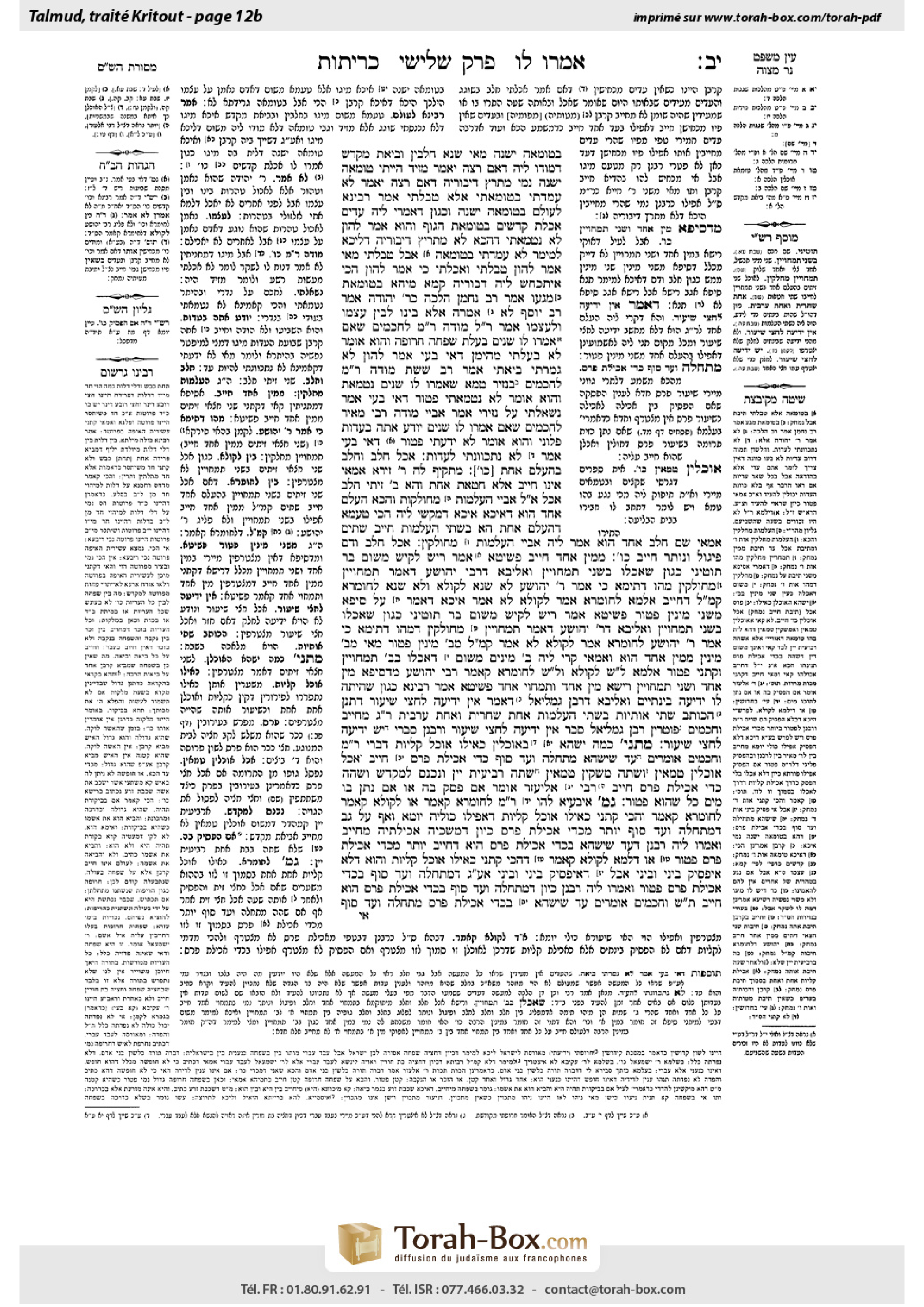
Keritot 12b: Talmud study for Daf Yomi
Daf Yomi is the daily study of one Talmud folio. Explore 37 tractates with scans, Hebrew text, Sefaria English and AI-generated French translations where annotated.
Passage selection and English or AI-generated French translation are available where the scan has annotations. Daf Study is independent of Torah-Box and Sefaria.
Browse Keritot · כריתות · All tractatesKeritot 12b text and translations
This page of Keritot includes the Aramaic text, an English translation and an AI-generated French translation, alongside the scan above.
כריתות י״ב ב · Aramaic and Hebrew text
בְּטוּמְאָה יְשָׁנָה, מַאי שְׁנָא חֲלָבִין וּבִיאַת מִקְדָּשׁ דְּמוֹדוּ לֵיהּ, דְּאִם רָצָה יֹאמַר: ״מֵזִיד הָיִיתִי״? טוּמְאָה יְשָׁנָה נָמֵי מְתָרֵץ דִּיבּוּרֵיהּ, דְּאִם רָצָה יֹאמַר: ״לֹא עָמַדְתִּי בְּטוּמְאָתִי אֶלָּא טָבַלְתִּי״!
אָמַר רָבִינָא: לְעוֹלָם בְּטוּמְאָה יְשָׁנָה, וּכְגוֹן דְּאָמְרִי לֵיהּ עֵדִים: אָכַלְתָּ קָדָשִׁים בְּטוּמְאַת הַגּוּף, וְהוּא אָמַר לְהוֹן: ״לֹא נִטְמֵאתִי״, דְּהָכָא לָא מְתָרֵיץ דִּיבּוּרֵיהּ. דְּלֵיכָּא לְמֵימַר לֹא עָמַדְתִּי בְּטוּמְאָה אֲבָל טָבַלְתִּי,
מַאי אָמַר לְהוֹן? ״טָבַלְתִּי וְאָכַלְתִּי״, כִּי אָמַר לְהוֹן הָכִי, אִיתַּכְחַשׁ לֵיהּ דִּבּוּרֵיהּ קַמָּא מִיהָא בְּטוּמְאַת מַגָּעוֹ!
אָמַר רַב נַחְמָן: הֲלָכָה כְּרַבִּי יְהוּדָה. אָמַר רַב יוֹסֵף: לֹא אֲמָרָהּ [רַבִּי יְהוּדָה] אֶלָּא בֵּינוֹ לְבֵין עַצְמוֹ וּלְעַצְמוֹ.
אָמַר רֵישׁ לָקִישׁ: מוֹדֶה רַבִּי מֵאִיר לַחֲכָמִים, שֶׁאִם אָמְרוּ לוֹ שְׁנַיִם: בָּעַלְתָּ שִׁפְחָה חֲרוּפָה, וְהוּא אוֹמֵר: לֹא בָּעַלְתִּי – מְהֵימַן, דְּאִי בָּעֵי אָמַר לְהוֹן: לֹא גָּמַרְתִּי בִּיאָתִי.
אָמַר רַב שֵׁשֶׁת: מוֹדֶה רַבִּי מֵאִיר לַחֲכָמִים בְּנָזִיר טָמֵא, שֶׁאָמְרוּ לוֹ שְׁנַיִם: נִטְמֵאתָ, וְהוּא אוֹמֵר: לֹא נִטְמֵאתִי – פָּטוּר, דְּאִי בָּעֵי אָמַר: נִשְׁאַלְתִּי עַל נִזְירִי.
אָמַר אַבָּיֵי: מוֹדֶה רַבִּי מֵאִיר לַחֲכָמִים, שֶׁאִם אָמְרוּ לוֹ שְׁנַיִם: יוֹדֵעַ אַתָּה בְּעֵדוּת פְּלוֹנִי, וְהוּא אוֹמֵר: לֹא יָדַעְתִּי – פָּטוּר, דְּאִי בָּעֵי אָמַר: לֹא נִתְכַּוַּונְתִּי לְעֵדוּת.
אָכַל חֵלֶב וָחֵלֶב בְּהֶעְלֵם (אַחַת) [אֶחָד]. מַתְקֵיף לַהּ רַבִּי זֵירָא: אַמַּאי אֵינוֹ חַיָּיב אֶלָּא חַטָּאת אַחַת וְהָא שְׁנֵי זֵיתֵי חֵלֶב אָכַל!
אֲמַר לֵיהּ אַבָּיֵי: הֶעְלֵמוֹת מְחוּלָּקוֹת, וְהָכָא הֶעְלֵם אֶחָד הוּא דְּאִיכָּא.
אִיכָּא דְּמַקְשֵׁי לֵיהּ הָכִי: טַעְמָא דְּהֶעְלֵם אֶחָד, הָא בִּשְׁתֵּי הֶעְלֵמוֹת חַיָּיב שְׁתַּיִם. אַמַּאי? שֵׁם חֵלֶב אֶחָד הוּא! אֲמַר לֵיהּ אַבָּיֵי: הֶעְלֵמוֹת מְחוּלָּקִין.
אָכַל חֵלֶב וָדָם פִּיגּוּל וְנוֹתָר – חַיָּיב כּוּ׳.
מִמִּין אֶחָד חַיָּיב, פְּשִׁיטָא! אָמַר רֵישׁ לָקִישׁ מִשּׁוּם בַּר תּוּטֵינִי: כְּגוֹן שֶׁאֲכָלוֹ בִּשְׁנֵי תַמְחוּיִין, וְאַלִּיבָּא דְּרַבִּי יְהוֹשֻׁעַ: דְּאָמַר תַּמְחוּיִין מְחוּלָּקִין.
מַהוּ דְּתֵימָא: כִּי אָמַר רַבִּי יְהוֹשֻׁעַ – לָא שְׁנָא לְקוּלָּא, וְלָא שְׁנָא לְחוּמְרָא. קָא מַשְׁמַע לַן דְּחַיָּיב, אַלְמָא: לְחוּמְרָא אָמַר, לְקוּלָּא לָא אָמַר.
אִיכָּא דְּאָמַר עַל סֵיפָא: מִשְּׁנֵי מִינִין – פָּטוּר. פְּשִׁיטָא! אָמַר רֵישׁ לָקִישׁ מִשּׁוּם בַּר תּוּטֵינִי: כְּגוֹן שֶׁאֲכָלוֹ בִּשְׁנֵי תַמְחוּיִין, וְאַלִּיבָּא דְּרַבִּי יְהוֹשֻׁעַ: דְּאָמַר תַּמְחוּיִין מְחוּלָּקִין.
דְּמַהוּ דְּתֵימָא: כִּי אָמַר רַבִּי יְהוֹשֻׁעַ – לְחוּמְרָא אָמַר, לְקוּלָּא לָא אָמַר. קָא מַשְׁמַע לַן: מִשְּׁנֵי מִינִין פָּטוּר.
מַאי מִשְּׁנֵי מִינִין? מִמִּין אֶחָד הוּא, וְאַמַּאי קָרֵי לֵיהּ שְׁנֵי מִינִים – מִשּׁוּם דַּאֲכָלוֹ בִּשְׁנֵי תַמְחוּיִין, וְקָתָנֵי: פָּטוּר, אַלְמָא לָא שְׁנָא לְקוּלָּא וְלָא שְׁנָא לְחוּמְרָא קָאָמַר רַבִּי יְהוֹשֻׁעַ.
מִדְּסֵיפָא מִין אֶחָד וּשְׁנֵי תַמְחוּיִין, רֵישָׁא מִין אֶחָד וְתַמְחוּי אֶחָד. פְּשִׁיטָא!
אָמַר רָבִינָא: כְּגוֹן שֶׁהָיְתָה לוֹ יְדִיעָה בֵּינְתַיִים, וְאַלִּיבָּא דְּרַבָּן גַּמְלִיאֵל, דְּאָמַר: אֵין יְדִיעָה לַחֲצִי שִׁיעוּר.
דִּתְנַן: הַכּוֹתֵב שְׁתֵּי אוֹתִיּוֹת בִּשְׁתֵּי הֶעְלֵמוֹת, אַחַת שַׁחֲרִית וְאַחַת עַרְבִית – רַבָּן גַּמְלִיאֵל מִחַיַּיב, וַחֲכָמִים פּוֹטְרִין.
רַבָּן גַּמְלִיאֵל סָבַר: אֵין יְדִיעָה לַחֲצִי שִׁיעוּר, וְרַבָּנַן סָבְרִי: יֵשׁ יְדִיעָה לַחֲצִי שִׁיעוּר.
מַתְנִי׳ כַּמָּה יִשְׁהֶא בָּאוֹכָלִין? כְּאִילּוּ אוֹכֵל קְלָיוֹת, דִּבְרֵי רַבִּי מֵאִיר. וַחֲכָמִים אוֹמְרִים: עַד שֶׁיִּשְׁהֶא מִתְּחִלָּה וְעַד סוֹף כְּדֵי אֲכִילַת פְּרָס – חַיָּיב.
אָכַל אוֹכָלִין טְמֵאִין וְשָׁתָה מַשְׁקִין טְמֵאִין, שָׁתָה רְבִיעִית יַיִן וְנִכְנַס לַמִּקְדָּשׁ וְשָׁהָה כְּדֵי אֲכִילַת פְּרָס – חַיָּיב, רַבִּי אֶלְעָזָר אוֹמֵר: אִם פָּסֵק בָּהּ אוֹ אִם נָתַן בּוֹ מַיִם כׇּל שֶׁהוּא – פָּטוּר.
גְּמָ׳ אִיבַּעְיָא לְהוּ: רַבִּי מֵאִיר, לְחוּמְרָא קָאָמַר אוֹ לְקוּלָּא קָאָמַר? לְחוּמְרָא קָאָמַר, וְהָכִי קָתָנֵי: כְּאִילּוּ אוֹכֵל קְלָיוֹת, דַּאֲפִילּוּ כּוּלֵּיהּ יוֹמָא. וְאַף עַל גַּב דְּמִתְּחִלָּה וְעַד סוֹף יוֹתֵר מִכְּדֵי אֲכִילַת פְּרָס, כֵּיוָן דִּמְשִׁיכָה אֲכִילְתֵיהּ – מִחַיַּיב. וַאֲמַרוּ לֵיהּ רַבָּנַן: דְּעַד שֶׁיִּשְׁהֶא בִּכְדֵי אֲכִילַת פְּרָס הוּא דְּחַיָּיב יוֹתֵר מִכְּדֵי אֲכִילַת פְּרָס – פָּטוּר.
אוֹ דִלְמָא לְקוּלָּא קָאָמַר, דְּהָכִי קָתָנֵי: כְּאִילּוּ אוֹכֵל קְלָיוֹת, וְהוּא דְּלָא אַיפְסֵיק בֵּינֵי וּבֵינֵי, אֲבָל דְּאַיפְסֵיק בֵּינֵי וּבֵינֵי, אַף עַל גַּב דְּמִתְּחִלָּה וְעַד סוֹף בִּכְדֵי אֲכִילַת פְּרָס – פָּטוּר. וְאָמְרוּ לֵיהּ רַבָּנַן: כֵּיוָן דְּמִתְּחִלָּה וְעַד סוֹף בִּכְדֵי אֲכִילַת פְּרָס הוּא – חַיָּיב?
תָּא שְׁמַע: וַחֲכָמִים אוֹמְרִים: עֵד שֶׁיִּשְׁהֶא בִּכְדֵי אֲכִילַת פְּרָס מִתְּחִלָּה וְעַד סוֹף.
Keritot 12b · English translation
that the baraita is referring to a case of old impurity, where the witnesses said to him: You became impure yesterday, what is different about the cases of eating forbidden fat and entering the Temple while impure, where the Rabbis concede to Rabbi Yehuda that one is not liable to bring a sin offering even though his denial is contradicted by two witnesses? He is exempt since if he wished, he could say: I did so intentionally. Therefore, his denial can be interpreted to mean: My eating the forbidden fat or entering the Temple was not unwitting but intentional. If so, if he denies that he is in a state of old impurity, he can also explain his statement, since if he wished, he could say that he meant: I did not remain in my state of ritual impurity, but rather I immersed in a ritual bath.
Ravina said: Actually, the baraita can be referring to a case of old impurity, and nevertheless the Rabbis distinguish between one’s denial that he is impure and one’s denial that he ate or entered the Temple. The case is one where the witnesses say to him: You ate sacrificial meat while in a state of physical impurity, and he says to them: I did not become impure. The reason he is liable to bring an offering is that here he cannot explain his statement, as one cannot say that the phrase: I did not become impure, can be explained to mean: I did not remain in a state of impurity but rather I immersed.
Ravina elaborates: What would he say to them to explain his statement that he did not become impure? If he says: I immersed and I ate, then when he says this to them, his initial statement has been contradicted in any event with regard to his impurity imparted by contact. His initial claim that he did not become impure has not been adjusted with regard to this matter, and that claim was contradicted by the two witnesses.
Rav Naḥman says: The halakha is in accordance with the opinion of Rabbi Yehuda that even if two witnesses testify that a person became impure, and he claims that he did not become impure, he is deemed credible about himself more than the testimony of one hundred people. Rav Yosef says: Rabbi Yehuda said that he is deemed credible when he states that he is pure against the testimony of witnesses only when the person is by himself and only with regard to himself, but as far as others are concerned, he is regarded as impure.
Reish Lakish says: Although according to Rabbi Meir one is liable to bring an offering based on the testimony of two witnesses that he ate forbidden fat even if he denied it, Rabbi Meir concedes to the Rabbis that if two witnesses said to him: You engaged in sexual intercourse with an espoused maidservant, and he says: I did not engage in sexual intercourse, he is deemed credible, since if he wishes, he can say to them: I did not complete my act of intercourse, in which case, as stated earlier (10b), he is not liable to bring a guilt offering.
Likewise, Rav Sheshet says: Rabbi Meir concedes to the Rabbis in the case of an impure nazirite, i.e., one to whom two witnesses said: You became impure and are therefore liable to bring a sin offering, and he says: I did not become impure, that he is exempt, since if he wishes, he can say: I requested from a halakhic authority to dissolve my nazirite vow, and he dissolved it. Therefore, it was permitted for me to become impure. Nazirites are prohibited from becoming impure with the impurity imparted by a corpse, whereas non-nazirites may come into contact with a corpse.
Likewise, Abaye says: Rabbi Meir concedes to the Rabbis that if two witnesses said to a person: You know testimony about so-and-so, and he says: I do not know, and he takes an oath to this effect, he is exempt from bringing an offering for taking a false oath of testimony. The reason is that if he wishes, he can say: I did witness the event, but I had not intended to offer testimony, in which case he is exempt from bringing an offering for taking a false oath of testimony.
§ The mishna teaches that if one unwittingly ate an olive-bulk of forbidden fat and then ate another olive-bulk of forbidden fat during one lapse of awareness, he is liable to bring only one sin offering. Rabbi Zeira objects to this: Why is he liable to bring only one sin offering? But didn’t he eat two olive-bulks of forbidden fat?
Abaye said to Rabbi Zeira: One is liable to bring two sin offerings only when he ate the olive-bulks of forbidden fat during separate lapses of awareness, e.g., he ate forbidden fat when he was unaware that it was prohibited, and subsequently became aware of the prohibition and then forgot about it and ate another olive-bulk of forbidden fat. This is derived from the verse: “If his sin, which he has sinned, is known to him, then he shall bring for his offering a goat, a female without blemish, for his sin which he has sinned” (Leviticus 4:28). But here there is only one lapse of awareness.
The Gemara cites a different version of the discussion between Rabbi Zeira and Abaye. There are those who claim that Rabbi Zeira raised his difficulty to Abaye in this manner: The reason that one is liable to bring only one sin offering for his two transgressions of eating forbidden fat is that both acts took place during one lapse of awareness; but if he ate forbidden fat in two lapses of awareness, he is liable to bring two sin offerings. But why? It is one category of prohibition of forbidden fat that he has violated, and therefore he should bring only one sin offering. Abaye said to Rabbi Zeira: With regard to bringing sin offerings, separate lapses of awareness render him liable to bring multiple offerings.
§ The mishna teaches: If one ate forbidden fat, and blood, and piggul, and notar in one lapse of awareness, he is liable to bring a sin offering for each and every one of them. In a case where one ate half an olive-bulk and then ate another half olive-bulk during one lapse of awareness, if the two half olive-bulks were both from one type of forbidden food, he is liable to bring a sin offering. If they were from two types, he is exempt.
The Gemara raises a difficulty: The ruling that if one ate two halves of an olive-bulk of one type of food he is liable to bring a sin offering is obvious, as he ate an olive-bulk of a forbidden food. Reish Lakish said in the name of bar Tutini: This is referring to a case where he ate them from two dishes, and it is in accordance with the opinion of Rabbi Yehoshua, who says that eating food from distinct dishes differentiates his acts of consumption and renders them separate transgressions.
This ruling was necessary lest you say that when Rabbi Yehoshua says that separate dishes render his acts separate transgressions, it is no different if this principle results in a leniency and it is no different if it results in a stringency. Therefore, the mishna teaches us that if he ate two half olive-bulks from two dishes, he is liable to bring a sin offering. Evidently, Rabbi Yehoshua says that eating food from separate dishes renders his acts of consumption separate transgressions only when this principle produces a stringency, but he did not say it as a leniency.
There are those who say that this discussion referred to the latter clause of the mishna: In a case where one ate half an olive-bulk and then ate another half olive-bulk during one lapse of awareness, if they were from two types of food, he is exempt. The Gemara asks: Isn’t that obvious, as he did not eat an entire olive-bulk of one type? Reish Lakish said in the name of bar Tutini: The mishna is referring to a case where he ate an olive-bulk of one type, but he ate it in two dishes, and it is in accordance with the opinion of Rabbi Yehoshua, who says that eating food from separate dishes differentiates his acts of consumption and renders them separate transgressions.
This ruling was necessary lest you say that when Rabbi Yehoshua says that separate dishes render his acts separate transgressions, he says it only when it results in a stringency, but he does not say it when it results in a leniency. Therefore, the mishna teaches us that if he ate an olive-bulk from two types of food, he is exempt.
The Gemara explains: What does the mishna mean when it states the case of eating from two types of food? It is actually a case of two half olive-bulks from one type of food; and why does the tanna call it two types? It is because he ate it in two dishes, half an olive-bulk in each dish, and the mishna teaches that he is exempt. Evidently, it is no different if it results in a leniency and it is no different if it results in a stringency; in both cases Rabbi Yehoshua says that separate dishes render one’s acts of consumption separate transgressions.
The Gemara objects: From the fact that in the latter clause, when the mishna refers to two types of food it actually means one type of food but the case is where one ate it from two dishes, one can infer that when the former clause states that if one ate two half olive-bulks of one type of food he is liable to bring a sin offering, it must mean that it is one type of food and one ate it from one dish. But if so, why is it necessary to state this halakha; isn’t it obvious?
Ravina said: The mishna is referring to a case where he ate the two half olive-bulks but he had a period of awareness in the interim, e.g., he unwittingly ate half an olive-bulk of forbidden fat, then he became aware that he had done so, and subsequently he unwittingly ate another half an olive-bulk of forbidden fat. And the mishna is in accordance with the opinion of Rabban Gamliel, who says: There is no awareness for a half-measure. If one unwittingly performed a half-measure of a prohibited act and then became aware of his transgression, and then again unwittingly performed another half-measure of the prohibited act, his awareness in the interim does not prevent the two acts from combining. Accordingly, in the case here, it is as though he ate a full olive-bulk during one lapse of awareness.
As we learned in a mishna (Shabbat 105a): With regard to one who writes two letters on Shabbat, which is the minimum that one must write in order to be rendered liable for this prohibited labor, and he did so unwittingly in two separate lapses of awareness, one letter in the morning and one letter in the afternoon, Rabban Gamliel deems him liable to bring a sin offering for writing on Shabbat, and the Rabbis deem him exempt.
The basis of this dispute is that Rabban Gamliel holds that there is no awareness for a half-measure. Therefore, the fact that he became aware of his transgression after writing the first letter is of no significance. His awareness does not divide between the first act of writing a letter and the second act of writing a letter. And the Rabbis hold: There is awareness for a half-measure. Consequently, the two half-measures are considered to have been performed during separate lapses of awareness, and they do not combine to render him liable to bring a sin offering.
MISHNA: How much time can one expend while eating an olive-bulk of forbidden food and still be liable for violating the prohibition? The duration is calculated as though he were eating toasted grain, which one eats one kernel at a time. If he eats the olive-bulk of forbidden food within the amount of time it would take to eat an olive-bulk of toasted grain, he is liable. This is the statement of Rabbi Meir. And the Rabbis say: Unless the amount of time he expends from beginning to end is more than the time it takes to eat a half-loaf [peras] of bread, he is liable.
Likewise, one who ate a quarter-loaf of ritually impure foods or drank a quarter-log of ritually impure liquids within the amount of time it takes to eat a half-loaf of bread is rendered unfit to partake of teruma, the portion of the produce designated for priests, until he becomes pure. Similarly, if one drank a quarter-log of wine and entered the Temple, and he remained there for the time it takes to eat a half-loaf of bread, he is liable. Rabbi Elazar says: If he interrupted his drinking of the quarter-log of wine or if he placed any amount of water into the wine, he is exempt.
GEMARA: A dilemma was raised before the Sages: Does Rabbi Meir state his opinion, that the duration of time is calculated as though one were eating toasted grain, as a stringency or does he state it as a leniency? The Gemara elaborates: Does he state it as a stringency, and this is what he is teaching: The duration is calculated as though he were eating toasted grain a little at a time, and therefore even if it takes him the entire day to consume an olive-bulk of the forbiden food, and even though from beginning to end he expends more than the time it takes to eat a half-loaf of bread, since he consumed a full olive-bulk in one extended act of eating, he is liable; and the Rabbis said to him that unless he expends less than the time it takes to eat a half-loaf of bread, he is liable, but if he expends more than the time it takes to eat a half-loaf of bread, he is exempt?
Or perhaps Rabbi Meir says his opinion as a leniency, as this is what he is teaching: The duration is calculated as though he were eating toasted grain, which is eaten continuously one kernel after another, and therefore he is liable only if he did not interrupt at all in between his bites. But if he interrupted in between them, then although the duration from beginning to end was less than the time it takes to eat a half-loaf of bread, he is exempt; and the Rabbis said to him: Since the amount of time from beginning to end is less than the time it takes to eat a half-loaf of bread, he is liable, despite the interruptions.
The Gemara suggests a resolution: Come and hear the mishna: And the Rabbis say: Unless the amount of time he expends from beginning to end is the time it takes to eat a half-loaf of bread.
Keritot 12b · Traduction française (IA)
que la baraïta se rapporte à un cas d’impureté ancienne, où les témoins lui ont dit : « Tu es devenu impur hier. » En quoi les cas de consommation de graisse interdite et d’entrée dans le Temple en état d’impureté sont-ils différents, puisque les Sages concèdent à Rabbi Yehuda qu’on n’est pas tenu d’apporter un sacrifice expiatoire, même si sa dénégation est contredite par deux témoins ? Il est quitte, car il pourrait dire, s’il le voulait : « Je l’ai fait intentionnellement. » Sa dénégation peut donc s’interpréter ainsi : « Je n’ai pas consommé la graisse interdite ni pénétré dans le Temple par inadvertance, mais intentionnellement. » Dès lors, s’il nie être en état d’impureté ancienne, il peut également expliquer ses propos : s’il le voulait, il pourrait dire : « Je ne suis pas resté en état d’impureté rituelle ; je me suis plutôt immergé dans un bain rituel. »
Ravina dit : En réalité, la baraïta peut se rapporter à un cas d’impureté ancienne, et les Sages distinguent néanmoins la dénégation de son état d’impureté de la dénégation du fait d’avoir mangé ou d’être entré dans le Temple. Il s’agit d’un cas où les témoins lui disent : « Tu as mangé de la viande consacrée alors que tu étais en état d’impureté physique », et où il leur répond : « Je ne suis pas devenu impur. » Il est tenu d’apporter un sacrifice parce qu’il ne peut pas expliquer autrement ses propos : on ne peut pas comprendre l’expression « Je ne suis pas devenu impur » comme signifiant : « Je ne suis pas resté en état d’impureté, mais je me suis immergé. »
Ravina précise : Que leur dirait-il pour expliquer son affirmation selon laquelle il n’est pas devenu impur ? S’il dit : « Je me suis immergé et j’ai mangé », alors, en leur disant cela, il contredit de toute façon sa déclaration initiale concernant l’impureté transmise par contact. Il n’a pas rectifié sa déclaration initiale sur ce point, et celle-ci a été contredite par les deux témoins.
Rav Naḥman dit : La halakha suit l’opinion de Rabbi Yehuda : même si deux témoins attestent qu’une personne est devenue impure et qu’elle prétend ne pas l’être devenue, elle est jugée plus crédible au sujet de son propre état que le témoignage de cent personnes. Rav Yosef dit : Rabbi Yehuda a dit qu’elle est jugée crédible lorsqu’elle affirme être pure face au témoignage de témoins uniquement si elle est seule, et uniquement pour ce qui la concerne ; quant aux autres, elle est considérée comme impure.
Reish Lakish dit : Bien que, selon Rabbi Meïr, on soit tenu d’apporter un sacrifice sur la foi du témoignage de deux témoins affirmant qu’on a mangé de la graisse interdite, même si on le nie, Rabbi Meïr concède aux Sages que si deux témoins lui disent : « Tu as eu des rapports sexuels avec une servante fiancée », et qu’il répond : « Je n’ai pas eu de rapports sexuels », il est jugé crédible, car il pourrait leur dire, s’il le voulait : « Je n’ai pas mené l’acte sexuel à son terme. » Dans ce cas, comme cela a été indiqué plus haut (10b), il n’est pas tenu d’apporter un sacrifice de culpabilité.
De même, Rav Sheshet dit : Rabbi Meïr concède aux Sages le cas d’un nazir impur, c’est-à-dire celui à qui deux témoins disent : « Tu es devenu impur et tu es donc tenu d’apporter un sacrifice expiatoire », et qui répond : « Je ne suis pas devenu impur » : il est quitte, car il pourrait dire, s’il le voulait : « J’ai demandé à une autorité halakhique de délier mon vœu de naziréat, et elle l’a délié. » Il m’était donc permis de devenir impur. Les naziréens n’ont pas le droit de contracter l’impureté transmise par un cadavre, tandis que les personnes qui ne sont pas naziréennes peuvent entrer en contact avec un cadavre.
De même, Abaye dit : Rabbi Meïr concède aux Sages que si deux témoins disent à quelqu’un : « Tu connais un témoignage au sujet d’un tel », et qu’il répond : « Je ne sais rien », puis prête serment en ce sens, il est quitte de l’obligation d’apporter un sacrifice pour un faux serment de témoignage. En effet, s’il le voulait, il pourrait dire : « J’ai bien été témoin de l’événement, mais je n’avais pas l’intention de témoigner. » Dans ce cas, il est quitte de l’obligation d’apporter un sacrifice pour un faux serment de témoignage.
§ La Michna enseigne que si quelqu’un a consommé par inadvertance un volume d’olive de graisse interdite, puis un autre volume d’olive de graisse interdite durant un seul défaut de conscience, il n’est tenu d’apporter qu’un seul sacrifice expiatoire. Rabbi Zeïra objecte : Pourquoi n’est-il tenu d’apporter qu’un seul sacrifice expiatoire ? N’a-t-il pas consommé deux volumes d’olive de graisse interdite ?
Abaye dit à Rabbi Zeïra : On est tenu d’apporter deux sacrifices expiatoires uniquement si l’on a consommé les volumes d’olive de graisse interdite au cours de défauts de conscience distincts. Par exemple, on a consommé de la graisse interdite sans savoir qu’elle était interdite, puis on a pris connaissance de l’interdiction, on l’a ensuite oubliée et on a consommé un autre volume d’olive de graisse interdite. Cela se déduit du verset : « Si le péché qu’il a commis lui est connu, il apportera pour son offrande une chèvre sans défaut, une femelle, pour le péché qu’il a commis » (Lévitique 4,28). Mais ici, il n’y a qu’un seul défaut de conscience.
La Guemara rapporte une autre version de la discussion entre Rabbi Zeïra et Abaye. Certains affirment que Rabbi Zeïra a soulevé la difficulté suivante auprès d’Abaye : La raison pour laquelle on n’est tenu d’apporter qu’un seul sacrifice expiatoire pour ses deux transgressions consistant à manger de la graisse interdite est que les deux actes ont eu lieu durant un seul défaut de conscience ; mais s’il a consommé de la graisse interdite au cours de deux défauts de conscience, il est tenu d’apporter deux sacrifices expiatoires. Pourquoi ? Il n’a transgressé qu’une seule catégorie d’interdiction, celle de la graisse interdite ; il ne devrait donc apporter qu’un seul sacrifice expiatoire. Abaye dit à Rabbi Zeïra : Pour ce qui est de l’obligation d’apporter des sacrifices expiatoires, des défauts de conscience distincts rendent la personne passible de plusieurs sacrifices.
§ La Michna enseigne : Si quelqu’un a consommé de la graisse interdite, du sang, du piggul et du notar au cours d’un seul défaut de conscience, il est tenu d’apporter un sacrifice expiatoire pour chacun d’eux. Si quelqu’un a consommé un demi-volume d’olive, puis un autre demi-volume d’olive durant un seul défaut de conscience, et que les deux demi-volumes d’olive proviennent d’un même type d’aliment interdit, il est tenu d’apporter un sacrifice expiatoire. S’ils proviennent de deux types différents, il est quitte.
La Guemara soulève une difficulté : La décision selon laquelle celui qui a consommé deux demi-volumes d’olive d’un même type d’aliment est tenu d’apporter un sacrifice expiatoire va de soi, puisqu’il a consommé un volume d’olive d’un aliment interdit. Reish Lakish a dit au nom de bar Tutini : Cela se rapporte à un cas où il les a consommés dans deux plats, et suit l’opinion de Rabbi Yehoshua, qui affirme que la consommation d’aliments provenant de plats distincts différencie les actes de consommation et les rend passibles séparément.
Cette décision était nécessaire, car tu aurais pu dire que, lorsque Rabbi Yehoshua affirme que des plats distincts rendent les actes passibles séparément, cela vaut aussi bien lorsque ce principe entraîne une indulgence que lorsqu’il entraîne une rigueur. La Michna nous enseigne donc que s’il a consommé deux demi-volumes d’olive provenant de deux plats, il est tenu d’apporter un sacrifice expiatoire. Il ressort de là que Rabbi Yehoshua affirme que la consommation d’aliments provenant de plats distincts rend les actes de consommation passibles séparément uniquement lorsque ce principe entraîne une rigueur, mais pas lorsqu’il entraîne une indulgence.
Certains disent que cette discussion porte sur la dernière partie de la Michna : si quelqu’un a consommé un demi-volume d’olive, puis un autre demi-volume d’olive durant un seul défaut de conscience, et que les aliments étaient de deux types différents, il est quitte. La Guemara demande : N’est-ce pas évident, puisqu’il n’a pas consommé un volume entier d’olive d’un seul type ? Reish Lakish a dit au nom de bar Tutini : La Michna se rapporte à un cas où il a consommé un volume d’olive d’un seul type, mais dans deux plats ; elle suit l’opinion de Rabbi Yehoshua, qui affirme que la consommation d’aliments provenant de plats distincts différencie les actes de consommation et les rend passibles séparément.
Cette décision était nécessaire, car tu aurais pu dire que, lorsque Rabbi Yehoshua affirme que des plats distincts rendent les actes passibles séparément, il ne l’affirme que lorsque cela entraîne une rigueur, mais pas lorsque cela entraîne une indulgence. La Michna nous enseigne donc que s’il a consommé un volume d’olive provenant de deux types d’aliments, il est quitte.
La Guemara explique : Que signifie, dans la Michna, le cas de consommation de deux types d’aliments ? En réalité, il s’agit de deux demi-volumes d’olive d’un seul type d’aliment. Pourquoi le tanna parle-t-il de deux types ? Parce qu’il les a consommés dans deux plats, un demi-volume d’olive dans chaque plat, et la Michna enseigne qu’il est quitte. Il ressort donc de là que le principe s’applique aussi bien lorsqu’il entraîne une indulgence que lorsqu’il entraîne une rigueur : dans les deux cas, Rabbi Yehoshua affirme que des plats distincts rendent les actes de consommation passibles séparément.
La Guemara objecte : Puisque, dans la dernière partie, lorsque la Michna parle de deux types d’aliments, elle désigne en réalité un seul type d’aliment, mais un cas où on l’a consommé dans deux plats, on peut en déduire que, dans la première partie, lorsqu’elle enseigne que celui qui a consommé deux demi-volumes d’olive d’un même type d’aliment est tenu d’apporter un sacrifice expiatoire, il s’agit nécessairement d’un seul type d’aliment consommé dans un seul plat. Mais alors, pourquoi énoncer cette halakha ? N’est-ce pas évident ?
Ravina dit : La Michna se rapporte à un cas où il a consommé les deux demi-volumes d’olive, mais où il y a eu entre les deux une période de prise de conscience. Par exemple, il a consommé par inadvertance un demi-volume d’olive de graisse interdite, puis s’est rendu compte qu’il l’avait fait et, par la suite, a consommé par inadvertance un autre demi-volume d’olive de graisse interdite. La Michna suit l’opinion de Rabban Gamliel, qui affirme qu’il n’y a pas de prise de conscience pour une demi-mesure. Si quelqu’un a accompli par inadvertance une demi-mesure d’un acte interdit, puis a pris conscience de sa transgression, puis a de nouveau accompli par inadvertance une autre demi-mesure de cet acte interdit, la prise de conscience intermédiaire n’empêche pas les deux actes de se combiner. Par conséquent, dans le cas présent, c’est comme s’il avait consommé un volume entier d’olive au cours d’un seul défaut de conscience.
Comme nous l’avons appris dans une Michna (Chabbat 105a) : celui qui écrit deux lettres le Chabbat — le minimum requis pour être passible de cette activité interdite — et qui le fait par inadvertance au cours de deux défauts de conscience distincts, une lettre le matin et une autre l’après-midi, Rabban Gamliel le déclare tenu d’apporter un sacrifice expiatoire pour avoir écrit le Chabbat, tandis que les Sages le déclarent quitte.
Le fondement de cette controverse est que Rabban Gamliel considère qu’il n’y a pas de prise de conscience pour une demi-mesure. Par conséquent, le fait qu’il ait pris conscience de sa transgression après avoir écrit la première lettre n’a aucune importance. Sa prise de conscience ne sépare pas le premier acte d’écriture d’une lettre du second acte d’écriture d’une lettre. Les Sages, eux, considèrent qu’il y a une prise de conscience pour une demi-mesure. Par conséquent, les deux demi-mesures sont considérées comme ayant été accomplies au cours de défauts de conscience distincts ; elles ne se combinent donc pas pour le rendre tenu d’apporter un sacrifice expiatoire.
MICHNA : Combien de temps peut-on consacrer à manger un volume d’olive d’un aliment interdit tout en restant passible de la transgression de l’interdiction ? La durée est calculée comme s’il mangeait du grain grillé, dont on mange les grains un à un. S’il consomme le volume d’olive de l’aliment interdit dans le temps qu’il faut pour manger un volume d’olive de grain grillé, il est passible. Telle est la déclaration de Rabbi Meïr. Les Sages disent : Il est passible si le temps écoulé entre le début et la fin ne dépasse pas le temps qu’il faut pour manger une demi-miche [peras] de pain.
De même, celui qui a consommé un quart de miche d’aliments rituellement impurs ou bu un quart de log de liquides rituellement impurs dans le temps qu’il faut pour manger une demi-miche de pain est rendu inapte à consommer la terouma, la part des récoltes réservée aux prêtres, jusqu’à ce qu’il devienne pur. De même, si quelqu’un a bu un quart de log de vin et est entré dans le Temple, et qu’il y est resté le temps qu’il faut pour manger une demi-miche de pain, il est passible. Rabbi Elazar dit : S’il a interrompu sa consommation du quart de log de vin, ou s’il a ajouté au vin une quantité quelconque d’eau, il est quitte.
GUEMARA : Une question fut posée aux Sages : Rabbi Meïr énonce-t-il son opinion — selon laquelle on calcule la durée comme s’il mangeait du grain grillé — par rigueur ou par indulgence ? La Guemara développe : L’énonce-t-il par rigueur, et voici ce qu’il enseigne : on calcule la durée comme s’il mangeait du grain grillé petit à petit ; par conséquent, même s’il lui faut toute la journée pour consommer un volume d’olive de l’aliment interdit, et même si le temps écoulé entre le début et la fin dépasse le temps qu’il faut pour manger une demi-miche de pain, il est passible, puisqu’il a consommé un volume entier d’olive au cours d’un seul acte de consommation prolongé. Les Sages lui ont alors répondu qu’il est passible tant que le temps écoulé ne dépasse pas celui qu’il faut pour manger une demi-miche de pain ; mais s’il dépasse ce temps, il est quitte ?
Ou peut-être Rabbi Meïr énonce-t-il son opinion par indulgence, et voici ce qu’il enseigne : on calcule la durée comme s’il mangeait du grain grillé, que l’on mange sans interruption, grain après grain ; il n’est donc passible que s’il n’a fait aucune pause entre ses bouchées. S’il a fait une pause entre celles-ci, même si la durée totale, du début à la fin, est inférieure au temps qu’il faut pour manger une demi-miche de pain, il est quitte. Les Sages lui ont alors répondu : Puisque le temps écoulé entre le début et la fin est inférieur au temps qu’il faut pour manger une demi-miche de pain, il est passible, malgré les interruptions.
La Guemara propose une réponse : Viens et écoute la Michna : « Les Sages disent : Il est passible si le temps écoulé entre le début et la fin correspond au temps qu’il faut pour manger une demi-miche de pain. »
Traduction française générée par IA à partir de l’édition anglaise de Sefaria. Vérifie toujours un passage avec le texte source.
Text from Sefaria: William Davidson Edition - Vocalized Aramaic (CC BY NC); William Davidson Edition - English (CC BY NC).