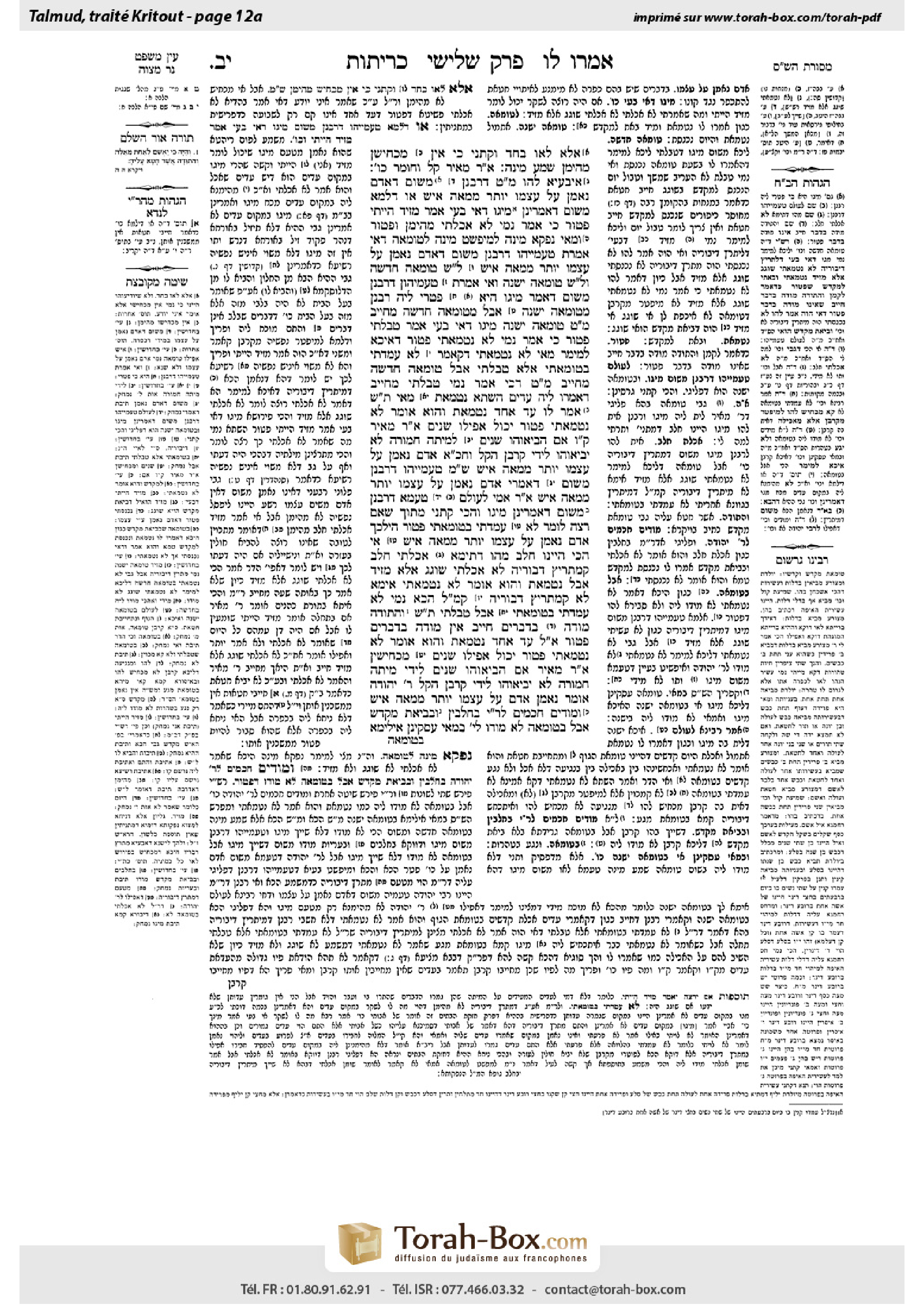
Keritot 12a: Talmud study for Daf Yomi
Daf Yomi is the daily study of one Talmud folio. Explore 37 tractates with scans, Hebrew text, Sefaria English and AI-generated French translations where annotated.
Passage selection and English or AI-generated French translation are available where the scan has annotations. Daf Study is independent of Torah-Box and Sefaria.
Browse Keritot · כריתות · All tractatesKeritot 12a text and translations
This page of Keritot includes the Aramaic text, an English translation and an AI-generated French translation, alongside the scan above.
כריתות י״ב א · Aramaic and Hebrew text
אֶלָּא לָאו בְּחַד, וְקָתָנֵי כִּי אֵין מַכְחִישָׁן מְהֵימַן, שְׁמַע מִינָּה.
אָמַר רַבִּי מֵאִיר: קַל וָחוֹמֶר.
אִבַּעְיָא לְהוּ: מַאי טַעְמַיְיהוּ דְּרַבָּנַן, מִשּׁוּם דְּאָדָם נֶאֱמָן עַל עַצְמוֹ יוֹתֵר מִמֵּאָה אִישׁ, אוֹ דִּלְמָא מִשּׁוּם דְּאָמְרִינַן: מִיגּוֹ דְּאִי בָּעֵי אָמַר ״מֵזִיד הָיִיתִי״ – פָּטוּר, כִּי אָמַר נָמֵי ״לֹא אָכַלְתִּי״ – מְהֵימַן וּפָטוּר?
וּמַאי נָפְקָא מִינָּה? לְמִיפְשַׁט מִינַּהּ לְטוּמְאָה, דְּאִי אָמְרַתְּ טַעְמַיְיהוּ דְּרַבָּנַן מִשּׁוּם דְּאָדָם נֶאֱמָן עַל עַצְמוֹ יוֹתֵר מִמֵּאָה אִישׁ – לָא שְׁנָא טוּמְאָה חֲדָשָׁה וְלָא שְׁנָא טוּמְאָה יְשָׁנָה.
וְאִי אָמְרַתְּ טַעְמֵיהוֹן דְּרַבָּנַן מִשּׁוּם דְּאָמַר ״מִיגּוֹ״ הִיא – פָּטְרִי לֵיהּ רַבָּנַן מִטּוּמְאָה יְשָׁנָה, אֲבָל מִטּוּמְאָה חֲדָשָׁה מִחַיַּיב. מַאי טַעְמָא? טוּמְאָה יְשָׁנָה, מִיגּוֹ דְּאִי בָּעֵי אָמַר ״טָבַלְתִּי״ – פָּטוּר, כִּי אָמַר נָמֵי ״לֹא נִטְמֵאתִי״ – פָּטוּר, דְּאִיכָּא לְמֵימַר: מַאי ״לֹא נִטְמֵאתִי״ דְּקָאָמַר – לֹא עָמַדְתִּי בְּטוּמְאָתִי אֶלָּא טָבַלְתִּי.
אֲבָל טוּמְאָה חֲדָשָׁה – מִחַיַּיב, מַאי טַעְמָא? דְּכִאי אָמַר נָמֵי ״טָבַלְתִּי״ – מִחַיַּיב, דְּאָמְרוּ לֵיהּ עֵדִים: הַשְׁתָּא נִטְמֵאתָ.
מַאי? תָּא שְׁמַע: אָמַר לוֹ עֵד אֶחָד: נִטְמֵאתָ, וְהוּא אוֹמֵר: לֹא נִטְמֵאתִי – פָּטוּר. יָכוֹל אֲפִילּוּ שְׁנַיִם? אָמַר רַבִּי מֵאִיר: קַל וָחוֹמֶר, אִם הֱבִיאוּהוּ שְׁנַיִם לְמִיתָה חֲמוּרָה – לֹא יְבִיאוּהוּ לִידֵי קׇרְבָּן הַקַּל? וַחֲכָמִים אוֹמְרִים: אָדָם נֶאֱמָן עַל עַצְמוֹ יוֹתֵר מִמֵּאָה אִישׁ. שְׁמַע מִינַּהּ טַעְמַיְיהוּ דְּרַבָּנַן מִשּׁוּם דְּאָמְרִי: אָדָם נֶאֱמָן עַל עַצְמוֹ יוֹתֵר מִמֵּאָה אִישׁ.
אָמַר רַבִּי אַמֵּי: לְעוֹלָם טַעְמָא דְּרַבָּנַן מִשּׁוּם דְּאָמְרִינַן ״מִיגּוֹ״, וְהָכִי קָתָנֵי: מִתּוֹךְ שֶׁאִם רָצָה לוֹמַר: לֹא עָמַדְתִּי בְּטוּמְאָתִי – פָּטוּר, הִילְכָּךְ אָדָם נֶאֱמָן עַל עַצְמוֹ יוֹתֵר מִמֵּאָה אִישׁ. אִי הָכִי, הַיְינוּ חֵלֶב!
מַהוּ דְּתֵימָא: ״אָכַלְתִּי חֵלֶב״, קָמְתָרֵיץ דִּיבּוּרֵיהּ: לָא אָכַלְתִּי שׁוֹגֵג אֶלָּא מֵזִיד, אֲבָל: נִטְמֵאתָ, וְהוּא אוֹמֵר: לֹא נִטְמֵאתִי, אֵימָא לָא קָמְתָרֵיץ דִּבּוּרֵיהּ, קָא מַשְׁמַע לַן: הָכָא נָמֵי: לֹא עָמַדְתִּי בְּטוּמְאָתִי אֲבָל טָבַלְתִּי.
תָּא שְׁמַע: ״וְהִתְוַדָּה״ – מוֹדֶה בַּדְּבָרִים – חַיָּיב, אֵין מוֹדֶה בַּדְּבָרִים – פָּטוּר. אָמַר לוֹ עֵד אֶחָד: נִטְמֵאתָ, וְהוּא אוֹמֵר: לֹא נִטְמֵאתִי – פָּטוּר.
יָכוֹל אֲפִילּוּ שְׁנַיִם מַכְחִישִׁין? אָמַר רַבִּי מֵאִיר: אִם הֱבִיאוּהוּ שְׁנַיִם לִידֵי מִיתָה חֲמוּרָה, לֹא יְבִיאוּהוּ לִידֵי קׇרְבָּן הַקַּל? רַבִּי יְהוּדָה אוֹמֵר: נֶאֱמָן אָדָם עַל עַצְמוֹ יוֹתֵר מִמֵּאָה אִישׁ.
וּמוֹדִים חֲכָמִים לְרַבִּי יְהוּדָה בַּחֲלָבִין וּבְבִיאַת מִקְדָּשׁ, אֲבָל בְּטוּמְאָה – לָא מוֹדוּ לֵיהּ.
בְּמַאי עָסְקִינַן? אִילֵּימָא
Keritot 12a · English translation
Rather, isn’t the baraita referring to a case of one witness, and it teaches that when he does not contradict the testimony of the witness, the witness is deemed credible? Learn from it that one witness can render a person liable to bring a sin offering if the person does not contradict the testimony.
§ The mishna teaches that if two witnesses say that someone ate forbidden fat, and he denies it, Rabbi Meir deems him liable to bring a sin offering. Rabbi Meir said: This conclusion can be inferred a fortiori: If two witnesses could have brought him liability to receive the severe punishment of death, can they not bring him liability to sacrifice an offering, which is relatively lenient? The Rabbis said to him: Witnesses are unable to render another person liable to bring an offering contrary to his statement, as what if he wishes to say: I did so intentionally, in which case he would be exempt from bringing an offering?
A dilemma was raised before the Sages: What is the reasoning of the Rabbis, who deem him exempt from bringing an offering? Is it because they hold that a person is deemed credible about himself more than the testimony of one hundred people? Or perhaps it is because we say that since he could advance a more advantageous claim [miggo], in that if he wishes, he could say: I did so intentionally, in which case he would be exempt from bringing an offering, therefore, also when he says: I did not eat, he is deemed credible and is exempt.
The Gemara asks: And what is the practical difference between the two possibilities? The Gemara answers: The difference is whether it is possible to resolve from it the case of ritual impurity, when witnesses testify that one became ritually impure before entering the Temple, and he claims that he did not become impure. If you say that the Rabbis’ reasoning is that a person is deemed credible about himself more than the testimony of one hundred people, then it is no different if it is a case of new impurity, where they testify that he became impure the day he entered the Temple, and it is no different if it is a case of old impurity, where they testify that he became impure at some earlier date. In either case, the person’s claim that he was not impure when he entered the Temple would be deemed credible.
But if you say that the reasoning of the Rabbis is that he can say miggo, then the Rabbis would deem him exempt from the obligation to bring a sliding-scale offering in a case of old impurity, but in a case of new impurity he would be obligated to bring a sliding-scale offering. What is the reason? With regard to old impurity, since if he wishes, he could say: I immersed in a ritual bath after becoming impure and at sunset I became ritually pure, in which case he would be exempt from bringing an offering for having entered the Temple the following day, then also when he says: I did not become impure, he is exempt, as it can be said: What does he mean when he says: I did not become impure? He means: I did not remain in my state of impurity, but rather I immersed in a ritual bath.
But in a case of new impurity, he would be obligated to bring an offering. What is the reason? It is because even when he says: I immersed in a ritual bath, he would be obligated to bring an offering if he entered the Temple, as the witnesses would say to him: You became impure just now, and you could not have purified yourself in the meantime.
What, then, is the reasoning of the Rabbis? The Gemara suggests: Come and hear a baraita: If one witness said to a person: You became impure, and he says: I did not become impure, he is exempt from bringing an offering. One might have thought this is the halakha even where two witnesses said this. Rabbi Meir said: This conclusion can be inferred a fortiori: If two witnesses could have brought him liability to receive the severe punishment of death, can they not bring him liability to bring an offering, which is relatively lenient? And the Rabbis say: A person is deemed credible about himself more than the testimony of one hundred people. The Gemara explains its suggestion: Learn from the baraita that the reasoning of the Rabbis is that they say that a person is deemed credible about himself more than the testimony of one hundred people.
Rabbi Ami said: Actually, the Rabbis’ reasoning is that we say miggo, and this is what it is teaching: Since if he wished to say: I did not remain in my state of impurity but rather I immersed, then he would be exempt, therefore a person is deemed credible about himself more than the testimony of one hundred people. The Gemara asks: If so, this case is identical to that of eating forbidden fat, which the mishna already discussed.
The Gemara explains that the baraita mentions the case of ritual impurity lest you say the following: When he says: I did not eat forbidden fat, he may explain his statement to mean: I did not eat forbidden fat unwittingly but intentionally, and I am therefore not obligated to bring an offering. But if two witnesses say: You have become impure, and he says: I have not become impure, one might say that he cannot explain his statement in a manner that would exempt him, as it makes no difference whether he became impure unwittingly or intentionally. Therefore, the baraita teaches us that here too, he can explain his statement in a different manner: I did not remain in my state of impurity, but rather I immersed, and he is therefore not obligated to bring an offering.
The Gemara suggests: Come and hear an explanation of the opinion of the Rabbis from another baraita, which discusses the case of the defiling of the Temple, by entering it while ritually impure, or its sacrificial foods, by partaking of them while ritually impure one who enters the Temple or eats sacred foods in a state of ritual impurity: The Torah states: “And it shall be, when he shall be guilty of one of these things, that he shall confess…and he shall bring…for a sin offering” (Leviticus 5:5–6). This verse indicates that only one who confesses to sinning is liable to bring a sin offering, whereas one who does not confess is exempt from bringing a sin offering. If one witness said to him: You have become impure, and he says: I have not become impure, he is exempt from bringing a sin offering.
One might have thought even in a case where two witnesses contradict him, he is exempt from bringing an offering. Rabbi Meir said: If two witnesses could have brought him liability to receive the severe punishment of death, can they not bring him liability to bring an offering, which is relatively lenient? Rabbi Yehuda says: A person is deemed credible about himself more than the testimony of one hundred people.
The baraita continues: And the Rabbis, whose opinion is cited in the mishna, concede to Rabbi Yehuda with regard to denying the accusation of two witnesses that he ate forbidden fats, or with regard to entering the Temple in a state of impurity, that if the person says that he did not eat the fats or enter the Temple, he is deemed credible. But with regard to ritual impurity, where witnesses say that he entered the Temple or ate sanctified food while impure and he says that he entered the Temple or ate the sanctified food but he was not impure, they do not concede to him; rather, they accept the opinion of Rabbi Meir that the testimony of two witnesses renders him obligated to bring an offering despite the fact that he denies that he transgressed.
The Gemara asks: What type of impurity are we dealing with? If we say
Keritot 12a · Traduction française (IA)
Mais la baraïta ne parle-t-elle pas plutôt du cas d’un seul témoin, et n’enseigne-t-elle pas que, lorsqu’il ne contredit pas le témoignage de ce témoin, celui-ci est réputé digne de foi ? Apprends-en qu’un seul témoin peut rendre une personne passible d’apporter un sacrifice expiatoire si elle ne contredit pas son témoignage.
§ La Michna enseigne que si deux témoins affirment qu’une personne a consommé du suif interdit et qu’elle le nie, Rabbi Méïr la juge tenue d’apporter un sacrifice expiatoire. Rabbi Méïr dit : On peut déduire cette conclusion a fortiori : si deux témoins ont pu la rendre passible de la peine sévère de mort, ne peuvent-ils pas la rendre tenue d’apporter un sacrifice, qui est relativement moins grave ? Les Sages lui répondirent : Des témoins ne peuvent pas rendre une personne tenue d’apporter un sacrifice à l’encontre de ses propres déclarations, car que se passerait-il si elle voulait dire : « Je l’ai fait intentionnellement », auquel cas elle serait dispensée d’apporter un sacrifice ?
Un dilemme fut soumis aux Sages : quel est le raisonnement des Sages, qui la dispensent d’apporter un sacrifice ? Est-ce parce qu’ils considèrent qu’une personne est plus crédible au sujet de sa propre personne que cent personnes témoignant contre elle ? Ou bien est-ce parce que nous disons que, puisqu’elle pourrait avancer un argument plus avantageux [miggo] — car si elle le voulait, elle pourrait dire : « Je l’ai fait intentionnellement », auquel cas elle serait dispensée d’apporter un sacrifice —, elle est également réputée digne de foi et dispensée lorsqu’elle dit : « Je n’ai pas mangé » ?
La Guemara demande : Quelle est la différence pratique entre ces deux possibilités ? La Guemara répond : La différence concerne la possibilité de déduire de ce cas la règle applicable à l’impureté rituelle, lorsque des témoins attestent qu’une personne est devenue rituellement impure avant d’entrer dans le Temple, et qu’elle affirme ne pas être devenue impure. Si tu dis que le raisonnement des Sages est qu’une personne est plus crédible au sujet de sa propre personne que cent personnes témoignant contre elle, alors il n’y a pas de différence entre le cas d’une impureté récente, où les témoins attestent qu’elle est devenue impure le jour où elle est entrée dans le Temple, et celui d’une impureté ancienne, où ils attestent qu’elle est devenue impure à une date antérieure. Dans les deux cas, son affirmation selon laquelle elle n’était pas impure lorsqu’elle est entrée dans le Temple serait réputée digne de foi.
Mais si tu dis que le raisonnement des Sages tient au fait qu’elle peut invoquer le miggo, alors ils la dispenseraient d’apporter un sacrifice à offrande variable dans le cas d’une impureté ancienne, mais, dans le cas d’une impureté récente, elle serait tenue d’apporter un sacrifice à offrande variable. Pour quelle raison ? Dans le cas d’une impureté ancienne, puisqu’elle pourrait, si elle le voulait, dire : « Après être devenue impure, je me suis immergée dans un mikvé et, au coucher du soleil, je suis redevenue rituellement pure », auquel cas elle serait dispensée d’apporter un sacrifice pour être entrée dans le Temple le lendemain, elle est également dispensée lorsqu’elle dit : « Je ne suis pas devenue impure ». On peut en effet comprendre qu’elle veut dire : « Je ne suis pas restée dans mon état d’impureté, mais je me suis immergée dans un mikvé. »
Mais dans le cas d’une impureté récente, elle serait tenue d’apporter un sacrifice. Pour quelle raison ? Parce que même si elle dit : « Je me suis immergée dans un mikvé », elle serait tenue d’apporter un sacrifice si elle était entrée dans le Temple, car les témoins lui diraient : « Tu es devenue impure à l’instant et tu n’as pas pu te purifier entre-temps. »
Quel est donc le raisonnement des Sages ? La Guemara propose : Viens et entends une baraïta : Si un témoin dit à une personne : « Tu es devenue impure », et qu’elle répond : « Je ne suis pas devenue impure », elle est dispensée d’apporter un sacrifice. On aurait pu penser que telle est la halakha même lorsque deux témoins l’affirment. Rabbi Méïr dit : On peut déduire cette conclusion a fortiori : si deux témoins ont pu la rendre passible de la peine sévère de mort, ne peuvent-ils pas la rendre tenue d’apporter un sacrifice, qui est relativement moins grave ? Et les Sages disent : Une personne est plus crédible au sujet de sa propre personne que cent personnes témoignant contre elle. La Guemara explique la suggestion : Apprends de la baraïta que le raisonnement des Sages est qu’une personne est plus crédible au sujet de sa propre personne que cent personnes témoignant contre elle.
Rabbi Ami dit : En réalité, le raisonnement des Sages tient au miggo, et voici ce que la baraïta enseigne : puisqu’elle pourrait, si elle le voulait, dire : « Je ne suis pas restée dans mon état d’impureté, mais je me suis immergée », auquel cas elle serait dispensée, une personne est donc plus crédible au sujet de sa propre personne que cent personnes témoignant contre elle. La Guemara demande : Si c’est ainsi, ce cas est identique à celui de la consommation de suif interdit, déjà traité par la Michna.
La Guemara explique que la baraïta mentionne le cas de l’impureté rituelle afin d’éviter qu’on dise ceci : lorsqu’une personne dit : « Je n’ai pas mangé de suif interdit », elle peut préciser que ses paroles signifient : « Je n’ai pas mangé de suif interdit par inadvertance, mais intentionnellement, et je ne suis donc pas tenue d’apporter un sacrifice. » Mais si deux témoins disent : « Tu es devenue impure », et qu’elle répond : « Je ne suis pas devenue impure », on pourrait dire qu’elle ne peut pas préciser ses paroles d’une manière qui la dispenserait, puisqu’il importe peu qu’elle soit devenue impure par inadvertance ou intentionnellement. La baraïta nous enseigne donc qu’ici aussi, elle peut préciser autrement ses paroles : « Je ne suis pas restée dans mon état d’impureté, mais je me suis immergée », et elle n’est donc pas tenue d’apporter un sacrifice.
La Guemara propose : Viens et entends une explication de l’opinion des Sages à partir d’une autre baraïta, qui traite de la profanation du Temple — lorsqu’une personne y entre à l’état d’impureté rituelle — ou de ses aliments sacrificiels — lorsqu’une personne les consomme à l’état d’impureté rituelle. La Torah dit : « Et il arrivera, lorsqu’il sera coupable de l’une de ces choses, qu’il confessera… et il apportera… en sacrifice expiatoire » (Lévitique 5, 5-6). Ce verset indique que seul celui qui confesse avoir péché est tenu d’apporter un sacrifice expiatoire, tandis que celui qui ne confesse pas l’avoir fait en est dispensé. Si un témoin lui dit : « Tu es devenu impur », et qu’il répond : « Je ne suis pas devenu impur », il est dispensé d’apporter un sacrifice expiatoire.
On aurait pu penser que même si deux témoins le contredisent, il est dispensé d’apporter un sacrifice. Rabbi Méïr dit : Si deux témoins ont pu le rendre passible de la peine sévère de mort, ne peuvent-ils pas le rendre tenu d’apporter un sacrifice, qui est relativement moins grave ? Rabbi Yehouda dit : Une personne est plus crédible au sujet de sa propre personne que cent personnes témoignant contre elle.
La baraïta poursuit : Les Sages, dont l’opinion est citée dans la Michna, reconnaissent à Rabbi Yehouda, lorsqu’il s’agit de nier l’accusation de deux témoins selon laquelle une personne a consommé du suif interdit, ou qu’elle est entrée dans le Temple à l’état d’impureté, que si elle affirme ne pas avoir consommé le suif ni être entrée dans le Temple, elle est réputée digne de foi. Mais, concernant l’impureté rituelle, lorsque des témoins disent qu’elle est entrée dans le Temple ou a consommé des aliments sacrés alors qu’elle était impure, et qu’elle affirme être entrée dans le Temple ou avoir consommé ces aliments sans être impure, les Sages ne lui donnent pas raison ; ils retiennent plutôt l’opinion de Rabbi Méïr, selon laquelle le témoignage de deux témoins la rend tenue d’apporter un sacrifice, bien qu’elle nie avoir transgressé.
La Guemara demande : De quel type d’impureté s’agit-il ? Si nous disons
Traduction française générée par IA à partir de l’édition anglaise de Sefaria. Vérifie toujours un passage avec le texte source.
Text from Sefaria: William Davidson Edition - Vocalized Aramaic (CC BY NC); William Davidson Edition - English (CC BY NC).