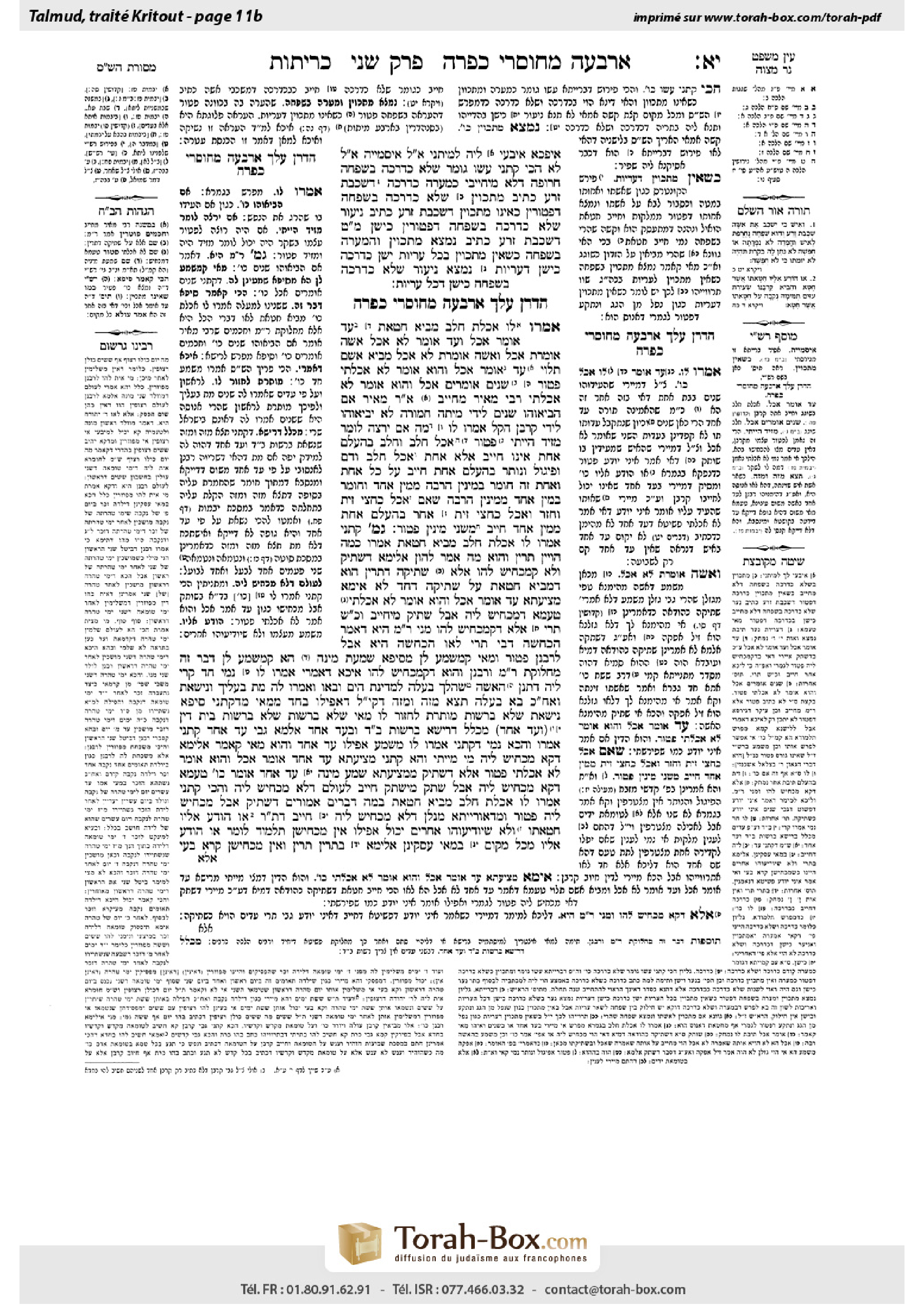
Keritot 11b: Talmud study for Daf Yomi
Daf Yomi is the daily study of one Talmud folio. Explore 37 tractates with scans, Hebrew text, Sefaria English and AI-generated French translations where annotated.
Passage selection and English or AI-generated French translation are available where the scan has annotations. Daf Study is independent of Torah-Box and Sefaria.
Browse Keritot · כריתות · All tractatesKeritot 11b text and translations
This page of Keritot includes the Aramaic text, an English translation and an AI-generated French translation, alongside the scan above.
כריתות י״א ב · Aramaic and Hebrew text
אִיפְּכָא אִיבְּעִי לֵיהּ לְמִיתְנֵי!
אֲמַר לֵיהּ: אִיסְמְיַיהּ? אֲמַר לֵיהּ: לָא, הָכִי קָתָנֵי: עָשׂוּ גּוֹמֵר שֶׁלֹּא כְּדַרְכָּהּ בְּשִׁפְחָה חֲרוּפָה, דְּלָא מִיחַיְּיבִי, כִּמְעָרֶה כְּדַרְכָּהּ, דְּ״שִׁכְבַת זֶרַע״ כְּתִיב.
מִתְכַּוֵּין שֶׁלֹּא כְּדַרְכָּהּ בְּשִׁפְחָה, דִּפְטוּרִין כְּאֵינוֹ מִתְכַּוֵּין, דְּ״שִׁכְבַת זֶרַע״ כְּתִיב. נֵיעוֹר שֶׁלֹּא כְּדַרְכָּהּ בְּשִׁפְחָה, דִּפְטוּרִין כְּיָשֵׁן, מַאי טַעְמָא? דְּ״שִׁכְבַת זֶרַע״ כְּתִיב.
נִמְצָא מִתְכַּוֵּין וְהַמְעָרֶה בְּשִׁפְחָה, כְּשֶׁאֵין מִתְכַּוֵּין בְּכׇל עֲרָיוֹת. יָשֵׁן כְּדַרְכָּהּ – כְּיָשֵׁן דַּעֲרָיוֹת, נִמְצָא נֵיעוֹר שֶׁלֹּא כְּדַרְכָּהּ בְּשִׁפְחָה – כְּיָשֵׁן דְּכׇל עֲרָיוֹת.
הֲדַרַן עֲלָךְ אַרְבָּעָה מְחוּסְּרֵי כַּפָּרָה
מַתְנִי׳ אָמְרוּ לוֹ: אָכַלְתָּ חֵלֶב – מֵבִיא חַטָּאת. עֵד אוֹמֵר: אָכַל, וְעֵד אוֹמֵר: לֹא אָכַל, אִשָּׁה אוֹמֶרֶת: אָכַל, וְאִשָּׁה אוֹמֶרֶת: לֹא אָכַל – מֵבִיא אָשָׁם תָּלוּי. עֵד אוֹמֵר: אָכַל, וְהוּא אוֹמֵר: לֹא אָכַלְתִּי – פָּטוּר.
שְׁנַיִם אוֹמְרִים: אָכַל, וְהוּא אוֹמֵר: לֹא אָכַלְתִּי – רַבִּי מֵאִיר מְחַיֵּיב. אָמַר רַבִּי מֵאִיר: אִם הֱבִיאוּהוּ שְׁנַיִם לִידֵי מִיתָה חֲמוּרָה, לֹא יְבִיאוּהוּ לִידֵי קׇרְבָּן הַקַּל? אָמְרוּ לוֹ: מָה אִם יִרְצֶה לוֹמַר ״מֵזִיד הָיִיתִי״ – פָּטוּר.
אָכַל חֵלֶב וְחֵלֶב בְּהֶעְלֵם (אַחַת) [אֶחָד] – אֵינוֹ חַיָּיב אֶלָּא אַחַת. אָכַל חֵלֶב וָדָם וּפִיגּוּל וְנוֹתָר בְּהֶעְלֵם (אַחַת) [אֶחָד] – חַיָּיב עַל כׇּל אַחַת וְאַחַת. זֶה חוֹמֶר בְּמִינִין הַרְבֵּה מִמִּין אֶחָד.
וְחוֹמֶר בְּמִין אֶחָד מִמִּינִין הַרְבֵּה, שֶׁאִם אָכַל כַּחֲצִי זַיִת וְחָזַר וְאָכַל כַּחֲצִי זַיִת אַחֵר בְּהֶעְלֵם אֶחָד, מִמִּין אֶחָד – חַיָּיב, מִשְּׁנֵי מִינִין – פָּטוּר.
גְּמָ׳ קָתָנֵי: אָמְרוּ לוֹ ״אָכַלְתָּ חֵלֶב״ – מֵבִיא חַטָּאת. אָמְרוּ כְּמָה הָוְיָין? תְּרֵין. וְהוּא מָה אָמַר לְהוֹן? אִלֵּימָא דְּשָׁתֵיק וְלָא קָמַכְחֵישׁ לְהוּ, אֶלָּא שְׁתִיקָה דִּתְרֵין הוּא דְּמֵבִיא חַטָּאת, עַל שְׁתִיקָה דְּחַד – לָא.
אֵימָא מְצִיעֲתָא, עֵד אוֹמֵר: אָכַל, וְהוּא אוֹמֵר: לֹא אָכַלְתִּי. טַעְמָא דְּמַכְחִישׁ לֵיהּ, אֲבָל שָׁתֵיק – מִיחַיַּיב, וְכׇל שֶׁכֵּן תְּרֵי!
אֶלָּא: דְּקָמַכְחֵישׁ לְהוּ, מַנִּי – רַבִּי מֵאִיר הִיא, דְּאָמַר: הַכְחָשָׁה דְּבֵי תְרֵי לָאו הַכְחָשָׁה הִיא, אֲבָל לְרַבָּנַן, פָּטוּר.
וּמַאי קָמַשְׁמַע לַן? מִסֵּיפָא שָׁמְעַתְּ מִינַּהּ! הָא קָמַשְׁמַע לַן: דָּבָר זֶה מַחְלוֹקֶת רַבִּי מֵאִיר וְרַבָּנַן, וְהוּא דְּקָמַכְחֵישׁ לְהוּ.
אִיכָּא דְאָמְרִי: ״אָמְרוּ לוֹ״ נָמֵי חַד קָרֵי לֵיהּ, דִּתְנַן: הָאִשָּׁה שֶׁהָלַךְ בַּעְלָהּ לִמְדִינַת הַיָּם וּבָאוּ וְאָמְרוּ לָהּ מֵת בַּעֲלִיךְ וְנִישֵּׂאת וְאַחַר כָּךְ בָּא בַּעְלָהּ – תֵּצֵא מִזֶּה וּמִזֶּה, דְּקַיְימָא לַן דַּאֲפִילּוּ בְּחַד.
מִמַּאי? מִדְּקָתָנֵי סֵיפָא: נִישֵּׂאת שֶׁלֹּא בִּרְשׁוּת – מוּתֶּרֶת לַחְזוֹר לוֹ. מַאי שֶׁלֹּא בִּרְשׁוּת – שֶׁלֹּא בִּרְשׁוּת בֵּית דִּין וְעֵד אֶחָד,
מִכְּלָל דְּרֵישָׁא, בִּרְשׁוּת בֵּית דִּין וּבְעֵד אֶחָד. אַלְמָא גַּבֵּי עֵד אֶחָד קָתָנֵי ״אָמְרוּ״, וְהָכָא נָמֵי דְּקָתָנֵי ״אָמְרוּ לוֹ״, מַשְׁמַע אֲפִילּוּ עֵד אֶחָד.
וְהוּא, מַאי קָאָמַר? אִלֵּימָא דְּקָא מַכְחֵישׁ לֵיהּ, מִי מַיְיתֵי? וְהָא קָתָנֵי מְצִיעֲתָא: עֵד אֶחָד אוֹמֵר: אָכַל, וְהוּא אוֹמֵר לֹא אָכַלְתִּי – פָּטוּר!
אֶלָּא דְּשָׁתֵיק, מִמְּצִיעֲתָא שְׁמַע מִינַּהּ: עֵד אֶחָד אוֹמֵר: כּוּ׳. טַעְמָא דְּקָא מַכְחֵישׁ לֵיהּ, אֲבָל שָׁתֵק מִישְׁתָּק – חַיָּיב!
לְעוֹלָם דְּלָא מַכְחֵישׁ לֵיהּ, וְהָכִי קָתָנֵי: אָמְרוּ לוֹ: אָכַלְתָּ חֵלֶב – מֵבִיא חַטָּאת. בַּמֶּה דְבָרִים אֲמוּרִים: דְּשָׁתֵיק, אֲבָל מַכְחֵישׁ לֵיהּ – פָּטוּר.
וּמִדְּאוֹרָיְיתָא מְנָלַן דְּלָא מַכְחֵישׁ לֵיהּ חַיָּיב? דְּתָנוּ רַבָּנַן: ״אוֹ הוֹדַע אֵלָיו חַטָּאתוֹ״ – וְלֹא שֶׁיּוֹדִיעוּהוּ אֲחֵרִים. יָכוֹל אֲפִילּוּ אֵין מַכְחִישָׁן? תַּלְמוּד לוֹמַר: ״אוֹ הוֹדַע אֵלָיו״ – מִכׇּל מָקוֹם.
בְּמַאי עָסְקִינַן? אִלֵּימָא בִּתְרֵין, תְּרֵין וְאֵין מַכְחִישָׁן קְרָא בָּעֵי?
Keritot 11b · English translation
It should teach the opposite, i.e., it should say: They made one who engages in the initial stage of intercourse like one who completes the act, as it is obvious that one who completes the act is liable.
The tanna said to Rav Sheshet: Should I remove this baraita, as it is apparently corrupted? Rav Sheshet said to him: No; do not remove the baraita, as this is what it is teaching: The Sages rendered one who completes an atypical act of intercourse with an espoused maidservant, for which he is not liable, like one who engages in the initial stage of intercourse with her in the typical manner, for which he is also exempt. They derived this from the fact that it is written: “Lies carnally.”
Similarly, they rendered one who engages intentionally in atypical intercourse with a maidservant, for which they are both exempt, like one who does so in a typical manner unintentionally, as it is written: “Lies carnally.” And they also rendered one who engages in intercourse in an atypical manner with an espoused maidservant while he is awake, for which they are both exempt, like one who does so while sleeping. What is the reason? They derived this from the fact that it is written: “Lies carnally.”
The Gemara concludes: It has been determined that one who engages in intercourse intentionally or engages in the initial stage of intercourse with an espoused maidservant is like one who does so unintentionally with all those with whom relations are forbidden, meaning that he is exempt. Similarly, one who engages in intercourse with an espoused maidservant in a typical manner while sleeping is like one who does so, while sleeping, with all those others with whom relations are forbidden, and he is likewise exempt. Furthermore, it has also been determined that one who engages in atypical intercourse with an espoused maidservant while awake is like one who does so with all those with whom relations are forbidden, while sleeping, and he is also exempt.
MISHNA: If witnesses said to a person: We saw that you ate forbidden fat, he is liable to bring a sin offering if he did so unwittingly. If a witness says: He ate forbidden fat, and a witness says: He did not eat forbidden fat, or if a woman says: He ate forbidden fat, and a woman says: He did not eat forbidden fat, he is liable to bring a provisional guilt offering, brought by one who is uncertain as to whether he committed a sin that requires a sin offering. If a witness says: He ate forbidden fat, and the person himself says: I did not eat forbidden fat, he is exempt.
If two witnesses say: He ate forbidden fat, and the person himself says: I did not eat forbidden fat, Rabbi Meir deems him liable to bring a sin offering. Rabbi Meir said: This conclusion can be derived a fortiori: If two witnesses could have brought him liability to receive the severe punishment of death, can they not bring him liability to sacrifice an offering, which is relatively lenient? The Rabbis said to him: Witnesses are unable to render another person liable to bring an offering contrary to his statement, as what if he wishes to say: I did so intentionally, in which case he would be exempt from bringing an offering?
If one unwittingly ate an olive-bulk of forbidden fat and then ate another olive-bulk of forbidden fat during one lapse of awareness, i.e., in a case where he did not discover in the interim that fat is forbidden, or that the food he is eating is forbidden fat, he is liable to bring only one sin offering. If one ate forbidden fat, and blood, and piggul, and notar in one lapse of awareness, he is liable to bring a sin offering for each and every one of them. This is a stringency that applies to one who eats several types of forbidden food and does not apply to one who eats one type of forbidden food.
And a stringency that applies to one who eats one type of forbidden food and not to one who eats several types of forbidden food is that if one ate half an olive-bulk and then ate another half an olive-bulk during one lapse of awareness, in a case where they were both from one type of forbidden food, he is liable to bring a sin offering. If they were from two types, he is exempt, because he did not eat an olive-bulk of any specific forbidden food.
GEMARA: The mishna teaches: If witnesses said to him: You ate forbidden fat, he is liable to bring a sin offering. The Gemara analyzes the first clause of the mishna: Since the mishna employs the plural form of the word said, how many witnesses are involved in the case? There must be at least two witnesses. And what does he say to them in response? If we say that he is silent and does not contradict them, then it may be inferred that it is only when he responds with silence in response to the claim of two witnesses that he brings a sin offering, but for silence in response to the claim of one witness, he does not bring a sin offering.
But say the middle clause: If a witness says that he ate forbidden fat, and the person himself says: I did not eat it, he is exempt. The Gemara infers: The reason that he is exempt is that he contradicts him. But if he is silent, he is liable, and all the more so if he is silent when two witnesses claim that he ate forbidden fat. This contradicts the inference from the first clause that silence in response to one witness does not render one liable to bring a sin offering.
Rather, the first clause is referring to a case where he contradicts the claim of the two witnesses. Whose opinion is this? It is that of Rabbi Meir, who says in the continuation of the mishna that the person’s contradiction of the testimony of two witnesses is not considered a contradiction, and he is liable to bring a sin offering. But according to the opinion of the Rabbis, he is exempt.
The Gemara asks: And according to this answer, what does the tanna teach us in the first clause? From the latter clause you already learn that according to Rabbi Meir, one is liable to bring a sin offering as a result of the testimony of two witnesses, even if he contradicts them. The Gemara answers: The latter clause is clarifying the first clause, and this is what it teaches us: This matter that was stated in the first clause is actually the subject of a dispute between Rabbi Meir and the Rabbis, and that dispute pertains to a case where he contradicts their testimony.
Some say a different explanation of the first clause: The case is where only one witness asserts that the individual ate forbidden fat, and occasionally the plural verb form in the expression: Witnesses said to him, can also be used to refer to one witness. As we learned in a mishna (Yevamot 87b): With regard to a woman whose husband went overseas, and witnesses came and said to her: Your husband died, and she married another man on the basis of this testimony, and afterward her husband came back, she must leave both this man, her first husband, and that one, whom she married subsequently. This mishna indicates that the plural expression can be used in the case of a single witness, as we maintain that this mishna is referring even to a case where one witness testified that her husband died.
From where is this inferred? It is inferred from the fact that the latter clause of that mishna teaches: If she married without consent and then her first husband returned, she is permitted to return to him. What does the mishna mean when it states that she remarried without consent? It means she remarried without the consent of the court, which would be granted based on the testimony of one witness. Rather, two witnesses testified that her husband had died. Since that is full-fledged halakhic testimony, she is permitted to remarry independently, even without the explicit consent of the court.
By inference, one may conclude that the first clause is referring to a case where she married with the consent of the court and on the basis of the testimony of one witness. Evidently, that mishna teaches the plural form of the word: Said, when it is referring to one witness, and here, too, in this mishna where it teaches the phrase: Witnesses said to him, it indicates that even one witness renders one liable to bring a sin offering.
The Gemara asks: And what does he say in response to the witness? If we say that he contradicts the witness, does he bring an offering? But doesn’t the middle clause teach: If a witness says: He ate forbidden fat, and the person himself says: I did not eat forbidden fat, he is exempt?
Rather, if it is referring to a case where he is silent, the clause is unnecessary, as one can learn this halakha from the middle clause, which states: If a witness says: He ate forbidden fat, and the person himself says: I did not eat forbidden fat, he is exempt from bringing a sin offering. This indicates that the reason he is exempt is that he contradicts the witness, but if he was silent, he is liable to bring a sin offering.
The Gemara rejects this reasoning: Actually, the first clause of the mishna is referring to a case where he does not contradict the witness but remains silent. And this is what the mishna is teaching: If they, i.e., even one witness, said to him: You ate forbidden fat, he is liable to bring a sin offering. The middle clause then clarifies: In what case is this statement said? It is said where he was silent in response to this accusation, but if he contradicts the witness, he is exempt.
The Gemara asks: And from where do we derive that by Torah law that if he does not contradict the witness, he is liable to bring a sin offering? It is as the Sages taught in a baraita with regard to a verse that deals with a sin offering: “Or if his sin is known to him” (Leviticus 4:28), that this is referring to a case where he found out himself but not a case where others informed him of his sin. One might have thought he is exempt even if he does not contradict the claim of the witness. Therefore, the verse states: “Or if his sin is known to him,” which teaches that in any case where he knows that he sinned, even if others informed him of it, he is liable. He is exempt only if he denies it.
The Gemara asks: What are we dealing with, in the case where he is informed by others? If we say that it is referring to two witnesses who inform him, in a case where two witnesses testify and he does not contradict them does one need a verse to render him liable?
Keritot 11b · Traduction française (IA)
Il aurait fallu enseigner le contraire, c’est-à-dire dire : Ils ont assimilé celui qui s’engage dans le début d’un rapport sexuel à celui qui va jusqu’au bout de l’acte, puisque, de toute évidence, celui qui va jusqu’au bout est passible.
Le tanna demanda à Rav Sheshet : Dois-je écarter cette baraïta, puisqu’elle semble corrompue ? Rav Sheshet lui répondit : Non, n’écarte pas la baraïta, car voici ce qu’elle enseigne : Les Sages ont assimilé celui qui accomplit un rapport sexuel atypique avec une servante fiancée — acte pour lequel il n’est pas passible — à celui qui s’engage avec elle dans un rapport sexuel typique, mais seulement au début — acte pour lequel il est également exempt. Ils l’ont déduit du fait qu’il est écrit : « A une relation charnelle. »
De même, ils ont assimilé celui qui a intentionnellement un rapport atypique avec une servante — cas où tous deux sont exempts — à celui qui le fait involontairement de manière typique, comme il est écrit : « A une relation charnelle. » Ils ont également assimilé celui qui a un rapport atypique avec une servante fiancée alors qu’il est éveillé — cas où tous deux sont exempts — à celui qui le fait en dormant. Quelle en est la raison ? Ils l’ont déduit du fait qu’il est écrit : « A une relation charnelle. »
La Guemara conclut : Il a été établi que celui qui a intentionnellement un rapport sexuel avec une servante fiancée, ou qui s’engage avec elle au début d’un rapport, est assimilé à celui qui agit involontairement avec toutes les personnes avec lesquelles les relations sont interdites, c’est-à-dire qu’il est exempt. De même, celui qui a un rapport sexuel typique avec une servante fiancée en dormant est assimilé à celui qui agit en dormant avec toutes les autres personnes avec lesquelles les relations sont interdites, et il est lui aussi exempt. En outre, il a également été établi que celui qui a un rapport atypique avec une servante fiancée alors qu’il est éveillé est assimilé à celui qui agit en dormant avec toutes les personnes avec lesquelles les relations sont interdites, et il est lui aussi exempt.
MICHNA : Si des témoins disent à quelqu’un : « Nous t’avons vu manger du suif interdit », il est tenu d’apporter un sacrifice expiatoire s’il l’a fait par inadvertance. Si un témoin dit : « Il a mangé du suif interdit », et qu’un témoin dit : « Il n’a pas mangé de suif interdit », ou si une femme dit : « Il a mangé du suif interdit », et qu’une femme dit : « Il n’a pas mangé de suif interdit », il est tenu d’apporter un sacrifice de culpabilité provisoire, que doit apporter celui qui ne sait pas avec certitude s’il a commis une faute exigeant un sacrifice expiatoire. Si un témoin dit : « Il a mangé du suif interdit », et que l’intéressé dit lui-même : « Je n’ai pas mangé de suif interdit », il est exempt.
Si deux témoins disent : « Il a mangé du suif interdit », et que l’intéressé dit lui-même : « Je n’ai pas mangé de suif interdit », Rabbi Meïr le déclare tenu d’apporter un sacrifice expiatoire. Rabbi Meïr dit : Cette conclusion se déduit a fortiori : si deux témoins ont pu le rendre passible de la peine sévère de mort, ne peuvent-ils pas le rendre tenu d’apporter un sacrifice, peine relativement légère ? Les Sages lui répondirent : Les témoins ne peuvent pas obliger quelqu’un à apporter un sacrifice contre sa propre déclaration, car que se passerait-il s’il voulait dire : « Je l’ai fait intentionnellement », auquel cas il serait exempt d’apporter un sacrifice ?
Si quelqu’un a mangé par inadvertance un volume d’olive de suif interdit, puis un autre volume d’olive de suif interdit au cours d’une seule période d’inconscience, c’est-à-dire sans avoir appris entre-temps que le suif est interdit ou que l’aliment qu’il mange est du suif interdit, il n’est tenu d’apporter qu’un seul sacrifice expiatoire. Si quelqu’un a mangé du suif interdit, du sang, du piggoul et du notar au cours d’une seule période d’inconscience, il est tenu d’apporter un sacrifice expiatoire pour chacun d’eux. C’est une rigueur qui s’applique à celui qui mange plusieurs sortes d’aliments interdits, mais pas à celui qui mange une seule sorte d’aliment interdit.
La rigueur qui s’applique à celui qui mange une seule sorte d’aliment interdit, mais pas à celui qui en mange plusieurs sortes, est la suivante : si quelqu’un a mangé un demi-volume d’olive, puis un autre demi-volume d’olive au cours d’une seule période d’inconscience, et que les deux portions provenaient d’une seule sorte d’aliment interdit, il est tenu d’apporter un sacrifice expiatoire. Si elles provenaient de deux sortes, il est exempt, car il n’a mangé le volume d’olive d’aucun aliment interdit en particulier.
GUEMARA : La Michna enseigne : Si des témoins lui disent : « Tu as mangé du suif interdit », il est tenu d’apporter un sacrifice expiatoire. La Guemara examine la première clause de la Michna : puisque celle-ci emploie le pluriel pour le verbe « dire », combien de témoins sont concernés ? Il doit y en avoir au moins deux. Et que leur répond-il ? Si nous disons qu’il garde le silence et ne les contredit pas, on peut en déduire qu’il n’apporte un sacrifice expiatoire que lorsqu’il garde le silence face à l’accusation de deux témoins, mais qu’il n’en apporte pas s’il garde le silence face à l’accusation d’un seul témoin.
Mais considérons la clause médiane : Si un témoin dit qu’il a mangé du suif interdit, et que l’intéressé dit lui-même : « Je n’en ai pas mangé », il est exempt. La Guemara en déduit que la raison de son exemption est qu’il contredit le témoin. Mais s’il garde le silence, il est tenu d’apporter un sacrifice, à plus forte raison s’il garde le silence lorsque deux témoins affirment qu’il a mangé du suif interdit. Cela contredit la déduction tirée de la première clause, selon laquelle le silence face à un seul témoin ne rend pas quelqu’un tenu d’apporter un sacrifice expiatoire.
Il faut plutôt dire que la première clause concerne un cas où il contredit les deux témoins. De qui est-ce l’opinion ? C’est celle de Rabbi Meïr, qui dit dans la suite de la Michna que la contradiction opposée par l’intéressé au témoignage de deux témoins n’est pas considérée comme une contradiction, et qu’il est tenu d’apporter un sacrifice expiatoire. Mais selon les Sages, il est exempt.
La Guemara demande : Selon cette réponse, qu’est-ce que le tanna nous enseigne dans la première clause ? La clause finale nous apprend déjà que, selon Rabbi Meïr, on est tenu d’apporter un sacrifice expiatoire sur la foi du témoignage de deux témoins, même si on les contredit. La Guemara répond : La clause finale vient préciser la première, et voici ce qu’elle nous enseigne : le sujet évoqué dans la première clause fait en réalité l’objet d’une controverse entre Rabbi Meïr et les Sages, et cette controverse concerne un cas où l’intéressé contredit leur témoignage.
Certains donnent une autre explication de la première clause : le cas concerne un seul témoin qui affirme que l’intéressé a mangé du suif interdit ; il arrive que la forme verbale plurielle dans l’expression « des témoins lui dirent » puisse aussi désigner un seul témoin. En effet, nous avons appris dans une Michna (Yevamot 87b) : Au sujet d’une femme dont le mari est parti outre-mer, si des témoins viennent lui dire : « Ton mari est mort », et qu’elle épouse un autre homme sur la foi de ce témoignage, puis que son mari revient, elle doit quitter les deux hommes : celui-ci, son premier mari, et celui-là, qu’elle a épousé par la suite. Cette Michna indique qu’une expression au pluriel peut être employée dans le cas d’un seul témoin, puisque nous considérons que cette Michna concerne même le cas où un seul témoin a attesté la mort de son mari.
D’où le déduit-on ? On le déduit de la clause finale de cette Michna, qui enseigne : Si elle s’est remariée sans autorisation et que son premier mari revient ensuite, elle peut retourner auprès de lui. Que signifie la Michna lorsqu’elle dit qu’elle s’est remariée sans autorisation ? Cela signifie qu’elle s’est remariée sans l’autorisation du tribunal, laquelle aurait été accordée sur le témoignage d’un seul témoin. Il s’ensuit que deux témoins ont attesté la mort de son mari. Puisqu’il s’agit d’un témoignage pleinement valable selon la halakha, elle est autorisée à se remarier de sa propre initiative, même sans autorisation explicite du tribunal.
On peut en déduire que la première clause concerne un cas où elle s’est remariée avec l’autorisation du tribunal, sur la foi du témoignage d’un seul témoin. Cette Michna emploie donc la forme plurielle du verbe « dire » alors qu’elle se réfère à un seul témoin ; de même, dans cette Michna-ci, lorsqu’elle enseigne l’expression « des témoins lui dirent », cela indique que même un seul témoin rend quelqu’un tenu d’apporter un sacrifice expiatoire.
La Guemara demande : Et que répond-il au témoin ? Si nous disons qu’il le contredit, apporte-t-il un sacrifice ? Mais la clause médiane n’enseigne-t-elle pas : Si un témoin dit : « Il a mangé du suif interdit », et que l’intéressé dit lui-même : « Je n’ai pas mangé de suif interdit », il est exempt ?
Il faut plutôt dire que le cas concerne celui qui garde le silence ; cette clause est inutile, car on peut déduire cette halakha de la clause médiane, qui dit : Si un témoin dit : « Il a mangé du suif interdit », et que l’intéressé dit lui-même : « Je n’ai pas mangé de suif interdit », il est exempt d’apporter un sacrifice expiatoire. Cela indique que la raison de son exemption est qu’il contredit le témoin ; s’il avait gardé le silence, il aurait été tenu d’apporter un sacrifice expiatoire.
La Guemara rejette ce raisonnement : En réalité, la première clause de la Michna concerne le cas où il ne contredit pas le témoin, mais garde le silence. Et voici ce que la Michna enseigne : Si eux, c’est-à-dire même un seul témoin, lui disent : « Tu as mangé du suif interdit », il est tenu d’apporter un sacrifice expiatoire. La clause médiane vient alors préciser : Dans quel cas cette déclaration s’applique-t-elle ? Elle s’applique lorsqu’il a gardé le silence en réponse à cette accusation ; mais s’il contredit le témoin, il est exempt.
La Guemara demande : Et d’où déduisons-nous que, selon la Torah, s’il ne contredit pas le témoin, il est tenu d’apporter un sacrifice expiatoire ? C’est ce qu’enseignent les Sages dans une baraïta au sujet d’un verset relatif au sacrifice expiatoire : « Ou si son péché lui est connu » (Lévitique 4,28), qui vise le cas où il l’a appris de lui-même, mais non celui où d’autres l’ont informé de son péché. On aurait pu penser qu’il est exempt même s’il ne contredit pas l’affirmation du témoin. C’est pourquoi le verset dit : « Ou si son péché lui est connu », pour enseigner que dans tous les cas où il sait qu’il a péché, même si d’autres l’en ont informé, il est tenu d’apporter un sacrifice. Il n’est exempt que s’il le nie.
La Guemara demande : De quel cas s’agit-il lorsque d’autres l’informent ? Si nous disons qu’il s’agit de deux témoins qui l’informent, faut-il un verset pour le rendre passible lorsqu’ils témoignent et qu’il ne les contredit pas ?
Traduction française générée par IA à partir de l’édition anglaise de Sefaria. Vérifie toujours un passage avec le texte source.
Text from Sefaria: William Davidson Edition - Vocalized Aramaic (CC BY NC); William Davidson Edition - English (CC BY NC).