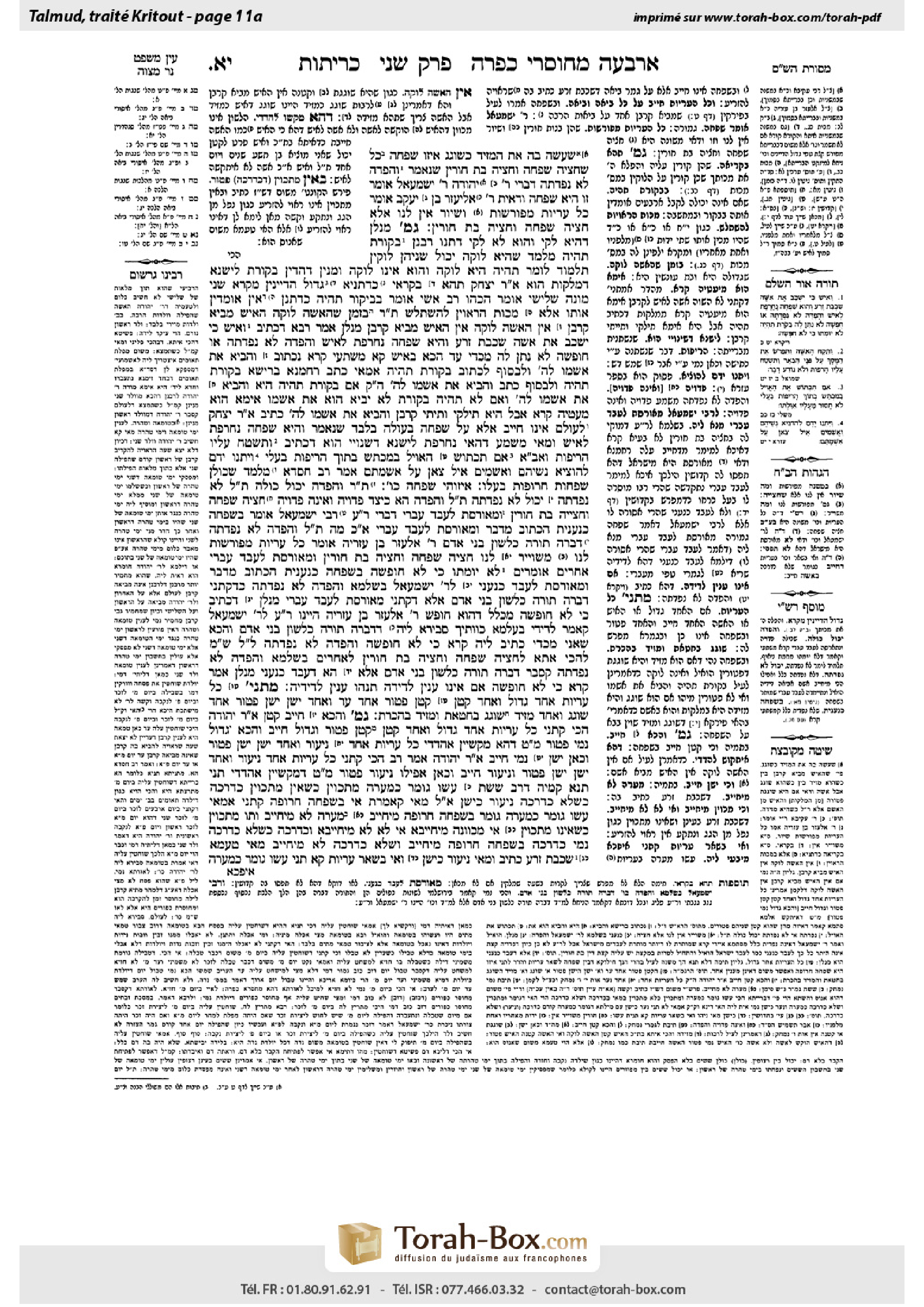
Keritot 11a: Talmud study for Daf Yomi
Daf Yomi is the daily study of one Talmud folio. Explore 37 tractates with scans, Hebrew text, Sefaria English and AI-generated French translations where annotated.
Passage selection and English or AI-generated French translation are available where the scan has annotations. Daf Study is independent of Torah-Box and Sefaria.
Browse Keritot · כריתות · All tractatesKeritot 11a text and translations
This page of Keritot includes the Aramaic text, an English translation and an AI-generated French translation, alongside the scan above.
כריתות י״א א · Aramaic and Hebrew text
שֶׁעָשָׂה בָּהּ אֶת הַמֵּזִיד כַּשּׁוֹגֵג.
אֵיזוֹ שִׁפְחָה? כֹּל שֶׁחֶצְיָהּ שִׁפְחָה וְחֶצְיָהּ בַּת חוֹרִין, שֶׁנֶּאֱמַר: ״וְהׇפְדֵּה לֹא נִפְדָּתָה״, דִּבְרֵי רַבִּי יְהוּדָה. רַבִּי יִשְׁמָעֵאל אוֹמֵר: זוֹ הִיא שִׁפְחָה וַדָּאִית. רַבִּי אֱלִיעֶזֶר בֶּן יַעֲקֹב אוֹמֵר: כׇּל עֲרָיוֹת מְפוֹרָשׁוֹת, וְשִׁיּוּר אֵין לָנוּ אֶלָּא חֶצְיָהּ שִׁפְחָה וְחֶצְיָהּ בַּת חוֹרִין.
גְּמָ׳ מְנָלַן דְּהִיא לָקְיָ[א] וְהוּא לָא לָקֵי? דְּתָנוּ רַבָּנַן: ״בִּקּוֹרֶת תִּהְיֶה״ – מְלַמֵּד שֶׁהִיא לוֹקָה. יָכוֹל שְׁנֵיהֶן לוֹקִין? תַּלְמוּד לוֹמַר: ״תִּהְיֶה״ – הִיא לוֹקֶה וְהוּא אֵינוֹ לוֹקֶה.
וּמִנַּיִן דְּהָדֵין ״בִּקּוֹרֶת״ לִישָּׁנָא דְּמַלְקוּת הוּא? אָמַר רַבִּי יִצְחָק: ״תְּהֵא בֵּקָרָאֵי״, כִּדְתַנְיָא: גְּדוֹל הַדַּיָּינִין מַקְרִא, שֵׁנִי מוֹנֶה, שְׁלִישִׁי אוֹמֵר: הַכֵּהוּ. רַב אָשֵׁי אוֹמַר: ״בְּבִיקּוּר תִּהְיֶה״, כְּדִתְנַן: אֵין אוֹמְדִין אוֹתוֹ אֶלָּא מַכּוֹת הָרְאוּיוֹת לְהִשְׁתַּלֵּשׁ.
תָּנוּ רַבָּנַן: בִּזְמַן שֶׁהָאִשָּׁה לוֹקָה – הָאִישׁ מֵבִיא קׇרְבָּן, אֵין הָאִשָּׁה לוֹקָה – אֵין הָאִישׁ מֵבִיא קׇרְבָּן. מְנָלַן? אָמַר רָבָא, דִּכְתִיב: ״וְאִישׁ כִּי יִשְׁכַּב אֶת אִשָּׁה שִׁכְבַת זֶרַע וְהִיא שִׁפְחָה נֶחֱרֶפֶת לְאִישׁ וְהׇפְדֵּה לֹא נִפְדָּתָה אוֹ חוּפְשָׁה לֹא נִתַּן לָהּ״.
מִכְּדִי עַד הָכָא בְּאִישׁ קָא מִשְׁתַּעֵי קְרָא, נִכְתּוֹב: ״וְהֵבִיא אֶת אֲשָׁמוֹ לַה׳״, וּלְבַסּוֹף לִכְתּוֹב ״בִּקּוֹרֶת תִּהְיֶה״. אַמַּאי כְּתַב רַחֲמָנָא בְּרֵישָׁא: ״בִּקּוֹרֶת תִּהְיֶה״ וּלְבַסּוֹף כְּתַב: ״וְהֵבִיא אֶת אֲשָׁמוֹ לַה׳״? הָכִי קָאָמַר: אִם בִּקּוֹרֶת תִּהְיֶה הִיא – ״וְהֵבִיא אֶת אֲשָׁמוֹ לַה׳״, וְאִם לֹא תִּהְיֶה בִּקּוֹרֶת – לֹא יָבִיא הוּא אֶת אֲשָׁמוֹ.
אֵימָא, הוּא מַעֲטֵיהּ קְרָא, אֲבָל הִיא תִּילְקֵי וְתַיְתֵי קׇרְבָּן! – ״וְהֵבִיא אֶת אֲשָׁמוֹ לַה׳״ כְּתִיב.
אָמַר רַבִּי יִצְחָק: לְעוֹלָם אֵינוֹ חַיָּיב אֶלָּא עַל שִׁפְחָה בְּעוּלָה בִּלְבָד, שֶׁנֶּאֱמַר: ״וְהִיא שִׁפְחָה נֶחֱרֶפֶת לְאִישׁ״. וּמַאי מַשְׁמַע, דְּהַאי ״נֶחֱרֶפֶת״ לִישָּׁנָא דְּשַׁנּוֹיֵי הוּא? דִּכְתִיב ״וַתִּשְׁטַח עָלָיו הָרִיפוֹת״. וְאִי בָּעֵית אֵימָא: ״אִם תִּכְתּוֹשׁ הָאֱוִיל בַּמַּכְתֵּשׁ בְּתוֹךְ הָרִיפוֹת בַּעֱלִי״.
״וַיִּתְּנוּ יָדָם לְהוֹצִיא נְשֵׁיהֶם וַאֲשֵׁמִים אֵיל צֹאן עַל אַשְׁמָתָם״, אָמַר רַב חִסְדָּא: מְלַמֵּד שֶׁכּוּלָּן שְׁפָחוֹת חֲרוּפוֹת בָּעֲלוּ.
אֵיזוֹהִי שִׁפְחָה כּוּ׳. תָּנוּ רַבָּנַן: ״וְהׇפְדֵּה״, יָכוֹל כּוּלָּהּ? תַּלְמוּד לוֹמַר: ״לֹא נִפְדָּתָה״. יָכוֹל לֹא נִפְדָּתָה? תַּלְמוּד לוֹמַר: ״וְהׇפְדֵּה״,
הָא כֵיצַד? פְּדוּיָה וְאֵינָהּ פְּדוּיָה – חֶצְיָהּ שִׁפְחָה וְחֶצְיָיהּ בַּת חוֹרִין וּמְאוֹרֶסֶת לְעֶבֶד עִבְרִי, דִּבְרֵי רַבִּי עֲקִיבָא. רַבִּי יִשְׁמָעֵאל אוֹמֵר: בְּשִׁפְחָה כְּנַעֲנִית הַכָּתוּב מְדַבֵּר, וּמְאוֹרֶסֶת לְעֶבֶד עִבְרִי. אִם כֵּן מָה תַּלְמוּד לוֹמַר: ״וְהׇפְדֵּה לֹא נִפְדָּתָה״? דִּבְּרָה תוֹרָה כִלְשׁוֹן בְּנֵי אָדָם.
רַבִּי אֶלְעָזָר בֶּן עֲזַרְיָה אוֹמֵר: כׇּל עֲרָיוֹת מְפוֹרָשׁוֹת לָנוּ, מְשׁוּיָּיר לָנוּ חֶצְיָהּ שִׁפְחָה וְחֶצְיָהּ בַּת חוֹרִין וּמְאוֹרֶסֶת לְעֶבֶד עִבְרִי. אֲחֵרִים אוֹמְרִים: ״לֹא יוּמְתוּ כִּי לֹא חוּפָּשָׁה״ – בְּשִׁפְחָה כְּנַעֲנִית הַכָּתוּב מְדַבֵּר, וּמְאוֹרֶסֶת לְעֶבֶד כְּנַעֲנִי.
לְרַבִּי יִשְׁמָעֵאל, בִּשְׁלָמָא ״וְהׇפְדֵּה לֹא נִפְדָּתָה״ – כִּדְקָתָנֵי: דִּבְּרָה תּוֹרָה כִלְשׁוֹן בְּנֵי אָדָם, אֶלָּא דְּקָתָנֵי: מְאוֹרֶסֶת לְעֶבֶד עִבְרִי, מְנָלַן? דִּכְתִיב: ״כִּי לֹא חוּפָּשָׁה״, מִכְּלָל דְּהוּא חוּפַּשׁ.
רַבִּי אֶלְעָזָר בֶּן עֲזַרְיָה הַיְינוּ רַבִּי עֲקִיבָא! לְרַבִּי יִשְׁמָעֵאל קָאָמַר: לְדִידִי, בְּעָלְמָא כְּווֹתָיךְ סְבִירָא לֵיהּ דְּדִבְּרָה תוֹרָה כִלְשׁוֹן בְּנֵי אָדָם, וְהָכָא שָׁאנֵי. מִכְּדֵי כְּתִיב לֵיהּ קְרָא: ״כִּי לֹא חוּפָּשָׁה״, ״וְהׇפְדֵּה לֹא נִפְדָּתָה״ לְמָה לִי? שְׁמַע מִינָּה לְהָכִי אֲתָא, לְחֶצְיָהּ שִׁפְחָה וְחֶצְיָהּ בַּת חוֹרִין.
לַאֲחֵרִים, בִּשְׁלָמָא ״וְהׇפְדֵּה לֹא נִפְדָּתָה״, קָסָבַר: דִּבְּרָה תּוֹרָה כִלְשׁוֹן בְּנֵי אָדָם, אֶלָּא הָא דְּעֶבֶד כְּנַעֲנִי מְנָלַן? אֲמַר קְרָא: ״כִּי לֹא חוּפָּשָׁה״, אִם אֵינוֹ עִנְיָן לְדִידַהּ – תְּנֵהוּ עִנְיָן לְדִידֵיהּ.
מַתְנִי׳ כׇּל עֲרָיוֹת, אֶחָד גָּדוֹל וְאֶחָד קָטָן – קָטָן פָּטוּר, אֶחָד עֵר וְאֶחָד יָשֵׁן – יָשֵׁן פָּטוּר, אֶחָד שׁוֹגֵג וְאֶחָד מֵזִיד – שׁוֹגֵג בְּחַטָּאת וּמֵזִיד בְּהִכָּרֵת.
גְּמָ׳ וְהָכָא, חַיָּיב קָטָן? אָמַר רַב יְהוּדָה, הָכִי קָתָנֵי: כׇּל עֲרָיוֹת, אֶחָד גָּדוֹל וְאֶחָד קָטָן – קָטָן פָּטוּר וְגָדוֹל חַיָּיב, וְהָכָא – גָּדוֹל נָמֵי פָּטוּר, מַאי טַעְמָא? דְּהָא מִקַּשְׁיָין אַהֲדָדֵי.
כׇּל עֲרָיוֹת, אֶחָד נֵיעוֹר וְאֶחָד יָשֵׁן – פָּטוּר. וְכָאן, יָשֵׁן נָמֵי חַיָּיב? אָמַר רַב יְהוּדָה אָמַר רַב, הָכִי קָתָנֵי: כׇּל עֲרָיוֹת, אֶחָד נֵיעוֹר וְאֶחָד יָשֵׁן – יָשֵׁן פָּטוּר וְנֵיעוֹר חַיָּיב, וְכָאן – אֲפִילּוּ נֵיעוֹר פָּטוּר, מַאי טַעְמָא? דְּמִקַּשְׁיָין אַהֲדָדֵי.
תָּנֵי תַּנָּא קַמֵּיהּ דְּרַב שֵׁשֶׁת: עָשׂוּ גּוֹמֵר כִּמְעָרֶה, מִתְכַּוֵּין כְּשֶׁאֵין מִתְכַּוֵּין, כְּדַרְכָּהּ כְּשֶׁלֹּא כְּדַרְכָּהּ, נֵיעוֹר כְּיָשֵׁן.
אֲמַר לֵיהּ: מַאי קָאָמְרַתְּ? אִי בְּשִׁפְחָה חֲרוּפָה קָתָנֵי, אַמַּאי עָשׂוּ גּוֹמֵר כִּמְעָרֶה? גּוֹמֵר בְּשִׁפְחָה חֲרוּפָה מִיחַיַּיב, מְעָרֶה לָא מִיחַיַּיב! וְתוּ: מִתְכַּוֵּין כְּשֶׁאֵינוֹ מִתְכַּוֵּין, אִי מִכַּוְּונָה – מִיחַיְּיבָא, אִי לָא – לָא מִיחַיְּיבָא!
וּכְדַרְכָּהּ כְּשֶׁלֹּא כְּדַרְכָּהּ נָמֵי, כְּדַרְכָּהּ בְּשִׁפְחָה חֲרוּפָה מִיחַיַּיב, וְשֶׁלֹּא כְּדַרְכָּהּ לָא מִיחַיַּיב, מַאי טַעְמָא? ״שִׁכְבַת זֶרַע״ כְּתִיב! וּמַאי נֵיעוֹר כְּיָשֵׁן?
וְאִי בִּשְׁאָר עֲרָיוֹת קָא תָנֵי, עָשׂוּ גּוֹמֵר כִּמְעָרֶה?
Keritot 11a · English translation
That the Torah established her status so that the one who engages in intercourse with her intentionally is like the one who does so unwittingly, as both are liable to bring a guilt offering, whereas one who engages in intercourse with those with whom relations are forbidden is liable to bring a sin offering only when he does so unwittingly.
Who is the espoused maidservant in question? It is any woman who is half-maidservant half-free woman, i.e., a maidservant who belonged to two masters, one of whom liberated her, as it is stated: “And she was redeemed and not redeemed” (Leviticus 19:20), which means that she was partially but not completely redeemed. This is the statement of Rabbi Yehuda. Rabbi Yishmael says: An espoused maidservant is a full-fledged maidservant whose status is certain, as the language of the verse does not mean redeemed and not redeemed; it is simply a way of stating that she was not redeemed. Rabbi Eliezer ben Ya’akov says: All those with whom relations are forbidden are enumerated in the Torah, and we have no exception other than one who is half-maidservant half-free woman.
GEMARA: The mishna teaches that in the case of an espoused maidservant the Torah did not equate the man with the woman. The Gemara asks: From where do we derive that she is flogged and that he is not flogged? As the Sages taught in a baraita: The verse states: “And if a man lies carnally with a woman, and she is a maidservant designated for a man…there shall be an inspection [bikkoret tihye]” (Leviticus 19:20). This teaches that she is flogged. And as one might have thought that both are flogged, the verse states: “There shall be [tihye],” in the feminine, to teach that she is flogged and he is not flogged.
And from where is it derived that this word inspection [bikkoret] is a term for flogging? Rabbi Yitzḥak said: It indicates that she shall be subjected to the reciting of [bikra’ei] the verses, as it is taught in a baraita: The procedure for administering lashes is that before each lash is administered, the eldest or most prominent of the three judges recites the relevant verses in the Torah; the second-eldest one counts the lashes; and the third says to the attendant: Strike him. Rav Ashi says that it indicates that she shall be subject to an assessment [bikkur], as we learned in a mishna (Makkot 22a): One assesses the number of lashes that the one sentenced to be flogged is capable of withstanding, but only by a number of lashes fit to be divided by three. This teaches that the assessment is an essential part of the flogging procedure.
The Sages taught in a baraita: At the time that, i.e., in any case where, the woman is flogged, the man brings an offering. In a case where the woman is not flogged, the man does not bring an offering. The Gemara asks: From where do we derive this? Rava said that it is as it is written: “And if a man lies carnally with a woman, and she is a maidservant designated for a man, and not at all redeemed, nor was freedom given her; there shall be an inspection…He shall bring his guilt offering unto the Lord” (Leviticus 19:20–21).
The Gemara explains: Since until here, the verse is dealing with a man, let it first write: “He shall bring his guilt offering unto the Lord,” and at the end let it write: “There shall be an inspection.” Why did the Merciful One first write: “There shall be an inspection,” and at the end write: “He shall bring his guilt offering unto the Lord”? The Gemara explains that this is what the verse is saying: If there will be an inspection, meaning that the woman is to be flogged, then “he shall bring his guilt offering unto the Lord.” But if there will not be an inspection, then he shall not bring his guilt offering.
The Gemara objects: You can say that the verse in fact excludes him from being flogged due to the use of the term “there shall be,” thereby limiting his liability to bring a guilt offering; but even so, she should be flogged and also bring an offering. The Gemara explains: “He shall bring his guilt offering unto the Lord,” is written in the verse, instead of merely: He shall bring a guilt offering. This teaches that only he, and not she, brings a guilt offering.
Rabbi Yitzḥak says: Actually, he is liable only in a case where he engages in intercourse with a non-virgin maidservant, as it is stated: “And she is a maidservant designated [neḥerefet] for a man.” And from where may it be inferred that this word “designated [neḥerefet],” is a term of change, i.e., that she has already changed from her status as a virgin to that of a non-virgin? Rabbi Yitzḥak explains: As it is written: “And strewed groats [harifot] thereon” (II Samuel 17:19). Since groats are grains that have been crushed or otherwise changed from their original form, the linguistic correlation between harifot and neḥerefet indicates that both terms are referring to some form of change. And if you wish, say that it is inferred from the verse: “Though you should bray a fool in a mortar with a pestle among groats [harifot]” (Proverbs 27:22).
It is stated in another verse: “And among the sons of the priests there were found some that had married foreign women, namely: Of the sons of Jeshua, son of Jozadak, and his brethren, Maaseiah, and Eliezer, and Jarib, and Gedaliah. And they gave their hand that they would divorce their wives; and being guilty, a ram of the flock for their guilt” (Ezra 10:18–19). Rav Ḥisda said: This teaches that they had all engaged in intercourse with espoused maidservants, as guilt offerings are brought for engaging in intercourse only with an espoused maidservant.
§ The mishna teaches: Which is the espoused maidservant? According to Rabbi Yehuda, it is any woman who is half-maidservant and half-free woman, whereas Rabbi Yishmael maintains that it is referring to a full-fledged maidservant. In relation to this dispute, the Sages taught in a baraita that deals with the verse: “And she was redeemed” (Leviticus 19:20): One might have thought that this means she was entirely redeemed. Therefore, the verse states: “And she was redeemed and not redeemed,” to teach that she was not entirely redeemed. If so, one might have thought that she was not redeemed at all. Therefore, the verse states: “And she was redeemed,” to teach that it is discussing a maidservant who was partially redeemed.
The baraita asks: How so? The baraita answers: The verse is referring to a maidservant who was both redeemed and not redeemed, as half of her is a maidservant owned by one master who did not redeem her, and half of her is a free woman, as the partner who previously owned the other half of her has freed her, and she is betrothed to a Hebrew slave. This is the statement of Rabbi Akiva. Rabbi Yishmael says that the verse is speaking of a Canaanite maidservant who was not redeemed at all and who is engaged to a Hebrew slave. If so, why must the verse state: “And she was redeemed and not redeemed”? The repetition is not halakhically significant; it is there because the Torah spoke in the language of people, and the phrase simply means: And she was not at all redeemed.
Rabbi Elazar ben Azarya says: All those with whom relations are forbidden are enumerated for us explicitly in the Torah. The only case which is excluded for us from that generalization is a half-maidservant half-free woman who is betrothed to a Hebrew slave. And Aḥerim say that when it states: “They shall not be put to death because she was not free,” the verse is speaking about a Canaanite maidservant who is betrothed to a Canaanite slave.
The Gemara objects: According to Rabbi Yishmael, granted that the phrase “and she was redeemed and not redeemed” is referring simply to a Canaanite maidservant, as it is taught in the baraita: The Torah spoke in the language of people. But from where do we derive that which is taught, i.e., that she is betrothed specifically to a Hebrew slave? The Gemara explains that it is as it is written: “They shall not be put to death, because she was not free” (Leviticus 19:20). By inference, it may be concluded that he, the man to whom she is betrothed, is free. A Hebrew slave is not the property of his owner, but is merely obligated to serve him for a period of time.
The Gemara raises an objection: The opinion of Rabbi Elazar ben Azarya is identical to the opinion of Rabbi Akiva. Why was it stated separately in the baraita? The Gemara explains: It is because Rabbi Elazar is saying to Rabbi Yishmael: According to me, in general I hold in accordance with your opinion, that the Torah spoke in the language of people. But here it is different, since it is also written in the verse: “Because she was not free.” If so, why do I need the phrase “and she is redeemed and not redeemed”? Conclude from it that it comes for this purpose, to teach that the verse is referring to a woman who is half-maidservant half-free woman.
The Gemara further objects: According to Aḥerim, granted that the phrase “and she was redeemed and not redeemed” is referring to a Canaanite maidservant, as they too maintain that the Torah spoke in the language of people. But from where do we derive that she is betrothed to a Canaanite slave? The Gemara explains that the verse states: “Because she was not free,” and if it is not needed for the matter of her status as a maidservant, as it is already established that she is not free, apply it to the matter of his status as a slave.
MISHNA: This mishna cites an additional difference between the status of an espoused maidservant and the status of forbidden relatives. In all cases of intercourse with those with whom relations are forbidden, if one is an adult and one is a minor, the minor is exempt; if one is awake and one is sleeping, the sleeping one is exempt; if one commits the act unwittingly and one does so intentionally, the one who did so unwittingly is liable to bring a sin offering and the one who did so intentionally is liable to be punished with karet. By contrast, in a case of intercourse with an espoused maidservant, the man is liable to bring a guilt offering only if the woman is flogged, and that is the case only if she was an adult, awake, and committed the sin intentionally.
GEMARA: The mishna teaches that in all instances of intercourse with those with whom relations are forbidden, a minor is exempt. The Gemara asks: And is that to say that here, in the case of an espoused maidservant, a minor is liable? But a minor is exempt from all liabilities in the Torah. Rav Yehuda said: This is what the mishna is teaching: In all cases of intercourse with those with whom relations are forbidden, if one is an adult and one is a minor, the minor is exempt and the adult is liable. But here, in the case of an espoused maidservant, the adult is also exempt. What is the reason? Their punishments are linked, as they are juxtaposed to each other in the verse: “There shall be an inspection…and he shall bring his guilt offering unto the Lord” (Leviticus 19:20–21).
The mishna teaches: In all cases of intercourse with those with whom relations are forbidden, if one is awake and one is sleeping, the one who is sleeping is exempt. The Gemara asks: And is that to say that here the one who is sleeping is liable? Rav Yehuda said that Rav said: This is what the mishna is teaching: In all cases of intercourse with those with whom relations are forbidden, if one is awake and one is sleeping, the one who is sleeping is exempt and the one who is awake is liable. But here, even the one who is awake is exempt. What is the reason? Their punishments are linked, as they are juxtaposed to each other in the verse: “There shall be an inspection…and he shall bring his guilt offering unto the Lord” (Leviticus 19:20–21).
A tanna taught a baraita before Rav Sheshet: The Sages rendered one who completes the act of intercourse like one who engages in the initial stage of intercourse; one who commits the act intentionally like one who does so unintentionally; one who engages in intercourse in a typical manner like one who engages in intercourse in an atypical manner, i.e., anal intercourse; and one who is awake like one who is sleeping.
Rav Sheshet said to him: What are you saying? If you are teaching this with regard to an espoused maidservant, why would you say that they rendered one who completes the act like one who engages in the initial stage of intercourse? This is not the case, as one who completes the act with an espoused maidservant is liable, but one who engages in the initial stage of intercourse is not liable. And furthermore, they did not make one who commits the act intentionally like one who does so unintentionally: If she intended it, she is liable to receive lashes; if she did not intend it, she is not liable.
And they also did not render engaging in intercourse in a typical manner like doing so in an atypical manner: One who engages in intercourse in a typical manner with an espoused maidservant is liable, and one who does so in an atypical manner is not liable. What is the reason? It is written: “Lies carnally [shikhvat zera],” and the literal meaning of this term is referring to intercourse that can lead to procreation, as zera means seed. And finally, in what way can it be said that they rendered one who is awake like one who is sleeping? One who is sleeping is always exempt, as the circumstances are beyond his control. Consequently, it seems that the baraita cannot be referring to intercourse with an espoused maidservant.
And if you teach this baraita in relation to intercourse with all those others with whom relations are forbidden, how is it that they rendered one who completes the act like one who engages in the initial stage of intercourse?
Keritot 11a · Traduction française (IA)
Que la Torah a établi son statut de telle sorte que celui qui a des relations avec elle intentionnellement est assimilé à celui qui le fait sans intention, car tous deux sont tenus d'offrir un sacrifice de culpabilité, tandis que celui qui a des relations avec celles avec qui les relations sont interdites n'est tenu d'offrir un sacrifice expiatoire que s'il le fait sans intention.
Qui est la servante fiancée en question ? C'est toute femme qui est mi-servante, mi-femme libre, c'est-à-dire une servante qui appartenait à deux maîtres, dont l'un l'a libérée, comme il est écrit : « Et elle a été rachetée et non rachetée » (Lévitique 19:20), ce qui signifie qu'elle a été partiellement mais non totalement rachetée. C'est l'opinion de Rabbi Yehuda. Rabbi Yishmaël dit : Une servante fiancée est une servante à part entière dont le statut est certain, car le langage du verset ne signifie pas « rachetée et non rachetée » ; c'est simplement une manière de dire qu'elle n'a pas été rachetée. Rabbi Eliezer ben Ya'akov dit : Tous ceux avec qui les relations sont interdites sont énumérés dans la Torah, et nous n'avons aucune exception autre que celle qui est mi-servante, mi-femme libre.
GUEMARA : La Michna enseigne que dans le cas d'une servante fiancée, la Torah n'a pas assimilé l'homme à la femme. La Guemara demande : D'où déduisons-nous qu'elle est fouettée et qu'il ne l'est pas ? Comme les Sages l'ont enseigné dans une baraïta : Le verset dit : « Et si un homme couche avec une femme, et qu'elle est une servante désignée pour un homme… il y aura une inspection [bikkoret tihye] » (Lévitique 19:20). Cela enseigne qu'elle est fouettée. Et comme on pourrait penser que tous deux sont fouettés, le verset dit : « Il y aura [tihye] », au féminin, pour enseigner qu'elle est fouettée et qu'il ne l'est pas.
Et d'où déduit-on que ce mot « inspection » [bikkoret] est un terme désignant le fouettement ? Rabbi Yitzḥak a dit : Cela indique qu'elle sera soumise à la récitation [bikra'ei] des versets, comme on l'enseigne dans une baraïta : La procédure pour administrer les coups de fouet est que, avant chaque coup, le plus âgé ou le plus éminent des trois juges récite les versets pertinents de la Torah ; le deuxième compte les coups ; et le troisième dit à l'assistant : Frappe-le. Rav Ashi dit que cela indique qu'elle sera soumise à une évaluation [bikkur], comme nous l'avons appris dans une Michna (Makkot 22a) : On évalue le nombre de coups que celui qui a été condamné au fouettement est capable de supporter, mais seulement par un nombre de coups divisible par trois. Cela enseigne que l'évaluation est une partie essentielle de la procédure de fouettement.
Les Sages ont enseigné dans une baraïta : Dans tout cas où la femme est fouettée, l'homme apporte une offrande. Dans un cas où la femme n'est pas fouettée, l'homme n'apporte pas d'offrande. La Guemara demande : D'où déduisons-nous cela ? Rava a dit que c'est comme il est écrit : « Et si un homme couche avec une femme, et qu'elle est une servante désignée pour un homme, et qu'elle n'a pas été rachetée du tout, ni qu'on ne lui a pas donné la liberté ; il y aura une inspection… Il apportera son sacrifice de culpabilité à l'Éternel » (Lévitique 19:20-21).
La Guemara explique : Puisque jusqu'ici, le verset traite d'un homme, qu'il écrive d'abord : « Il apportera son sacrifice de culpabilité à l'Éternel », et à la fin qu'il écrive : « Il y aura une inspection ». Pourquoi le Tout-Puissant a-t-il d'abord écrit : « Il y aura une inspection », et à la fin écrit : « Il apportera son sacrifice de culpabilité à l'Éternel » ? La Guemara explique que c'est ce que le verset dit : S'il y a une inspection, ce qui signifie que la femme doit être fouettée, alors « il apportera son sacrifice de culpabilité à l'Éternel ». Mais s'il n'y a pas d'inspection, alors il n'apportera pas son sacrifice de culpabilité.
La Guemara objecte : Tu peux dire que le verset exclut en fait qu'il soit fouetté en raison de l'utilisation du terme « il y aura », limitant ainsi sa responsabilité d'apporter un sacrifice de culpabilité ; mais même ainsi, elle devrait être fouettée et aussi apporter une offrande. La Guemara explique : « Il apportera son sacrifice de culpabilité à l'Éternel » est écrit dans le verset, au lieu de simplement : Il apportera un sacrifice de culpabilité. Cela enseigne que c'est lui seulement, et non elle, qui apporte un sacrifice de culpabilité.
Rabbi Yitzḥak dit : En réalité, il n'est tenu que dans le cas où il a des relations avec une servante non vierge, comme il est écrit : « Et qu'elle est une servante désignée [neḥerefet] pour un homme ». Et d'où peut-on inférer que ce mot « désignée [neḥerefet] » est un terme de changement, c'est-à-dire qu'elle a déjà changé de son statut de vierge à celui de non-vierge ? Rabbi Yitzḥak explique : Comme il est écrit : « Et il a répandu des sarrasins [harifot] dessus » (II Samuel 17:19). Puisque les sarrasins sont des grains qui ont été écrasés ou autrement changés de leur forme originale, la corrélation linguistique entre harifot et neḥerefet indique que les deux termes font référence à une forme de changement. Et si tu le souhaites, dis que cela est inféré du verset : « Même si tu pilais un fou dans un mortier avec un pilon parmi les sarrasins [harifot] » (Proverbes 27:22).
Il est écrit dans un autre verset : « Et parmi les fils des prêtres, il s'en trouva qui avaient épousé des femmes étrangères, à savoir : Parmi les fils de Jeshua, fils de Jozadak, et ses frères, Maaseiah, Eliezer, Jarib et Gedaliah. Et ils donnèrent leur main pour répudier leurs femmes ; et, étant coupables, un bélier du troupeau pour leur culpabilité » (Esdras 10:18-19). Rav Ḥisda a dit : Cela enseigne qu'ils ont tous eu des relations avec des servantes fiancées, car les sacrifices de culpabilité sont apportés pour avoir eu des relations uniquement avec une servante fiancée.
§ La Michna enseigne : Quelle est la servante fiancée ? Selon Rabbi Yehouda, il s'agit de toute femme qui est mi-servante et mi-femme libre, tandis que Rabbi Yichmaël soutient qu'il s'agit d'une servante à part entière. À propos de ce différend, les Sages ont enseigné dans une baraïta qui traite du verset : « Et elle fut rachetée » (Lévitique 19:20) : On aurait pu penser que cela signifie qu'elle fut entièrement rachetée. Par conséquent, le verset énonce : « Et elle fut rachetée et non rachetée », pour enseigner qu'elle ne fut pas entièrement rachetée. Si tel est le cas, on aurait pu penser qu'elle ne fut pas rachetée du tout. Par conséquent, le verset énonce : « Et elle fut rachetée », pour enseigner qu'il est question d'une servante qui fut partiellement rachetée.
La baraïta demande : Comment cela ? La baraïta répond : Le verset fait référence à une servante qui fut à la fois rachetée et non rachetée, car la moitié d'elle est une servante appartenant à un maître qui ne l'a pas rachetée, et la moitié d'elle est une femme libre, car le partenaire qui possédait précédemment l'autre moitié d'elle l'a libérée, et elle est fiancée à un esclave hébreu. C'est l'opinion de Rabbi Akiva. Rabbi Yishmaël dit que le verset parle d'une servante cananéenne qui ne fut pas rachetée du tout et qui est fiancée à un esclave hébreu. Si tel est le cas, pourquoi le verset doit-il énoncer : « Et elle fut rachetée et non rachetée » ? La répétition n'a pas de portée halakhique ; elle est là parce que la Torah a parlé le langage des hommes, et la phrase signifie simplement : Et elle ne fut pas rachetée du tout.
Rabbi Elazar ben Azarya dit : Tous ceux avec qui les relations sont interdites nous sont énumérés explicitement dans la Torah. Le seul cas qui nous est exclu de cette généralisation est celui d'une mi-servante mi-femme libre qui est fiancée à un esclave hébreu. Et les Autres disent que lorsque le verset énonce : « On ne les mettra pas à mort, car elle n'était pas libre », le verset parle d'une servante cananéenne qui est fiancée à un esclave cananéen.
La Guemara objecte : Selon Rabbi Yishmaël, admettons que la phrase « et elle fut rachetée et non rachetée » fasse simplement référence à une servante cananéenne, comme il est enseigné dans la baraïta : La Torah a parlé le langage des hommes. Mais d'où déduisons-nous ce qui est enseigné, à savoir qu'elle est fiancée spécifiquement à un esclave hébreu ? La Guemara explique que c'est comme il est écrit : « On ne les mettra pas à mort, car elle n'était pas libre » (Lévitique 19:20). Par inférence, on peut conclure que lui, l'homme à qui elle est fiancée, est libre. Un esclave hébreu n'est pas la propriété de son maître, mais est simplement tenu de le servir pendant une période donnée.
La Guemara soulève une objection : L'opinion de Rabbi Elazar ben Azarya est identique à celle de Rabbi Akiva. Pourquoi a-t-elle été énoncée séparément dans la baraïta ? La Guemara explique : C'est parce que Rabbi Elazar dit à Rabbi Yishmaël : Selon moi, en général, je suis d'accord avec ton opinion, que la Torah a parlé le langage des hommes. Mais ici, c'est différent, car il est également écrit dans le verset : « Car elle n'était pas libre ». Si tel est le cas, pourquoi ai-je besoin de la phrase « et elle fut rachetée et non rachetée » ? En conclus que cela vient à cet effet, pour enseigner que le verset fait référence à une femme qui est mi-servante mi-femme libre.
La Guemara objecte davantage : Selon les Autres, admettons que la phrase « et elle fut rachetée et non rachetée » fasse référence à une servante cananéenne, car eux aussi soutiennent que la Torah a parlé le langage des hommes. Mais d'où déduisons-nous qu'elle est fiancée à un esclave cananéen ? La Guemara explique que le verset énonce : « Car elle n'était pas libre », et si cela n'est pas nécessaire pour la question de son statut de servante, car il est déjà établi qu'elle n'est pas libre, applique-le à la question de son statut d'esclave.
MICHNA : Cette Michna cite une différence supplémentaire entre le statut d'une servante fiancée et le statut des parents interdits. Dans tous les cas de rapports avec ceux avec qui les relations sont interdites, si l'un est adulte et l'autre mineur, le mineur est exempt ; si l'un est éveillé et l'autre endormi, celui qui dort est exempt ; si l'un commet l'acte sans le savoir et l'autre le fait intentionnellement, celui qui l'a fait sans le savoir est tenu d'offrir un sacrifice expiatoire et celui qui l'a fait intentionnellement est tenu d'être puni par la kareth. En revanche, dans le cas de rapports avec une servante fiancée, l'homme n'est tenu d'offrir un sacrifice de culpabilité que si la femme est fouettée, et ce n'est le cas que si elle était adulte, éveillée et a commis le péché intentionnellement.
GUEMARA : La Michna enseigne que dans tous les cas de rapports avec des personnes avec qui les relations sont interdites, un mineur est exempt. La Guemara demande : Et est-ce à dire qu'ici, dans le cas d'une servante fiancée, un mineur est tenu ? Mais un mineur est exempt de toutes les responsabilités dans la Torah. Rav Yehouda a dit : C'est ce que la Michna enseigne : Dans tous les cas de rapports avec des personnes avec qui les relations sont interdites, si l'un est adulte et l'autre mineur, le mineur est exempt et l'adulte est tenu. Mais ici, dans le cas d'une servante fiancée, l'adulte est également exempt. Quelle est la raison ? Leurs peines sont liées, car elles sont juxtaposées l'une à l'autre dans le verset : « Il y aura une enquête… et il apportera son sacrifice de culpabilité à l'Éternel » (Lévitique 19:20-21).
La Michna enseigne : Dans tous les cas de rapports avec des personnes avec qui les relations sont interdites, si l'un est éveillé et l'autre endormi, celui qui dort est exempt. La Guemara demande : Et est-ce à dire qu'ici celui qui dort est tenu ? Rav Yehouda a dit que Rav a dit : C'est ce que la Michna enseigne : Dans tous les cas de rapports avec des personnes avec qui les relations sont interdites, si l'un est éveillé et l'autre endormi, celui qui dort est exempt et celui qui est éveillé est tenu. Mais ici, même celui qui est éveillé est exempt. Quelle est la raison ? Leurs peines sont liées, car elles sont juxtaposées l'une à l'autre dans le verset : « Il y aura une enquête… et il apportera son sacrifice de culpabilité à l'Éternel » (Lévitique 19:20-21).
Un tanna a enseigné une baraïta devant Rav Chéchet : Les Sages ont assimilé celui qui accomplit l'acte de la relation sexuelle à celui qui s'engage dans la phase initiale de la relation ; celui qui commet l'acte intentionnellement à celui qui le fait involontairement ; celui qui a une relation sexuelle de manière habituelle à celui qui en a une de manière inhabituelle, c'est-à-dire une relation anale ; et celui qui est éveillé à celui qui dort.
Rav Chéchet lui dit : Que dis-tu ? Si tu enseignes cela à propos d'une servante fiancée, pourquoi dirais-tu qu'ils ont assimilé celui qui accomplit l'acte à celui qui s'engage dans la phase initiale de la relation ? Ce n'est pas le cas, car celui qui accomplit l'acte avec une servante fiancée est passible de la peine, tandis que celui qui s'engage dans la phase initiale de la relation n'est pas passible. De plus, ils n'ont pas assimilé celui qui commet l'acte intentionnellement à celui qui le fait involontairement : Si elle l'a voulu, elle est passible de la flagellation ; si elle ne l'a pas voulu, elle n'est pas passible.
Et ils n'ont pas non plus assimilé la relation sexuelle de manière habituelle à celle de manière inhabituelle : Celui qui a une relation sexuelle de manière habituelle avec une servante fiancée est passible, et celui qui le fait de manière inhabituelle n'est pas passible. Quelle est la raison ? Il est écrit : « Il couche avec elle [shikhvat zera] », et le sens littéral de ce terme fait référence à une relation qui peut mener à la procréation, car zera signifie semence. Et enfin, en quoi peuvent-ils avoir assimilé celui qui est éveillé à celui qui dort ? Celui qui dort est toujours exempt, car les circonstances sont hors de son contrôle. Par conséquent, il semble que la baraïta ne peut pas faire référence à la relation avec une servante fiancée.
Et si tu enseignes cette baraïta en relation avec les rapports avec toutes les autres personnes avec qui les relations sont interdites, comment se fait-il qu'ils aient assimilé celui qui accomplit l'acte à celui qui s'engage dans la phase initiale de la relation ?
Traduction française générée par IA à partir de l’édition anglaise de Sefaria. Vérifie toujours un passage avec le texte source.
Text from Sefaria: William Davidson Edition - Vocalized Aramaic (CC BY NC); William Davidson Edition - English (CC BY NC).