Keritot 10b: Talmud study for Daf Yomi
Daf Yomi is the daily study of one Talmud folio. Explore 37 tractates with scans, Hebrew text, Sefaria English and AI-generated French translations where annotated.
Passage selection and English or AI-generated French translation are available where the scan has annotations. Daf Study is independent of Torah-Box and Sefaria.
Browse Keritot · כריתות · All tractatesKeritot 10b text and translations
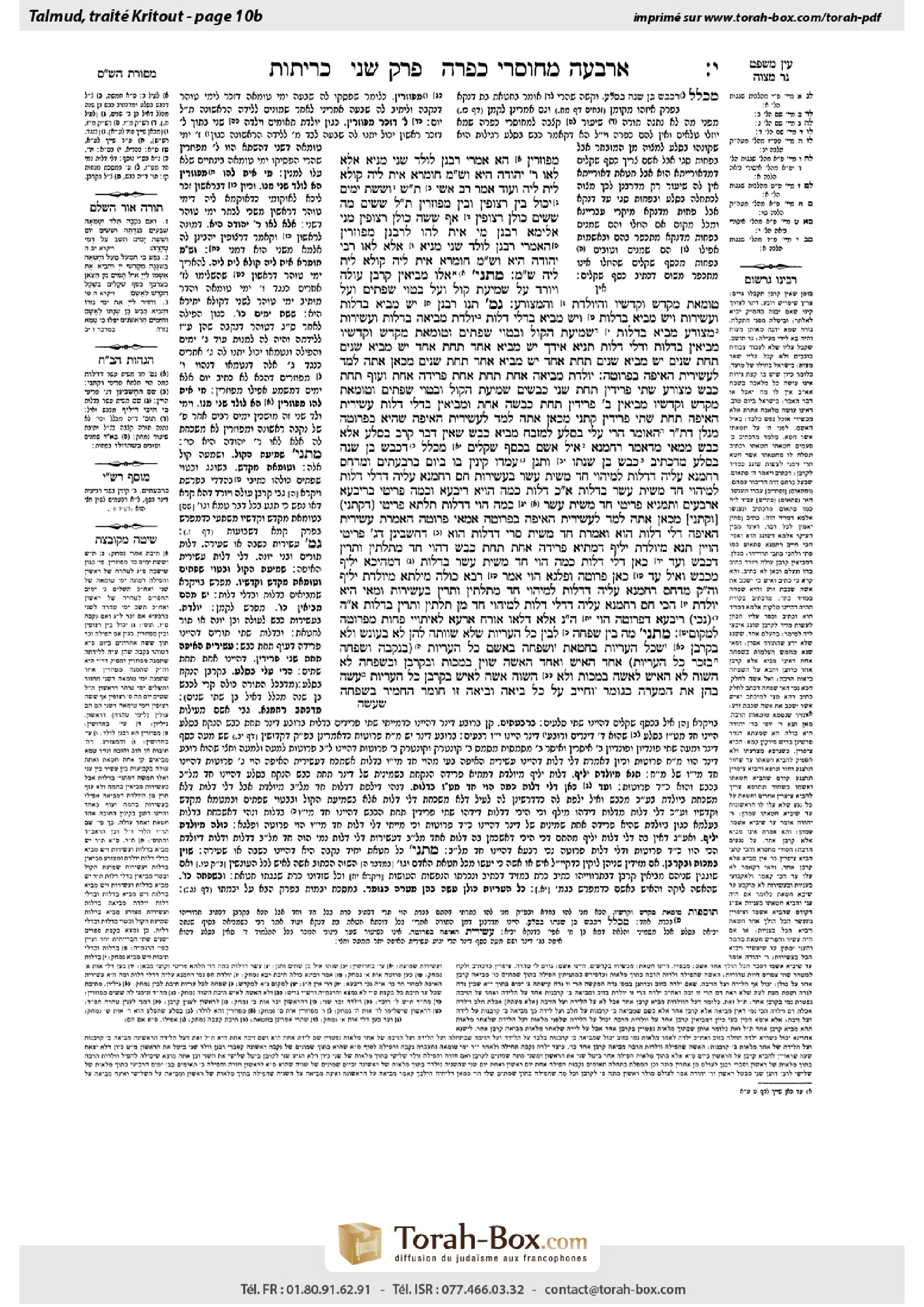
This page of Keritot includes the Aramaic text, an English translation and an AI-generated French translation, alongside the scan above.
כריתות י׳ ב · Aramaic and Hebrew text
מְפוּזָּרִין? הָא אָמְרִי רַבָּנַן: לְוָלָד שֵׁנִי מָנְיָא! אֶלָּא לָאו רַבִּי יְהוּדָה הִיא, וּשְׁמַע מִינַּהּ: חוּמְרָא אִית לֵיהּ, קוּלָּא לֵית לֵיהּ.
וְעוֹד אָמַר רַב אָשֵׁי, תָּא שְׁמַע: ״וְשֵׁשֶׁת יָמִים״ – יָכוֹל בֵּין רְצוּפִין וּבֵין מְפוּזָּרִין? תַּלְמוּד לוֹמַר: ״שִׁשִּׁים״, מָה שִׁשִּׁים כּוּלָּן רְצוּפִין – אַף שִׁשָּׁה כּוּלָּן רְצוּפִין. מַנִּי? אִלֵּימָא רַבָּנַן, מִי אִית לְהוּ לְרַבָּנַן מְפוּזָּרִין? הָאָמְרִי רַבָּנַן: לְוָלָד שֵׁנִי מָנְיָא!
אֶלָּא לָאו רַבִּי יְהוּדָה הִיא, וּשְׁמַע מִינַּהּ: חוּמְרָא אִית לֵיהּ, קוּלָּא לֵית לֵיהּ? שְׁמַע מִינָּה.
מַתְנִי׳ אֵלּוּ מְבִיאִין קׇרְבָּן עוֹלֶה וְיוֹרֵד: עַל שְׁמִיעַת קוֹל, וְעַל בִּטּוּי שְׂפָתָיִם, וְעַל טוּמְאַת מִקְדָּשׁ וְקָדָשָׁיו, וְהַיּוֹלֶדֶת, וְהַמְצוֹרָע.
גְּמָ׳ תָּנוּ רַבָּנַן: יֵשׁ מֵבִיא בְּדַלּוּת וַעֲשִׁירוּת, וְיֵשׁ מֵבִיא בְּדַלּוּת וְיֵשׁ מֵבִיא בְּדַלֵּי דַלּוּת:
יוֹלֶדֶת – מְבִיאָה בְּדַלּוּת וַעֲשִׁירוּת. מְצוֹרָע – מֵבִיא בְּדַלּוּת. שְׁמִיעַת הַקּוֹל וּבִטּוּי שְׂפָתָיִם וְטוּמְאַת מִקְדָּשׁ וְקָדָשָׁיו – מְבִיאִין בְּדַלּוּת וְדַלֵּי דַלּוּת.
תַּנְיָא אִידַּךְ: יֵשׁ מֵבִיא אֶחָד תַּחַת אֶחָד, יֵשׁ מֵבִיא שְׁנַיִם תַּחַת שְׁנַיִם, יֵשׁ מֵבִיא שְׁנַיִם תַּחַת אֶחָד, יֵשׁ מֵבִיא אֶחָד תַּחַת שְׁנַיִם, מִכָּאן אַתָּה לָמֵד לַעֲשִׂירִית הָאֵיפָה בִּפְרוּטָה.
יוֹלֶדֶת מְבִיאָה אַחַת תַּחַת אַחַת – פְּרִידָה אַחַת וָעוֹף תַּחַת כֶּבֶשׂ, מְצוֹרָע – שְׁתֵּי פְרִידִין תַּחַת שְׁנֵי כְבָשִׂים, שְׁמִיעַת הַקּוֹל וּבִטּוּי שְׂפָתָיִם וְטוּמְאַת מִקְדָּשׁ וְקָדָשָׁיו – מְבִיאִין שְׁתֵּי פְרִידִין תַּחַת כִּבְשָׂה אַחַת, וּמְבִיאִין בְּדַלֵּי דַלּוּת עֲשִׂירִית הָאֵיפָה תַּחַת שְׁתֵּי פְרִידִין.
קָתָנֵי: מִכָּאן אַתָּה לָמֵד לַעֲשִׂירִית הָאֵיפָה שֶׁהִיא בִּפְרוּטָה. מְנָלַן? דְּתָנוּ רַבָּנַן: הָאוֹמֵר ״הֲרֵי עָלַי בְּסֶלַע לַמִּזְבֵּחַ״ – מֵבִיא כֶּבֶשׂ, שֶׁאֵין דָּבָר קָרֵב בְּסֶלַע אֶלָּא כֶּבֶשׂ.
מִמַּאי? מִדְּאָמַר רַחֲמָנָא ״אֵיל אָשָׁם בְּכֶסֶף שְׁקָלִים״, מִכְּלָל דְּכֶבֶשׂ בֶּן שָׁנָה בְּסֶלַע, מִדִּכְתִיב ״כֶּבֶשׂ בֶּן שְׁנָתוֹ״. וּתְנַן: עָמְדוּ קִינִּין בּוֹ בַּיּוֹם בְּרִבְעָתַיִם.
וּמִדְּחָס רַחֲמָנָא עֲלֵיהּ דְּדַלּוּת לְמִיהְוֵי חַד מִשֵּׁית עֲשַׂר בַּעֲשִׁירוּת, חָס רַחֲמָנָא עֲלֵיהּ דְּדַלֵּי דַּלּוּת לְמִיהְוֵי חַד מִשֵּׁית עֲשַׂר בְּדַלּוּת.
אִם כֵּן, דַּלּוּת כְּמָה הָוְיָא – רִיבְעָא, וּכְמָה פְּרִיטֵי בְּרִיבְעָא – אַרְבָּעִים וּתְמָנְיָא פְּרִיטֵי, חַד מִשֵּׁית עֲשַׂר כְּמָה הָוֵי דְּדַלּוּת – תְּלָתָא פְּרִיטֵי.
דְּקָתָנֵי: מִכָּאן אַתָּה לָמֵד לַעֲשִׂירִית הָאֵיפָה בִּפְרוּטָה, אַמַּאי פְּרוּטָה? הָאָמְרַתְּ: עֲשִׂירִית הָאֵיפָה דַּלֵּי דַּלּוּת הוּא, וְאָמְרַתְּ חַד מִשֵּׁית סְרֵי דְּדַלּוּת הוּא, דְּחָשְׁבִינַן דִּתְלָתָא פְּרִיטֵי הָוַיִין!
תַּנָּא מִיּוֹלֶדֶת יָלֵיף, דְּמַתְיָא פְּרִידָה אַחַת תַּחַת כֶּבֶשׂ, דְּהָוֵי חַד מִתְּלָתִין וּתְרֵין דְּכֶבֶשׂ. וְעַד כָּאן, דַּלֵּי דַּלּוּת כְּמָה הָוֵי – חַד מִשֵּׁית עֲשַׂר בְּדַלּוּת, דְּמֵהֵיכָא יָלֵיף – מִכֶּבֶשׂ וְאַיִל. עַד כָּאן, פְּרוּטָה וּפַלְגָא הָוֵי!
אָמַר רָבָא: כּוּלַּהּ מִילְּתָא מִיּוֹלֶדֶת יָלֵיף, וְהָכִי קָאָמַר: מִדְּחָס רַחֲמָנָא עֲלֵיהּ דְּדַלּוּת לְמִיהְוֵי חַד מִתְּלָתִין וּתְרֵין בַּעֲשִׁירוּת, וּמַאי הִיא – יוֹלֶדֶת, הָכִי חָס רַחֲמָנָא עֲלֵיהּ דְּדַלֵּי דַּלּוּת לְמִיהְוֵי חַד מִן תְּלָתִין וּתְרֵין בְּדַלּוּת.
אִי הָכִי, נְכֵי רִיבְעָא דִּפְרוּטָה הָוֵי! הָכִי נָמֵי, אֶלָּא דְּלָאו אוֹרַח אַרְעָא לְאֵיתוֹיֵי פָּחוֹת מִפְּרוּטָה לַמָּקוֹם.
מַתְנִי׳ מָה בֵּין שִׁפְחָה לְבֵין כׇּל הָעֲרָיוֹת? שֶׁלֹּא שָׁוְותָה לָהֶן לֹא בָּעוֹנֶשׁ וְלֹא בַּקׇּרְבָּן. שֶׁכׇּל הָעֲרָיוֹת בְּחַטָּאת, וְשִׁפְחָה בְּאָשָׁם. כׇּל הָעֲרָיוֹת בִּנְקֵבָה, וְשִׁפְחָה בְּזָכָר.
כׇּל הָעֲרָיוֹת אֶחָד הָאִישׁ וְאֶחָד הָאִשָּׁה שָׁוִין בַּמַּכּוֹת וּבַקׇּרְבָּן, וּבַשִּׁפְחָה לֹא הִשְׁוָה לֹא הָאִישׁ לָאִשָּׁה בַּמַּכּוֹת, וְלֹא הִשְׁוָה אִשָּׁה לָאִישׁ בַּקׇּרְבָּן.
כׇּל הָעֲרָיוֹת עָשָׂה בָּהֶן אֶת הַמְעָרֶה כְּגוֹמֵר, וְחַיָּיב עַל כׇּל בִּיאָה וּבִיאָה.
(זוֹ חוֹמֶר) הֶחְמִיר בְּשִׁפְחָה,
Keritot 10b · English translation
it is possible for a woman who gave birth to count dispersed days? No, as the Rabbis say that she counts the days from the birth of the second fetus. Rather, is it not the opinion of Rabbi Yehuda? And therefore, conclude from it that Rabbi Yehuda is of the opinion that the second offspring is considered as though it exists only where a stringency results, but where a leniency results, he is not of the opinion that the second offspring is considered to have existed.
And further, Rav Ashi said: Come and hear a proof from a baraita, which discusses the verse: “Sixty days and six days” (Leviticus 12:5). One might have thought that she counts these six days whether they are continuous or dispersed, so that if, for example, she miscarried on the sixty-third day, she would complete the remaining three days of purity for the first fetus after completing the period of purification for the second. Therefore, the verse states: “Sixty” to teach that just as the sixty days are all continuous, so too, the six days are all continuous. Whose opinion is this? If we say it is the opinion of the Rabbis, that cannot be correct, as are the Rabbis of the opinion that it is possible for a woman who gave birth to count dispersed days? Didn’t the Rabbis say that she counts for the second offspring?
Rather, is it not the opinion of Rabbi Yehuda? And therefore, may one conclude from it that Rabbi Yehuda is of the opinion that the second offspring is considered extant only where a stringency results; but where a leniency results, he is not of the opinion that the second offspring is considered to have existed? The Gemara rules: Indeed, conclude from it that this is the case.
MISHNA: These are the five situations mentioned in the mishna (9a) in which one brings a sliding-scale offering: For hearing the voice of an oath, i.e., where one took a false oath that he does not have any testimony to provide on a given issue; and for the utterance of the lips, which is a case where one took a false oath about a different matter; and for the defiling of the Temple, by entering it while ritually impure, or defiling its sacrificial foods, by partaking of them while ritually impure; and a woman after childbirth; and a leper at the end of his purification process.
GEMARA: The Sages taught a baraita with regard to the nature of a sliding-scale offering, which varies depending on the owner’s financial status: There is a case in which one brings the offering in one of two possible states, either a bird offering if the individual is in a state of poverty or an animal offering if he is in a state of wealth; and there is a case in which one brings the offering in one of three possible states, of wealth, of poverty, or of extreme poverty.
The Gemara elaborates: A woman after childbirth brings a sliding-scale offering either in poverty, i.e., two doves or two pigeons, one as a burnt offering and one as a sin offering, or in wealth, i.e., a lamb as a burnt offering and a dove or a pigeon as a sin offering (see Leviticus 12:1–8). A leper brings the offering either in poverty in the form of a lamb for a guilt offering, and two doves or two pigeons, one as a sin offering and one as a burnt offering, or in wealth in the form of a lamb for a guilt offering, a lamb as a burnt offering, and a female lamb as a sin offering (see Leviticus 14:10–22). For the hearing of the voice, i.e., taking a false oath that one cannot provide testimony, or the utterance of the lips, or the defiling of the Temple or its sacrificial foods, one brings an offering either in wealth, i.e., a female lamb or goat as a sin offering, or in poverty, i.e., two doves or two pigeons, one as a sin offering and one as a burnt offering, or in extreme poverty, i.e., a meal offering.
It is taught in another baraita: When offerings are brought in poverty rather than wealth, there is a case in which one brings one offering instead of a different one; there is a case in which one brings two offerings instead of two other offerings; there is a case in which one brings two offerings instead of one offering; and there is a case in which one brings one offering instead of two offerings. From here you may derive that the offering of one-tenth of an ephah may be worth as little as one peruta.
A woman after childbirth brings one offering instead of one offering: One young bird, as a sin offering that she would bring even in wealth, and another bird as a burnt offering instead of the lamb. A leper brings two young birds instead of two lambs. For the hearing of the voice and the utterance of the lips and the defiling of the Temple or its sacrificial foods, one brings two young birds instead of one female lamb, and in a case of extreme poverty one brings one meal offering of one-tenth of an ephah instead of two young birds.
The baraita teaches: From here you may derive that the offering of one-tenth of an ephah may be worth as little as one peruta. The Gemara asks: From where do we learn this halakha? The Gemara answers that it is as the Sages taught in a baraita: In the case of one who says: It is incumbent upon me to bring an offering worth one sela to the altar, he brings a lamb, as there is nothing that is sacrificed upon the altar that is worth one sela other than a lamb.
From where is this halakha derived? It is derived from the fact that the Merciful One states in the Torah that the ram brought in its second year as a guilt offering must be “according to your valuation in silver by shekels” (Leviticus 5:15), i.e., it must be worth two sela. It may therefore be understood by inference that a lamb, i.e., a young ram, in its first year is worth one sela. And it is known that a lamb is brought when it is within its first year, as it is written: “A lamb of the first year” (Leviticus 12:6). And we learned in a mishna (8a): The price of nests, i.e., pairs of birds brought by an impoverished person instead of a lamb, stood that day at one-quarter of a silver dinar. A quarter-dinar is one-sixteenth of a sela, the price of a lamb.
And from the fact that the Merciful One has mercy upon one who brings an offering in poverty, in that He permits him to bring an offering that is worth one-sixteenth of the value of the lamb that is brought in wealth, it may be inferred that the Merciful One takes pity upon one who brings an offering in extreme poverty, and consequently He permits him to bring an offering which is worth one-sixteenth of the value of the offering brought in moderate poverty. Accordingly, the offering brought in extreme poverty may be equal to a two hundred fifty-sixth part of the value of a sela.
The Gemara examines the mathematics necessary to determine that the value of the offering brought in extreme poverty is equal to one peruta: If so, how much is the offering brought in poverty worth? It is worth one-quarter of a dinar. And how many perutot are in one-quarter of a dinar? Forty-eight perutot. Accordingly, how many perutot are in the offering brought in extreme poverty, which is worth one-sixteenth of the offering brought in poverty? Three perutot.
The Gemara objects: But with regard to that which the baraita teaches: From here you may derive that the offering of one-tenth of an ephah may be worth as little as one peruta, why did the baraita teach that it may be worth one peruta, rather than three perutot? Didn’t you say that one-tenth of an ephah is brought in extreme poverty, and you also said that this offering should be worth one-sixteenth of the offering brought in poverty, which we calculated to be three perutot?
The Gemara answers: The tanna derives the cost of an offering brought in poverty from the case of a woman after childbirth, who brings one bird instead of a lamb, as a bird is worth one thirty-second of the value of a lamb. The Gemara asks: But until now, how much was the offering brought in extreme poverty calculated to be worth? One-sixteenth of the value of the offering brought in poverty. And from where is this derived? It is derived from the value of the lamb and the ram, as explained earlier. If so, until now, the calculations lead to the conclusion that the offering brought in extreme poverty is worth one and one-half perutot, as one thirty-second of the value of a lamb is equal to one-eighth of a silver dinar rather than one-quarter, which means that the offering brought in poverty is worth twenty-four perutot, one-sixteenth of which is equal to one and one-half perutot.
Rather, Rava said a different answer: The entire matter is derived from the offering brought by a woman after childbirth, and this is what the tanna is saying: It is derived from the fact that the Merciful One has mercy upon one who brings an offering in poverty, in that he may bring an offering which is worth one thirty-second of the value of the offering brought in wealth. Rava adds parenthetically: And from what case is this principle derived? From the case of a woman after childbirth. So too, the Merciful One has mercy upon one who brings an offering in extreme poverty, in that he may bring an offering that is worth one thirty-second of the value of the offering brought in moderate poverty.
The Gemara objects: If so, the value should be one peruta minus one-quarter, i.e., three-quarters of a peruta. The Gemara explains: Indeed that is so, but it is not proper conduct to bring an offering worth less than one peruta before God.
MISHNA: What are the differences between an espoused maidservant and all those others with whom relations are forbidden? The difference is that the status of the maidservant is not equal to their status, neither with regard to punishment nor with regard to an offering, as one who unwittingly engages in intercourse with any of those with whom relations are forbidden is liable to bring a sin offering, and by contrast, one who unwittingly engages in intercourse with an espoused maidservant is liable to bring a guilt offering. One who unwittingly engages in intercourse with any of those with whom relations are forbidden brings a female animal, and one who unwittingly engages in intercourse with an espoused maidservant brings a male animal, as a sin offering is a female and a guilt offering is a male.
Furthermore, with regard to engaging in intercourse with any of those with whom relations are forbidden, both the man and the woman are equal with regard to liability to receive lashes if they were forewarned, and with regard to liability to bring an offering if they did so unwittingly. And in the case of one who engages in intercourse with a maidservant, the Torah did not equate the man with the woman with regard to lashes, as she alone is flogged, as will be explained, and the Torah did not equate the woman with the man with regard to bringing an offering, as she does not bring an offering.
With regard to intercourse with any of those with whom relations are forbidden, the Torah rendered the halakhic status of one who engages in the initial stage of intercourse [hame’areh] to be like that of one who completes the act, and one is liable to bring a sin offering for each and every act of intercourse that he performs unwittingly. By contrast, in the case of relations with an espoused maidservant, one is liable only for completing the act of intercourse, and the man brings a single offering for several transgressions.
This is a stringency that the Torah imposed with regard to the maidservant relative to other individuals with whom relations are forbidden:
Keritot 10b · Traduction française (IA)
Une femme qui a accouché peut-elle compter des jours discontinus ? Non, car les Sages disent qu’elle compte les jours à partir de la naissance du deuxième fœtus. N’est-ce donc pas plutôt l’opinion de Rabbi Yehuda ? Il faut donc en conclure que, selon Rabbi Yehuda, le deuxième fœtus est considéré comme ayant existé uniquement lorsqu’il en résulte une rigueur, mais que, lorsqu’il en résulte un allègement, il ne considère pas qu’il ait existé.
De plus, Rav Ashi a dit : Viens entendre une preuve tirée d’une baraïta, qui traite du verset : « Soixante jours et six jours » (Lévitique 12:5). On aurait pu penser qu’elle compte ces six jours, qu’ils soient consécutifs ou discontinus, de sorte que si, par exemple, elle faisait une fausse couche le soixante-troisième jour, elle achèverait les trois jours de pureté restant pour le premier fœtus après avoir achevé la période de purification du second. Le verset dit donc : « soixante », pour enseigner que, de même que les soixante jours sont tous consécutifs, les six jours doivent eux aussi être tous consécutifs. De qui est-ce l’opinion ? Si l’on dit que c’est celle des Sages, cela ne peut être exact : les Sages pensent-ils qu’une femme qui a accouché peut compter des jours discontinus ? Les Sages n’ont-ils pas dit qu’elle compte les jours à partir de la naissance du deuxième fœtus ?
N’est-ce donc pas plutôt l’opinion de Rabbi Yehuda ? Faut-il donc en conclure que, selon Rabbi Yehuda, le deuxième fœtus est considéré comme ayant existé uniquement lorsqu’il en résulte une rigueur, mais que, lorsqu’il en résulte un allègement, il ne considère pas qu’il ait existé ? La Guemara tranche : En effet, conclus-en que c’est bien le cas.
MICHNA : Voici les cinq situations mentionnées dans la Michna (9a) dans lesquelles on apporte une offrande graduée selon les moyens : avoir entendu la voix d’un serment, c’est-à-dire avoir prêté un faux serment en affirmant n’avoir aucun témoignage à fournir sur une question donnée ; l’énoncé des lèvres, c’est-à-dire avoir prêté un faux serment sur une autre affaire ; la souillure du Temple, en y entrant alors qu’on est en état d’impureté rituelle, ou la souillure de ses aliments sacrificiels, en en consommant alors qu’on est en état d’impureté rituelle ; une femme après l’accouchement ; et un lépreux à la fin de son processus de purification.
GUEMARA : Les Sages ont enseigné dans une baraïta au sujet de la nature d’une offrande graduée selon les moyens de son propriétaire : dans un cas, on apporte l’offrande sous l’une de deux formes possibles, soit une offrande d’oiseaux si la personne est pauvre, soit une offrande animale si elle est riche ; dans un autre cas, on apporte l’offrande sous l’une de trois formes possibles, selon que la personne est riche, pauvre ou extrêmement pauvre.
La Guemara précise : Une femme après l’accouchement apporte une offrande graduée selon ses moyens, soit dans la pauvreté, c’est-à-dire deux tourterelles ou deux pigeons, l’un en holocauste et l’autre en sacrifice expiatoire, soit dans l’aisance, c’est-à-dire un agneau en holocauste et une tourterelle ou un pigeon en sacrifice expiatoire (voir Lévitique 12:1–8). Un lépreux apporte l’offrande soit dans la pauvreté, sous la forme d’un agneau en sacrifice de culpabilité et de deux tourterelles ou de deux pigeons, l’un en sacrifice expiatoire et l’autre en holocauste, soit dans l’aisance, sous la forme d’un agneau en sacrifice de culpabilité, d’un agneau en holocauste et d’une agnelle en sacrifice expiatoire (voir Lévitique 14:10–22). Pour avoir entendu la voix d’un serment, c’est-à-dire avoir prêté un faux serment en affirmant ne pas pouvoir fournir de témoignage, pour l’énoncé des lèvres, ou pour avoir souillé le Temple ou ses aliments sacrificiels, on apporte une offrande soit dans l’aisance, c’est-à-dire une brebis ou une chèvre en sacrifice expiatoire, soit dans la pauvreté, c’est-à-dire deux tourterelles ou deux pigeons, l’un en sacrifice expiatoire et l’autre en holocauste, soit dans l’extrême pauvreté, c’est-à-dire une offrande de farine.
Une autre baraïta enseigne : lorsqu’on apporte des offrandes dans la pauvreté plutôt que dans l’aisance, il y a un cas où l’on apporte une offrande à la place d’une autre ; un cas où l’on apporte deux offrandes à la place de deux autres ; un cas où l’on apporte deux offrandes à la place d’une seule ; et un cas où l’on apporte une offrande à la place de deux. De là, on peut déduire que l’offrande d’un dixième d’épha peut valoir aussi peu qu’une perouta.
Une femme après l’accouchement apporte une offrande à la place d’une autre : un jeune oiseau en sacrifice expiatoire, qu’elle aurait apporté même dans l’aisance, et un autre oiseau en holocauste à la place de l’agneau. Un lépreux apporte deux jeunes oiseaux à la place de deux agneaux. Pour avoir entendu la voix d’un serment, pour l’énoncé des lèvres ou pour avoir souillé le Temple ou ses aliments sacrificiels, on apporte deux jeunes oiseaux à la place d’une brebis ; dans le cas d’une extrême pauvreté, on apporte une offrande de farine d’un dixième d’épha à la place de deux jeunes oiseaux.
La baraïta enseigne : De là, on peut déduire que l’offrande d’un dixième d’épha peut valoir aussi peu qu’une perouta. La Guemara demande : D’où apprenons-nous cette halakha ? La Guemara répond que c’est ce que les Sages ont enseigné dans une baraïta : celui qui dit : « Je m’engage à apporter à l’autel une offrande d’une valeur d’un sela » apporte un agneau, car rien de ce qui est offert sur l’autel ne vaut un sela, hormis un agneau.
D’où cette halakha est-elle déduite ? Elle l’est du fait que le Miséricordieux énonce dans la Torah que le bélier apporté en sacrifice de culpabilité dans sa deuxième année doit être « selon ton estimation, en argent, par sicles » (Lévitique 5:15), c’est-à-dire qu’il doit valoir deux sela. On peut donc en déduire qu’un agneau, c’est-à-dire un jeune bélier dans sa première année, vaut un sela. On sait qu’un agneau est apporté alors qu’il est dans sa première année, comme il est écrit : « un agneau de la première année » (Lévitique 12:6). Et nous avons appris dans une Michna (8a) que, ce jour-là, le prix des nids — c’est-à-dire des paires d’oiseaux qu’une personne pauvre apporte à la place d’un agneau — était d’un quart de dinar d’argent. Un quart de dinar équivaut à un seizième de sela, le prix d’un agneau.
Et du fait que le Miséricordieux a pitié de celui qui apporte une offrande dans la pauvreté, puisqu’il lui permet d’apporter une offrande valant un seizième de la valeur de l’agneau apporté dans l’aisance, on peut déduire que le Miséricordieux prend aussi en pitié celui qui apporte une offrande dans l’extrême pauvreté et lui permet donc d’apporter une offrande valant un seizième de la valeur de l’offrande apportée dans la pauvreté. Par conséquent, l’offrande apportée dans l’extrême pauvreté peut équivaloir à un deux-cent-cinquante-sixième de la valeur d’un sela.
La Guemara examine les calculs nécessaires pour établir que la valeur de l’offrande apportée dans l’extrême pauvreté équivaut à une perouta : si tel est le cas, quelle est la valeur de l’offrande apportée dans la pauvreté ? Elle vaut un quart de dinar. Et combien y a-t-il de peroutot dans un quart de dinar ? Quarante-huit peroutot. Combien y a-t-il donc de peroutot dans l’offrande apportée dans l’extrême pauvreté, qui vaut un seizième de l’offrande apportée dans la pauvreté ? Trois peroutot.
La Guemara objecte : Puisque la baraïta enseigne : « De là, on peut déduire que l’offrande d’un dixième d’épha peut valoir aussi peu qu’une perouta », pourquoi enseigne-t-elle qu’elle peut valoir une perouta plutôt que trois peroutot ? N’as-tu pas dit que le dixième d’épha est apporté dans l’extrême pauvreté, et n’as-tu pas également dit que cette offrande devrait valoir un seizième de l’offrande apportée dans la pauvreté, ce que nous avons calculé à trois peroutot ?
La Guemara répond : Le tanna déduit le coût d’une offrande apportée dans la pauvreté du cas d’une femme après l’accouchement, qui apporte un oiseau à la place d’un agneau, car un oiseau vaut un trente-deuxième de la valeur d’un agneau. La Guemara demande : Mais jusqu’à présent, à combien avait-on évalué l’offrande apportée dans l’extrême pauvreté ? À un seizième de la valeur de l’offrande apportée dans la pauvreté. Et d’où cela est-il déduit ? De la valeur de l’agneau et du bélier, comme expliqué précédemment. Si tel est le cas, les calculs effectués jusqu’à présent mènent à la conclusion que l’offrande apportée dans l’extrême pauvreté vaut une perouta et demie, puisque un trente-deuxième de la valeur d’un agneau équivaut à un huitième de dinar d’argent, et non à un quart. Cela signifie que l’offrande apportée dans la pauvreté vaut vingt-quatre peroutot, dont un seizième équivaut à une perouta et demie.
Rava a plutôt donné une autre réponse : toute l’affaire est déduite de l’offrande apportée par une femme après l’accouchement, et voici ce que dit le tanna : on déduit du fait que le Miséricordieux a pitié de celui qui apporte une offrande dans la pauvreté, puisqu’il peut apporter une offrande valant un trente-deuxième de la valeur de l’offrande apportée dans l’aisance. Rava ajoute incidemment : De quel cas ce principe est-il déduit ? Du cas d’une femme après l’accouchement. De même, le Miséricordieux a pitié de celui qui apporte une offrande dans l’extrême pauvreté, puisqu’il peut apporter une offrande valant un trente-deuxième de la valeur de l’offrande apportée dans la pauvreté.
La Guemara objecte : Dans ce cas, la valeur devrait être inférieure d’un quart de perouta à une perouta, c’est-à-dire trois quarts de perouta. La Guemara explique : C’est effectivement le cas, mais il ne convient pas d’apporter devant Dieu une offrande valant moins d’une perouta.
MICHNA : Quelles sont les différences entre une servante fiancée et toutes les autres femmes avec lesquelles les relations sont interdites ? Le statut de la servante diffère du leur, tant en matière de peine qu’en matière d’offrande : celui qui a involontairement des relations avec l’une des femmes avec lesquelles les relations sont interdites est tenu d’apporter un sacrifice expiatoire, tandis que celui qui a involontairement des relations avec une servante fiancée est tenu d’apporter un sacrifice de culpabilité. Le premier apporte un animal femelle, tandis que celui qui a involontairement des relations avec une servante fiancée apporte un animal mâle, car le sacrifice expiatoire est une femelle et le sacrifice de culpabilité un mâle.
De plus, dans le cas de relations avec l’une des femmes avec lesquelles les relations sont interdites, l’homme et la femme sont soumis à la même responsabilité, tant pour la flagellation s’ils ont été avertis que pour l’apport d’une offrande s’ils ont agi involontairement. En revanche, dans le cas de relations avec une servante, la Torah n’a pas placé l’homme et la femme sur un pied d’égalité en matière de flagellation : seule la femme est flagellée, comme cela sera expliqué. La Torah ne les a pas non plus placés sur un pied d’égalité en matière d’apport d’une offrande, car la femme n’en apporte pas.
En ce qui concerne les relations avec l’une des femmes avec lesquelles les relations sont interdites, la Torah a conféré le même statut halakhique à celui qui entame la pénétration [hame’areh] qu’à celui qui achève l’acte, et l’on est tenu d’apporter un sacrifice expiatoire pour chaque rapport sexuel involontaire. En revanche, dans le cas de relations avec une servante fiancée, on n’est passible que si l’on achève l’acte, et l’homme apporte une seule offrande pour plusieurs transgressions.
Voici une rigueur que la Torah a imposée concernant la servante, par rapport aux autres personnes avec lesquelles les relations sont interdites :
Traduction française générée par IA à partir de l’édition anglaise de Sefaria. Vérifie toujours un passage avec le texte source.
Text from Sefaria: William Davidson Edition - Vocalized Aramaic (CC BY NC); William Davidson Edition - English (CC BY NC).