Keritot 10a: Talmud study for Daf Yomi
Daf Yomi is the daily study of one Talmud folio. Explore 37 tractates with scans, Hebrew text, Sefaria English and AI-generated French translations where annotated.
Passage selection and English or AI-generated French translation are available where the scan has annotations. Daf Study is independent of Torah-Box and Sefaria.
Browse Keritot · כריתות · All tractatesKeritot 10a text and translations
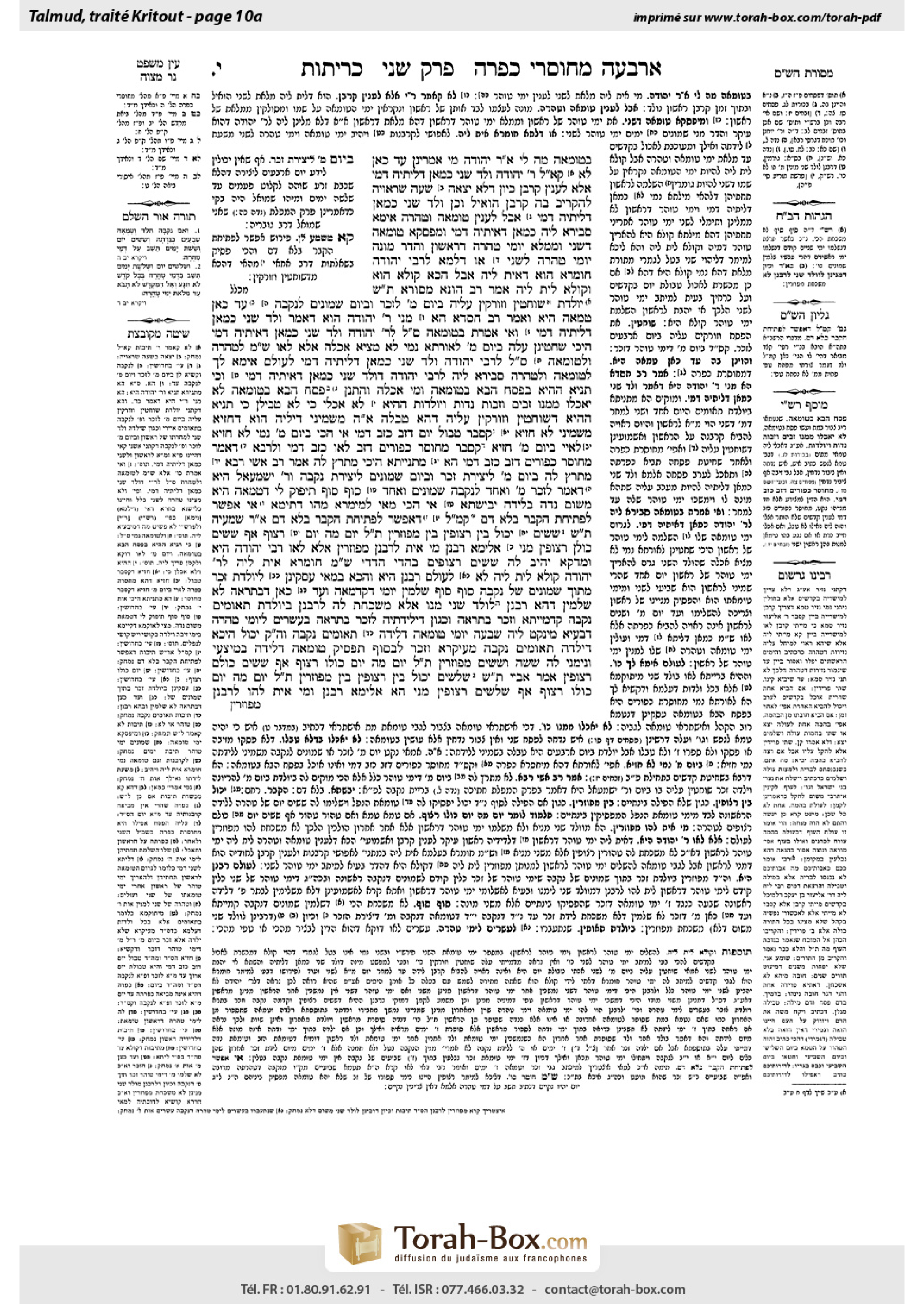
This page of Keritot includes the Aramaic text, an English translation and an AI-generated French translation, alongside the scan above.
כריתות י׳ א · Aramaic and Hebrew text
בְּטוּמְאָה מָה לִי אָמַר רַבִּי יְהוּדָה? מִי אָמְרִינַן: עַד כָּאן לָא קָאָמַר רַבִּי יְהוּדָה וָלָד שֵׁנִי כְּמַאן דְּלֵיתֵיהּ דָּמֵי אֶלָּא לְעִנְיַן קׇרְבָּן, כֵּיוָן דְּלֹא יָצְאָה שָׁעָה שֶׁרְאוּיָה לְהַקְרִיב בָּהּ קׇרְבָּן, הוֹאִיל וְכֵן – וָלָד שֵׁנִי כְּמַאן דְּלֵיתֵיהּ דָּמֵי, אֲבָל לְעִנְיַן טוּמְאָה וְטׇהֳרָה, אֵימָא סְבִירָא לֵיהּ כְּמַאן דְּאִיתֵיהּ דָּמֵי, וּמַפְסְקָא טוּמְאָה דְּשֵׁנִי, וּמְמַלֵּא יוֹמֵי טׇהֳרָה דְּרִאשׁוֹן וַהֲדַר (מוֹנֶה) [מָנֵי לֵיהּ] יוֹמֵי,
אוֹ דִלְמָא לְרַבִּי יְהוּדָה חוּמְרָא הוּא דְּאִית לֵיהּ, אֲבָל הָכָא – קוּלָּא הוּא, וְקוּלָּא לֵית לֵיהּ.
אָמַר רַב הוּנָא מִסּוּרָא, תָּא שְׁמַע: יוֹלֶדֶת, שׁוֹחֲטִין וְזוֹרְקִין עָלֶיהָ בְּיוֹם אַרְבָּעִים לַזָּכָר וּבְיוֹם שְׁמוֹנִים לַנְּקֵבָה.
עַד כָּאן? טְמֵאָה הִיא! וְאָמַר רַב חִסְדָּא: הָא מַנִּי? רַבִּי יְהוּדָה הִיא, דְּאָמַר: וָלָד שֵׁנִי כְּמַאן דְּלֵיתֵיהּ דָּמֵי.
וְאִי אָמְרַתְּ בְּטוּמְאָה סְבִירָא לֵיהּ לְרַבִּי יְהוּדָה וָלָד שֵׁנִי כְּמַאן דְּאִיתֵיהּ דָּמֵי, הֵיכִי שָׁחֲטִינַן עֲלַהּ בְּיוֹם אַרְבָּעִים? לְאוּרְתָּא נָמֵי לָא מָצְיָא אָכְלָה! אֶלָּא לָאו שְׁמַע מִינָּה: לְטׇהֳרָה וּלְטוּמְאָה סְבִירָא לֵיהּ לְרַבִּי יְהוּדָה וָלָד שֵׁנִי כְּמַאן דְּלֵיתֵיהּ דָּמֵי!
לְעוֹלָם אֵימָא לָךְ: לְטוּמְאָה וּלְטׇהֳרָה סְבִירָא לֵיהּ לְרַבִּי יְהוּדָה דְּוָלָד שֵׁנִי כְּמַאן דְּאִיתֵיהּ דָּמֵי, וְכִי תַנְיָא הַהִיא – בְּפֶסַח הַבָּא בְּטוּמְאָה.
וּמִי אָכְלָה? וְהָתְנַן: פֶּסַח הַבָּא בְּטוּמְאָה, לֹא יֹאכְלוּ מִמֶּנּוּ זָבִים וְזָבוֹת, נִדּוֹת וְיוֹלְדוֹת!
הָהִיא, לָא אָכְלָן כִּי לָא טְבִילָן. כִּי תַּנְיָא הַהִיא דְּשׁוֹחֲטִין וְזוֹרְקִין עָלֶיהָ, דְּהָא טָבְלָה. אִי הָכִי, מִשְּׁמִינִי דִּילַיהּ הוּא דְּחַזְיָא!
מִשְּׁמִינִי לָא חַזְיָא, קָסָבַר: טְבוּל יוֹם דְּזָב – כְּזָב דָּמֵי.
אִי הָכִי, בְּיוֹם אַרְבָּעִים נָמֵי לָא חַזְיָא! לָאיֵי, בְּיוֹם אַרְבָּעִים חַזְיָא, קָסָבַר: מְחוּסַּר כִּפּוּרִים דְּזָב – לָאו כְּזָב דָּמֵי.
וּלְרָבָא, דְּאָמַר מְחוּסַּר כִּפּוּרִים דְּזָב כְּזָב דָּמֵי, הָא מַתְנִייתָא הֵיכִי מְתָרֵץ לַהּ? אָמַר רַב אָשֵׁי: רָבָא מְתָרֵץ לַהּ בְּיוֹם אַרְבָּעִים לִיצִירַת זָכָר וּבְיוֹם שְׁמוֹנִים לִיצִירַת נְקֵבָה, וְרַבִּי יִשְׁמָעֵאל הִיא, דְּאָמַר: לְזָכָר אַרְבָּעִים וְאֶחָד, לִנְקֵבָה שְׁמוֹנִים וְאֶחָד.
סוֹף סוֹף, תִּיפּוֹק לִי דִּטְמֵאָה הִיא מִשּׁוּם נִדָּה! – בְּלֵידָה יַבִּישְׁתָּא. אִי הָכִי, מַאי לְמֵימְרָא? מַהוּ דְּתֵימָא: אִי אֶפְשָׁר לִפְתִיחַת הַקֶּבֶר בְּלֹא דָּם, קָא מַשְׁמַע לַן דְּאֶפְשָׁר לִפְתִיחַת הַקֶּבֶר בְּלֹא דָּם.
אָמַר רַבִּי שְׁמַעְיָה, תָּא שְׁמַע: ״שִׁשִּׁים״, יָכוֹל בֵּין רְצוּפִין בֵּין מְפוּזָּרִין? תַּלְמוּד לוֹמַר: ״יוֹם״, מָה יוֹם רָצוּף – אַף שִׁשִּׁים כּוּלָּן רְצוּפִין. מַנִּי? אִלֵּימָא רַבָּנַן, מִי אִית [לְהוּ] לְרַבָּנַן מְפוּזָּרִין?
אֶלָּא לָאו רַבִּי יְהוּדָה הִיא, וּמִדְּקָא יָהֵיב לַהּ שִׁשִּׁים רְצוּפִים בַּהֲדֵי הֲדָדֵי, שְׁמַע מִינָּה חוּמְרָא אִית לֵיהּ, לְרַבִּי יְהוּדָה קוּלָּא לֵית לֵיהּ!
לָא, לְעוֹלָם רַבָּנַן הִיא. וְהָכָא בְמַאי עָסְקִינַן – לְיוֹלֶדֶת זָכָר מִתּוֹךְ שְׁמוֹנִים שֶׁל נְקֵבָה.
סוֹף סוֹף, שָׁלְמִין יוֹמֵי דְּקַדְמָאָה, וְעַד כָּאן דְּבָתְרָאָה לָא שָׁלְמִין, דְּהָא רַבָּנַן לְוָלָד שֵׁנִי מָנוּ! אֶלָּא מַשְׁכַּחַתְּ לַהּ לְרַבָּנַן – בְּיוֹלֶדֶת תְּאוֹמִים, נְקֵבָה קַדְמָיְיתָא וְזָכָר בָּתְרָאָה, וּכְגוֹן דִּילֵידְתֵּיהּ לְזָכָר בָּתְרָאָה בְּעֶשְׂרִים לְיוֹמֵי טׇהֳרָה, דְּבָעֲיָא מִינְקָט לֵיהּ שִׁבְעָה יוֹמֵי טוּמְאָה דְּלֵידָה (תאומים נקבה),
וְהָכִי קָאָמַר: יָכוֹל הֵיכָא דְּיָלְדָה תְּאוֹמִים, נְקֵבָה מֵעִיקָּרָא וְזָכָר לְבַסּוֹף, תַּפְסֵיק טוּמְאָה דְּלֵידָה בְּמִיצְעֵי, וְנִימְנֵי לַהּ שִׁשָּׁה וְשִׁשִּׁים מְפוּזָּרִין? תַּלְמוּד לוֹמַר: ״יוֹם״, מָה יוֹם כּוּלּוֹ רָצוּף – אַף שִׁשִּׁים כּוּלָּם רְצוּפִין.
אָמַר אַבָּיֵי, תָּא שְׁמַע: ״שְׁלֹשִׁים״ – יָכוֹל בֵּין רְצוּפִין בֵּין מְפוּזָּרִין? תַּלְמוּד לוֹמַר: ״יוֹם״, מָה יוֹם כּוּלּוֹ רָצוּף – אַף שְׁלֹשִׁים רְצוּפִין. מַנִּי הָא? אִלֵּימָא רַבָּנַן, וּמִי אִית לְהוּ לְרַבָּנַן
Keritot 10a · English translation
Concerning ritual impurity, what does Rabbi Yehuda say? Do we say that Rabbi Yehuda says that the second offspring is considered as though it does not exist only with regard to the matter of an offering? In other words, since the time in which it was possible to sacrifice an offering for the second fetus had not yet emerged, since that is so, the second offspring is considered as though it does not exist. But concerning the matter of ritual impurity and purity, we say that he holds that it is considered as something that does exist, and accordingly, the days of impurity brought on by the second birth interrupt the days of purity following the first birth. The woman must therefore observe the days of impurity for the second birth, and afterward she completes the days of purity for the first birth, and then counts the days of purity brought on by the second fetus.
Or perhaps, according to Rabbi Yehuda, the second offspring is considered as though it exists only where there is a stringency that results from that definition. But here, if the woman would complete the days of purity of the first birth after the days of impurity of the second, this is a leniency, as she is deemed pure even if she sees blood during these days, and therefore, perhaps Rabbi Yehuda does not hold that the offspring is considered existent where this results in a leniency.
Rav Huna from Sura said: Come and hear a proof from a baraita: In the case of a woman after childbirth, one slaughters the Paschal offering and sprinkles its blood on her account on the fourteenth of Nisan, if this occurs on the fortieth day after giving birth to a male or on the eightieth day after giving birth to a female. Although she is still impure at the time of the sacrifice, she will be able to partake of the Paschal offering on the night of the fifteenth of Nisan.
The Sages challenged this baraita: Is that so? But she is still impure on the night of the fifteenth of Nisan, and she may not partake of sacrificial meat until she brings her offering on the forty-first day for a male or the eighty-first day for a female. And Rav Ḥisda said in response: In accordance with whose opinion is this baraita? It is in accordance with the opinion of Rabbi Yehuda, who says that the second offspring is deemed as though it does not exist. The baraita is dealing with a case where the woman gave birth to two male offspring on two consecutive days, and the fourteenth of Nisan occurred on the fortieth day after the birth of the second offspring, which is the forty-first day following the birth of the first.
And if you say that concerning impurity, Rabbi Yehuda holds that the second offspring is considered as though it is extant, which means that the days of purity following the first birth are delayed by the second birth and the mother does not become pure until the second term is complete, how may one slaughter the Paschal offering on her account on the fortieth day? After all, in the evening of the fifteenth she also may not eat the Paschal offering, because only forty days will have passed from the time of the second birth, and she would still be impure. Rather, must one not conclude from it that concerning ritual purity and impurity, Rabbi Yehuda holds that the second offspring is considered as though it does not exist?
The Gemara rejects this proof: Actually, I could say to you: Even concerning impurity and purity, Rabbi Yehuda holds that the second offspring is considered as something that does exist; and when that baraita is taught, it is dealing with a case of a woman who gave birth to one child, and it is referring to a case of a Paschal offering that is brought in impurity. When the majority of a community is impure, the Paschal offering is brought even in impurity.
The Gemara objects: And in that case, does she partake of it, as the baraita suggests? But didn’t we learn in a mishna (Pesaḥim 95b): With regard to a Paschal offering brought in impurity, men who experience a gonorrhea-like discharge [zavim], women who experience a discharge of uterine blood after their menstrual periods [zavot], menstruating women, and women after childbirth may not partake of it?
The Gemara explains: In that case, they do not partake of it because they did not immerse themselves in a ritual bath. But when that mishna is taught, that one slaughters the Paschal offering and sprinkles its blood on her account, the reason is that she had already immersed herself on the eighth day after giving birth. The Gemara objects: If that is so, then it is from the eighth day following his birth that she is fit to eat a Paschal offering brought in impurity, and there is no reason for the baraita to specify that the offering is slaughtered on the fortieth day.
The Gemara explains: Actually, she is not fit from the eighth day, because the tanna maintains that a zav who immersed that day and is waiting for nightfall for the purification process to be completed is considered to have the status of a zav and may not partake of a Paschal offering brought in ritual impurity. Similarly, a woman who immerses after giving birth is considered like one who immersed that day, and therefore she cannot partake of sacrificial meat until the end of the forty-day period.
The Gemara objects: If that is so, then on the fortieth day she is also not fit to eat the Paschal offering. The Gemara explains: This is not so; on the fortieth day she is fit to partake of the Paschal offering after nightfall, because the tanna holds that a zav who has immersed himself and waited for nightfall but is lacking atonement, i.e., he has not yet brought an atonement offering to complete the purification process, is not considered to have the status of a zav. Therefore, after completing the purification period, the woman may partake of the offering, despite the fact that she has not yet brought her atonement offering.
The Gemara asks: But according to Rava, who says that a zav who is lacking atonement is considered to have the status of a zav, how does he resolve the problem in this baraita? Rav Ashi said that Rava resolves it as follows: The baraita is not referring to the fortieth day after the birth of a male, but to a miscarriage that occurred on the fortieth day after the conception of a male, or the eightieth day after the conception of a female. And it is in accordance with the opinion of Rabbi Yishmael, who says that it takes forty-one days for a male fetus to be formed, and eighty-one days for a female fetus to be formed. Since the miscarriage occurred before the forty-first or eighty-first day, it does not render the woman impure with the impurity of childbirth, and therefore she may partake of the Paschal offering.
The Gemara objects: But ultimately, one should conclude that she is impure because she has the status of a menstruating woman. The Gemara explains: The mishna was stated with regard to the case of a dry birth, in which no blood was expelled, and therefore no impurity imparted. The Gemara asks: If that is so, then what is the purpose of stating it? The ruling in such a case is obvious. The Gemara answers: It was necessary to state it, lest you say that it is impossible for the womb to open without blood being expelled. The tanna therefore teaches us that it is possible for the womb to open without blood being expelled. Accordingly, Rabbi Yehuda’s opinion with regard to the impurity of a second birth cannot be deduced from this mishna.
Rabbi Shemaya said: Come and hear a proof from a baraita: The verse states with regard to a woman who gave birth to a female: “And she shall continue in the blood of purification sixty days and six days” (Leviticus 12:5). One might have thought that she counts the days whether they are continuous or dispersed. Therefore, the verse states: “Sixty days and six days,” to teach that just as a day is a continuous time period, so too all sixty days are continuous. And whose opinion is this? If we say it is the opinion of the Rabbis, that cannot be correct, as are the Rabbis of the opinion that it is possible for a woman who gave birth to count dispersed days? This is not the case, as the Rabbis count the days of purification from the second birth.
Rather, is it not the opinion of Rabbi Yehuda? And from the fact that he prescribes for her sixty continuous days to be counted together, conclude from it that Rabbi Yehuda maintains that the second offspring is considered extant only where a stringency results, but where a leniency results, in that she continues counting the days of purity of the first birth after completing the days of impurity for the second birth, he does not maintain that the second offspring is considered as though it exists.
The Gemara rejects this proof: No, actually, the baraita is stated in accordance with the opinion of the Rabbis. And what are we dealing with here? We are dealing with a woman who gives birth to a male within the eighty-day period following the birth of a female, so that the forty-day period for the male is entirely subsumed within the purification period for the female. In such a case, even the Rabbis would maintain that the second birth does not interrupt the term following the first. She would observe the seven days of impurity for the male, and then complete the days of purity for the female. Consequently, the verse teaches that the sixty-six days of purity following the first birth are observed continuously, and there is no need to observe additional days due to the intervening days of impurity.
The Gemara objects: But ultimately, this scenario is impossible; the reason is that the days of the first birth are completed while the days of the latter birth are not completed, as the Rabbis count the days following the second birth, and therefore the term relating to the first birth is abandoned. The Gemara offers a different explanation of the baraita: Rather, you find a case of counting dispersed days according to the Rabbis in a case where a woman gives birth to twins, first a female and then a male, and for example, she gives birth to the latter offspring, the male, on the twentieth day of the days of purity for the female, as she is required to observe for him seven days of impurity for birth.
The Gemara explains: And this is what the baraita is saying: One might have thought that where she gave birth to twins, a female initially and a male afterward, that the impurity of the second birth interrupts the term following the first birth in the middle, and she counts sixty-six dispersed days. Therefore, the verse states: “Sixty days and six days,” to teach that just as a day is an entirely continuous time period, so too all sixty days are to be continuous. Since the baraita could be in accordance with the opinion of the Rabbis, no proof can be inferred with regard to the opinion of Rabbi Yehuda.
Abaye said: Come and hear a proof from a baraita which discusses a woman who gave birth to a male. The verse states: “And she shall continue in the blood of purification three days and thirty days” (Leviticus 12:4). One might have thought that she counts the days whether they are continuous or dispersed. Therefore, the verse states: “Three days and thirty days,” to teach that just as a day is an entirely continuous time period, so too all thirty days are to be continuous. And whose opinion is this? If we say it is the Rabbis, that cannot be correct, as are the Rabbis of the opinion that
Keritot 10a · Traduction française (IA)
Concernant l’impureté rituelle, que dit Rabbi Yehouda ? Faut-il dire qu’à ses yeux, le second fœtus est considéré comme inexistant uniquement en matière d’offrande ? Autrement dit, puisque le moment où il aurait été possible de présenter une offrande pour le second fœtus n’est pas encore arrivé, celui-ci est considéré comme inexistant. Mais, en matière d’impureté et de pureté, faut-il dire qu’il considère qu’il existe, de sorte que les jours d’impureté entraînés par la seconde naissance interrompent les jours de pureté qui suivent la première ? La femme doit donc observer les jours d’impureté dus à la seconde naissance, puis achever les jours de pureté dus à la première, avant de compter les jours de pureté dus au second fœtus.
Ou peut-être Rabbi Yehouda considère-t-il que le second fœtus existe uniquement lorsque cette définition entraîne une rigueur. Mais ici, si la femme achevait les jours de pureté dus à la première naissance après les jours d’impureté dus à la seconde, ce serait une indulgence, puisqu’elle serait considérée comme pure même si elle voyait du sang pendant ces jours. Peut-être, par conséquent, Rabbi Yehouda ne considère-t-il pas que le fœtus existe lorsque cela entraîne une indulgence.
Rav Houna de Soura dit : Viens et entends une preuve tirée d’une baraïta. Dans le cas d’une femme qui vient d’accoucher, on égorge le sacrifice pascal et on asperge son sang en sa faveur le quatorze Nisan, si ce jour tombe le quarantième jour après la naissance d’un garçon ou le quatre-vingtième jour après la naissance d’une fille. Bien qu’elle soit encore impure au moment du sacrifice, elle pourra consommer le sacrifice pascal dans la nuit du quinze Nisan.
Les Sages objectèrent à cette baraïta : Est-ce bien le cas ? Pourtant, elle est encore impure dans la nuit du quinze Nisan et ne peut consommer de viande sacrificielle avant d’avoir présenté son offrande, le quarante et unième jour pour un garçon ou le quatre-vingt-unième jour pour une fille. Rav Ḥisda répondit : Selon l’opinion de qui cette baraïta a-t-elle été enseignée ? Selon celle de Rabbi Yehouda, qui dit que le second fœtus est considéré comme inexistant. La baraïta traite du cas d’une femme qui a donné naissance à deux garçons à deux jours consécutifs, le quatorze Nisan tombant le quarantième jour après la naissance du second garçon, soit le quarante et unième jour après la naissance du premier.
Et si tu dis qu’en matière d’impureté, Rabbi Yehouda considère que le second fœtus existe — ce qui signifie que la seconde naissance repousse les jours de pureté qui suivent la première et que la mère ne devient pure qu’à l’issue de la seconde période — comment peut-on égorger le sacrifice pascal en sa faveur le quarantième jour ? En effet, le soir du quinze Nisan, elle ne pourrait pas non plus consommer le sacrifice pascal, car seuls quarante jours se seraient écoulés depuis la seconde naissance et elle serait encore impure. Ne faut-il donc pas en conclure qu’en matière d’impureté et de pureté rituelles, Rabbi Yehouda considère que le second fœtus est inexistant ?
La Guemara rejette cette preuve : En réalité, je pourrais te dire que, même en matière d’impureté et de pureté, Rabbi Yehouda considère que le second fœtus existe. Lorsque cette baraïta est enseignée, elle traite d’une femme qui a donné naissance à un seul enfant et d’un sacrifice pascal offert en état d’impureté. Lorsque la majorité de la communauté est impure, le sacrifice pascal est offert même en état d’impureté.
La Guemara objecte : Dans ce cas, en consomme-t-elle, comme le suggère la baraïta ? N’avons-nous pas appris dans une Michna (Pessaḥim 95b) que, lorsqu’un sacrifice pascal est offert en état d’impureté, les hommes atteints d’un écoulement semblable à la gonorrhée [zavim], les femmes qui ont un écoulement de sang utérin après leurs périodes menstruelles [zavot], les femmes en période de menstruation et les femmes qui viennent d’accoucher ne peuvent pas en consommer ?
La Guemara explique : Dans ce cas, ils n’en consomment pas parce qu’ils ne se sont pas immergés dans un bain rituel. Mais lorsque cette Michna enseigne qu’on égorge le sacrifice pascal et qu’on asperge son sang en sa faveur, c’est parce qu’elle s’était déjà immergée le huitième jour après l’accouchement. La Guemara objecte : Si tel est le cas, elle est apte à consommer un sacrifice pascal offert en état d’impureté dès le huitième jour après l’accouchement ; il n’y a donc aucune raison pour que la baraïta précise que le sacrifice est égorgé le quarantième jour.
La Guemara explique : En réalité, elle n’est pas apte dès le huitième jour, car le tanna considère qu’un zav qui s’est immergé ce jour-là et attend la tombée de la nuit pour que son processus de purification soit achevé conserve le statut de zav et ne peut consommer un sacrifice pascal offert en état d’impureté rituelle. De même, une femme qui s’immerge après un accouchement est considérée comme quelqu’un qui s’est immergé ce jour-là ; elle ne peut donc consommer de viande sacrificielle avant la fin de la période de quarante jours.
La Guemara objecte : Si tel est le cas, elle n’est pas non plus apte à consommer le sacrifice pascal le quarantième jour. La Guemara explique : Il n’en est pas ainsi ; le quarantième jour, elle est apte à consommer le sacrifice pascal après la tombée de la nuit, car le tanna considère qu’un zav qui s’est immergé et a attendu la tombée de la nuit, mais dont l’expiation reste à accomplir — c’est-à-dire qui n’a pas encore présenté le sacrifice expiatoire nécessaire à l’achèvement du processus de purification — ne conserve pas le statut de zav. Ainsi, après avoir achevé la période de purification, la femme peut consommer l’offrande, bien qu’elle n’ait pas encore présenté son sacrifice expiatoire.
La Guemara demande : Mais selon Rava, qui dit qu’un zav dont l’expiation reste à accomplir conserve le statut de zav, comment résout-il la difficulté soulevée par cette baraïta ? Rav Ashi dit que Rava la résout ainsi : La baraïta ne parle pas du quarantième jour après la naissance d’un garçon, mais d’une fausse couche survenue le quarantième jour après la conception d’un garçon ou le quatre-vingtième jour après la conception d’une fille. Elle suit l’opinion de Rabbi Yishmaël, qui dit qu’il faut quarante et un jours pour qu’un fœtus mâle se forme et quatre-vingt-un jours pour qu’un fœtus femelle se forme. Puisque la fausse couche est survenue avant le quarante et unième ou le quatre-vingt-unième jour, elle ne rend pas la femme impure de l’impureté liée à l’accouchement ; elle peut donc consommer le sacrifice pascal.
La Guemara objecte : Mais, en définitive, il faudrait conclure qu’elle est impure parce qu’elle a le statut d’une femme menstruée. La Guemara explique : La Michna traite du cas d’un accouchement à sec, sans expulsion de sang ; aucune impureté n’a donc été transmise. La Guemara demande : Si tel est le cas, pourquoi le préciser ? La règle applicable dans une telle situation est évidente. La Guemara répond : Il était nécessaire de le préciser, de peur que tu ne dises qu’il est impossible que l’utérus s’ouvre sans expulsion de sang. Le tanna nous enseigne donc qu’il est possible que l’utérus s’ouvre sans expulsion de sang. Par conséquent, on ne peut pas déduire de cette Michna l’opinion de Rabbi Yehouda concernant l’impureté due à une seconde naissance.
Rabbi Shemaya dit : Viens et entends une preuve tirée d’une baraïta. À propos d’une femme qui a donné naissance à une fille, le verset dit : « Elle restera encore dans le sang de sa purification soixante jours et six jours » (Lévitique 12:5). On aurait pu penser qu’elle compte les jours, qu’ils soient consécutifs ou dispersés. C’est pourquoi le verset dit : « Soixante jours et six jours », pour enseigner que, de même qu’un jour constitue une période continue, les soixante jours doivent eux aussi être continus. Et de qui est-ce l’opinion ? Si nous disons qu’il s’agit de celle des Rabbins, cela ne peut convenir : les Rabbins pensent-ils qu’une femme qui a accouché peut compter des jours dispersés ? Ce n’est pas le cas, puisque les Rabbins comptent les jours de pureté à partir de la seconde naissance.
Mais ne s’agit-il pas plutôt de l’opinion de Rabbi Yehouda ? Et du fait qu’il prescrit qu’elle compte ensemble soixante jours continus, conclus-en que Rabbi Yehouda estime que le second fœtus est considéré comme existant uniquement lorsqu’il en résulte une rigueur ; mais lorsqu’il en résulte une indulgence — c’est-à-dire lorsqu’elle poursuit le décompte des jours de pureté dus à la première naissance après avoir achevé les jours d’impureté dus à la seconde —, il ne considère pas le second fœtus comme existant.
La Guemara rejette cette preuve : Non, en réalité, la baraïta suit l’opinion des Rabbins. De quel cas s’agit-il ici ? D’une femme qui donne naissance à un garçon au cours des quatre-vingts jours suivant la naissance d’une fille, de sorte que les quarante jours du garçon sont entièrement inclus dans la période de purification de la fille. Dans un tel cas, même les Rabbins considéreraient que la seconde naissance n’interrompt pas la période qui suit la première. Elle observerait les sept jours d’impureté dus à la naissance du garçon, puis achèverait les jours de pureté dus à la fille. Le verset enseigne donc que les soixante-six jours de pureté suivant la première naissance doivent être observés sans interruption, et qu’il n’est pas nécessaire d’observer des jours supplémentaires en raison des jours d’impureté intervenus entre-temps.
La Guemara objecte : Mais, en définitive, ce scénario est impossible, car les jours dus à la première naissance s’achèvent avant ceux dus à la naissance ultérieure ; or les Rabbins comptent les jours suivant la seconde naissance, et la période liée à la première naissance est donc abandonnée. La Guemara propose une autre explication de la baraïta : On trouve plutôt un cas où, selon les Rabbins, les jours sont comptés de façon discontinue : une femme donne naissance à des jumeaux, d’abord une fille, puis un garçon. Par exemple, elle donne naissance au second enfant, le garçon, le vingtième jour de la période de pureté de la fille, et doit observer pour lui sept jours d’impureté liée à la naissance.
La Guemara explique : Voici ce que dit la baraïta : On aurait pu penser que, lorsqu’une femme donne naissance à des jumeaux, d’abord une fille, puis un garçon, l’impureté due à la seconde naissance interrompt au milieu la période qui suit la première naissance et qu’elle compte soixante-six jours de façon discontinue. C’est pourquoi le verset dit : « Soixante jours et six jours », pour enseigner que, de même qu’un jour constitue une période entièrement continue, les soixante jours doivent eux aussi être continus. Puisque la baraïta peut suivre l’opinion des Rabbins, on ne peut en déduire quelle est l’opinion de Rabbi Yehouda.
Abayé dit : Viens et entends une preuve tirée d’une baraïta qui traite d’une femme ayant donné naissance à un garçon. Le verset dit : « Elle restera dans le sang de sa purification trois jours et trente jours » (Lévitique 12:4). On aurait pu penser qu’elle compte les jours, qu’ils soient consécutifs ou dispersés. C’est pourquoi le verset dit : « Trois jours et trente jours », pour enseigner que, de même qu’un jour constitue une période entièrement continue, les trente jours doivent eux aussi être continus. Et de qui est-ce l’opinion ? Si nous disons qu’il s’agit de celle des Rabbins, cela ne peut convenir, car les Rabbins pensent que
Traduction française générée par IA à partir de l’édition anglaise de Sefaria. Vérifie toujours un passage avec le texte source.
Text from Sefaria: William Davidson Edition - Vocalized Aramaic (CC BY NC); William Davidson Edition - English (CC BY NC).