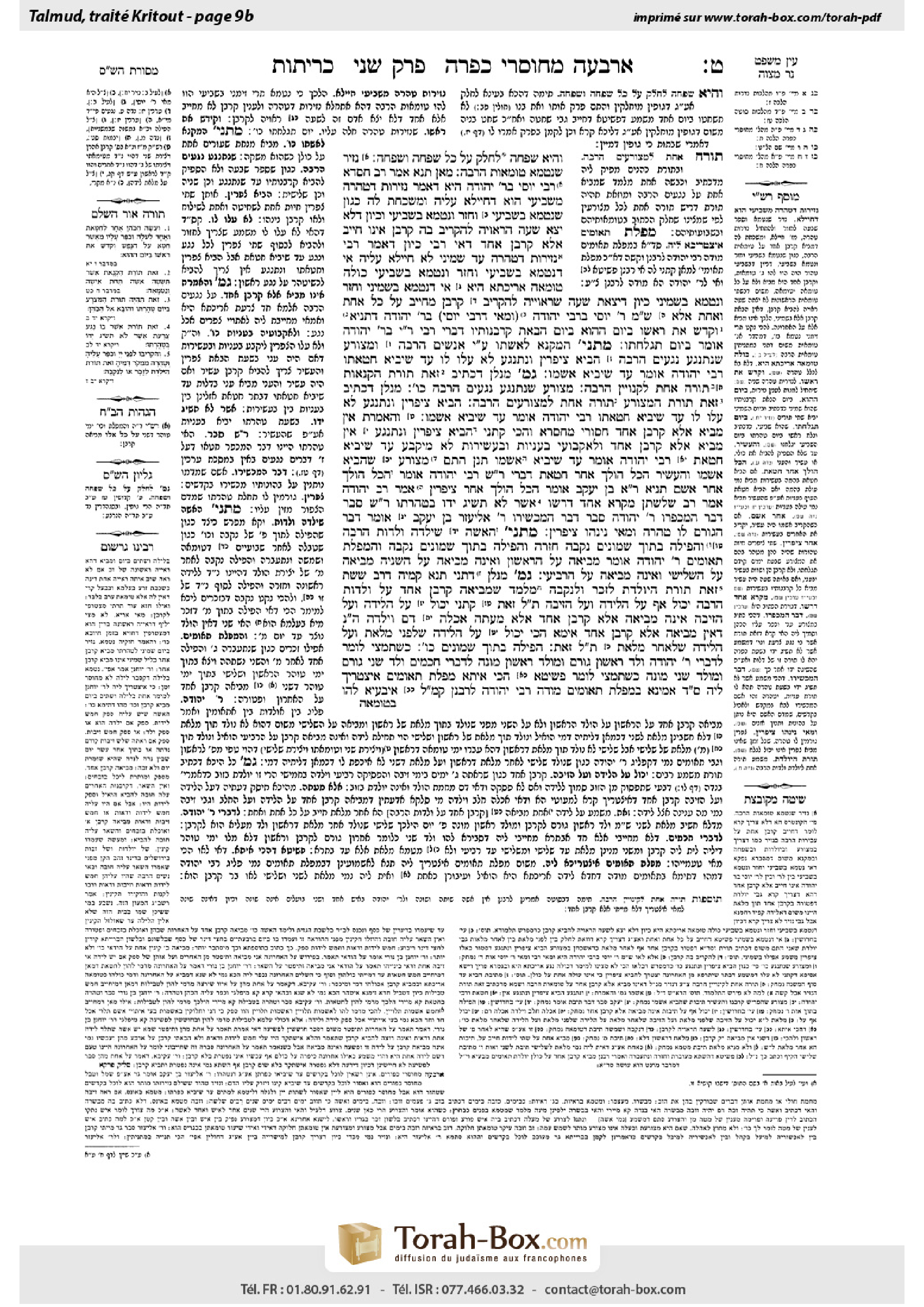
Keritot 9b: Talmud study for Daf Yomi
Daf Yomi is the daily study of one Talmud folio. Explore 37 tractates with scans, Hebrew text, Sefaria English and AI-generated French translations where annotated.
Passage selection and English or AI-generated French translation are available where the scan has annotations. Daf Study is independent of Torah-Box and Sefaria.
Browse Keritot · כריתות · All tractatesKeritot 9b text and translations
This page of Keritot includes the Aramaic text, an English translation and an AI-generated French translation, alongside the scan above.
כריתות ט׳ ב · Aramaic and Hebrew text
וְהִיא שִׁפְחָה״ – לְחַלֵּק עַל כׇּל שִׁפְחָה וְשִׁפְחָה.
נָזִיר שֶׁנִּטְמָא טוּמְאוֹת הַרְבֵּה. מַאן תַּנָּא?
אָמַר רַב חִסְדָּא: רַבִּי יוֹסֵי בְּרַבִּי יְהוּדָה הִיא, דְּאָמַר: נְזִירוּת דְּטׇהֳרָה מִשְּׁבִיעִי הוּא דְּחָיְילָא עֲלֵיהּ. וּמַשְׁכַּחַת לַהּ כְּגוֹן שֶׁנִּטְמָא בַּשְּׁבִיעִי, וְחָזַר וְנִטְמָא בַּשְּׁבִיעִי, וְכֵיוָן דְּלֹא יָצָא שָׁעָה הָרְאוּיָה לְהַקְרִיב בָּהּ קׇרְבָּן – אֵינוֹ חַיָּיב אֶלָּא קׇרְבָּן אֶחָד.
דְּאִי רַבִּי, כֵּיוָן דְּאָמַר רַבִּי: נְזִירוּת דְּטׇהֳרָה עַד שְׁמִינִי לָא חָיְילָא עֲלֵיהּ, אִי דְּנִטְמָא בַּשְּׁבִיעִי וְחָזַר וְנִטְמָא בַּשְּׁבִיעִי – כּוּלַּהּ טוּמְאָה אֲרִיכְתָּא הִיא,
אִי דְּנִטְמָא בַּשְּׁמִינִי וְחָזַר וְנִטְמָא בַּשְּׁמִינִי, כֵּיוָן דְּיָצָאת שָׁעָה שֶׁרְאוּיָיה לְהַקְרִיב קׇרְבָּן – מְחַיֵּיב עַל כׇּל אַחַת וְאַחַת! אֶלָּא שְׁמַע מִינָּה רַבִּי יוֹסֵי בְּרַבִּי יְהוּדָה.
וּמַאי דְּרַבִּי יוֹסֵי בְּרַבִּי יְהוּדָה? דְּתַנְיָא: ״וְקִדַּשׁ אֶת רֹאשׁוֹ בַּיּוֹם הַהוּא״ – בְּיוֹם הֲבָאַת קׇרְבְּנוֹתָיו, דִּבְרֵי רַבִּי.
רַבִּי יוֹסֵי בְּרַבִּי יְהוּדָה אוֹמֵר: בְּיוֹם תִּגְלַחְתּוֹ.
מַתְנִי׳ הַמְקַנֵּא לְאִשְׁתּוֹ עַל יְדֵי אֲנָשִׁים הַרְבֵּה וּמְצוֹרָע שֶׁנִּתְנַגַּע נְגָעִים הַרְבֵּה,
הֵבִיא צִיפֳּרִין וְנִתְנַגֵּעַ – לֹא עָלוּ לוֹ עַד שֶׁיָּבִיא חַטָּאתוֹ, רַבִּי יְהוּדָה אוֹמֵר: עַד שֶׁיָּבִיא אֲשָׁמוֹ.
גְּמָ׳ מְנָלַן? דִּכְתִיב: ״זֹאת תּוֹרַת הַקְּנָאוֹת״ – תּוֹרָה אַחַת לְקִנּוּיִין הַרְבֵּה.
מְצוֹרָע שֶׁנִּתְנַגֵּעַ נְגָעִים הַרְבֵּה כּוּ׳. מְנָלַן? דִּכְתִיב: ״זֹאת תּוֹרַת הַמְּצוֹרָע״ – תּוֹרָה אַחַת לִמְצוֹרָעִים הַרְבֵּה.
הֵבִיא צִיפֳּרִין וְנִתְנַגֵּעַ – לֹא עָלוּ לוֹ עַד שֶׁיָּבִיא חַטָּאתוֹ, רַבִּי יְהוּדָה אוֹמֵר: עַד שֶׁיָּבִיא אֲשָׁמוֹ.
וְהָאָמְרַתְּ: אֵין מֵבִיא אֶלָּא קׇרְבָּן אֶחָד! חַסּוֹרֵי מִחַסְּרָא וְהָכִי קָתָנֵי: הֵבִיא צִיפֳּרִין וְנִתְנַגֵּעַ – אֵין מֵבִיא אֶלָּא קׇרְבָּן אֶחָד. וּלְאַקְבּוֹעֵי בַּעֲנִיּוּת וּבַעֲשִׁירוּת – לָא מִיקְּבַע, עַד שֶׁיָּבִיא חַטָּאת. רַבִּי יְהוּדָה אוֹמֵר: עַד שֶׁיָּבִיא אֲשָׁמוֹ.
תְּנַן הָתָם: מְצוֹרָע שֶׁהֵבִיא אֲשָׁמוֹ וְהֶעֱשִׁיר – הַכֹּל הוֹלֵךְ אַחַר חַטָּאת, דִּבְרֵי רַבִּי שִׁמְעוֹן. רַבִּי יְהוּדָה אוֹמֵר: הַכֹּל הוֹלֵךְ אַחַר אָשָׁם. תַּנְיָא רַבִּי אֱלִיעֶזֶר בֶּן, יַעֲקֹב אוֹמֵר: הַכֹּל הוֹלֵךְ אַחַר צִיפֳּרִין.
אָמַר רַב יְהוּדָה אָמַר רַב: שְׁלָשְׁתָּן מִקְרָא אֶחָד דָּרְשׁוּ – ״אֲשֶׁר לֹא תַשִּׂיג יָדוֹ בְּטׇהֳרָתוֹ״, רַבִּי שִׁמְעוֹן סָבַר: דָּבָר הַמְכַפְּרוֹ, רַבִּי יְהוּדָה סָבַר: דָּבָר הַמַּכְשִׁירוֹ, רַבִּי אֱלִיעֶזֶר בֶּן יַעֲקֹב אוֹמֵר: דָּבָר הַגּוֹרֵם לוֹ טׇהֳרָה, וּמַאי נִינְהוּ? צִיפֳּרִין.
מַתְנִי׳ הָאִשָּׁה שֶׁיָּלְדָה וְלָדוֹת הַרְבֵּה, וְהִפִּילָה בְּתוֹךְ שְׁמוֹנִים נְקֵבָה, חָזְרָה וְהִפִּילָה בְּתוֹךְ שְׁמוֹנִים נְקֵבָה,
וְהַמַּפֶּלֶת תְּאוֹמִים,
רַבִּי יְהוּדָה אוֹמֵר: מְבִיאָה עַל הָרִאשׁוֹן וְאֵינָהּ מְבִיאָה עַל הַשֵּׁנִי. מְבִיאָה עַל הַשְּׁלִישִׁי וְאֵינָהּ מְבִיאָה עַל הָרְבִיעִי.
גְּמָ׳ מְנָלַן? דְּתָנֵי תַּנָּא קַמֵּיהּ דְּרַב שֵׁשֶׁת: ״זֹאת תּוֹרַת הַיּוֹלֶדֶת לַזָּכָר וְלַנְּקֵבָה״ – מְלַמֵּד שֶׁמְּבִיאָה קׇרְבָּן אֶחָד עַל וְלָדוֹת הַרְבֵּה. יָכוֹל אַף עַל הַלֵּידָה וְעַל הַזִּיבָה? תַּלְמוּד לוֹמַר: ״זֹאת״.
קָתָנֵי: יָכוֹל עַל הַלֵּידָה וְעַל הַזִּיבָה אֵינָהּ מְבִיאָה אֶלָּא קׇרְבָּן אֶחָד. אֶלָּא מֵעַתָּה, אָכְלָה דָּם וְיָלְדָה, הָכִי נָמֵי דְּאֵין מְבִיאָה אֶלָּא קׇרְבָּן אֶחָד?
אֵימָא הָכִי: יָכוֹל עַל הַלֵּידָה שֶׁלִּפְנֵי מְלֹאת וְעַל הַלֵּידָה שֶׁלְּאַחַר מְלֹאת? תַּלְמוּד לוֹמַר: ״זֹאת״.
הִפִּילָה בְּתוֹךְ שְׁמוֹנִים כּוּ׳. כְּשֶׁתִּמְּצֵי לוֹמַר לְדִבְרֵי רַבִּי יְהוּדָה – וָלָד רִאשׁוֹן גּוֹרֵם וּמִוָּלָד רִאשׁוֹן מוֹנָה. לְדִבְרֵי חֲכָמִים – וָלָד שֵׁנִי גּוֹרֵם וּמִוָּלָד שֵׁנִי מוֹנָה.
כְּשֶׁתִּמְצֵי לוֹמַר? פְּשִׁיטָא, הָכִי אִיתָא! מַפֶּלֶת תְּאוֹמִים אִיצְטְרִיךְ לֵיהּ, סָלְקָא דַעְתָּךְ אָמֵינָא בְּמַפֶּלֶת תְּאוֹמִים מוֹדֶה רַבִּי יְהוּדָה לְרַבָּנַן, קָא מַשְׁמַע לַן.
אִיבַּעְיָא לְהוּ:
Keritot 9b · English translation
and she is a maidservant designated to a man” (Leviticus 19:20). This verse likewise serves to require separate offerings for each and every espoused maidservant.
§ The mishna teaches: A nazirite who became ritually impure with several instances of contact with ritual impurity brings one offering for several transgressions. The Gemara asks: Who is the tanna that taught this?
Rav Ḥisda said: It is the opinion of Rabbi Yosei, son of Rabbi Yehuda, who says: A new naziriteship of purity, which is required of a nazirite who became ritually impure, takes effect from the seventh day of the nazirite’s purification. And therefore, you find that the nazirite brings one offering for several transgressions in a case where he became impure on the seventh day of his purification, was pure for seven days, and again became impure on the seventh day of his purification. And since for each case where he became impure the appropriate time to sacrifice an offering, i.e., the eighth day of his purification, had not yet emerged, he is liable to bring only one offering.
Rav Ḥisda explains: The mishna must be in accordance with the opinion of Rabbi Yosei, son of Rabbi Yehuda, as if it follows the opinion of Rabbi Yehuda HaNasi, then it is not possible for a nazirite to bring one offering for several transgressions, since Rabbi Yehuda HaNasi says: A new naziriteship of purity does not take effect until a nazirite’s eighth day of purification. If there was a case where a nazirite became impure on the seventh day of his purification, was pure for seven days, and then became impure again on the seventh day of his purification, according to Rabbi Yehuda HaNasi, that is all one long period of impurity, as the new term of naziriteship has not yet begun, and therefore the nazirite brings one offering for the entire period.
And if there was a case where a nazirite became impure on the eighth day of his purification, was pure for seven days, and then again became impure on the eighth day of his purification, then since the appropriate time to sacrifice an offering had emerged, he is obligated to bring an offering for each and every time he became impure. Rav Ḥisda concludes: Rather, conclude from it that the mishna is in accordance with the opinion of Rabbi Yosei, son of Rabbi Yehuda.
The Gemara clarifies: And what is the statement of Rabbi Yosei, son of Rabbi Yehuda? As it is taught in a baraita: The verse states with regard to a nazirite who begins a new naziriteship of purity after having become impure: “And on the eighth day he shall bring two doves or two pigeons…And the priest shall prepare one for a sin offering and the other for a burnt offering, and make atonement for him, for that he sinned by reason of the dead; and he shall sanctify his head on that day” (Numbers 6:10–11). This teaches that the new term of naziriteship begins on the day of the bringing of his offerings, which is the eighth day of his purification. This is the statement of Rabbi Yehuda HaNasi.
By contrast, Rabbi Yosei, son of Rabbi Yehuda, says: The verse means that the new term of naziriteship begins on the day of his shaving, i.e., the seventh day of his purification.
MISHNA: The mishna continues to list the five situations in which one offering is brought to atone for several transgressions: Third, one who issues a warning to his wife declaring himself jealous with regard to several different men with whom he suspects her of committing adultery, and forbidding her to be alone with them. If the wife was then found separately in seclusion with each of the men, he brings her to the Temple with one single meal offering of jealousy. And fourth, a leper who was afflicted with several instances of leprosy, meaning that he was purified from his leprosy, and before he brought his offerings, he suffered a relapse of the leprosy. When he is finally purified, he brings only one set of offerings.
If a leper brought the two requisite birds on the first day of his purification (see Leviticus 14:4–7), and prior to bringing his offerings on the eighth day of his purification he was afflicted with a relapse of leprosy, those birds do not satisfy his obligation until he brings his sin offering. Rabbi Yehuda says: Until he brings his guilt offering.
GEMARA: The mishna teaches that if a man issues a warning to his wife with regard to several different men, and the wife violates the warning and is secluded with each of them, he brings one meal offering of jealousy. The Gemara asks: From where do we derive this halakha? The Gemara answers that it is as it is written: “This is the law of jealousies, when a wife, being under her husband, goes aside, and is defiled” (Numbers 5:29). The plural form of the word “jealousies,” teaches that one law, meaning one sacrificial offering, can suffice for several jealousies, i.e., different warnings.
The mishna teaches that a leper who was afflicted with several instances of leprosy brings one single offering. The Gemara asks: From where do we derive this halakha? The Gemara answers that it is as it is written: “This shall be the law of the leper in the day of his purification” (Leviticus 14:2). The term “the law” teaches that one law, meaning one sacrificial offering, can suffice for several lepers, i.e., for several instances of leprosy in the same individual.
§ The mishna teaches: If a leper brought the two birds on the first day of his purification, and prior to bringing his offerings on the eighth day of his purification he was afflicted with a relapse of leprosy, those birds do not satisfy his obligation until he brings his sin offering. Rabbi Yehuda says: Until he brings his guilt offering. This apparently means that when he is healed from the relapse of his leprosy, he must bring additional birds to fulfill the obligation generated by the first instance of leprosy.
The Gemara challenges this assumption: But didn’t you say in the mishna that he brings only one set of offerings for several instances of leprosy? The Gemara answers: The text of the mishna is incomplete, and this is what it is teaching: In the case of a leper who was afflicted with several instances of leprosy and was subsequently purified from his leprosy, if he brought the two birds, and was then afflicted with a relapse of leprosy, he brings only one set of offerings. But with regard to establishing whether a leper has a status of poverty or of affluence in order to determine whether he brings a poor man’s offering or a rich man’s offering (see Leviticus, chapter 14), that is not established until he brings his sin offering. Rabbi Yehuda says: The leper’s status of poverty or affluence is not established until he brings his guilt offering.
The Gemara cites a dispute that supports this interpretation: We learned in a mishna there (Nega’im 14:11): In a case of a leper who was poor when he brought his guilt offering and then became wealthy before bringing the other offerings, all differences in offerings between a leper with the status of a rich man or a poor man follow his status at the time he brought his sin offering; this is the statement of Rabbi Shimon. Rabbi Yehuda says: It all follows his status at the time he brought his guilt offering. The Gemara cites an additional opinion: It is taught in a baraita that Rabbi Eliezer ben Ya’akov says: It all follows his status at the time he brought the two birds.
Rav Yehuda says that Rav says: All three of them interpreted the same verse to arrive at their respective opinions: “This is the law of he who has the mark of leprosy, whose means do not suffice for that which pertains to his purification” (Leviticus 14:32). Rabbi Shimon holds that the term “his purification” is referring to the matter that atones for his sin, i.e., the sin offering. Rabbi Yehuda holds that it is referring to the matter that renders him fit to consume sacrificial meat, which is the guilt offering. And Rabbi Eliezer ben Ya’akov says that it is referring to the matter that causes him to return to a state of purity. And what are these? The birds.
MISHNA: The mishna continues with the last of the five situations in which one offering is brought to atone for several transgressions: A woman who gave birth to several offspring. This is a case where a woman gave birth to a daughter, after which she is ritually impure for fourteen days and then enters a period of sixty-six days of ritual purity, even if she experiences uterine bleeding. Nevertheless, during this interim period, she is still somewhat impure, and it is therefore prohibited for her to enter the Temple or to partake of consecrated food, and at the end of the period she must bring an offering. And during those days of ritual purity, she became pregnant again and then miscarried a female fetus within the eighty days, and then became pregnant again and miscarried another female fetus within eighty days of the first miscarriage. In this situation, when she ultimately completes her process of purification, she brings one single offering for all the births and miscarriages.
And a similar halakha applies to a woman who miscarries multiple fetuses from a single pregnancy at different points in time, miscarrying each fetus before completing the purification period of forty days for a male or eighty days for a female for the previous fetus. When she finally completes her process of purification, she brings one single offering for all of the miscarriages.
Rabbi Yehuda says: In these cases, a single offering does not suffice for all the births or miscarriages. Rather, she brings an offering for the first birth or miscarriage and does not bring an offering for the second miscarriage, as it took place before the completion of the purification period for the first. She then brings an offering for the third miscarriage and does not bring an offering for the fourth fetus, as it was miscarried before the completion of the purification period for the third fetus.
GEMARA: The mishna teaches that a woman who gave birth to several offspring brings a single offering. The Gemara asks: From where do we derive this halakha? The Gemara explains: As the tanna taught a baraita before Rav Sheshet with regard to the verse: “This is the law for the woman who bears a child, whether a male or a female” (Leviticus 12:7). This teaches that she brings one offering for several offspring. One might have thought that she brings one single offering even in a case where she becomes purified simultaneously both for a birth and for an irregular discharge of blood from the uterus [ziva]. Therefore, the verse states: “This,” to exclude such a case.
The Gemara challenges the assumption that was refuted by the textual derivation: The tanna teaches: One might have thought that even in a case where she completes her purification at the same time for a birth and for ziva, she should bring only one offering. If that is so, then in a case where she consumed blood unintentionally, and is therefore liable to bring a sin offering, and she also gave birth, might one also have thought that she should bring only one offering? That is illogical, as these offerings are two completely different obligations. So too, the offerings after childbirth and ziva are two separate obligations.
The Gemara explains: Rather, say that this is what the tanna taught: One might have thought that she should bring only one offering for a birth that occurred before the completion of the term, i.e., the first birth, and for a birth that occurred after the completion of the purification period for the first one. Therefore, the verse states: “This,” to negate that assumption.
§ The mishna teaches that in a case of a woman who miscarried within the eighty-day purification period of a previous miscarriage, and then miscarried a third time within the eighty-day purification period for the second miscarriage, the first tanna says that she brings a single offering for all of them, and Rabbi Yehuda says that she must bring a separate offering for the third miscarriage, as it took place after the completion of the purification period for the first one. The Gemara states: When you analyze the matter you will find that one should say that according to Rabbi Yehuda, the first fetus is the one that causes the obligation of the offering, and she therefore counts the purification period from the birth or miscarriage of the first fetus; and according to the Rabbis, it is the second fetus that causes the obligation of the offering, and she counts the purification period from the birth or miscarriage of the second fetus.
The Gemara asks: Why was it necessary to state that when you analyze the matter you will find that one should say that according to Rabbi Yehuda the first fetus causes the obligation and according to the Rabbis it is the second fetus which causes the obligation? This is obvious, as it is stated explicitly. The Gemara answers: It was necessary for the Gemara to say this with regard to the case of a woman who miscarries multiple fetuses from the same pregnancy. It might enter your mind to say that in a case of a woman who miscarries multiple fetuses from the same pregnancy, Rabbi Yehuda concedes to the Rabbis that as the fetuses were in the womb together, their births are deemed a single event, and therefore the woman counts eighty days from the miscarriage of the second fetus. Consequently, the Gemara teaches us that Rabbi Yehuda disagrees with the Rabbis even in this case.
§ A dilemma was raised before the Sages:
Keritot 9b · Traduction française (IA)
« et elle est une servante désignée pour un homme » (Lévitique 19:20). Ce verset sert également à imposer des offrandes distinctes pour chacune des servantes promises à un homme.
§ La Michna enseigne : Un nazir qui a contracté l’impureté rituelle à plusieurs reprises apporte une offrande pour plusieurs transgressions. La Guemara demande : Quel est le tanna qui a enseigné cela ?
Rav Ḥisda dit : C’est l’opinion de Rabbi Yosei, fils de Rabbi Yehuda, qui affirme qu’un nouveau naziréat de pureté, requis d’un nazir qui a contracté l’impureté rituelle, prend effet à partir du septième jour de sa purification. Ainsi, le nazir apporte une offrande pour plusieurs transgressions dans le cas où il a contracté l’impureté le septième jour de sa purification, est resté pur pendant sept jours, puis a de nouveau contracté l’impureté le septième jour de sa purification. Et puisque, dans chacun des cas où il a contracté l’impureté, le moment où il aurait dû apporter une offrande, c’est-à-dire le huitième jour de sa purification, n’est pas encore arrivé, il n’est tenu d’apporter qu’une seule offrande.
Rav Ḥisda explique : La Michna doit être conforme à l’opinion de Rabbi Yosei, fils de Rabbi Yehuda. En effet, si elle suivait l’opinion de Rabbi Yehuda HaNasi, il serait impossible qu’un nazir apporte une seule offrande pour plusieurs transgressions, puisque Rabbi Yehuda HaNasi affirme qu’un nouveau naziréat de pureté ne prend effet qu’au huitième jour de purification du nazir. Si un nazir a contracté l’impureté le septième jour de sa purification, est resté pur pendant sept jours, puis a de nouveau contracté l’impureté le septième jour de sa purification, selon Rabbi Yehuda HaNasi, il s’agit d’une seule longue période d’impureté, car le nouveau naziréat n’a pas encore commencé. Le nazir apporte donc une seule offrande pour toute cette période.
Et si le nazir a contracté l’impureté le huitième jour de sa purification, est resté pur pendant sept jours, puis a de nouveau contracté l’impureté le huitième jour de sa purification, alors, puisque le moment où il aurait dû apporter une offrande est arrivé, il est tenu d’apporter une offrande pour chacune des fois où il a contracté l’impureté. Rav Ḥisda conclut : Il faut donc en déduire que la Michna est conforme à l’opinion de Rabbi Yosei, fils de Rabbi Yehuda.
La Guemara précise : Et quelle est l’opinion de Rabbi Yosei, fils de Rabbi Yehuda ? Comme il est enseigné dans une baraïta : Au sujet d’un nazir qui commence un nouveau naziréat de pureté après avoir contracté l’impureté, le verset dit : « Et le huitième jour, il apportera deux tourterelles ou deux jeunes pigeons… Le prêtre offrira l’un en sacrifice expiatoire et l’autre en holocauste, et fera expiation pour lui, parce qu’il a péché à cause du mort ; et il consacrera sa tête en ce jour » (Nombres 6:10–11). Cela enseigne que le nouveau naziréat commence le jour où il apporte ses offrandes, c’est-à-dire le huitième jour de sa purification. Telle est l’opinion de Rabbi Yehuda HaNasi.
En revanche, Rabbi Yosei, fils de Rabbi Yehuda, affirme que le verset signifie que le nouveau naziréat commence le jour où il se rase, c’est-à-dire le septième jour de sa purification.
MICHNA : La Michna poursuit l’énumération des cinq situations dans lesquelles une offrande expie plusieurs transgressions. Troisièmement, un homme qui avertit sa femme, déclarant qu’il est jaloux au sujet de plusieurs hommes différents avec lesquels il la soupçonne d’adultère, et lui interdisant de s’isoler avec eux. Si sa femme est ensuite trouvée isolée à part avec chacun de ces hommes, il l’amène au Temple avec une seule offrande de jalousie. Quatrièmement, un lépreux qui a connu plusieurs épisodes de lèpre : il a été purifié de sa lèpre puis, avant d’apporter ses offrandes, a subi une rechute. Lorsqu’il est finalement purifié, il n’apporte qu’un seul ensemble d’offrandes.
Si un lépreux a apporté les deux oiseaux requis le premier jour de sa purification (voir Lévitique 14:4–7), puis a subi une rechute de lèpre avant d’apporter ses offrandes le huitième jour de sa purification, ces oiseaux ne satisfont pas à son obligation tant qu’il n’a pas apporté son sacrifice expiatoire. Rabbi Yehuda dit : tant qu’il n’a pas apporté son sacrifice de culpabilité.
GUEMARA : La Michna enseigne que si un homme avertit sa femme au sujet de plusieurs hommes différents et que sa femme enfreint l’avertissement en s’isolant avec chacun d’eux, il apporte une seule offrande de jalousie. La Guemara demande : D’où déduisons-nous cette halakha ? La Guemara répond que c’est ce qui est écrit : « Telle est la loi des jalousies, lorsqu’une femme, sous l’autorité de son mari, se détourne et se souille » (Nombres 5:29). La forme plurielle du mot « jalousies » enseigne qu’une seule loi, c’est-à-dire une seule offrande sacrificielle, peut suffire pour plusieurs jalousies, autrement dit pour plusieurs avertissements différents.
La Michna enseigne qu’un lépreux qui a connu plusieurs épisodes de lèpre apporte une seule offrande. La Guemara demande : D’où déduisons-nous cette halakha ? La Guemara répond que c’est ce qui est écrit : « Telle sera la loi du lépreux, le jour de sa purification » (Lévitique 14:2). L’expression « la loi » enseigne qu’une seule loi, c’est-à-dire une seule offrande sacrificielle, peut suffire pour plusieurs lépreux, autrement dit pour plusieurs épisodes de lèpre chez un même individu.
§ La Michna enseigne : Si un lépreux a apporté les deux oiseaux le premier jour de sa purification, puis a subi une rechute de lèpre avant d’apporter ses offrandes le huitième jour de sa purification, ces oiseaux ne satisfont pas à son obligation tant qu’il n’a pas apporté son sacrifice expiatoire. Rabbi Yehuda dit : tant qu’il n’a pas apporté son sacrifice de culpabilité. Cela semble signifier que, lorsqu’il est guéri de la rechute de lèpre, il doit apporter des oiseaux supplémentaires pour s’acquitter de l’obligation née du premier épisode de lèpre.
La Guemara conteste cette hypothèse : Mais n’as-tu pas dit dans la Michna qu’il n’apporte qu’un seul ensemble d’offrandes pour plusieurs épisodes de lèpre ? La Guemara répond : Le texte de la Michna est incomplet, et voici ce qu’elle enseigne : dans le cas d’un lépreux qui a connu plusieurs épisodes de lèpre et a ensuite été purifié, s’il a apporté les deux oiseaux puis subi une rechute de lèpre, il n’apporte qu’un seul ensemble d’offrandes. Cependant, pour déterminer si le lépreux a le statut de pauvre ou de riche, afin de savoir s’il apporte l’offrande d’un pauvre ou celle d’un riche (voir Lévitique, chapitre 14), son statut n’est établi qu’au moment où il apporte son sacrifice expiatoire. Rabbi Yehuda dit : le statut de pauvre ou de riche du lépreux n’est établi qu’au moment où il apporte son sacrifice de culpabilité.
La Guemara cite une controverse à l’appui de cette interprétation. Nous avons appris dans une Michna, là-bas (Nega’im 14:11) : dans le cas d’un lépreux qui était pauvre lorsqu’il a apporté son sacrifice de culpabilité, puis est devenu riche avant d’apporter les autres offrandes, toutes les différences entre les offrandes dues par un lépreux ayant le statut de riche et celles dues par un lépreux ayant le statut de pauvre dépendent de son statut au moment où il a apporté son sacrifice expiatoire. Telle est l’opinion de Rabbi Shimon. Rabbi Yehuda dit : tout dépend de son statut au moment où il a apporté son sacrifice de culpabilité. La Guemara cite une opinion supplémentaire : il est enseigné dans une baraïta que Rabbi Eliezer ben Ya’akov dit : tout dépend de son statut au moment où il a apporté les deux oiseaux.
Rav Yehuda dit au nom de Rav : tous trois ont interprété le même verset pour parvenir à leurs opinions respectives : « Telle est la loi de celui qui est atteint d’une marque de lèpre, dont les moyens ne suffisent pas pour ce qui concerne sa purification » (Lévitique 14:32). Rabbi Shimon estime que l’expression « sa purification » désigne ce qui expie son péché, c’est-à-dire le sacrifice expiatoire. Rabbi Yehuda estime qu’elle désigne ce qui le rend apte à consommer de la viande consacrée, c’est-à-dire le sacrifice de culpabilité. Rabbi Eliezer ben Ya’akov dit qu’elle désigne ce qui le fait revenir à un état de pureté. Et qu’est-ce donc ? Les oiseaux.
MICHNA : La Michna poursuit avec la dernière des cinq situations dans lesquelles une offrande expie plusieurs transgressions : une femme qui a mis au monde plusieurs enfants. Il s’agit d’une femme qui a donné naissance à une fille ; elle est alors rituellement impure pendant quatorze jours, puis entre dans une période de soixante-six jours de pureté rituelle, même si elle a des saignements utérins. Néanmoins, pendant cette période intermédiaire, elle reste quelque peu impure ; il lui est donc interdit d’entrer dans le Temple ou de consommer des aliments consacrés, et elle doit apporter une offrande à la fin de cette période. Au cours de ces jours de pureté rituelle, elle est de nouveau tombée enceinte, puis a fait une fausse couche d’un fœtus féminin au cours des quatre-vingts jours. Elle est ensuite de nouveau tombée enceinte et a fait une autre fausse couche d’un fœtus féminin dans les quatre-vingts jours suivant la première fausse couche. Dans ce cas, lorsqu’elle achève finalement son processus de purification, elle apporte une seule offrande pour toutes les naissances et les fausses couches.
Une halakha semblable s’applique à une femme qui fait plusieurs fausses couches de fœtus issus d’une même grossesse à des moments différents, chaque fœtus étant expulsé avant qu’elle ait achevé la période de purification de quarante jours pour un garçon ou de quatre-vingts jours pour une fille, relative au fœtus précédent. Lorsqu’elle achève finalement son processus de purification, elle apporte une seule offrande pour toutes les fausses couches.
Rabbi Yehuda dit : dans ces cas, une seule offrande ne suffit pas pour toutes les naissances ou fausses couches. Elle apporte plutôt une offrande pour la première naissance ou fausse couche et n’en apporte pas pour la deuxième fausse couche, puisqu’elle a eu lieu avant la fin de la période de purification relative à la première. Elle apporte ensuite une offrande pour la troisième fausse couche et n’en apporte pas pour le quatrième fœtus, puisqu’il a été expulsé avant la fin de la période de purification relative au troisième fœtus.
GUEMARA : La Michna enseigne qu’une femme qui a mis au monde plusieurs enfants apporte une seule offrande. La Guemara demande : D’où déduisons-nous cette halakha ? La Guemara explique : le tanna enseigna une baraïta devant Rav Sheshet à propos du verset : « Telle est la loi concernant la femme qui met au monde un enfant, qu’il soit mâle ou femelle » (Lévitique 12:7). Cela enseigne qu’elle apporte une offrande pour plusieurs enfants. On aurait pu penser qu’elle apporte une seule offrande même dans le cas où elle achève simultanément sa purification pour une naissance et pour un écoulement irrégulier de sang utérin [ziva]. Le verset dit donc : « Telle », afin d’exclure ce cas.
La Guemara conteste l’hypothèse réfutée par la déduction tirée du texte : le tanna enseigne qu’on aurait pu penser que, même si elle achève simultanément sa purification pour une naissance et pour une ziva, elle ne devrait apporter qu’une seule offrande. Dans ce cas, si elle avait consommé du sang involontairement et était donc tenue d’apporter un sacrifice expiatoire, tout en ayant également mis au monde un enfant, aurait-on aussi pu penser qu’elle ne devait apporter qu’une seule offrande ? Ce serait illogique, car ces offrandes correspondent à deux obligations entièrement différentes. De même, les offrandes dues après un accouchement et celles dues pour une ziva correspondent à deux obligations distinctes.
La Guemara explique : Il faut plutôt comprendre que voici ce qu’enseignait le tanna : on aurait pu penser qu’elle ne devait apporter qu’une seule offrande pour une naissance survenue avant la fin de la période, c’est-à-dire la première naissance, et pour une naissance survenue après la fin de la période de purification relative à la première. Le verset dit donc : « Telle », afin d’écarter cette hypothèse.
§ La Michna enseigne que, dans le cas d’une femme qui fait une fausse couche au cours de la période de purification de quatre-vingts jours relative à une fausse couche précédente, puis une troisième fausse couche au cours de la période de purification de quatre-vingts jours relative à la deuxième, le premier tanna affirme qu’elle apporte une seule offrande pour toutes, tandis que Rabbi Yehuda dit qu’elle doit apporter une offrande distincte pour la troisième fausse couche, puisqu’elle a eu lieu après la fin de la période de purification relative à la première. La Guemara déclare : à l’examen, on conclut que, selon Rabbi Yehuda, c’est le premier fœtus qui entraîne l’obligation d’apporter l’offrande ; elle compte donc la période de purification à partir de la naissance ou de la fausse couche du premier fœtus. Selon les Rabbins, c’est le deuxième fœtus qui entraîne cette obligation, et elle compte la période de purification à partir de la naissance ou de la fausse couche du deuxième fœtus.
La Guemara demande : Pourquoi était-il nécessaire de dire qu’à l’examen, on conclut que, selon Rabbi Yehuda, le premier fœtus entraîne l’obligation, tandis que, selon les Rabbins, c’est le deuxième fœtus qui l’entraîne ? Cela est évident, puisque c’est énoncé explicitement. La Guemara répond : il était nécessaire de le préciser à propos du cas d’une femme qui fait une fausse couche de plusieurs fœtus issus de la même grossesse. On aurait pu penser que, dans ce cas, Rabbi Yehuda admet aux Rabbins que, puisque les fœtus se trouvaient ensemble dans l’utérus, leurs naissances sont considérées comme un seul événement, et que la femme compte donc quatre-vingts jours à partir de la fausse couche du deuxième fœtus. La Guemara nous enseigne donc que Rabbi Yehuda est en désaccord avec les Rabbins même dans ce cas.
§ Une question fut soulevée devant les Sages :
Traduction française générée par IA à partir de l’édition anglaise de Sefaria. Vérifie toujours un passage avec le texte source.
Text from Sefaria: William Davidson Edition - Vocalized Aramaic (CC BY NC); William Davidson Edition - English (CC BY NC).