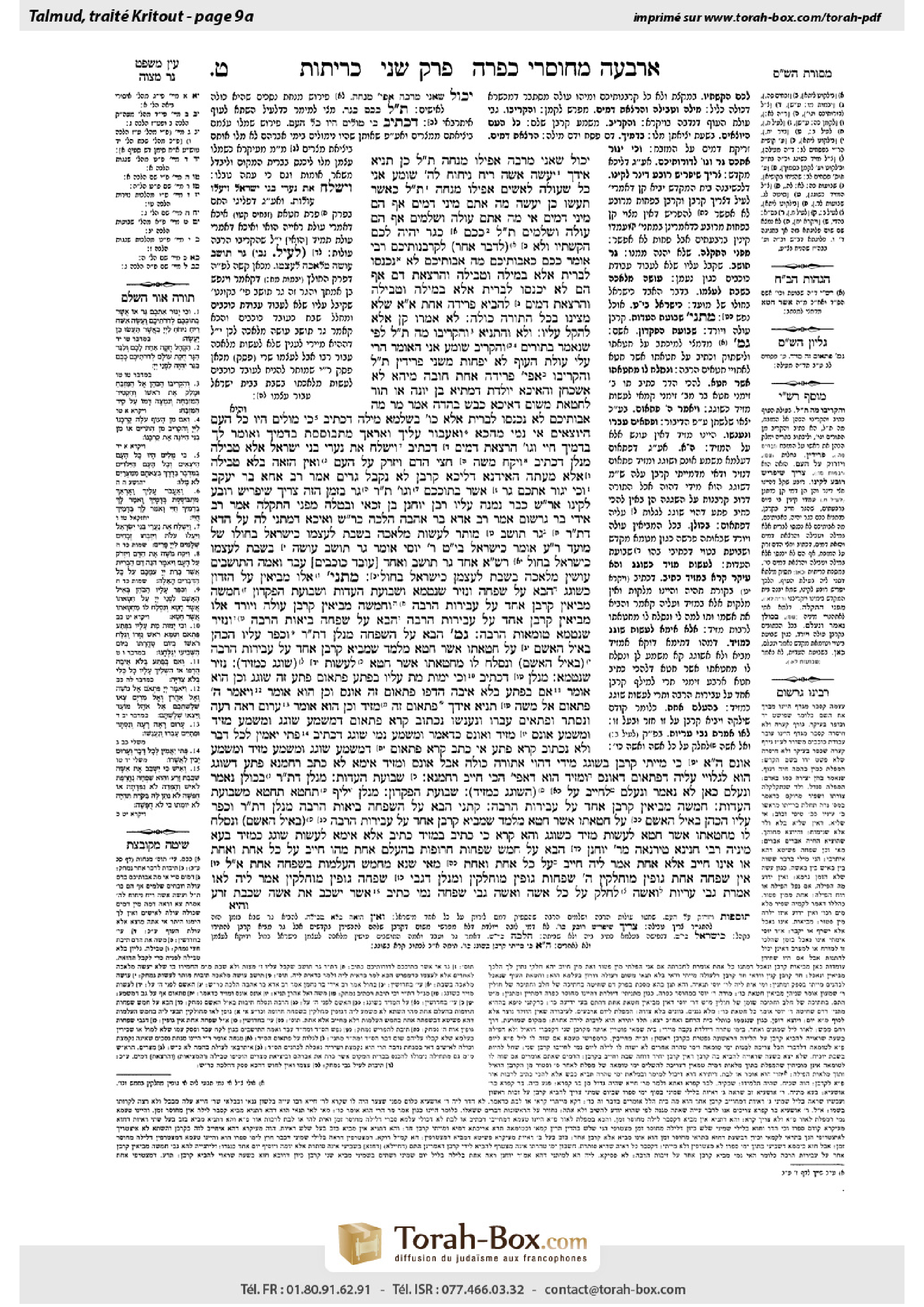
Keritot 9a: Talmud study for Daf Yomi
Daf Yomi is the daily study of one Talmud folio. Explore 37 tractates with scans, Hebrew text, Sefaria English and AI-generated French translations where annotated.
Passage selection and English or AI-generated French translation are available where the scan has annotations. Daf Study is independent of Torah-Box and Sefaria.
Browse Keritot · כריתות · All tractatesKeritot 9a text and translations
This page of Keritot includes the Aramaic text, an English translation and an AI-generated French translation, alongside the scan above.
כריתות ט׳ א · Aramaic and Hebrew text
יָכוֹל שֶׁאֲנִי מְרַבֶּה אֲפִילּוּ מִנְחָה? תַּלְמוּד לוֹמַר: ״כֵּן״.
תַּנְיָא אִידַּךְ: ״וְעָשָׂה אִשֵּׁה רֵיחַ נִיחוֹחַ לַה׳״, שׁוֹמֵעַ אֲנִי כֹּל שֶׁעוֹלֶה לָאִשִּׁים, אֲפִילּוּ מִנְחָה? תַּלְמוּד לוֹמַר: ״כַּאֲשֶׁר תַּעֲשׂוּ כֵּן יַעֲשֶׂה״ – מָה אַתֶּם מִינֵי דָמִים, אַף הֵם מִינֵי דָמִים.
אִי מָה אַתֶּם עוֹלָה וּשְׁלָמִים, אַף הֵם עוֹלָה וּשְׁלָמִים! תַּלְמוּד לוֹמַר: ״כָּכֶם כַּגֵּר יִהְיֶה״ – לָכֶם הִקַּשְׁתִּיו, וְלֹא לְדָבָר אַחֵר, לְקׇרְבְּנוֹתֵיכֶם.
רַבִּי אוֹמֵר: ״כָּכֶם״ – כַּאֲבוֹתֵיכֶם, מָה אֲבוֹתֵיכֶם לֹא נִכְנְסוּ לַבְּרִית אֶלָּא בְּמִילָה וּטְבִילָה וְהַרְצָאַת דָּם – אַף הֵם לֹא יִכָּנְסוּ לַבְּרִית אֶלָּא בְּמִילָה וּטְבִילָה וְהַרְצָאַת דָּמִים.
לְהָבִיא פְּרִידָה אַחַת – אִי אֶפְשָׁר, שֶׁלֹּא מָצִינוּ בְּכׇל הַתּוֹרָה כּוּלָּהּ. לֹא אָמְרוּ קֵן אֶלָּא לְהָקֵל עָלָיו.
וְלָא? וְהָתַנְיָא: ״וְהִקְרִיבוֹ״, מָה תַּלְמוּד לוֹמַר? לְפִי שֶׁנֶּאֱמַר בְּתוֹרִים: ״וְהִקְרִיב״, שׁוֹמֵעַ אֲנִי הָאוֹמֵר: ״הֲרֵי עָלַי עוֹלַת הָעוֹף״ לֹא יִפְחוֹת מִשְּׁנֵי פְרִידִין? תַּלְמוּד לוֹמַר: ״וְהִקְרִיבוֹ״ – אֲפִילּוּ פְּרִידָה אַחַת! – חוֹבָה מִיהָא לָא אַשְׁכְּחַן.
וְהָאִיכָּא יוֹלֶדֶת, דְּמַתְיָא בֶּן יוֹנָה אוֹ תוֹר לְחַטָּאת! – מִשּׁוּם דְּאִיכָּא כֶּבֶשׂ בַּהֲדַהּ.
אָמַר מָר: מָה אֲבוֹתֵיכֶם לֹא נִכְנְסוּ לַבְּרִית אֶלָּא כּוּ׳. בִּשְׁלָמָא מִילָה, דִּכְתִיב: ״כִּי מוּלִים הָיוּ כׇּל הָעָם הַיּוֹצְאִים״, אִי נָמֵי מֵהָכָא: ״וְאֶעֱבוֹר עָלַיִךְ וָאֶרְאֵךְ מִתְבּוֹסֶסֶת בְּדָמָיִךְ וָאוֹמַר לָךְ בְּדָמַיִךְ חֲיִי וְגוֹ׳״.
הַרְצָאַת דָּמִים, דִּכְתִיב: ״וַיִּשְׁלַח אֶת נַעֲרֵי בְּנֵי יִשְׂרָאֵל״. אֶלָּא טְבִילָה מְנָלַן? דִּכְתִיב: ״וַיִּקַּח מֹשֶׁה חֲצִי הַדָּם וְיִזְרוֹק עַל הָעָם״ – וְאֵין הַזָּאָה בְּלֹא טְבִילָה.
אֶלָּא מֵעַתָּה, הָאִידָּנָא דְּלֵיכָּא קׇרְבָּן לָא נְקַבֵּל גֵּרִים! אָמַר רַב אַחָא בַּר יַעֲקֹב: ״וְכִי יָגוּר אִתְּכֶם גֵּר אֲשֶׁר בְּתוֹכְכֶם וְגוֹ׳״.
תָּנוּ רַבָּנַן: גֵּר בִּזְמַן הַזֶּה – צָרִיךְ שֶׁיַּפְרִישׁ רוֹבַע לְקִינּוֹ. אָמַר רַבִּי שִׁמְעוֹן: כְּבָר נִמְנָה (עָלָיו) [עָלֶיהָ] רַבָּן יוֹחָנָן בֶּן זַכַּאי וּבִטְּלָהּ, מִפְּנֵי הַתַּקָּלָה. אָמַר רַב אִידִי בַּר גֵּרְשׁוֹם אָמַר רַב אַדָּא בַּר אַהֲבָה: הֲלָכָה כְּרַבִּי שִׁמְעוֹן.
וְאִיכָּא דְמַתְנֵי לַהּ עַל הָדָא, דְּתָנוּ רַבָּנַן: גֵּר תּוֹשָׁב מוּתָּר לַעֲשׂוֹת מְלָאכָה בְּשַׁבָּת לְעַצְמוֹ כְּיִשְׂרָאֵל בְּחוּלּוֹ שֶׁל מוֹעֵד.
רַבִּי עֲקִיבָא אוֹמֵר: כְּיִשְׂרָאֵל בְּיוֹם טוֹב. רַבִּי יוֹסֵי אוֹמֵר: גֵּר תּוֹשָׁב עוֹשֶׂה בַּשַּׁבָּת לְעַצְמוֹ כְּיִשְׂרָאֵל בַּחוֹל. רַבִּי שִׁמְעוֹן אוֹמֵר: אֶחָד גֵּר תּוֹשָׁב וְאֶחָד עֶבֶד וְאָמָה הַתּוֹשָׁבִים עוֹשִׂין מְלָאכָה בַּשַּׁבָּת לְעַצְמָן כְּיִשְׂרָאֵל בַּחוֹל.
מַתְנִי׳ אֵלּוּ מְבִיאִין עַל הַזָּדוֹן כַּשּׁוֹגֵג: הַבָּא עַל שִׁפְחָה, וְנָזִיר שֶׁנִּטְמָא, וּשְׁבוּעַת הָעֵדוּת, וּשְׁבוּעַת הַפִּקָּדוֹן.
חֲמִשָּׁה מְבִיאִין קׇרְבָּן אֶחָד עַל עֲבֵירוֹת הַרְבֵּה, וַחֲמִשָּׁה מְבִיאִין קׇרְבָּן עוֹלֶה וְיוֹרֵד. אֵלּוּ מְבִיאִין קׇרְבָּן אֶחָד עַל עֲבֵירוֹת הַרְבֵּה: הַבָּא עַל שִׁפְחָה בִּיאוֹת הַרְבֵּה, וְנָזִיר שֶׁנִּטְמָא טוּמְאוֹת הַרְבֵּה.
גְּמָ׳ הַבָּא עַל הַשִּׁפְחָה, מְנָלַן?
דְּתָנוּ רַבָּנַן: ״וְכִפֶּר עָלָיו הַכֹּהֵן בְּאֵיל הָאָשָׁם עַל חַטָּאתוֹ אֲשֶׁר חָטָא״, מְלַמֵּד שֶׁמֵּבִיא קׇרְבָּן אֶחָד עַל עֲבֵירוֹת הַרְבֵּה. ״בְּאֵיל הָאָשָׁם... וְנִסְלַח לוֹ מֵחַטָּאתוֹ אֲשֶׁר חָטָא״ – לַעֲשׂוֹת שׁוֹגֵג כְּמֵזִיד.
נָזִיר שֶׁנִּטְמָא, מְנָלַן?
דִּכְתִיב: ״וְכִי יָמוּת מֵת עָלָיו בְּפֶתַע פִּתְאוֹם״, ״פֶּתַע״ – זֶה שׁוֹגֵג, וְכֵן הוּא אוֹמֵר: ״אִם בְּפֶתַע בְּלֹא אֵיבָה הֲדָפוֹ״, ״פִּתְאוֹם״ – זֶה אוֹנֶס, וְכֵן הוּא אוֹמֵר: ״וַיֹּאמֶר ה׳ פִּתְאֹם אֶל מֹשֶׁה״.
תַּנְיָא אִידַּךְ: ״פִּתְאוֹם״ – זֶה מֵזִיד, וְכֵן הוּא אוֹמֵר: ״עָרוּם רָאָה רָעָה וְנִסְתָּר וּפְתָאִים עָבְרוּ וְנֶעֱנָשׁוּ״.
נִכְתּוֹב קְרָא ״פִּתְאוֹם״, דְּמַשְׁמַע שׁוֹגֵג, וּמַשְׁמַע מֵזִיד, וּמַשְׁמַע אוֹנֶס. מֵזִיד וְאוֹנֶס – כְּדַאֲמַרַן, וּמַשְׁמַע נָמֵי שׁוֹגֵג, דִּכְתִיב: ״פֶּתִי יַאֲמִין לְכׇל דָּבָר״, וְלָא נִכְתּוֹב קְרָא ״פֶּתַע״!
אִי כְּתַב קְרָא ״פִּתְאוֹם״, דְּמַשְׁמַע שׁוֹגֵג וּמַשְׁמַע מֵזִיד וּמַשְׁמַע אוֹנֶס, הֲוָה אָמֵינָא: כִּי מַיְיתֵי קׇרְבָּן – בְּשׁוֹגֵג, מִידֵּי דְּהָוֵי אַתּוֹרָה כּוּלַּהּ, אֲבָל אוֹנֶס וּמֵזִיד אֵימָא לָא,
כְּתַב רַחֲמָנָא ״פֶּתַע״, דְּשׁוֹגֵג הוּא, לְגַלּוֹיֵי עֲלֵיהּ דְּפִתְאוֹם דְּאוֹנֶס וּמֵזִיד הוּא, דַּאֲפִילּוּ הָכִי חַיֵּיב רַחֲמָנָא.
שְׁבוּעַת הָעֵדוּת, מְנָלַן? דְּתָנוּ רַבָּנַן: בְּכוּלָּן נֶאֱמַר ״וְנֶעְלַם״, כָּאן לֹא נֶאֱמַר ״וְנֶעְלַם״ – לְחַיֵּיב עַל הַשּׁוֹגֵג כְּמֵזִיד.
שְׁבוּעַת הַפִּקָּדוֹן, מְנָלַן? יָלֵיף ״תֶּחְטָא״ ״תֶּחְטָא״ מִשְּׁבוּעַת הָעֵדוּת.
חֲמִשָּׁה מְבִיאִין קׇרְבָּן אֶחָד עַל עֲבֵירוֹת הַרְבֵּה. קָתָנֵי: הַבָּא עַל הַשִּׁפְחָה בִּיאוֹת הַרְבֵּה. מְנָלַן?
דְּתָנוּ רַבָּנַן: ״וְכִפֶּר עָלָיו הַכֹּהֵן בְּאֵיל הָאָשָׁם עַל חַטָּאתוֹ אֲשֶׁר חָטָא״, מְלַמֵּד שֶׁמֵּבִיא קׇרְבָּן אֶחָד עַל עֲבֵירוֹת הַרְבֵּה. ״בְּאֵיל הָאָשָׁם וְנִסְלַח לוֹ מֵחַטָּאתוֹ אֲשֶׁר חָטָא״ – לַעֲשׂוֹת מֵזִיד כְּשׁוֹגֵג.
וְהָא קְרָא, כִּי כְּתִיב – בְּמֵזִיד כְּתִיב! אֶלָּא אֵימָא: לַעֲשׂוֹת שׁוֹגֵג כְּמֵזִיד.
בְּעָא מִינֵּיהּ רַבִּי חֲנִינָא טִירְנָאָה מֵרַבִּי יוֹחָנָן: הַבָּא עַל חָמֵשׁ שְׁפָחוֹת חֲרוּפוֹת בְּהֶעְלֵם אֶחָד, מַהוּ? חַיָּיב עַל כָּל אַחַת וְאַחַת, אוֹ אֵינוֹ חַיָּיב אֶלָּא אַחַת? אֲמַר לֵיהּ: חַיָּיב עַל כָּל אַחַת וְאַחַת.
מַאי שְׁנָא מֵחֲמִשָּׁ[ה] הֶעְלֵמוֹת בְּשִׁפְחָה אַחַת? אֲמַר לֵיהּ: (אֵין) שִׁפְחָה אַחַת [אֵין] גּוּפִין מוּחְלָקִין, חָמֵשׁ שְׁפָחוֹת גּוּפִין מוּחְלָקִין.
וּמְנָלַן דְּגַבֵּי שִׁפְחָה גּוּפִין מוּחְלָקִין? אֲמַר לֵיהּ: לָאו אָמְרַתְּ גַּבֵּי עֲרָיוֹת ״וְאִשָּׁה״ – לְחַלֵּק עַל כׇּל אִשָּׁה וְאִשָּׁה? גַּבֵּי שִׁפְחָה נָמֵי כְּתִיב: ״אֲשֶׁר יִשְׁכַּב אֶת אִשָּׁה שִׁכְבַת זֶרַע
Keritot 9a · English translation
The baraita continues: One might have thought that I include as an option even a meal offering, which would not be entirely consumed on the altar. Therefore, the verse states: “So he shall do,” to exclude a meal offering.
It is taught in another baraita: The verse states: “And if a stranger sojourn with you, or whoever may be among you, throughout your generations, and will offer an offering made by fire, of a pleasing aroma unto the Lord, as you do, so he shall do” (Numbers 15:14).From this verse I would derive that he fulfills his obligation with any offering that is brought on the fire of the altar, even a meal offering. Therefore, to negate that interpretation, the verse states: “As you do, so he shall do,” which teaches that just as you entered the covenant with types of offerings whose blood is sprinkled on the altar, so too must they, converts, bring types of offerings whose blood is sprinkled on the altar.
The baraita continues: If so, why not derive similarly: Just as you entered the covenant with a burnt offering and a peace offering, so too, they must enter the covenant with a burnt offering and a peace offering? How is it derived that a convert may fulfill his obligation with a single burnt offering from an animal? The baraita answers that the verse states: “As you are, so shall the stranger be before the Lord” (Numbers 15:15). This serves to emphasize: I compared him to you in order to derive that just like you, he too must bring types of offerings whose blood is sprinkled on the altar, but I did not extend this comparison to another matter, i.e., to insist that his offerings must be identical to all of your offerings.
The baraita continues: Rabbi Yehuda HaNasi says: The offering of a convert is derived from the verse: “As you are, so shall the stranger be” (Numbers 15:15), which means as your ancestors were: Just as your ancestors entered the covenant only through circumcision and immersion in a ritual bath and the sprinkling of blood on the altar, so too they may enter the covenant only through circumcision and immersion and the sprinkling of some blood, which requires at least a bird offering.
The baraita adds: And it is impossible to bring only one young bird as an offering, as we have not found an offering of a single bird anywhere in the entire Torah. Consequently, if the requirement for the sprinkling of blood is fulfilled with a bird offering, the convert must bring at least two birds. By contrast, if he chooses he may bring a single animal as a burnt offering, because a bird nest was stated in the Torah only in order to be lenient for him.
The Gemara challenges Rabbi Yehuda HaNasi’s statement: And is it true that we have not found an offering of an individual bird anywhere in the Torah? But isn’t it taught in a baraita: The verse states with regard to a bird sacrificed as a burnt offering: “And the priest shall sacrifice it” (Leviticus 1:15). Why must the verse state this? Since it is stated about doves: “And he shall sacrifice his offering of doves” (Leviticus 1:14), in the plural, I might derive from here that the one who says: It is incumbent upon me to bring a bird as a burnt offering, shall not bring less than two young birds. Therefore, the verse states: “And the priest shall sacrifice it” (Leviticus 1:15), in the singular, to teach that one may bring a gift offering of even one single young bird. The Gemara responds: In any event, we have not found an obligatory offering of just one bird.
The Gemara challenges this assertion as well: But isn’t there the offering of a woman after childbirth, who brings a single pigeon or dove as a sin offering (Leviticus 12:6)? The Gemara answers: This is not difficult, because in that case there is a lamb with it as part of her offerings; the bird is not brought as a complete offering by itself.
The Gemara returns to the main part of Rabbi Yehuda HaNasi’s statement. The Master said: Just as your ancestors entered the covenant only through circumcision, immersion in a ritual bath, and the sprinkling of blood, converts must do the same. The Gemara objects: Granted, they underwent circumcision prior to entering the covenant, as it is written: “For all the nation that left Egypt was circumcised” (Joshua 5:5). Alternatively, it may be derived from here, a verse describing the redemption from Egypt: “And when I passed by you, and saw you wallowing in your blood, I said unto you: In your blood, live; and I said unto you: In your blood, live” (Ezekiel 16:6). The Sages interpret the double mention of blood in this verse as referring to the blood of the Paschal offering and the blood of circumcision.
The Gemara continues: And granted as well, they entered the covenant through the sprinkling of blood, as it is written: “And he sent the young men of the children of Israel, and they sacrificed burnt offerings, and they sacrificed peace offerings” (Exodus 24:5). The Gemara asks: But from where do we derive that immersion in a ritual bath was also part of the process of entering the covenant? The Gemara answers: As it is written: “And Moses took half the blood…and sprinkled it on the people” (Exodus 24:6–8), and there is no sprinkling of sacrificial blood without immersion.
The Gemara objects: If that is so, that these three rituals are required by Torah law for a convert to enter the congregation, then now, in our time, when there are no offerings, we not should have the ability to accept converts. In response, Rav Aḥa bar Ya’akov says that the verse states: “And if a stranger sojourn with you, or whosoever may be among you, throughout your generations” (Numbers 15:14). This teaches that converts may be accepted throughout the generations, even when there is no Temple and sacrificial offerings are therefore impossible.
§ With regard to the offerings of a convert, the Sages taught in a baraita: A convert in the present time is required to set aside a quarter of a dinar for his bird nest, so that when the Temple is rebuilt he can purchase the offering with this money. Rabbi Shimon says: Rabban Yoḥanan ben Zakkai already assembled a panel of Sages who voted and nullified this ordinance, due to a potential mishap. If one would inadvertently use such money, he would be liable for the misuse of consecrated property. Rav Idi bar Gershom says that Rav Adda bar Ahava says: The halakha is in accordance with the opinion of Rabbi Shimon, who says that a convert should not set aside money for the purchase of offerings.
The Gemara comments: And there are those who teach this statement of Rav Adda bar Ahava with regard to this case, as the Sages taught in a baraita: A gentile who resides in Eretz Yisrael and observes the seven Noahide mitzvot [ger toshav] is permitted to perform labor on Shabbat for himself in the same manner that a Jew is permitted to perform labor on the intermediate days of a Festival, i.e., only for matters that, if unattended, will result in significant loss.
The baraita continues: Rabbi Akiva says: A ger toshav may perform labor on Shabbat in the same manner that a Jew is permitted to perform labor on a Festival, i.e., only for the purpose of preparing food. Rabbi Yosei says: A ger toshav may perform labor on Shabbat for himself in the same manner that a Jew is permitted to perform labor on a weekday. Rabbi Shimon says: Both a ger toshav and a resident male or female slave may perform labor on Shabbat for themselves in the same manner that a Jew may perform labor on a weekday. According to this tradition, it is in relation to this baraita that Rav Adda bar Ahava said that the halakha is in accordance with the opinion of Rabbi Shimon.
MISHNA: These individuals bring an offering for an intentional transgression in the same manner as they do for an unwitting transgression: One who engages in intercourse with an espoused maidservant, who is liable to bring a guilt offering (see Leviticus 19:20–22); and a nazirite who became ritually impure, who is required to bring a sheep as a guilt offering and two doves or two pigeons, one as a sin offering and one as a burnt offering (see Numbers 6:9–12); and one who falsely takes the oath of testimony, asserting that he does not have any testimony to provide on a given issue (see Leviticus 5:1); and one who falsely takes the oath on a deposit, asserting that an item belonging to another is not in his possession (see Leviticus 5:21–26).
There are five individuals who bring one offering for several transgressions, i.e., for violating the same transgression several times; and there are five individuals who bring a sliding-scale offering, which is determined based on the financial status of the sinner. These are the five individuals who bring one offering for several transgressions: First, one who engages in several acts of intercourse with an espoused maidservant, and second, a nazirite who became ritually impure due to several instances of contact with ritual impurity.
gemara The mishna teaches that one who engages in intercourse with an espoused maidservant brings an offering for an intentional transgression as he does for an unwitting transgression. The Gemara asks: From where do we derive this?
As the Sages taught in a baraita: The verse states: “And the priest shall make atonement for him with the ram of the guilt offering before the Lord for his sin that he has sinned” (Leviticus 19:22). The superfluous phrase: That he has sinned, teaches that he brings one offering for several transgressions. Furthermore, the verse concludes: “With the ram of the guilt offering before the Lord for his sin that he has sinned; and he shall be forgiven for his sin that he has sinned.” The second occurrence of the phrase “that he has sinned” serves to render the halakha with regard to an unwitting transgression the same as it is with regard to an intentional transgression, that one brings a guilt offering in either case.
§ The mishna teaches: A nazirite who became ritually impure brings an offering for an intentional transgression as he does for an unwitting transgression. The Gemara asks: From where do we derive this?
The Gemara answers: It is as it is written with regard to a nazirite: “And if any man die unexpectedly [befeta], suddenly [pitom] beside him” (Numbers 6:9). When the verse states: “Unexpectedly,” this is referring to an unwitting transgression, and similarly, it states: “But if he thrust him unexpectedly without enmity” (Numbers 35:22). And when the verse states: “Suddenly,” this is referring to circumstances beyond his control, and similarly, it states: “And the Lord spoke suddenly to Moses, and to Aaron, and to Miriam: Come out you three to the Tent of Meeting. And they three came out” (Numbers 12:4). The Lord’s speech came to them suddenly, in a manner that was beyond their control.
It is taught in another baraita: “Suddenly”; this is referring to an intentional transgression, and similarly the verse states: “A prudent man sees the evil, and hides himself; but the thoughtless pass on, and are punished” (Proverbs 22:3). The tanna interprets the expression “the thoughtless [peta’im]” as related to the word “suddenly [pitom],” and one can be punished, as the thoughtless are punished in the verse, but only for an intentional transgression.
The Gemara objects: Let the verse write simply: “Suddenly [pitom],” as this term indicates unwitting transgression, and it also indicates intentional transgression, and it also indicates transgression due to circumstances beyond his control. The Gemara elaborates: “Suddenly” indicates intentional transgression and transgression due to circumstances beyond his control, as the tanna said in the baraitot earlier; and it also indicates unwitting transgression, as it is written: “The thoughtless one [peti] believes every word” (Proverbs 14:15), and because he is misinformed, his transgression is unwitting. And if so, let the verse not write: Unexpected [peta].
The Gemara explains: If the verse had written only “suddenly,” which indicates unwitting transgression, and also indicates intentional transgression, and also indicates transgression due to circumstances beyond his control, I would say: When a nazirite brings an offering, it is in a situation where he transgressed unwittingly, as is the case for all mitzvot in the entire Torah, that one is generally liable to bring an offering for an unwitting transgression; but for a transgression due to circumstances beyond his control or an intentional transgression, I would say the nazirite is not liable to bring an offering.
Therefore, the Merciful One wrote: Unexpected, which is a term that indicates unwitting transgression, in order to reveal about the word “suddenly” that it is a term that indicates transgression due to circumstances beyond his control or intentional transgression. Consequently, it teaches that even in this case the Merciful One rendered him liable to bring an offering.
§ The mishna teaches that one who falsely takes the oath of testimony brings an offering for an intentional transgression in the same manner as he does for an unwitting transgression. The Gemara asks: From where do we derive this halakha? The Gemara answers that it is as the Sages taught in a baraita: With regard to all those who are liable to bring a sliding-scale offering, it is stated: “And it be hid from him” (see Leviticus 5:2–4). But here, with regard to the oath of testimony (Leviticus 5:1), it is not stated: And it be hid from him. This omission serves to render him liable for an unwitting transgression in the same manner as an intentional transgression.
The mishna teaches that one who falsely takes the oath on a deposit brings an offering for an intentional transgression as he does for an unwitting transgression. The Gemara asks: From where do we derive this halakha? The Gemara answers: The tanna derives it from a verbal analogy between the term “shall sin,” stated with regard to an oath on a deposit (Leviticus 5:21), and the term “shall sin,” stated with regard to the oath of testimony (Leviticus 5:1). It is derived from this verbal analogy that just as in the case of the oath of testimony one is liable for committing an intentional transgression in the same manner as an unwitting transgression, the same applies to the oath on a deposit.
§ The mishna teaches: There are five individuals who bring one offering for several transgressions, i.e., for violating the same transgression several times. Among them, the tanna teaches: One who engages in several acts of intercourse with an espoused maidservant. The Gemara asks: From where do we derive this halakha?
The Gemara answers: It is as the Sages taught in a baraita: The verse states: “And the priest shall make atonement for him with the ram of the guilt offering before the Lord for his sin that he has sinned” (Leviticus 19:22). The superfluous phrase “that he has sinned” teaches that he brings one offering for several transgressions. Furthermore, the verse concludes: “With the ram of the guilt offering before the Lord for his sin that he has sinned; and he shall be forgiven for his sin that he has sinned.” The second instance of the phrase “that he has sinned” serves to render the halakha with regard to an intentional transgression the same as it is with regard to an unwitting transgression, that one brings a guilt offering in either case.
The Gemara objects: But when this verse is written, it is written with regard to an intentional transgression, as the verse states: “There shall be an inspection” (Leviticus 19:20), which indicates a punishment of lashes, and lashes are given only for an intentional transgression. The Gemara responds: Rather, say that the language of the baraita should be reversed, as follows: The phrase “that he has sinned” renders the halakha with regard to an unwitting transgression to be the same as it is with regard to an intentional transgression.
Rabbi Ḥanina of Tirna’a raised a dilemma before Rabbi Yoḥanan: If one engages in intercourse with five espoused maidservants [shefaḥot ḥarufot] in one lapse of awareness, meaning that he was not informed of the prohibition in between his unwitting transgressions, what is the halakha? Is he liable to bring an offering for each and every one, or is he liable to bring only one offering? Rabbi Yoḥanan said to him: He is liable to bring an offering for each and every one.
Rabbi Ḥanina asked Rabbi Yoḥanan: What is different about this instance compared to the case of five lapses of awareness with regard to one espoused maidservant, when he brings only one offering, as stated in the mishna? Rabbi Yoḥanan said to him: In a case of multiple transgressions with one espoused maidservant, there are not separate bodies, as he committed multiple transgressions with the same individual. By contrast, in a case of separate transgressions with five espoused maidservants, there are five separate bodies, and therefore each one requires a separate offering.
Rabbi Ḥanina further asked Rabbi Yoḥanan: And from where do we derive that there is halakhic significance to the separate bodies in the case of an espoused maidservant? Rabbi Yoḥanan said to him: Did you not state with regard to those with whom relations are forbidden that when the verse states: “And you shall not approach unto a woman to uncover her nakedness, as long as she is impure by her uncleanness” (Leviticus 18:19), this serves to require separate offerings for each and every woman with whom one committed unwitting transgressions? With regard to an espoused maidservant it is also similarly written: “And if a man lies carnally with a woman,
Keritot 9a · Traduction française (IA)
La baraïta poursuit : On aurait pu penser qu’il faut également inclure une offrande végétale, qui ne serait pas entièrement consumée sur l’autel. Le verset dit donc : « Ainsi fera-t-il », afin d’exclure une offrande végétale.
Une autre baraïta enseigne : Le verset dit : « Si un étranger séjourne avec vous, ou quiconque se trouve parmi vous, dans toutes vos générations, et qu’il offre une offrande consumée par le feu, d’une odeur agréable pour le Seigneur, comme vous faites, ainsi fera-t-il » (Nombres 15:14). De ce verset, je déduirais qu’il accomplit son obligation avec n’importe quelle offrande placée sur le feu de l’autel, même une offrande végétale. Pour écarter cette interprétation, le verset dit donc : « Comme vous faites, ainsi fera-t-il », ce qui enseigne que, de même que vous êtes entrés dans l’alliance au moyen de types d’offrandes dont le sang est aspergé sur l’autel, eux aussi, les convertis, doivent apporter des types d’offrandes dont le sang est aspergé sur l’autel.
La baraïta poursuit : Si tel est le cas, pourquoi ne pas déduire de même que, tout comme vous êtes entrés dans l’alliance avec un holocauste et un sacrifice de paix, eux aussi doivent entrer dans l’alliance avec un holocauste et un sacrifice de paix ? Comment déduit-on qu’un converti peut accomplir son obligation avec un seul holocauste animal ? La baraïta répond que le verset dit : « Comme vous êtes, ainsi sera l’étranger devant le Seigneur » (Nombres 15:15). Cela souligne : Je l’ai comparé à vous afin d’en déduire que, comme vous, il doit apporter des types d’offrandes dont le sang est aspergé sur l’autel ; mais je n’ai pas étendu cette comparaison à un autre sujet, c’est-à-dire que ses offrandes doivent être identiques à toutes les vôtres.
La baraïta poursuit : Rabbi Yehouda HaNassi dit : L’offrande d’un converti est déduite du verset : « Comme vous êtes, ainsi sera l’étranger » (Nombres 15:15), c’est-à-dire comme l’étaient vos ancêtres. De même que vos ancêtres ne sont entrés dans l’alliance que par la circoncision, l’immersion dans un bain rituel et l’aspersion du sang sur l’autel, eux aussi ne peuvent entrer dans l’alliance que par la circoncision, l’immersion et l’aspersion d’une certaine quantité de sang, ce qui exige au moins une offrande d’oiseau.
La baraïta ajoute : Il est impossible de n’apporter qu’un seul jeune oiseau en offrande, car nous n’avons trouvé nulle part dans toute la Torah une offrande constituée d’un seul oiseau. Par conséquent, si l’exigence d’aspersion du sang est satisfaite au moyen d’une offrande d’oiseaux, le converti doit apporter au moins deux oiseaux. En revanche, s’il le souhaite, il peut apporter un seul animal en holocauste, car le nid d’oiseaux n’a été mentionné dans la Torah que pour lui faciliter les choses.
La Guemara conteste également cette affirmation de Rabbi Yehouda HaNassi : Est-il vrai que nous n’ayons trouvé nulle part dans la Torah une offrande individuelle d’un oiseau ? N’est-il pas enseigné dans une baraïta : À propos d’un oiseau offert en holocauste, le verset dit : « Le prêtre l’offrira » (Lévitique 1:15). Pourquoi le verset doit-il préciser cela ? Puisqu’il est dit à propos des colombes : « Il offrira son offrande de colombes » (Lévitique 1:14), au pluriel, j’aurais pu déduire que celui qui dit : « Je suis tenu d’apporter un oiseau en holocauste » ne doit pas en apporter moins de deux jeunes oiseaux. Le verset dit donc : « Le prêtre l’offrira » (Lévitique 1:15), au singulier, pour enseigner qu’on peut apporter une offrande volontaire constituée d’un seul jeune oiseau. La Guemara répond : Quoi qu’il en soit, nous n’avons trouvé aucune offrande obligatoire constituée d’un seul oiseau.
La Guemara conteste également cette affirmation : Mais il y a l’offrande d’une femme après l’accouchement, qui apporte un seul pigeon ou une seule tourterelle en sacrifice expiatoire (Lévitique 12:6). La Guemara répond : Il n’y a pas de difficulté, car dans ce cas, un agneau accompagne cet oiseau dans le cadre de ses offrandes ; l’oiseau n’est pas apporté comme une offrande complète à lui seul.
La Guemara revient à l’essentiel de la déclaration de Rabbi Yehouda HaNassi. Le Maître a dit : De même que vos ancêtres ne sont entrés dans l’alliance que par la circoncision, l’immersion dans un bain rituel et l’aspersion du sang, les convertis doivent faire de même. La Guemara objecte : Il est certes admis qu’ils ont été circoncis avant d’entrer dans l’alliance, comme il est écrit : « Tout le peuple sorti d’Égypte était circoncis » (Josué 5:5). On peut aussi le déduire de ce verset décrivant la rédemption d’Égypte : « Quand je suis passé près de toi et que je t’ai vu te débattre dans ton sang, je t’ai dit : Vis par ton sang ; et je t’ai dit : Vis par ton sang » (Ézéchiel 16:6). Les Sages interprètent la double mention du sang dans ce verset comme désignant le sang du sacrifice pascal et le sang de la circoncision.
La Guemara poursuit : Il est également admis qu’ils sont entrés dans l’alliance par l’aspersion du sang, comme il est écrit : « Il envoya les jeunes gens des enfants d’Israël, et ils offrirent des holocaustes et des sacrifices de paix » (Exode 24:5). La Guemara demande : Mais d’où déduit-on que l’immersion dans un bain rituel faisait également partie du processus d’entrée dans l’alliance ? La Guemara répond : Comme il est écrit : « Moïse prit la moitié du sang… et en aspergea le peuple » (Exode 24:6–8), et il n’y a pas d’aspersion de sang sacrificiel sans immersion.
La Guemara objecte : Si tel est le cas, si ces trois rites sont exigés par la Torah pour qu’un converti entre dans la communauté, alors, de nos jours, en l’absence d’offrandes, nous ne devrions pas pouvoir accepter de convertis. En réponse, Rav Aḥa bar Ya’akov dit que le verset précise : « Si un étranger séjourne avec vous, ou quiconque se trouve parmi vous, dans toutes vos générations » (Nombres 15:14). Cela enseigne qu’on peut accepter des convertis dans toutes les générations, même lorsqu’il n’y a pas de Temple et que les offrandes sacrificielles sont donc impossibles.
§ Au sujet des offrandes d’un converti, les Sages ont enseigné dans une baraïta : De nos jours, un converti doit mettre de côté un quart de dinar pour son nid d’oiseaux, afin de pouvoir acheter l’offrande avec cet argent lorsque le Temple sera reconstruit. Rabbi Shimon dit : Rabban Yoḥanan ben Zakkai a déjà réuni un collège de Sages qui a voté l’annulation de cette ordonnance, en raison du risque d’incident. Si quelqu’un utilisait cet argent par inadvertance, il serait passible d’avoir détourné un bien consacré. Rav Idi bar Gershom dit au nom de Rav Adda bar Ahava : La halakha est conforme à l’opinion de Rabbi Shimon, selon laquelle un converti ne doit pas mettre d’argent de côté pour l’achat des offrandes.
La Guemara fait remarquer : Certains transmettent cette déclaration de Rav Adda bar Ahava à propos de ce cas, comme les Sages l’ont enseigné dans une baraïta : Un non-Juif qui réside en Eretz Israël et observe les sept mitsvot noahides [ger toshav] est autorisé à travailler pour lui-même pendant Chabbat de la même manière qu’un Juif est autorisé à travailler pendant les jours intermédiaires d’une fête, c’est-à-dire uniquement pour des travaux dont l’omission entraînerait une perte importante.
La baraïta poursuit : Rabbi Akiva dit : Un ger toshav peut travailler pendant Chabbat de la même manière qu’un Juif est autorisé à travailler pendant une fête, c’est-à-dire uniquement pour préparer de la nourriture. Rabbi Yosei dit : Un ger toshav peut travailler pour lui-même pendant Chabbat de la même manière qu’un Juif est autorisé à travailler un jour de semaine. Rabbi Shimon dit : Un ger toshav ainsi qu’un esclave résident, homme ou femme, peuvent travailler pour eux-mêmes pendant Chabbat de la même manière qu’un Juif peut travailler un jour de semaine. Selon cette tradition, c’est à propos de cette baraïta que Rav Adda bar Ahava a dit que la halakha est conforme à l’opinion de Rabbi Shimon.
MICHNA : Les personnes suivantes apportent une offrande pour une transgression intentionnelle de la même manière que pour une transgression involontaire : celui qui a des relations sexuelles avec une servante fiancée, qui est passible d’apporter un sacrifice de culpabilité (voir Lévitique 19:20–22) ; le nazir devenu impur rituellement, qui doit apporter un mouton comme sacrifice de culpabilité et deux tourterelles ou deux pigeons, l’un en sacrifice expiatoire et l’autre en holocauste (voir Nombres 6:9–12) ; celui qui prête faussement le serment de témoignage, affirmant n’avoir aucun témoignage à fournir sur une question donnée (voir Lévitique 5:1) ; et celui qui prête faussement le serment relatif à un dépôt, affirmant qu’un objet appartenant à autrui ne se trouve pas en sa possession (voir Lévitique 5:21–26).
Cinq personnes apportent une seule offrande pour plusieurs transgressions, c’est-à-dire pour avoir enfreint plusieurs fois la même interdiction ; et cinq personnes apportent une offrande à valeur graduée, déterminée selon la situation financière du pécheur. Voici les cinq personnes qui apportent une offrande pour plusieurs transgressions : premièrement, celui qui a plusieurs fois des relations sexuelles avec une servante fiancée ; deuxièmement, le nazir devenu impur rituellement à la suite de plusieurs contacts avec une source d’impureté rituelle.
Guemara : La Michna enseigne que celui qui a des relations sexuelles avec une servante fiancée apporte une offrande pour une transgression intentionnelle comme pour une transgression involontaire. La Guemara demande : D’où déduit-on cela ?
Les Sages l’ont enseigné dans une baraïta : Le verset dit : « Le prêtre fera pour lui l’expiation devant le Seigneur avec le bélier du sacrifice de culpabilité, pour le péché qu’il a commis » (Lévitique 19:22). La formule superflue « qu’il a commis » enseigne qu’il apporte une seule offrande pour plusieurs transgressions. En outre, le verset se termine ainsi : « Avec le bélier du sacrifice de culpabilité devant le Seigneur, pour le péché qu’il a commis ; et il lui sera pardonné pour le péché qu’il a commis. » La seconde occurrence de la formule « qu’il a commis » sert à rendre la halakha d’une transgression involontaire identique à celle d’une transgression intentionnelle : dans les deux cas, on apporte un sacrifice de culpabilité.
§ La Michna enseigne que le nazir devenu impur rituellement apporte une offrande pour une transgression intentionnelle comme pour une transgression involontaire. La Guemara demande : D’où déduit-on cela ?
La Guemara répond : Comme il est écrit au sujet d’un nazir : « Si un homme meurt soudainement [befeta], à l’improviste [pitom], auprès de lui » (Nombres 6:9). Lorsque le verset dit « soudainement », il s’agit d’une transgression involontaire ; de même, il est dit : « S’il le pousse soudainement, sans hostilité » (Nombres 35:22). Et lorsque le verset dit « à l’improviste », il s’agit de circonstances indépendantes de sa volonté ; de même, il est dit : « Le Seigneur parla soudainement à Moïse, à Aaron et à Miriam : Sortez tous trois vers la Tente de la Rencontre. Et tous trois sortirent » (Nombres 12:4). La parole du Seigneur leur parvint à l’improviste, dans des circonstances indépendantes de leur volonté.
Une autre baraïta enseigne : « À l’improviste » désigne une transgression intentionnelle ; de même, le verset dit : « L’homme prudent voit le mal et se met à l’abri, mais les naïfs passent outre et en subissent les conséquences » (Proverbes 22:3). Le tanna interprète l’expression « les naïfs [peta’im] » comme apparentée au mot « à l’improviste [pitom] ». Or, on ne peut subir une punition, comme les naïfs dans ce verset, que pour une transgression intentionnelle.
La Guemara objecte : Que le verset écrive simplement « à l’improviste [pitom] », puisque ce terme désigne une transgression involontaire, une transgression intentionnelle et également une transgression commise dans des circonstances indépendantes de la volonté de son auteur. La Guemara développe : « À l’improviste » désigne une transgression intentionnelle et une transgression commise dans des circonstances indépendantes de sa volonté, comme l’a dit le tanna dans les baraïtot précédentes ; le terme désigne aussi une transgression involontaire, comme il est écrit : « Le naïf [peti] croit tout ce qu’on lui dit » (Proverbes 14:15), et, induit en erreur, il commet une transgression involontaire. Dans ce cas, que le verset n’écrive pas « soudainement [peta] ».
La Guemara explique : Si le verset n’avait écrit que « à l’improviste », terme qui désigne une transgression involontaire, mais aussi une transgression intentionnelle et une transgression commise dans des circonstances indépendantes de la volonté de son auteur, j’aurais dit : Lorsque le nazir apporte une offrande, c’est parce qu’il a transgressé involontairement, comme c’est le cas pour toutes les mitsvot de toute la Torah, pour lesquelles on est généralement passible d’apporter une offrande en cas de transgression involontaire ; mais pour une transgression commise dans des circonstances indépendantes de sa volonté ou pour une transgression intentionnelle, j’aurais dit que le nazir n’est pas passible d’apporter une offrande.
C’est pourquoi le Miséricordieux a écrit « soudainement », terme qui désigne une transgression involontaire, afin de révéler que le mot « à l’improviste » désigne une transgression commise dans des circonstances indépendantes de la volonté de son auteur ou une transgression intentionnelle. Par conséquent, cela enseigne que, même dans ce cas, le Miséricordieux l’a rendu passible d’apporter une offrande.
§ La Michna enseigne que celui qui prête faussement le serment de témoignage apporte une offrande pour une transgression intentionnelle comme pour une transgression involontaire. La Guemara demande : D’où déduit-on cette halakha ? La Guemara répond que les Sages l’ont enseigné dans une baraïta : À propos de tous ceux qui sont passibles d’une offrande à valeur graduée, il est dit : « Et que cela lui ait été caché » (voir Lévitique 5:2–4). Mais ici, à propos du serment de témoignage (Lévitique 5:1), il n’est pas dit : « Et que cela lui ait été caché ». Cette omission sert à le rendre passible, pour une transgression involontaire, de la même manière que pour une transgression intentionnelle.
La Michna enseigne que celui qui prête faussement le serment relatif à un dépôt apporte une offrande pour une transgression intentionnelle comme pour une transgression involontaire. La Guemara demande : D’où déduit-on cette halakha ? La Guemara répond : Le tanna la déduit d’une analogie verbale entre le terme « pécher », employé à propos du serment relatif à un dépôt (Lévitique 5:21), et le terme « pécher », employé à propos du serment de témoignage (Lévitique 5:1). Cette analogie verbale enseigne que, de même que dans le cas du serment de témoignage, on est passible pour une transgression intentionnelle comme pour une transgression involontaire, il en va de même pour le serment relatif à un dépôt.
§ La Michna enseigne : Cinq personnes apportent une seule offrande pour plusieurs transgressions, c’est-à-dire pour avoir enfreint plusieurs fois la même interdiction. Parmi elles, le tanna enseigne : celui qui a plusieurs fois des relations sexuelles avec une servante fiancée. La Guemara demande : D’où déduit-on cette halakha ?
La Guemara répond : Les Sages l’ont enseigné dans une baraïta : Le verset dit : « Le prêtre fera pour lui l’expiation devant le Seigneur avec le bélier du sacrifice de culpabilité, pour le péché qu’il a commis » (Lévitique 19:22). La formule superflue « qu’il a commis » enseigne qu’il apporte une seule offrande pour plusieurs transgressions. En outre, le verset se termine ainsi : « Avec le bélier du sacrifice de culpabilité devant le Seigneur, pour le péché qu’il a commis ; et il lui sera pardonné pour le péché qu’il a commis. » La seconde occurrence de la formule « qu’il a commis » sert à rendre la halakha d’une transgression intentionnelle identique à celle d’une transgression involontaire : dans les deux cas, on apporte un sacrifice de culpabilité.
La Guemara objecte : Mais ce verset, tel qu’il est écrit, concerne une transgression intentionnelle, puisque le verset dit : « Il y aura une inspection » (Lévitique 19:20), ce qui indique une punition par la flagellation, et la flagellation n’est infligée que pour une transgression intentionnelle. La Guemara répond : Il faut plutôt inverser la formulation de la baraïta comme suit : La formule « qu’il a commis » rend la halakha d’une transgression involontaire identique à celle d’une transgression intentionnelle.
Rabbi Ḥanina de Tirna’a posa un dilemme à Rabbi Yoḥanan : Si quelqu’un a des relations sexuelles avec cinq servantes fiancées [shefaḥot ḥarufot] au cours d’une seule période d’inconscience, c’est-à-dire sans avoir été informé de l’interdiction entre ses transgressions involontaires, quelle est la halakha ? Doit-il apporter une offrande pour chacune d’elles, ou seulement une offrande ? Rabbi Yoḥanan lui dit : Il doit apporter une offrande pour chacune d’elles.
Rabbi Ḥanina demanda à Rabbi Yoḥanan : En quoi ce cas diffère-t-il de celui de cinq périodes d’inconscience concernant une seule servante fiancée, où il n’apporte qu’une seule offrande, comme l’enseigne la Michna ? Rabbi Yoḥanan lui dit : Dans le cas de transgressions répétées avec une seule servante fiancée, il n’y a pas de corps distincts, puisqu’il a commis plusieurs transgressions avec la même personne. En revanche, dans le cas de transgressions distinctes avec cinq servantes fiancées, il y a cinq corps distincts ; chacune exige donc une offrande séparée.
Rabbi Ḥanina demanda encore à Rabbi Yoḥanan : D’où déduit-on que la distinction entre les corps a une portée halakhique dans le cas d’une servante fiancée ? Rabbi Yoḥanan lui dit : N’as-tu pas dit, à propos des personnes avec lesquelles les relations sont interdites, que lorsque le verset dit : « Tu ne t’approcheras pas d’une femme pour découvrir sa nudité tant qu’elle est impure de son impureté » (Lévitique 18:19), cela exige des offrandes distinctes pour chacune des femmes avec lesquelles on a commis des transgressions involontaires ? Concernant une servante fiancée, il est également écrit de la même manière : « Si un homme couche charnellement avec une femme,
Traduction française générée par IA à partir de l’édition anglaise de Sefaria. Vérifie toujours un passage avec le texte source.
Text from Sefaria: William Davidson Edition - Vocalized Aramaic (CC BY NC); William Davidson Edition - English (CC BY NC).