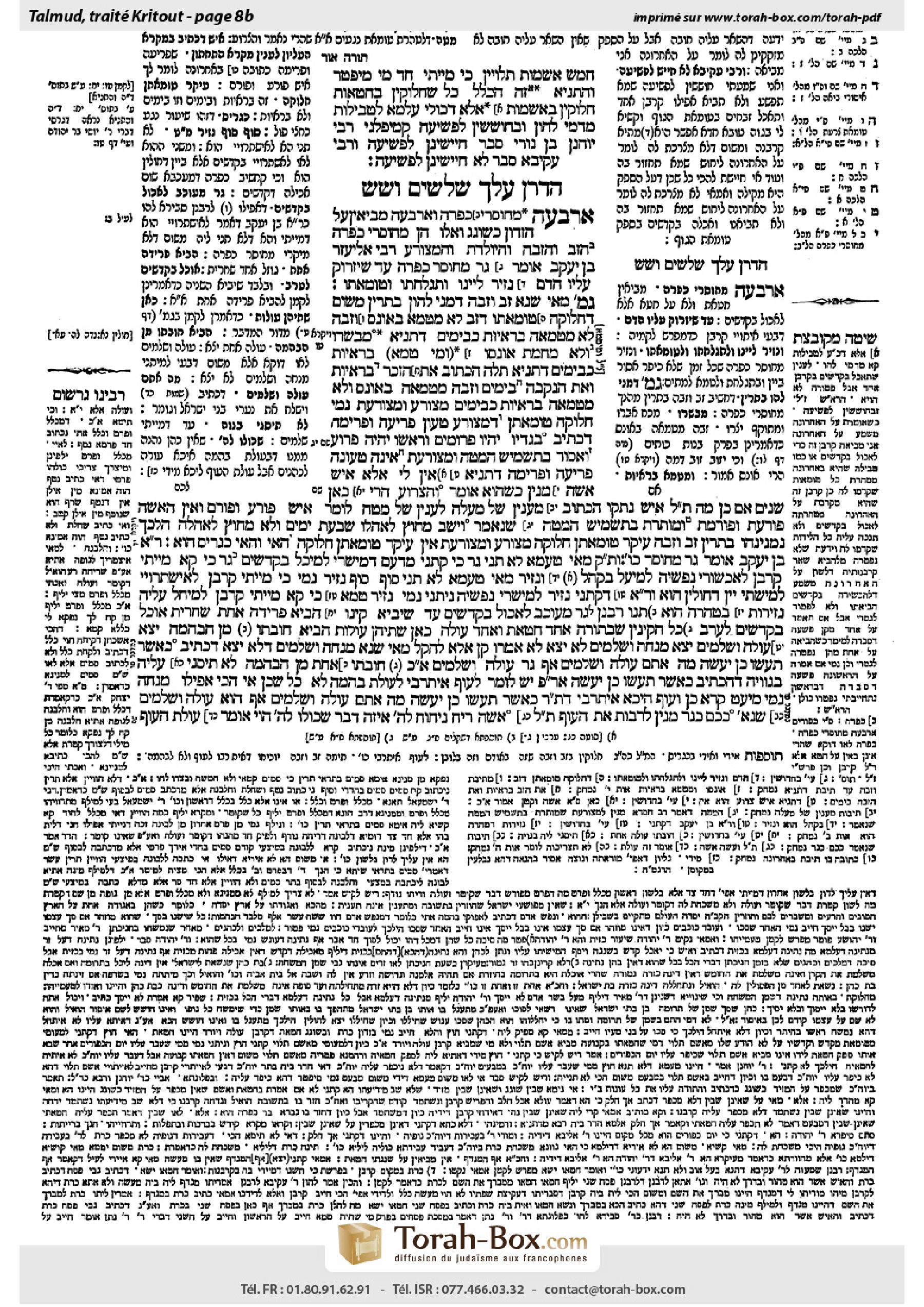
Keritot 8b: Talmud study for Daf Yomi
Daf Yomi is the daily study of one Talmud folio. Explore 37 tractates with scans, Hebrew text, Sefaria English and AI-generated French translations where annotated.
Passage selection and English or AI-generated French translation are available where the scan has annotations. Daf Study is independent of Torah-Box and Sefaria.
Browse Keritot · כריתות · All tractatesKeritot 8b text and translations
This page of Keritot includes the Aramaic text, an English translation and an AI-generated French translation, alongside the scan above.
כריתות ח׳ ב · Aramaic and Hebrew text
חָמֵשׁ אֲשָׁמוֹת תְּלוּיִין, כִּי מַיְיתֵי חַד מִי מִיפְּטַר? וְהָתַנְיָא, זֶה הַכְּלָל: כֹּל שֶׁחֲלוּקִין בְּחַטָּאוֹת – חֲלוּקִין בַּאֲשָׁמוֹת!
אֶלָּא, דְּכוּלֵּי עָלְמָא לִטְבִילוֹת מְדַמֵּי לְהוֹן, וּבְחוֹשְׁשִׁין לִפְשִׁיעָה קָמִיפַּלְגִי, רַבִּי יוֹחָנָן בֶּן נוּרִי סָבַר: חָיְישִׁינַן לִפְשִׁיעָה, וְרַבִּי עֲקִיבָא סָבַר: לָא חָיְישִׁינַן לִפְשִׁיעָה.
הֲדַרַן עֲלָךְ שְׁלֹשִׁים וָשֵׁשׁ
מַתְנִי׳ אַרְבָּעָה מְחוּסְּרֵי כַּפָּרָה, וְאַרְבָּעָה מְבִיאִין עַל הַזָּדוֹן כַּשּׁוֹגֵג.
וְאֵלּוּ הֵן מְחוּסְּרֵי כַּפָּרָה: הַזָּב, וְהַזָּבָה, וְהַיּוֹלֶדֶת, וְהַמְצוֹרָע.
רַבִּי אֱלִיעֶזֶר בֶּן יַעֲקֹב אוֹמֵר: גֵּר מְחוּסָּר כַּפָּרָה עַד שֶׁיִּזָּרֵק עָלָיו הַדָּם. נָזִיר – לְיֵינוֹ וְתִגְלַחְתּוֹ וְטוּמְאָתוֹ.
גְּמָ׳ מַאי שְׁנָא זָב וְזָבָה דְּמָנֵי לְהוֹן בִּתְרֵין – מִשּׁוּם דַּחֲלוּקָהּ טוּמְאָתוֹ, דְּזָב לָא מְטַמֵּא בְּאוֹנֶס וְזָבָה לָא מְטַמְּאָה בִּרְאִיּוֹת בְיָמִים,
דְּתַנְיָא: ״מִבְּשָׂרוֹ״ – וְלֹא מֵחֲמַת אוֹנְסוֹ. (וּמִי טָמֵא) [וּמִיטַּמֵּא] בִּרְאִיּוֹת כִּבְיָמִים, דְּתַנְיָא: תָּלָה הַכָּתוּב אֶת הַזָּכָר בִּרְאִיּוֹת וְאֶת הַנְּקֵבָה בְּיָמִים. וְזָבָה מִטַּמְּאָה בְּאוֹנֶס, וְלֹא מִטַּמְּאָה בִּרְאִיּוֹת כִּבְיָמִים.
מְצוֹרָע וּמְצוֹרַעַת נָמֵי חֲלוּקָה טוּמְאָתָן, דִּמְצוֹרָע טָעוּן פְּרִיעָה וּפְרִימָה, דִּכְתִיב: ״בְּגָדָיו יִהְיוּ פְרֻמִים וְרֹאשׁוֹ יִהְיֶה פָרוּעַ״. וְאָסוּר בְּתַשְׁמִישׁ הַמִּטָּה.
וּמְצוֹרַעַת אֵינָהּ טְעוּנָה פְּרִיעָה וּפְרִימָה, דְּתַנְיָא: אֵין לִי אֶלָּא אִישׁ, אִשָּׁה מִנַּיִן? כְּשֶׁהוּא אוֹמֵר: ״וְהַצָּרוּעַ״ – הֲרֵי כָּאן שְׁנַיִם.
אִם כֵּן מָה תַּלְמוּד לוֹמַר: ״אִישׁ״? נִתְּקוֹ הַכָּתוּב מֵעִנְיָן שֶׁל מַעְלָה לְעִנְיָן שֶׁל מַטָּה, לוֹמַר: אִישׁ פּוֹרֵעַ וּפוֹרֵם, וְאֵין הָאִשָּׁה פּוֹרַעַת וּפוֹרֶמֶת. וּמוּתֶּרֶת בְּתַשְׁמִישׁ הַמִּטָּה, שֶׁנֶּאֱמַר: ״וְיָשַׁב מִחוּץ לְאׇהֳלוֹ שִׁבְעַת יָמִים״ – וְלֹא מִחוּץ לְאׇהֳלָהּ.
הִלְכָּךְ נַמְנִינְהוּ בִּתְרֵין! זָב וְזָבָה – עִיקַּר טוּמְאָתָן חֲלוּקָה, מְצוֹרָע וּמְצוֹרַעַת – אֵין עִיקַּר טוּמְאָתָן חֲלוּקָה, הַאי וְהַאי כִּגְרִיס הוּא.
רַבִּי אֱלִיעֶזֶר בֶּן יַעֲקֹב אוֹמֵר: גֵּר מְחוּסָּר כּוּ׳. וְתַנָּא קַמָּא, מַאי טַעְמָא לָא תָּנֵי גֵּר? כִּי קָתָנֵי – מִדַּעַם דְּמִישְׁ[תְּ]רֵי לְמֵיכַל בְּקָדָשִׁים, גֵּר – כִּי קָא מַיְיתֵי קׇרְבָּן לְאַכְשׁוֹרֵי נַפְשֵׁיהּ לְמֵיעַל בְּקָהָל.
וְנָזִיר מַאי טַעְמָא לָא תָּנֵי? סוֹף סוֹף נָזִיר נָמֵי כִּי מַיְיתֵי קׇרְבָּן – לְאִישְׁתְּרוֹיֵי לְמִישְׁתֵּי יַיִן דְּחוּלִּין הוּא.
וְרַבִּי אֱלִיעֶזֶר, דְּקָתָנֵי נָזִיר לְמִישְׁרֵי נַפְשֵׁיהּ, נִיתְנֵי נָמֵי נָזִיר טָמֵא! כִּי קָא מַיְיתֵי קׇרְבָּן – לְמֵיחַל עֲלֵיהּ נְזִירוּת בְּטָהֳרָה הוּא.
תָּנוּ רַבָּנַן: גֵּר מְעוּכָּב לֶאֱכוֹל בְּקָדָשִׁים עַד שֶׁיָּבִיא קִינּוֹ, הֵבִיא פְּרִידָה אַחַת שַׁחֲרִית – אוֹכֵל בְּקָדָשִׁים לָעֶרֶב. כׇּל הַקִּינִּין שֶׁבַּתּוֹרָה – אֶחָד חַטָּאת וְאֶחָד עוֹלָה, כָּאן – שְׁתֵּיהֶן עוֹלוֹת.
הֵבִיא חוֹבָתוֹ מִן הַבְּהֵמָה – יָצָא, עוֹלָה וּשְׁלָמִים – יָצָא, מִנְחָה וּשְׁלָמִים – לֹא יָצָא. לֹא אָמְרוּ קֵן אֶלָּא לְהָקֵל.
מַאי שְׁנָא מִנְחָה וּשְׁלָמִים דְּלֹא יָצָא, דִּכְתִיב: ״כַּאֲשֶׁר תַּעֲשׂוּ כֵּן יַעֲשֶׂה״, מָה אַתֶּם עוֹלָה וּשְׁלָמִים – אַף גֵּר עוֹלָה וּשְׁלָמִים?
אִם כֵּן, חוֹבָתוֹ אַחַת מִן הַבְּהֵמָה לָא תִּיסְגֵּי עֲלֵיהּ בְּגַוֵּויהּ, דְּהָכְתִיב: ״כַּאֲשֶׁר תַּעֲשׂוּ כֵּן יַעֲשֶׂה״! אָמַר רַב פָּפָּא, יֵשׁ לוֹמַר: לְעוֹף אִיתְרַבִּי, לְעוֹלַת בְּהֵמָה לֹא כׇּל שֶׁכֵּן?
אִי הָכִי, אֲפִילּוּ מִנְחָה נָמֵי! מַיעֵט קְרָא: ״כֵּן״.
וָעוֹף הֵיכָא אִיתְרַבִּי? דְּתָנוּ רַבָּנַן: ״כַּאֲשֶׁר תַּעֲשׂוּ כֵּן יַעֲשֶׂה״ – מָה אַתֶּם עוֹלָה וּשְׁלָמִים, אַף הוּא עוֹלָה וּשְׁלָמִים, שֶׁנֶּאֱמַר: ״כָּכֶם כַּגֵּר״. מִנַּיִן לְרַבּוֹת אֶת הָעוֹף? תַּלְמוּד לוֹמַר: ״אִשֵּׁה רֵיחַ נִיחֹחַ לַה׳״ – אֵיזֶה דָּבָר שֶׁכּוּלּוֹ לַה׳? הֱוֵי אוֹמֵר [זוֹ] עוֹלַת הָעוֹף.
Keritot 8b · English translation
to bring five provisional guilt offerings, when he brings one offering is he exempt from bringing the rest? But isn’t it taught in a baraita that this is the principle: In any case where one’s transgressions are divided with regard to sin offerings, i.e., where one must bring a separate sin offering for each act when he becomes aware that he has sinned, they are likewise divided with regard to provisional guilt offerings, when there is uncertainty as to whether or not he sinned?
Rather, everyone agrees that we compare the sin offerings of a woman after childbirth and a zava to immersions, and therefore by Torah law it is sufficient for her to say: I am bringing it for one of them. And they disagree with regard to whether we are concerned for her negligence. Rabbi Yoḥanan ben Nuri maintains we are concerned for her negligence. In other words, if she says: I am bringing it for one of my obligations, if she gives birth in the following years she might think that she does not need to bring an offering for each birth, and she will neglect to bring an offering. By requiring her to declare: I am bringing the offering for the last definite obligation, the Sages thereby remind her that all her births require offerings. And Rabbi Akiva maintains we are not concerned for her negligence, and therefore it is sufficient for her to say: I am bringing the offering for one of them.
MISHNA: There are four individuals whose halakhic status is defined as: Lacking atonement [khappara], which means they had been in a state of ritual impurity and underwent rituals to purify themselves, but since they have not yet brought the requisite atonement offering to complete the purification process, they may not partake of sacrificial meat. And there are also four individuals who bring an offering for an intentional transgression in the same manner as they do for an unwitting transgression.
And these are the four individuals who lack atonement: The man who experiences a gonorrhea-like discharge [zav], the woman who experiences a discharge of uterine blood after her menstrual period [zava], the woman after childbirth, and the leper. In all four of these cases, although the individual has completed all of the other steps of the purification process, the process is not complete until the atonement offering has been brought.
Rabbi Eliezer ben Ya’akov says: A convert also lacks atonement, even after he has been circumcised and has immersed in a ritual bath, until the priest sprinkles the blood of his offering on the altar on his behalf. A nazirite also lacks atonement with regard to his permission for drinking wine, and cutting his hair, and his exposure to ritual impurity imparted by a corpse, until his offerings are sacrificed.
GEMARA: The mishna lists four individuals whose status is defined as lacking atonement until their offering is brought: The zav, the zava, the woman after childbirth, and the leper. The Gemara asks: What is different about a zav and a zava, that the tanna decided to count them as two separate cases? The Gemara answers: They are different due to the fact that the impurity of a zav is distinct from that of a zava, as a zav does not become impure if he has a discharge by accident, i.e., due to a cause such as an illness or having consumed certain foods, whereas there is no such exemption in the case of a zava; and a zava, unlike a zav, does not become impure by three sightings of menstrual-type blood on one day like she becomes impure by sightings on three consecutive days.
As it is taught in a baraita: The verse states: “When any man has a discharge from his flesh, his discharge is impure” (Leviticus 15:2). The term “from his flesh” teaches that the discharge is impure only if it is due to an internal cause, and not due to his accident. And furthermore, a zav becomes impure by three sightings of gonorrhea-like discharge on one day like he becomes impure by three such sightings on three consecutive days, as it is taught in a baraita: The verse links the impurity of the male, i.e., a zav, to the number of sightings on the same day or on consecutive days, and of the female zava to the number of consecutive days on which she experiences sightings of blood. And by contrast, a zava becomes impure if she has a discharge by accident, and does not become impure by three sightings on one day like she becomes impure by sightings on three consecutive days. Therefore, the mishna counts them as two separate cases.
The Gemara objects: But the impurities of a male leper and a female leper are also distinct, as a male leper requires letting his hair grow wild and rending his garments, as it is written: “His garments shall be rent and the hair of his head shall go wild” (Leviticus 13:45), and he is prohibited from engaging in sexual intercourse.
And by contrast, a female leper does not require letting her hair grow wild and rending her garments, as it is taught in a baraita: The verse states: “He is a leprous man” (Leviticus 13:44): I have derived only that a man can be a leper; from where do I derive that a woman can also be a leper? When the verse states: “And the leper in whom the mark is” (Leviticus 13:45), without specifying a man, the verse teaches that there are two here, i.e., a man and a woman.
The baraita asks: If so, why does the verse state: “A leprous man”? The baraita answers: The verse removed it from the matter stated earlier, and applied it to the matter stated later: “His garments shall be rent, and the hair of his head shall go wild,” to say that a man who is a leper lets his hair grow wild and rends his garments, but the woman who is a leper does not need to let her hair grow wild and does not rend her garments. And a female leper is permitted to engage in sexual intercourse, as it is stated: “And he shall dwell outside his tent for seven days” (Leviticus 14:8), and not: Outside her tent.
The Gemara now resumes stating its objection: Therefore, let us count the male and female leper as two separate cases, as the mishna does with regard to the zav and zava. Why does the mishna not do so? The Gemara explains: With regard to a zav and zava, they are treated as separate cases because the essence of their impurity is distinct, as the impurity of a zav is based on the number of sightings of discharge, whereas the impurity of a zava is based on the number of consecutive days on which she experiences sightings of menstrual-type blood. By contrast, with regard to a male leper and female leper, the essence of their impurity is not distinct, as in both this case of a male leper and that case of a female leper, the impurity is based on a leprous mark which is at least the area of a split bean.
§ The mishna teaches that Rabbi Eliezer ben Ya’akov says: A convert also lacks atonement until the priest sprinkles the blood of his offering on the altar on his behalf. The Gemara asks: And what is the reason that the first tanna does not also teach a convert, i.e., why does the first tanna not include him in the list of individuals lacking atonement? The Gemara answers: When the first tanna teaches those individuals who lack atonement, he includes any matter where the atonement offering completes the process of purification and thereby permits the individual to partake of sacrificial meat. But when a convert brings his atonement offering, it is to qualify him to enter the congregation of Israel through marriage, not to permit him to partake of sacrificial meat.
The Gemara asks: And what is the reason that the first tanna also does not teach that a nazirite lacks atonement? The Gemara answers: Ultimately, as well, when a nazirite brings his offering, it is to permit him to drink non-sacred wine, not to permit him to partake of sacrificial meat.
The Gemara objects: And according to the opinion of Rabbi Eliezer ben Ya’akov, who teaches a nazirite in the mishna’s list of those who lack atonement, because the nazirite brings his offering in order to permit himself to drink wine, let him also teach, i.e., include in the list, a ritually impure nazirite. The Gemara answers: A ritually pure nazirite brings an offering in order to render an action permitted, and therefore Rabbi Eliezer ben Ya’akov considers him lacking atonement. By contrast, when a ritually impure nazirite brings his offering, it is not to render an action permitted, but rather to effect upon himself a new period of naziriteship in purity.
§ With regard to the atonement offering of a convert, the Sages taught in a baraita: A convert is precluded from partaking of sacrificial meat until he brings his bird nest, i.e., his offering of a pair of birds, either pigeons or doves. If he brought one young bird [perida] in the morning, he may partake of sacrificial meat in the evening, and may bring the second bird at a later time. Furthermore, with regard to all other cases in the Torah where bird nests are mandated as offerings, one of the birds is brought as a sin offering and the other one as a burnt offering; but here, in the case of the convert, both of them are burnt offerings.
The baraita continues: If, instead of birds, the convert brought a burnt offering from an animal as his obligatory offering, he has fulfilled his obligation, and if he brought a burnt offering and a peace offering, he has also fulfilled his obligation; but if he brought a meal offering and a peace offering, he has not fulfilled his obligation. This is because a bird nest was stated in the Torah only to be lenient for him. Therefore, if he voluntarily brought an animal, which is more expensive, as a burnt offering, he has fulfilled his obligation.
The Gemara asks: What is different about a meal offering and peace offering, that if the convert brings these he has not fulfilled his obligation? The Gemara answers: It is as it is written: “And if a stranger dwell with you, or whosoever may be among you, throughout your generations, and will offer an offering made by fire of a pleasing aroma unto the Lord; as you do, so he shall do” (Numbers 15:14). From this verse it is derived: Just as you brought a burnt offering and a peace offering when you entered the covenant on Mount Sinai, as it is stated: “And they sacrificed burnt offerings, and they sacrificed peace offerings” (Exodus 24:5), so too, a convert must bring a burnt offering and a peace offering.
The Gemara objects: If so, in a case where he brought one offering from an animal for his obligation, that should not be enough for him, as isn’t it written: “As you do, so he shall do,” which teaches that he must bring both a burnt offering and a peace offering? Why, then, does the baraita state that a single burnt offering from an animal is sufficient? Rav Pappa says: One can say that this is derived from an a fortiori inference: If a bird offering was included as an inexpensive way for a convert to fulfill his obligation, would the Torah not all the more so include a more expensive animal burnt offering?
The Gemara objects: If so, then even a meal offering should fulfill the convert’s obligation. The Gemara answers: The verse restricts the acceptable offerings, excluding a meal offering, as it states: “Just as you do, so he shall do,” meaning that he must not do less than that.
The Gemara asks: And where was a bird offering included as an option? The Gemara answers that this is as the Sages taught in a baraita: The verse states: “As you do, so he shall do” (Numbers 15:14): Just as you entered the covenant with a burnt offering and a peace offering, so too, a convert fulfills his obligation with a burnt offering and a peace offering, as it is stated: “As you are, so shall the stranger be” (Numbers 15:15). From where is it derived to include the option of the bird offering instead of an animal? The verse states: “An offering made by fire, of a pleasing aroma unto the Lord” (Numbers 15:14). Which item is an offering that is entirely for the Lord? You must say: This is referring to a bird burnt offering, which is entirely consumed upon the altar.
Keritot 8b · Traduction française (IA)
Doit-il apporter cinq sacrifices de culpabilité provisoires ? Lorsqu’il en apporte un, est-il quitte des autres ? Pourtant, une baraïta enseigne ce principe : chaque fois que les transgressions d’une personne sont divisées en matière de sacrifices expiatoires — c’est-à-dire qu’elle doit apporter un sacrifice expiatoire distinct pour chaque acte lorsqu’elle prend conscience d’avoir péché —, elles sont également divisées en matière de sacrifices de culpabilité provisoires, lorsqu’il y a un doute quant au fait qu’elle ait péché ou non.
Au contraire, tous reconnaissent que nous comparons les sacrifices expiatoires d’une femme après l’accouchement et d’une zava aux immersions rituelles ; en vertu de la Torah, il lui suffit donc de dire : « J’apporte ce sacrifice pour l’un d’eux. » Ils sont en désaccord sur la question de savoir s’il faut craindre qu’elle fasse preuve de négligence. Rabbi Yoḥanan ben Nuri estime qu’il faut craindre sa négligence. Autrement dit, si elle dit : « J’apporte ce sacrifice pour l’une de mes obligations », elle pourrait penser, après avoir accouché les années suivantes, qu’elle n’a pas besoin d’apporter un sacrifice pour chaque accouchement et négliger ainsi d’en apporter un. En lui demandant de déclarer : « J’apporte le sacrifice pour la dernière obligation certaine », les Sages lui rappellent que chacun de ses accouchements nécessite un sacrifice. Rabbi Akiva, lui, estime qu’il n’y a pas lieu de craindre sa négligence ; il lui suffit donc de dire : « J’apporte le sacrifice pour l’un d’eux. »
MICHNA : Quatre personnes ont le statut de « privées d’expiation » [khappara] : elles se trouvaient en état d’impureté rituelle et ont accompli les rites de purification, mais, comme elles n’ont pas encore apporté le sacrifice expiatoire requis pour achever le processus de purification, elles ne peuvent pas consommer de viande sacrificielle. Il y a également quatre personnes qui apportent un sacrifice pour une transgression intentionnelle de la même manière que pour une transgression involontaire.
Voici les quatre personnes privées d’expiation : l’homme atteint d’un écoulement semblable à la gonorrhée [zav], la femme qui connaît un écoulement de sang utérin après ses règles [zava], la femme après l’accouchement et le lépreux. Dans ces quatre cas, bien que la personne ait achevé toutes les autres étapes du processus de purification, celui-ci ne s’achève qu’une fois le sacrifice expiatoire apporté.
Rabbi Eliezer ben Ya’akov dit : un converti est également privé d’expiation, même après avoir été circoncis et s’être immergé dans un bain rituel, jusqu’à ce que le prêtre asperge en sa faveur le sang de son sacrifice sur l’autel. Un naziréen est également privé d’expiation en ce qui concerne l’autorisation de boire du vin, de se couper les cheveux et de se rendre impur au contact d’un cadavre, jusqu’à ce que ses sacrifices soient offerts.
GUEMARA : La Michna énumère quatre personnes privées d’expiation jusqu’à ce que leur sacrifice soit apporté : le zav, la zava, la femme après l’accouchement et le lépreux. La Guemara demande : En quoi le zav et la zava diffèrent-ils, pour que le tanna ait décidé de les compter comme deux cas distincts ? La Guemara répond : Ils diffèrent par le fait que l’impureté du zav est distincte de celle de la zava. En effet, un zav ne devient pas impur si son écoulement est accidentel, c’est-à-dire dû à une cause telle qu’une maladie ou la consommation de certains aliments, tandis qu’il n’existe pas d’exemption de ce type dans le cas d’une zava. De plus, contrairement au zav, une zava ne devient pas impure à la suite de trois écoulements de sang menstruel en un seul jour, comme elle le devient après des écoulements pendant trois jours consécutifs.
Comme l’enseigne une baraïta : le verset dit : « Lorsqu’un homme a un écoulement provenant de sa chair, son écoulement est impur » (Lévitique 15:2). L’expression « provenant de sa chair » enseigne que l’écoulement n’est impur que s’il est dû à une cause interne, et non s’il est accidentel. En outre, un zav devient impur à la suite de trois écoulements semblables à la gonorrhée en un seul jour, tout comme il devient impur à la suite de trois écoulements de ce type sur trois jours consécutifs. En effet, une baraïta enseigne que le verset établit un lien entre l’impureté de l’homme, c’est-à-dire du zav, et le nombre d’écoulements survenus le même jour ou des jours consécutifs, tandis que, pour la femme zava, il la relie au nombre de jours consécutifs pendant lesquels elle connaît des écoulements de sang. À l’inverse, une zava devient impure si son écoulement est accidentel, mais elle ne devient pas impure à la suite de trois écoulements en un seul jour comme elle le devient après des écoulements pendant trois jours consécutifs. C’est pourquoi la Michna les compte comme deux cas distincts.
La Guemara objecte : Pourtant, les règles d’impureté d’un lépreux et d’une lépreuse sont également distinctes : un lépreux doit laisser pousser ses cheveux et déchirer ses vêtements, comme il est écrit : « Ses vêtements seront déchirés et les cheveux de sa tête pousseront librement » (Lévitique 13:45), et il lui est interdit d’avoir des relations sexuelles.
À l’inverse, une lépreuse n’est pas tenue de laisser pousser ses cheveux ni de déchirer ses vêtements, comme l’enseigne une baraïta : le verset dit : « C’est un homme lépreux » (Lévitique 13:44). J’en ai déduit seulement qu’un homme peut être lépreux ; d’où déduire qu’une femme peut également l’être ? Lorsque le verset dit : « Et le lépreux qui porte la marque » (Lévitique 13:45), sans préciser qu’il s’agit d’un homme, il enseigne qu’il y en a deux ici, c’est-à-dire un homme et une femme.
La baraïta demande : Si tel est le cas, pourquoi le verset dit-il : « Un homme lépreux » ? La baraïta répond : Le verset l’a retiré du sujet énoncé précédemment pour le rattacher au sujet énoncé ensuite : « Ses vêtements seront déchirés et les cheveux de sa tête pousseront librement », afin d’enseigner qu’un homme lépreux laisse pousser ses cheveux et déchire ses vêtements, tandis qu’une femme lépreuse n’a pas à laisser pousser ses cheveux et ne déchire pas ses vêtements. Une lépreuse est également autorisée à avoir des relations sexuelles, car il est dit : « Il demeurera hors de sa tente pendant sept jours » (Lévitique 14:8), et non : « Hors de sa tente à elle ».
La Guemara reprend maintenant son objection : comptons donc le lépreux et la lépreuse comme deux cas distincts, comme le fait la Michna pour le zav et la zava. Pourquoi la Michna ne le fait-elle pas ? La Guemara explique : le zav et la zava sont traités comme des cas distincts parce que l’essence de leur impureté diffère : l’impureté du zav dépend du nombre d’écoulements, tandis que celle de la zava dépend du nombre de jours consécutifs pendant lesquels elle connaît des écoulements de sang menstruel. En revanche, pour le lépreux et la lépreuse, l’essence de leur impureté ne diffère pas : dans le cas du lépreux comme dans celui de la lépreuse, l’impureté dépend d’une marque de lèpre d’une taille au moins égale à celle d’une fève fendue.
§ La Michna enseigne que Rabbi Eliezer ben Ya’akov dit : un converti est également privé d’expiation jusqu’à ce que le prêtre asperge en sa faveur le sang de son sacrifice sur l’autel. La Guemara demande : Pourquoi le premier tanna n’enseigne-t-il pas lui aussi le cas du converti, c’est-à-dire pourquoi ne l’inclut-il pas dans la liste des personnes privées d’expiation ? La Guemara répond : Lorsqu’il enseigne les cas des personnes privées d’expiation, le premier tanna inclut toute situation où le sacrifice expiatoire achève le processus de purification et permet ainsi à la personne de consommer de la viande sacrificielle. Mais lorsqu’un converti apporte son sacrifice expiatoire, c’est pour lui permettre d’entrer dans l’assemblée d’Israël par le mariage, et non pour lui permettre de consommer de la viande sacrificielle.
La Guemara demande : Pourquoi le premier tanna n’enseigne-t-il pas non plus qu’un naziréen est privé d’expiation ? La Guemara répond : En définitive, lorsqu’un naziréen apporte son sacrifice, c’est pour être autorisé à boire du vin non consacré, et non pour être autorisé à consommer de la viande sacrificielle.
La Guemara objecte : Selon l’opinion de Rabbi Eliezer ben Ya’akov, qui mentionne un naziréen dans la liste des personnes privées d’expiation de la Michna parce que celui-ci apporte son sacrifice afin de pouvoir boire du vin, ne devrait-il pas également mentionner, c’est-à-dire inclure dans la liste, un naziréen rituellement impur ? La Guemara répond : Un naziréen rituellement pur apporte un sacrifice afin de rendre une action permise ; c’est pourquoi Rabbi Eliezer ben Ya’akov le considère comme privé d’expiation. En revanche, lorsqu’un naziréen rituellement impur apporte son sacrifice, ce n’est pas pour rendre une action permise, mais pour inaugurer pour lui-même une nouvelle période de naziréat dans la pureté.
§ À propos du sacrifice expiatoire d’un converti, les Sages enseignent dans une baraïta : un converti ne peut pas consommer de viande sacrificielle avant d’avoir apporté son nid, c’est-à-dire son offrande constituée d’une paire d’oiseaux, pigeons ou tourterelles. S’il a apporté un oisillon [perida] le matin, il peut consommer de la viande sacrificielle le soir et apporter le second oiseau plus tard. En outre, dans tous les autres cas prévus par la Torah où un nid d’oiseaux est requis comme offrande, l’un des oiseaux est apporté comme sacrifice expiatoire et l’autre comme holocauste ; mais ici, dans le cas du converti, les deux sont des holocaustes.
La baraïta poursuit : si, au lieu d’oiseaux, le converti a apporté comme offrande obligatoire un holocauste constitué d’un animal, il s’est acquitté de son obligation ; s’il a apporté un holocauste et un sacrifice de paix, il s’en est également acquitté. Mais s’il a apporté une offrande végétale et un sacrifice de paix, il ne s’est pas acquitté de son obligation. En effet, le nid d’oiseaux n’a été mentionné dans la Torah que pour lui accorder une facilité. Par conséquent, s’il a apporté volontairement un animal, plus coûteux, comme holocauste, il s’est acquitté de son obligation.
La Guemara demande : En quoi une offrande végétale et un sacrifice de paix diffèrent-ils, pour que le converti ne s’acquitte pas de son obligation en les apportant ? La Guemara répond : C’est comme il est écrit : « Si un étranger séjourne parmi vous, ou quiconque se trouve parmi vous, au fil de vos générations, et qu’il offre un sacrifice consumé par le feu, d’agréable odeur pour le Seigneur, comme vous faites, ainsi fera-t-il » (Nombres 15:14). De ce verset, on déduit que, de même que vous avez apporté un holocauste et un sacrifice de paix lorsque vous êtes entrés dans l’alliance au mont Sinaï, comme il est dit : « Ils offrirent des holocaustes et des sacrifices de paix » (Exode 24:5), de même un converti doit apporter un holocauste et un sacrifice de paix.
La Guemara objecte : Si tel est le cas, lorsqu’il n’a apporté qu’un seul sacrifice animal pour s’acquitter de son obligation, cela ne devrait pas suffire, car n’est-il pas écrit : « Comme vous faites, ainsi fera-t-il », ce qui enseigne qu’il doit apporter à la fois un holocauste et un sacrifice de paix ? Pourquoi la baraïta dit-elle alors qu’un seul holocauste animal suffit ? Rav Pappa dit : On peut dire que cela se déduit d’un raisonnement a fortiori : si l’offrande d’un oiseau a été incluse comme moyen peu coûteux pour un converti de s’acquitter de son obligation, la Torah n’inclurait-elle pas, à plus forte raison, un holocauste animal plus coûteux ?
La Guemara objecte : Si tel est le cas, une offrande végétale devrait elle aussi permettre au converti de s’acquitter de son obligation. La Guemara répond : Le verset restreint les sacrifices acceptables et exclut une offrande végétale, car il est dit : « Comme vous faites, ainsi fera-t-il », ce qui signifie qu’il ne doit pas faire moins que cela.
La Guemara demande : Et où l’offrande d’un oiseau a-t-elle été incluse comme possibilité ? La Guemara répond que cela découle de ce que les Sages ont enseigné dans une baraïta : le verset dit : « Comme vous faites, ainsi fera-t-il » (Nombres 15:14). De même que vous êtes entrés dans l’alliance avec un holocauste et un sacrifice de paix, de même un converti s’acquitte de son obligation avec un holocauste et un sacrifice de paix, comme il est dit : « Comme vous êtes, ainsi sera l’étranger » (Nombres 15:15). D’où déduire qu’il est également possible d’apporter des oiseaux plutôt qu’un animal ? Le verset dit : « Un sacrifice consumé par le feu, d’agréable odeur pour le Seigneur » (Nombres 15:14). Quel sacrifice est entièrement destiné au Seigneur ? Il faut dire qu’il s’agit d’un holocauste d’oiseau, qui est entièrement consumé sur l’autel.
Traduction française générée par IA à partir de l’édition anglaise de Sefaria. Vérifie toujours un passage avec le texte source.
Text from Sefaria: William Davidson Edition - Vocalized Aramaic (CC BY NC); William Davidson Edition - English (CC BY NC).