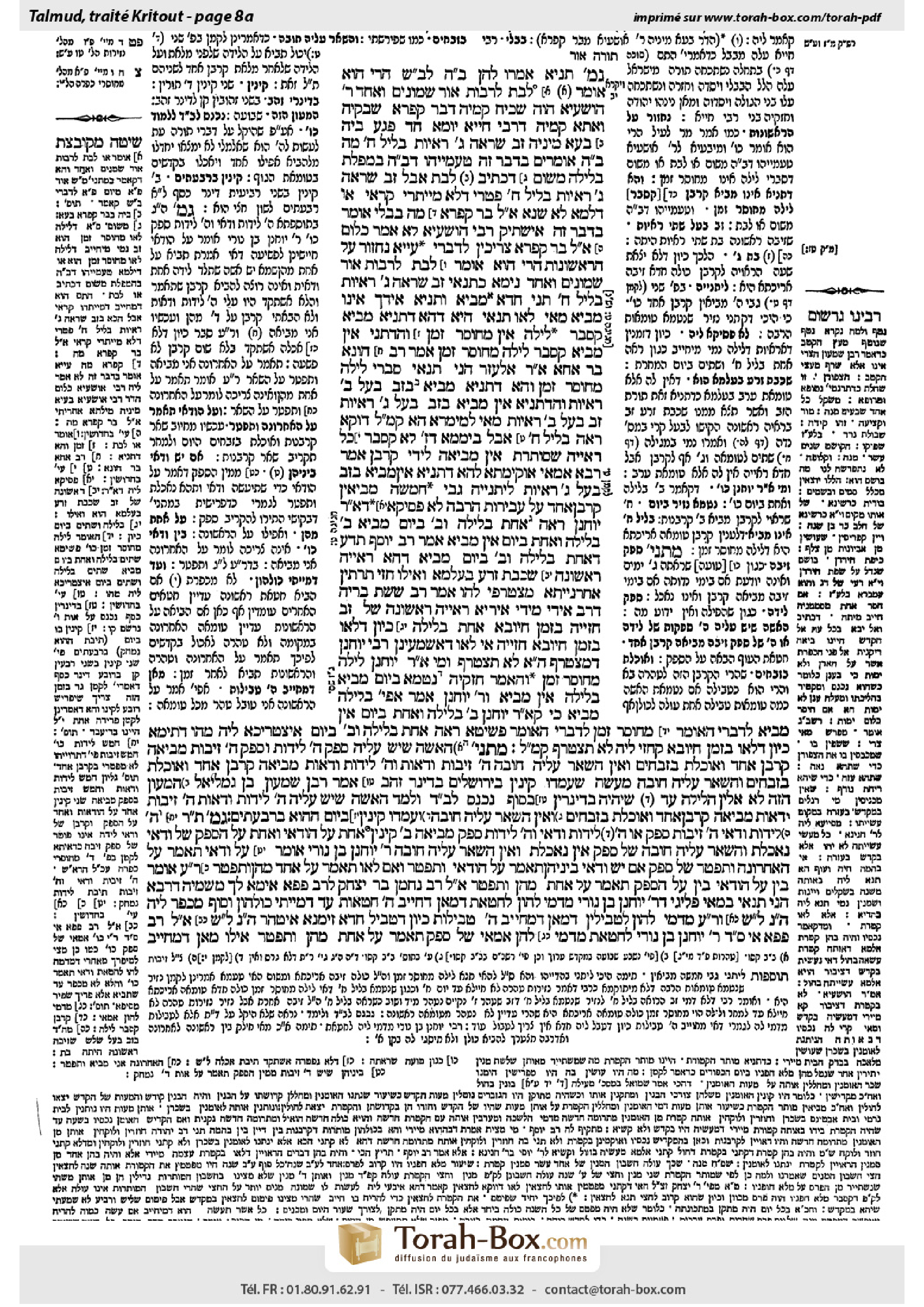
Keritot 8a: Talmud study for Daf Yomi
Daf Yomi is the daily study of one Talmud folio. Explore 37 tractates with scans, Hebrew text, Sefaria English and AI-generated French translations where annotated.
Passage selection and English or AI-generated French translation are available where the scan has annotations. Daf Study is independent of Torah-Box and Sefaria.
Browse Keritot · כריתות · All tractatesKeritot 8a text and translations
This page of Keritot includes the Aramaic text, an English translation and an AI-generated French translation, alongside the scan above.
כריתות ח׳ א · Aramaic and Hebrew text
גְּמָ׳ תַּנְיָא: אָמְרוּ לָהֶן בֵּית הִלֵּל לְבֵית שַׁמַּאי: הֲרֵי הוּא אוֹמֵר: ״לְבַת״ לְרַבּוֹת אוֹר שְׁמוֹנִים וְאֶחָד.
רַבִּי הוֹשַׁעְיָא הֲוָה שְׁכִיחַ קַמֵּיהּ דְּבַר קַפָּרָא, שַׁבְקֵיהּ וַאֲתָא קַמֵּיהּ דְּרַבִּי חִיָּיא. יוֹמָא חַד פְּגַע בֵּיהּ, בְּעָא מִינֵּיהּ: זָב שֶׁרָאָה שָׁלֹשׁ רְאִיּוֹת בְּלֵיל שְׁמִינִי, מָה בֵּית הִלֵּל אוֹמְרִים בְּדָבָר זֶה?
טַעְמַיְיהוּ דְּבֵית הִלֵּל בְּמַפֶּלֶת בַּלַּיְלָה מִשּׁוּם דִּכְתִיב: ״לְבַת״, אֲבָל זָב שֶׁרָאָה שָׁלֹשׁ רְאִיּוֹת בְּלֵיל שְׁמִינִי – פָּטְרִי, דְּלָא מְיַיתְּרִי קְרָאֵי, אוֹ דִלְמָא לָא שְׁנָא?
אֲמַר לֵיהּ בַּר קַפָּרָא: מָה בָּבְלִי אוֹמֵר בְּדָבָר זֶה? אִישְׁתִּיק רַבִּי הוֹשַׁעְיָא, לָא אֲמַר כְּלוּם. אֲמַר לֵיהּ בַּר קַפָּרָא: צְרִיכִין לְדִבְרֵי עִיָּיא? נַחְזוֹר עַל הָרִאשׁוֹנוֹת: הֲרֵי הוּא אוֹמֵר: ״לְבַת״ – לְרַבּוֹת אוֹר שְׁמוֹנִים וְאֶחָד.
נֵימָא כְּתַנָּאֵי: זָב שֶׁרָאָה שָׁלֹשׁ רְאִיּוֹת בְּלֵיל שְׁמִינִי, תָּנֵי חֲדָא: מֵבִיא, וְתַנְיָא אִידַּךְ: אֵינוֹ מֵבִיא. מַאי לַָאו תַּנָּאֵי הִיא, דְּהָא דְּתַנְיָא מֵבִיא, קָסָבַר: לַיְלָה אֵין מְחוּסַּר זְמַן, וְהָדְתָנֵי אֵין מֵבִיא, קָסָבַר: לַיְלָה מְחוּסַּר זְמַן?
אָמַר רַב הוּנָא בַּר אַחָא אָמַר רַבִּי אֶלְעָזָר: הָנֵי תַּנָּאֵי סָבְרִי לַיְלָה מְחוּסַּר זְמַן. וְהָא דְּתַנְיָא מֵבִיא – בְּזָב בַּעַל שְׁתֵּי רְאִיּוֹת, וְהָדְתַנְיָא אֵין מֵבִיא – בְּזָב בַּעַל שָׁלֹשׁ רְאִיּוֹת.
זָב בַּעַל שְׁתֵּי רְאִיּוֹת, מַאי לְמֵימְרָא? הָא קָא מַשְׁמַע לַן: דַּוְקָא רָאָה בְּלֵיל שְׁמִינִי, אֲבָל בִּימָמָא דִּשְׁבִיעִי, לָא. קָסָבַר: כׇּל רְאִיָּיה שֶׁסּוֹתֶרֶת – אֵין מְבִיאָה לִידֵי קׇרְבָּן.
אָמַר רָבָא: אַמַּאי אוֹקֵימְתַּאּ לְהָא דְּתַנְיָא אֵין מֵבִיא – בְּזָב בַּעַל שָׁלֹשׁ רְאִיּוֹת, לִיתְנְיַיהּ גַּבֵּי, חֲמִשָּׁה מְבִיאִין קׇרְבָּן אֶחָד עַל עֲבֵירוֹת הַרְבֵּה! – לָא פְּסִיקָא, דְּאָמַר רַבִּי יוֹחָנָן: רָאָה אַחַת בַּלַּיְלָה וּשְׁתַּיִם בַּיּוֹם – מֵבִיא, שְׁתַּיִם בַּלַּיְלָה וְאַחַת בַּיּוֹם – אֵין מֵבִיא.
אָמַר רַב יוֹסֵף: תֵּדַע דְּאַחַת בַּלַּיְלָה וּשְׁתַּיִם בַּיּוֹם מֵבִיא, דְּהָא רְאִיָּיה רִאשׁוֹנָה שִׁכְבַת זֶרַע בְּעָלְמָא, וְאִילּוּ חָזֵי תַּרְתֵּין אַחְרָנְיָיתָא מִצְטָרְפִי לְהוּ.
אָמַר רַב שֵׁשֶׁת בְּרֵיהּ דְּרַב אִידִי: מִידֵּי אִירְיָא? רְאִיָּיה רִאשׁוֹנָה שֶׁל זָב – חַזְיַיהּ בִּזְמַן חִיּוּבָא. אַחַת בַּלַּיְלָה, כֵּיוָן דְּלָאו בִּזְמַן חִיּוּבָא חַזְיַיהּ, אִי לָאו דְּאַשְׁמְעִינַן רַבִּי יוֹחָנָן דְּמִצְטַרְפָא, הֲוָה אָמֵינָא לָא תִּצְטְרֵף.
וּמִי אָמַר רַבִּי יוֹחָנָן: לַיְלָה מְחוּסַּר זְמַן?
וְהָאָמַר חִזְקִיָּה: נִטְמָא בַּיּוֹם – מֵבִיא, בַּלַּיְלָה – אֵין מֵבִיא. וְרַבִּי יוֹחָנָן אָמַר: אֲפִילּוּ בַּלַּיְלָה – מֵבִיא!
כִּי קָאָמַר רַבִּי יוֹחָנָן: ״שְׁתַּיִם בַּלַּיְלָה וְאַחַת בַּיּוֹם – אֵין מֵבִיא״, לְדִבְרֵי הָאוֹמֵר מְחוּסַּר זְמַן.
לְדִבְרֵי הָאוֹמֵר? פְּשִׁיטָא! רָאָה אַחַת בַּלַּיְלָה וּשְׁתַּיִם בַּיּוֹם אִיצְטְרִיכָא לֵיהּ. מַהוּ דְּתֵימָא: כֵּיוָן דְּלָאו בִּזְמַן חִיּוּבָא קָחָזֵי לֵיהּ – לָא תִּצְטְרֵף, קָא מַשְׁמַע לַן.
מַתְנִי׳ הָאִשָּׁה שֶׁיֵּשׁ עָלֶיהָ סְפֵק חָמֵשׁ לֵידוֹת וּסְפֵק חָמֵשׁ זִיבוֹת – מְבִיאָה קׇרְבָּן אֶחָד וְאוֹכֶלֶת בִּזְבָחִים וְאֵין הַשְּׁאָר עָלֶיהָ חוֹבָה. חָמֵשׁ זִיבוֹת וַדָּאוֹת וְחָמֵשׁ לֵידוֹת וַדָּאוֹת – מְבִיאָה קׇרְבָּן אֶחָד וְאוֹכֶלֶת בִּזְבָחִים וְהַשְּׁאָר עָלֶיהָ חוֹבָה.
מַעֲשֶׂה שֶׁעָמְדוּ קִינִּין בִּירוּשָׁלַיִם בְּדִינַר זָהָב, אָמַר רַבָּן שִׁמְעוֹן בֶּן גַּמְלִיאֵל: הַמָּעוֹן הַזֶּה, לֹא אָלִין הַלַּיְלָה עַד שֶׁיִּהְיֶה בְּדִינָרִין (בַּסּוֹף) [כֶּסֶף!] נִכְנַס לְבֵית דִּין וְלִמֵּד: ״הָאִשָּׁה שֶׁיֵּשׁ עָלֶיהָ חָמֵשׁ לֵידוֹת וַדָּאוֹת חָמֵשׁ זִיבוֹת וַדָּאוֹת – מְבִיאָה קׇרְבָּן אֶחָד וְאוֹכֶלֶת בִּזְבָחִים וְאֵין הַשְּׁאָר עָלֶיהָ חוֹבָה״ וְעָמְדוּ קִינִּין בַּיּוֹם הַהוּא בְּרִבְעָתַיִם.
גְּמָ׳ תָּנוּ רַבָּנַן: חָמֵשׁ לֵידוֹת וַדַּאי חָמֵשׁ זִיבוֹת סָפֵק אוֹ חָמֵשׁ לֵידוֹת וַדַּאי וְחָמֵשׁ לֵידוֹת סָפֵק – מְבִיאָה שְׁתֵּי קִינִּין, אַחַת עַל הַוַּדַּאי וְאַחַת עַל הַסָּפֵק, שֶׁל וַדַּאי נֶאֱכֶלֶת וְהַשְּׁאָר עָלֶיהָ חוֹבָה, שֶׁל סָפֵק אֵין נֶאֱכֶלֶת וְאֵין הַשְּׁאָר עָלֶיהָ חוֹבָה.
רַבִּי יוֹחָנָן בֶּן נוּרִי אוֹמֵר: עַל וַדַּאי תֹּאמַר: ״עַל הָאַחֲרוֹנָה״ וְתִפָּטֵר. שֶׁל סָפֵק, אִם יֵשׁ וַדַּאי בֵּינֵיהֶן, תֹּאמַר: ״עַל הַוַּדַּאי״ וְתִפָּטֵר, וְאִם לָאו, תֹּאמַר: ״עַל אֶחָד מֵהֶן״ וְתִפָּטֵר. רַבִּי עֲקִיבָא אוֹמֵר: בֵּין עַל הַוַּדַּאי בֵּין עַל הַסָּפֵק, תֹּאמַר: ״עַל אַחַת מֵהֶן״ וְתִפָּטֵר.
אֲמַר לֵיהּ רַב נַחְמָן בַּר יִצְחָק לְרַב פָּפָּא, אֵימָא לָךְ מִשְּׁמֵיהּ דְּרָבָא: הָנֵי תַּנָּאֵי בְּמַאי פְּלִיגִי, דְּרַבִּי יוֹחָנָן בֶּן נוּרִי מְדַמֵּי לְהוֹן לְחַטָּאת, דְּמַאן דְּחַיָּיב חָמֵשׁ חַטָּאוֹת עַד דְּמַיְיתֵי כּוּלְּהוֹן וְסוֹף מִכַּפַּר לֵיהּ, הָכָא נָמֵי לָא שְׁנָא.
וְרַבִּי עֲקִיבָא מְדַמֵּי לְהוֹן לִטְבִילוֹת, דְּמַאן דִּמְחַיַּיב חָמֵשׁ טְבִילוֹת, כֵּיוָן דְּטָבֵיל חֲדָא זִימְנָא אִיטְּהַר, הָכָא נָמֵי לָא שְׁנָא.
אֲמַר לֵיהּ רַב פָּפָּא: אִי סָלְקָא דַעְתָּךְ רַבִּי יוֹחָנָן בֶּן נוּרִי לְחַטָּאת מְדַמֵּי לְהוֹן, אַמַּאי שֶׁל סָפֵק תֹּאמַר: ״עַל אַחַת מֵהֶן״, וְתִפָּטֵר? אִילּוּ מַאן דִּמְחַיַּיב
Keritot 8a · English translation
GEMARA: In continuation of the discussion of the mishna, it is taught in a baraita that Beit Hillel said to Beit Shammai: The verse states: “And when the days of her purification are fulfilled, for a son or for a daughter” (Leviticus 12:6). The entire clause: “For a son or for a daughter,” is superfluous and serves to include the night preceding the eighty-first day, i.e., if she has a miscarriage at that point she is obligated to bring another offering.
The Gemara relates: Rabbi Hoshaya would regularly study before bar Kappara. He then left him and came to study before Rabbi Ḥiyya. One day Rabbi Hoshaya encountered bar Kappara and raised the following dilemma before him: With regard to a man who experiences a gonorrhea-like discharge [zav], who is obligated to bring an offering on the eighth day of his purification for three discharges, if he saw another three sightings, i.e., experienced an additional three discharges, on the night preceding the eighth day, what do Beit Hillel say about this matter? Must the zav bring a separate offering for this impurity as he would if he experienced the discharges on the eighth day?
Rabbi Hoshaya explains the sides of the dilemma: Is the reason for the ruling of Beit Hillel that a woman who miscarries on the night preceding the eighty-first day must bring an additional offering due to the derivation from the verse, as it is written: “For a son or for a daughter”? But with regard to a zav who saw three sightings on the night preceding the eighth day, they deem him exempt, as in this case there are no superfluous verses from which one could derive this obligation. Or perhaps there is no difference between these halakhot, and just as a woman who miscarried on the night preceding the eighty-first day after childbirth must bring another offering, as it is the night preceding the day upon which she can bring her offering, a zav must likewise bring another offering for this impurity.
Bar Kappara said to Rabbi Hoshaya: What does the Babylonian, i.e., Rabbi Ḥiyya, who came from Babylonia, say about this matter? Rabbi Hoshaya was silent and did not say anything. Bar Kappara said to him: Do we require the statement of Iyya, i.e., Ḥiyya? Let us review the earlier ruling, as the baraita teaches that the verse that states: “For a son or for a daughter” (Leviticus 12:6), serves to include the night of the eighty-first day. This indicates that the halakha applies only in the case of a woman after childbirth.
The Gemara suggests: Let us say this dilemma is subject to a dispute between tanna’im. With regard to a zav who saw three sightings on the night preceding the eighth day, it is taught in one baraita that he brings an additional offering, and it is taught in another baraita that he does not bring another offering. What, is it not the case that this is a dispute between tanna’im? As, the tanna of this baraita who taught that he brings an additional offering holds that night is not considered part of a date whose time has not yet arrived, and therefore it is as though the eighth day itself has begun; and the tanna of that baraita who taught that he does not bring another offering holds that night is considered part of a date whose time has not yet arrived, and consequently it is not yet time to sacrifice his first offering of a zav.
Rav Huna bar Aḥa said that Rabbi Elazar said: These tanna’im both hold that night is considered part of a date whose time has not yet arrived, and therefore a zav who experienced three discharges on the night preceding the eighth day does not bring another offering. And the ruling of this baraita, which taught that he brings an additional offering, is stated with regard to a zav who experienced two sightings. Since this zav has completed his purification process, as he is not obligated to bring an offering, these discharges constitute a new instance of ritual impurity. And the ruling of that baraita, which taught that he does not bring another offering, is stated with regard to a zav who had experienced three sightings. This zav must bring an offering, and the time for the offering has not yet arrived on the eighth night. Therefore, he is not obligated to bring another offering.
The Gemara raises a difficulty: If the ruling of that baraita is stated with regard to a zav who experienced two sightings, what is the purpose of stating this halakha? It is obvious that this is a new instance of ritual impurity. The Gemara explains: This is what the baraita teaches us: It is specifically if this zav saw a discharge on the night preceding the eighth day that he must bring an offering; but if he saw a discharge on the seventh day he is not obligated to bring an offering. This is because the tanna of this baraita holds: Any sighting of ziva that negates the days of purity, i.e., which causes the zav to have to count seven clean days afresh, does not bring him to the point of being liable to bring another offering.
Rava said: Why did you interpret that which is taught in the baraita, i.e., that he does not bring another offering, as stating a ruling with regard to a zav who experienced three sightings? If that is correct, let the tanna teach this example in the list that appears in a mishna from the next chapter (9a): There are five people who bring one offering for multiple transgressions, i.e., for violating the same transgression several times. The Gemara explains: The tanna did not include this case in that list because he could not state this halakha as a definitive ruling. As Rabbi Yoḥanan says: If the zav saw one discharge at night and then two on the eighth day, he brings an additional offering for these discharges. By contrast, if he saw two discharges at night and one in the day, he does not bring an additional offering.
Rav Yosef said: Know that if a zav saw one discharge at night and two in the day he brings an additional offering. This is because the first sighting of any zav is considered merely semen, since one who has a single discharge of ziva immerses on that day and is rendered ritually pure at sundown, like one who experiences a seminal emission. And yet if he sees two other discharges they combine with the first one to establish him as a zav and render him liable to bring an offering. The same applies in this case with regard to the eighth day.
Rav Sheshet, son of Rav Idi, said: Are the cases comparable? With regard to the first sighting of a zav, he saw it at a time of potential liability to bring an offering, which is why it combines with the next two discharges. By contrast, in a case where a zav sees one discharge at night preceding the eighth day, since he saw it when it was not the time of potential liability to bring an offering for the subsequent two sightings, as one who sees three discharges on the night preceding the eighth day does not bring an additional offering, were it not for the fact that Rabbi Yoḥanan teaches us that it combines with the other two discharges I would say it does not combine with them.
The Gemara asks: And does Rabbi Yoḥanan actually say that night is considered part of a date whose time has not yet arrived, as indicated by his ruling that if a zav experienced two discharges at night and one in the daytime he does not bring an additional offering?
But doesn’t Ḥizkiyya say that if a nazirite contracted ritual impurity through contact with a corpse and underwent the purification rites, after which he must bring an offering on the eighth day, and he again became ritually impure on the eighth day itself, he brings a second set of offerings. But if he became ritually impure on the night preceding the eighth day he does not bring an additional set of offerings, because he could not have brought the offering at night. And Rabbi Yoḥanan says: Even if the nazirite became ritually impure on the night preceding the eighth day, he brings a second set of offerings. This indicates that according to Rabbi Yoḥanan, night is not considered part of a date whose time has not yet arrived.
The Gemara answers: When Rabbi Yoḥanan says that if a zav experienced two discharges at night and one on the eighth day he does not bring an additional offering, he spoke according to the statement of the one who says that night is considered part of a date whose time has not yet arrived. He himself maintains that even if a zav experienced all three discharges at night he must bring an additional offering.
The Gemara objects: If he spoke only according to the statement of the one who says that night is considered part of a date whose time has not yet arrived, it is obvious that no new offerings are required. What novelty did Rabbi Yoḥanan intend to express? The Gemara answers: It was necessary for him to teach the first case, of a zav who saw one discharge at night and two in the day. Lest you say: Since he saw the one at night when it was not the time of incurring liability to bring an offering, it should not combine with the other two discharges. Rabbi Yoḥanan therefore teaches us that the discharges do combine with each other.
MISHNA: With regard to a woman who has in her case uncertainty concerning five births, and likewise a woman with regard to whom there is uncertainty concerning five irregular discharges of blood from the uterus [ziva], she brings one offering, and then she may partake of the meat of offerings. And the remaining offerings are not an obligation for her. If she experienced five definite discharges of a zava or five definite births, she brings one offering, and then she may partake of the meat of offerings. And the remaining offerings are an obligation for her.
There was an incident where the price of nests, i.e., pairs of birds, stood in Jerusalem at one gold dinar, as the great demand for birds for the offerings of a woman after childbirth and a zava led to an increase in the price. Rabban Shimon ben Gamliel said: I swear by this abode of the Divine Presence that I will not lie down tonight until the price of nests will be in silver dinars. Ultimately, he entered the court and taught: A woman who has in her case five definite discharges of a zava or five definite births brings one offering, and then she may partake of the meat of offerings. And the remaining offerings are not an obligation for her. And as a result, the price of the nests stood that day at one-quarter of a silver dinar, as the demand for nests decreased.
GEMARA: The Sages taught in a baraita (Tosefta 1:10): If a woman has the obligations of five definite births and five uncertain discharges of a zava, or five definite births and five uncertain births, she brings two nests, one for the definite obligation and one for the uncertain obligation. That which she brought for the definite obligation is eaten by the priests, and the remaining offerings are an obligation for her. That which she brought for the uncertain obligation is not eaten, and the remaining offerings are not an obligation for her.
Rabbi Yoḥanan ben Nuri says: With regard to offerings brought for the definite obligation, she should say: I am bringing the offering for the last definite obligation, and she is exempt from bringing the rest of the offerings. The reason is so that she should not think that no atonement is required for the others. With regard to offerings brought for the uncertain obligation, if there is a definite obligation among the uncertain offerings she should say: I am bringing it for the definite obligation, and she is exempt from the rest. But if there is no definite obligation she should say: I am bringing the offering for any one of them, not necessarily for the last one, and she is exempt. Rabbi Akiva says: Whether she brings her offering for the definite obligation or whether she brings it for the uncertain obligation, she should say: I am bringing it for one of them, and she is exempt.
Rav Naḥman bar Yitzḥak said to Rav Pappa: I will say a statement to you in the name of Rava: With regard to these tanna’im, with regard to what matter do they disagree? Their disagreement is that Rabbi Yoḥanan ben Nuri, who requires her to bring the offering for her definite obligation for the last definite obligation, compares the offerings of a woman after childbirth to a sin offering brought for a transgression. As, one who is liable to bring five sin offerings does not achieve atonement until he brings all of them, and only the offering that he brings at the end atones for him. Here too, it is no different, and therefore she achieves atonement and may consume sacrificial food only if she brings an offering for her last obligation.
And Rabbi Akiva compares the offerings of a woman after childbirth to immersions in a ritual bath. As with regard to one who is obligated to perform five immersions, once he has immersed one time he is purified. Here too, it is no different, and consequently as soon as she brings an offering for any of the obligations she is ritually pure and is permitted to partake of sacrificial food.
Rav Pappa said to Rav Naḥman bar Yitzḥak: If it enters your mind that Rabbi Yoḥanan ben Nuri compares the offerings of a woman after childbirth to a sin offering, why then, with regard to offerings brought for the uncertain obligation, should she say: I am bringing it for any one of them, and she is exempt? If one who is obligated
Keritot 8a · Traduction française (IA)
GUEMARA : Dans le prolongement de la discussion de la Michna, une baraïta enseigne que Beit Hillel dit à Beit Shammaï : Le verset dit : « Lorsque les jours de sa purification seront accomplis, pour un fils ou pour une fille » (Lévitique 12:6). Toute la proposition « pour un fils ou pour une fille » est superflue et sert à inclure la nuit précédant le quatre-vingt-unième jour, c’est-à-dire que si elle fait une fausse couche à ce moment-là, elle est tenue d’apporter un autre sacrifice.
La Guemara rapporte : Rabbi Hoshaya étudiait régulièrement auprès de bar Kappara. Il le quitta ensuite et vint étudier auprès de Rabbi Ḥiyya. Un jour, Rabbi Hoshaya rencontra bar Kappara et lui soumit le dilemme suivant : À propos d’un homme qui a un écoulement semblable à une gonorrhée [zav] et qui est tenu d’apporter un sacrifice le huitième jour de sa purification après trois écoulements, que disent Beit Hillel si cet homme a eu trois autres écoulements, c’est-à-dire trois écoulements supplémentaires, la nuit précédant le huitième jour ? Le zav doit-il apporter un sacrifice distinct pour cette impureté, comme il le ferait s’il avait eu ces écoulements le huitième jour ?
Rabbi Hoshaya expose les deux aspects du dilemme : La raison pour laquelle Beit Hillel statue qu’une femme qui fait une fausse couche la nuit précédant le quatre-vingt-unième jour doit apporter un sacrifice supplémentaire tient-elle à la déduction tirée du verset, comme il est écrit : « Pour un fils ou pour une fille » ? Mais, à propos d’un zav qui a eu trois écoulements la nuit précédant le huitième jour, le déclarent-ils exempt, car, dans ce cas, il n’y a pas de verset superflu dont on puisse déduire cette obligation ? Ou bien n’y a-t-il aucune différence entre ces halakhot et, de même qu’une femme ayant fait une fausse couche la nuit précédant le quatre-vingt-unième jour après un accouchement doit apporter un autre sacrifice, puisqu’il s’agit de la nuit précédant le jour où elle peut apporter son sacrifice, un zav doit-il lui aussi apporter un autre sacrifice pour cette impureté ?
Bar Kappara dit à Rabbi Hoshaya : Que dit le Babylonien, c’est-à-dire Rabbi Ḥiyya, venu de Babylonie, à ce sujet ? Rabbi Hoshaya resta silencieux et ne répondit rien. Bar Kappara lui dit : Avons-nous besoin de l’avis d’Iyya, c’est-à-dire Ḥiyya ? Réexaminons la décision précédente : la baraïta enseigne que le verset « pour un fils ou pour une fille » (Lévitique 12:6) sert à inclure la nuit du quatre-vingt-unième jour. Cela indique que la halakha ne s’applique qu’au cas d’une femme après un accouchement.
La Guemara propose : Disons que ce dilemme fait l’objet d’un désaccord entre des tannaïm. À propos d’un zav qui a eu trois écoulements la nuit précédant le huitième jour, une baraïta enseigne qu’il apporte un sacrifice supplémentaire, tandis qu’une autre baraïta enseigne qu’il n’apporte pas d’autre sacrifice. N’est-ce pas là un désaccord entre des tannaïm ? Le tanna de cette baraïta, qui enseigne qu’il apporte un sacrifice supplémentaire, estime que la nuit n’est pas considérée comme faisant partie d’une date dont le moment n’est pas encore arrivé ; c’est donc comme si le huitième jour lui-même avait commencé. Et le tanna de l’autre baraïta, qui enseigne qu’il n’apporte pas d’autre sacrifice, estime que la nuit est considérée comme faisant partie d’une date dont le moment n’est pas encore arrivé ; par conséquent, le moment d’offrir son premier sacrifice de zav n’est pas encore venu.
Rav Huna bar Aḥa a dit au nom de Rabbi Elazar : Ces tannaïm estiment tous deux que la nuit est considérée comme faisant partie d’une date dont le moment n’est pas encore arrivé ; un zav qui a eu trois écoulements la nuit précédant le huitième jour n’apporte donc pas d’autre sacrifice. La décision de cette baraïta, qui enseigne qu’il apporte un sacrifice supplémentaire, concerne un zav qui a eu deux écoulements. Comme ce zav a achevé son processus de purification, puisqu’il n’est pas tenu d’apporter de sacrifice, ces écoulements constituent un nouvel épisode d’impureté rituelle. La décision de l’autre baraïta, qui enseigne qu’il n’apporte pas d’autre sacrifice, concerne un zav qui a eu trois écoulements. Ce zav doit apporter un sacrifice, mais le moment de l’offrande n’est pas encore arrivé durant la nuit du huitième jour. Il n’est donc pas tenu d’apporter un autre sacrifice.
La Guemara soulève une difficulté : si la décision de cette baraïta concerne un zav qui a eu deux écoulements, pourquoi énoncer cette halakha ? Il est évident qu’il s’agit d’un nouvel épisode d’impureté rituelle. La Guemara explique : Voici ce que la baraïta nous enseigne : c’est précisément si ce zav a eu un écoulement la nuit précédant le huitième jour qu’il doit apporter un sacrifice ; mais s’il a eu un écoulement le septième jour, il n’est pas tenu d’apporter de sacrifice. En effet, le tanna de cette baraïta estime que tout écoulement de ziva qui annule les jours de pureté, c’est-à-dire qui oblige le zav à recommencer à compter sept jours purs, ne le rend pas passible d’apporter un autre sacrifice.
Rava dit : Pourquoi avez-vous interprété l’enseignement de la baraïta, selon lequel il n’apporte pas d’autre sacrifice, comme portant sur un zav qui a eu trois écoulements ? Si c’est le cas, que le tanna enseigne cet exemple dans la liste d’une Michna du chapitre suivant (9a) : Il y a cinq personnes qui apportent un seul sacrifice pour plusieurs transgressions, c’est-à-dire pour avoir commis plusieurs fois la même transgression. La Guemara explique : Le tanna n’a pas inclus ce cas dans cette liste, car il ne pouvait pas énoncer cette halakha comme une décision définitive. En effet, Rabbi Yoḥanan dit : Si le zav a eu un écoulement la nuit, puis deux le huitième jour, il apporte un sacrifice supplémentaire pour ces écoulements. En revanche, s’il a eu deux écoulements la nuit et un pendant la journée, il n’apporte pas de sacrifice supplémentaire.
Rav Yosef dit : Sachez que si un zav a eu un écoulement la nuit et deux pendant la journée, il apporte un sacrifice supplémentaire. En effet, le premier écoulement de tout zav est considéré comme du simple sperme, puisque celui qui a un seul écoulement de ziva s’immerge le jour même et devient rituellement pur au coucher du soleil, comme celui qui a une émission séminale. Pourtant, si deux autres écoulements surviennent, ils s’ajoutent au premier et le rendent zav, passible d’apporter un sacrifice. Il en va de même ici, à propos du huitième jour.
Rav Sheshet, fils de Rav Idi, dit : Ces cas sont-ils comparables ? S’agissant du premier écoulement d’un zav, il l’a eu à un moment où il pouvait devenir passible d’apporter un sacrifice ; c’est pourquoi il s’ajoute aux deux écoulements suivants. En revanche, si un zav a un écoulement la nuit précédant le huitième jour, comme il l’a eu à un moment où il ne pouvait pas devenir passible d’apporter un sacrifice pour les deux écoulements suivants — car celui qui a trois écoulements la nuit précédant le huitième jour n’apporte pas de sacrifice supplémentaire —, si Rabbi Yoḥanan ne nous enseignait pas que cet écoulement s’ajoute aux deux autres, je dirais qu’il ne s’y ajoute pas.
La Guemara demande : Rabbi Yoḥanan dit-il réellement que la nuit est considérée comme faisant partie d’une date dont le moment n’est pas encore arrivé, comme l’indique sa décision selon laquelle un zav qui a eu deux écoulements la nuit et un pendant la journée n’apporte pas de sacrifice supplémentaire ?
Or, Ḥizkiyya ne dit-il pas que si un naziréen est devenu rituellement impur au contact d’un cadavre et a accompli les rites de purification, après quoi il doit apporter un sacrifice le huitième jour, puis redevient rituellement impur le huitième jour même, il apporte un deuxième ensemble de sacrifices ? Mais s’il est redevenu rituellement impur la nuit précédant le huitième jour, il n’apporte pas d’ensemble de sacrifices supplémentaire, car il n’aurait pas pu apporter le sacrifice la nuit. Et Rabbi Yoḥanan dit : Même si le naziréen est redevenu rituellement impur la nuit précédant le huitième jour, il apporte un deuxième ensemble de sacrifices. Cela indique que, selon Rabbi Yoḥanan, la nuit n’est pas considérée comme faisant partie d’une date dont le moment n’est pas encore arrivé.
La Guemara répond : Lorsque Rabbi Yoḥanan dit qu’un zav qui a eu deux écoulements la nuit et un le huitième jour n’apporte pas de sacrifice supplémentaire, il parlait selon l’avis de celui qui dit que la nuit est considérée comme faisant partie d’une date dont le moment n’est pas encore arrivé. Lui-même estime que même si un zav a eu les trois écoulements durant la nuit, il doit apporter un sacrifice supplémentaire.
La Guemara objecte : S’il parlait uniquement selon l’avis de celui qui dit que la nuit est considérée comme faisant partie d’une date dont le moment n’est pas encore arrivé, il est évident qu’aucun nouveau sacrifice n’est requis. Quelle nouveauté Rabbi Yoḥanan voulait-il donc enseigner ? La Guemara répond : Il lui fallait enseigner le premier cas, celui d’un zav qui a eu un écoulement la nuit et deux pendant la journée. De peur que tu ne dises : Puisqu’il a eu l’écoulement nocturne à un moment où il ne pouvait pas devenir passible d’apporter un sacrifice, il ne devrait pas s’ajouter aux deux autres écoulements, Rabbi Yoḥanan nous enseigne donc que les écoulements s’ajoutent les uns aux autres.
MICHNA : Une femme qui a une incertitude concernant cinq accouchements, et de même une femme qui a une incertitude concernant cinq écoulements irréguliers de sang de l’utérus [ziva], apporte un sacrifice, puis peut consommer la viande des sacrifices. Les sacrifices restants ne constituent pas une obligation pour elle. Si elle a eu cinq écoulements certains de zava ou cinq accouchements certains, elle apporte un sacrifice, puis peut consommer la viande des sacrifices. Les sacrifices restants constituent une obligation pour elle.
Un jour, le prix des nids, c’est-à-dire des paires d’oiseaux, atteignit un dinar d’or à Jérusalem, car la forte demande d’oiseaux destinés aux sacrifices des femmes après un accouchement et des zavot avait fait monter les prix. Rabban Shimon ben Gamliel dit : Je le jure par cette demeure de la Présence divine : je ne me coucherai pas ce soir avant que le prix des nids ne soit en dinars d’argent. Finalement, il entra au tribunal et enseigna : Une femme qui a eu cinq écoulements certains de zava ou cinq accouchements certains apporte un sacrifice, puis peut consommer la viande des sacrifices. Les sacrifices restants ne constituent pas une obligation pour elle. En conséquence, ce jour-là, le prix des nids tomba à un quart de dinar d’argent, car la demande de nids diminua.
GUEMARA : Les Sages ont enseigné dans une baraïta (Tosefta 1:10) : Si une femme a l’obligation d’apporter des sacrifices pour cinq accouchements certains et cinq écoulements incertains de zava, ou pour cinq accouchements certains et cinq accouchements incertains, elle apporte deux nids, l’un pour l’obligation certaine et l’autre pour l’obligation incertaine. Les sacrifices qu’elle a apportés pour l’obligation certaine sont consommés par les prêtres, et les sacrifices restants constituent une obligation pour elle. Ceux qu’elle a apportés pour l’obligation incertaine ne sont pas consommés, et les sacrifices restants ne constituent pas une obligation pour elle.
Rabbi Yoḥanan ben Nuri dit : Pour les sacrifices apportés au titre de l’obligation certaine, elle doit dire : « J’apporte le sacrifice pour la dernière obligation certaine », et elle est dispensée d’apporter le reste des sacrifices. La raison en est qu’elle ne doit pas penser qu’aucune expiation n’est requise pour les autres. Pour les sacrifices apportés au titre de l’obligation incertaine, s’il y a une obligation certaine parmi les obligations incertaines, elle doit dire : « Je l’apporte pour l’obligation certaine », et elle est dispensée du reste. Mais s’il n’y a aucune obligation certaine, elle doit dire : « J’apporte le sacrifice pour l’une d’entre elles », sans nécessairement le destiner à la dernière, et elle est dispensée. Rabbi Akiva dit : Qu’elle apporte son sacrifice au titre de l’obligation certaine ou au titre de l’obligation incertaine, elle doit dire : « Je l’apporte pour l’une d’entre elles », et elle est dispensée.
Rav Naḥman bar Yitzḥak dit à Rav Pappa : Je vais te transmettre un enseignement au nom de Rava : Sur quel point ces tannaïm sont-ils en désaccord ? Rabbi Yoḥanan ben Nuri, qui exige qu’elle destine le sacrifice pour son obligation certaine à la dernière obligation certaine, compare les sacrifices d’une femme après un accouchement au sacrifice expiatoire offert pour une transgression. En effet, celui qui est tenu d’apporter cinq sacrifices expiatoires n’obtient pas l’expiation avant de les avoir tous apportés ; seul le sacrifice apporté en dernier l’expie. Ici aussi, il en va de même : elle n’obtient l’expiation et ne peut consommer des aliments sacrificiels que si elle apporte un sacrifice pour sa dernière obligation.
Et Rabbi Akiva compare les sacrifices d’une femme après un accouchement aux immersions dans un bain rituel. En effet, celui qui est tenu de faire cinq immersions est purifié dès qu’il s’est immergé une fois. Ici aussi, il en va de même ; par conséquent, dès qu’elle apporte un sacrifice pour l’une de ses obligations, elle est rituellement pure et peut consommer des aliments sacrificiels.
Rav Pappa dit à Rav Naḥman bar Yitzḥak : Si tu penses que Rabbi Yoḥanan ben Nuri compare les sacrifices d’une femme après un accouchement à un sacrifice expiatoire, pourquoi, pour les sacrifices apportés au titre de l’obligation incertaine, devrait-elle dire : « Je l’apporte pour l’une d’entre elles », et être dispensée ? Si celui qui est tenu
Traduction française générée par IA à partir de l’édition anglaise de Sefaria. Vérifie toujours un passage avec le texte source.
Text from Sefaria: William Davidson Edition - Vocalized Aramaic (CC BY NC); William Davidson Edition - English (CC BY NC).