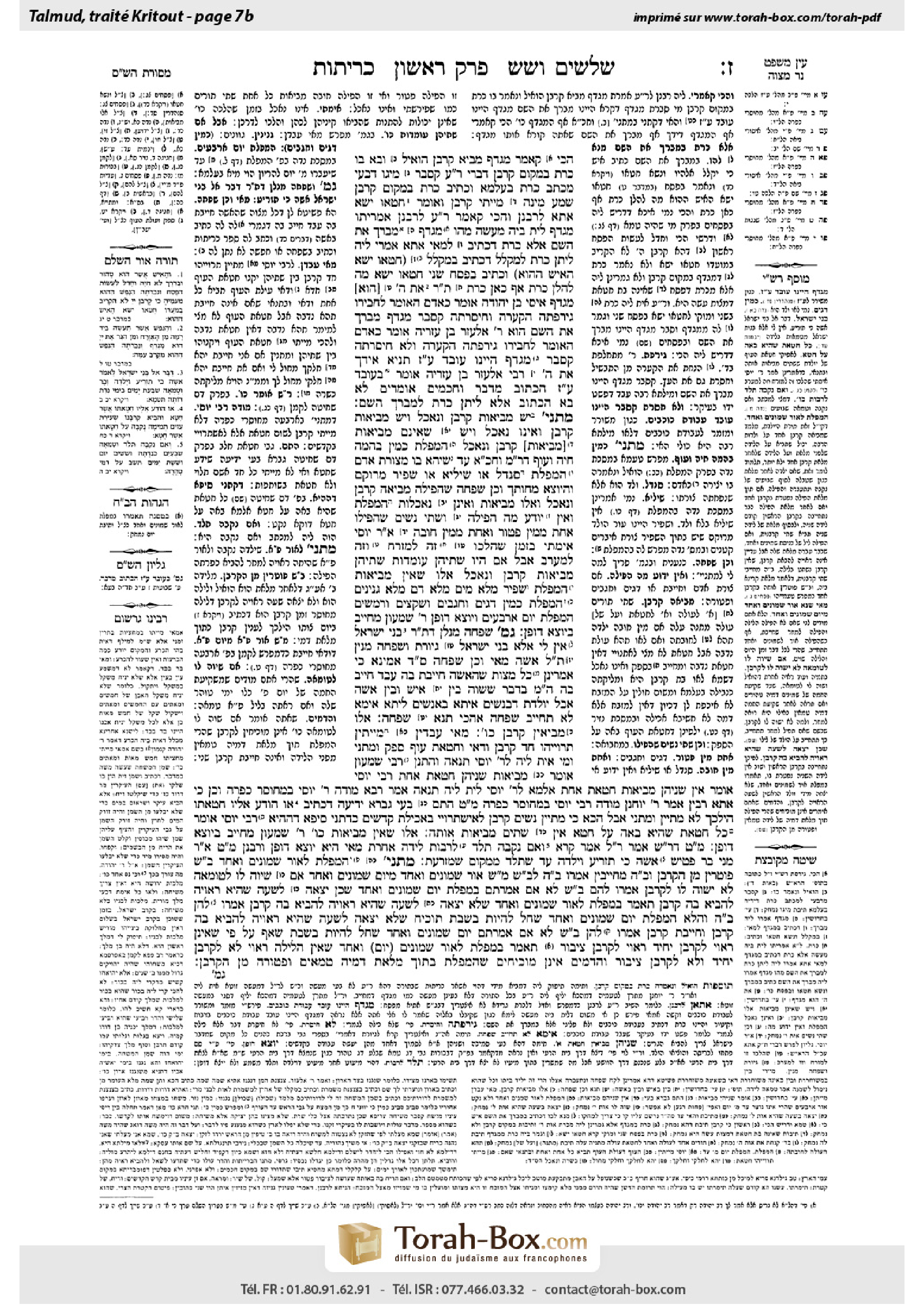
Keritot 7b: Talmud study for Daf Yomi
Daf Yomi is the daily study of one Talmud folio. Explore 37 tractates with scans, Hebrew text, Sefaria English and AI-generated French translations where annotated.
Passage selection and English or AI-generated French translation are available where the scan has annotations. Daf Study is independent of Torah-Box and Sefaria.
Browse Keritot · כריתות · All tractatesKeritot 7b text and translations
This page of Keritot includes the Aramaic text, an English translation and an AI-generated French translation, alongside the scan above.
כריתות ז׳ ב · Aramaic and Hebrew text
הָכִי קָאָמַר: מְגַדֵּף מֵבִיא קׇרְבָּן הוֹאִיל וּבָא בּוֹ כָּרֵת בִּמְקוֹם קׇרְבָּן, דִּבְרֵי רַבִּי עֲקִיבָא. קָסָבַר: מִיגּוֹ דְּבָעֵי מִכְתַּב כָּרֵת בְּעָלְמָא, וּכְתִיב כָּרֵת בִּמְקוֹם קׇרְבָּן, שְׁמַע מִינַּהּ מַיְיתֵי קׇרְבָּן.
וְאוֹמֵר: ״חֶטְאוֹ יִשָּׂא״. אֲתָא[ן] לְרַבָּנַן, וְהָכִי קָאָמַר רַבִּי עֲקִיבָא לְרַבָּנַן: אָמְרִיתוּ מְגַדֵּף לֵית בֵּיהּ מַעֲשֶׂה, מַהוּ מְגַדֵּף – מְבָרֵךְ אֶת הַשֵּׁם. אֶלָּא כָּרֵת דִּכְתִיב, לְמַאי אֲתָא?
אָמְרִי לֵיהּ: לִיתֵּן כָּרֵת לִמְקַלֵּל, דִּכְתִיב בִּמְקַלֵּל: (״חֶטְאוֹ יִשָּׂא הָאִישׁ הַהוּא״) [״וְנָשָׂא חֶטְאוֹ״], וּכְתִיב בְּפֶסַח שֵׁנִי: ״חֶטְאוֹ יִשָּׂא״, מָה לְהַלָּן – כָּרֵת, אַף כָּאן – כָּרֵת.
תָּנוּ רַבָּנַן: ״אֶת ה׳ [הוּא] מְגַדֵּף״, אִיסִי בֶּן יְהוּדָה אוֹמֵר: כְּאָדָם הָאוֹמֵר לַחֲבֵירוֹ ״גֵּירַפְתָּה הַקְּעָרָה וְחִיסַּרְתָּהּ״. קָסָבַר: מְגַדֵּף – מְבָרֵךְ אֶת הַשֵּׁם הוּא.
רַבִּי אֶלְעָזָר בֶּן עֲזַרְיָה אוֹמֵר: כְּאָדָם הָאוֹמֵר לַחֲבֵירוֹ ״גֵּירַפְתָּה הַקְּעָרָה וְלֹא חִיסַּרְתָּהּ״. קָסָבַר: מְגַדֵּף – הַיְינוּ עוֹבֵד עֲבוֹדָה זָרָה.
תַּנְיָא אִידַּךְ: ״אֶת ה׳״, רַבִּי אֶלְעָזָר בֶּן עֲזַרְיָה אוֹמֵר: בְּעוֹבֵד עֲבוֹדָה זָרָה הַכָּתוּב מְדַבֵּר, וַחֲכָמִים אוֹמְרִים: לֹא בָּא הַכָּתוּב אֶלָּא לִיתֵּן כָּרֵת לִמְבָרֵךְ הַשֵּׁם.
מַתְנִי׳ יֵשׁ מְבִיאוֹת קׇרְבָּן וְנֶאֱכָל, וְיֵשׁ מְבִיאוֹת קׇרְבָּן וְאֵינוֹ נֶאֱכָל, וְיֵשׁ שֶׁאֵינָם מְבִיאוֹת.
מְבִיאוֹת קׇרְבָּן וְנֶאֱכָל: הַמַּפֶּלֶת כְּמִין בְּהֵמָה חַיָּה וָעוֹף, דִּבְרֵי רַבִּי מֵאִיר. וַחֲכָמִים אוֹמְרִים: עַד שֶׁיְּהֵא בּוֹ מִצּוּרַת אָדָם.
הַמַּפֶּלֶת סַנְדָּל אוֹ שִׁילְיָא אוֹ שַׁפִּיר מְרוּקָּם, וְהַיּוֹצֵא מְחוּתָּךְ, וְכֵן שִׁפְחָה שֶׁהִפִּילָה, מְבִיאָה קׇרְבָּן וְנֶאֱכָל.
וְאֵלּוּ מְבִיאוֹת וְאֵינָן נֶאֱכָלוֹת: הַמַּפֶּלֶת וְאֵין יוֹדֵעַ מָה הִפִּילָה, וּשְׁתֵּי נָשִׁים שֶׁהִפִּילוּ, אַחַת מִמִּין פְּטוּר וְאַחַת מִמִּין חוֹבָה. אָמַר רַבִּי יוֹסֵי: אֵימָתַי? בִּזְמַן שֶׁהָלְכוּ זֶה לַמִּזְרָח וְזֶה לַמַּעֲרָב. אֲבָל אִם הָיוּ שְׁתֵּיהֶן עוֹמְדוֹת – שְׁתֵּיהֶן מְבִיאוֹת קׇרְבָּן, וְנֶאֱכָל.
אֵלּוּ שֶׁאֵין מְבִיאוֹת: הַמַּפֶּלֶת שַׁפִּיר מָלֵא מַיִם, מָלֵא דָּם, מָלֵא גְּנִינִים, הַמַּפֶּלֶת כְּמִין דָּגִים וַחֲגָבִים וּשְׁקָצִים וּרְמָשִׂים, הַמַּפֶּלֶת יוֹם אַרְבָּעִים, וְיוֹצֵא דּוֹפֶן. רַבִּי שִׁמְעוֹן מְחַיֵּיב בְּיוֹצֵא דּוֹפֶן.
גְּמָ׳ שִׁפְחָה מְנָלַן? דְּתָנוּ רַבָּנַן: ״בְּנֵי יִשְׂרָאֵל״, אֵין לִי אֶלָּא בְּנֵי יִשְׂרָאֵל, גִּיּוֹרֶת וְשִׁפְחָה מִנַּיִן? תַּלְמוּד לוֹמַר: ״אִשָּׁה״.
מַאי ״וְכֵן שִׁפְחָה״? סָלְקָא דַעְתָּךְ אָמֵינָא: כִּי אָמְרִינַן כׇּל מִצְוָה שֶׁהָאִשָּׁה חַיֶּיבֶת בָּהּ – עֶבֶד חַיָּיב בָּהּ, הָנֵי מִילֵּי בְּדָבָר שֶׁשָּׁוֶה בֵּין אִישׁ וּבֵין אִשָּׁה. אֲבָל יוֹלֶדֶת, דִּבְנָשִׁים אִיתַהּ, בַּאֲנָשִׁים לֵיתַהּ, אֵימָא לָא תִּחַיַּיב שִׁפְחָה, אַהָכִי תְּנָא: שִׁפְחָה.
אֵלּוּ מְבִיאִין קׇרְבָּן כּוּ׳. מַאי עָבְדִין? מַייתְיָן תַּרְוַיְיהוּ חַד קׇרְבָּן וַדַּאי, וְחַטַּאת עוֹף סָפֵק, וּמַתְנֵי.
וּמִי אִית לֵיהּ לְרַבִּי יוֹסֵי תְּנָאָה? וְהָתְנַן: רַבִּי שִׁמְעוֹן אוֹמֵר: מְבִיאוֹת שְׁנֵיהֶן חַטָּאת אַחַת. רַבִּי יוֹסֵי אוֹמֵר אֵין שְׁנֵיהֶן מְבִיאוֹת חַטָּאת אַחַת. אַלְמָא לְרַבִּי יוֹסֵי לֵית לֵיהּ תְּנָאָה!
אָמַר רָבָא: מוֹדֶה רַבִּי יוֹסֵי בִּמְחוּסַּר כַּפָּרָה. וְכֵן כִּי אֲתָא רָבִין אָמַר רַבִּי יוֹחָנָן: מוֹדֶה רַבִּי יוֹסֵי בִּמְחוּסַּר כַּפָּרָה.
מַאי טַעְמָא? הָתָם בָּעֵי גַּבְרָא יְדִיעָה, דִּכְתִיב: ״אוֹ הוֹדַע אֵלָיו חַטָּאתוֹ״ הִילְכָּךְ, לָא מַתְיָין וּמַתְנְיָ[ין]. אֲבָל הָכָא, כִּי מַתְיָין נָשִׁים קׇרְבָּן – לְאִישְׁתְּרוֹיֵי בַּאֲכִילַת קָדָשִׁים.
כִּדְתָנֵי סֵיפָא דְּהַהִיא: רַבִּי יוֹסֵי אוֹמֵר: כׇּל חַטָּאת שֶׁהִיא בָּאָה עַל חֵטְא – אֵין שְׁתַּיִם מְבִיאוֹת אוֹתָהּ.
אֵלּוּ שֶׁאֵין מְבִיאוֹת כּוּ׳ רַבִּי שִׁמְעוֹן מְחַיֵּיב בְּיוֹצֵא דּוֹפֶן. מַאי טַעְמָא דְּרַבִּי שִׁמְעוֹן? אָמַר רֵישׁ לָקִישׁ: אָמַר קְרָא: ״וְאִם נְקֵבָה תֵּלֵד״, לְרַבּוֹת לֵידָה אַחֶרֶת, מַאי הִיא – יוֹצֵא דּוֹפֶן.
וְרַבָּנַן מַאי טַעְמָא? אָמַר רַבִּי מַנִּי בַּר פַּטִּישׁ: ״אִשָּׁה כִּי תַזְרִיעַ וְיָלְדָה״ – עַד שֶׁתֵּלֵד מִמָּקוֹם שֶׁמַּזְרַעַת.
מַתְנִי׳ הַמַּפֶּלֶת לְאוֹר שְׁמוֹנִים וְאֶחָד, בֵּית שַׁמַּאי פּוֹטְרִין מִן הַקׇּרְבָּן, וּבֵית הִלֵּל מְחַיְּיבִין.
אָמְרוּ בֵּית הִלֵּל לְבֵית שַׁמַּאי: מַאי שְׁנָא אוֹר שְׁמוֹנִים וְאֶחָד מִיּוֹם שְׁמוֹנִים וְאֶחָד? אִם שָׁיוָה לוֹ לְטוּמְאָה, לֹא יִשְׁוֶה לוֹ לְקׇרְבָּן?
אָמְרוּ לָהֶם בֵּית שַׁמַּאי: לֹא, אִם אֲמַרְתֶּם בְּמַפֶּלֶת יוֹם שְׁמוֹנִים וְאֶחָד, שֶׁכֵּן יָצְאָה לְשָׁעָה שֶׁהִיא רְאוּיָה לְהָבִיא בָּהּ קׇרְבָּן, תֹּאמַר בְּמַפֶּלֶת לְאוֹר שְׁמוֹנִים וְאֶחָד, שֶׁלֹּא יָצְאָה לְשָׁעָה שֶׁהִיא רְאוּיָה לְהָבִיא בָּהּ קׇרְבָּן.
אָמְרוּ לָהֶן בֵּית הִלֵּל: וַהֲלֹא הַמַּפֶּלֶת יוֹם שְׁמוֹנִים וְאֶחָד שֶׁחָל לִהְיוֹת בְּשַׁבָּת תּוֹכִיחַ, שֶׁלֹּא יָצְאָה לְשָׁעָה שֶׁהִיא רְאוּיָה לְהָבִיא בָּהּ קׇרְבָּן, וְחַיֶּיבֶת קׇרְבָּן!
אָמְרוּ לָהֶן בֵּית שַׁמַּאי: לֹא, אִם אֲמַרְתֶּם יוֹם שְׁמוֹנִים וְאֶחָד שֶׁחָל לִהְיוֹת בַּשַּׁבָּת, שֶׁאַף עַל פִּי שֶׁאֵינוֹ רָאוּי לְקׇרְבַּן יָחִיד, רָאוּי לְקׇרְבַּן צִיבּוּר, תֹּאמַר בְּמַפֶּלֶת לְאוֹר שְׁמוֹנִים יוֹם וְאֶחָד, שֶׁאֵין הַלַּיְלָה רָאוּי לֹא לְקׇרְבַּן יָחִיד וְלֹא לְקׇרְבַּן צִיבּוּר?
וְהַדָּמִים אֵינָן מוֹכִיחִים, שֶׁהַמַּפֶּלֶת בְּתוֹךְ מְלֹאת – דָּמֶיהָ טְמֵאִים, וּפְטוּרָה מִן הַקׇּרְבָּן.
Keritot 7b · English translation
The Gemara answers that this is what Rabbi Akiva is saying: One who unwittingly blasphemes brings an offering, since its punishment of karet comes, i.e., is written, in a place where the Torah discusses an offering, i.e., karet is mentioned in a passage that discusses a sin offering (see Numbers 15:27–31). This is the statement of Rabbi Akiva, as he maintains: Since the verse should have written karet in general, i.e., without connecting it to bringing an offering, and yet this karet is written in a place where the Torah discusses an offering, conclude from it that the unwitting blasphemer brings an offering for his transgression.
The Gemara analyzes the next clause of the baraita: And the verse states: “Whoever curses his God shall bear his sin” (Leviticus 24:15). The Gemara explains: Here we arrive at the opinion of the Rabbis, and this is what Rabbi Akiva is saying to the Rabbis: You say that the transgression of one who blasphemes does not involve an action, as what is the case of one who blasphemes? It is one who blesses, i.e., curses, the Name, i.e., God. But if so, then concerning the punishment of karet that is written: “That person blasphemes the Lord; and that soul shall be cut off [venikhreta] from among his people” (Numbers 15:30), for what purpose does it come, if not to render him liable to bring an offering?
The Rabbis say to him: It comes to give the punishment of karet to one who curses God, in order to teach that the phrase: “Shall bear his sin,” written in the verse: “Whoever curses his God shall bear his sin” (Leviticus 24:15), is referring to karet, so that one can derive by verbal analogy that an individual who was obligated to bring a Paschal offering for the second Pesaḥ and did not do so is likewise liable to receive karet. As it is written with regard to one who curses God: “Whoever curses his God shall bear his sin,” and it is written with regard to one who was obligated to bring a Paschal offering for the second Pesaḥ and did not do so: “That man shall bear his sin” (Numbers 9:13). Just as there, with regard to one who curses God it is referring to the punishment of karet, so too here, with regard to the Paschal offering it is referring to the punishment of karet.
With regard to one who blasphemes, the Sages taught in a baraita: The verse states: “That person blasphemes [megaddef ] the Lord” (Numbers 15:30). Isi ben Yehuda says: This is like a person who says to another: You cleaned [geirafta] the bowl and rendered it lacking, i.e., the transgression of blasphemy is so severe that it is compared to one who does actual damage to God. Isi ben Yehuda maintains that the case of the blasphemer is identical to that of one who blesses, i.e., curses, the Name, i.e., God, which is a particularly severe transgression.
Rabbi Elazar ben Azarya says that this is like a person who says to another: You cleaned the bowl and removed its contents, but did not render it lacking, i.e., the transgression of blasphemy is not compared to one who does actual damage to God. Rabbi Elazar ben Azarya maintains that the case of the blasphemer is the same as that of an idol worshipper, which is a less severe transgression.
This dispute as to the nature of the transgression of the blasphemer is taught in another baraita: “That person blasphemes the Lord” (Numbers 15:30), and Rabbi Elazar ben Azarya says: The verse is speaking of an idol worshipper. And the Rabbis say: The verse comes only to give the punishment of karet to one who blesses, i.e., curses, the Name, i.e., God.
MISHNA: There are some women who bring a sin offering of a woman after childbirth and the offering is eaten by the priests. And there are some women who bring a sin offering but it is not eaten. And there are some women who do not bring a sin offering at all.
The mishna elaborates: The following women bring a sin offering and it is eaten by the priests: One who miscarries a fetus with a form similar to a domesticated animal, one who miscarries a fetus with a form similar to an undomesticated animal, or one who miscarries a fetus with a form similar to a bird; this is the statement of Rabbi Meir. And the Rabbis say: She does not bring a sin offering unless the fetus has the form of a person.
With regard to a woman who miscarries a sandal fetus, i.e., one that has the form of a flat fish; or if she miscarries the placenta; or an amniotic sac in which tissue developed; or a fetus that emerged cut, i.e., in pieces; and likewise a Canaanite maidservant, owned by a Jew, who miscarried; in all these cases she brings a sin offering and it is eaten by the priests.
And these women bring sin offerings but their sin offerings are not eaten: One who miscarries and does not know the nature of what she miscarried; and two women who miscarried, in a case where one miscarried a fetus of a type for which a woman is exempt from bringing an offering and the other one miscarried a fetus of a type for which a woman is liable to bring an offering, and they do not know which miscarried which type. Rabbi Yosei said: When is their sin offering not eaten? It is when both women went to different places within the Temple to bring their offerings, e.g., this woman went to the east and that woman went to the west. But if both of them were standing together, both of them together bring one sin offering, and it is eaten.
These women do not bring a sin offering: A woman who miscarries an amniotic sac full of water, or one full of blood, or one full of different colors; and likewise a woman who miscarries a fetus with a form similar to fish, or grasshoppers, or repugnant creatures, or creeping animals; and a woman who miscarries on the fortieth day of her pregnancy; and a woman who gives birth by caesarean section. Rabbi Shimon deems a woman liable to bring a sin offering in the case where she gives birth by caesarean section.
GEMARA: From where do we derive that in the case of a Canaanite maidservant, owned by a Jew, who miscarried, she brings a sin offering and it is eaten? As the Sages taught in a baraita: The passage discussing the halakhot of a woman following childbirth begins with the verse: “Speak to the children of Israel, saying: If a woman conceives and gives birth to a male” (Leviticus 12:2). From this verse I have derived only that the full-fledged children of Israel are included in these halakhot; from where do I derive that a convert and a Canaanite maidservant are also included in these halakhot? The verse states “a woman,” which includes other women.
The Gemara asks: What is the meaning of the special emphasis in the mishna: And likewise a Canaanite maidservant? Why does the mishna deem it necessary to write this halakha? The Gemara answers: It might enter your mind to say that when we say: With regard to any mitzva in which a woman is obligated a Canaanite slave is also obligated in that mitzva, this statement applies with regard to a matter that is the same for a man and for a woman. But with regard to the offerings of a woman after childbirth, which is a category that applies to women but does not apply to men, one might say a Canaanite maidservant is not obligated to bring these offerings. It is for this reason the mishna taught the case of a Canaanite maidservant.
§ The mishna teaches: These women bring a sin offering but their sin offerings are not eaten. It then teaches that in a case where one miscarried a fetus of a type for which a woman is exempt from bringing an offering and the other one miscarried a fetus of a type for which a woman is obligated to bring an offering, Rabbi Yosei maintains that if both are standing together they bring one offering together. The Gemara asks: What exactly do they do? The two of them bring one definite burnt offering, and a sin offering of a bird due to uncertainty, and they each stipulate that if she is obligated to bring the sin offering the animal is hers, and if not then it belongs to the other woman.
The Gemara asks: And is Rabbi Yosei of the opinion that a stipulation is effective in the case of a sin offering? But didn’t we learn in a mishna (23a): With regard to a situation where one of two women unwittingly ate a piece of forbidden fat and is obligated to bring a sin offering, but it is unknown which woman, Rabbi Shimon says: They both bring one sin offering together, and Rabbi Yosei says: They do not both bring one sin offering together. Evidently, Rabbi Yosei is not of the opinion that a stipulation is effective with regard to a sin offering.
Rava said: Rabbi Yosei concedes that a stipulation is effective with regard to one who has not yet brought an atonement offering to complete the purification process, as is the case concerning a woman after childbirth. And likewise, when Ravin came from Eretz Yisrael to Babylonia he said that Rabbi Yoḥanan says: Rabbi Yosei concedes with regard to one who has not yet brought an atonement offering that a stipulation is effective.
The Gemara asks: What is the reason for this difference between the sin offering of one who has not yet brought an atonement offering and standard sin offerings? The Gemara answers: There, with regard to a sin offering brought for a transgression, the man requires definite awareness of his transgression for him to be obligated to bring a sin offering, as it is written: “If his sin, which he has sinned, be known to him” (Leviticus 4:28). Therefore, in the case where one of two women ate forbidden fat, they do not bring a sin offering together and stipulate that it should be for whichever of them ate the forbidden fat. But here, with regard to a woman after a miscarriage, when these women bring their sin offering they do so only in order to become permitted in the consumption of sacrificial food, and therefore the stipulation is effective.
The Gemara cites a proof that this distinction is in fact the opinion of Rabbi Yosei: As it is taught in the latter clause of that mishna that Rabbi Yosei says: With regard to any sin offering that comes as atonement for a sin, two people do not bring it together. This indicates that if a sin offering does not atone for a sin, two people can bring it together.
§ The mishna teaches: And these women do not bring a sin offering, and among them are a woman who gives birth by caesarean section. Rabbi Shimon deems a woman liable to bring an offering in a case where she gives birth by caesarean section. The Gemara asks: What is the reason of Rabbi Shimon? Reish Lakish said that the verse states: “But if she bears a girl” (Leviticus 12:5). The term “she bears” is superfluous in the context of the passage, and it serves to include another type of birth, and what is it? This is a birth by caesarean section.
The Gemara asks: And as for the Rabbis, what is their reasoning? Rabbi Mani bar Pattish said that their ruling is derived from the verse: “If a woman conceives [tazria] and gives birth to a male” (Leviticus 12:2). The word tazria literally means to receive seed, indicating that all the halakhot mentioned in that passage do not apply unless she gives birth through the place where she receives seed, not through any other place, such as in the case of a caesarean section.
MISHNA: A woman who gives birth to a daughter counts fourteen days during which she is ritually impure. That is followed by sixty-six days during which she remains ritually pure even if she experiences a flow of blood. The Torah obligates a woman to bring her offering on the eighty-first day (see Leviticus 12:1–6). If the woman miscarries another fetus before that day, she is not required to bring an additional offering. In the case of a woman who miscarries a fetus on the night of, i.e., preceding, the eighty-first day, Beit Shammai deem her exempt from bringing a second offering and Beit Hillel deem her liable to bring a second offering.
Beit Hillel said to Beit Shammai: What is different between the night of the eighty-first and the day of the eighty-first? If they are equal with regard to the halakhot of ritual impurity, i.e., the blood flow of this woman on the eighty-first night renders her ritually impure and all the standard strictures of ritual impurity apply to her, will the two time periods not be equal with regard to liability to bring an additional offering as well?
Beit Shammai said to Beit Hillel: No, there is a difference between that night and the following day. If you said with regard to a woman who miscarries on the eighty-first day that she is obligated to bring an additional offering, this is logical, as she emerged into a period that is fit for her to bring her offering. Would you say the same with regard to a woman who miscarries on the night of the eighty-first day, where she did not emerge into a period that is fit for her to bring her offering, as offerings are not sacrificed at night?
Beit Hillel said to Beit Shammai: But let the case of a woman who miscarries on the eighty-first day that occurs on Shabbat prove that this distinction is incorrect, as she did not emerge into a period that is fit for her to bring her offering because individual offerings are not sacrificed on Shabbat, and nevertheless she is obligated to bring an additional offering.
Beit Shammai said to Beit Hillel: No, there is a difference between these cases. If you said this ruling with regard to a woman who miscarries on the eighty-first day that occurs on Shabbat, the reason is that although Shabbat is unfit for the sacrifice of an individual offering, it is fit for the sacrifice of a communal offering whose time is fixed, e.g., the daily offering. Would you say the same with regard to a woman who miscarries on the night of the eighty-first day, as the night is completely unfit, since neither an individual offering nor a communal offering is sacrificed at night?
Beit Shammai add: And as for the ritual impurity status of the blood, i.e., Beit Hillel’s opinion that the two time periods are equal with regard to the halakhot of ritual impurity, this does not prove what the halakha should be with regard to offerings, as with regard to a woman who miscarries before the completion of the term of eighty days, her blood is impure like the blood of a woman after childbirth, and nevertheless she is exempt from bringing the offering.
Keritot 7b · Traduction française (IA)
La Guemara répond que voici ce que dit Rabbi Akiva : Celui qui blasphème par inadvertance apporte une offrande, puisque la peine de karet qui le concerne est mentionnée dans un passage où la Torah traite d’une offrande, c’est-à-dire dans un passage qui traite d’un sacrifice expiatoire (voir Nombres 15:27–31). Telle est la position de Rabbi Akiva, qui considère que le verset aurait dû mentionner le karet de manière générale, sans le rattacher à l’apport d’une offrande. Or, puisque cette peine de karet est mentionnée dans un passage où la Torah traite d’une offrande, on en déduit que celui qui blasphème par inadvertance apporte une offrande pour sa transgression.
La Guemara analyse la clause suivante de la baraïta : « Quiconque maudit son Dieu portera la peine de son péché » (Lévitique 24:15). La Guemara explique : Nous en arrivons ici à l’opinion des Rabbins, et voici ce que Rabbi Akiva leur dit : Vous dites que la transgression de celui qui blasphème ne comporte pas d’acte, car en quoi consiste le blasphème ? Il consiste à bénir, c’est-à-dire à maudire, le Nom, c’est-à-dire Dieu. Mais alors, à quoi sert la peine de karet mentionnée dans le verset : « Cet homme blasphème contre le Seigneur, et cette âme sera retranchée [venikhreta] du milieu de son peuple » (Nombres 15:30), si ce n’est à le rendre passible d’apporter une offrande ?
Les Rabbins lui répondent : Elle sert à infliger la peine de karet à celui qui maudit Dieu, afin d’enseigner que l’expression « portera la peine de son péché », dans le verset « Quiconque maudit son Dieu portera la peine de son péché » (Lévitique 24:15), désigne le karet. On peut ainsi déduire par analogie verbale qu’un individu qui était tenu d’apporter une offrande pascale à Pessa’h chéni et ne l’a pas fait est également passible de karet. En effet, il est écrit au sujet de celui qui maudit Dieu : « Quiconque maudit son Dieu portera la peine de son péché », et au sujet de celui qui était tenu d’apporter une offrande pascale à Pessa’h chéni et ne l’a pas fait : « Cet homme portera la peine de son péché » (Nombres 9:13). De même que là, au sujet de celui qui maudit Dieu, cela désigne la peine de karet, de même ici, au sujet de l’offrande pascale, cela désigne la peine de karet.
Au sujet de celui qui blasphème, les Sages ont enseigné dans une baraïta : Le verset dit : « Cet homme blasphème [megaddef] contre le Seigneur » (Nombres 15:30). Isi ben Yehouda dit : C’est comme quelqu’un qui dit à un autre : « Tu as récuré [geirafta] le bol et tu l’as rendu incomplet », c’est-à-dire que la transgression du blasphème est si grave qu’elle est comparée au fait d’infliger un dommage réel à Dieu. Isi ben Yehouda considère que le cas du blasphémateur est identique à celui de celui qui bénit, c’est-à-dire maudit, le Nom, c’est-à-dire Dieu, ce qui constitue une transgression particulièrement grave.
Rabbi Elazar ben Azarya dit que c’est comme quelqu’un qui dit à un autre : « Tu as récuré le bol et en as retiré le contenu, mais tu ne l’as pas rendu incomplet », c’est-à-dire que la transgression du blasphème n’est pas comparée au fait d’infliger un dommage réel à Dieu. Rabbi Elazar ben Azarya considère que le cas du blasphémateur est le même que celui de l’idolâtre, dont la transgression est moins grave.
Cette controverse sur la nature de la transgression du blasphémateur est enseignée dans une autre baraïta : « Cet homme blasphème contre le Seigneur » (Nombres 15:30). Rabbi Elazar ben Azarya dit que le verset parle d’un idolâtre. Les Rabbins disent que le verset ne vient que pour infliger la peine de karet à celui qui bénit, c’est-à-dire maudit, le Nom, c’est-à-dire Dieu.
MICHNA : Certaines femmes apportent un sacrifice expiatoire après un accouchement, et les prêtres le consomment. D’autres femmes apportent un sacrifice expiatoire qui n’est pas consommé. Enfin, certaines femmes n’apportent aucun sacrifice expiatoire.
La Michna détaille : Les femmes suivantes apportent un sacrifice expiatoire, que les prêtres consomment : celle qui fait une fausse couche et dont le fœtus a une forme semblable à celle d’un animal domestique, celle dont le fœtus a une forme semblable à celle d’un animal sauvage, ou celle dont le fœtus a une forme semblable à celle d’un oiseau ; telle est la position de Rabbi Meïr. Les Rabbins disent : Elle n’apporte un sacrifice expiatoire que si le fœtus a une forme humaine.
Dans le cas d’une femme qui fait une fausse couche et expulse un fœtus en forme de sandale, c’est-à-dire ayant la forme d’un poisson plat, ou qui expulse le placenta, ou une poche amniotique dans laquelle du tissu s’est développé, ou un fœtus fragmenté, c’est-à-dire sorti en morceaux ; de même, une servante cananéenne appartenant à un Juif qui fait une fausse couche apporte un sacrifice expiatoire, que les prêtres consomment.
Les femmes suivantes apportent un sacrifice expiatoire qui n’est pas consommé : celle qui fait une fausse couche sans savoir ce qu’elle a expulsé ; et deux femmes qui font une fausse couche, dont l’une a expulsé un fœtus pour lequel une femme est dispensée d’apporter une offrande, et l’autre un fœtus pour lequel une femme est tenue d’en apporter une, sans qu’elles sachent laquelle a expulsé quel type de fœtus. Rabbi Yossi dit : Dans quel cas leur sacrifice expiatoire n’est-il pas consommé ? Lorsque les deux femmes se sont rendues en des endroits différents du Temple pour apporter leurs offrandes, par exemple, l’une à l’est et l’autre à l’ouest. Mais si elles se tenaient ensemble, elles apportent toutes deux un seul sacrifice expiatoire, qui est consommé.
Ces femmes n’apportent pas de sacrifice expiatoire : celle qui expulse une poche amniotique remplie d’eau, ou de sang, ou de liquides de couleurs diverses ; de même, celle qui expulse un fœtus ayant une forme semblable à celle d’un poisson, de sauterelles, de créatures répugnantes ou d’animaux rampants ; celle qui fait une fausse couche le quarantième jour de sa grossesse ; et celle qui accouche par césarienne. Rabbi Shimon considère qu’une femme qui accouche par césarienne est tenue d’apporter un sacrifice expiatoire.
GUEMARA : D’où savons-nous que, dans le cas d’une servante cananéenne appartenant à un Juif qui fait une fausse couche, elle apporte un sacrifice expiatoire que les prêtres consomment ? Les Sages ont enseigné dans une baraïta : Le passage traitant des lois concernant la femme après l’accouchement commence par le verset : « Parle aux enfants d’Israël en ces termes : Si une femme conçoit et donne naissance à un garçon » (Lévitique 12:2). De ce verset, j’ai déduit que seuls les enfants d’Israël de naissance sont concernés par ces lois. D’où déduis-je qu’une convertie et une servante cananéenne sont également concernées ? Le verset dit « une femme », ce qui inclut d’autres femmes.
La Guemara demande : Que signifie la précision particulière de la Michna : « De même, une servante cananéenne » ? Pourquoi la Michna a-t-elle jugé nécessaire d’énoncer cette halakha ? La Guemara répond : On pourrait être tenté de dire que lorsqu’on affirme qu’un esclave cananéen est également tenu d’accomplir toute mitsva à laquelle une femme est tenue, cela vaut pour une obligation identique pour l’homme et la femme. Mais pour les offrandes de la femme après l’accouchement, catégorie qui concerne les femmes mais pas les hommes, on pourrait dire qu’une servante cananéenne n’est pas tenue d’apporter ces offrandes. C’est pourquoi la Michna enseigne le cas d’une servante cananéenne.
§ La Michna enseigne : Ces femmes apportent un sacrifice expiatoire, mais celui-ci n’est pas consommé. Elle enseigne ensuite que, lorsque l’une a expulsé un fœtus pour lequel une femme est dispensée d’apporter une offrande et l’autre un fœtus pour lequel une femme est tenue d’en apporter une, Rabbi Yossi considère que si elles se tiennent ensemble, elles apportent ensemble une seule offrande. La Guemara demande : Que font-elles exactement ? Elles apportent un holocauste dont l’obligation est certaine, ainsi qu’un sacrifice expiatoire d’oiseau en raison du doute, et chacune stipule que, si elle est tenue d’apporter le sacrifice expiatoire, l’animal lui appartient ; sinon, il appartient à l’autre femme.
La Guemara demande : Rabbi Yossi estime-t-il qu’une stipulation est valable pour un sacrifice expiatoire ? Mais n’avons-nous pas appris dans une Michna (23a) : Lorsqu’une des deux femmes a mangé par inadvertance un morceau de graisse interdite et est tenue d’apporter un sacrifice expiatoire, mais qu’on ignore laquelle, Rabbi Shimon dit : Elles apportent ensemble un seul sacrifice expiatoire ; Rabbi Yossi dit : Elles n’apportent pas ensemble un seul sacrifice expiatoire. Il ressort de là que Rabbi Yossi ne considère pas qu’une stipulation soit valable pour un sacrifice expiatoire.
Rava dit : Rabbi Yossi reconnaît qu’une stipulation est valable pour celle qui n’a pas encore apporté l’offrande d’expiation nécessaire à l’achèvement de son processus de purification, comme c’est le cas d’une femme après l’accouchement. De même, lorsque Ravin vint d’Eretz Israël en Babylonie, il rapporta que Rabbi Yoḥanan dit : Rabbi Yossi reconnaît qu’une stipulation est valable pour celle qui n’a pas encore apporté l’offrande d’expiation.
La Guemara demande : Quelle est la raison de cette différence entre le sacrifice expiatoire de celle qui n’a pas encore apporté l’offrande d’expiation et les sacrifices expiatoires ordinaires ? La Guemara répond : Dans le cas d’un sacrifice expiatoire apporté pour une transgression, l’intéressé doit avoir pleinement connaissance de sa transgression pour être tenu d’apporter un sacrifice expiatoire, comme il est écrit : « Si le péché qu’il a commis lui est connu » (Lévitique 4:28). Par conséquent, dans le cas où l’une des deux femmes a mangé de la graisse interdite, elles n’apportent pas ensemble un sacrifice expiatoire en stipulant qu’il sera pour celle qui a mangé la graisse interdite. Mais ici, dans le cas d’une femme après une fausse couche, elles n’apportent leur sacrifice expiatoire que pour être autorisées à consommer des aliments consacrés ; la stipulation est donc valable.
La Guemara cite une preuve que telle est bien l’opinion de Rabbi Yossi : En effet, la dernière clause de cette Michna enseigne que Rabbi Yossi dit : Deux personnes n’apportent pas ensemble un sacrifice expiatoire destiné à expier une faute. Cela indique que si un sacrifice expiatoire n’expie pas une faute, deux personnes peuvent l’apporter ensemble.
§ La Michna enseigne : Ces femmes n’apportent pas de sacrifice expiatoire, notamment celle qui accouche par césarienne. Rabbi Shimon considère qu’une femme qui accouche par césarienne est tenue d’apporter une offrande. La Guemara demande : Quelle est la raison de Rabbi Shimon ? Reish Lakish dit que le verset énonce : « Mais si elle donne naissance à une fille » (Lévitique 12:5). L’expression « elle donne naissance » est superflue dans le contexte du passage et sert à inclure un autre type de naissance. Lequel ? La naissance par césarienne.
La Guemara demande : Et quelle est la raison des Rabbins ? Rabbi Mani bar Pattish dit que leur décision se déduit du verset : « Si une femme conçoit [tazria] et donne naissance à un garçon » (Lévitique 12:2). Le mot tazria signifie littéralement « recevoir la semence », ce qui indique que toutes les lois mentionnées dans ce passage ne s’appliquent que si elle accouche par l’endroit où elle reçoit la semence, et non par un autre endroit, comme lors d’une césarienne.
MICHNA : Une femme qui donne naissance à une fille compte quatorze jours pendant lesquels elle est rituellement impure. Ceux-ci sont suivis de soixante-six jours pendant lesquels elle demeure rituellement pure, même si elle a un écoulement de sang. La Torah oblige la femme à apporter son offrande le quatre-vingt-unième jour (voir Lévitique 12:1–6). Si elle fait une autre fausse couche avant ce jour, elle n’est pas tenue d’apporter une offrande supplémentaire. Dans le cas d’une femme qui fait une fausse couche la nuit précédant le quatre-vingt-unième jour, Beit Shammaï la dispense d’apporter une seconde offrande, tandis que Beit Hillel considère qu’elle est tenue d’en apporter une.
Beit Hillel dit à Beit Shammaï : Quelle différence y a-t-il entre la nuit précédant le quatre-vingt-unième jour et le quatre-vingt-unième jour lui-même ? S’ils sont équivalents quant aux lois de l’impureté rituelle — c’est-à-dire que l’écoulement de sang de cette femme durant la nuit précédant le quatre-vingt-unième jour la rend rituellement impure et que toutes les règles strictes de l’impureté rituelle s’appliquent à elle —, ces deux périodes ne sont-elles pas également équivalentes quant à l’obligation d’apporter une offrande supplémentaire ?
Beit Shammaï dit à Beit Hillel : Non, il y a une différence entre cette nuit et le jour qui suit. Si tu dis qu’une femme qui fait une fausse couche le quatre-vingt-unième jour est tenue d’apporter une offrande supplémentaire, c’est logique, puisqu’elle est entrée dans une période où elle peut apporter son offrande. Dirais-tu la même chose d’une femme qui fait une fausse couche durant la nuit précédant le quatre-vingt-unième jour, alors qu’elle n’est pas entrée dans une période où elle peut apporter son offrande, puisque les offrandes ne sont pas sacrifiées la nuit ?
Beit Hillel dit à Beit Shammaï : Mais le cas d’une femme qui fait une fausse couche le quatre-vingt-unième jour lorsque celui-ci tombe un Chabbat prouve que cette distinction est erronée : elle n’est pas entrée dans une période où elle peut apporter son offrande, car les offrandes individuelles ne sont pas sacrifiées le Chabbat, et pourtant elle est tenue d’apporter une offrande supplémentaire.
Beit Shammaï dit à Beit Hillel : Non, il y a une différence entre ces cas. Si tu énonces cette règle pour une femme qui fait une fausse couche le quatre-vingt-unième jour lorsque celui-ci tombe un Chabbat, c’est parce que, bien que le Chabbat ne convienne pas au sacrifice d’une offrande individuelle, il convient au sacrifice d’une offrande communautaire dont la date est fixée, comme l’offrande quotidienne. Dirais-tu la même chose d’une femme qui fait une fausse couche durant la nuit précédant le quatre-vingt-unième jour, puisque la nuit ne convient absolument pas : ni une offrande individuelle ni une offrande communautaire ne sont sacrifiées la nuit ?
Beit Shammaï ajoute : Quant au statut d’impureté rituelle du sang — c’est-à-dire l’opinion de Beit Hillel selon laquelle les deux périodes sont équivalentes quant aux lois de l’impureté rituelle —, cela ne prouve pas quelle devrait être la halakha concernant les offrandes. En effet, chez une femme qui fait une fausse couche avant la fin des quatre-vingts jours, son sang est impur comme celui d’une femme après l’accouchement ; pourtant, elle est dispensée d’apporter l’offrande.
Traduction française générée par IA à partir de l’édition anglaise de Sefaria. Vérifie toujours un passage avec le texte source.
Text from Sefaria: William Davidson Edition - Vocalized Aramaic (CC BY NC); William Davidson Edition - English (CC BY NC).