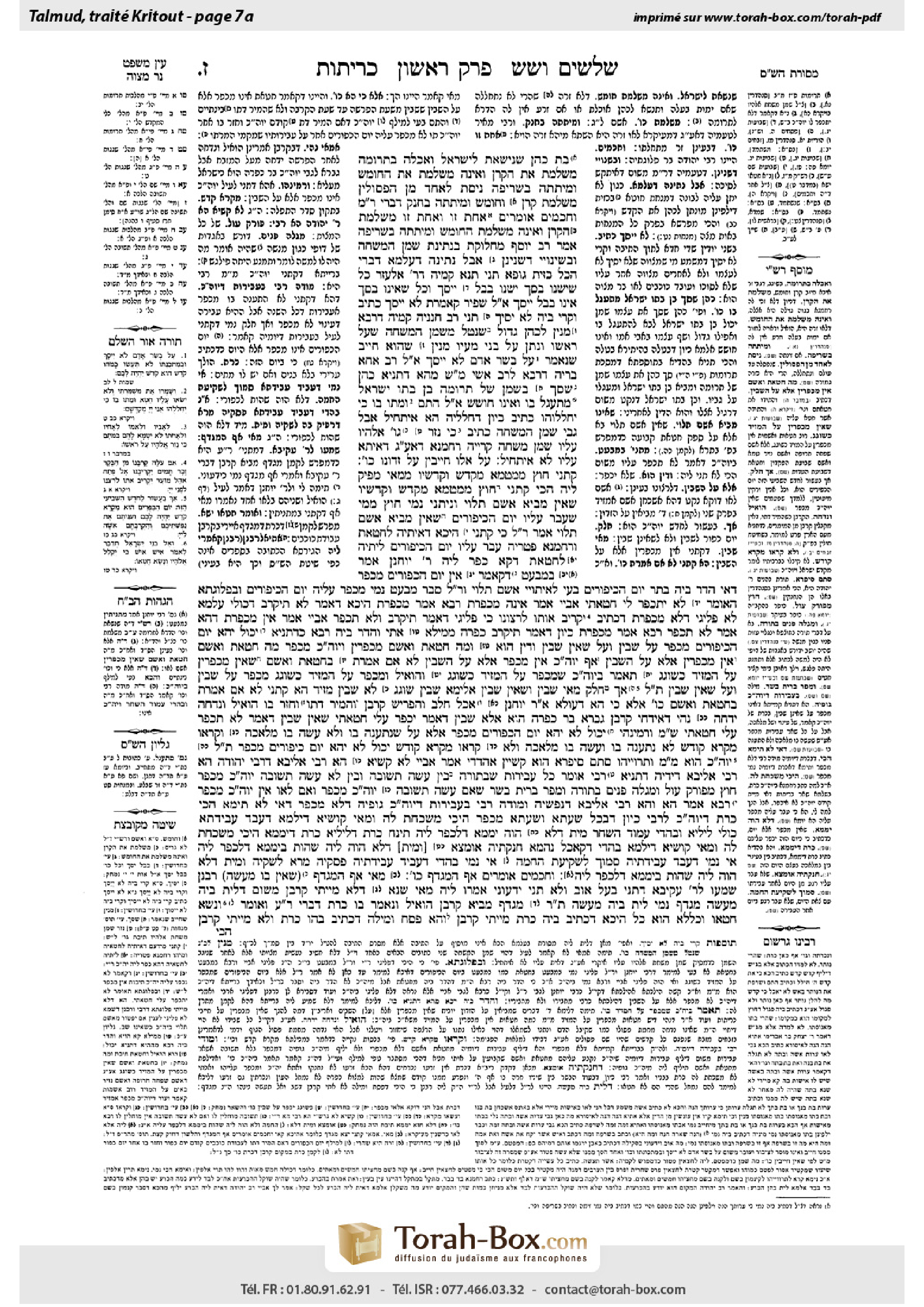
Keritot 7a: Talmud study for Daf Yomi
Daf Yomi is the daily study of one Talmud folio. Explore 37 tractates with scans, Hebrew text, Sefaria English and AI-generated French translations where annotated.
Passage selection and English or AI-generated French translation are available where the scan has annotations. Daf Study is independent of Torah-Box and Sefaria.
Browse Keritot · כריתות · All tractatesKeritot 7a text and translations
This page of Keritot includes the Aramaic text, an English translation and an AI-generated French translation, alongside the scan above.
כריתות ז׳ א · Aramaic and Hebrew text
בַּת כֹּהֵן שֶׁנִּישֵּׂאת לְיִשְׂרָאֵל, וְאָכְלָה בִּתְרוּמָה – מְשַׁלֶּמֶת אֶת הַקֶּרֶן וְאֵינָהּ מְשַׁלֶּמֶת אֶת הַחוֹמֶשׁ, וּמִיתָתָהּ בִּשְׂרֵיפָה.
נִיסֵּת לְאֶחָד מִן הַפְּסוּלִין – מְשַׁלֶּמֶת קֶרֶן וָחוֹמֶשׁ, וּמִיתָתָהּ בְּחֶנֶק, דִּבְרֵי רַבִּי מֵאִיר.
וַחֲכָמִים אוֹמְרִים: אַחַת זוֹ וְאַחַת זוֹ מְשַׁלֶּמֶת [אֶת] הַקֶּרֶן וְאֵינָהּ מְשַׁלֶּמֶת [אֶת] הַחוֹמֶשׁ, וּמִיתָתָהּ בִּשְׂרֵיפָה.
אָמַר רַב יוֹסֵף: מַחְלוֹקֶת בִּנְתִינַת שֶׁמֶן הַמִּשְׁחָה וּבְשִׁינּוּיֵי דְּשַׁנִּינַן, אֲבָל נְתִינָה דְּעָלְמָא – דִּבְרֵי הַכֹּל כְּזַיִת.
גּוּפָא. תָּנֵי תַּנָּא קַמֵּיהּ דְּרַבִּי אֶלְעָזָר: כֹּל שֶׁיֶּשְׁנוֹ בְּסָךְ – יֶשְׁנוֹ בְּבַל יִיסָךְ, וְכׇל שֶׁאֵינוֹ בְּסָךְ – אֵינוֹ בְּבַל יִיסָךְ. אֲמַר לֵיהּ: שַׁפִּיר קָאָמְרַתְּ, ״לֹא יִיסָךְ״ כְּתִיב, וּקְרִי בֵּיהּ ״לֹא יַסִּיךְ״.
תָּנֵי רַב חֲנַנְיָה קַמֵּיהּ דְּרָבָא: מִנַּיִן לְכֹהֵן גָּדוֹל שֶׁנָּטַל מִשֶּׁמֶן הַמִּשְׁחָה שֶׁעַל רֹאשׁוֹ וְנָתַן עַל בְּנֵי מֵעָיו, מִנַּיִן שֶׁהוּא חַיָּיב? שֶׁנֶּאֱמַר: ״עַל בְּשַׂר אָדָם לֹא יִיסָךְ״. אֲמַר לֵיהּ רַב אַחָא בְּרֵיהּ דְּרָבָא לְרַב אָשֵׁי: מַאי שְׁנָא מֵהָא דְּתַנְיָא: כֹּהֵן שֶׁסָּךְ בְּשֶׁמֶן שֶׁל תְּרוּמָה, בֶּן בִּתּוֹ יִשְׂרָאֵל מִתְעַגֵּל בּוֹ וְאֵינוֹ חוֹשֵׁשׁ?
אֲמַר לֵיהּ: הָתָם, ״וּמֵתוּ בוֹ כִּי יְחַלְּלֻהוּ״ כְּתִיב – כֵּיוָן דְּחַלְּלֵיהּ הָא אִיתַּחַיל, אֲבָל גַּבֵּי שֶׁמֶן הַמִּשְׁחָה כְּתִיב: ״כִּי נֵזֶר [שֶׁמֶן מִשְׁחַת] אֱלֹהָיו עָלָיו״ – ״שֶׁמֶן מִשְׁחָה״ קַרְיֵיהּ רַחֲמָנָא, דְּאַף עַל גַּב דְּאִיתֵיהּ עָלָיו לָא אִיתַּחַיל.
עַל אֵלּוּ חַיָּיבִין עַל זְדוֹנוֹ כּוּ׳. קָתָנֵי: חוּץ מִמְּטַמֵּא מִקְדָּשׁ וְקָדָשָׁיו. מִמַּאי מַפֵּיק לֵיהּ? הָכִי קָתָנֵי: חוּץ מִמִּטַּמֵּא מִקְדָּשׁ וְקָדָשָׁיו, שֶׁאֵין מֵבִיא אָשָׁם תָּלוּי.
וְנִיתְנֵי נָמֵי: חוּץ מִמִּי שֶׁעָבַר עָלָיו יוֹם הַכִּיפּוּרִים, שֶׁאֵין מֵבִיא אָשָׁם תָּלוּי! אָמַר רֵישׁ לָקִישׁ: כִּי קָתָנֵי, הֵיכָא דְּאִיתֵיהּ לַחֲטָאֵהּ וְרַחֲמָנָא פַּטְרֵיהּ. עָבַר עָלָיו יוֹם הַכִּיפּוּרִים לֵיתֵיהּ לַחֲטָאֵהּ, דְּקָא כַפַּר לֵיהּ.
רַבִּי יוֹחָנָן אָמַר: בִּמְבַעֵט, דְּקָאָמַר: אֵין יוֹם הַכִּפּוּרִים מְכַפֵּר, דְּאִי הָדַר בֵּיהּ בָּתַר יוֹם הַכִּיפּוּרִים, בָּעֵי לְאֵיתוֹיֵי אָשָׁם תָּלוּי. וְרֵישׁ לָקִישׁ סָבַר: מְבַעֵט נָמֵי מְכַפַּר עֲלֵיהּ יוֹם הַכִּיפּוּרִים.
וּבִפְלוּגְתָּא: הָאוֹמֵר: ״לֹא יִתְכַּפֵּר לִי חַטָּאתִי״, אַבָּיֵי אָמַר: אֵינָהּ מְכַפֶּרֶת, רָבָא אָמַר: מְכַפֶּרֶת. הֵיכָא דְּאָמַר: ״לֹא תִּיקְרַב״ – דְּכוּלֵּי עָלְמָא לָא פְּלִיגִי דְּלָא מְכַפְּרָה, דִּכְתִיב: ״יַקְרִיב אוֹתוֹ״ – לִרְצוֹנוֹ. כִּי פְּלִיגִי, דְּאָמַר: ״תִּיקְרַב וְלֹא תְּכַפֵּר״, אַבָּיֵי אָמַר: אֵין מְכַפֶּרֶת, דְּהָא אָמַר לֹא תְּכַפֵּר. רָבָא אָמַר: מְכַפֶּרֶת, כֵּיוָן דְּאָמַר תִּיקְרַב – כַּפָּרָה מִמֵּילָא (אָתֵי).
וַהֲדַר בֵּיהּ רָבָא, כִּדְתַנְיָא: יָכוֹל יְהֵא יוֹם הַכִּיפּוּרִים מְכַפֵּר עַל שָׁבִין וְעַל שֶׁאֵין שָׁבִין? וְדִין הוּא, וּמָה חַטָּאת וְאָשָׁם מְכַפְּרִין וְיוֹם הַכִּפּוּרִים מְכַפֵּר, מָה חַטָּאת וְאָשָׁם אֵין מְכַפְּרִין אֶלָּא עַל הַשָּׁבִין אַף יוֹם הַכִּפּוּרִים אֵין מְכַפֵּר אֶלָּא עַל הַשָּׁבִין!
לֹא, אִם אָמַרְתָּ בְּחַטָּאת וְאָשָׁם, שֶׁאֵין מְכַפְּרִין עַל הַמֵּזִיד כַּשּׁוֹגֵג, תֹּאמַר בְּיוֹם הַכִּפּוּרִים, שֶׁמְּכַפֵּר עַל הַמֵּזִיד כַּשּׁוֹגֵג. וְהוֹאִיל וּמְכַפֵּר עַל הַמֵּזִיד כַּשּׁוֹגֵג, מְכַפֵּר עַל שָׁבִין וְעַל שֶׁאֵין שָׁבִין! תַּלְמוּד לוֹמַר: ״אַךְ״, חָלַק.
מַאי ״שָׁבִין״ וְ״שֶׁאֵין שָׁבִין״? אִלֵּימָא ״שָׁבִין״ – שׁוֹגֵג, ״לֹא שָׁבִין״ – מֵזִיד, הָא קָתָנֵי: לֹא אִם אָמַרְתָּ בְּחַטָּאת וְאָשָׁם כּוּ׳!
אֶלָּא, כִּי הָא דְּעוּלָּא אָמַר רַבִּי יוֹחָנָן: אָכַל חֵלֶב וְהִפְרִישׁ קׇרְבָּן, וְנִשְׁתַּמֵּד וְחָזַר בּוֹ, הוֹאִיל וְנִדְחָה – יִדָּחֶה.
נְהִי דְּאִידְּחִי קׇרְבָּן, גַּבְרָא בַּר כַּפָּרָה הוּא! אֶלָּא ״שָׁבִין״ – דְּאָמַר: ״יְכַפֵּר עָלַי חַטָּאתִי״, ״שֶׁאֵין שָׁבִין״ – דְּאָמַר: ״לֹא תְּכַפֵּר עָלַי חַטָּאתִי״, שְׁמַע מִינַּהּ:
וּרְמִינְהִי: יָכוֹל לֹא יְהֵא יוֹם הַכִּפּוּרִים מְכַפֵּר אֶלָּא עַל שֶׁנִּתְעַנָּה בּוֹ וְלֹא עָשָׂה בּוֹ מְלָאכָה וּקְרָאוֹ מִקְרָא קוֹדֶשׁ, לֹא נִתְעַנָּה בּוֹ וְעָשָׂה בּוֹ מְלָאכָה וְלֹא קְרָאוֹ מִקְרָא קוֹדֶשׁ יָכוֹל לֹא יְהֵא יוֹם כִּיפּוּרִים מְכַפֵּר? תַּלְמוּד לוֹמַר: ״יוֹם הַכִּפּוּרִים הוּא״, מִכׇּל מָקוֹם. וְתַרְוַיְיהוּ סְתָם סִיפְרָא הוּא, קַשְׁיָין אַהֲדָדֵי!
אָמַר אַבָּיֵי, לָא קַשְׁיָא: הָא – רַבִּי אַלִּיבָּא דְּרַבִּי יְהוּדָה, הָא – רַבִּי אַלִּיבָּא דִּידֵיהּ, דְּתַנְיָא: רַבִּי אוֹמֵר: כׇּל עֲבֵירוֹת שֶׁבַּתּוֹרָה, בֵּין עָשָׂה תְּשׁוּבָה וּבֵין לֹא עָשָׂה תְּשׁוּבָה – יוֹם הַכִּפּוּרִים מְכַפֵּר,
חוּץ מִפּוֹרֵק עוֹל, וּמְגַלֶּה פָּנִים בַּתּוֹרָה, וּמֵפֵר בְּרִית בָּשָׂר, שֶׁאִם עָשָׂה תְּשׁוּבָה – יוֹם הַכִּפּוּרִים מְכַפֵּר, וְאִם לָאו – אֵין יוֹם הַכִּפּוּרִים מְכַפֵּר.
רָבָא אָמַר: הָא וְהָא רַבִּי אַלִּיבָּא דְּנַפְשֵׁיהּ, וּמוֹדֶה רַבִּי בַּעֲבֵירוֹת דְּיוֹם הַכִּפּוּרִים גּוּפֵיהּ – דְּלָא מְכַפַּר. דְּאִי לָא תֵּימָא הָכִי, כָּרֵת דְּיוֹם הַכִּפּוּרִים לְרַבִּי, כֵּיוָן דִּבְכֹל שַׁעְתָּא וְשַׁעְתָּא מְכַפַּר, הֵיכִי מַשְׁכַּחַתְּ לַהּ?
וּמַאי קוּשְׁיָא? דִּילְמָא דַּעֲבַד עֲבִידְתָּא כּוּלֵּי לֵילְיָא וּבַהֲדֵי עַמּוּד הַשַּׁחַר מִית, דְּלָא הֲוָה יְמָמָא דִּלְכַפַּר לֵיהּ! תִּינַח כָּרֵת דְּלֵילְיָא, כָּרֵת דִּימָמָא הֵיכִי מַשְׁכַּחַתְּ לַהּ?
וּמַאי קוּשְׁיָא? דִּילְמָא בַּהֲדֵי דְּקָאָכַל נַהֲמָא חֲנַקְתֵּיהּ אוּמְצָא, דְּלָא הֲוָה לֵיהּ שְׁהוּת בִּימָמָא דִּלְכַפַּר לֵיהּ. אִי נָמֵי, דַּעֲבַד עֲבִידְתֵּיהּ סָמוּךְ לִשְׁקִיעַת הַחַמָּה. אִי נָמֵי, בַּהֲדֵי דְּעָבֵיד עֲבִידְתֵּיהּ פַּסְקֵיהּ מָרָא לְשָׁקֵיהּ וּמִית, דְּלָא הֲוָה לֵיהּ שְׁהוּת בִּימָמָא דִּלְכַפַּר לֵיהּ.
וַחֲכָמִים אוֹמְרִים אַף הַמְגַדֵּף כּוּ׳. מַאי אַף הַמְגַדֵּף שֶׁאֵין בּוֹ מַעֲשֶׂה?
רַבָּנַן שְׁמַעוּ לְרַבִּי עֲקִיבָא דְּתָנֵי בַּעַל אוֹב וְלָא תָּנֵי יִדְּעוֹנִי, אֲמַרוּ לֵיהּ: מַאי שְׁנָא דְּלָא מַיְיתֵי קׇרְבָּן, מִשּׁוּם דְּלֵית בֵּיהּ מַעֲשֶׂה? מְגַדֵּף נָמֵי לֵית בֵּיהּ מַעֲשֶׂה!
תָּנוּ רַבָּנַן: מְגַדֵּף מֵבִיא קׇרְבָּן, הוֹאִיל וְנֶאֱמַר בּוֹ כָּרֵת, דִּבְרֵי רַבִּי עֲקִיבָא, וְאוֹמֵר: ״וְנָשָׂא חֶטְאוֹ״. וּכְלָלָא הוּא, כֹּל הֵיכָא דִּכְתִיב בֵּיהּ כָּרֵת מַיְיתֵי קׇרְבָּן? וְהָא פֶּסַח וּמִילָה דִּכְתִיב בְּהוּ כָּרֵת וְלָא מַיְיתֵי קׇרְבָּן!
Keritot 7a · English translation
With regard to the daughter of a priest who married an Israelite and then unwittingly partook of teruma, she pays the principal, as a thief would, as she partook of teruma to which she owns no rights. But she does not pay the additional one-fifth payment, which is the fine paid by an Israelite who partakes of teruma unwittingly (see Leviticus 22:14). This is because she is not completely disqualified from the priesthood, since if she becomes widowed or divorced without having borne children she will again be permitted to partake of teruma. And if she commits adultery her death penalty is administered by burning, as is the halakha with regard to the daughter of a priest (see Leviticus 21:9).
By contrast, if she married one of those who are unfit for her to marry due to his lineage, thereby disqualifying herself from the priesthood for the future, she pays the principal and the additional one-fifth payment, and her death is by strangulation, as is the halakha with regard to Israelite women. This is the statement of Rabbi Meir.
And the Rabbis say: In both this case and that case, whether she was married to an Israelite or to one unfit for her to marry, she pays the principal but she does not pay the additional one-fifth payment, and her death is by burning, as she previously had the status of a daughter of the priesthood. This opinion of the Rabbis is presumably that of Rabbi Yehuda, who is usually the disputant of Rabbi Meir. As explained with regard to the anointing of a king, Rabbi Yehuda requires that the individual in question must have the status of a stranger, i.e., not a High Priest or a king, from beginning to end.
Rav Yosef said the dispute between Rabbi Meir and Rabbi Yehuda applies to the placing of the anointing oil, and it is explained by those answers that we answered earlier, that according to Rabbi Meir one is liable for the placing of any amount, as the verse uses an expression of applying, whereas according to Rabbi Yehuda one is liable only if one places oil that is the volume of an olive-bulk. But with regard to placing in general, e.g., the prohibition not to place frankincense on the meal offering of a sinner (see Leviticus 5:11), everyone agrees one is liable for placing only the volume of an olive-bulk.
The Gemara discusses the matter itself: A tanna teaches a baraita before Rabbi Elazar: Anyone included in the obligation not to apply anointing oil to himself or others is likewise included as the object of: It shall not be applied, i.e., it is prohibited to apply the oil to him. And anyone not included in the obligation not to apply anointing oil to himself or others is not included as the object of: It shall not be applied. Rabbi Elazar said to that tanna: You are saying well, as it is written: “Upon the flesh of a person it shall not be applied [lo yisakh]” (Exodus 30:32), and you read into the verse: Lo yasikh, he shall not apply it to others. This dual reading indicates that one who is commanded not to apply the oil is the same as the one upon whom it is prohibited to apply the oil, as stated by the tanna.
§ Rav Ḥananya taught a halakha before Rava: From where is it derived with regard to a High Priest who took from the anointing oil that is on his head and placed it on his stomach; from where is it derived that he is liable? It is derived from a verse, as it is stated: “Upon the flesh of a person it shall not be applied” (Exodus 30:32). Rav Aḥa, son of Rava, said to Rav Ashi: What is different between this case and that which is taught in a baraita: In the case of a priest who applied teruma oil to himself, the Israelite son of his daughter may rub against [mitaggel] this oil without concern that he might be deriving benefit from teruma?
Rav Ashi said to him: There, with regard to teruma oil, it is written: “They will die through it if they profane it” (Leviticus 22:9), and since the priest has already profaned the oil by using it, it is considered profaned. But with regard to the anointing oil it is written: “For the consecration of the anointing oil of His God is upon him” (Leviticus 21:12). The Merciful One calls it anointing oil even at this stage, to teach that even though it is upon the High Priest it is not considered profaned, and instead remains sacred.
§ The mishna teaches: For any of these prohibitions, one is liable to receive karet for its intentional violation and to bring a sin offering for its unwitting violation. And for violation in a case where it is unknown to him whether he transgressed, he is liable to bring a provisional guilt offering. The Gemara notes that the mishna further teaches: This is the halakha for all the transgressions listed above except for one who defiles the Temple, i.e., he enters the Temple while ritually impure or renders its consecrated items ritually impure. The Gemara asks: From what halakha does the tanna exclude these cases? After all, one who enters the Temple while impure or renders its consecrated items impure is also liable to receive karet. The Gemara answers: This is what the mishna is teaching: Except for one who defiles the Temple or renders its consecrated items ritually impure, as he does not bring a provisional guilt offering.
The Gemara suggests: And let the mishna also teach: Except for one who sinned and Yom Kippur passed, as he too does not bring a provisional guilt offering. Reish Lakish said: When the tanna teaches these exceptions he is referring to those cases where there is a sin and nevertheless the Merciful One exempts him from bringing a provisional guilt offering. By contrast, in a case where Yom Kippur passed, there is no remaining sin, as Yom Kippur atoned for him, i.e., for his sin.
Rabbi Yoḥanan said: The mishna is referring to one who rejects the atonement of Yom Kippur, who says: Yom Kippur does not atone for one’s sins. In this situation Yom Kippur does not atone for him, which means that if he retracted from his sinful ways after Yom Kippur he is required to bring a provisional guilt offering. Therefore, it cannot be listed in the exceptions stated in the mishna. The Gemara notes: And Reish Lakish does not explain the mishna in this manner, as he maintains that even with regard to one who rejects its atonement, Yom Kippur atones for his sins.
The Gemara notes: And their dispute is with regard to the issue that is the subject of the dispute between later amora’im: Concerning one who says: My sin offering, which is sacrificed for me, should not atone for me, Abaye said: This sin offering does not atone for him. Rava said: It atones for him. The Gemara explains: In a case where he said: I do not want it to be sacrificed, everyone agrees that it does not atone for him, as it is written: “He shall bring it in accordance with his will” (Leviticus 1:3), which indicates that if the offering is brought against his will it is not effective. Where they disagree is when he says: The sin offering should be sacrificed but it should not atone for me. Abaye said: It does not atone for him, as he said that it should not atone for him. Rava said: It does atone for him, as once he says it should be sacrificed, the atonement comes by itself.
The Gemara notes: And Rava retracted his opinion, as it is taught in a baraita: One might have thought that Yom Kippur atones for those who repent and for those who do not repent. The baraita elaborates: And there is a logical inference to negate this assertion: Just as a sin offering and a guilt offering atone, and likewise Yom Kippur atones, just as a sin offering and a guilt offering atone only for those who repent, so too, Yom Kippur atones only for those who repent.
The baraita rejects this opinion: No, if you said this is the halakha with regard to a sin offering and a guilt offering, which do not atone for intentional sins as they do for unwitting sins, shall you also say that this is the halakha with regard to Yom Kippur, which does atone for intentional sins as it does for unwitting sins? Yom Kippur effects atonement even in cases where offerings do not. And since it is the case that the atonement of Yom Kippur is far-reaching in that it atones for intentional sins as it does for unwitting sins, it follows that it may atone both for those who repent and for those who do not repent. To dispel this notion, the verse states: “Yet on the tenth day of this month it is Yom Kippur” (Leviticus 23:27). By means of the word “yet,” the verse divided and limited the atonement of Yom Kippur so that it atones only for those who repent. This concludes the baraita.
The Gemara analyzes this baraita. What is the meaning of: Those who repent and those who do not repent? Shall we say those who repent are those whose transgressions were unwitting, whereas those who do not repent are those whose transgressions were intentional? This cannot be the case, as the baraita teaches: No, if you said this is the halakha with regard to a sin offering and a guilt offering, which do not atone for intentional sins as they do for unwitting sins. Since the baraita is referring to the concepts of intentional and unwitting sins in this clause, the categories of those who repent and do not repent must have another meaning.
Rather, the category of those who do not repent is like that which Ulla says that Rabbi Yoḥanan says: If one unwittingly ate forbidden fat and separated an offering for this sin, and became an apostate and subsequently retracted his apostasy, nevertheless, since the offering was rejected from being sacrificed while he was an apostate, it shall remain rejected. Accordingly, the baraita is suggesting that the same applies to one who became an apostate and Yom Kippur passed: Even if he retracts his apostasy, the following Yom Kippur should not atone for his transgression.
The Gemara rejects this interpretation: Granted, the offering is rejected from the altar, and therefore it cannot be sacrificed at a later stage. But the man himself is fit for atonement, and he can bring another sin offering. The Gemara suggests another interpretation of the baraita: Rather, it must be that the category of those who repent is referring to one who says: My sin offering should atone for me, and the category of those who do not repent is referring to one who says: My sin offering should not atone for me. The Gemara comments: Conclude from the baraita that a sin offering does not atone for one who states beforehand: My sin offering should not atone for me, in contradiction of the earlier statement of Rava. Since Rava was aware of this baraita, he must have retracted his opinion.
The Gemara continues its analysis of this baraita by comparing it to another baraita. And the Sages raise a contradiction: One might have thought that Yom Kippur shall atone only for one who fasted on it and did not perform labor on it and declared it a holy convocation. With regard to one who did not fast on it, or performed labor on it, or did not declare it a holy convocation, one might have thought that Yom Kippur shall not atone for him. To counter this the verse states: “Yet on the tenth day of this seventh month it is Yom Kippur” (Leviticus 23:27); the additional emphasis of “it is” serves to teach that the day atones in any case. The ruling of this baraita disputes the one cited earlier, which states that Yom Kippur atones only for those who repent, and both are unattributed baraitot in the Sifra. They are difficult, as they contradict each other.
Abaye said: This is not difficult. This first baraita is the opinion of Rabbi Yehuda HaNasi in accordance with the opinion of Rabbi Yehuda, and that second baraita is the opinion of Rabbi Yehuda HaNasi in accordance with his own opinion. As it is taught in a baraita that Rabbi Yehuda HaNasi says: For all transgressions that are stated in the Torah, whether one repented or whether one did not repent, Yom Kippur atones.
Rabbi Yehuda HaNasi continues: This is the halakha except for one who divests himself of the yoke of God, by denying His existence, and one who impudently reveals facets of the Torah in a manner that departs from their true meaning, and one who nullifies the covenant of the flesh, i.e., circumcision. With regard to these, if one repented, Yom Kippur atones, and if not, Yom Kippur does not atone. This indicates that according to the opinion of Rabbi Yehuda HaNasi, Yom Kippur atones even if one did not repent.
Rava said: Both this baraita and that baraita are the opinion of Rabbi Yehuda HaNasi in accordance with his own opinion, that Yom Kippur atones even for those who do not repent, but even Rabbi Yehuda HaNasi concedes that with regard to the transgressions of violating Yom Kippur itself, e.g., if one ate or performed labor on Yom Kippur, that Yom Kippur does not atone for those transgressions. He must necessarily concede this point, as if you do not say so, then according to Rabbi Yehuda HaNasi, with regard to the punishment of karet for transgressing the prohibitions of Yom Kippur, since each and every hour of the day atones for one’s sins, how can you find the application of karet in this case?
The Gemara questions this proof: And what is the difficulty? Perhaps you find a case where he performed labor the entire night of Yom Kippur and died at dawn, as in such a case there was no daytime of Yom Kippur, which is the part of Yom Kippur that effects atonement, to atone for him. The Gemara asks: That works out well with regard to the punishment of karet for transgressing at night; but with regard to karet for transgressing at daytime, how can you find these circumstances, i.e., how can he be liable to receive karet for transgressing in the day?
The Gemara responds: And what is the difficulty? Perhaps while eating bread he choked on a chunk of meat he ate with it, and died, as there was not enough time in the day after his transgression to atone for him. Alternatively, it is referring to a case where he performed labor close to sunset; alternatively, it is referring to a case where as he was performing labor, the hoe with which he was working cut his thigh and he died, as in these cases too there was no time in the day after his transgression to atone for him, either because it was no longer Yom Kippur or because he died immediately.
§ The mishna teaches: And the Rabbis say: The halakha is the same, i.e., there is no obligation to bring a sin offering, even with regard to the one who blasphemes, as it is stated with regard to the sin offering: “You shall have one law for him who performs the action unwittingly” (Numbers 15:29), excluding one who blasphemes, as he does not perform an action but sins with speech. The Gemara asks: What caused the Rabbis to specify: Even one who blasphemes, as he does not perform an action? Why do the Rabbis mention this explanation?
The Gemara explains: The Rabbis heard that Rabbi Akiva teaches in his list of those who must bring a sin offering a necromancer, and he does not teach a sorcerer in his list, and therefore they said to him: What is different about a sorcerer that he does not bring an offering? It must be due to the fact that his transgression does not involve an action. If so, with regard to the sin of one who blasphemes as well, it does not involve an action.
The Sages taught in a baraita (Tosefta 1:1): One who unwittingly blasphemes brings an offering, since karet is stated with regard to it. This is the statement of Rabbi Akiva. And the verse states: “Whoever curses his God shall bear his sin” (Leviticus 24:15), as the Gemara will explain. The Gemara asks: And is it an established principle that wherever it is written karet with regard to a mitzva, one who violates it unwittingly brings an offering? But there is the case of the mitzva of the Paschal offering, and the mitzva of circumcision, as the punishment of karet is written for failing to perform them, and yet one does not bring an offering for failing to perform these mitzvot unwittingly.
Keritot 7a · Traduction française (IA)
Concernant la fille d’un prêtre qui a épousé un Israélite puis a consommé de la terouma par inadvertance, elle rembourse le principal, comme le ferait un voleur, puisqu’elle a consommé de la terouma à laquelle elle n’a aucun droit. Mais elle ne paie pas le supplément d’un cinquième, qui est l’amende que paie un Israélite qui consomme de la terouma par inadvertance (voir Lévitique 22:14). En effet, elle n’est pas entièrement exclue de la prêtrise, car si elle devient veuve ou divorcée sans avoir eu d’enfant, elle sera de nouveau autorisée à consommer de la terouma. Et si elle commet un adultère, elle est mise à mort par le feu, conformément à la halakha concernant la fille d’un prêtre (voir Lévitique 21:9).
En revanche, si elle a épousé l’un de ceux qu’elle n’a pas le droit d’épouser en raison de son ascendance, ce qui l’exclut définitivement de la prêtrise, elle rembourse le principal ainsi que le supplément d’un cinquième, et elle est mise à mort par strangulation, conformément à la halakha concernant les femmes israélites. Telle est la déclaration de Rabbi Meïr.
Et les Sages disent : dans les deux cas, qu’elle ait été mariée à un Israélite ou à quelqu’un qu’elle n’avait pas le droit d’épouser, elle rembourse le principal, mais ne paie pas le supplément d’un cinquième, et elle est mise à mort par le feu, puisqu’elle avait auparavant le statut de fille de prêtre. Cette opinion des Sages est vraisemblablement celle de Rabbi Yehouda, qui est habituellement l’opposant de Rabbi Meïr. Comme cela a été expliqué à propos de l’onction d’un roi, Rabbi Yehouda exige que la personne en question ait le statut d’étranger, c’est-à-dire qu’elle ne soit ni grand prêtre ni roi, du début à la fin.
Rav Yossef dit que le désaccord entre Rabbi Meïr et Rabbi Yehouda porte sur l’application de l’huile d’onction, et il s’explique par les réponses données précédemment : selon Rabbi Meïr, on est passible même pour l’application d’une quantité quelconque, puisque le verset emploie une expression signifiant appliquer, tandis que selon Rabbi Yehouda, on n’est passible que si l’on applique une quantité équivalant au volume d’une olive. Mais, en ce qui concerne l’application en général, par exemple l’interdiction de mettre de l’encens sur l’offrande de farine d’un pécheur (voir Lévitique 5:11), tous s’accordent à dire qu’on n’est passible que pour l’application d’une quantité équivalant au volume d’une olive.
La Guemara examine la question elle-même : un tanna enseigne une baraïta devant Rabbi Elazar : quiconque est soumis à l’interdiction de s’appliquer de l’huile d’onction ou d’en appliquer à autrui est également concerné par l’interdiction « elle ne sera pas appliquée », c’est-à-dire qu’il est interdit de lui appliquer l’huile. Et quiconque n’est pas soumis à l’interdiction de s’appliquer de l’huile d’onction ou d’en appliquer à autrui n’est pas concerné par l’interdiction « elle ne sera pas appliquée ». Rabbi Elazar dit à ce tanna : Tu as bien parlé, car il est écrit : « Sur la chair d’un homme, elle ne sera pas appliquée [lo yisakh] » (Exode 30:32), et tu lis dans le verset : lo yasikh, « il ne l’appliquera pas » à autrui. Cette double lecture indique que celui à qui il est interdit d’appliquer l’huile est le même que celui sur lequel il est interdit de l’appliquer, comme l’a dit le tanna.
§ Rav Ḥananya enseigna une halakha devant Rava : d’où apprend-on qu’un grand prêtre qui prend de l’huile d’onction qui se trouve sur sa tête et se l’applique sur le ventre est passible ? On l’apprend d’un verset, comme il est dit : « Sur la chair d’un homme, elle ne sera pas appliquée » (Exode 30:32). Rav Aḥa, fils de Rava, dit à Rav Ashi : en quoi ce cas diffère-t-il de celui enseigné dans une baraïta : lorsqu’un prêtre s’applique sur lui-même de l’huile de terouma, le fils israélite de sa fille peut se frotter contre [mitaggel] cette huile sans craindre d’en tirer un bénéfice provenant de la terouma ?
Rav Ashi lui dit : là, au sujet de l’huile de terouma, il est écrit : « Ils mourront à cause d’elle s’ils la profanent » (Lévitique 22:9), et puisque le prêtre a déjà profané l’huile en l’utilisant, elle est considérée comme profanée. Mais au sujet de l’huile d’onction, il est écrit : « Car l’huile d’onction de son Dieu est sur lui » (Lévitique 21:12). Le Miséricordieux la nomme huile d’onction même à ce stade, pour enseigner que, bien qu’elle soit sur le grand prêtre, elle n’est pas considérée comme profanée et demeure au contraire sacrée.
§ La Michna enseigne : pour chacune de ces interdictions, on est passible de karet si on la transgresse intentionnellement et on doit apporter un sacrifice expiatoire si on la transgresse par inadvertance. Et si l’on ignore si l’on a commis une transgression, on doit apporter un sacrifice de culpabilité provisoire. La Guemara relève que la Michna enseigne également : telle est la halakha pour toutes les transgressions énumérées ci-dessus, à l’exception de celui qui rend le Temple impur, c’est-à-dire celui qui entre dans le Temple en état d’impureté rituelle ou rend rituellement impurs ses objets consacrés. La Guemara demande : De quelle halakha le tanna exclut-il ces cas ? Après tout, celui qui entre dans le Temple en état d’impureté ou rend rituellement impurs ses objets consacrés est également passible de karet. La Guemara répond : Voici ce qu’enseigne la Michna : à l’exception de celui qui rend le Temple impur ou rend rituellement impurs ses objets consacrés, car il n’apporte pas de sacrifice de culpabilité provisoire.
La Guemara propose : Que la Michna enseigne aussi : à l’exception de celui qui a péché et dont Yom Kippour est passé, car lui non plus n’apporte pas de sacrifice de culpabilité provisoire. Reish Lakish dit : lorsque le tanna enseigne ces exceptions, il fait référence aux cas où il y a eu péché et où, malgré cela, le Miséricordieux l’exempte d’apporter un sacrifice de culpabilité provisoire. En revanche, lorsque Yom Kippour est passé, il ne reste pas de péché, puisque Yom Kippour a expié sa faute.
Rabbi Yoḥanan dit : la Michna parle de celui qui rejette l’expiation de Yom Kippour et dit : « Yom Kippour n’expie pas les péchés. » Dans cette situation, Yom Kippour n’expie pas pour lui, ce qui signifie que s’il renonce à ses voies pécheresses après Yom Kippour, il doit apporter un sacrifice de culpabilité provisoire. Par conséquent, ce cas ne peut être inclus dans les exceptions énoncées par la Michna. La Guemara relève que Reish Lakish n’explique pas ainsi la Michna, car il soutient que Yom Kippour expie les péchés même pour celui qui rejette son pouvoir expiatoire.
La Guemara relève que leur désaccord porte sur la question qui fait l’objet d’une controverse entre des amoraïm ultérieurs : au sujet de celui qui dit : « Que mon sacrifice expiatoire offert pour moi ne m’apporte pas l’expiation », Abayé dit : ce sacrifice expiatoire ne lui apporte pas l’expiation. Rava dit : il lui apporte l’expiation. La Guemara explique : s’il a dit : « Je ne veux pas qu’il soit offert », tous s’accordent à dire qu’il ne lui apporte pas l’expiation, car il est écrit : « Il l’offrira selon son gré » (Lévitique 1:3), ce qui indique que si l’offrande est présentée contre son gré, elle n’est pas valable. Leur désaccord porte sur le cas où il dit : « Que le sacrifice expiatoire soit offert, mais qu’il ne m’apporte pas l’expiation. » Abayé dit : il ne lui apporte pas l’expiation, puisqu’il a dit qu’il ne devait pas l’expier. Rava dit : il lui apporte l’expiation, car dès lors qu’il dit qu’il doit être offert, l’expiation se produit d’elle-même.
La Guemara relève que Rava est revenu sur son opinion, car une baraïta enseigne : on aurait pu penser que Yom Kippour expie pour ceux qui se repentent et pour ceux qui ne se repentent pas. La baraïta développe : un raisonnement logique permet de rejeter cette affirmation : de même que le sacrifice expiatoire et le sacrifice de culpabilité apportent l’expiation, et que Yom Kippour apporte lui aussi l’expiation, de même que le sacrifice expiatoire et le sacrifice de culpabilité n’expient que pour ceux qui se repentent, Yom Kippour n’expie lui aussi que pour ceux qui se repentent.
La baraïta rejette cette opinion : Non, si tu as dit que telle est la halakha concernant le sacrifice expiatoire et le sacrifice de culpabilité, qui n’expient pas les péchés intentionnels comme ils expient les péchés commis par inadvertance, diras-tu aussi que telle est la halakha concernant Yom Kippour, qui expie les péchés intentionnels comme les péchés commis par inadvertance ? Yom Kippour opère l’expiation même dans les cas où les sacrifices ne le font pas. Et puisque l’expiation de Yom Kippour a une portée si étendue qu’elle couvre les péchés intentionnels comme ceux commis par inadvertance, il s’ensuit qu’elle peut expier à la fois pour ceux qui se repentent et pour ceux qui ne se repentent pas. Pour écarter cette idée, le verset dit : « Pourtant, le dixième jour de ce mois est Yom Kippour » (Lévitique 23:27). Par le mot « pourtant », le verset a distingué et limité l’expiation de Yom Kippour, de sorte qu’elle ne s’applique qu’à ceux qui se repentent. La baraïta s’achève ici.
La Guemara analyse cette baraïta. Que signifie : ceux qui se repentent et ceux qui ne se repentent pas ? Faut-il dire que ceux qui se repentent sont ceux dont les transgressions ont été commises par inadvertance, tandis que ceux qui ne se repentent pas sont ceux dont les transgressions ont été commises intentionnellement ? Cela ne peut pas être le cas, car la baraïta enseigne : « Non, si tu as dit que telle est la halakha concernant le sacrifice expiatoire et le sacrifice de culpabilité, qui n’expient pas les péchés intentionnels comme ils expient les péchés commis par inadvertance. » Puisque, dans cette clause, la baraïta parle des notions de péchés intentionnels et de péchés commis par inadvertance, les catégories de ceux qui se repentent et de ceux qui ne se repentent pas doivent avoir un autre sens.
Mais la catégorie de ceux qui ne se repentent pas correspond à ce qu’Oula rapporte au nom de Rabbi Yoḥanan : si quelqu’un a consommé par inadvertance du suif interdit et a mis de côté une offrande pour cette faute, puis est devenu apostat et a ensuite renoncé à son apostasie, néanmoins, puisque l’offrande a été écartée de la possibilité d’être sacrifiée alors qu’il était apostat, elle demeure écartée. Ainsi, la baraïta suggère que la même règle s’applique à celui qui est devenu apostat et dont Yom Kippour est passé : même s’il renonce à son apostasie, le Yom Kippour suivant ne devrait pas expier sa transgression.
La Guemara rejette cette interprétation : il est entendu que l’offrande est écartée de l’autel et ne peut donc pas être sacrifiée par la suite. Mais l’homme lui-même peut bénéficier de l’expiation et apporter un autre sacrifice expiatoire. La Guemara propose une autre interprétation de la baraïta : il faut plutôt comprendre que la catégorie de ceux qui se repentent désigne celui qui dit : « Que mon sacrifice expiatoire m’apporte l’expiation », et que la catégorie de ceux qui ne se repentent pas désigne celui qui dit : « Que mon sacrifice expiatoire ne m’apporte pas l’expiation. » La Guemara commente : conclus de la baraïta qu’un sacrifice expiatoire n’expie pas pour celui qui déclare au préalable : « Que mon sacrifice expiatoire ne m’apporte pas l’expiation », contrairement à ce qu’avait affirmé Rava précédemment. Puisque Rava connaissait cette baraïta, il a nécessairement rétracté son opinion.
La Guemara poursuit l’analyse de cette baraïta en la comparant à une autre baraïta. Et les Sages soulèvent une contradiction : on aurait pu penser que Yom Kippour expie uniquement pour celui qui a jeûné ce jour-là, n’y a pas effectué de travail et l’a déclaré sainte convocation. À propos de celui qui n’a pas jeûné ce jour-là, ou y a effectué du travail, ou ne l’a pas déclaré sainte convocation, on aurait pu penser que Yom Kippour n’expie pas pour lui. Pour contrer cette idée, le verset dit : « Pourtant, le dixième jour de ce septième mois, c’est Yom Kippour » (Lévitique 23:27) ; l’insistance supplémentaire sur « c’est » enseigne que le jour expie dans tous les cas. La décision de cette baraïta contredit celle citée précédemment, selon laquelle Yom Kippour n’expie que pour ceux qui se repentent, et toutes deux sont des baraïtot anonymes du Sifra. Elles sont difficiles à concilier, car elles se contredisent.
Abayé dit : il n’y a pas de difficulté. Cette première baraïta exprime l’opinion de Rabbi Yehouda HaNassi conformément à celle de Rabbi Yehouda, tandis que cette seconde baraïta exprime l’opinion de Rabbi Yehouda HaNassi conformément à sa propre opinion. En effet, une baraïta enseigne que Rabbi Yehouda HaNassi dit : pour toutes les transgressions mentionnées dans la Torah, qu’on se soit repenti ou non, Yom Kippour expie.
Rabbi Yehouda HaNassi poursuit : telle est la halakha, à l’exception de celui qui se dépouille du joug du Royaume des Cieux en niant l’existence de Dieu, de celui qui expose avec insolence des aspects de la Torah d’une manière qui s’écarte de leur véritable sens, et de celui qui annule l’alliance de la chair, c’est-à-dire la circoncision. Pour ces transgressions, si l’on s’est repenti, Yom Kippour expie ; sinon, Yom Kippour n’expie pas. Cela indique que, selon l’opinion de Rabbi Yehouda HaNassi, Yom Kippour expie même si l’on ne s’est pas repenti.
Rava dit : ces deux baraïtot expriment toutes deux l’opinion de Rabbi Yehouda HaNassi conformément à sa propre opinion, selon laquelle Yom Kippour expie même pour ceux qui ne se repentent pas. Mais Rabbi Yehouda HaNassi reconnaît lui aussi que, pour les transgressions consistant à violer Yom Kippour lui-même, par exemple si l’on a mangé ou effectué du travail à Yom Kippour, Yom Kippour n’expie pas ces transgressions. Il doit nécessairement reconnaître ce point, car si tu ne l’admets pas, alors, selon Rabbi Yehouda HaNassi, comment le karet pour avoir transgressé les interdictions de Yom Kippour peut-il s’appliquer, puisque chaque heure du jour expie les péchés ?
La Guemara conteste cette preuve : quelle est la difficulté ? On peut peut-être trouver un cas où il a effectué du travail pendant toute la nuit de Yom Kippour et est mort à l’aube, car, dans un tel cas, il n’y a pas eu de journée de Yom Kippour — qui est la partie de Yom Kippour qui opère l’expiation — pour expier en sa faveur. La Guemara demande : cela résout la question du karet pour une transgression commise la nuit ; mais, pour le karet dû à une transgression commise le jour, comment peut-on trouver de telles circonstances, c’est-à-dire comment peut-il être passible de karet pour une transgression commise durant la journée ?
La Guemara répond : quelle est la difficulté ? Peut-être s’est-il étouffé avec un morceau de viande qu’il mangeait avec du pain, puis est mort, de sorte qu’il n’y a pas eu assez de temps dans la journée après sa transgression pour expier en sa faveur. Autre possibilité : il s’agit d’un cas où il a effectué du travail peu avant le coucher du soleil. Autre possibilité encore : alors qu’il effectuait du travail, la houe avec laquelle il travaillait lui a entaillé la cuisse et il est mort. Dans ces cas aussi, il n’y a pas eu assez de temps dans la journée après sa transgression pour expier en sa faveur, soit parce que Yom Kippour était déjà terminé, soit parce qu’il est mort immédiatement.
§ La Michna enseigne : Et les Sages disent : la halakha est la même, c’est-à-dire qu’il n’est pas tenu d’apporter un sacrifice expiatoire, même dans le cas de celui qui blasphème, comme il est dit au sujet du sacrifice expiatoire : « Vous aurez une seule loi pour celui qui commet l’acte par inadvertance » (Nombres 15:29), ce qui exclut celui qui blasphème, car il n’accomplit pas un acte, mais pèche par la parole. La Guemara demande : Qu’est-ce qui a poussé les Sages à préciser : « même celui qui blasphème, car il n’accomplit pas un acte » ? Pourquoi les Sages mentionnent-ils cette explication ?
La Guemara explique : les Sages avaient entendu que Rabbi Akiva, dans sa liste de ceux qui doivent apporter un sacrifice expiatoire, mentionne un nécromancien, mais n’y mentionne pas un sorcier. Ils lui ont donc dit : en quoi le cas du sorcier diffère-t-il, pour qu’il n’apporte pas d’offrande ? Cela doit être parce que sa transgression n’implique pas d’acte. Si tel est le cas, la faute de celui qui blasphème n’implique pas non plus d’acte.
Les Sages ont enseigné dans une baraïta (Tosefta 1:1) : celui qui blasphème par inadvertance apporte une offrande, puisque le karet est mentionné à son sujet. Telle est la déclaration de Rabbi Akiva. Et le verset dit : « Quiconque maudit son Dieu portera son péché » (Lévitique 24:15), comme la Guemara l’expliquera. La Guemara demande : Est-il établi en principe que partout où le karet est mentionné à propos d’une mitsva, celui qui la transgresse par inadvertance apporte une offrande ? Mais il y a le cas de la mitsva de l’offrande pascale et de la mitsva de la circoncision : le châtiment du karet est prévu pour ne pas les accomplir, et pourtant on n’apporte pas d’offrande pour avoir négligé ces mitsvot par inadvertance.
Traduction française générée par IA à partir de l’édition anglaise de Sefaria. Vérifie toujours un passage avec le texte source.
Text from Sefaria: William Davidson Edition - Vocalized Aramaic (CC BY NC); William Davidson Edition - English (CC BY NC).