Keritot 6b: Talmud study for Daf Yomi
Daf Yomi is the daily study of one Talmud folio. Explore 37 tractates with scans, Hebrew text, Sefaria English and AI-generated French translations where annotated.
Passage selection and English or AI-generated French translation are available where the scan has annotations. Daf Study is independent of Torah-Box and Sefaria.
Browse Keritot · כריתות · All tractatesKeritot 6b text and translations
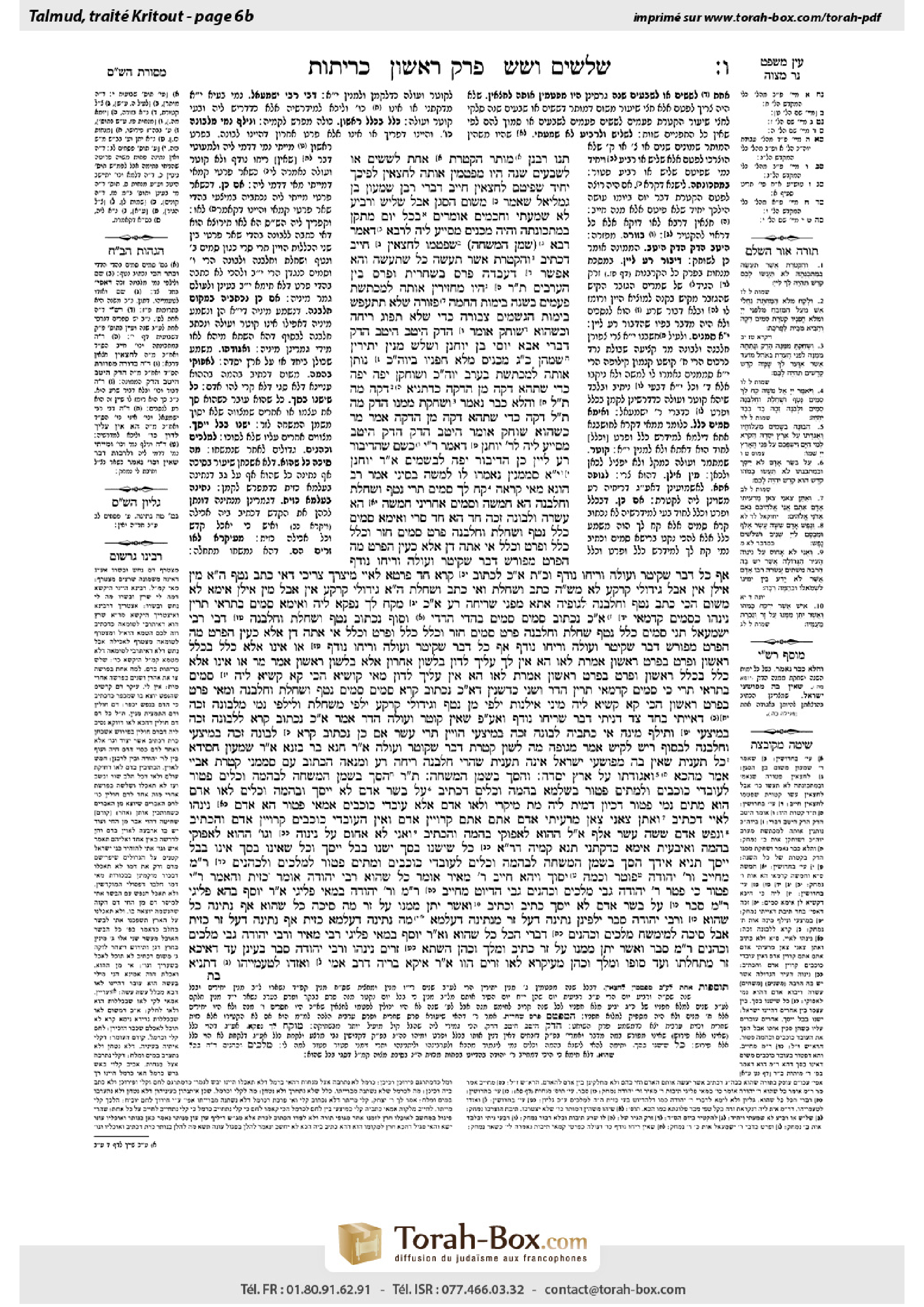
This page of Keritot includes the Aramaic text, an English translation and an AI-generated French translation, alongside the scan above.
כריתות ו׳ ב · Aramaic and Hebrew text
תָּנוּ רַבָּנַן: מוֹתַר הַקְּטֹרֶת, אַחַת לְשִׁשִּׁים אוֹ לְשִׁבְעִים שָׁנָה, הָיוּ מְפַטְּמִין אוֹתָהּ לַחֲצָאִין. לְפִיכָךְ יָחִיד שֶׁפִּיטֵּם לַחֲצָאִין – חַיָּיב, דִּבְרֵי רַבָּן שִׁמְעוֹן בֶּן גַּמְלִיאֵל, שֶׁאָמַר מִשּׁוּם הַסְּגָן.
אֲבָל שְׁלִישׁ וּרְבִיעַ לֹא שָׁמַעְתִּי. וַחֲכָמִים אוֹמְרִים: בְּכׇל יוֹם מְתַקֵּן בְּמַתְכּוּנְתָּהּ, וְהָיָה מַכְנִיס.
מְסַיַּיע לֵיהּ לְרָבָא, דְּאָמַר רָבָא: שֶׁמֶן הַמִּשְׁחָה שֶׁפִּטְּמוֹ לַחֲצָאִין – חַיָּיב, דִּכְתִיב: ״וְהַקְּטֹרֶת אֲשֶׁר תַּעֲשֶׂה״ – כֹּל שֶׁתַּעֲשֶׂה, וְהָא אֶפְשָׁר דְּעָבְדַהּ פְּרָס בְּשַׁחֲרִית וּפְרָס בֵּין הָעַרְבַּיִם.
תָּנוּ רַבָּנַן: הָיוּ מַחֲזִירִין אוֹתָהּ לְמַכְתֶּשֶׁת פַּעֲמַיִם בְּשָׁנָה, בִּימוֹת הַחַמָּה פְּזוּרָה – שֶׁלֹּא תִּתְעַפֵּשׁ, בִּימוֹת הַגְּשָׁמִים צְבוּרָה – כְּדֵי שֶׁלֹּא תָּפוּג רֵיחָהּ. וּכְשֶׁהוּא שׁוֹחֵק, אוֹמֵר: הָדֵק הֵיטֵב, הֵיטֵב הָדֵק, דִּבְרֵי אַבָּא יוֹסֵי בֶּן יוֹחָנָן.
וְשָׁלֹשׁ מָנִין יְתֵירִין שֶׁמֵּהֶן כֹּהֵן גָּדוֹל מַכְנִיס מְלֹא חׇפְנָיו בְּיוֹם הַכִּפּוּרִים, נוֹתֵן אוֹתָהּ לְמַכְתֶּשֶׁת בְּעֶרֶב יוֹם הַכִּפּוּרִים, וְשׁוֹחֲקָן יָפֶה יָפֶה, כְּדֵי שֶׁתְּהֵא דַּקָּה מִן הַדַּקָּה, כִּדְתַנְיָא: ״דַּקָּה״, מָה תַּלְמוּד לוֹמַר? וַהֲלֹא כְּבָר נֶאֱמַר: ״וְשָׁחַקְתָּ מִמֶּנּוּ הָדֵק״, מָה תַּלְמוּד לוֹמַר: ״דַּקָּה״? כְּדֵי שֶׁתְּהֵא דַּקָּה מִן הַדַּקָּה.
אָמַר מָר: כְּשֶׁהוּא שׁוֹחֵק, אוֹמֵר ״הֵיטֵב הָדֵק, הָדֵק הֵיטֵב״: מְסַיַּיע לֵיהּ לְרַבִּי יוֹחָנָן, דְּאָמַר רַבִּי יוֹחָנָן: כְּשֵׁם שֶׁהַדִּיבּוּר רַע לַיַּיִן – כֵּן הַדִּיבּוּר יָפֶה לַבְּשָׂמִים.
אָמַר רַבִּי יוֹחָנָן: אַחַד עָשָׂר סַמְמָנִין נֶאֶמְרוּ לוֹ לְמֹשֶׁה בְּסִינַי. אָמַר רַב הוּנָא: מַאי קְרָאָה? ״קַח לְךָ סַמִּים״ – תְּרֵי, ״נָטָף וּשְׁחֵלֶת וְחֶלְבְּנָה״ – הָא חַמְשָׁה, וְ״סַמִּים״ אַחֲרִינֵי – חַמְשָׁה, הָא עַשְׂרָה, ״וּלְבוֹנָה זַכָּה״ – חַד, הָא חַד סְרֵי.
וְאֵימָא ״סַמִּים״ – כָּלַל, ״נָטָף וּשְׁחֵלֶת וְחֶלְבְּנָה״ – פָּרַט, ״סַמִּים״ – חָזַר וְכָלַל. כְּלָל וּפְרָט וּכְלָל, אִי אַתָּה דָן אֶלָּא כְּעֵין הַפְּרָט. מָה הַפְּרָט מְפוֹרָשׁ – דָּבָר שֶׁקִּיטֵּר וְעוֹלֶה וְרֵיחוֹ נוֹדֵף, אַף כׇּל דָּבָר שֶׁקִּיטֵּר וְעוֹלֶה וְרֵיחוֹ נוֹדֵף.
וְכִי תֵימָא, אִם כֵּן, לִכְתּוֹב קְרָא חַד פְּרָטָא! לָאיֵי, מִיצְרָךְ צְרִיכִי, דְּאִי כְּתַב ״נָטָף״ הֲוָה אָמֵינָא: מִין אִילָן – אִין, אֲבָל גִּידּוּלֵי קַרְקַע – לָא, מִשּׁוּם הָכִי כְּתַב: ״וּשְׁחֵלֶת״. וְאִי כְּתַב ״וּשְׁחֵלֶת״, הֲוָה אָמֵינָא: גִּידּוּלֵי קַרְקַע – אִין, אֲבָל מִין אִילָן – אֵימָא לָא, מִשּׁוּם הָכִי כְּתַב: ״נָטָף״.
וְחֶלְבְּנָה לְגוּפֵיהּ אֲתָא, מִפְּנֵי שֶׁרֵיחָהּ רַע! אִם כֵּן, מִ״קַּח לְךָ״ נָפְקָא לֵיהּ.
וְאֵימָא: ״סַמִּים״ בָּתְרָאֵי תְּרֵין נִינְהוּ, כְּ״סַמִּים״ קַדְמָאֵי! אִם כֵּן, נִכְתּוֹב ״סַמִּים״ ״סַמִּים״ בַּהֲדֵי הֲדָדֵי, וְסוֹף נִכְתּוֹב ״נָטָף וּשְׁחֵלֶת וְחֶלְבְּנָה״.
דְּבֵי רַבִּי יִשְׁמָעֵאל תָּנֵי: ״סַמִּים״ – כָּלַל, ״נָטָף שְׁחֵלֶת וְחֶלְבְּנָה״ – פָּרַט, ״סַמִּים״ – חָזַר וְכָלַל. כְּלָל וּפְרָט וּכְלָל, אִי אַתָּה דָן אֶלָּא כְּעֵין הַפְּרָט. מָה הַפְּרָט מְפוֹרָשׁ – דָּבָר שֶׁקִּיטֵּר וְעוֹלֶה וְרֵיחוֹ נוֹדֵף, אַף כׇּל דָּבָר שֶׁקִּיטֵּר וְעוֹלֶה וְרֵיחוֹ נוֹדֵף.
אוֹ אֵינוֹ אֶלָּא כְּלָל בִּכְלָל רִאשׁוֹן, וּפְרָט בִּפְרָט רִאשׁוֹן? אָמְרַתְּ לָאו. הָא אֵין לְךָ עָלֶיךָ לָדוּן בְּלָשׁוֹן אַחֲרוֹן, אֶלָּא בְּלָשׁוֹן רִאשׁוֹן.
אָמַר מָר: אוֹ אֵינוֹ אֶלָּא כְּלָל בִּכְלָל רִאשׁוֹן, וּפְרָט בִּפְרָט רִאשׁוֹן? אָמְרַתְּ לָאו, הָא אֵין עָלֶיךָ לָדוּן. מַאי קוּשְׁיָא? הָכִי קָא קַשְׁיָא לֵיהּ: ״סַמִּים״ בָּתְרָאֵי תְּרֵי, כִּי סַמִּים קַדְמָאֵי תְּרֵין! הֲדַר וְשַׁנִּי כִּדְשַׁנִּין, דְּאִם כֵּן נִכְתּוֹב קְרָא: ״סַמִּים סַמִּים נָטָף וּשְׁחֵלֶת וְחֶלְבְּנָה״.
וּמַאי. ״פְּרָט בִּפְרָט רִאשׁוֹן״? הָכִי קָא קַשְׁיָא לֵיהּ: מִינֵי אִילָנוֹת יָלְפִי מִן נָטָף, וְגִידּוּלֵי קַרְקַע יָלְפִי מִשְּׁחֵלֶת, וְלֵילְפִי נָמֵי מִלְּבוֹנָה זַכָּה, דְּאַיְיתֵי בְּחַד צַד, דְּנֵיתֵי דָּבָר שֶׁרֵיחוֹ נוֹדֵף וְאַף עַל פִּי שֶׁאֵין קוֹטֵר וְעוֹלֶה!
הֲדַר אָמַר: אִם כֵּן, נִכְתּוֹב קְרָא לִלְבוֹנָה זַכָּה בְּמִיצְעֵי, וְתֵילַף מִינַּהּ.
אִי כַּתְבַיהּ לְבוֹנָה זַכָּה בְּמִיצְעֵי, הָוַיִין תְּרֵי עָשָׂר! אִם כֵּן, נִכְתּוֹב קְרָא לְבוֹנָה זַכָּה בְּמִיצְעֵי, וְחֶלְבְּנָה לְבַסּוֹף. רֵישׁ לָקִישׁ אָמַר: מִגּוּפַהּ, מָה לְשׁוֹן ״קְטֹרֶת״? דָּבָר שֶׁקּוֹטֵר וְעוֹלֶה.
אָמַר רַב חָנָא בַּר בִּזְנָא אָמַר רַבִּי שִׁמְעוֹן חֲסִידָא: כׇּל תַּעֲנִית שֶׁאֵין בָּהּ מִפּוֹשְׁעֵי יִשְׂרָאֵל אֵינָהּ תַּעֲנִית, שֶׁהֲרֵי חֶלְבְּנָה רֵיחָהּ רַע וּמְנָאָהּ הַכָּתוּב עִם סַמְמָנֵי קְטֹרֶת. אַבָּיֵי אָמַר: מֵהָכָא: ״וַאֲגֻדָּתוֹ עַל אֶרֶץ יְסָדָהּ״
וְהַסָּךְ בְּשֶׁמֶן הַמִּשְׁחָה. תָּנוּ רַבָּנַן: הַסָּךְ בְּשֶׁמֶן הַמִּשְׁחָה לִבְהֵמָה וְכֵלִים – פָּטוּר, לְגוֹיִם וּלְמֵתִים – פָּטוּר. בִּשְׁלָמָא בְּהֵמָה וְכֵלִים, דִּכְתִיב: ״עַל בְּשַׂר אָדָם לֹא יִיסָךְ״, וּבְהֵמָה וְכֵלִים לָאו אָדָם הוּא. מֵתִים נָמֵי פָּטוּר, דְּכֵיוָן דְּמִית לֵיהּ – מֵת מִיקְּרֵי, וְלָאו אָדָם. אֶלָּא גּוֹיִם, אַמַּאי פָּטוּר? הָא אָדָם נִינְהוּ!
לָאיֵי, דִּכְתִיב: ״וְאַתֵּן צֹאנִי צֹאן מַרְעִיתִי אָדָם אַתֶּם״ – אַתֶּם קְרוּיִין ״אָדָם״ וְאֵין הַגּוֹיִם קְרוּיִין ״אָדָם״.
וְהָכְתִיב: ״וְנֶפֶשׁ אָדָם שִׁשָּׁה עָשָׂר אָלֶף״! אֲמַר לֵיהּ: הָהוּא לְאַפּוֹקֵי בְּהֵמָה.
וְהָכְתִיב: ״וַאֲנִי לֹא אָחוּס עַל נִינְוֵה וְגוֹ׳״! הַהוּא לְאַפּוֹקֵי בְּהֵמָה.
וְאִיבָּעֵית אֵימָא – כִּדְקָתָנֵי תַּנָּא קַמֵּיהּ דְּרַבִּי אֶלְעָזָר: כֹּל שֶׁיֶּשְׁנוֹ בְּסָךְ – יֶשְׁנוֹ בְּבַל יִיסָךְ, וְכֹל שֶׁאֵינוֹ בְּסָךְ – אֵינוֹ בְּבַל יִיסָךְ.
תַּנְיָא אִידַּךְ: הַסָּךְ בְּשֶׁמֶן הַמִּשְׁחָה לִבְהֵמָה וְכֵלִים, לְגוֹיִם וּמֵתִים – פָּטוּר, לִמְלָכִים וּלְכֹהֲנִים – רַבִּי מֵאִיר מְחַיֵּיב, וְרַבִּי יְהוּדָה פּוֹטֵר. וְכַמָּה יָסוּךְ וִיהֵא חַיָּיב? רַבִּי מֵאִיר אוֹמֵר: כׇּל שֶׁהוּא, רַבִּי יְהוּדָה אוֹמֵר: כְּזַיִת. וְהָאָמַר רַבִּי יְהוּדָה: פָּטוּר! כִּי פָּטַר רַבִּי יְהוּדָה – גַּבֵּי מְלָכִים וְכֹהֲנִים, גַּבֵּי הֶדְיוֹט מְחַיֵּיב.
רַבִּי מֵאִיר וְרַבִּי יְהוּדָה בְּמַאי פְּלִיגִי אָמַר רַב יוֹסֵף: בְּהָא פְּלִיגִי – רַבִּי מֵאִיר סָבַר: ״עַל בְּשַׂר אָדָם לֹא יִיסָךְ״ כְּתִיב, וּכְתִיב: ״וַאֲשֶׁר יִתֵּן מִמֶּנּוּ עַל זָר״, מָה סִיכָה כׇּל שֶׁהוּא – אַף נְתִינָה כׇּל שֶׁהוּא.
וְרַבִּי יְהוּדָה סָבַר: יָלְפִינַן נְתִינָה דְּעַל זָר מִנְּתִינָה דְּעָלְמָא, מָה נְתִינָה דְּעָלְמָא כְּזַיִת, אַף נְתִינָה דְּעַל זָר – כְּזַיִת. אֲבָל סִיכָה לְמִימְשַׁח מְלָכִים וְכֹהֲנִים – דִּבְרֵי הַכֹּל כׇּל שֶׁהוּא.
וְאָמַר רַב יוֹסֵף: בְּמַאי פְּלִיגִי רַבִּי מֵאִיר וְרַבִּי יְהוּדָה גַּבֵּי מְלָכִים וְכֹהֲנִים? רַבִּי מֵאִיר סָבַר: ״וַאֲשֶׁר יִתֵּן מִמֶּנּוּ עַל זָר״ כְּתִיב, וּמֶלֶךְ וְכֹהֵן הַשְׁתָּא זָרִים נִינְהוּ. וְרַבִּי יְהוּדָה סָבַר: בָּעֵינַן עַד דְּאִיכָּא זָר מִתְּחִלָּתוֹ וְעַד סוֹפוֹ, וּמֶלֶךְ וְכֹהֵן מֵעִיקָּרָא לָאו זָרִים הָווּ.
אָמַר רַב אִיקָא בְּרֵיהּ דְּרַב אַמֵּי: וְאָזְדוּ לְטַעְמַיְיהוּ, דְּתַנְיָא:
Keritot 6b · English translation
§ The Sages taught in a baraita: The leftover of the incense, from the three extra maneh each year, would accumulate so that once every sixty or every seventy years they would blend the incense for the new year by halves, i.e., they required only half the usual amount, and the other half would come from the leftover incense. Therefore, a private individual who blended incense by halves in order to smell it is liable for violating the prohibition: “And the incense that you shall prepare, according to its composition you shall not prepare for yourselves, it shall be to you sacred for the Lord” (Exodus 30:37). This is the statement of Rabban Shimon ben Gamliel, who said it in the name of the deputy High Priest.
Rabban Shimon ben Gamliel added: But I did not hear the same with regard to the blending of one-third or one-quarter of the amount of the incense. And the Rabbis say: Every day one would prepare incense for the day according to its composition, i.e., in the appropriate ratio for each ingredient, and he would bring it in the Sanctuary and burn it on the golden altar.
The Gemara comments: This opinion of the Rabbis supports the opinion of Rava, as Rava says: With regard to the anointing oil that one blended in parts, i.e., in any amount, in order to apply it to the skin, he is exempt, but if one blended the incense to smell it, even in parts, he is liable, as it is written: “And the incense that you shall prepare, according to its composition you shall not prepare for yourselves” (Exodus 30:37). This teaches that any incense of the amount that you prepare for the Sanctuary is prohibited, as it is possible to burn a portion, i.e., one-half of the maneh that must be prepared, in the morning, and a portion in the afternoon.
The Sages taught in a baraita: They would return the incense to the mortar to regrind it twice a year; in the summer they would place it scattered so that it should not grow moldy, while in the rainy season it was kept piled, in order that its scent should not dissipate. And when one would grind the incense he would say: Crush well, well crush; this is the statement of Abba Yosei ben Yoḥanan.
And as for the extra three maneh of incense from which the High Priest would bring in his handful required on Yom Kippur, one would place it in the mortar on Yom Kippur eve and grind it thoroughly so that the incense should be extra fine. As it is taught in a baraita: The verse states, with regard to the incense on Yom Kippur, that it shall be: “Finely ground aromatic incense” (Leviticus 16:12). What is the meaning when the verse states this? Isn’t it already stated with regard to all incense: “And you shall grind some of it finely” (Exodus 30:36)? Why must the verse state “finely ground”? This teaches that on Yom Kippur one must grind the incense more, in order that it should be extra fine.
The Master said earlier: When one would grind the incense he would say: Crush well, well crush. The Gemara notes that this supports the opinion of Rabbi Yoḥanan, as Rabbi Yoḥanan says: Just as speech is detrimental to wine, and therefore no words were spoken during its preparation, so too, speech is beneficial to the preparation of the spices of the incense.
§ Rabbi Yoḥanan says: The eleven ingredients of the incense were stated by God to Moses at Sinai, as not all of them are specified in the verses. Rav Huna said: What is the verse from which it is derived? “Take for you spices, stacte, and onycha, and galbanum; spices with pure frankincense” (Exodus 30:34). The plural form of the phrase: “Take for you spices” is referring to two ingredients; “stacte, and onycha, and galbanum” are three ingredients; this results in a total of five; and the other mention of “spices” indicates that there are another five, i.e., that one should double the previous total, and this results in a total of ten. And finally, “pure frankincense” is one, and this results in a total of eleven.
The Gemara raises a difficulty: But why not say the first mention of “spices” is a generalization; “stacte, and onycha, and galbanum,” is a detail; and when the verse repeats “spices” it is then generalized again. This is the hermeneutical principle of: a generalization, and a detail, and a generalization, and therefore you may deduce that the verse is referring only to items similar to the detail: Just as the detail is explicit in that it is referring to an item whose smoke rises and its scent diffuses, so too, it includes any item whose smoke rises and its scent diffuses.
And if you would say: If that is so, that this is a generalization, and a detail, and a generalization, then let the verse write only one detail of the three; the fact is that indeed [la’ei], all the details are necessary. As, if the Torah had written merely “stacte,” I would say that spices from a type of tree, yes, they may serve as ingredients of the incense, but spices grown from the ground, no, they may not serve this purpose. It is due to that reason that the verse wrote “and onycha.” And if the Torah had written only “and onycha,” I would say that spices grown from the ground, yes, they may serve as ingredients of the incense, but spices from a type of tree, one might say no, they may not serve this purpose. It is due to that reason that the verse wrote “stacte.”
The Gemara concludes its rejection of the suggested resolution: And as for the mention of galbanum, this comes for itself, i.e., one would not otherwise have included this ingredient, because unlike the other spices its smell is foul. Consequently, all these details are necessary, and therefore it is possible to expound the verse as a generalization, and a detail, and a generalization, which means that the difficulty remains: How is it derived that there were eleven spices? The Gemara answers: If so, that the verse is a generalization, and a detail, and a generalization, there is no need for the first mention of “spices,” as one could derive the generalization from the phrase “Take for you.”
The Gemara raises another difficulty: How is it derived from the verse that there are eleven spices? But why not say that the last mention of “spices” signifies two ingredients, just like the first mention of “spices”? The Gemara answers: If so, let the verse write “spices” and “spices” together, and afterward let it write “stacte, and onycha, and galbanum.” The fact that the second mention of “spices” is written after all those specified ingredients indicates that its number corresponds to the total of all of them.
The school of Rabbi Yishmael teaches in a baraita: The first mention of “spices” is a generalization; “stacte, and onycha, and galbanum,” is a detail; and when the verse repeats “spices” it then generalized again. This is a generalization, and a detail, and a generalization, and you may deduce that the verse is referring only to items similar to the detail: Just as the detail is explicit in that it is referring to an item whose smoke rises and its scent diffuses, so too, it includes any item whose smoke rises and its scent diffuses.
The baraita continues: Or perhaps it is only that the second generalization is in the same category as the first generalization, and the second detail is in the same category as the first detail. You must say that this is not the case; consequently, you cannot learn in accordance with the last version, but rather you must learn in accordance with the first version.
The Gemara clarifies the latter clause of the baraita. The Master said: Or perhaps it is only that the second generalization is in the same category as the first generalization, and the second detail is in the same category as the first detail. You must say that this is not the case; consequently, you cannot learn in accordance with the last version, but rather you must learn in accordance with the first version. The Gemara asks: What is the difficulty alluded to here by the baraita? The Gemara explains that this is what is difficult to the tanna: Let us say that the last mention of “spices” is referring to two ingredients, just as the first mention of “spices” is referring to two ingredients. The tanna then answered as we answered earlier, that if so, let the verse write: Spices, spices, stacte, and onycha, and galbanum, in that order.
The Gemara further asks: And what is the meaning of the suggestion: The second detail is in the same category as the first detail? The Gemara answers that this is what is difficult to the tanna: Since it is derived by the principle of a generalization, and a detail, and a generalization that all items similar to those specified in the verse are included, as stated earlier that spices from types of trees are derived from the mention of stacte and spices grown from the ground are derived from the mention of onycha, one might say as follows: Let them also learn from the mention of pure frankincense, which includes one aspect, i.e., that one should include an item whose scent diffuses, even though its smoke does not rise.
The Gemara continues: The tanna then said that this cannot be the case, as if so, let the verse write “pure frankincense” in the middle, between the two mentions of “spices,” alongside stacte, onycha, and galbanum, and then one would derive this halakha from it. Since the frankincense is mentioned after the second mention of “spices,” it is not part of the generalization, detail, and generalization.
The Gemara questions this claim: If the verse were to write “pure frankincense” in the middle, there would be twelve ingredients in the incense, as that ingredient would also be included in the doubling of the second mention of “spices.” The Gemara explains: If so, that frankincense is meant to be one of the details, let the verse write “pure frankincense” in the middle and “galbanum” at the end, after the second mention of “spices.” Since the verse placed frankincense at the end, one cannot derive halakhot from it as a detail. Reish Lakish says that this halakha can be derived from the word incense itself: What is the meaning of the term incense [ketoret]? It means an item that produces smoke [koter] and rises.
Rav Ḥana bar Bizna says that Rabbi Shimon Ḥasida says: Any fast that does not include the participation of some of the sinners of the Jewish people is not a fast, as the smell of galbanum is foul and yet the verse lists it with the ingredients of the incense. Abaye says that this is derived from here: “It is He Who builds His upper chambers in the heavens and has established His bundle on the earth” (Amos 9:6), i.e., when the people are united as a bundle, including their sinners, they are established upon the earth.
§ The mishna includes in its list of those liable to receive karet: And one who applies the anointing oil to his skin. The Sages taught in a baraita: One who applies the anointing oil to animals or vessels is exempt, and one who applies it to gentiles or to corpses is exempt. The Gemara objects: Granted, one is exempt in the case of animals and vessels, as it is written: “Upon the flesh of a person it shall not be applied” (Exodus 30:32), and animals and vessels are not the flesh of a person. It is also clear why one is exempt if he applies it to a corpse, as once someone has died, the body is called a corpse and not a person. But if one applies anointing oil to gentiles why is he exempt? Aren’t they included in the meaning of the term person [adam]?
The Gemara explains: Indeed they are not. As it is written: “And you My sheep, the sheep of My pasture, are people [adam]” (Ezekiel 34:31), from which it is derived that you, the Jewish people, are called adam, but gentiles are not called adam.
The Gemara raises an objection based on a verse discussing captives taken during the war against Midian. But isn’t it written: “And the people [nefesh adam] were sixteen thousand” (Numbers 31:40). This indicates that gentiles are also referred to as adam. The Sage who was asked this said to the questioner: That term serves to exclude, i.e., to distinguish between the people who were taken captive and the animals that were taken as spoils of war, which are also mentioned in that verse.
The Gemara raises another difficulty: But isn’t it written: “And should I not have pity on Nineveh, that great city, wherein are more than one hundred and twenty thousand people [adam] who cannot discern between their right hand and their left hand, and also much cattle” (Jonah 4:11). The inhabitants of Nineveh were gentiles. The Gemara answers: That term serves to exclude them from the animals mentioned in the verse.
And if you wish, say instead a different reason why one who applies anointing oil to gentiles is exempt. This is as a tanna teaches before Rabbi Elazar: Anyone included in the obligation not to apply anointing oil to himself or others is likewise included as subject to the prohibition of: It shall not be applied, i.e., it is prohibited to apply the oil to him. And anyone not included in the obligation not to apply anointing oil to himself or others is not included as the object of: It shall not be applied. Only Jews are included in the prohibition against applying the anointing oil.
It is taught in another baraita: One who applies the anointing oil to animals or vessels, or to gentiles or on corpses, is exempt. If one applies the anointing oil to kings or to priests after they had already been anointed, Rabbi Meir deems him liable and Rabbi Yehuda deems him exempt. And how much oil must one apply to his skin and be liable? Rabbi Meir says: Any amount. Rabbi Yehuda says: An olive-bulk. The Gemara raises a difficulty: But doesn’t Rabbi Yehuda say that he is entirely exempt? The Gemara answers: When Rabbi Yehuda deems him exempt that is with regard to applying oil to kings and priests, whereas in the case of an ordinary person Rabbi Yehuda deems him liable.
The Gemara asks: Concerning what matter do Rabbi Meir and Rabbi Yehuda disagree? Rav Yosef says that they disagree concerning this issue: Rabbi Meir holds that this halakha is based on the fact that it is written: “Upon the flesh of a person it shall not be applied” (Exodus 30:32), and it is written: “Or whoever places any of it upon a stranger, he shall be cut off from his people” (Exodus 30:33). The wording of the prohibition teaches with regard to the liability to receive karet: Just as the act of applying the oil to the skin prohibited by the verse refers to the application of any amount, as there is no specific measure stated in this regard, so too, the act of placing the oil mentioned with regard to karet refers to any amount.
And Rabbi Yehuda holds: We derive the halakha of placing [netina] that is stated here, which is upon a stranger, i.e., one upon whom there is no mitzva to place the anointing oil, from the halakha of giving [netina] in general. Just as giving in general is with the amount of an olive-bulk, so too, placing anointing oil upon a stranger is with the amount of an olive-bulk. The principle that giving [netina] in general is with the amount of an olive-bulk is derived from the verse: “And if a man eats a sacred thing in error then he shall add a fifth part in addition to it, and shall give [venatan] to the priest the sacred item” (Leviticus 22:14). This verse is referring to an item given for eating, and the minimum amount that must be consumed for an act to be considered eating is an olive-bulk. Rav Yosef adds: But with regard to the mitzva of applying the oil in order to anoint kings and priests, everyone agrees it is accomplished with any amount.
And Rav Yosef further says: With regard to what matter do Rabbi Meir and Rabbi Yehuda disagree in the case of kings and priests who had already been anointed? Rabbi Meir holds that since it is written: “Or whoever puts any of it upon a stranger,” and right now the king and priest are strangers because the mitzva to anoint them no longer applies, they are included in the prohibition. And Rabbi Yehuda holds: For the purposes of this prohibition we require that the individual in question be a stranger from his beginning to his end, and the king and priest were initially not strangers.
Rav Ika, son of Rav Ami, said: And Rabbi Meir and Rabbi Yehuda both follow their lines of reasoning, as it is taught in a mishna (Terumot 7:2):
Keritot 6b · Traduction française (IA)
§ Les Sages ont enseigné dans une baraïta : Le reste de l’encens, provenant des trois mané supplémentaires préparés chaque année, s’accumulait, si bien que, tous les soixante ou soixante-dix ans, on préparait l’encens de la nouvelle année en deux moitiés : on n’avait alors besoin que de la moitié de la quantité habituelle, l’autre moitié provenant de l’encens restant. Par conséquent, un particulier qui préparait l’encens en deux moitiés pour en respirer le parfum est passible d’avoir transgressé l’interdiction : « Vous ne préparerez pas pour vous-mêmes un encens de même composition que celui que vous préparerez ; il sera pour vous sacré, pour le Seigneur » (Exode 30:37). Telle est la déclaration de Rabban Shimon ben Gamliel, qui la tenait du vice-grand prêtre.
Rabban Shimon ben Gamliel ajouta : Mais je n’ai pas entendu la même chose au sujet de la préparation d’un tiers ou d’un quart de la quantité d’encens. Les Sages disent, quant à eux : Chaque jour, on préparait l’encens destiné à ce jour selon sa composition, c’est-à-dire en respectant les proportions appropriées de chaque ingrédient ; on l’apportait ensuite dans le Sanctuaire et on le brûlait sur l’autel d’or.
La Guemara fait remarquer que l’opinion des Sages confirme celle de Rava. En effet, Rava dit : Celui qui mélange l’huile d’onction en fractions, c’est-à-dire en n’importe quelle quantité, afin de l’appliquer sur la peau, est exempt ; mais celui qui prépare l’encens pour en respirer le parfum est passible, même s’il le prépare en fractions, comme il est écrit : « Vous ne préparerez pas pour vous-mêmes un encens de même composition que celui que vous préparerez » (Exode 30:37). Cela enseigne que toute quantité d’encens préparée selon la composition prévue pour le Sanctuaire est interdite, car il est possible de brûler une partie de la quantité à préparer — la moitié du mané — le matin, puis une partie l’après-midi.
Les Sages ont enseigné dans une baraïta : On remettait l’encens dans le mortier pour le broyer de nouveau deux fois par an ; en été, on l’étalait afin qu’il ne moisisse pas, tandis que pendant la saison des pluies, on le gardait en tas afin que son parfum ne se dissipe pas. Lorsqu’on broyait l’encens, on disait : « Broie bien, broie bien » ; telle est la déclaration d’Abba Yosei ben Yoḥanan.
Quant aux trois mané d’encens supplémentaires, sur lesquels le grand prêtre prélevait la poignée nécessaire le jour de Yom Kippour, on les plaçait dans le mortier la veille de Yom Kippour et on les broyait soigneusement afin que l’encens soit très fin. En effet, une baraïta enseigne : À propos de l’encens de Yom Kippour, le verset dit qu’il doit être « un encens aromatique finement broyé » (Lévitique 16:12). Que signifie cette précision ? N’est-il pas déjà dit, à propos de tout encens : « Tu en broieras une partie finement » (Exode 30:36) ? Pourquoi le verset précise-t-il « finement broyé » ? Cela enseigne que, le jour de Yom Kippour, on doit broyer davantage l’encens, afin qu’il soit très fin.
Le Maître a dit plus haut : Lorsqu’on broyait l’encens, on disait : « Broie bien, broie bien. » La Guemara relève que cela confirme l’opinion de Rabbi Yoḥanan. En effet, Rabbi Yoḥanan dit : De même que la parole nuit au vin, raison pour laquelle on ne prononçait aucun mot pendant sa préparation, de même la parole contribue à la préparation des épices de l’encens.
§ Rabbi Yoḥanan dit : Dieu a indiqué à Moïse au Sinaï les onze ingrédients de l’encens, car ils ne sont pas tous spécifiés dans les versets. Rav Huna dit : De quel verset le déduit-on ? « Prends pour toi des aromates : du stacté, de l’onycha et du galbanum ; des aromates avec de l’oliban pur » (Exode 30:34). Le pluriel de l’expression « prends pour toi des aromates » désigne deux ingrédients ; « du stacté, de l’onycha et du galbanum » en désigne trois, soit un total de cinq. La seconde mention des « aromates » indique qu’il y en a encore cinq, c’est-à-dire qu’il faut doubler le nombre précédent, ce qui donne un total de dix. Enfin, « de l’oliban pur » en désigne un, ce qui donne un total de onze.
La Guemara soulève une difficulté : Pourquoi ne pas dire que la première mention des « aromates » constitue une généralité, que « du stacté, de l’onycha et du galbanum » constitue une particularité, puis que la répétition des « aromates » dans le verset constitue à nouveau une généralité ? Il s’agirait alors du principe herméneutique de la généralité, de la particularité et de la généralité ; on peut donc déduire que le verset ne vise que des éléments comparables à ceux de la particularité : de même que la particularité désigne explicitement un élément dont la fumée s’élève et dont le parfum se répand, cela inclut aussi tout élément dont la fumée s’élève et dont le parfum se répand.
Et si tu dis : Si tel est le cas, si l’on a affaire à une généralité, une particularité et une généralité, le verset n’a qu’à mentionner une seule des trois particularités. En réalité [la’ei], toutes les particularités sont nécessaires. En effet, si la Torah avait seulement écrit « stacté », j’aurais dit que les aromates provenant d’une sorte d’arbre peuvent servir d’ingrédients pour l’encens, mais que ceux qui poussent dans le sol ne le peuvent pas. C’est pour cette raison que le verset a écrit « et de l’onycha ». Et si la Torah avait seulement écrit « et de l’onycha », j’aurais dit que les aromates qui poussent dans le sol peuvent servir d’ingrédients pour l’encens, mais que ceux qui proviennent d’une sorte d’arbre ne le peuvent peut-être pas. C’est pour cette raison que le verset a écrit « stacté ».
La Guemara achève de rejeter la solution proposée : Quant à la mention du galbanum, elle est nécessaire en elle-même, car on n’aurait pas inclus cet ingrédient autrement, son odeur étant fétide, contrairement à celle des autres aromates. Par conséquent, toutes ces particularités sont nécessaires, et il est donc possible d’interpréter le verset comme une généralité, une particularité et une généralité. La difficulté demeure donc : comment déduit-on qu’il y avait onze aromates ? La Guemara répond : Si le verset relève d’une généralité, d’une particularité et d’une généralité, la première mention des « aromates » est superflue, puisque l’on pourrait déduire la généralité de l’expression « prends pour toi ».
La Guemara soulève une autre difficulté : Comment déduit-on du verset qu’il y a onze aromates ? Pourquoi ne pas dire que la dernière mention des « aromates » désigne deux ingrédients, tout comme la première ? La Guemara répond : Dans ce cas, que le verset écrive « aromates » et « aromates » l’un à la suite de l’autre, puis qu’il mentionne « du stacté, de l’onycha et du galbanum ». Le fait que la seconde mention des « aromates » soit écrite après tous ces ingrédients spécifiés indique que le nombre qu’elle désigne correspond au total de tous les précédents.
L’école de Rabbi Yishmael enseigne dans une baraïta : La première mention des « aromates » constitue une généralité ; « du stacté, de l’onycha et du galbanum » constitue une particularité ; puis, lorsque le verset répète les « aromates », il énonce de nouveau une généralité. Il s’agit d’une généralité, d’une particularité et d’une généralité, et l’on peut donc déduire que le verset ne vise que des éléments comparables à ceux de la particularité : de même que la particularité désigne explicitement un élément dont la fumée s’élève et dont le parfum se répand, cela inclut aussi tout élément dont la fumée s’élève et dont le parfum se répand.
La baraïta poursuit : Ou peut-être faut-il seulement dire que la seconde généralité relève de la même catégorie que la première généralité, et que la seconde particularité relève de la même catégorie que la première particularité. Il faut dire que ce n’est pas le cas ; par conséquent, on ne peut pas interpréter le verset selon la dernière approche, mais il faut le faire selon la première.
La Guemara précise la dernière partie de la baraïta. Le Maître a dit : Ou peut-être faut-il seulement dire que la seconde généralité relève de la même catégorie que la première généralité, et que la seconde particularité relève de la même catégorie que la première particularité. Il faut dire que ce n’est pas le cas ; par conséquent, on ne peut pas interpréter le verset selon la dernière approche, mais il faut le faire selon la première. La Guemara demande : Quelle difficulté la baraïta évoque-t-elle ici ? Voici ce qui pose problème au tanna : Disons que la dernière mention des « aromates » désigne deux ingrédients, tout comme la première mention des « aromates » en désigne deux. Le tanna répondit alors comme nous l’avons fait plus haut : dans ce cas, que le verset écrive, dans cet ordre, « aromates, aromates, stacté, onycha et galbanum ».
La Guemara demande encore : Que signifie la suggestion selon laquelle la seconde particularité relève de la même catégorie que la première ? La Guemara répond que voici ce qui pose problème au tanna : Puisqu’on déduit, par le principe de la généralité, de la particularité et de la généralité, que tous les éléments comparables à ceux spécifiés dans le verset sont inclus — comme on l’a dit plus haut, les aromates provenant de sortes d’arbres sont déduits de la mention du stacté et ceux qui poussent dans le sol sont déduits de la mention de l’onycha —, on pourrait dire ce qui suit : Déduisons-le aussi de la mention de l’oliban pur, qui comporte un aspect, à savoir qu’il faut inclure un élément dont le parfum se répand, même si sa fumée ne s’élève pas.
La Guemara poursuit : Le tanna répondit alors que cela ne peut pas être le cas, car si tel était le cas, que le verset écrive « oliban pur » au milieu, entre les deux mentions des « aromates », à côté du stacté, de l’onycha et du galbanum ; on en déduirait alors cette halakha de cet ingrédient. Puisque l’oliban est mentionné après la seconde mention des « aromates », il ne fait pas partie de la séquence de la généralité, de la particularité et de la généralité.
La Guemara conteste cette affirmation : Si le verset écrivait « oliban pur » au milieu, les ingrédients de l’encens seraient au nombre de douze, puisque cet ingrédient serait également inclus dans le doublement correspondant à la seconde mention des « aromates ». La Guemara explique : Si l’oliban devait être l’une des particularités, que le verset écrive « oliban pur » au milieu et « galbanum » à la fin, après la seconde mention des « aromates ». Puisque le verset a placé l’oliban à la fin, on ne peut pas en déduire des halakhot comme s’il s’agissait d’une particularité. Reish Lakish dit qu’on peut déduire cette halakha du mot même « encens » : que signifie le terme « encens » [ketoret] ? Il désigne un élément qui produit de la fumée [koter] et s’élève.
Rav Ḥana bar Bizna dit au nom de Rabbi Shimon Ḥasida : Tout jeûne auquel ne participent pas certains pécheurs du peuple juif n’est pas un jeûne, car l’odeur du galbanum est fétide et pourtant le verset le compte parmi les ingrédients de l’encens. Abaye dit que cela se déduit de ce verset : « C’est Lui qui bâtit ses chambres hautes dans les cieux et qui a établi son faisceau sur la terre » (Amos 9:6), c’est-à-dire que lorsque le peuple est uni en un faisceau, y compris ses pécheurs, il est établi sur la terre.
§ La Michna compte parmi ceux qui sont passibles de karet celui qui applique l’huile d’onction sur sa peau. Les Sages ont enseigné dans une baraïta : Celui qui applique l’huile d’onction sur des animaux ou des ustensiles est exempt ; celui qui l’applique sur des non-Juifs ou des cadavres est exempt. La Guemara objecte : Il est évident que l’on est exempt dans le cas des animaux et des ustensiles, car il est écrit : « Elle ne sera pas appliquée sur la chair d’un homme » (Exode 30:32), et les animaux et les ustensiles ne sont pas la chair d’un homme. Il est également clair que l’on est exempt si on l’applique sur un cadavre, car, une fois qu’une personne est morte, son corps est appelé un cadavre et non une personne. Mais si quelqu’un applique l’huile d’onction sur des non-Juifs, pourquoi est-il exempt ? Ne sont-ils pas compris dans le sens du terme « personne » [adam] ?
La Guemara explique : En effet, ils ne le sont pas. Car il est écrit : « Et vous, mes brebis, les brebis de mon pâturage, vous êtes des hommes [adam] » (Ézéchiel 34:31). On en déduit que vous, le peuple juif, êtes appelés adam, mais que les non-Juifs ne sont pas appelés adam.
La Guemara soulève une objection fondée sur un verset qui parle des captifs pris pendant la guerre contre Madian. Mais n’est-il pas écrit : « Et les personnes [nefesh adam] étaient au nombre de seize mille » (Nombres 31:40) ? Cela indique que les non-Juifs sont également désignés par le terme adam. Le Sage à qui cette question fut posée répondit à son interlocuteur : Ce terme sert à exclure, c’est-à-dire à distinguer les personnes capturées des animaux pris comme butin de guerre, qui sont également mentionnés dans ce verset.
La Guemara soulève une autre difficulté : Mais n’est-il pas écrit : « Et ne devrais-je pas avoir pitié de Ninive, cette grande ville, où se trouvent plus de cent vingt mille personnes [adam] qui ne savent pas distinguer leur main droite de leur main gauche, ainsi qu’un grand nombre de bêtes » (Jonas 4:11) ? Les habitants de Ninive étaient des non-Juifs. La Guemara répond : Ce terme sert à les distinguer des animaux mentionnés dans le verset.
Et si tu le souhaites, donne une autre raison pour laquelle celui qui applique l’huile d’onction sur des non-Juifs est exempt. C’est ce qu’un tanna enseigne devant Rabbi Elazar : Quiconque est soumis à l’obligation de ne pas appliquer l’huile d’onction sur lui-même ou sur autrui est également concerné par l’interdiction « elle ne sera pas appliquée », c’est-à-dire qu’il est interdit de lui appliquer l’huile. Quiconque n’est pas soumis à l’obligation de ne pas appliquer l’huile d’onction sur lui-même ou sur autrui n’est pas concerné par l’interdiction « elle ne sera pas appliquée ». Seuls les Juifs sont concernés par l’interdiction d’appliquer l’huile d’onction.
Une autre baraïta enseigne : Celui qui applique l’huile d’onction sur des animaux ou des ustensiles, ou sur des non-Juifs ou des cadavres, est exempt. Si quelqu’un applique l’huile d’onction sur des rois ou des prêtres après qu’ils ont déjà reçu l’onction, Rabbi Meir le considère comme passible, tandis que Rabbi Yehuda le considère comme exempt. Quelle quantité d’huile faut-il appliquer sur sa peau pour être passible ? Rabbi Meir dit : Une quantité quelconque. Rabbi Yehuda dit : Le volume d’une olive. La Guemara soulève une difficulté : Mais Rabbi Yehuda ne dit-il pas qu’il est entièrement exempt ? La Guemara répond : Lorsque Rabbi Yehuda le considère comme exempt, cela concerne l’application d’huile sur des rois et des prêtres ; dans le cas d’une personne ordinaire, Rabbi Yehuda le considère comme passible.
La Guemara demande : Sur quel point Rabbi Meir et Rabbi Yehuda sont-ils en désaccord ? Rav Yosef dit qu’ils divergent sur la question suivante : Rabbi Meir estime que cette halakha repose sur le fait qu’il est écrit : « Elle ne sera pas appliquée sur la chair d’un homme » (Exode 30:32), ainsi que : « Celui qui en mettrait sur un étranger sera retranché de son peuple » (Exode 30:33). La formulation de l’interdiction enseigne, en ce qui concerne la passibilité de karet : de même que l’acte d’appliquer l’huile sur la peau, interdit par le verset, désigne l’application d’une quantité quelconque, puisqu’aucune mesure précise n’est indiquée à cet égard, de même l’acte de mettre l’huile, mentionné à propos du karet, désigne une quantité quelconque.
Rabbi Yehuda estime que la halakha relative au fait de mettre [netina] l’huile, mentionné ici à propos d’un étranger — c’est-à-dire d’une personne sur qui l’on n’a pas la mitsva d’appliquer l’huile d’onction —, se déduit de la halakha relative au don [netina] en général. De même que le don en général se fait à hauteur du volume d’une olive, de même l’application d’huile d’onction sur un étranger doit porter sur le volume d’une olive. Le principe selon lequel un don [netina] porte en général sur le volume d’une olive se déduit du verset : « Si quelqu’un mange par erreur une chose sainte, il y ajoutera un cinquième et donnera [venatan] au prêtre la chose sainte » (Lévitique 22:14). Ce verset parle d’un aliment donné à manger, et la quantité minimale qui doit être consommée pour que l’acte soit considéré comme une consommation est le volume d’une olive. Rav Yosef ajoute : Toutefois, concernant la mitsva d’appliquer l’huile pour conférer l’onction aux rois et aux prêtres, tous s’accordent à dire qu’une quantité quelconque suffit.
Rav Yosef dit encore : Sur quel point Rabbi Meir et Rabbi Yehuda sont-ils en désaccord dans le cas de rois et de prêtres qui ont déjà reçu l’onction ? Rabbi Meir estime que, puisqu’il est écrit : « Celui qui en mettrait sur un étranger », et que, pour le moment, le roi et le prêtre sont des étrangers, car la mitsva de leur conférer l’onction ne s’applique plus, ils sont concernés par l’interdiction. Rabbi Yehuda estime, lui, que, pour les besoins de cette interdiction, il faut que la personne en question ait été étrangère du début à la fin ; or, le roi et le prêtre ne l’étaient pas au départ.
Rav Ika, fils de Rav Ami, dit : Rabbi Meir et Rabbi Yehuda sont tous deux cohérents avec leurs raisonnements respectifs, comme il est enseigné dans une Michna (Teroumot 7:2) :
Traduction française générée par IA à partir de l’édition anglaise de Sefaria. Vérifie toujours un passage avec le texte source.
Text from Sefaria: William Davidson Edition - Vocalized Aramaic (CC BY NC); William Davidson Edition - English (CC BY NC).