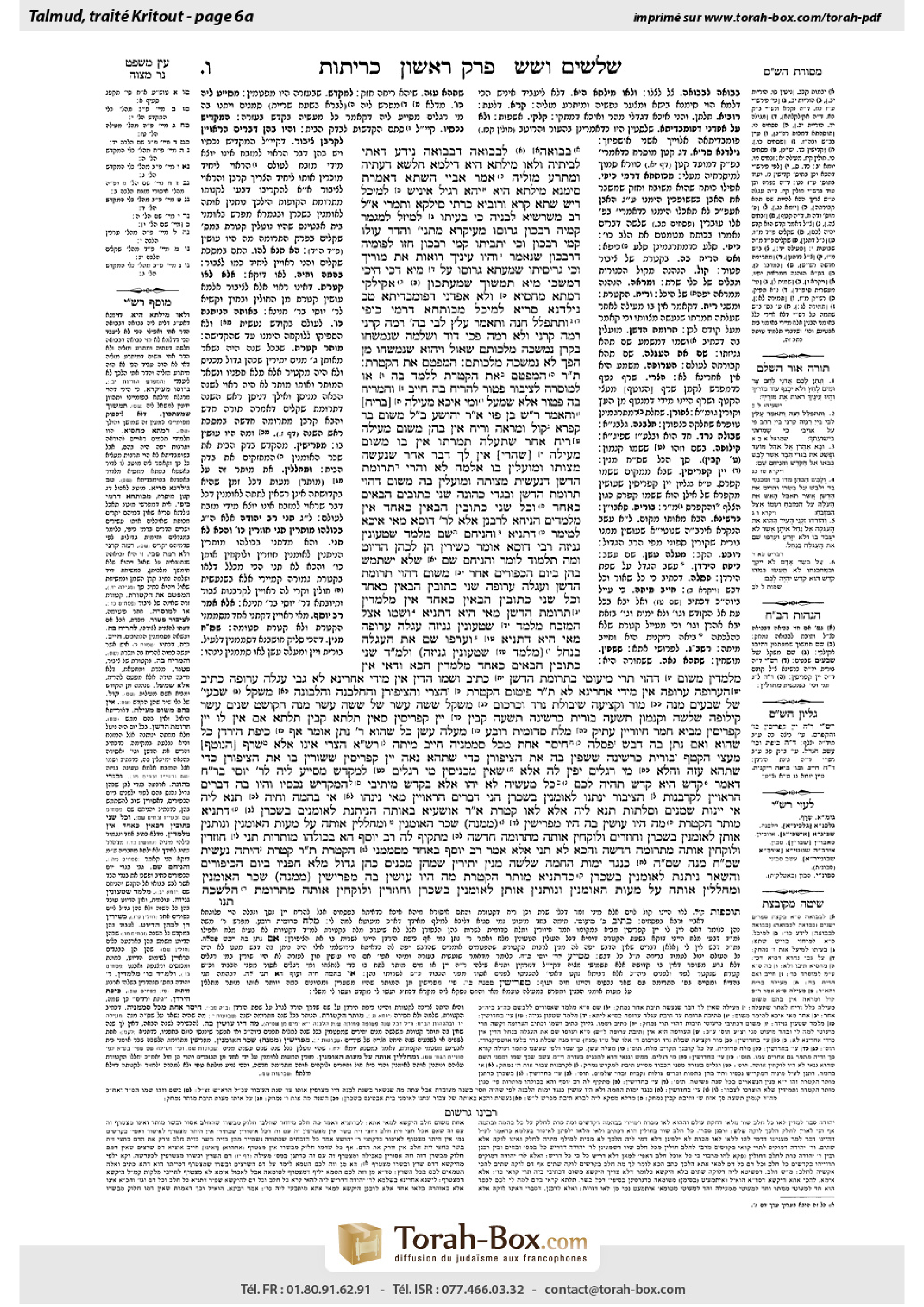
Keritot 6a: Talmud study for Daf Yomi
Daf Yomi is the daily study of one Talmud folio. Explore 37 tractates with scans, Hebrew text, Sefaria English and AI-generated French translations where annotated.
Passage selection and English or AI-generated French translation are available where the scan has annotations. Daf Study is independent of Torah-Box and Sefaria.
Browse Keritot · כריתות · All tractatesKeritot 6a text and translations
This page of Keritot includes the Aramaic text, an English translation and an AI-generated French translation, alongside the scan above.
כריתות ו׳ א · Aramaic and Hebrew text
בָּבוּאָה לְבָבוּאָה דְבָבוּאָה, נִידַּע דְּאָתֵי לְבֵיתֵיהּ. וְלָאו מִילְּתָא הִיא, דִּילְמָא חָלְשָׁא דַּעְתֵּיהּ, וּמִתְּרַע מַזָּלֵיהּ.
אָמַר אַבָּיֵי: הַשְׁתָּא דְּאָמְרַתְּ סִימָנָא מִילְּתָא הִיא, יְהֵא רְגִיל אִינִישׁ לְמֵיכַל רֵישׁ שַׁתָּא קָרָא וְרוּבְּיָא, כַּרָּתֵי, סִילְקָא וְתַמְרֵי.
אֲמַר לְהוּ רַב מְשַׁרְשְׁיָא לִבְנֵיהּ: כִּי בָּעֵיתוּ לְמֵיזֵל לְמִגְמַר קַמֵּי רַבְּכוֹן, גְּרוּסוּ מֵעִיקָּרָא מַתְנִיתִין וַהֲדַר עוּלוּ קַמֵּי רַבְּכוֹן, וְכִי יָתְבִיתוּ קַמֵּי רַבְּכוֹן, חֲזוֹ לְפוּמֵּיהּ דְּרַבְּכוֹן, שֶׁנֶּאֱמַר: ״וְהָיוּ עֵינֶיךָ רוֹאוֹת אֶת מוֹרֶיךָ״, וְכִי גָּרְסִיתוּ שְׁמַעְתָּא, גְּרוּסוּ עַל מַיָּא, דְּכִי הֵיכִי דְּמָשְׁכִי מַיָּא תִּמְשׁוֹךְ שְׁמַעְתְּכוֹן.
אַקִּילְקֵי דְּמָתָא מַחְסֵיָא, וְלָא אַפַּדְנֵי דְפוּמְבְּדִיתָא. טָב גִּילְדָּנָא סַרְיָא לְמֵיכַל מִכּוּתָּחָא דְּרָמֵי כֵּיפֵי.
״וַתִּתְפַּלֵּל חַנָּה וַתֹּאמַר עָלַץ לִבִּי בַּה׳ רָמָה קַרְנִי״, ״רָמָה קַרְנִי״ וְלֹא ״רָמָה פַּכִּי״ – דָּוִד וּשְׁלֹמֹה שֶׁנִּמְשְׁחוּ בְּקֶרֶן – נִמְשְׁכָה מַלְכוּתָם, שָׁאוּל וְיֵהוּא שֶׁנִּמְשְׁחוּ מִן הַפַּךְ – לֹא נִמְשְׁכָה מַלְכוּתָם.
הַמְפַטֵּם אֶת הַקְּטֹרֶת. תָּנוּ רַבָּנַן: הַמְפַטֵּם אֶת הַקְּטֹרֶת לְלַמֵּד בָּהּ אוֹ לְמוֹסְרָהּ לַצִּיבּוּר – פָּטוּר, לְהָרִיחַ בָּהּ – חַיָּיב. וְהַמֵּרִיחַ בָּהּ פָּטוּר, אֶלָּא שֶׁמָּעַל.
וּמִי אִיכָּא מְעִילָה? וְהָאָמַר רַבִּי שִׁמְעוֹן בֶּן פַּזִּי אָמַר רַבִּי יְהוֹשֻׁעַ בֶּן לֵוִי מִשּׁוּם בַּר קַפָּרָא: קוֹל וּמַרְאֶה וָרֵיחַ – אֵין בָּהֶן מִשּׁוּם מְעִילָה!
רֵיחַ אַחַר שֶׁתַּעֲלֶה תִּמְרָתוֹ אֵין בּוֹ מִשּׁוּם מְעִילָה, אֵין לְךָ דָּבָר אַחֵר שֶׁנַּעֲשָׂה מִצְוָתוֹ וּמוֹעֲלִין בּוֹ.
אַלְּמָה לָא? וַהֲרֵי תְּרוּמַת הַדֶּשֶׁן, דְּנַעֲשֵׂית מִצְוָתָהּ וּמוֹעֲלִין בָּהּ!
מִשּׁוּם דְּהָוֵי תְּרוּמַת הַדֶּשֶׁן וּבִגְדֵי כְהוּנָּה שְׁנֵי כְתוּבִים הַבָּאִים כְּאֶחָד, וְכֹל שְׁנֵי כְתוּבִין הַבָּאִין כְּאֶחָד אֵין מְלַמְּדִים.
הָנִיחָא לְרַבָּנַן, אֶלָּא לְרַבִּי דּוֹסָא מַאי אִיכָּא לְמֵימַר? דְּתַנְיָא: ״וְהִנִּיחָם שָׁם״, מְלַמֵּד שֶׁטְּעוּנִין גְּנִיזָה.
רַבִּי דּוֹסָא אוֹמֵר: כְּשֵׁירִין הֵן לְכֹהֵן הֶדְיוֹט, וּמָה תַּלְמוּד לוֹמַר ״וְהִנִּיחָם שָׁם״? שֶׁלֹּא יִשְׁתַּמֵּשׁ בָּהֶן בְּיוֹם הַכִּפּוּרִים אַחֵר.
מִשּׁוּם דְּהָוֵי תְּרוּמַת הַדֶּשֶׁן וְעֶגְלָה עֲרוּפָה שְׁנֵי כְתוּבִין הַבָּאִין כְּאֶחָד, וְכֹל שְׁנֵי כְתוּבִין הַבָּאִין כְּאֶחָד אֵין מְלַמְּדִין. תְּרוּמַת הַדֶּשֶׁן מַאי הִיא? דְּתַנְיָא: ״וְשָׂמוֹ אֵצֶל הַמִּזְבֵּחַ״, מְלַמֵּד שֶׁטְּעוּנִין גְּנִיזָה. עֶגְלָה עֲרוּפָה מַאי הִיא? דְּתַנְיָא: ״וְעָרְפוּ שָׁם אֶת הָעֶגְלָה בַּנָּחַל״, מְלַמֵּד שֶׁטְּעוּנִין גְּנִיזָה.
וּלְמַאן דְּאָמַר: שְׁנֵי כְתוּבִין הַבָּאִים כְּאֶחָד מְלַמְּדִין, הָכָא וַדַּאי אֵין מְלַמְּדִין, מִשּׁוּם דְּהָוֵי תְּרֵי מִיעוּטֵי. בִּתְרוּמַת הַדֶּשֶׁן כְּתִיב: ״וְשָׂמוֹ״ – הָדֵין אִין, מִידֵּי אַחֲרִינָא לָא, גַּבֵּי עֶגְלָה עֲרוּפָה כְּתִיב: ״הָעֲרוּפָה״ – עֲרוּפָה אִין, מִידֵּי אַחֲרִינָא לָא.
תָּנוּ רַבָּנַן: פִּיטּוּם הַקְּטֹרֶת: הַצֳּרִי, וְהַצִּיפּוֹרֶן, וְהַחֶלְבְּנָה, וְהַלְּבוֹנָה – מִשְׁקַל שִׁבְעִים שֶׁל שִׁבְעִים מָנָה. מוֹר, וּקְצִיעָה, שִׁיבּוֹלֶת נֵרְדְּ, וְכַרְכּוֹם – מִשְׁקָל שִׁשָּׁה עָשָׂר שֶׁל שִׁשָּׁה עָשָׂר מָנֶה. הַקּוֹשְׁטְ – שְׁנֵים עָשָׂר, קִילּוּפָה – שְׁלֹשָׁה, וְקִנָּמוֹן – תִּשְׁעָה. בּוֹרִית כַּרְשִׁינָה – תִּשְׁעָה קַבִּין, יֵין קַפְרִיסִין – סְאִין תְּלָתָא קַבִּין תְּלָתָא. אִם אֵין לוֹ יֵין קַפְרִיסִין מֵבִיא חֲמַר חִיוַּרְיָין עַתִּיק. מֶלַח סְדוֹמִית – רוֹבַע. מַעֲלֵה עָשָׁן – כׇּל שֶׁהוּא. רַבִּי נָתָן אוֹמֵר: אַף כִּיפַּת הַיַּרְדֵּן כׇּל שֶׁהוּא.
וְאִם נָתַן בָּהּ דְּבַשׁ – פְּסָלָהּ. חִיסַּר אַחַת מִכׇּל סַמְמָנֶיהָ – חַיָּיב מִיתָה. רַבִּי שִׁמְעוֹן אוֹמֵר: הַצֳּרִי אֵינוֹ אֶלָּא שְׂרָף מֵעֲצֵי הַקְּטָף. בּוֹרִית כַּרְשִׁינָה, שֶׁשָּׁפִין בָּהּ אֶת הַצִּיפּוֹרֶן כְּדֵי שֶׁתְּהֵא נָאָה. יֵין קַפְרִיסִין, שֶׁשּׁוֹרִין בּוֹ אֶת הַצִּיפּוֹרֶן כְּדֵי שֶׁתְּהֵא עַזָּה. וַהֲלֹא מֵי רַגְלַיִם יָפִין לָהּ, אֶלָּא שֶׁאֵין מַכְנִיסִין מֵי רַגְלַיִם לַמִּקְדָּשׁ.
מְסַיַּיע לֵיהּ לְרַבִּי יוֹסֵי בְּרַבִּי חֲנִינָא: דְּאָמַר ״קֹדֶשׁ הִיא קֹדֶשׁ תִּהְיֶה לָכֶם״ – כׇּל מַעֲשֶׂיהָ לֹא יְהוּ אֶלָּא בַּקֹּדֶשׁ.
מֵיתִיבִי: הַמַּקְדִּישׁ נְכָסָיו וְהָיוּ בָּהּ דְּבָרִים הָרְאוּיִין לְקׇרְבְּנוֹת הַצִּיבּוּר – יִנָּתְנוּ לָאוּמָּנִין בִּשְׂכָרָן.
הָנֵי דְּבָרִים הָרְאוּיִין, מַאי נִינְהוּ? אִי בְּהֵמָה וְחַיָּה – תְּנָא לֵיהּ! אִי יֵינוֹת שְׁמָנִים וּסְלָתוֹת – תְּנָא לֵיהּ! אֶלָּא לָאו קְטֹרֶת?
אָמַר רַבִּי אוֹשַׁעְיָא: בְּאוֹתָהּ הַנִּיתֶּנֶת לְאוּמָּנִים בִּשְׂכָרָן. דְּתַנְיָא: מוֹתַר הַקְּטֹרֶת, מָה הָיוּ עוֹשִׂין בָּהּ? הָיוּ מַפְרִישִׁין מִמֶּנָּה שְׂכַר הָאוּמָּנִין, וּמְחַלְּלִין אוֹתָהּ עַל מְעוֹת הָאוּמָּנִין וְנוֹתְנִין אוֹתָן לָאוּמָּנִין בִּשְׂכָרָן, וְחוֹזְרִים וְלוֹקְחִין אוֹתָהּ מִתְּרוּמָה חֲדָשָׁה.
מַתְקֵיף לַהּ רַב יוֹסֵף: הָא בְּכוּלְּהוּ מוֹתָרוֹת תָּנֵי חוֹזְרִין וְלוֹקְחִין אוֹתָהּ מִתְּרוּמָה חֲדָשָׁה, וְהָכָא לָא תָּנֵי!
אֶלָּא אָמַר רַב יוֹסֵף: בְּאֶחָד מִסַּמְמָנֵי הַקְּטֹרֶת.
תָּנוּ רַבָּנַן: קְטֹרֶת הָיְתָה נַעֲשֵׂית שְׁלֹשׁ מֵאוֹת שִׁשִּׁים וּשְׁמוֹנָה מָנֶה, שְׁלֹשׁ מֵאוֹת שִׁשִּׁים וַחֲמִשָּׁה כְּנֶגֶד יְמוֹת הַחַמָּה, שְׁלֹשָׁה מָנִין יְתֵירִין, שֶׁמֵּהֶן מַכְנִיס כֹּהֵן גָּדוֹל מְלֹא חׇפְנָיו בְּיוֹם הַכִּיפּוּרִים, וְהַשְּׁאָר נִיתֶּנֶת לָאוּמָּנִין בִּשְׂכָרָן.
כִּדְתַנְיָא: מוֹתַר הַקְּטֹרֶת מָה הָיוּ עוֹשִׂין בָּהּ? מַפְרִישִׁין מִמֶּנָּה שְׂכַר הָאוּמָּנִין, וּמְחַלְּלִין אוֹתָהּ עַל מְעוֹת הָאוּמָּנִין וְנוֹתְנִין אוֹתָן לָאוּמָּנִין בִּשְׂכָרָן, וְחוֹזְרִין וְלוֹקְחִין אוֹתָהּ מִתְּרוּמַת הַלִּשְׁכָּה.
Keritot 6a · English translation
the reflection [bavua] of a reflection of his reflection he shall know that he will return and come to his home. The Sages say about this: And this is nothing, i.e., one should not practice these divinations, as perhaps he will become despondent if he does not see the positive sign and his fortune will turn bad, and this itself will result in his failure.
Abaye said: Now that you have said that a sign is a substantial matter, a person should be accustomed to eat, at the start of the year, gourd, fenugreek, leeks, beets, and dates, as each of these grow and multiply quickly, which is a good omen for the deeds of the upcoming year.
With regard to positive omens, Rav Mesharshiyya said to his sons: When you want to go to study in the presence of your teacher, initially study the mishnayot and then ascend before your teacher. And when you sit before your teacher, see your teacher’s mouth, as it is stated: “And your eyes shall see your teacher” (Isaiah 30:20). And when you learn a halakha, learn near a source of flowing water, as just as the water flow continues, so too, your learning should continue.
Rav Mesharshiyya gave his sons additional advice: It is better for you to dwell on the garbage piles [akilkei] of the city Mata Meḥasya and not to dwell in the palaces [apadnei] of the city Pumbedita. It is better to eat rotten fish [gildana] than high-quality kutḥa, which uproots and tosses rocks from their places, i.e., it is a very spicy, powerful flavoring.
The Gemara further discusses the issue of anointing and good omens. Hannah said in her prayer after her son Samuel was born: “And Hannah prayed and said: My heart exults in the Lord, my horn is exalted in the Lord” (I Samuel 2:1). The Gemara notes that Hannah said: “My horn is exalted,” and she did not say: My jug is exalted. With regard to David and Solomon, who were anointed with oil from a horn, this was a good omen for them, and their kingships lasted. But with regard to Saul and Jehu, who were anointed with oil from a jug, their kingships did not last.
§ The mishna included in its list of those liable to receive karet: One who blends the incense according to the specifications of the incense used in the Temple service, for purposes other than use in the Temple. The Sages taught in a baraita: One who blends the incense in order to teach himself how to prepare it or in order to transfer it to the community is exempt from liability. But if he prepares it in order to smell it he is liable to receive karet, as it is stated: “He who prepares it in order to smell it shall be cut off from his people” (Exodus 30:38). And one who actually smells the incense mixture is exempt from the punishment of karet and from bringing a sin offering; but he has misused consecrated property, and is therefore liable to bring a guilt offering if he acted unwittingly.
The Gemara asks: And is there the prohibition of misuse of consecrated property with regard to smell? But doesn’t Rabbi Shimon ben Pazi say that Rabbi Yehoshua ben Levi says in the name of bar Kappara: With regard to exposure to the sound, or to the sight, or to the smell of consecrated items, including incense, these are not subject to the prohibition of misuse of consecrated property?
The Gemara answers: With regard to exposure to the smell of the incense, the following distinction applies: The smell of the incense that is emitted when the spices are placed on the coals on the altar is subject to the prohibition, since this is the manner in which the mitzva is performed. By contrast, the smell emitted after the flame catches and the column of smoke rises is not subject to the prohibition of misuse of consecrated property. The reason is that its mitzva has already been performed, and you have no case in which an item is at the stage after its mitzva has already been performed and yet one is liable for its misuse.
The Gemara asks: And why not say that misuse of consecrated property applies to an item whose mitzva has been already performed? But there is the case of the daily removal of the ashes of the offerings from the altar, whose mitzva has been performed, as the offerings have been burnt, and yet one who uses the ashes is liable for misusing the ashes, as derived from the verse: “And the priest shall put on his linen garment, and his linen breeches shall he put upon his flesh; and he shall take up the ashes of what the fire has consumed of the burnt offering on the altar, and he shall put them beside the altar” (Leviticus 6:3).
The Gemara answers: This case does not disprove the principle, since the halakhot of the removal of the ashes and the priestly vestments of white linen worn by the High Priest on Yom Kippur are two verses that come as one, i.e., to teach the same matter, and there is a principle that any two verses that come as one do not teach their common aspect to apply to other cases. In other words, if a halakha is stated twice with regard to two separate cases, this halakha applies only to those cases. Had the Torah wanted to teach that this halakha applies to all other relevant cases as well, it would have mentioned it only once, and other cases would be derived from there. The fact that two cases are mentioned indicates they are exceptions.
The Gemara comments: The fact that the Torah mentions this halakha twice works out well according to the opinion of the Rabbis, who maintain that the priestly vestments worn by the High Priest on Yom Kippur require interment. But according to the opinion of Rabbi Dosa, what can be said? As it is taught in a baraita: The verse states: “And Aaron shall come into the Tent of Meeting, and shall take off the linen garments, which he put on when he went into the sacred place, and he shall leave them there” (Leviticus 16:23). This phrase teaches that his vestments require interment. Although their use for the mitzva has been completed, it is prohibited to derive benefit from these garments. This is the opinion of the Rabbis.
Rabbi Dosa says: These priestly vestments may no longer be used by the High Priest on Yom Kippur, but they are fit for use by an ordinary priest, as they are similar to those worn by ordinary priests on a daily basis. Rabbi Dosa adds: And what is the meaning when the verse states: “And he shall leave them there”? This teaches that the High Priest may not use them on another Yom Kippur. According to the opinion of Rabbi Dosa, only one verse teaches there is misuse of consecrated property with regard to an item that has already been used for performing its mitzva. Therefore, one should derive a principle from the verse discussing the removal of the ashes.
The Gemara answers: One cannot derive a general principle from this case, because the removal of the ashes and the halakha of the heifer whose neck is broken, from which one may not derive benefit after that rite has been performed, are two verses that come as one, and any two verses that come as one do not teach their common aspect to apply to other cases. The Gemara elaborates: What is the case of the removal of the ashes? As it is taught in a baraita: The verse states: “And he shall put them beside the altar” (Leviticus 6:3). This teaches that they require interment. What is the case of the heifer whose neck is broken? As it is taught in a baraita: The verse states: “And they shall break the heifer’s neck in the valley” (Deuteronomy 21:4). This teaches that such heifers require interment.
The Gemara adds: And even according to the one who says that two verses that come as one do teach their common aspect to apply to other cases, here they certainly do not teach that misuse of consecrated property applies to items whose mitzva has been performed. This is due to the fact that there are two terms indicating exclusions with regard to these halakhot, limiting this halakha to those cases. With regard to the removal of the ashes it is written: “And he shall put it.” The word “it” teaches that in this particular case, yes, there is misuse of consecrated property, but with regard to any other matter this prohibition does not apply. With regard to the heifer whose neck is broken it is written: “The heifer that had its neck broken” (Deuteronomy 21:6). The word “the” indicates that with regard to the heifer that had its neck broken, yes, but with regard to any other matter the prohibition of misuse of consecrated property does not apply.
§ The Sages taught in a baraita: How is the blending of the incense performed? Balm, and onycha, and galbanum, and frankincense, each of these by a weight of seventy maneh, i.e., seventy units of one hundred dinars. Myrrh, and cassia, and spikenard, and saffron, each of these by a weight of sixteen maneh. Costus by a weight of twelve maneh; three maneh of aromatic bark; and nine maneh of cinnamon. Kersannah lye of the volume of nine kav; Cyprus wine of the volume of three se’a and three more kav, a half-se’a. If one does not have Cyprus wine he brings old white wine. Sodomite salt is brought by the volume of a quarter-kav. Lastly, a minimal amount of the smoke raiser, a plant that causes the smoke of the incense to rise properly. Rabbi Natan says: Also a minimal amount of Jordan amber.
And if one placed honey in the incense he has disqualified it, as it is stated: “For you shall make no leaven, nor any honey, smoke as an offering made by fire unto the Lord” (Leviticus 2:11). If he omitted any one of its spices he is liable to receive death at the hand of Heaven. Rabbi Shimon says: The balm mentioned here is nothing other than a resin exuded from the balsam tree, not the bark of the tree itself. The Kersannah lye mentioned is not part of the ingredients of the incense itself, but it is necessary as one rubs the onycha in it so that the onycha should be pleasant. Likewise, the Cyprus wine is required as one soaks the onycha in it so that it should be strong. And urine is good for this purpose, but one does not bring urine into the Temple because it is inappropriate.
The Gemara comments: This final ruling supports the opinion of Rabbi Yosei, son of Rabbi Ḥanina, who says with regard to a verse that discusses the incense: It is sacred, it shall be sacred to you (see Exodus 30:36–37), that this teaches that all of its actions should be performed only in the sacred area of the Temple.
The Gemara raises an objection from a mishna (Shekalim 4:6): With regard to one who consecrates all his possessions without specifying for what purpose, they are consecrated for Temple maintenance. And if among them there were items suitable for use as communal offerings, which may not be used for the maintenance of the Temple but only for sacrificial purposes, what is done with those items to remove their consecration for Temple maintenance so that they can be properly consecrated for sacrificial use? They are given to Temple artisans as their wages, and they are thereby desacralized. They can then be consecrated again for their proper purpose.
The Gemara analyzes the mishna: These items that are suitable for use as communal offerings, what are they? If they are domesticated animals and undomesticated animals, the tanna taught the halakha with regard to them later in that same mishna. Likewise, if they are wines, oils, and flours, the tanna taught them in that mishna as well. Rather, is it not referring to incense consecrated by a private individual? If so, this would mean that one can prepare and consecrate incense outside the Temple.
Rabbi Oshaya said: The mishna is referring to that incense which is given to the Temple artisans as their wages, i.e., the incense was prepared in the sacred place and was desacralized when it was given to the artisans, who subsequently consecrated it. As it is taught in a mishna (Shekalim 4:5): The leftover incense from one year could not be used the following year, as it had been purchased with the shekels collected for the previous year. What would they do with it in order to render it usable? The Temple treasurers would remove an amount of it equal to the value of the wages of the artisans who worked in the Temple. And they would then desacralize that incense by transferring its sanctity to the money owed the artisans. They would then give the incense to the artisans as their wages. And finally, they would return and purchase the incense from the artisans with funds from the new collection of shekels.
Rav Yosef objects to this explanation: How can the mishna in Shekalim 4:6 be interpreted as referring to artisans who consecrated leftover incense? With regard to all leftovers the tanna teaches: They would return and purchase the incense from the artisans with funds from the new collection of shekels, as stated in the mishna earlier. And yet here, in tractate Shekalim, the tanna does not teach this clause, indicating that it is not speaking of incense paid to the artisans and repurchased from them.
Rather, Rav Yosef says: The mishna is referring to one of the ingredients of the incense, which an individual consecrated when it is not in the Temple. It is not speaking of incense that has already been blended, as this action may be performed only in the sacred area, as claimed by Rabbi Yosei, son of Rabbi Ḥanina.
The Sages taught in a baraita: The incense was prepared from ingredients amounting to the weight of 368 maneh, i.e., 368 units of one hundred dinars. Of these, 365 of them correspond to the days of the solar year. The additional three maneh are those from which the High Priest would bring in to the Sanctuary his handful required on Yom Kippur (see Leviticus 16:12), and the rest, i.e., the incense that was not used over the course of the year, was given to the artisans as their wages.
This is as it is taught in the aforementioned mishna (Shekalim 4:5): With regard to the leftover incense, what would they do with it? The Temple treasurers would remove an amount of it equal to the value of the wages of the artisans who worked in the Temple. And they would then desacralize that incense by transferring its sanctity to the money owed to the artisans. They would then give the incense to the artisans as their wages. And finally, they would return and purchase the incense from the artisans with funds from the collection of the Temple treasury chamber.
Keritot 6a · Traduction française (IA)
Le reflet [bavua] d’un reflet de son reflet : il saura qu’il reviendra et rentrera chez lui. Les Sages disent à ce sujet : « Cela ne signifie rien », c’est-à-dire qu’il ne faut pas pratiquer ces divinations, car il pourrait se décourager s’il ne voit pas de signe favorable ; sa fortune pourrait alors tourner, et cela même entraînerait son échec.
Abayé dit : Puisque nous avons établi qu’un signe a de l’importance, une personne devrait prendre l’habitude de manger, au début de l’année, des courges, du fenugrec, des poireaux, des bettes et des dattes, car chacun de ces aliments pousse et se multiplie rapidement, ce qui est de bon augure pour les actes de l’année à venir.
Au sujet des présages favorables, Rav Mesharshiyya dit à ses fils : Lorsque vous voulez aller étudier auprès de votre maître, étudiez d’abord les Michnayot, puis présentez-vous devant lui. Lorsque vous êtes assis devant votre maître, regardez sa bouche, comme il est dit : « Tes yeux verront ton maître » (Isaïe 30, 20). Lorsque vous étudiez une halakha, étudiez près d’une source d’eau courante ; de même que l’eau continue de couler, votre étude doit elle aussi se poursuivre.
Rav Mesharshiyya donna encore ce conseil à ses fils : Mieux vaut pour vous habiter sur les tas d’ordures [akilkei] de la ville de Mata Meḥasya que dans les palais [apadnei] de la ville de Poumbedita. Mieux vaut manger du poisson avarié [gildana] que du kutḥa de qualité supérieure, qui déracine et projette des pierres, c’est-à-dire un condiment au goût très piquant et puissant.
La Guemara poursuit son examen de la question de l’onction et des présages favorables. Après la naissance de son fils Samuel, Hanna pria ainsi : « Mon cœur exulte dans l’Éternel, ma corne est exaltée dans l’Éternel » (I Samuel 2, 1). La Guemara relève que Hanna dit : « Ma corne est exaltée », et non : « Ma cruche est exaltée ». David et Salomon, qui furent oints avec de l’huile provenant d’une corne, reçurent ainsi un présage favorable, et leur règne dura. En revanche, Saül et Jéhu, qui furent oints avec de l’huile provenant d’une cruche, ne conservèrent pas leur règne.
§ La Michna inclut dans sa liste des personnes passibles de karet celui qui compose l’encens selon les spécifications de l’encens utilisé pour le service du Temple, mais à une autre fin. Les Sages enseignent dans une baraïta : Celui qui compose l’encens pour apprendre à le préparer ou pour le remettre à la communauté n’est pas passible. Mais s’il le prépare pour en humer l’odeur, il est passible de karet, comme il est dit : « Celui qui en préparera pour en humer l’odeur sera retranché de son peuple » (Exode 30, 38). Celui qui hume effectivement le mélange d’encens n’est passible ni de karet ni de l’obligation d’apporter un sacrifice expiatoire ; mais il a détourné des biens consacrés et doit donc apporter un sacrifice de culpabilité s’il a agi par inadvertance.
La Guemara demande : Le fait de humer une odeur peut-il entraîner l’interdiction de détourner des biens consacrés ? Pourtant, Rabbi Shimon ben Pazi dit que Rabbi Yehoshua ben Levi dit au nom de bar Kappara : L’exposition au son, à la vue ou à l’odeur des objets consacrés, y compris l’encens, n’est pas soumise à l’interdiction de détourner des biens consacrés.
La Guemara répond : Concernant l’exposition à l’odeur de l’encens, la distinction suivante s’applique : l’odeur qui se dégage lorsque les aromates sont placés sur les charbons de l’autel est soumise à l’interdiction, puisque c’est ainsi que s’accomplit la mitsva. En revanche, l’odeur qui se dégage après que la flamme a pris et que la colonne de fumée s’élève n’est pas soumise à l’interdiction de détourner des biens consacrés. En effet, la mitsva a déjà été accomplie, et il n’existe aucun cas où un objet dont la mitsva a déjà été accomplie peut néanmoins faire l’objet d’un détournement de biens consacrés.
La Guemara demande : Pourquoi ne pas dire que le détournement de biens consacrés s’applique à un objet dont la mitsva a déjà été accomplie ? Il y a pourtant le cas du retrait quotidien des cendres des sacrifices de l’autel : la mitsva a été accomplie, puisque les sacrifices ont été brûlés, et pourtant celui qui utilise les cendres est passible de détournement de ces cendres, comme on le déduit du verset : « Le prêtre revêtira son vêtement de lin et mettra sur sa chair le caleçon de lin ; il enlèvera les cendres de ce que le feu a consumé de l’holocauste sur l’autel et les déposera à côté de l’autel » (Lévitique 6, 3).
La Guemara répond : Ce cas ne réfute pas le principe, car les règles du retrait des cendres et des vêtements sacerdotaux de lin blanc portés par le Grand Prêtre à Yom Kippour sont deux versets qui enseignent une même chose ; or, deux versets qui enseignent une même chose ne permettent pas d’étendre leur point commun à d’autres cas. Autrement dit, si une halakha est énoncée deux fois à propos de deux cas distincts, elle ne s’applique qu’à ces cas. Si la Torah avait voulu enseigner que cette halakha s’applique aussi à tous les autres cas pertinents, elle ne l’aurait mentionnée qu’une fois, et l’on en aurait déduit les autres cas. Le fait que deux cas soient mentionnés indique qu’ils font exception.
La Guemara fait remarquer : Le fait que la Torah mentionne cette halakha deux fois s’explique bien selon l’opinion des Rabbins, qui considèrent que les vêtements sacerdotaux portés par le Grand Prêtre à Yom Kippour doivent être enterrés. Mais que peut-on dire selon l’opinion de Rabbi Dosa ? Car il est enseigné dans une baraïta : Le verset dit : « Aaron entrera dans la Tente d’assignation, ôtera les vêtements de lin qu’il avait revêtus en entrant dans le lieu saint et les laissera là » (Lévitique 16, 23). Cette expression enseigne que ses vêtements doivent être enterrés. Bien que leur usage pour la mitsva soit achevé, il est interdit d’en tirer profit. Telle est l’opinion des Rabbins.
Rabbi Dosa dit : Ces vêtements sacerdotaux ne peuvent plus être utilisés par le Grand Prêtre à Yom Kippour, mais ils peuvent l’être par un prêtre ordinaire, puisqu’ils sont semblables à ceux que les prêtres ordinaires portent chaque jour. Rabbi Dosa ajoute : Que signifie alors l’expression du verset « il les laissera là » ? Elle enseigne que le Grand Prêtre ne peut pas les utiliser lors d’un autre Yom Kippour. Selon l’opinion de Rabbi Dosa, un seul verset enseigne donc qu’il y a détournement de biens consacrés concernant un objet qui a déjà servi à l’accomplissement de sa mitsva. Il faudrait par conséquent déduire un principe du verset qui traite du retrait des cendres.
La Guemara répond : On ne peut pas déduire un principe général de ce cas, car le retrait des cendres et la loi de la génisse dont la nuque est brisée, dont il est interdit de tirer profit après l’accomplissement du rite, sont deux versets qui enseignent une même chose ; or, deux versets qui enseignent une même chose ne permettent pas d’étendre leur point commun à d’autres cas. La Guemara précise : Quel est le cas du retrait des cendres ? Il est enseigné dans une baraïta : Le verset dit : « Il les déposera à côté de l’autel » (Lévitique 6, 3). Cela enseigne qu’elles doivent être enterrées. Quel est le cas de la génisse dont la nuque est brisée ? Il est enseigné dans une baraïta : Le verset dit : « Ils briseront la nuque de la génisse dans la vallée » (Deutéronome 21, 4). Cela enseigne que ces génisses doivent être enterrées.
La Guemara ajoute : Même selon celui qui dit que deux versets qui enseignent une même chose permettent d’étendre leur point commun à d’autres cas, ils n’enseignent certainement pas ici que le détournement de biens consacrés s’applique aux objets dont la mitsva a été accomplie. En effet, ces lois comportent deux termes indiquant une exclusion, qui limitent cette halakha à ces cas. À propos du retrait des cendres, il est écrit : « Il les déposera. » Le mot « les » enseigne que, dans ce cas précis, oui, il y a détournement de biens consacrés, mais que cette interdiction ne s’applique à aucun autre cas. À propos de la génisse dont la nuque est brisée, il est écrit : « La génisse dont la nuque a été brisée » (Deutéronome 21, 6). Le mot « la » indique que l’interdiction de détourner des biens consacrés s’applique à la génisse dont la nuque a été brisée, oui, mais pas à d’autres cas.
§ Les Sages enseignent dans une baraïta : Comment compose-t-on l’encens ? Le baume, l’onycha, le galbanum et l’oliban, chacun à raison de soixante-dix mané, c’est-à-dire soixante-dix unités de cent dinars. La myrrhe, la casse, le nard et le safran, chacun à raison de seize mané. Le costus à raison de douze mané ; trois mané d’écorce aromatique ; et neuf mané de cannelle. De la lessive de Kersannah, pour un volume de neuf kav ; du vin de Chypre, pour un volume de trois séa et trois kav supplémentaires, soit un demi-séa. S’il n’a pas de vin de Chypre, il apporte du vieux vin blanc. Du sel de Sodome est apporté à raison d’un quart de kav. Enfin, une quantité minimale de la plante qui fait monter la fumée, afin qu’elle s’élève correctement. Rabbi Natan dit : On ajoute aussi une quantité minimale d’ambre du Jourdain.
Si quelqu’un met du miel dans l’encens, il le rend impropre, comme il est dit : « Vous ne ferez brûler aucune pâte levée ni aucun miel comme offrande consumée par le feu pour l’Éternel » (Lévitique 2, 11). S’il omet l’un de ses aromates, il est passible de mort par la main du Ciel. Rabbi Shimon dit : Le baume mentionné ici n’est rien d’autre que la résine exsudée par l’arbre à baume, et non l’écorce de l’arbre lui-même. La lessive de Kersannah mentionnée ne fait pas partie des ingrédients de l’encens proprement dit ; elle est nécessaire pour y frotter l’onycha, afin que celle-ci soit agréable. De même, le vin de Chypre est nécessaire pour y faire tremper l’onycha, afin qu’elle soit forte. L’urine convient à cet usage, mais on n’en apporte pas au Temple, car cela ne convient pas.
La Guemara fait remarquer : Cette dernière décision appuie l’opinion de Rabbi Yosei, fils de Rabbi Ḥanina, qui dit au sujet d’un verset traitant de l’encens : « Il est saint, il sera saint pour vous » (voir Exode 30, 36-37). Cela enseigne que toutes les opérations relatives à l’encens doivent être effectuées uniquement dans l’enceinte sacrée du Temple.
La Guemara soulève une objection à partir d’une Michna (Shekalim 4, 6) : Celui qui consacre tous ses biens sans préciser à quelle fin les consacre les voue à l’entretien du Temple. Si parmi eux se trouvent des objets pouvant servir d’offrandes communautaires, qui ne peuvent pas être utilisés pour l’entretien du Temple mais uniquement à des fins sacrificielles, que fait-on de ces objets pour lever leur consécration à l’entretien du Temple afin qu’ils puissent être consacrés comme il convient à un usage sacrificiel ? On les donne comme salaire aux artisans du Temple, et ils sont ainsi désacralisés. On peut ensuite les consacrer de nouveau à l’usage qui leur convient.
La Guemara analyse la Michna : Quels sont ces objets pouvant servir d’offrandes communautaires ? S’il s’agit d’animaux domestiques et d’animaux sauvages, le tanna enseigne leur halakha plus loin dans cette même Michna. De même, s’il s’agit de vins, d’huiles et de farines, le tanna les mentionne également dans cette Michna. Ne s’agit-il pas plutôt d’encens consacré par un particulier ? Si tel est le cas, cela signifierait qu’on peut préparer et consacrer de l’encens en dehors du Temple.
Rabbi Oshaya dit : La Michna parle de cet encens donné comme salaire aux artisans du Temple : il a été préparé dans le lieu saint, puis désacralisé lorsqu’il a été remis aux artisans, qui l’ont ensuite consacré. Car il est enseigné dans une Michna (Shekalim 4, 5) : Le reste de l’encens d’une année ne pouvait pas être utilisé l’année suivante, car il avait été acheté avec les shekalim recueillis l’année précédente. Que faisait-on pour le rendre utilisable ? Les trésoriers du Temple prélevaient une quantité d’encens égale à la valeur du salaire des artisans qui travaillaient au Temple. Ils désacralisaient ensuite cet encens en transférant sa sainteté à l’argent dû aux artisans. Puis ils donnaient l’encens aux artisans en guise de salaire. Enfin, ils rachetaient l’encens aux artisans avec les fonds de la nouvelle collecte de shekalim.
Rav Yosef objecte à cette explication : Comment interpréter la Michna de Shekalim 4, 6 comme parlant d’artisans qui auraient consacré le reste de l’encens ? À propos de tous les restes, le tanna enseigne qu’ils rachetaient ensuite l’encens aux artisans avec les fonds de la nouvelle collecte de shekalim, comme l’indique la Michna précédente. Pourtant, ici, dans le traité Shekalim, le tanna n’enseigne pas cette clause, ce qui indique qu’il ne s’agit pas d’encens donné aux artisans puis racheté auprès d’eux.
Rav Yosef dit plutôt : La Michna parle de l’un des ingrédients de l’encens, consacré par un particulier alors qu’il ne se trouvait pas dans le Temple. Il ne s’agit pas d’encens déjà composé, car cette opération ne peut être effectuée que dans l’enceinte sacrée, comme l’a affirmé Rabbi Yosei, fils de Rabbi Ḥanina.
Les Sages enseignent dans une baraïta : L’encens était préparé à partir d’ingrédients pesant au total 368 mané, c’est-à-dire 368 unités de cent dinars. Parmi ceux-ci, 365 correspondaient aux jours de l’année solaire. Les trois mané supplémentaires étaient destinés à la poignée que le Grand Prêtre devait apporter dans le Sanctuaire à Yom Kippour (voir Lévitique 16, 12). Le reste, c’est-à-dire l’encens qui n’avait pas été utilisé au cours de l’année, était donné aux artisans en guise de salaire.
C’est ce qui est enseigné dans la Michna précitée (Shekalim 4, 5) : Que faisait-on du reste de l’encens ? Les trésoriers du Temple prélevaient une quantité égale à la valeur du salaire des artisans qui travaillaient au Temple. Ils désacralisaient ensuite cet encens en transférant sa sainteté à l’argent dû aux artisans. Puis ils donnaient l’encens aux artisans en guise de salaire. Enfin, ils rachetaient l’encens aux artisans avec les fonds provenant de la collecte de la chambre du Trésor du Temple.
Traduction française générée par IA à partir de l’édition anglaise de Sefaria. Vérifie toujours un passage avec le texte source.
Text from Sefaria: William Davidson Edition - Vocalized Aramaic (CC BY NC); William Davidson Edition - English (CC BY NC).