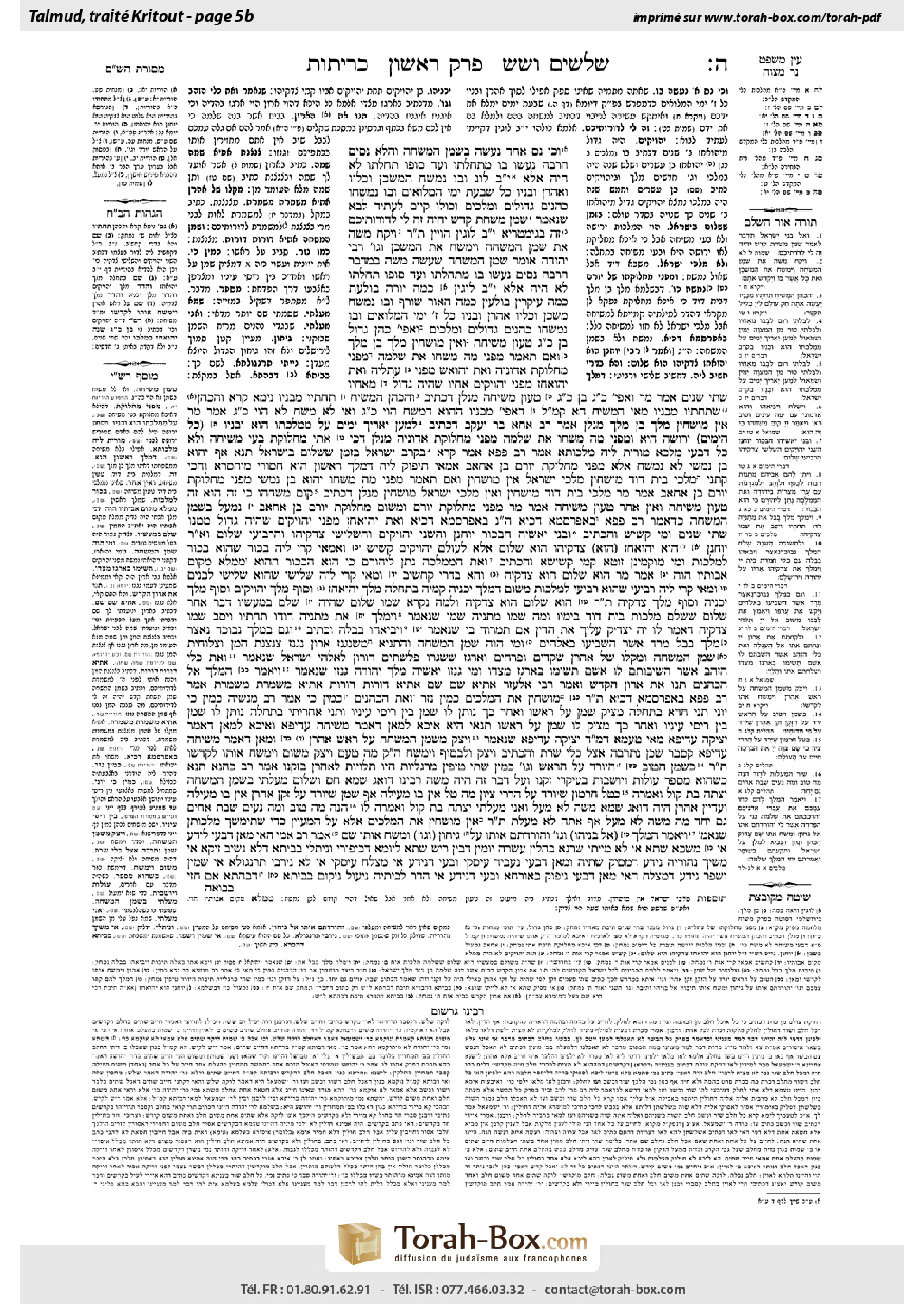
Keritot 5b: Talmud study for Daf Yomi
Daf Yomi is the daily study of one Talmud folio. Explore 37 tractates with scans, Hebrew text, Sefaria English and AI-generated French translations where annotated.
Passage selection and English or AI-generated French translation are available where the scan has annotations. Daf Study is independent of Torah-Box and Sefaria.
Browse Keritot · כריתות · All tractatesKeritot 5b text and translations
This page of Keritot includes the Aramaic text, an English translation and an AI-generated French translation, alongside the scan above.
כריתות ה׳ ב · Aramaic and Hebrew text
וְכִי נֵס אֶחָד נַעֲשָׂה בַּשֶּׁמֶן הַמִּשְׁחָה? וַהֲלֹא נִסִּים הַרְבֵּה נַעֲשׂוּ בּוֹ מִתְּחִלָּתוֹ וְעַד סוֹפוֹ, תְּחִלָּתוֹ לֹא הָיָה אֶלָּא שְׁנֵים עָשָׂר לוֹג, וּבוֹ נִמְשַׁח הַמִּשְׁכָּן וְכֵלָיו וְאַהֲרֹן וּבָנָיו כׇּל שִׁבְעַת יְמֵי הַמִּלּוּאִים, וּבוֹ נִמְשְׁחוּ כֹּהֲנִים גְּדוֹלִים וּמְלָכִים, וְכוּלּוֹ קַיָּים לֶעָתִיד לָבֹא,
שֶׁנֶּאֱמַר: ״שֶׁמֶן מִשְׁחַת קֹדֶשׁ יִהְיֶה זֶה לִי לְדֹרֹתֵיכֶם״ – ״זֶה״ בְּגִימַטְרִיָּא שְׁנֵים עָשָׂר לוּגִּין הָוְיָין.
תָּנוּ רַבָּנַן ״וַיִּקַּח מֹשֶׁה אֶת שֶׁמֶן הַמִּשְׁחָה וַיִּמְשַׁח אֶת הַמִּשְׁכָּן וְגוֹ׳״, רַבִּי יְהוּדָה אוֹמֵר: שֶׁמֶן הַמִּשְׁחָה שֶׁעָשָׂה מֹשֶׁה בַּמִּדְבָּר הַרְבֵּה נִסִּים נַעֲשׂוּ בּוֹ מִתְּחִלָּתוֹ וְעַד סוֹפוֹ: תְּחִלָּתוֹ לֹא הָיָה אֶלָּא שְׁנֵים עָשָׂר לוּגִּין, כַּמָּה יוֹרָה בּוֹלַעַת, כַּמָּה עִיקָּרִין בּוֹלְעִין, כַּמָּה הָאוּר שׂוֹרֵף, וּבוֹ נִמְשַׁח מִשְׁכָּן וְכֵלָיו, אַהֲרֹן וּבָנָיו כָּל שִׁבְעַת יְמֵי הַמְּלוּאִים,
וּבוֹ נִמְשְׁחוּ כֹּהֲנִים גְּדוֹלִים וּמְלָכִים. וַאֲפִילּוּ כֹּהֵן גָּדוֹל בֶּן כֹּהֵן גָּדוֹל טָעוּן מְשִׁיחָה. וְאֵין מוֹשְׁחִין מֶלֶךְ בֶּן מֶלֶךְ. וְאֵם תֹּאמַר: מִפְּנֵי מָה מָשְׁחוּ אֶת שְׁלֹמֹה? מִפְּנֵי מַחְלוֹקֶת אֲדוֹנִיָּה, וְאֶת יְהוֹאָשׁ – מִפְּנֵי עֲתַלְיָה, וְאֶת יְהוֹאָחָז – מִפְּנֵי יְהוֹיָקִים אָחִיו, שֶׁהָיָה גָּדוֹל מֵאֶחָיו שְׁתֵּי שָׁנִים.
אָמַר מָר: וַאֲפִילּוּ כֹּהֵן גָּדוֹל בֵּן כֹּהֵן גָּדוֹל טָעוּן מְשִׁיחָה. מְנָלַן? דִּכְתִיב: ״וְהַכֹּהֵן הַמָּשִׁיחַ תַּחְתָּיו מִבָּנָיו״, נֵימָא קְרָא ״וְהַכֹּהֵן שֶׁתַּחְתָּיו מִבָּנָיו״, מַאי ״הַמָּשִׁיחַ״? הָא קָא מַשְׁמַע לַן דַּאֲפִילּוּ מִבָּנָיו, הָהוּא דִּמְשַׁח הָוֵי כֹּהֵן גָּדוֹל, וְאִי לָא מְשַׁח לָא הָוֵי כֹּהֵן גָּדוֹל.
אָמַר מָר: אֵין מוֹשְׁחִין מֶלֶךְ בֶּן מֶלֶךְ. מְנָלַן? אָמַר רַב אַחָא בַּר יַעֲקֹב, דִּכְתִיב: ״לְמַעַן יַאֲרִיךְ יָמִים עַל מַמְלַכְתּוֹ הוּא וּבָנָיו כׇּל הַיָּמִים״ – יְרוּשָּׁה הִיא.
וּמִפְּנֵי מָה מָשְׁחוּ אֶת שְׁלֹמֹה? מִפְּנֵי מַחְלוֹקֶת אֲדוֹנִיָּה. מְנָלַן דְּכִי אָתֵי מַחְלוֹקֶת בָּעֵי מְשִׁיחָה, וְלָא כׇּל דְּבָעֵי מַלְכָּא מוֹרֵית לֵיהּ מַלְכוּתָא? אָמַר רַב פָּפָּא, אָמַר קְרָא: ״בְּקֶרֶב יִשְׂרָאֵל״ – בִּזְמַן שֶׁשָּׁלוֹם בְּיִשְׂרָאֵל.
תָּנָא: אַף יֵהוּא בֶּן נִמְשִׁי לֹא נִמְשַׁח אֶלָּא מִפְּנֵי מַחְלוֹקֶת יוֹרָם בֶּן אַחְאָב: אַמַּאי? תִּיפּוֹק לֵיהּ דְּמֶלֶךְ רִאשׁוֹן הוּא! חַסּוֹרֵי מִיחַסְּרָא וְהָכִי קָתָנֵי: מַלְכֵי בֵּית דָּוִד מוֹשְׁחִין, מַלְכֵי יִשְׂרָאֵל אֵין מוֹשְׁחִין. וְאִם תֹּאמַר: מִפְּנֵי מָה מָשְׁחוּ יֵהוּא בֶּן נִמְשִׁי? מִפְּנֵי מַחְלוֹקֶת יוֹרָם בֶּן אַחְאָב.
אָמַר מָר: מַלְכֵי בֵּית דָּוִד מוֹשְׁחִין, וְאֵין מַלְכֵי יִשְׂרָאֵל מוֹשְׁחִין. מְנָלַן? דִּכְתִיב: ״קוּם מְשָׁחֵהוּ כִּי זֶה הוּא״ – זֶה טָעוּן מְשִׁיחָה, וְאֵין אַחֵר טָעוּן מְשִׁיחָה.
אָמַר מָר: מִפְּנֵי מַחְלוֹקֶת יוֹרָם. וּמִשּׁוּם מַחְלוֹקֶת יוֹרָם בֶּן אַחְאָב נִמְעַל בְּשֶׁמֶן הַמִּשְׁחָה? כִּדְאָמַר רַב פָּפָּא: בַּאֲפַרְסְמָא דַּכְיָא, הָכָא נָמֵי בַּאֲפַרְסְמָא דַּכְיָא.
וְאֶת יְהוֹאָחָז מִפְּנֵי יְהוֹיָקִים, שֶׁהָיָה גָּדוֹל מִמֶּנּוּ שְׁתֵּי שָׁנִים. וּמִי קַשִּׁישׁ? וְהָכְתִיב: ״וּבְנֵי יֹאשִׁיָּה הַבְּכוֹר יוֹחָנָן וְהַשֵּׁנִי יְהוֹיָקִים וְהַשְּׁלִישִׁי צִדְקִיָּהוּ וְהָרְבִיעִי שַׁלּוּם״, וְאָמַר רַבִּי יוֹחָנָן: הוּא יְהוֹאָחָז, הוּא צִדְקִיָּהוּ, הוּא שַׁלּוּם!
אֶלָּא לְעוֹלָם יְהוֹיָקִים קַשִּׁישׁ, וְאַמַּאי קָרֵי לֵיהּ בְּכוֹר – שֶׁהוּא בְּכוֹר לַמַּלְכוּת. וּמִי מוֹקְמִינַן זוּטָא קַמֵּי קַשִּׁישָׁא? וְהָכְתִיב: ״וְאֶת הַמַּמְלָכָה נָתַן לִיהוֹרָם כִּי הוּא הַבְּכוֹר״! הַהוּא מְמַלֵּא מְקוֹם אֲבוֹתָיו הֲוָה.
אָמַר מָר: הוּא שַׁלּוּם הוּא צִדְקִיָּה. וְהָא בְּדָרֵי קָחָשֵׁיב! וּמַאי קָרֵי לֵיהּ שְׁלִישִׁי? שֶׁהוּא שְׁלִישִׁי לַבָּנִים, וּמַאי קָרֵי לֵיהּ רְבִיעִי? שֶׁהוּא רְבִיעִי לַמַּלְכוּת, מִשּׁוּם דִּמְלַךְ יְכָנְיָה קַמֵּיהּ – בִּתְחִלָּה מְלַךְ יְהוֹאָחָז, וְסוֹף מְלַךְ יְהוֹיָקִים, וְסוֹף מְלַךְ יְכָנְיָה, וְסוֹף מְלַךְ צִדְקִיָּה.
תָּנוּ רַבָּנַן: הוּא שַׁלּוּם הוּא צִדְקִיָּה, וְלָמָּה נִקְרָא שְׁמוֹ שַׁלּוּם? שֶׁהָיָה שָׁלֵם בְּמַעֲשָׂיו. דָּבָר אַחֵר: שַׁלּוּם – שֶׁשָּׁלֵם מַלְכוּת בֵּית דָּוִד בְּיָמָיו, וּמָה שְׁמוֹ? מַתַּנְיָה שְׁמוֹ, שֶׁנֶּאֱמַר: ״וַיַּמְלֵךְ אֶת מַתַּנְיָה דֹדוֹ תַּחְתָּיו וַיַּסֵּב שְׁמוֹ צִדְקִיָּה״,
דְּאָמַר: לוֹ יָהּ יַצְדִּיק עָלֶיךָ אֶת הַדִּין אִם תִּמְרוֹד בִּי, שֶׁנֶּאֱמַר: ״וַיְבִיאֵהוּ בָבֶלָה״ וּכְתִיב: ״וְגַם בַּמֶּלֶךְ נְבוּכַד נֶאצַּר מֶלֶךְ בָּבֶל מָרָד אֲשֶׁר הִשְׁבִּיעוֹ בֵּאלֹהִים״.
וּמִי הֲוָה שֶׁמֶן הַמִּשְׁחָה? וְהָתַנְיָא: מִשֶּׁנִּגְנַז אָרוֹן נִגְנַז צִנְצֶנֶת הַמָּן, וּצְלוֹחִית שֶׁמֶן הַמִּשְׁחָה, וּמַקְלוֹ שֶׁל אַהֲרֹן שְׁקֵדִים וּפְרָחִים,
וְאַרְגַּז שֶׁשִּׁגְּרוּ פְּלִשְׁתִּים דּוֹרוֹן לֵאלֹהֵי יִשְׂרָאֵל, שֶׁנֶּאֱמַר: ״וְאֶת כְּלֵי הַזָּהָב אֲשֶׁר הֲשֵׁבֹתֶם לוֹ אָשָׁם תָּשִׂימוּ בָאַרְגַּז מִצִּדּוֹ״. וּמִי גְּנָזוֹ? יֹאשִׁיָּה מֶלֶךְ יְהוּדָה גְּנָזוֹ, שֶׁנֶּאֱמַר: ״וַיֹּאמֶר הַמֶּלֶךְ אֶל הַכֹּהֲנִים תְּנוּ אֶת אֲרוֹן הַקֹּדֶשׁ״,
וְאָמַר רַבִּי אֶלְעָזָר: אָתְיָא ״שָׁם״ ״שָׁם״,
אָתְיָא ״דּוֹרוֹת״ ״דּוֹרוֹת״,
אַתְיָא ״מִשְׁמֶרֶת״ ״מִשְׁמֶרֶת״. אָמַר רַב פָּפָּא: בַּאֲפַרְסְמָא דַּכְיָא.
תָּנוּ רַבָּנַן: מוֹשְׁחִין אֶת הַמְּלָכִים כְּמִין נֵזֶר, וְאֶת הַכֹּהֲנִים כְּמִין ״כִּי״. אָמַר רַב מְנַשְּׁיָה: כְּמִין ״כִּי״ יְוָנִי. תָּנֵי חֲדָא: בַּתְּחִלָּה מַצִּיק שֶׁמֶן עַל רֹאשׁוֹ וְאַחַר כָּךְ נוֹתֵן לוֹ שֶׁמֶן בֵּין רִיסֵי עֵינָיו, וְתָנֵי אַחֲרִיתִי: בַּתְּחִלָּה נוֹתֵן לוֹ שֶׁמֶן בֵּין רִיסֵי עֵינָיו וְאַחַר כָּךְ מַצִּיק לוֹ שֶׁמֶן עַל רֹאשׁוֹ!
תַּנָּאֵי הִיא, אִיכָּא לְמַאן דְּאָמַר מְשִׁיחָה עֲדִיפָא, וְאִיכָּא לְמַאן דְּאָמַר יְצִיקָה עֲדִיפָא. מַאי טַעְמָא דְּמַאן דְּאָמַר יְצִיקָה עֲדִיפָא – שֶׁנֶּאֱמַר: ״וַיִּצֹק מִשֶּׁמֶן הַמִּשְׁחָה עַל רֹאשׁ אַהֲרֹן״, וּמַאן דְּאָמַר מְשִׁיחָה עֲדִיפָא – קָסָבַר: שֶׁכֵּן נִתְרַבָּה אֵצֶל כְּלֵי שָׁרֵת.
וְהָכְתִיב: ״וַיִּצֹק״ וּלְבַסּוֹף ״וַיִּמְשַׁח״! הָכִי קָאָמַר: מָה טַעַם ״וַיִּצֹק״ – מִשּׁוּם ״וַיִּמְשַׁח אוֹתוֹ לְקַדְּשׁוֹ״.
תָּנוּ רַבָּנַן: ״כַּשֶּׁמֶן הַטּוֹב הַיּוֹרֵד עַל הָרֹאשׁ וְגוֹ׳״ – כְּמִין שְׁתֵּי טִיפִּין מַרְגָּלִיּוֹת הָיוּ תְּלוּיוֹת לְאַהֲרֹן בִּזְקָנוֹ. אָמַר רַב כָּהֲנָא, תָּנָא: כְּשֶׁהוּא מְסַפֵּר עוֹלוֹת וְיוֹשְׁבוֹת בְּעִיקָּרֵי זְקָנוֹ. וְעַל דָּבָר זֶה הָיָה מֹשֶׁה רַבֵּינוּ דּוֹאֵג, שֶׁמָּא חַס וְשָׁלוֹם מָעַלְתִּי בְּשֶׁמֶן הַמִּשְׁחָה.
יָצְתָה בַּת קוֹל וְאָמְרָה: ״כְּטַל חֶרְמוֹן שֶׁיֹּרֵד עַל הַרְרֵי צִיּוֹן״, מָה טַל אֵין בּוֹ מְעִילָה – אַף שֶׁמֶן שֶׁיּוֹרֵד עַל זְקַן אַהֲרֹן אֵין בּוֹ מְעִילָה.
וַעֲדַיִין אַהֲרֹן הָיָה דּוֹאֵג, שֶׁמָּא מֹשֶׁה לֹא מָעַל, וַאֲנִי מָעַלְתִּי! יָצְתָה בַּת קוֹל וְאָמְרָה לוֹ: ״הִנֵּה מַה טּוֹב וּמַה נָּעִים שֶׁבֶת אַחִים גַּם יָחַד״, מָה מֹשֶׁה לֹא מָעַל, אַף אַתָּה לֹא מָעַלְתָּ.
תָּנוּ רַבָּנַן: אֵין מוֹשְׁחִין אֶת הַמְּלָכִים אֶלָּא עַל הַמַּעְיָין, כְּדֵי שֶׁתִּימָּשֵׁךְ מַלְכוּתָן, שֶׁנֶּאֱמַר: ״וַיֹּאמֶר הַמֶּלֶךְ אֶל בְּנָיָהוּ וְגוֹ׳ וְהוֹרַדְתֶּם אֹתוֹ עַל גִּחוֹן וְגוֹ׳ וּמָשַׁח אוֹתוֹ שָׁם״.
אָמַר רַב אַמֵּי: הַאי מַאן דְּבָעֵי לִידַּע אִי מָשְׁכָא שַׁתָּא אִי לָא, מַיְיתֵי שְׁרָגָא בְּהָלֵין עַשְׂרָה יוֹמִין דְּבֵין רֵישׁ שַׁתָּא לְיוֹמָא דְכִיפּוּרֵי, וְנִיתְלֵי בְּבֵיתָא דְּלָא נָשֵׁיב זִיקָא, אִי מְשִׁיךְ נְהוֹרֵיהּ נִידַּע דְּמַסֵּיק שַׁתֵּיהּ.
וּמַאן דְּבָעֵי נַעֲבֵיד עִיסְקֵי, וּבָעֵי דְּנִידַּע אִי מַצְלַח עִיסְקֵיהּ אִי לָא, נִירַבֵּי תַּרְנְגוֹלָא, אִי שָׁמֵין וְשָׁפַר נִידַּע דְּמַצְלַח.
הַאי מַאן דְּבָעֵי נִיפּוֹק בְּאוֹרְחָא, וּבָעֵי דְּנִידַּע אִי הָדַר לְבֵיתֵיהּ – נִיעוֹל נֵיקוּם בְּבֵיתָא דְּבַהֲתָא, אִם חָזֵי
Keritot 5b · English translation
And was just one miracle performed with the anointing oil? But many miracles were performed with it, from its initial preparation to its end. He explains: Its initial preparation was only the measure of twelve log, and even so the Tabernacle and its vessels were anointed with it, and likewise Aaron and his sons were anointed with it all the seven days of inauguration, and High Priests and kings were anointed with it throughout the generations, and yet despite the reduction in the amount of oil during its preparation process, as well as its multiple uses throughout history, it all remains intact for its use in the future.
Rabbi Yehuda adds that this is as it is stated: “This [zeh] shall be a sacred anointing oil to Me throughout your generations” (Exodus 30:31). The word zeh has a numerical value [bigimatriya] of twelve, which teaches that the original twelve log of oil that existed at the outset are extant throughout all the generations. If so, i.e., if such miracles were performed in connection with the oil, it is no wonder that its initial preparation was miraculous.
The Sages taught in a baraita: “And Moses took the anointing oil, and anointed the Tabernacle and all that was in it and sanctified them” (Leviticus 8:10). Rabbi Yehuda says: With regard to the anointing oil that Moses prepared in the wilderness, many miracles were performed with it, from its initial preparation to its end. Its initial preparation was only twelve log; consider how much of it a cauldron absorbs from what is cooked inside it, and how much of it the roots of the plants absorb, how much of it the fire burns, and yet the Tabernacle, and its vessels, and Aaron, and his sons were all anointed with it all seven days of the inauguration.
The baraita adds: And High Priests and kings were anointed with it, and even a High Priest, the son of a High Priest, requires anointing with the oil. But one does not anoint a king, the son of a king. And if you say: If so, for what reason did they anoint King Solomon, who was the son of King David? It was due to the dispute over the throne instigated by his older brother Adonijah, who attempted to usurp the monarchy. And similarly Joash, son of Ahaziah, was anointed king (see II Kings 11:12) due to the threat of Athaliah, his paternal grandmother, who attempted to seize the monarchy for herself (II Kings 11:1–3). And Jehoahaz, son of Josiah, was anointed as king (II Kings 23:30) due to the competition from Jehoiakim, his brother, who was two years older than his brother, i.e., Jehoahaz. Ordinarily the older brother succeeds the father, but Jehoahaz was more worthy of the throne.
The Gemara clarifies several aspects of this baraita. The Master said earlier: And even a High Priest, the son of a High Priest, requires anointing. The Gemara asks: From where do we derive this halakha? It is derived from a verse, as it is written: “And the anointed priest that shall be in his stead from among his sons” (Leviticus 6:15). Let the verse say merely: The priest that shall be in his stead from among his sons. What is taught by the addition of the term “anointed”? This teaches us that even when the new High Priest is from among the sons of the previous High Priest, only that priest who is anointed with oil is the High Priest, but if he is not anointed with oil he is not the High Priest.
The Master said earlier: But one does not anoint a king, the son of a king. The Gemara asks: From where do we derive this halakha? Rav Aḥa bar Ya’akov said that this is as it is written: In order that he may prolong his days in his kingdom, he and his sons, all the days in the midst of Israel (see Deuteronomy 17:20). The mention of a king’s sons teaches that the kingdom is an inheritance, which does not need to be confirmed by anointing.
The baraita further taught: And for what reason did they anoint King Solomon? Due to the dispute over the throne instigated by his older brother Adonijah. The Gemara asks: From where do we derive that in a situation where there is a dispute the new king requires anointing, and the current king cannot simply grant the kingship as an inheritance to whomever he desires? Rav Pappa said that the verse states: “He and his children in the midst of Israel” (Deuteronomy 17:20). At a time when there is peace in Israel the monarchy transfers smoothly to the king’s son, but not when there is a dispute.
It was taught in a baraita: Also Jehu, son of Jehoshaphat, son of Nimshi, was anointed by Elisha the prophet only due to the dispute with Joram, son of Ahab, who was the incumbent king, against whose reign Jehu rebelled (see II Kings 9:1–6). The Gemara asks: Why is it necessary to state this reason? Let the tanna of the baraita derive that Jehu required anointing due to the fact that he was the first king of his lineage, as Jehu was not the son of a king. The Gemara answers: The baraita is incomplete, and this is what it is teaching: One anoints the kings of the house of David with the anointing oil, but one does not anoint the kings from the kingdom of Israel. And if you say: For what reason did Elisha anoint Jehu, son of Jehoshaphat, son of Nimshi? This was due to the dispute with Joram, son of Ahab.
The Master said earlier: One anoints the kings of the house of David with the anointing oil, but one does not anoint the kings of Israel. The Gemara asks: From where do we derive this halakha? It is derived from a verse, as it is written with regard to the anointing of David: “Arise, anoint him; for this is he” (I Samuel 16:12). This king, i.e., any king from the house of David, requires anointing, but another king, i.e., from the kingdom of Israel, whose kings were not descendants of the house of David, does not require anointing.
The Master said earlier that Jehu was anointed due to the dispute with Joram. The Gemara asks: And due to the dispute with Joram, son of Ahab, will we misuse consecrated property by anointing someone unnecessarily with the anointing oil, which is called “a sacred anointing oil” (Exodus 30:31)? After all, kings of the kingdom of Israel do not require anointing. The Gemara answers: This is as Rav Pappa said with regard to Jehoahaz: They anointed him with pure balsam oil, rather than with the anointing oil. Here too, Elisha anointed Jehu with pure balsam oil, not the anointing oil.
It was further stated in the baraita: And Jehoahaz, son of Josiah, was anointed due to the competition from Jehoiakim, his brother, who was two years older than him. The Gemara asks: And was Jehoiakim in fact older than Jehoahaz? But isn’t it written: “And the sons of Josiah: The firstborn Johanan, the second Jehoiakim, the third Zedekiah, the fourth Shallum” (I Chronicles 3:15); and Rabbi Yoḥanan says: The one who is called Johanan in that verse is also called Jehoahaz, and the one who is called Zedekiah is the same as the one called Shallum. If so, Jehoahaz is the eldest son, not Jehoiakim. Why, then, was it necessary to anoint Jehoahaz?
The Gemara answers: Rather, Jehoiakim was actually older than Jehoahaz. And why does the verse call Jehoahaz the firstborn? This is referring to the fact that Jehoahaz was the firstborn with regard to the monarchy, i.e., he became king first. The Gemara asks: And do we establish the younger son as king before the older son? But isn’t it written with regard to Jehoshaphat: “And he gave the kingdom to Jehoram, because he was the firstborn” (II Chronicles 21:3)? The Gemara answers: Jehoram was one who filled the place of his fathers, i.e., he was fit to serve as king, and therefore as he was firstborn he received the kingship, whereas Jehoiakim was deemed unworthy of the honor, despite being the oldest among his brothers.
The Master said earlier: The one who is called Shallum is also called Zedekiah. The Gemara objects: But the Torah counts these individuals in a row, i.e., one after the other, as I Chronicles 3:15 mentions the first, second, third, and fourth sons. This indicates that they are different people. The Gemara answers: Shallum and Zedekiah are in fact one and the same, and what is the reason the verse calls Zedekiah the third? The reason is that he is third of the sons, i.e., the third in order of birth. And what is the reason the verse calls Shallum the fourth? The reason is that he is fourth to the kingship, because Jeconiah reigned before him. How so? Initially Jehoahaz reigned, and afterward Jehoiakim reigned, and afterward Jeconiah reigned, and afterward Zedekiah reigned. Accordingly, Zedekiah, called Shallum, was fourth to the kingship.
The Sages taught in a baraita: The one who is called Shallum is also called Zedekiah, and why was he called Shallum? Because he was perfect [shalem] in his good deeds. Alternatively, he was called Shallum because in his days the kingdom of the house of David was completed [shalam], as he was the last king in the Davidic dynasty. And what was his true name? Mattaniah was his name, as it is stated: “And the king of Babylonia made Mattaniah, his father’s brother, king in his stead, and changed his name to Zedekiah” (II Kings 24:17).
The baraita explains: Why did the king of Babylonia, Nebuchadnezzar, call him by the name Zedekiah? The reason is that Nebuchadnezzar said to him: God will justify [yatzdik] the judgment over you if you rebel against me, as it is stated with regard to Nebuchadnezzar and Jehoiachin: “And brought him to Babylon” (II Chronicles 36:10), and with regard to Zedekiah it is stated: “And he also rebelled against King Nebuchadnezzar, who had made him swear by God” (II Chronicles 36:13).
§ The Gemara raises a difficulty with regard to the statement that Jehoahaz was anointed: And was there anointing oil in the days of Jehoahaz? But isn’t it taught in a baraita (Tosefta, Yoma 2:15) that from when the Ark was sequestered, along with it was sequestered the jar of manna that was next to it (see Exodus 16:33), and the flask of the anointing oil, and Aaron’s staff with its almonds and blossoms (see Numbers 17:23).
The baraita continues: And also sequestered with the Ark was the chest that the Philistines sent as a gift to the God of Israel after they captured the Ark and were stricken by several plagues, as it is stated: “And put the jewels of gold that you return to Him for a guilt offering, in a coffer by its side, and send it away that it may go” (I Samuel 6:8). And who sequestered the Ark? Josiah, king of Judah, sequestered it, as it is stated: And the king said to the priests: Put the sacred Ark in the house that Solomon, the son of David, king of Israel, built (see II Chronicles 35:3).
And Rabbi Elazar says: How do we know that all these items needed to be sequestered together with the Ark? The halakha that the jar of manna was to be kept with the Ark is derived through a verbal analogy between the words “there” and “there.” The word “there” is stated with regard to the Ark: “Where I will meet with you there” (Exodus 30:6), and it is also stated with regard to the manna: “And put there” (Exodus 16:33).
The halakha that the anointing oil was to be kept together with the Ark is derived through a verbal analogy between the words “generations” and “generations.” This term is stated with regard to the jar of manna: “To be kept throughout your generations” (Exodus 16:33), and also with regard to the anointing oil: “This shall be a sacred anointing oil to Me throughout your generations” (Exodus 30:31).
Finally, the halakha that Aaron’s staff was to be kept together with the Ark is derived through a verbal analogy between the terms “to be kept” and “to be kept.” This term is stated with regard to the jar of manna, and also with regard to Aaron’s staff: “To be kept there, for a token against the rebellious children” (Numbers 17:25). All these items, which are connected through these verbal analogies, including the anointing oil, were kept by the side of the Ark, and therefore they were sequestered together with the Ark. If so, how was Jehoahaz anointed with the anointing oil? Rav Pappa said: They did not anoint Jehoahaz with the anointing oil, but with pure balsam.
§ The Sages taught in a baraita: One anoints the kings by placing the oil around the head in a shape similar to a crown, and one anoints the High Priests by placing the oil upon the head in the shape similar to chi. In explanation of this statement, Rav Menashya says: It is placed in a shape similar to the Greek letter chi, which looks like the letter Χ. It is taught in one baraita: First, one pours oil on the head of the High Priest, and afterward one places oil between his eyelashes. And it is taught in another baraita: First, one places oil between his eyelashes, and afterward one pours oil on his head. The baraitot contradict each other.
The Gemara explains: This is a matter of dispute between tanna’im, as there is a tanna who says: Anointing between his eyelashes is preferable to pouring on the head and therefore comes first, and there is a tanna who says that pouring on the head is preferable to anointing between his eyelashes, and therefore comes first. What is the reasoning of the one who says that pouring on the head is preferable? As it is stated: “And he poured of the anointing oil upon Aaron’s head and anointed him to sanctify him” (Leviticus 8:12), which indicates that pouring is first, followed by anointing. And as for the one who says that anointing between his eyelashes is preferable to pouring on the head and precedes it, he holds that anointing is preferable in that its use is increased, i.e., it is performed on the service vessels, whereas pouring is not mentioned with regard to the service vessels.
The Gemara raises a difficulty: But according to the opinion that anointing is preferable, isn’t it written: “He poured,” and ultimately: “He anointed” (Leviticus 8:12)? The Gemara explains that this is what the verse is saying: What is the reason for “he poured”? This action was made possible due to the fact that he had already: “Anointed him to sanctify him.” In other words, the pouring came after the anointing, which is the primary act.
The Sages taught in a baraita: The verse states: “It is like the precious oil upon the head descending upon the beard; the beard of Aaron, that descends upon the collar of his garments” (Psalms 133:2). Two drops of anointing oil shaped like pearls hung from Aaron’s beard. Rav Kahana says it is taught: When Aaron would speak his beard would move, and these drops would miraculously rise and sit on the roots of his beard, so that they would not fall to the ground. And with regard to this matter Moses, our teacher, was concerned, thinking: Perhaps, God forbid, I misused the anointing oil by pouring too much, which resulted in these two additional drops.
A Divine Voice emerged and said: “It is like the precious oil upon the head, descending upon the beard; the beard of Aaron, that descends upon the collar of his garments, like the dew of the Hermon that comes down upon the mountains of Zion” (Psalms 133:2–3). This comparison serves to teach: Just as the Hermon’s dew is not subject to misuse of consecrated property, as it is not consecrated but can be used by all, so too, the anointing oil that descends upon Aaron’s beard is not subject to misuse of consecrated property.
And still Aaron himself was concerned, thinking: Perhaps Moses did not misuse consecrated property but I misused the oil, as the additional oil is on my body and I derive benefit from it. A Divine Voice emerged and said to him: “Behold how good and how pleasant it is for brothers to dwell together in unity” (Psalms 133:1). Just as your brother Moses did not misuse consecrated property, so too, you did not misuse consecrated property.
§ The Gemara cites a baraita which discusses the anointing of kings. The Sages taught: One may anoint kings only next to a spring. This is done as a fortuitous sign, so that their kingdom should continue uninterrupted just as the waters of the spring flow uninterrupted throughout the year. As it is stated with regard to the coronation of Solomon in the days of King David: And the king said to Benaiah: Take with you the servants of your lord, and cause Solomon my son to ride upon my own mule, and bring him down to Gihon. And let Zadok the priest and Nathan the prophet anoint him there king over Israel (see I Kings 1:33–34). The Sages derived from here that all kings should be anointed near a spring.
Parenthetical to this matter of performing an act as a fortuitous sign, the Gemara cites that which Rav Ami says: One who desires to know if he will live through this current year or not should bring a lit candle during those ten days between Rosh HaShana and Yom Kippur and hang it in a house through which wind does not blow, and he should watch it carefully: If its light continues he shall know that he will live out his year.
And one who desires to conduct business and wants to know if his business will succeed or not should raise a rooster. If the rooster gets fat and beautiful he shall know that the venture will succeed.
This one who wishes to leave on a journey and wants to know whether he will return to his home should enter a dark house. If he sees
Keritot 5b · Traduction française (IA)
Et n’y eut-il qu’un seul miracle accompli avec l’huile d’onction ? Pourtant, de nombreux miracles furent accomplis avec elle, depuis sa préparation initiale jusqu’à son épuisement. Il explique : au départ, il n’y en avait que douze log ; pourtant, on en oignit le Tabernacle et ses ustensiles, ainsi qu’Aaron et ses fils pendant les sept jours de l’inauguration. On en oignit aussi les grands prêtres et les rois au fil des générations. Malgré la diminution de la quantité d’huile pendant sa préparation et ses multiples usages au cours de l’histoire, elle demeure intacte pour être utilisée à l’avenir.
Rabbi Yehuda ajoute que c’est ce qui est dit : « Ceci [zeh] sera pour Moi une huile d’onction sacrée, pour vos générations » (Exode 30:31). Le mot zeh a pour valeur numérique [bigimatriya] douze, ce qui enseigne que les douze log d’huile qui existaient au départ sont restés intacts à travers toutes les générations. Dans ce cas, c’est-à-dire si de tels miracles furent accomplis à propos de l’huile, il n’est pas étonnant que sa préparation initiale ait été miraculeuse.
Les Sages ont enseigné dans une baraïta : « Moïse prit l’huile d’onction, oignit le Tabernacle et tout ce qui s’y trouvait, et les sanctifia » (Lévitique 8:10). Rabbi Yehuda dit : De nombreux miracles furent accomplis avec l’huile d’onction que Moïse prépara dans le désert, depuis sa préparation initiale jusqu’à son épuisement. Au départ, il n’y en avait que douze log ; songez à la quantité absorbée par un chaudron de ce qu’on y fait cuire, à celle absorbée par les racines des plantes et à celle consumée par le feu. Pourtant, on en oignit le Tabernacle, ses ustensiles, Aaron et ses fils pendant les sept jours de l’inauguration.
La baraïta ajoute : On en oignit les grands prêtres et les rois ; même un grand prêtre fils d’un grand prêtre doit être oint avec cette huile. Mais on n’oint pas un roi fils d’un roi. Et si tu dis : dans ce cas, pourquoi le roi Salomon, fils du roi David, fut-il oint ? C’était en raison du conflit au sujet du trône provoqué par son frère aîné Adonija, qui tenta d’usurper la royauté. De même, Joas, fils d’Achazia, fut oint comme roi (voir II Rois 11:12) en raison de la menace que représentait Athalie, sa grand-mère paternelle, qui tenta de s’emparer de la royauté (II Rois 11:1–3). Joachaz, fils de Josias, fut également oint comme roi (II Rois 23:30) en raison de la rivalité avec son frère Joiaqim, qui avait deux ans de plus que lui, c’est-à-dire que Joachaz. D’ordinaire, le frère aîné succède à son père, mais Joachaz était plus digne du trône.
La Guemara clarifie plusieurs aspects de cette baraïta. Le Maître a dit précédemment : Même un grand prêtre fils d’un grand prêtre doit être oint. La Guemara demande : D’où déduisons-nous cette halakha ? Elle se déduit d’un verset, comme il est écrit : « Le prêtre oint qui sera à sa place parmi ses fils » (Lévitique 6:15). Que le verset dise simplement : « Le prêtre qui sera à sa place parmi ses fils ». Que nous enseigne l’ajout du terme « oint » ? Il nous enseigne que même lorsque le nouveau grand prêtre est l’un des fils du grand prêtre précédent, seul celui qui est oint d’huile est grand prêtre ; s’il n’est pas oint d’huile, il ne l’est pas.
Le Maître a dit précédemment : On n’oint pas un roi fils d’un roi. La Guemara demande : D’où déduisons-nous cette halakha ? Rav Aḥa bar Ya’akov dit que c’est ce qui est écrit : « Afin qu’il prolonge ses jours dans son royaume, lui et ses fils, au milieu d’Israël » (voir Deutéronome 17:20). La mention des fils d’un roi enseigne que la royauté se transmet par héritage et n’a pas besoin d’être confirmée par une onction.
La baraïta a également enseigné : Pourquoi le roi Salomon fut-il oint ? En raison du conflit au sujet du trône provoqué par son frère aîné Adonija. La Guemara demande : D’où déduisons-nous qu’en cas de conflit, le nouveau roi doit être oint et que le roi en place ne peut pas simplement transmettre la royauté par héritage à qui il le souhaite ? Rav Pappa dit que le verset énonce : « Lui et ses fils au milieu d’Israël » (Deutéronome 17:20). Lorsque la paix règne en Israël, la royauté se transmet sans difficulté au fils du roi, mais pas en cas de conflit.
Il a été enseigné dans une baraïta : Jéhu aussi, fils de Yehoshafat, fils de Nimshi, fut oint par le prophète Élisée uniquement en raison du conflit avec Joram, fils d’Achab, qui était le roi en place et contre le règne duquel Jéhu se révolta (voir II Rois 9:1–6). La Guemara demande : Pourquoi est-il nécessaire d’énoncer cette raison ? Que le tanna de la baraïta déduise que Jéhu devait être oint parce qu’il était le premier roi de sa lignée, puisqu’il n’était pas fils d’un roi. La Guemara répond : La baraïta est incomplète, et voici ce qu’elle enseigne : On oint les rois de la maison de David avec l’huile d’onction, mais on n’oint pas les rois du royaume d’Israël. Et si tu dis : pourquoi Élisée a-t-il oint Jéhu, fils de Yehoshafat, fils de Nimshi ? C’était en raison du conflit avec Joram, fils d’Achab.
Le Maître a dit précédemment : On oint les rois de la maison de David avec l’huile d’onction, mais on n’oint pas les rois d’Israël. La Guemara demande : D’où déduisons-nous cette halakha ? Elle se déduit d’un verset, comme il est écrit au sujet de l’onction de David : « Lève-toi, oins-le, car c’est lui » (I Samuel 16:12). Ce roi, c’est-à-dire tout roi de la maison de David, doit être oint ; mais un autre roi, c’est-à-dire un roi du royaume d’Israël, dont les rois ne descendaient pas de la maison de David, n’a pas besoin d’être oint.
Le Maître a dit précédemment que Jéhu fut oint en raison du conflit avec Joram. La Guemara demande : À cause du conflit avec Joram, fils d’Achab, allons-nous détourner un bien consacré en oignant inutilement quelqu’un avec l’huile d’onction, appelée « huile d’onction sacrée » (Exode 30:31) ? Après tout, les rois du royaume d’Israël n’ont pas besoin d’être oints. La Guemara répond : C’est comme l’a dit Rav Pappa au sujet de Joachaz : on l’oignit avec de l’huile de baume pure, et non avec l’huile d’onction. Ici aussi, Élisée oignit Jéhu avec de l’huile de baume pure, et non avec l’huile d’onction.
Il a également été dit dans la baraïta : Joachaz, fils de Josias, fut oint en raison de la rivalité avec son frère Joiaqim, qui avait deux ans de plus que lui. La Guemara demande : Joiaqim était-il réellement plus âgé que Joachaz ? N’est-il pas écrit : « Les fils de Josias : le premier-né Yohanan, le deuxième Joiaqim, le troisième Sédécias, le quatrième Shallum » (I Chroniques 3:15) ? Et Rabbi Yoḥanan dit : Celui qui est appelé Yohanan dans ce verset est également appelé Joachaz, et celui qui est appelé Sédécias est le même que celui qui est appelé Shallum. Si c’est le cas, Joachaz est le fils aîné, et non Joiaqim. Pourquoi donc fallait-il oindre Joachaz ?
La Guemara répond : En réalité, Joiaqim était plus âgé que Joachaz. Pourquoi alors le verset appelle-t-il Joachaz le premier-né ? Cela signifie que Joachaz fut le premier-né en ce qui concerne la royauté, c’est-à-dire qu’il devint roi le premier. La Guemara demande : Établit-on donc le fils cadet comme roi avant le fils aîné ? N’est-il pas écrit au sujet de Yehoshafat : « Il donna le royaume à Yehoram, parce qu’il était le premier-né » (II Chroniques 21:3) ? La Guemara répond : Yehoram était apte à prendre la place de ses pères, c’est-à-dire qu’il était digne d’être roi ; étant le premier-né, il reçut donc la royauté. Joiaqim, en revanche, fut jugé indigne de cet honneur, bien qu’il fût le plus âgé de ses frères.
Le Maître a dit précédemment : Celui qui est appelé Shallum est également appelé Sédécias. La Guemara objecte : Pourtant, la Torah énumère ces personnes l’une à la suite de l’autre, puisque I Chroniques 3:15 mentionne le premier, le deuxième, le troisième et le quatrième fils. Cela indique qu’il s’agit de personnes différentes. La Guemara répond : Shallum et Sédécias sont bien une seule et même personne. Pourquoi alors le verset appelle-t-il Sédécias le troisième ? Parce qu’il est le troisième des fils, c’est-à-dire le troisième dans l’ordre de naissance. Et pourquoi le verset appelle-t-il Shallum le quatrième ? Parce qu’il est le quatrième dans l’ordre de succession au trône, puisque Yekonia régna avant lui. Comment cela ? Joachaz régna d’abord, puis Joiaqim, puis Yekonia, et enfin Sédécias. Ainsi, Sédécias, appelé Shallum, fut le quatrième à accéder au trône.
Les Sages ont enseigné dans une baraïta : Celui qui est appelé Shallum est également appelé Sédécias. Pourquoi fut-il appelé Shallum ? Parce qu’il était irréprochable [shalem] dans ses bonnes actions. Autre explication : il fut appelé Shallum parce qu’en son temps la royauté de la maison de David prit fin [shalam], puisqu’il fut le dernier roi de la dynastie davidique. Et quel était son véritable nom ? Il s’appelait Mattania, comme il est dit : « Le roi de Babylone établit roi à sa place Mattania, son oncle, et changea son nom en Sédécias » (II Rois 24:17).
La baraïta explique : Pourquoi le roi de Babylone, Nabuchodonosor, l’appela-t-il Sédécias ? Parce que Nabuchodonosor lui dit : Dieu justifiera [yatzdik] le jugement porté contre toi si tu te révoltes contre moi. Comme il est dit au sujet de Nabuchodonosor et de Yekonia : « Il l’emmena à Babylone » (II Chroniques 36:10), et au sujet de Sédécias : « Il se révolta aussi contre le roi Nabuchodonosor, qui lui avait fait prêter serment par Dieu » (II Chroniques 36:13).
§ La Guemara soulève une difficulté au sujet de l’affirmation selon laquelle Joachaz fut oint : Y avait-il de l’huile d’onction à l’époque de Joachaz ? N’est-il pas enseigné dans une baraïta (Tosefta, Yoma 2:15) qu’à partir du moment où l’Arche fut mise à l’abri, on mit également à l’abri avec elle le récipient de manne qui se trouvait à côté (voir Exode 16:33), le flacon d’huile d’onction et le bâton d’Aaron avec ses amandes et ses fleurs (voir Nombres 17:23) ?
La baraïta poursuit : On mit également à l’abri avec l’Arche le coffre que les Philistins envoyèrent en offrande au Dieu d’Israël après avoir capturé l’Arche et avoir été frappés par plusieurs fléaux, comme il est dit : « Mettez dans un coffret, à côté, les objets d’or que vous Lui rendez en sacrifice de culpabilité, puis renvoyez-le afin qu’il s’en aille » (I Samuel 6:8). Et qui mit l’Arche à l’abri ? Josias, roi de Juda, la mit à l’abri, comme il est dit : « Le roi dit aux prêtres : Placez l’Arche sainte dans la Maison que Salomon, fils de David, roi d’Israël, a bâtie » (voir II Chroniques 35:3).
Et Rabbi Elazar dit : Comment savons-nous que tous ces objets devaient être mis à l’abri avec l’Arche ? La halakha selon laquelle le récipient de manne devait être conservé avec l’Arche se déduit par une analogie verbale entre les mots « là » et « là ». Le mot « là » est employé au sujet de l’Arche : « Là où Je te rencontrerai » (Exode 30:6), et il est également employé au sujet de la manne : « Et place-le là » (Exode 16:33).
La halakha selon laquelle l’huile d’onction devait être conservée avec l’Arche se déduit par une analogie verbale entre les mots « générations » et « générations ». Ce terme est employé au sujet du récipient de manne : « Pour être conservé à travers vos générations » (Exode 16:33), et également au sujet de l’huile d’onction : « Ceci sera pour Moi une huile d’onction sacrée, pour vos générations » (Exode 30:31).
Enfin, la halakha selon laquelle le bâton d’Aaron devait être conservé avec l’Arche se déduit par une analogie verbale entre les expressions « être conservé » et « être conservé ». Cette expression est employée au sujet du récipient de manne, ainsi qu’au sujet du bâton d’Aaron : « Pour être conservé là comme un signe contre les rebelles » (Nombres 17:25). Tous ces objets, reliés par ces analogies verbales, y compris l’huile d’onction, furent conservés à côté de l’Arche et furent donc mis à l’abri avec elle. Dans ce cas, comment Joachaz fut-il oint avec l’huile d’onction ? Rav Pappa dit : On n’oignit pas Joachaz avec l’huile d’onction, mais avec du baume pur.
§ Les Sages ont enseigné dans une baraïta : On oint les rois en disposant l’huile autour de leur tête en forme de couronne, et les grands prêtres en versant l’huile sur leur tête en forme de chi. Pour expliquer cette affirmation, Rav Menashya dit : On la dépose en forme de la lettre grecque chi, qui ressemble à la lettre Χ. Une baraïta enseigne : On verse d’abord de l’huile sur la tête du grand prêtre, puis on lui en dépose entre les sourcils. Une autre baraïta enseigne : On lui en dépose d’abord entre les sourcils, puis on verse de l’huile sur sa tête. Les baraïtot se contredisent.
La Guemara explique : C’est une controverse entre des tannaïm. Un tanna dit que l’onction entre les sourcils est préférable au versement sur la tête et doit donc être faite en premier, tandis qu’un autre tanna dit que le versement sur la tête est préférable à l’onction entre les sourcils et doit donc être fait en premier. Quel est le raisonnement de celui qui dit que le versement sur la tête est préférable ? Il est écrit : « Il versa de l’huile d’onction sur la tête d’Aaron et l’oignit pour le sanctifier » (Lévitique 8:12), ce qui indique que le versement précède l’onction. Quant à celui qui dit que l’onction entre les sourcils est préférable et précède le versement sur la tête, il considère que l’onction est préférable parce que son usage est plus étendu : elle est pratiquée sur les ustensiles du service, alors que le versement n’est pas mentionné à leur sujet.
La Guemara soulève une difficulté : Mais, selon l’opinion selon laquelle l’onction est préférable, n’est-il pas écrit d’abord : « Il versa », puis : « Il l’oignit » (Lévitique 8:12) ? La Guemara explique que voici ce que dit le verset : Pourquoi « versa-t-il » ? Cette action fut rendue possible parce qu’il l’avait déjà « oint pour le sanctifier ». Autrement dit, le versement eut lieu après l’onction, qui est l’acte principal.
Les Sages ont enseigné dans une baraïta : Le verset dit : « C’est comme l’huile précieuse sur la tête, qui descend sur la barbe, la barbe d’Aaron, et descend jusqu’au col de ses vêtements » (Psaumes 133:2). Deux gouttes d’huile d’onction, semblables à des perles, pendaient de la barbe d’Aaron. Rav Kahana enseigne : Quand Aaron parlait, sa barbe bougeait, et ces gouttes remontaient miraculeusement pour se poser à la racine de sa barbe, de sorte qu’elles ne tombent pas à terre. À ce sujet, Moïse notre maître était inquiet et pensait : Peut-être, à Dieu ne plaise, ai-je détourné un bien consacré en versant trop d’huile, ce qui a produit ces deux gouttes supplémentaires.
Une Voix céleste se fit entendre et dit : « C’est comme l’huile précieuse sur la tête, qui descend sur la barbe, la barbe d’Aaron, et descend jusqu’au col de ses vêtements, comme la rosée de l’Hermon qui descend sur les montagnes de Sion » (Psaumes 133:2–3). Cette comparaison enseigne : De même que la rosée de l’Hermon n’est pas soumise à l’interdiction de détourner un bien consacré, puisqu’elle n’est pas consacrée et que tous peuvent en profiter, de même l’huile d’onction qui descend sur la barbe d’Aaron n’est pas soumise à cette interdiction.
Aaron lui-même était pourtant inquiet et pensait : Peut-être Moïse n’a-t-il pas détourné un bien consacré, mais moi, j’ai détourné l’huile, puisque l’huile supplémentaire se trouve sur mon corps et que j’en tire profit. Une Voix céleste se fit entendre et lui dit : « Qu’il est bon et agréable pour des frères de demeurer ensemble dans l’unité » (Psaumes 133:1). De même que ton frère Moïse n’a pas détourné un bien consacré, toi non plus, tu n’as pas détourné un bien consacré.
§ La Guemara cite une baraïta qui traite de l’onction des rois. Les Sages ont enseigné : On ne peut oindre les rois qu’auprès d’une source. C’est un signe de bon augure, afin que leur règne se poursuive sans interruption, tout comme les eaux de la source coulent sans interruption tout au long de l’année. À propos du couronnement de Salomon du vivant du roi David, il est dit : « Le roi dit à Benaya : Prends avec toi les serviteurs de ton seigneur, fais monter mon fils Salomon sur ma propre mule et conduis-le à Guihon. Que le prêtre Tsadok et le prophète Nathan l’oignent là comme roi sur Israël » (voir I Rois 1:33–34). Les Sages en déduisirent que tous les rois doivent être oints près d’une source.
À propos de l’accomplissement d’un acte comme signe de bon augure, la Guemara cite les paroles de Rav Ami : Celui qui souhaite savoir s’il vivra jusqu’à la fin de l’année en cours doit prendre une bougie allumée pendant les dix jours entre Rosh HaShana et Yom Kippour, la suspendre dans une pièce à l’abri du vent et l’observer attentivement. Si sa flamme continue de brûler, il saura qu’il vivra jusqu’à la fin de l’année.
Celui qui souhaite faire des affaires et savoir si elles réussiront doit élever un coq. Si le coq engraisse et devient beau, il saura que son entreprise réussira.
Celui qui souhaite partir en voyage et savoir s’il retournera chez lui doit entrer dans une pièce sombre. S’il voit
Traduction française générée par IA à partir de l’édition anglaise de Sefaria. Vérifie toujours un passage avec le texte source.
Text from Sefaria: William Davidson Edition - Vocalized Aramaic (CC BY NC); William Davidson Edition - English (CC BY NC).