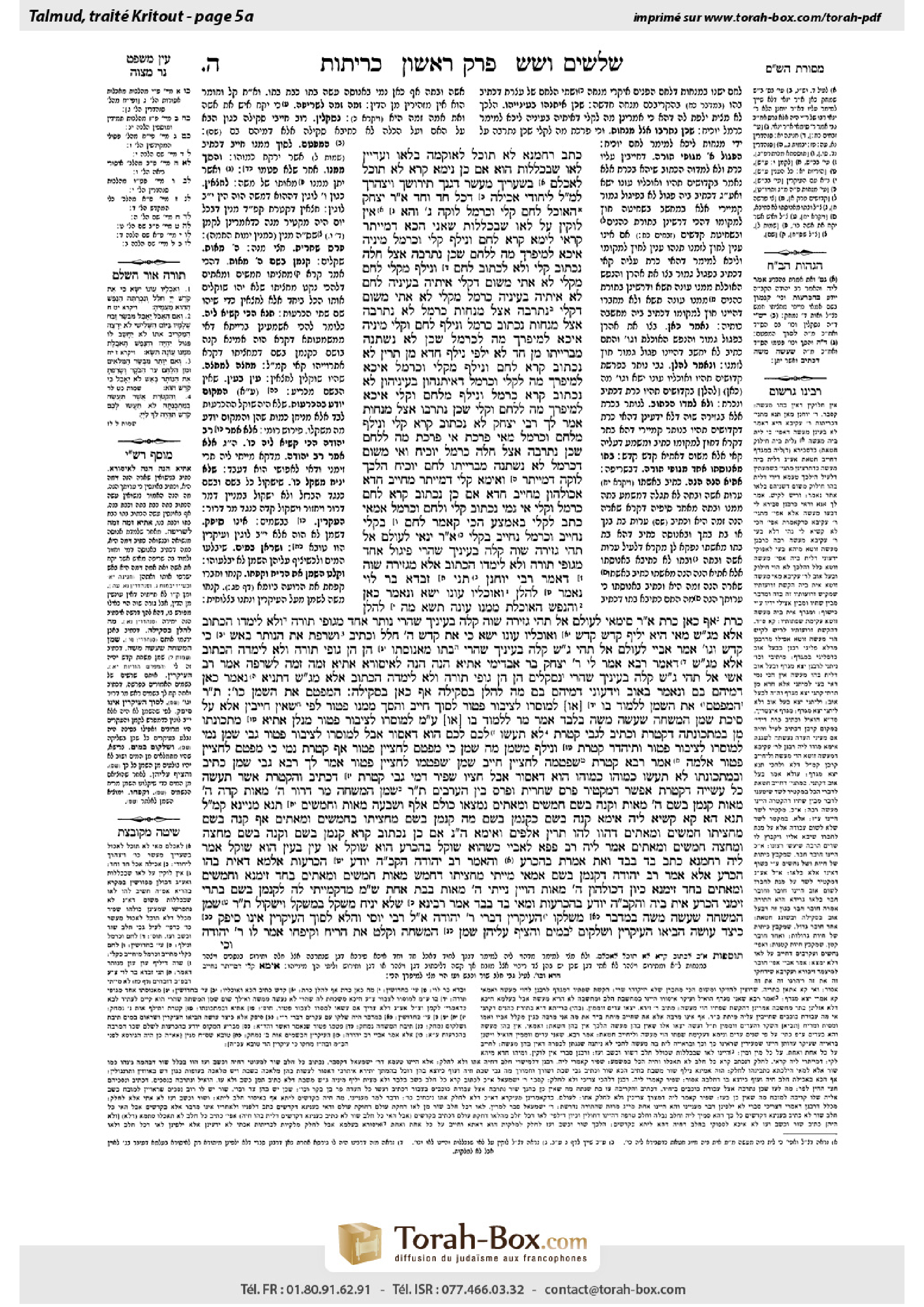
Keritot 5a: Talmud study for Daf Yomi
Daf Yomi is the daily study of one Talmud folio. Explore 37 tractates with scans, Hebrew text, Sefaria English and AI-generated French translations where annotated.
Passage selection and English or AI-generated French translation are available where the scan has annotations. Daf Study is independent of Torah-Box and Sefaria.
Browse Keritot · כריתות · All tractatesKeritot 5a text and translations
This page of Keritot includes the Aramaic text, an English translation and an AI-generated French translation, alongside the scan above.
כריתות ה׳ א · Aramaic and Hebrew text
כְּתַב רַחֲמָנָא: ״לֹא תוּכַל״, לְאוֹקֹמַהּ בְּלָאו.
וַעֲדַיִין, לָאו שֶׁבִּכְלָלוֹת הוּא! אִם כֵּן, נֵימָא קְרָא: ״לֹא תוּכַל לְאׇכְלָם בִּשְׁעָרֶיךָ״, ״מַעְשַׂר דְּגָנְךָ תִּירֹשְׁךָ וְיִצְהָרֶךָ״ לְמָה לִּי? לְיַחוֹדֵי אֲכִילָה דְּכׇל חַד וְחַד.
אָמַר רַבִּי יִצְחָק: הָאוֹכֵל לֶחֶם, קָלִי, וְכַרְמֶל – לוֹקֶה שָׁלֹשׁ. וְהָא אֵין לוֹקִין עַל לָאו שֶׁבִּכְלָלוֹת! שָׁאנֵי הָכָא דִּמְיַיתַּר קְרָאֵי –
לֵימָא קְרָא לֶחֶם, וְנֵילַף קָלִי וְכַרְמֶל מִינֵּיהּ. אִיכָּא לְמִיפְרַךְ: מָה לְלֶחֶם, שֶׁכֵּן נִתְרַבָּה אֵצֶל חַלָּה!
נִכְתּוֹב קָלִי וְלָא לִכְתּוֹב לֶחֶם, וְנֵילַף מִקָּלִי. לֶחֶם מִקָּלִי לָא אָתֵי, מִשּׁוּם דְּקָלֵי אִיתֵיהּ בְּעֵינֵיהּ, לֶחֶם לָא אִיתֵיהּ בְּעֵינֵיהּ. כַּרְמֶל מִקָּלִי לָא אָתֵי, מִשּׁוּם דְּקָלִי נִתְרַבָּה אֵצֶל מְנָחוֹת, כַּרְמֶל לֹא נִתְרַבָּה אֵצֶל מְנָחוֹת!
נִכְתּוֹב כַּרְמֶל וְנֵילַף לֶחֶם וְקָלִי מִינֵּיהּ. אִיכָּא לְמִיפְרַךְ: מָה לְכַרְמֶל שֶׁכֵּן לֹא נִשְׁתַּנָּה מִבְּרִיָּיתוֹ! מִן חַד לָא יָלְפִי, נֵילַף חֲדָא מִן תְּרֵין?
לָא נִכְתּוֹב קְרָא לֶחֶם וְנֵילַף מִקָּלִי וְכַרְמֶל – אִיכָּא לְמִיפְרַךְ: מָה לְקָלִי וְכַרְמֶל דְּאִיתַנְהוֹן בְּעֵינֵיהוֹן! לָא נִכְתּוֹב קְרָא כַּרְמֶל וְנֵילַף מִלֶּחֶם וְקָלִי – אִיכָּא לְמִיפְרַךְ: מָה לְלֶחֶם וְקָלִי שֶׁכֵּן נִתְרַבּוּ אֵצֶל מְנָחוֹת!
אָמַר לָךְ רַבִּי יִצְחָק: לָא נִכְתּוֹב קְרָא קָלִי, וְנֵילַף מִלֶּחֶם וְכַרְמֶל. מַאי פָּרְכַתְּ? אִי פָּרְכַתְּ: מָה לְלֶחֶם, שֶׁכֵּן נִתְרַבָּה אֵצֶל חַלָּה – כַּרְמֶל יוֹכִיחַ! וְאִי מִשּׁוּם דְּכַרְמֶל לֹא נִשְׁתַּנָּה מִבְּרִיָּיתוֹ – לֶחֶם יוֹכִיחַ! הִלְכָּךְ לוֹקֶה, דִּמְיַיתַּר.
וְאֵימָא: קָלִי דִּמְיַיתַּר מִחַיַּיב חֲדָא, אַכּוּלְּהוֹן מִחַיַּיב חֲדָא! אִם כֵּן, נִכְתּוֹב קְרָא: ״לֶחֶם כַּרְמֶל וְקָלִי״, אִי נָמֵי נִכְתּוֹב: ״קָלִי וְלֶחֶם וְכַרְמֶל״, אַמַּאי כְּתַב לְקָלִי בָּאֶמְצַע? הָכִי קָאָמַר: לֶחֶם בְּקָלִי נִחַיַּיב וְכַרְמֶל נִחַיַּיב בְּקָלִי.
אָמַר רַבִּי יַנַּאי: לְעוֹלָם אַל תְּהִי גְּזֵירָה שָׁוָה קַלָּה בְּעֵינֶיךָ, שֶׁהֲרֵי פִּיגּוּל אֶחָד מִגּוּפֵי תוֹרָה, וְלֹא לִימְּדוֹ הַכָּתוּב אֶלָּא מִגְּזֵירָה שָׁוָה.
דְּאָמַר רַבִּי יוֹחָנָן, תָּנֵי זַבְדָּא בַּר לֵוִי: נֶאֱמַר לְהַלָּן: ״וְאוֹכְלָיו עֲוֹנוֹ יִשָּׂא״, וְנֶאֱמַר כָּאן: ״וְהַנֶּפֶשׁ הָאֹכֶלֶת מִמֶּנּוּ עֲוֹנָהּ תִּשָּׂא״, מָה לְהַלָּן כָּרֵת – אַף כָּאן כָּרֵת.
אָמַר רַבִּי סִימַאי: לְעוֹלָם אַל תְּהִי גְּזֵירָה שָׁוָה קַלָּה בְּעֵינֶיךָ, שֶׁהֲרֵי נוֹתָר אֶחָד מִגּוּפֵי תוֹרָה, וְלֹא לִימְּדוֹ הַכָּתוּב אֶלָּא מִגְּזֵירָה שָׁוָה.
מַאי הִיא? יָלֵיף ״קֹדֶשׁ״ ״קֹדֶשׁ״ – ״וְאוֹכְלָיו עֲוֹנוֹ יִשָּׂא כִּי אֶת קֹדֶשׁ ה׳ חִלֵּל״, וּכְתִיב: ״וְשָׂרַפְתָּ אֶת הַנּוֹתָר בָּאֵשׁ כִּי קֹדֶשׁ וְגוֹ׳״
אָמַר אַבָּיֵי: לְעוֹלָם אַל תְּהִי גְּזֵירָה שָׁוָה קַלָּה בְּעֵינֶיךָ, שֶׁהֲרֵי בִּתּוֹ מֵאֲנוּסָתוֹ הֵן הֵן גּוּפֵי תוֹרָה, וְלֹא לִימְּדָהּ הַכָּתוּב אֶלָּא מִגְּזֵירָה שָׁוָה.
דְּאָמַר רָבָא, אֲמַר לִי רַבִּי יִצְחָק בַּר אַבְדִּימִי: אָתְיָא ״הֵנָּה״ ״הֵנָּה״ לְאִיסּוּרָא,
אָתְיָא ״זִמָּה״ ״זִמָּה״ לִשְׂרֵפָה.
אָמַר רַב אָשֵׁי: אַל תְּהִי גְּזֵירָה שָׁוָה קַלָּה בְּעֵינֶיךָ, שֶׁהֲרֵי נִסְקָלִים הֵן הֵן גּוּפֵי תוֹרָה, וְלֹא לִימְּדָהּ הַכָּתוּב אֶלָּא מִגְּזֵירָה שָׁוָה,
דְּתַנְיָא: נֶאֱמַר כָּאן: ״דְּמֵיהֶם בָּם״ וְנֶאֱמַר בְּאוֹב וְיִדְּעוֹנִי: ״דְּמֵיהֶם בָּם״. מָה לְהַלָּן – בִּסְקִילָה, אַף כָּאן – בִּסְקִילָה.
הַמְּפַטֵּם אֶת הַשֶּׁמֶן כּוּ׳. תָּנוּ רַבָּנַן: הַמְּפַטֵּם אֶת הַשֶּׁמֶן לִלְמוֹד בּוֹ, לְמוֹסְרוֹ לַצִּיבּוּר – פָּטוּר, לָסוּךְ – חַיָּיב. וְהַסָּךְ מִמֶּנּוּ – פָּטוּר, לְפִי שֶׁאֵין חַיָּיבִין אֶלָּא עַל סִיכַת שֶׁמֶן הַמִּשְׁחָה שֶׁעָשָׂה מֹשֶׁה בִּלְבַד.
אָמַר מָר: לִלְמוֹד בּוֹ עַל מְנָת לְמוֹסְרוֹ לַצִּיבּוּר – פָּטוּר. מְנָלַן? אַתְיָא ״מַתְכֻּנְתּוֹ״ מִן ״בְּמַתְכּוּנְתָּהּ״ דִּקְטֹרֶת, וּכְתִיב לְגַבֵּי קְטֹרֶת: ״לֹא תַעֲשׂוּ לָכֶם״ – לָכֶם הוּא דְּאָסוּר, אֲבָל לְמוֹסְרוֹ לַצִּיבּוּר – פָּטוּר, גַּבֵּי שֶׁמֶן נָמֵי, לְמוֹסְרוֹ לַצִּיבּוּר – פָּטוּר.
וְתִיהְדַּר קְטֹרֶת וְנֵילַף מִשֶּׁמֶן: מָה שֶׁמֶן כִּי מְפַטֵּם לַחֲצָיִין – פָּטוּר, אַף קְטֹרֶת נָמֵי כִּי מְפַטֵּם לַחֲצָיִין – פָּטוּר! אַלְּמָה אָמַר רָבָא: קְטֹרֶת שֶׁפִּטְּמָהּ לַחֲצָיִין – חַיָּיב, שֶׁמֶן שֶׁפִּטְּמוֹ לַחֲצָיִין – פָּטוּר?
אָמַר לָךְ רָבָא: גַּבֵּי שֶׁמֶן כְּתִיב ״וּבְמַתְכֻּנְתּוֹ לֹא תַעֲשׂוּ כָּמוֹהוּ״ – כָּמוֹהוּ הוּא דְּאָסוּר, אֲבָל חֶצְיוֹ שַׁפִּיר דָּמֵי. גַּבֵּי קְטֹרֶת דִּכְתִיב ״וְהַקְּטֹרֶת אֲשֶׁר תַּעֲשֶׂה״ – כֹּל עֲשִׂיָּיה דִקְטֹרֶת אֶפְשָׁר דְּמַקְטֵיר פְּרָס שַׁחֲרִית וּפְרָס בֵּין הָעַרְבַּיִם.
תָּנוּ רַבָּנַן: שֶׁמֶן הַמִּשְׁחָה מׇר דְּרוֹר חֲמֵשׁ מֵאוֹת, קִדָּה חֲמֵשׁ מֵאוֹת, קִנְּמָן בֶּשֶׂם חֲמֵשׁ מֵאוֹת, וּקְנֵה בֹשֶׂם חֲמִשִּׁים וּמָאתָיִם, נִמְצְאוּ כּוּלָּם אֶלֶף וְשִׁבְעָה מֵאוֹת וַחֲמִשִּׁים.
תַּנָּא מִנְיָינָא קָא מַשְׁמַע לַן? תַּנָּא הָא קָא קַשְׁיָא לֵיהּ, אֵימָא: קְנֵה בֹשֶׂם כְּקִנְּמׇן בֶּשֶׂם, מָה קִנְּמׇן בֶּשֶׂם מַחֲצִיתוֹ בַּחֲמִשִּׁים וּמָאתַיִם – אַף קְנֵה בֹשֶׂם מַחֲצִיתוֹ חֲמִשִּׁים וּמָאתָיִם, דְּהָווּ לְהוּ תְּרֵין אֲלָפִים.
וְאֵימָא הָכִי נָמֵי! אִם כֵּן, נִכְתּוֹב קְרָא: ״קִנְּמׇן בֶּשֶׂם וּקְנֵה בֹשֶׂם מֶחֱצָה וּמֶחֱצָה חֲמִשִּׁים וּמָאתַיִם״.
אֲמַר לֵיהּ רַב פָּפָּא לְאַבָּיֵי: כְּשֶׁהוּא שׁוֹקֵל, בְּהֶכְרֵעַ הוּא שׁוֹקֵל, אוֹ עַיִן בְּעַיִן הוּא שׁוֹקֵל? אֲמַר לֵיהּ: רַחֲמָנָא כְּתַב: ״בַּד בְּבַד״, וְאַתְּ אָמְרַתְּ בְּהֶכְרֵעַ? וְהָאָמַר רַב יְהוּדָה: הַקָּדוֹשׁ בָּרוּךְ הוּא יוֹדֵעַ הַכְרָעוֹת, אַלְמָא דְּאִית בְּהוּ הֶכְרֵעַ!
אֶלָּא, אָמַר רַב יְהוּדָה: דְּקִנְּמׇן בֶּשֶׂם אַמַּאי מַיְיתֵי מַחֲצִיתוֹ דַּחֲמֵשׁ מֵאוֹת, חֲמִשִּׁים וּמָאתַיִם בְּחַד זִימְנָא וַחֲמִשִּׁים וּמָאתַיִם בְּחַד זִימְנָא? כֵּיוָן דְּכוּלְּהוֹן חֲמֵשׁ מֵאוֹת הָוַיִין, נַיְיתֵי חֲמֵשׁ מֵאוֹת בְּבַת אַחַת! שְׁמַע מִינַּהּ, מִדְּקָמַיְיתֵי לַהּ לְקִנְּמׇן בֶּשֶׂם בִּתְרֵי זִימְנֵי, הֶכְרֵעַ אִית בֵּיהּ, וְהַקָּדוֹשׁ בָּרוּךְ הוּא יוֹדֵעַ בְּהֶכְרֵעוֹת.
וּמַאי ״בַּד בְּבַד״? אָמַר רָבִינָא: שֶׁלֹּא יַנִּיחַ מִשְׁקָל בְּמִשְׁקָל וְיִשְׁקוֹל.
תָּנוּ רַבָּנַן: שֶׁמֶן הַמִּשְׁחָה שֶׁעָשָׂה מֹשֶׁה בְמִדְבַּר – מְשַׁלְּקוֹ הָעִיקָּרִין, דִּבְרֵי רַבִּי יְהוּדָה. אָמַר לוֹ רַבִּי יוֹסֵי: וַהֲלֹא לָסוּךְ הָעִיקָּרִין אֵינוֹ סִיפֵּק! כֵּיצַד עוֹשֶׂה? הֵבִיאוּ הָעִיקָּרִין וּשְׁלָקוּם בְּמַיִם, וְהֵצִיף עֲלֵיהֶן שֶׁמֶן הַמִּשְׁחָה, וְקָלַט אֶת הָרֵיחַ, וְקִיפְּחוֹ.
אָמַר לוֹ רַבִּי יְהוּדָה:
Keritot 5a · English translation
reason that the Merciful One writes: “You may not eat” (Deuteronomy 12:17), to establish the consumption of second-tithe produce outside Jerusalem as a prohibition.
The Gemara challenges: But still, it is a general prohibition, as all three types of second tithe are included in a single command. The Gemara explains: If so, that one receives only one set of lashes, let the verse say: You may not eat them within your gates, as a previous verse already stated “your tithes” (Deuteronomy 12:11). Why do I need the verse to specify: “The tithe of your grain, of your wine, and of your oil”? This serves to designate a prohibition and the punishment of lashes for the consumption of each and every type of produce.
§ Rabbi Yitzḥak says: One who eats bread, parched grain, and fresh stalks before the omer offering has been sacrificed is flogged with three sets of lashes, as it states: “And you shall eat neither bread, nor parched grain, nor fresh stalks until this day itself, until you have brought the offering of your God; it is a statute forever throughout your generations in all your dwellings” (Leviticus 23:14). The Gemara raises a difficulty: But one is not flogged for transgressing a general prohibition. The Gemara answers: It is different here, as the verses are superfluous; the verse did not need to specify these three types of grain products.
The Gemara tries to ascertain which terms are superfluous. Let the verse say “bread,” and we will derive the halakha of parched grain and fresh stalks from that of bread. The Gemara questions this suggestion: This derivation can be refuted: What is unique about bread? It is unique in that it has an increased obligation with regard to ḥalla, which is separated only from the dough of bread, not from parched grain and fresh stalks not made into dough.
The Gemara further suggests: Let the verse write only “parched grain,” and let it not write bread or fresh stalks, and we will derive the halakha of bread and fresh stalks from that of parched grain. The Gemara responds: The halakha of bread cannot be derived from that of parched grain due to the fact that parched grain is in its unadulterated form, whereas bread is not in its unadulterated form, i.e., it has been fully processed, and therefore it can be maintained that only produce that has not been changed is prohibited before the omer. Likewise, the halakha of fresh stalks cannot be derived from that of parched grain due to the fact that parched grain has an increased obligation with regard to meal offerings, as the omer meal offering is of parched grain, whereas fresh stalks do not have an increased obligation with regard to meal offerings.
The Gemara further suggests: Let the verse write only “fresh stalks,” and we will derive the halakha of bread and parched grain from that of fresh stalks. The Gemara responds: This derivation can be refuted: What is unique about fresh stalks? They are unique in that they have not changed from their original state at all. The Gemara states: Clearly, the halakha of two of these types cannot be derived from the halakha of any one of the others. But let us derive the halakha of one of them from the halakha of the other two.
The Gemara elaborates: Let the verse not write bread, and let us derive its halakha from that of parched grain and fresh stalks. The Gemara responds: This derivation can be refuted: What is unique about parched grain and fresh stalks? They are unique in that relative to bread, which has been fully processed, they are in their unadulterated form. The Gemara suggests: Let the verse not write fresh stalks, and let us derive its halakha from the halakha of bread and parched grain. The Gemara responds: This derivation can be refuted: What is unique about bread and parched grain? They are unique in that they have an increased obligation with regard to meal offerings.
The Gemara explains that Rabbi Yitzḥak could say to you: Let the verse not write parched grain, and let us derive its halakha from the halakha of bread and fresh stalks. What would you say to refute this? If you refute it by saying: What is unique about bread? It is unique in that it has an increased obligation with regard to ḥalla, the example of fresh stalks will prove that this is not a decisive factor, as the obligation of ḥalla does not apply to it and yet it is prohibited before the omer. And if you would refute the derivation due to the fact that fresh stalks differ from parched grain, as they have not changed from their original state, the case of bread will prove that this is not the key factor, as it has changed from its original state and yet it is prohibited. Therefore, one is flogged for each type, as the verse is superfluous.
The Gemara objects: But why not say that for the consumption of parched grain, whose mention is superfluous, one is separately liable to receive one set of lashes, whereas for eating all the rest of them, i.e., bread and fresh stalks, one is liable to be flogged with only one set of lashes, as they are prohibited by a general prohibition? The Gemara explains: If so, and the halakha of parched grain is unique, let the verse write: Bread, fresh stalks, and parched grain; alternatively, let it write: Parched grain, bread, and fresh stalks. Why does it write the example of parched grain in between the others? This is what the verse is saying: One who eats bread is liable to receive the punishment given for eating parched grain, and likewise one who eats fresh stalks is liable to receive the punishment given for eating parched grain.
§ Rabbi Yannai says: A verbal analogy should never be lightly regarded in your eyes, as the fact that one is punished with karet for consuming meat of an offering that was sacrificed with the intent to consume it after its appointed time [piggul] is one of the fundamental principles of the Torah, and the verse taught it only through a verbal analogy.
The Gemara explains that this is as Rabbi Yoḥanan says that Zavda bar Levi teaches: It is stated there, with regard to meat of an offering left over after the appointed time for its consumption [notar]: “But everyone who eats it shall bear his iniquity” (Leviticus 19:8), and it is stated here, with regard to intent to consume an offering after its appointed time: “And the soul that eats it shall bear his iniquity” (Leviticus 7:18). Just as there the punishment for eating notar is karet, so too here, the punishment for eating piggul is karet.
Rabbi Simai says: A verbal analogy should never be lightly regarded in your eyes, as the fact that one is punished with karet for consuming notar, from which it is derived that one is punished with karet for partaking of piggul, is one of the fundamental principles of the Torah, and the verse taught it only through a verbal analogy.
What is this verbal analogy? One derives by verbal analogy of the word “sacred” in Leviticus and the word “sacred” in Exodus that the verse: “But everyone who eats it shall bear his iniquity,” is discussing notar. This verse states: “But everyone who eats it shall bear his iniquity, because he has profaned the sacred thing of the Lord” (Leviticus 19:8), and it is written: “You shall burn the leftovers [notar] in fire; they are not to be eaten, for they are sacred” (Exodus 29:34). Just as the verse in Exodus is referring to notar, the same is true of the verse in Leviticus.
Abaye says: A verbal analogy should never be lightly regarded in your eyes, as the fact that one is punished with karet for engaging in intercourse with one’s daughter born from the woman he raped is one of the fundamental principles of the Torah, and the verse taught it only through a verbal analogy.
Abaye elaborates: This is as Rava says: Rabbi Yitzḥak bar Avdimi said to me that this halakha is derived by a verbal analogy between the unusual form “they [henna]” and “they [henna],” written with regard to the prohibition against engaging in intercourse with one’s daughter born from the woman he raped. As it is written: “The nakedness of a woman and her daughter…you shall not take her son’s daughter, or her daughter’s daughter, to uncover her nakedness: They [henna] are near kinswomen” (Leviticus 18:17). And it is stated: “The nakedness of your son’s daughter, or of your daughter’s daughter; for they [henna] are your own nakedness” (Leviticus 18:10). This latter verse is interpreted as referring to one’s granddaughter from the woman he raped (see Yevamot 97a). The verbal analogy teaches that although one’s daughter from the woman he raped is not mentioned in the verse, she too is included with one’s granddaughter, just as a daughter and a granddaughter are equated in Leviticus 18:17.
Furthermore, the punishment for this transgression of intercourse with one’s daughter from the woman he raped is derived from a verbal analogy between: “It is lewdness” (Leviticus 18:17), which is written with regard to engaging in intercourse with both a woman and her daughter, and the same term “lewdness” that appears elsewhere, which teaches that the transgressor is liable to be put to death by burning. As it is stated: “And if a man take with his wife also her mother, it is lewdness; they shall be burnt with fire, both he and they” (Leviticus 20:14). This teaches that death by burning is the punishment for engaging in intercourse with both a woman and her daughter, and the same applies to intercourse with one’s daughter from the woman he raped, due to the verbal analogy of henna and henna linking the two cases.
Rav Ashi says: A verbal analogy should not be lightly regarded in your eyes, as the list of those who are liable to be put to death by stoning is one of the fundamental principles of the Torah, and the verse taught it only through a verbal analogy.
This is as it is taught in a baraita that it is stated here, with regard to engaging in intercourse with specific relatives: “Their blood shall be upon them” (Leviticus 20:11–16), and it is stated with regard to a necromancer and a sorcerer: “Their blood shall be upon them” (Leviticus 20:27). Just as there, the verse specifies that a necromancer and a sorcerer are executed by stoning, so too here, with regard to one who engages in intercourse with those relatives, they are executed by stoning.
§ The mishna’s list of prohibitions for whose unwitting violation one must bring a sin offering includes one who blends the anointing oil according to the specifications of the oil prepared by Moses in the wilderness (see Exodus 30:22–33). The Sages taught in a baraita: One who blends the anointing oil to learn how it was prepared or to transfer it to the community for them to use in the Temple is exempt. But if he blends the anointing oil in order to apply it to his body he is liable. And one who applies to his body the oil prepared by another is exempt, because he is liable for applying the oil to his body only if he uses the anointing oil that was prepared by Moses alone, in accordance with the verse: “Or whoever puts any of it upon a stranger” (Exodus 30:33), which is referring to that specific oil.
The Master said earlier: One who blends the anointing oil to learn how it was prepared or in order to transfer it to the community for them to use in the Temple is exempt. The Gemara asks: From where do we derive this? The Gemara answers: This is derived via a verbal analogy from the term: “Its composition” (Exodus 30:32), written with regard to the oil and the term: “According to its composition” (Exodus 30:37), written with regard to the incense. And it is written with regard to the incense in that verse: “You shall not prepare for yourselves,” from which it is inferred that it is incense prepared for yourselves that is prohibited, but if one prepares it to transfer it to the community he is exempt. With regard to the anointing oil as well, one who blends it to transfer it to the community is exempt.
The Gemara objects: But in light of this verbal analogy, let the case of incense return and let us derive it from that of the anointing oil: Just as with regard to the anointing oil, when one blends it in halves, i.e., not all the specified amount at once, he is exempt, so too, with regard to the incense, when one blends it in halves he should be exempt. Why, then, does Rava say: In the case of incense that one blended in halves, he is liable, whereas with regard to anointing oil that one blended in halves, he is exempt?
The Gemara answers that Rava could say to you: With regard to the anointing oil it is written: “Neither shall you prepare any like it according to its composition” (Exodus 30:32), which indicates that it is oil prepared precisely like it that is prohibited, but with regard to preparing half of it, one may well do so. By contrast, with regard to incense, as it is written: “And the incense that you shall prepare, according to its composition you shall not prepare for yourselves” (Exodus 30:37), which teaches that any act of preparing of this incense is prohibited, as it is possible to burn a portion, half of the maneh that must be prepared, in the morning, and a portion in the afternoon.
§ The Sages taught in a baraita: The anointing oil contains pure myrrh weighing 500 shekels, cassia of 500 shekels, aromatic cinnamon of 500 shekels, and aromatic calamus of 250 shekels. It is found that all of them together amount to 1,750 shekels.
The Gemara expresses surprise at the statement of the baraita: Does the tanna come to teach us the tally? Why is it necessary for the baraita to state the sum of the amounts? The Gemara answers that this is difficult for the tanna: Since the verse states: “And of aromatic cinnamon half so much, two hundred and fifty, and of aromatic calamus two hundred and fifty” (Exodus 30:23), one might say that the weight of aromatic calamus is like that of aromatic cinnamon: Just as half of the amount of aromatic cinnamon is two hundred and fifty, so too, the verse means that half of the amount of aromatic calamus is two hundred and fifty, which would mean that the sum total is two thousand.
The Gemara asks: But why not say that it is indeed so, that the total weight of calamus is five hundred? The Gemara answers: If so, let the verse write: And of aromatic cinnamon and of aromatic calamus half so much and half so much, two hundred and fifty. The fact that the verse employs the term “half so much” only with regard to cinnamon indicates that their weights were different.
Rav Pappa said to Abaye: When one weighs these substances, does he weigh the ingredients with a slight surplus, so that they tip the scales, or does he weigh the ingredients with precision? Abaye said to him that the Merciful One writes: “Of each there shall be a like weight” (Exodus 30:34), which indicates a precise measure, and you say it is possible that one weighs the ingredients with a surplus? The Gemara raises a difficulty: But doesn’t Rabbi Yehuda say: The Holy One, Blessed be He, knows the amount of surpluses that should be added. Evidently, there is a surplus involved in these measures.
Rather, one certainly weighs with a surplus, and this is what Rav Yehuda says: With regard to aromatic cinnamon, why does one bring half of its total of five hundred, i.e., two hundred and fifty at one time, and two hundred and fifty at one time? Since its entire amount is five hundred, let him bring five hundred all at once. Conclude from the fact that one brings aromatic cinnamon at two separate times that there is a surplus involved in this measure, i.e., one must add a little each time he weighs the cinnamon, and the Holy One, Blessed be He, knows the amount of surpluses.
The Gemara asks: But according to Rav Yehuda’s opinion, what is the meaning of the phrase: “Of each there shall be a like weight”? Ravina said: It means that one should not place a weight of one ingredient against the weight of another ingredient and weigh in this manner. In other words, after weighing one of the ingredients one may not weigh another ingredient against that one; rather, each ingredient must be weighed independently against the scales.
The Sages taught in a baraita: How did they prepare the anointing oil that Moses prepared in the wilderness? They would cook the roots of the spices in it; this is the statement of Rabbi Yehuda. Rabbi Yosei said to him: But that amount of oil is not sufficient even to apply to the roots, as they would absorb the oil; how, then, could the roots be cooked in it? Instead, how did they act? They brought the roots and boiled them in water and the fragrant substance would rise to the top, and one poured the anointing oil on the water, and the oil would absorb the fragrance and retain it, and later he removed the oil [vekipeḥo] from off the top and place it in its flask. This is how the anointing oil was prepared.
Rabbi Yehuda said to Rabbi Yosei:
Keritot 5a · Traduction française (IA)
la raison pour laquelle le Tout-Puissant écrit : « Tu ne mangeras pas » (Deutéronome 12:17), afin d'établir la consommation des produits de la seconde dîme en dehors de Jérusalem comme une interdiction.
La Guemara objecte : Mais il s'agit néanmoins d'une interdiction générale, car les trois types de seconde dîme sont inclus dans un seul commandement. La Guemara explique : Si c'était le cas, et que l'on ne reçoive qu'un seul lot de coups de fouet, que le verset dise : Tu ne les mangeras pas dans tes portes, car un verset précédent a déjà mentionné « tes dîmes » (Deutéronome 12:11). Pourquoi ai-je besoin que le verset précise : « La dîme de ton blé, de ton vin et de ton huile » ? Cela sert à désigner une interdiction et la punition des coups de fouet pour la consommation de chaque type de produit.
§ Rabbi Yitzḥak dit : Celui qui mange du pain, du grain grillé et des épis frais avant que l'offrande de l'omer n'ait été sacrifiée est fouetté de trois lots de coups, car il est écrit : « Vous ne mangerez ni pain, ni grain grillé, ni épis frais, jusqu'à ce jour même, jusqu'à ce que vous ayez apporté l'offrande de votre Dieu ; c'est une loi perpétuelle pour vos générations dans toutes vos demeures » (Lévitique 23:14). La Guemara soulève une difficulté : Mais on n'est pas fouetté pour avoir transgressé une interdiction générale. La Guemara répond : C'est différent ici, car les versets sont superflus ; le verset n'avait pas besoin de préciser ces trois types de produits céréaliers.
La Guemara tente de déterminer quels termes sont superflus. Que le verset dise « pain », et nous déduirons la halakha du grain grillé et des épis frais de celle du pain. La Guemara questionne cette suggestion : Cette déduction peut être réfutée : Qu'est-ce qui est unique au pain ? Il est unique en ce qu'il a une obligation accrue concernant la ḥalla, qui est séparée uniquement de la pâte du pain, et non du grain grillé et des épis frais non transformés en pâte.
La Guemara suggère davantage : Que le verset n'écrive que « grain grillé », et qu'il n'écrive ni pain ni épis frais, et nous déduirons la halakha du pain et des épis frais de celle du grain grillé. La Guemara répond : La halakha du pain ne peut pas être déduite de celle du grain grillé en raison du fait que le grain grillé est dans sa forme non altérée, tandis que le pain n'est pas dans sa forme non altérée, c'est-à-dire qu'il a été entièrement transformé, et par conséquent, on peut soutenir que seuls les produits qui n'ont pas été modifiés sont interdits avant l'omer. De même, la halakha des épis frais ne peut pas être déduite de celle du grain grillé en raison du fait que le grain grillé a une obligation accrue concernant les offrandes de farine, car l'offrande de farine de l'omer est de grain grillé, tandis que les épis frais n'ont pas d'obligation accrue concernant les offrandes de farine.
La Guemara suggère davantage : Que le verset n'écrive que « épis frais », et nous déduirons la halakha du pain et du grain grillé de celle des épis frais. La Guemara répond : Cette déduction peut être réfutée : Qu'est-ce qui est unique aux épis frais ? Ils sont uniques en ce qu'ils n'ont pas changé de leur état d'origine du tout. La Guemara déclare : Évidemment, la halakha de deux de ces types ne peut pas être déduite de la halakha de l'un des autres. Mais déduisons la halakha de l'un d'eux de la halakha des deux autres.
La Guemara développe : Que le verset ne mentionne pas le pain, et que nous déduisions sa halakha de celle du grain grillé et des épis frais. La Guemara répond : Cette déduction peut être réfutée : Qu'est-ce qui est unique au grain grillé et aux épis frais ? Ils sont uniques en ce qu'au regard du pain, qui a été entièrement transformé, ils sont dans leur forme non altérée. La Guemara suggère : Que le verset ne mentionne pas les épis frais, et que nous déduisions sa halakha de la halakha du pain et du grain grillé. La Guemara répond : Cette déduction peut être réfutée : Qu'est-ce qui est unique au pain et au grain grillé ? Ils sont uniques en ce qu'ils ont une obligation accrue concernant les offrandes de farine.
La Guemara explique que Rabbi Yitzḥak pourrait vous dire : Que le verset ne mentionne pas le grain grillé, et que nous déduisions sa halakha de la halakha du pain et des épis frais. Que diriez-vous pour réfuter cela ? Si vous le réfutez en disant : Qu'est-ce qui est unique au pain ? Il est unique en ce qu'il a une obligation accrue concernant la ḥalla, l'exemple des épis frais prouvera que ce n'est pas un facteur déterminant, car l'obligation de la ḥalla ne s'applique pas à eux et pourtant ils sont interdits avant l'omer. Et si vous réfutiez la déduction en raison du fait que les épis frais diffèrent du grain grillé, car ils n'ont pas changé de leur état d'origine, le cas du pain prouvera que ce n'est pas le facteur clé, car il a changé de son état d'origine et pourtant il est interdit. Par conséquent, on est fouetté pour chaque type, car le verset est superflu.
La Guemara objecte : Mais pourquoi ne pas dire que pour la consommation de grain grillé, dont la mention est superflue, on est séparément passible d'un lot de coups de fouet, tandis que pour manger le reste, c'est-à-dire le pain et les épis frais, on n'est passible que d'un seul lot de coups de fouet, car ils sont interdits par une interdiction générale ? La Guemara explique : Si c'était le cas, et que la halakha du grain grillé soit unique, que le verset écrive : Pain, épis frais, et grain grillé ; ou bien, qu'il écrive : Grain grillé, pain, et épis frais. Pourquoi écrit-il l'exemple du grain grillé entre les autres ? C'est ce que le verset dit : Celui qui mange du pain est passible de la punition donnée pour manger du grain grillé, et de même, celui qui mange des épis frais est passible de la punition donnée pour manger du grain grillé.
§ Rabbi Yannai dit : Une analogie verbale ne devrait jamais être considérée à la légère à vos yeux, car le fait que l'on soit puni par la karet pour consommer la viande d'une offrande qui a été sacrifiée avec l'intention de la consommer après son temps prescrit [piggul] est l'un des principes fondamentaux de la Torah, et le verset l'a enseigné uniquement par une analogie verbale.
La Guemara explique que c'est ainsi que Rabbi Yoḥanan dit que Zavda bar Levi enseigne : Il est écrit là, à propos de la chair d'une offrande laissée après le temps prescrit pour sa consommation [notar] : « Mais quiconque en mangera portera son iniquité » (Lévitique 19:8), et il est écrit ici, à propos de l'intention de consommer une offrande après le temps prescrit : « Et l'âme qui en mangera portera son iniquité » (Lévitique 7:18). De même qu'il y a, la punition pour manger du notar est la karet, de même ici, la punition pour manger du piggul est la karet.
Rabbi Simaï dit : Il ne faut jamais négliger une analogie verbale, car le fait qu'on soit puni de la karet pour consommer du notar, d'où il est déduit qu'on est puni de la karet pour consommer du piggul, est l'un des principes fondamentaux de la Torah, et le verset ne l'a enseigné que par une analogie verbale.
Quelle est cette analogie verbale ? On déduit par analogie verbale entre le mot « saint » dans Lévitique et le mot « saint » dans Exode que le verset : « Mais quiconque en mangera portera son iniquité », concerne le notar. Ce verset dit : « Mais quiconque en mangera portera son iniquité, parce qu'il a profané la chose sainte de l'Éternel » (Lévitique 19:8), et il est écrit : « Vous brûlerez les restes [notar] au feu ; ils ne seront pas mangés, car ils sont saints » (Exode 29:34). De même que le verset dans Exode se réfère au notar, il en est de même du verset dans Lévitique.
Abaye dit : Il ne faut jamais négliger une analogie verbale, car le fait qu'on soit puni de la karet pour avoir des rapports avec sa fille née de la femme qu'il a violée est l'un des principes fondamentaux de la Torah, et le verset ne l'a enseigné que par une analogie verbale.
Abaye précise : C'est ainsi que Rava l'enseigne : Rabbi Yitzḥak bar Avdimi m'a dit que cette halakha est déduite par une analogie verbale entre la forme inhabituelle « elles [henna] » et « elles [henna] », écrite à propos de l'interdiction d'avoir des rapports avec sa fille née de la femme qu'il a violée. Car il est écrit : « La nudité d'une femme et de sa fille… tu ne prendras pas la fille de son fils, ni la fille de sa fille, pour découvrir sa nudité : Elles [henna] sont parentes proches » (Lévitique 18:17). Et il est dit : « La nudité de la fille de ton fils, ou de la fille de ta fille ; car elles [henna] sont ta propre nudité » (Lévitique 18:10). Ce dernier verset est interprété comme se référant à sa petite-fille née de la femme qu'il a violée (voir Yevamot 97a). L'analogie verbale enseigne que bien que sa fille née de la femme qu'il a violée ne soit pas mentionnée dans le verset, elle est également incluse avec sa petite-fille, de même qu'une fille et une petite-fille sont équivalues dans Lévitique 18:17.
De plus, la punition pour cette transgression de rapports avec sa fille née de la femme qu'il a violée est déduite d'une analogie verbale entre : « C'est une abomination » (Lévitique 18:17), qui est écrit à propos d'avoir des rapports avec une femme et sa fille, et le même terme « abomination » qui apparaît ailleurs, qui enseigne que le transgresseur est passible de la mort par le feu. Car il est dit : « Et si un homme prend avec sa femme aussi sa mère, c'est une abomination ; ils seront brûlés au feu, lui et elles » (Lévitique 20:14). Cela enseigne que la mort par le feu est la punition pour avoir des rapports avec une femme et sa fille, et il en est de même pour les rapports avec sa fille née de la femme qu'il a violée, en raison de l'analogie verbale de henna et henna qui relie les deux cas.
Rav Ashi dit : Une analogie verbale ne doit pas être négligée à vos yeux, car la liste de ceux qui sont passibles de la lapidation est l'un des principes fondamentaux de la Torah, et le verset ne l'a enseignée que par une analogie verbale.
C'est ainsi qu'il est enseigné dans une baraïta : Il est écrit ici, à propos de rapports sexuels avec certains proches : « Leur sang sera sur eux » (Lévitique 20:11–16), et il est écrit à propos d'un nécromancien et d'un sorcier : « Leur sang sera sur eux » (Lévitique 20:27). De même qu'il y a, le verset précise qu'un nécromancien et un sorcier sont exécutés par lapidation, de même ici, à propos de celui qui a des rapports sexuels avec ces proches, ils sont exécutés par lapidation.
§ La liste des interdictions de la Michna, dont la violation involontaire oblige à offrir un sacrifice expiatoire, inclut celui qui prépare l'huile d'onction selon les spécifications de l'huile préparée par Moïse dans le désert (voir Exode 30:22–33). Les Sages ont enseigné dans une baraïta : Celui qui prépare l'huile d'onction pour apprendre comment elle était préparée ou pour la transmettre à la communauté afin qu'elle l'utilise dans le Temple est exempt. Mais s'il prépare l'huile d'onction afin de l'appliquer sur son corps, il est passible. Et celui qui applique sur son corps l'huile préparée par un autre est exempt, car il n'est passible d'appliquer l'huile sur son corps que s'il utilise l'huile d'onction qui a été préparée par Moïse seul, conformément au verset : « Ou quiconque en mettra sur un étranger » (Exode 30:33), qui se réfère à cette huile spécifique.
Le Maître a dit plus tôt : Celui qui mélange l'huile d'onction pour apprendre comment elle était préparée, ou afin de la transmettre à la communauté pour qu'elle l'utilise dans le Temple, est exempt. La Guemara demande : D'où déduisons-nous cela ? La Guemara répond : Cela est déduit par une analogie verbale entre le terme « Sa composition » (Exode 30:32), écrit à propos de l'huile, et le terme « Selon sa composition » (Exode 30:37), écrit à propos de l'encens. Et il est écrit à propos de l'encens dans ce verset : « Vous ne préparerez pas pour vous-mêmes », d'où il est déduit que c'est l'encens préparé pour vous-mêmes qui est interdit, mais si on le prépare pour le transmettre à la communauté, on est exempt. De même pour l'huile d'onction, celui qui la mélange pour la transmettre à la communauté est exempt.
La Guemara objecte : Mais à la lumière de cette analogie verbale, ne devrait-on pas retourner au cas de l'encens et le déduire de celui de l'huile d'onction ? De même qu'en ce qui concerne l'huile d'onction, lorsqu'on la mélange par moitié, c'est-à-dire non pas toute la quantité prescrite d'un seul coup, on est exempt, de même, en ce qui concerne l'encens, lorsqu'on le mélange par moitié, on devrait être exempt. Pourquoi donc Rava dit-il : Dans le cas de l'encens que l'on a mélangé par moitié, on est responsable, tandis qu'en ce qui concerne l'huile d'onction que l'on a mélangée par moitié, on est exempt ?
La Guemara répond que Rava pourrait vous dire : En ce qui concerne l'huile d'onction, il est écrit : « Vous ne préparerez point non plus d'autre semblable à celle-ci, selon sa composition » (Exode 30:32), ce qui indique que c'est l'huile préparée exactement comme elle qui est interdite, mais en ce qui concerne la préparation de la moitié, on peut le faire. En revanche, en ce qui concerne l'encens, comme il est écrit : « Et l'encens que vous préparerez, selon sa composition vous ne le préparerez point pour vous » (Exode 30:37), ce qui enseigne que tout acte de préparation de cet encens est interdit, car il est possible de brûler une portion, la moitié du maneh qui doit être préparé, le matin, et une portion l'après-midi.
§ Les Sages ont enseigné dans une baraïta : L'huile d'onction contient de la myrrhe pure pesant 500 shekels, de la casse de 500 shekels, de la cannelle aromatique de 500 shekels, et du calamus aromatique de 250 shekels. Il s'avère que tous ensemble, ils représentent 1 750 shekels.
La Guemara s'étonne de la déclaration de la baraïta : Le tanna vient-il nous enseigner le décompte ? Pourquoi est-il nécessaire que la baraïta énonce la somme des quantités ? La Guemara répond que c'est difficile pour le tanna : Puisque le verset dit : « Et de la cannelle aromatique la moitié de cette quantité, deux cent cinquante, et du calamus aromatique deux cent cinquante » (Exode 30:23), on pourrait dire que le poids du calamus aromatique est comme celui de la cannelle aromatique : De même que la moitié de la quantité de cannelle aromatique est de deux cent cinquante, de même, le verset signifie que la moitié de la quantité de calamus aromatique est de deux cent cinquante, ce qui signifierait que le total est de deux mille.
La Guemara demande : Mais pourquoi ne pas dire que c'est bien ainsi, que le poids total du calamus est de cinq cents ? La Guemara répond : Si c'était le cas, que le verset écrive : Et de la cannelle aromatique et du calamus aromatique, la moitié de cette quantité et la moitié de cette quantité, deux cent cinquante. Le fait que le verset emploie le terme « la moitié de cette quantité » uniquement en ce qui concerne la cannelle indique que leurs poids étaient différents.
Rav Pappa dit à Abaye : Lorsqu'on pèse ces substances, pèse-t-on les ingrédients avec un léger excédent, de sorte qu'ils fassent pencher la balance, ou pèse-t-on les ingrédients avec précision ? Abaye lui répondit que le Tout-Puissant écrit : « De chacun il y aura un poids égal » (Exode 30:34), ce qui indique une mesure précise, et vous dites qu'il est possible que l'on pèse les ingrédients avec un excédent ? La Guemara soulève une difficulté : Mais Rabbi Yehouda ne dit-il pas : Le Saint, béni soit-Il, connaît la quantité d'excédents qui doivent être ajoutés. Évidemment, il y a un excédent impliqué dans ces mesures.
Plutôt, on pèse certainement avec un excédent, et c'est ce que Rav Yehouda dit : En ce qui concerne la cannelle aromatique, pourquoi apporte-t-on la moitié de son total de cinq cents, c'est-à-dire deux cent cinquante d'un coup, et deux cent cinquante d'un coup ? Puisque sa quantité totale est de cinq cents, qu'il apporte cinq cents d'un seul coup. Concluez du fait que l'on apporte la cannelle aromatique à deux moments séparés qu'il y a un excédent impliqué dans cette mesure, c'est-à-dire qu'il faut ajouter un peu chaque fois qu'on pèse la cannelle, et le Saint, béni soit-Il, connaît la quantité d'excédents.
La Guemara demande : Mais selon l'opinion de Rav Yehouda, quelle est la signification de la phrase : « De chacun il y aura un poids égal » ? Ravina a dit : Cela signifie qu'on ne doit pas placer le poids d'un ingrédient contre le poids d'un autre ingrédient pour peser de cette manière. En d'autres termes, après avoir pesé l'un des ingrédients, on ne peut pas peser un autre ingrédient par rapport à celui-ci ; plutôt, chaque ingrédient doit être pesé indépendamment sur la balance.
Les Sages ont enseigné dans une baraïta : Comment préparaient-ils l'huile d'onction que Moïse a préparée dans le désert ? Ils faisaient cuire les racines des épices dedans ; c'est l'opinion de Rabbi Yehouda. Rabbi Yosse lui a dit : Mais cette quantité d'huile n'est pas suffisante même pour l'appliquer aux racines, car elles absorbent l'huile ; comment donc les racines pouvaient-elles être cuites dedans ? Au lieu de cela, comment agissaient-ils ? Ils apportaient les racines et les faisaient bouillir dans l'eau, et la substance parfumée montait à la surface, et l'on versait l'huile d'onction sur l'eau, et l'huile absorbait le parfum et le retenait, et plus tard on retirait l'huile [vekipeḥo] de la surface et on la plaçait dans son flacon. C'est ainsi que l'huile d'onction était préparée.
Rabbi Yehouda a dit à Rabbi Yosse :
Traduction française générée par IA à partir de l’édition anglaise de Sefaria. Vérifie toujours un passage avec le texte source.
Text from Sefaria: William Davidson Edition - Vocalized Aramaic (CC BY NC); William Davidson Edition - English (CC BY NC).