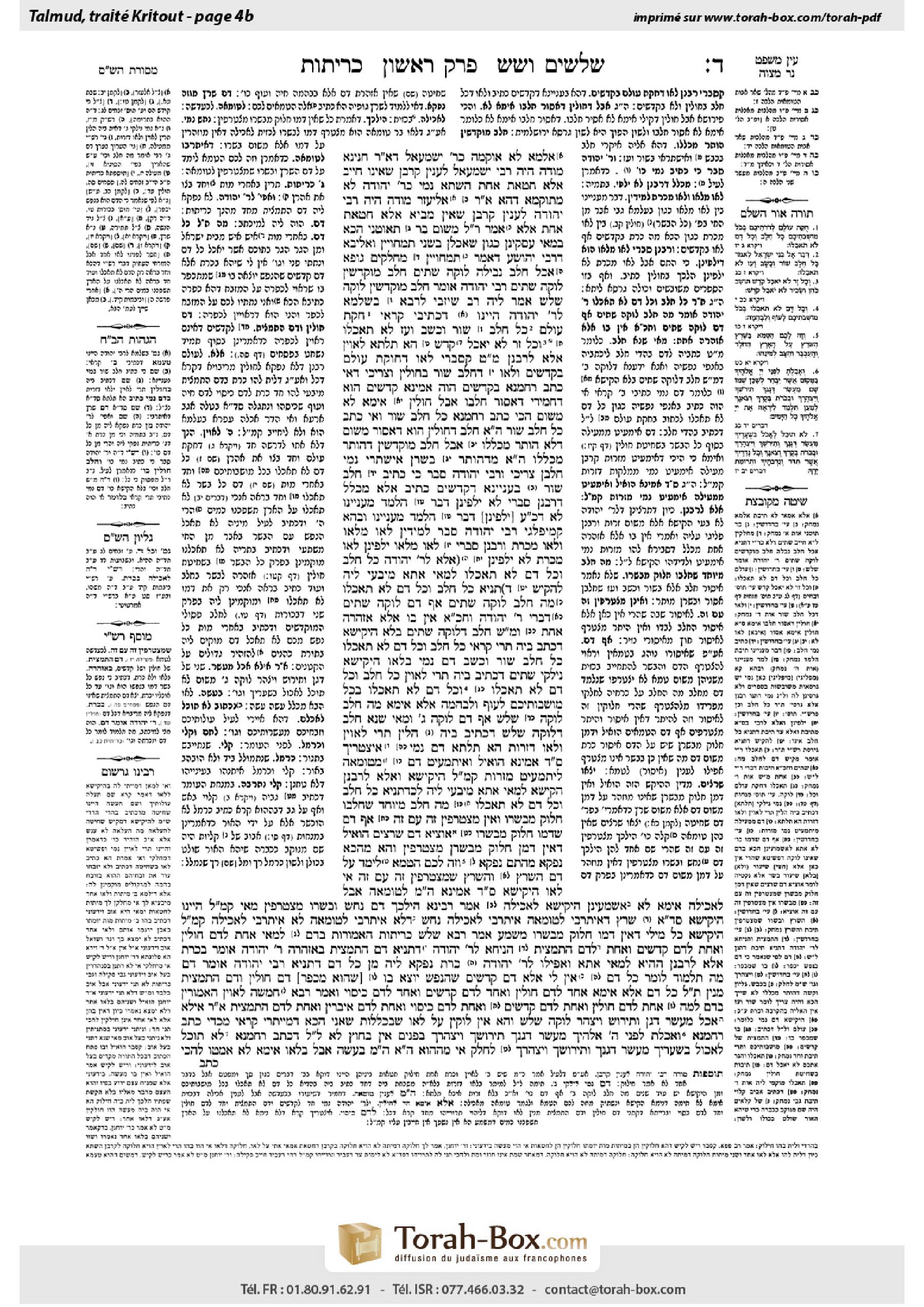
Keritot 4b: Talmud study for Daf Yomi
Daf Yomi is the daily study of one Talmud folio. Explore 37 tractates with scans, Hebrew text, Sefaria English and AI-generated French translations where annotated.
Passage selection and English or AI-generated French translation are available where the scan has annotations. Daf Study is independent of Torah-Box and Sefaria.
Browse Keritot · כריתות · All tractatesKeritot 4b text and translations
This page of Keritot includes the Aramaic text, an English translation and an AI-generated French translation, alongside the scan above.
כריתות ד׳ ב · Aramaic and Hebrew text
אַלְמָא לָא אוֹקְמַהּ כְּרַבִּי יִשְׁמָעֵאל, דְּאָמַר רַבִּי חֲנִינָא: מוֹדֶה הָיָה רַבִּי יִשְׁמָעֵאל לְעִנְיַן קׇרְבָּן שֶׁאֵינוֹ חַיָּיב אֶלָּא חַטָּאת אַחַת, הַשְׁתָּא נָמֵי כְּרַבִּי יְהוּדָה לָא מִתּוֹקְמָא, דְּהָא אָמַר רַבִּי אֱלִיעֶזֶר: מוֹדֶה הָיָה רַבִּי יְהוּדָה לְעִנְיַן קׇרְבָּן שֶׁאֵין מֵבִיא אֶלָּא חַטָּאת אַחַת!
אֶלָּא אָמַר רֵישׁ לָקִישׁ מִשּׁוּם בַּר תּאוּטֵנִי: הָכָא בְּמַאי עָסְקִינַן – כְּגוֹן שֶׁאֲכָלָן בִּשְׁנֵי תַמְחוּיִין, וְאַלִּיבָּא דְּרַבִּי יְהוֹשֻׁעַ, דְּאָמַר: תַּמְחוּיִין מְחַלְּקִים.
גּוּפָא: אָכַל חֵלֶב נְבֵילָה – לוֹקֶה שְׁתַּיִם, חֵלֶב מוּקְדָּשִׁין – לוֹקֶה שְׁתַּיִם, רַבִּי יְהוּדָה אוֹמֵר: חֵלֶב מוּקְדָּשִׁין – לוֹקֶה שָׁלֹשׁ.
אֲמַר לֵיהּ רַב שֵׁיזְבִי לְרָבָא: בִּשְׁלָמָא לְרַבִּי יְהוּדָה, הַיְינוּ דִּכְתִיבִי קְרָאֵי: ״חֻקַּת עוֹלָם״. ״כׇּל חֵלֶב שׁוֹר וְכֶשֶׂב וָעֵז לֹא תֹאכֵלוּ״, ״וְכׇל זָר לֹא יֹאכַל קֹדֶשׁ״ – הָא תְּלָתָא לָאוִין. אֶלָּא לְרַבָּנַן, מַאי טַעְמַיְיהוּ?
קָסָבְרִי: לָאו דְּ״חֻקַּת עוֹלָם״ בְּקָדָשִׁים, וְלָאו דְּ״חֵלֶב שׁוֹר״ בְּחוּלִּין. וּצְרִיכִי,
דְּאִי כְּתַב רַחֲמָנָא בְּקָדָשִׁים, הֲוָה אָמֵינָא: קָדָשִׁים הוּא דַּחֲמִירִי, דְּאָסוּר חֶלְבּוֹ, אֲבָל חוּלִּין – אֵימָא לָא, מִשּׁוּם הָכִי כְּתַב רַחֲמָנָא: ״כׇּל חֵלֶב שׁוֹר״.
וְאִי כְּתַב: ״כׇּל חֵלֶב שׁוֹר״, הֲוָה אָמֵינָא: חֵלֶב דְחוּלִּין הוּא דְּאָסוּר מִשּׁוּם דְּלֹא הוּתַּר מִכְּלָלוֹ, אֲבָל חֵלֶב מוּקְדָּשִׁין דְּהוּתַּר מִכְּלָלוֹ, הֲוָה אָמֵינָא: מִדְּהוּתַּר בְּשָׂרָן אִישְׁתְּרִי נָמֵי חֶלְבָּן, צְרִיכִי.
וְרַבִּי יְהוּדָה סָבַר: כִּי כְּתִיב ״חֵלֶב שׁוֹר״, בָּעִנְיָינָא דְקָדָשִׁים כְּתִיב.
אֶלָּא מִכְּלָל דְּרַבָּנַן סָבְרִי: לָא יָלְפִינַן דָּבָר הַלָּמֵד מֵעִנְיָינוֹ?
לָא, דְּכוּלֵּי עָלְמָא דָּבָר הַלָּמֵד מֵעִנְיָינוֹ, וּבְהָא קָמִיפַּלְגִי, רַבִּי יְהוּדָה סָבַר: לְמֵידִין לָאו מִלָּאו וְלָאו מִכָּרֵת, וְרַבָּנַן סָבְרִי: לָאו מִלָּאו יָלְפִינַן, לָאו מִכָּרֵת לָא יָלְפִינַן.
אֶלָּא לְרַבִּי יְהוּדָה, ״כׇּל חֵלֶב וְכׇל דָּם לֹא תֹאכֵלוּ״, לְמַאי אֲתָא? מִיבְּעֵי לֵיהּ לְהַקִּישׁ, דְּתַנְיָא: ״כׇּל חֵלֶב וְכׇל דָּם לֹא תֹאכֵלוּ״, מָה חֵלֶב לוֹקֶה שְׁתַּיִם – אַף דָּם לוֹקֶה שְׁתַּיִם, דִּבְרֵי רַבִּי יְהוּדָה. וַחֲכָמִים אוֹמְרִים: אֵין בּוֹ אֶלָּא אַזְהָרָה אֶחָת.
וּמַאי שְׁנָא חֵלֶב דְּלוֹקֶה שְׁתַּיִם בְּלָא הֶיקֵּישָׁא, דִּכְתַב בֵּיהּ תְּרֵי קְרָאֵי ״כׇּל חֵלֶב וְכׇל דָּם לֹא תֹאכֵלוּ״, ״כׇּל חֵלֶב שׁוֹר וְכֶשֶׂב״? דָּם נָמֵי בְּלָאו הֶיקֵּישָׁא נִילְקֵי שְׁתַּיִם, דִּכְתִיב בֵּיהּ תְּרֵי לָאוִין ״כׇּל חֵלֶב וְכׇל דָּם לֹא תֹאכֵלוּ״, ״וְכׇל דָּם לֹא תֹאכְלוּ בְּכֹל מוֹשְׁבֹתֵיכֶם לָעוֹף וְלַבְּהֵמָה״!
אֶלָּא אֵימָא: מָה חֵלֶב לוֹקֶה שָׁלֹשׁ, אַף דָּם לוֹקֶה שָׁלֹשׁ.
וּמַאי שְׁנָא חֵלֶב דְּלוֹקֶה שָׁלֹשׁ? דִּכְתִיב בֵּיהּ הָלֵין תְּרֵי לָאוִין וְלָאו דְּזָרוּת – הָא תְּלָתָא? דָּם נָמֵי!
אִיצְטְרִיךְ, סָלְקָא דַּעְתָּךְ אָמֵינָא: הוֹאִיל וְאִיתְמְעִיט דָּם מִטּוּמְאָה – לִיתְמְעִיט מִזָּרוּת, קָא מַשְׁמַע לַן הֶיקֵּישָׁא.
וְאֶלָּא לְרַבָּנַן, הֶקֵּישָׁא לְמַאי אֲתָא?
מִיבְּעֵי לֵיהּ לְכִדְתַנְיָא: ״כׇּל חֵלֶב וְכׇל דָּם לֹא תֹאכֵלוּ״, מָה חֵלֶב מְיוּחָד שֶׁחֶלְבּוֹ חָלוּק מִבְּשָׂרוֹ, וְאֵין מִצְטָרְפִין זֶה עִם זֶה – אַף דָּם, שֶׁדָּמוֹ חָלוּק מִבְּשָׂרוֹ.
אוֹצִיא דַּם שְׁרָצִים, הוֹאִיל דְּאֵין דָּמָן חָלוּק מִבְּשָׂרָן – מִצְטָרְפִין.
וְהָא מֵהָכָא נָפְקָא? מֵהָתָם נָפְקָא: ״וְזֶה לָכֶם הַטָּמֵא״ – לִימֵּד עַל דַּם הַשֶּׁרֶץ וְהַשֶּׁרֶץ שֶׁמִּצְטָרְפִין זֶה עִם זֶה!
אִי לָאו הֶיקֵּישָׁא, סָלְקָא דַּעְתָּךְ אָמֵינָא: הָנֵי מִילֵּי לְטוּמְאָה, אֲבָל לַאֲכִילָה – אֵימָא לָא, אַשְׁמְעִינַן הֶיקֵּישָׁא לַאֲכִילָה.
אָמַר רָבִינָא: הִילְכָּךְ, דַּם נָחָשׁ וּבְשָׂרוֹ מִצְטָרְפִין. מַאי קָא מַשְׁמַע לַן? הַיְינוּ הֶיקֵּישָׁא! סָלְקָא דַּעְתָּךְ אָמֵינָא: שֶׁרֶץ, דְּאִיתְרַבִּי לְטוּמְאָה – אִיתְרַבִּי לַאֲכִילָה. נָחָשׁ, דְּלָא אִיתְרַבִּי לְטוּמְאָה – לָא אִיתְרַבִּי לַאֲכִילָה, קָא מַשְׁמַע לַן הֶיקֵּישָׁא: כׇּל מִילֵּי דְּאֵין דָּמוֹ חָלוּק מִבְּשָׂרוֹ מַשְׁמַע.
אָמַר רָבָא: שָׁלֹשׁ כָּרֵיתוֹת הָאֲמוּרוֹת בַּדָּם. לְמַאי? אַחַת לְדַם חוּלִּין, וְאַחַת לְדַם קָדָשִׁים, וְאַחַת לְדַם הַתַּמְצִית.
הָנִיחָא לְרַבִּי יְהוּדָה, דְּתַנְיָא: דַּם הַתַּמְצִית בְּאַזְהָרָה, רַבִּי יְהוּדָה אוֹמֵר: בְּכָרֵת.
אֶלָּא לְרַבָּנַן, הַהִיא לְמַאי אֲתָא? וַאֲפִילּוּ לְרַבִּי יְהוּדָה, כָּרֵת נָפְקָא לֵיהּ מִן ״כׇּל דָּם״!
דְּתַנְיָא: רַבִּי יְהוּדָה אוֹמֵר: ״דָּם״, מָה תַּלְמוּד לוֹמַר ״כׇּל דָּם״?
אֵין לִי אֶלָּא דַּם קָדָשִׁים שֶׁהַנֶּפֶשׁ יוֹצֵא בּוֹ, דַּם חוּלִּין וְדַם הַתַּמְצִית, מִנַּיִן? תַּלְמוּד לוֹמַר: ״כׇּל דָּם״!
אֶלָּא אֵימָא: אֶחָד לְדַם חוּלִּין, וְאֶחָד לְדַם קָדָשִׁים, וְאֶחָד לְדַם כִּיסּוּי.
וְאָמַר רָבָא: חֲמִשָּׁה לָאוִין הָאֲמוּרִין בְּדָם לָמָּה? אַחַת לְדַם חוּלִּין, וְאַחַת לְדַם קָדָשִׁים, וְאַחַת לְדַם כִּיסּוּי, וְאַחַת לְדַם אֵיבָרִין, וְאַחַת לְדַם הַתַּמְצִית.
אָמַר רַבִּי אִילָא: אָכַל מַעֲשֵׂר דָּגָן וְתִירוֹשׁ וְיִצְהָר – לוֹקֶה שָׁלֹשׁ. וְהָא אֵין לוֹקִין עַל לָאו שֶׁבִּכְלָלוֹת! שָׁאנֵי הָכָא, דִּמְיַיתְּרִי קְרָאֵי –
מִכְּדִי כְּתַב רַחֲמָנָא: ״וְאָכַלְתָּ לִפְנֵי ה׳ אֱלֹהֶיךָ מַעְשַׂר דְּגָנְךָ תִּירֹשְׁךָ וְיִצְהָרֶךָ״, בִּפְנִים – אִין, בַּחוּץ – לָא, לְמָה לִי דִּכְתַב רַחֲמָנָא: ״לֹא תוּכַל לֶאֱכֹל בִּשְׁעָרֶיךָ מַעְשַׂר דְּגָנְךָ וְתִירֹשְׁךָ וְיִצְהָרֶךָ״? לְחַלֵּק.
אִי מֵהָהוּא, הֲוָה אָמֵינָא: הָנֵי מִילֵּי בַּעֲשֵׂה, אֲבָל בְּלָאו אֵימָא לָא, אַמְּטוּ לְהָכִי
Keritot 4b · English translation
Why does one not interpret the baraita in accordance with the opinion of Rabbi Yishmael? The reason is as Rabbi Ḥanina says: Although Rabbi Yishmael maintains that one who eats the fat of an ox, a sheep, and a goat is liable to receive a separate set of lashes for each one, he would concede with regard to bringing an offering that if he ate those types of forbidden fat in a single lapse of awareness he is liable to bring only one sin offering. Now too, the baraita should not be interpreted in accordance with the opinion of Rabbi Yehuda, as doesn’t Rabbi Eliezer say: Rabbi Yehuda would concede with regard to bringing an offering that if one ate forbidden fat of sacrificial animals he brings only one sin offering?
Rather, Reish Lakish said in the name of the Sage bar Ta’utni: What are we dealing with here, where one is liable to bring two sin offerings for eating forbidden fat of two categories? We are dealing with a case in which he ate the forbidden fat from two dishes, i.e., where each part was prepared in a different manner, and this is in accordance with the opinion of Rabbi Yehoshua, who says that dishes serve to separate the acts of eating. One who eats forbidden food from two different dishes in the course of a single lapse of awareness is considered to have transgressed two prohibitions and is liable to bring a sin offering for each one.
§ The Gemara returns to discuss the matter itself: If one ate forbidden fat of an animal carcass he is flogged with two sets of lashes for transgressing the prohibitions of eating forbidden fat and consuming an animal carcass. If he ate forbidden fat of sacrificial animals, he is flogged with two sets of lashes, for both eating forbidden fat and transgressing the prohibition forbidding a non-priest to partake of sacrificial animals. Rabbi Yehuda says: If one ate forbidden fat of sacrificial animals, he is flogged with three sets of lashes.
Rav Sheizevi said to Rava: Granted, according to the opinion of Rabbi Yehuda, this is the meaning of the three verses that are written: “It shall be a perpetual statute throughout your generations in all your dwellings, that you shall eat neither fat nor blood” (Leviticus 3:17); “You shall eat no fat, of ox, or sheep, or goat” (Leviticus 7:23); “And no non-priest shall partake of the sacred food” (Leviticus 22:10), as these are three prohibitions, two for eating forbidden fat of sacrificial animals, as the two verses that mention fat are discussing sacrificial animals, and one for the prohibition forbidding a non-priest to partake of consecrated food. But according to the opinion of the Rabbis, what is their reasoning? Why is one liable to receive only two sets of lashes?
The Gemara answers: The Rabbis maintain that the prohibition of: “It shall be a perpetual statute,” was stated with regard to sacrificial animals, but the prohibition of: “You shall eat no fat of ox,” was stated with regard to non-sacred animals. Therefore, if one ate forbidden fat of sacrificial animals he is liable to receive only two sets of lashes. And both verses are necessary, as one could not have been derived from the other.
As, had the Merciful One written the prohibition against eating forbidden fat only with regard to sacrificial animals I would say: It is only in the case of sacrificial animals, whose prohibitions are generally stringent, that their fat is forbidden. But with regard to non-sacred animals one might say their fat is not forbidden. It is due to that reason that the Merciful One writes: “You shall eat no fat of ox.”
And by contrast, had the Merciful One written only: “You shall eat no fat of ox,” I would say: It is only the fat of non-sacred animals that is forbidden, since there are no circumstances in which its general prohibition was permitted, i.e., those fats of domesticated animals are always forbidden. But with regard to sacrificial animals, whose general prohibition was permitted in certain circumstances, i.e., with regard to the rest of its meat after the blood has been sprinkled, I would say that from the fact that their meat was permitted, their fat was permitted as well. Therefore, both verses are necessary, in order to teach that the prohibition against eating forbidden fat applies equally to sacrificial animals and non-sacred animals.
And Rabbi Yehuda maintains that when it is written: “You shall eat no fat of ox,” it is also written with regard to the matter of sacrificial animals, as it is stated after the prohibition against eating forbidden fat: “For whoever eats the fat of the animal, of which men present an offering of fire to the Lord, even the soul that eats it shall be cut off from his people” (Leviticus 7:25), and this is derived by employing the hermeneutical principle: A matter is derived from its context.
The Gemara raises a difficulty: But can one conclude from here by inference that the Rabbis maintain we do not derive halakhot by employing the hermeneutical principle of: A matter is derived from its context? This cannot be correct, as it is an accepted, basic principle of exegesis.
The Gemara answers: No; everyone agrees we do derive halakhot by employing the hermeneutical principle of: A matter is derived from its context. And it is about this issue that they disagree: Rabbi Yehuda maintains that we derive the halakhot of one prohibition from the halakhot of another prohibition, and we derive the halakhot of a prohibition from the punishment of karet, and therefore he derives that the prohibition: “You shall eat no fat of ox,” is also written with regard to sacrificial animals from the nearby verse concerning karet, which is referring to sacrificial animals. And the Rabbis maintain that generally we derive the halakhot of one prohibition from the halakhot of another prohibition, but we do not derive the halakhot of a prohibition from the punishment of karet, and one is liable to receive karet for eating forbidden fat of sacrificial animals.
The Gemara asks: But if so, then according to Rabbi Yehuda, for what purpose does the verse: “It shall be a perpetual statute throughout your generations in all your dwellings, that you shall eat neither fat nor blood” (Leviticus 3:17), come? After all, he has already derived the prohibition against eating the forbidden fat of sacrificial animals from the verse: “You shall eat no fat of ox.” The Gemara answers: He requires it to juxtapose the prohibition against consuming blood to the prohibition against eating forbidden fat. As it is taught in a baraita: “You shall eat neither fat nor blood,” which teaches that just as for eating forbidden fat one is flogged with two sets of lashes, so too, for eating blood one is flogged with two sets of lashes. This is the statement of Rabbi Yehuda. And the Rabbis say: Only one prohibition applies to blood.
The Gemara asks: Why is the juxtaposition necessary according to Rabbi Yehuda? And what is different about forbidden fat that the baraita states that one who eats it is flogged with two sets of lashes even without needing to derive the double punishment from a juxtaposition? The reason must be that two verses are written with regard to it: “You shall eat neither fat nor blood,” and: “You shall eat no fat of ox or sheep.” With regard to blood as well, even without deriving the halakha from a juxtaposition, one who consumes it should be flogged with two sets of lashes, as two prohibitions are written with regard to it: “You shall eat neither fat nor blood,” and the verse: “And you shall eat no manner of blood, whether it is of fowl or of animal, in any of your dwellings” (Leviticus 7:26).
Rather, say that the baraita states the following: The juxtaposition teaches that just as for eating forbidden fat one is flogged with three sets of lashes, two for eating forbidden fat of sacrificial animals and one for the prohibition of a non-priest partaking of sacrificial food, from the verse: “And no non-priest shall partake of the sacred food” (Leviticus 22:10), so too, for eating blood one is flogged with three sets of lashes.
The Gemara again asks: And what is different about forbidden fat that it is obvious that one who eats it is flogged with three sets of lashes? The reason must be that these two prohibitions are written with regard to it, and there is also the prohibition of a non-priest partaking of consecrated food, as explained earlier, which totals three. The same can be said with regard to blood as well: The two verses stated above, together with the prohibition of a non-priest partaking of consecrated food, likewise render one liable to receive three sets of lashes. If so, the juxtaposition is unnecessary.
The Gemara answers: The juxtaposition was necessary, as it might enter your mind to say: Since blood is excluded from the halakha of ritual impurity, as one who consumes the blood of sacrificial animals in a state of ritual impurity has not transgressed the prohibition against consuming sacrificial food while impure, let it also be excluded from the prohibition of consumption as a non-priest. To counter this, Rabbi Yehuda teaches us that it is derived from the juxtaposition that one receives three sets of lashes for consuming the blood of sacrificial animals, including for transgressing the prohibition of a non-priest.
The Gemara asks: But according to the Rabbis, who maintain that only one prohibition applies to the consumption of the blood of sacrificial animals and that one is not liable to receive lashes for partaking of it as a non-priest, for what purpose does this juxtaposition come?
The Gemara answers that they require it for that which is taught in a baraita: The verse states: “You shall eat neither fat nor blood,” which teaches that just as forbidden fat is unique in that the fat of the animal is discrete from its flesh, i.e., the fat is forbidden and the flesh is permitted, and therefore they do not combine with each other, i.e., if one ate half an olive-bulk of forbidden fat and half an olive-bulk of permitted meat he is not liable for eating an olive-bulk of forbidden food, so too, the prohibition concerning blood does not combine with the flesh of non-kosher animals to constitute the volume of an olive-bulk in the case of an animal whose blood is discrete from its flesh, as the penalty of karet applies only to the animal’s blood, whereas its flesh is prohibited by a standard prohibition.
The baraita continues: Accordingly, I will exclude from this halakha the blood of the carcasses of creeping animals, since their blood is not discrete from their flesh, i.e., no separate prohibition applies to the blood of creeping animals, and consequently their flesh and blood combine with each other to form the volume of an olive-bulk of a creeping animal.
The Gemara asks: But is this halakha derived from here, i.e., from the derivation from the verse: “You shall eat neither fat nor blood”? It is derived from there, from a different verse, as it is taught in a baraita: The verse states: “And these are they that are impure for you among the creeping animals” (Leviticus 11:29). This teaches with regard to the blood of one of the eight creeping animals listed in the Torah and the flesh of the creeping animal, that they combine with each other to constitute the minimum volume.
The Gemara answers: If not for the juxtaposition, it might enter your mind to say this statement applies with regard to ritual impurity, that the blood of one of the creeping animals listed in the Torah and its flesh combine with each other to constitute the lentil-bulk measure required to impart impurity. But with regard to consumption, one might say they do not combine with each other. Therefore, the juxtaposition teaches us that they combine even with regard to consumption.
Ravina said: Therefore, the blood of a snake and its flesh combine with each other to constitute the volume of an olive-bulk. The Gemara asks: What is Ravina teaching us? This is exactly the derivation from the juxtaposition. The Gemara explains: It might enter your mind to say that with regard to a creeping animal, whose blood is included with regard to ritual impurity, it is also included with regard to consumption; whereas a snake, whose blood is not included with regard to ritual impurity, as it is not one of the eight creeping animals that are ritually impure (see Leviticus 11:29–30), is not included with regard to consumption. Therefore, the juxtaposition teaches us that every item whose blood is not discrete from its flesh is included in the derivation that its blood and flesh combine with each other.
§ Rava says: Concerning the three mentions of karet that are stated with regard to blood (Leviticus 7:27, 17:10, 17:14), about what types of blood do they teach? One is for the blood of non-sacred animals, one is for the blood of sacrificial animals, and one is for the blood of exudate, i.e., which exudes from the neck of the animal after the initial spurt of its slaughter.
The Gemara comments: This works out well according to the opinion of Rabbi Yehuda, as it is taught in a baraita: There is a prohibition stated with regard to the blood of exudate, but one is not punished with karet for consuming it. This is not as severe as consuming regular blood, for which one is liable to receive karet. Rabbi Yehuda says: One is liable to receive karet for the blood of exudate, as this blood is regarded as full-fledged blood.
The Gemara continues: But according to the opinion of the Rabbis, who say there is no punishment of karet for consuming blood of exudate, for what purpose does that third mention of karet concerning blood come? The Gemara adds: And even according to the opinion of Rabbi Yehuda, he derives the karet that one receives for this blood from a different source, from the superfluous phrase: “Who eats any manner of blood” (Leviticus 17:10).
As it is taught in a baraita concerning the verse: “And whatever man there be of the house of Israel, or of the strangers that sojourn among them, that eats any manner of blood, I will set My face against that soul that eats blood, and will cut him off from among his people” (Leviticus 17:10), that Rabbi Yehuda says: The verse could have stated in the first part of the verse: That eats blood. What is the meaning when the verse states there: “That eats any manner of blood”?
I have derived only the punishment of karet concerning the blood of sacrificial animals with regard to which the soul of the animal leaves the body when it emerges, as atonement is achieved through this blood, and the next verse states: “For the life of the flesh is in the blood, and I have given it to you upon the altar to make atonement for your souls” (Leviticus 17:11). Rabbi Yehuda continues: From where do I derive that the same punishment of karet applies to the blood of a non-sacred animal and the blood of exudate? The verse states: “Any manner of blood.” Rava’s statement, that the punishment of karet for consuming blood of exudate is derived from a different verse, does not accord with the opinion of Rabbi Yehuda either.
Rather, say that this is what Rava means: One mention of karet is for the blood of non-sacred animals, and one is for the blood of sacrificial animals, and one is for the blood of covering, i.e., the blood of an undomesticated animal or a bird, with regard to which there is a mitzva to cover their blood (see Leviticus 17:13).
And Rava further says: Why are there five prohibitions stated with regard to blood (Leviticus 3:17, 7:26, 17:14; Deuteronomy 12:16–23)? One is for the blood of non-sacred animals, and one is for the blood of sacrificial animals, and one is for the blood of covering, and one is for the blood left in the limbs of the animal, and one is for the blood of exudate.
§ Rabbi Illa says: If one ate outside Jerusalem the second tithe of grain, wine, and oil, he is flogged with three sets of lashes (see Deuteronomy 12:17). The Gemara raises a difficulty: But one is not flogged for transgressing a general prohibition. The prohibition concerning consuming second tithe outside Jerusalem is a general one, as it includes all of these categories. The Gemara explains: It is different here, as the verses are superfluous.
The Gemara elaborates: Since the Merciful One writes: “And you shall eat before the Lord your God, in the place where He shall choose to cause His name to dwell there, the tithe of your grain, of your wine, and of your oil” (Deuteronomy 14:23), from which it is derived that inside the chosen place, Jerusalem, yes, one may eat second tithe, but outside Jerusalem, no, one may not eat second tithe; why do I need the Merciful One to write: “You may not eat within your gates the tithe of your grain, or of your wine, or of your oil” (Deuteronomy 12:17)? This verse serves to separate the prohibitions concerning tithes, to teach that one is separately liable to receive lashes for consuming each type of produce.
The Gemara refutes this proof: If the halakha were derived only from that verse, i.e., “And you shall eat before the Lord your God,” I would say this statement applies only to the extent that there is a prohibition derived by inference from a positive mitzva, for which one does not receive lashes, as it has the status of a positive mitzva. But one might say that one does not transgress a prohibition. It is due to this
Keritot 4b · Traduction française (IA)
Pourquoi n’interprète-t-on pas la baraïta conformément à l’opinion de Rabbi Yishmael ? C’est pour la raison qu’expose Rabbi Ḥanina : bien que Rabbi Yishmael soutienne que celui qui mange le suif d’un bœuf, d’un mouton et d’une chèvre est passible d’une série distincte de coups de fouet pour chacun, il reconnaîtrait, s’agissant d’apporter un sacrifice, que s’il a mangé ces sortes de suif interdit lors d’une seule inadvertance, il n’est tenu d’apporter qu’un seul sacrifice expiatoire. De même, la baraïta ne devrait pas être interprétée conformément à l’opinion de Rabbi Yehuda, puisque Rabbi Eliezer ne dit-il pas que Rabbi Yehuda reconnaîtrait, s’agissant d’apporter un sacrifice, que si quelqu’un a mangé du suif interdit d’animaux consacrés, il n’apporte qu’un seul sacrifice expiatoire ?
Reish Lakish a plutôt dit au nom du Sage bar Ta’utni : De quel cas s’agit-il ici, où l’on est tenu d’apporter deux sacrifices expiatoires pour avoir mangé du suif interdit de deux catégories ? Il s’agit du cas où il a mangé le suif interdit dans deux plats, c’est-à-dire que chaque partie avait été préparée différemment ; cela correspond à l’opinion de Rabbi Yehoshua, qui dit que les plats séparent les actes de consommation. Celui qui mange des aliments interdits provenant de deux plats différents au cours d’une seule inadvertance est considéré comme ayant transgressé deux interdits et doit apporter un sacrifice expiatoire pour chacun.
§ La Guemara revient au sujet lui-même : si quelqu’un a mangé du suif interdit provenant d’une carcasse, il reçoit deux séries de coups de fouet pour avoir transgressé les interdits de manger du suif interdit et de consommer une carcasse. S’il a mangé du suif interdit d’animaux consacrés, il reçoit deux séries de coups de fouet : l’une pour avoir mangé du suif interdit et l’autre pour avoir transgressé l’interdit qui défend à un non-prêtre de consommer des aliments consacrés. Rabbi Yehuda dit : si quelqu’un a mangé du suif interdit d’animaux consacrés, il reçoit trois séries de coups de fouet.
Rav Sheizevi dit à Rava : Certes, selon l’opinion de Rabbi Yehuda, voici le sens des trois versets qui sont écrits : « Ce sera une loi perpétuelle pour vos générations, dans tous vos lieux d’habitation : vous ne mangerez ni suif ni sang » (Lévitique 3:17) ; « Vous ne mangerez aucun suif de bœuf, de mouton ou de chèvre » (Lévitique 7:23) ; « Aucun non-prêtre ne mangera d’aliment consacré » (Lévitique 22:10). Il s’agit de trois interdits : deux concernant la consommation du suif interdit d’animaux consacrés, puisque les deux versets qui mentionnent le suif parlent d’animaux consacrés, et un concernant l’interdit fait à un non-prêtre de consommer des aliments consacrés. Mais, selon l’opinion des Rabbins, quel est leur raisonnement ? Pourquoi n’est-on passible que de deux séries de coups de fouet ?
La Guemara répond : Les Rabbins soutiennent que l’interdit « Ce sera une loi perpétuelle » concerne les animaux consacrés, tandis que l’interdit « Vous ne mangerez aucun suif de bœuf » concerne les animaux non consacrés. Par conséquent, si quelqu’un a mangé du suif interdit d’animaux consacrés, il n’est passible que de deux séries de coups de fouet. Les deux versets sont nécessaires, car aucun ne pourrait être déduit de l’autre.
En effet, si le Miséricordieux avait écrit l’interdit de manger du suif interdit uniquement au sujet des animaux consacrés, j’aurais dit que leur suif est interdit seulement dans le cas des animaux consacrés, dont les interdits sont généralement rigoureux. Mais, au sujet des animaux non consacrés, on aurait pu dire que leur suif n’est pas interdit. C’est pour cette raison que le Miséricordieux écrit : « Vous ne mangerez aucun suif de bœuf ».
À l’inverse, si le Miséricordieux avait écrit uniquement : « Vous ne mangerez aucun suif de bœuf », j’aurais dit que seul le suif des animaux non consacrés est interdit, puisque l’interdit général qui le concerne n’est jamais levé, c’est-à-dire que le suif de ces animaux domestiques est toujours interdit. Mais, au sujet des animaux consacrés, dont l’interdit général est levé dans certaines circonstances — à savoir pour le reste de leur viande après l’aspersion du sang —, j’aurais dit que, puisque leur viande est permise, leur suif l’est également. Les deux versets sont donc nécessaires pour enseigner que l’interdit de manger du suif interdit s’applique aussi bien aux animaux consacrés qu’aux animaux non consacrés.
Et Rabbi Yehuda soutient que le verset « Vous ne mangerez aucun suif de bœuf » concerne également les animaux consacrés, comme le montre le verset qui suit l’interdit de manger du suif interdit : « Quiconque mangera du suif d’un animal dont on présente une offrande consumée par le feu à l’Éternel, cette personne qui en mangera sera retranchée de son peuple » (Lévitique 7:25). Cela se déduit au moyen du principe herméneutique selon lequel une loi s’interprète à partir de son contexte.
La Guemara soulève une difficulté : peut-on donc conclure de là que les Rabbins soutiennent qu’on ne déduit pas de halakhot au moyen du principe herméneutique selon lequel une loi s’interprète à partir de son contexte ? Cela ne saurait être exact, car il s’agit d’un principe exégétique fondamentalement admis.
La Guemara répond : Non ; tous conviennent qu’on déduit des halakhot au moyen du principe herméneutique selon lequel une loi s’interprète à partir de son contexte. Leur désaccord porte sur ce point : Rabbi Yehuda soutient qu’on déduit les halakhot d’un interdit de celles d’un autre interdit, ainsi que les halakhot d’un interdit de la peine de karet. Il déduit donc du verset voisin concernant le karet, qui parle des animaux consacrés, que l’interdit « Vous ne mangerez aucun suif de bœuf » concerne lui aussi les animaux consacrés. Les Rabbins, eux, soutiennent qu’en règle générale on déduit les halakhot d’un interdit de celles d’un autre interdit, mais qu’on ne déduit pas les halakhot d’un interdit de la peine de karet ; or, on est passible du karet pour avoir mangé du suif interdit d’animaux consacrés.
La Guemara demande : Mais alors, selon Rabbi Yehuda, à quoi sert le verset : « Ce sera une loi perpétuelle pour vos générations, dans tous vos lieux d’habitation : vous ne mangerez ni suif ni sang » (Lévitique 3:17) ? Après tout, il a déjà déduit l’interdit de manger le suif interdit d’animaux consacrés du verset : « Vous ne mangerez aucun suif de bœuf ». La Guemara répond : Il en a besoin pour juxtaposer l’interdit de consommer du sang à celui de manger du suif interdit. Car il est enseigné dans une baraïta : « Vous ne mangerez ni suif ni sang » enseigne que, de même que pour avoir mangé du suif interdit on reçoit deux séries de coups de fouet, de même, pour avoir consommé du sang, on reçoit deux séries de coups de fouet. Telle est l’opinion de Rabbi Yehuda. Les Rabbins disent : un seul interdit s’applique au sang.
La Guemara demande : Selon Rabbi Yehuda, pourquoi cette juxtaposition est-elle nécessaire ? Et en quoi le suif interdit diffère-t-il, puisque la baraïta affirme que celui qui en mange reçoit deux séries de coups de fouet, sans qu’il soit nécessaire de déduire cette double peine d’une juxtaposition ? La raison doit être que deux versets le concernant sont écrits : « Vous ne mangerez ni suif ni sang » et « Vous ne mangerez aucun suif de bœuf ou de mouton ». Pour le sang également, même sans déduire cette halakha d’une juxtaposition, celui qui en consomme devrait recevoir deux séries de coups de fouet, puisque deux interdits le concernant sont écrits : « Vous ne mangerez ni suif ni sang » et « Vous ne mangerez aucune sorte de sang, ni d’oiseau ni d’animal, dans tous vos lieux d’habitation » (Lévitique 7:26).
Il faut plutôt dire que la baraïta enseigne ceci : la juxtaposition apprend que, de même que pour avoir mangé du suif interdit on reçoit trois séries de coups de fouet — deux pour avoir mangé le suif interdit d’animaux consacrés et une pour avoir transgressé l’interdit qui défend à un non-prêtre de consommer des aliments consacrés, selon le verset « Aucun non-prêtre ne mangera d’aliment consacré » (Lévitique 22:10) —, de même, pour avoir consommé du sang, on reçoit trois séries de coups de fouet.
La Guemara demande de nouveau : Et en quoi le suif interdit diffère-t-il, de sorte qu’il est évident que celui qui en mange reçoit trois séries de coups de fouet ? La raison doit être que deux interdits le concernant sont écrits, auxquels s’ajoute l’interdit qui défend à un non-prêtre de consommer des aliments consacrés, comme expliqué précédemment, ce qui fait trois interdits. On peut en dire autant du sang : les deux versets mentionnés plus haut, auxquels s’ajoute l’interdit qui défend à un non-prêtre de consommer des aliments consacrés, rendent également passible de trois séries de coups de fouet. Dans ce cas, la juxtaposition est inutile.
La Guemara répond : La juxtaposition était nécessaire, car on aurait pu penser que, puisque le sang est exclu des lois de l’impureté rituelle — celui qui consomme le sang d’animaux consacrés alors qu’il est en état d’impureté rituelle n’a pas transgressé l’interdit de consommer des aliments consacrés en état d’impureté —, il est également exclu de l’interdit de consommation applicable à un non-prêtre. Pour écarter cette possibilité, Rabbi Yehuda nous enseigne qu’on déduit de la juxtaposition que celui qui consomme le sang d’animaux consacrés reçoit trois séries de coups de fouet, y compris pour avoir transgressé l’interdit applicable à un non-prêtre.
La Guemara demande : Mais, selon les Rabbins, qui soutiennent qu’un seul interdit s’applique à la consommation du sang d’animaux consacrés et qu’on ne reçoit pas de coups de fouet pour en avoir consommé en tant que non-prêtre, à quoi sert cette juxtaposition ?
La Guemara répond qu’ils en ont besoin pour ce qui est enseigné dans une baraïta : le verset « Vous ne mangerez ni suif ni sang » enseigne que, de même que le suif interdit se distingue par le fait que le suif de l’animal est séparé de sa chair — le suif est interdit, tandis que la chair est permise — et qu’ils ne s’additionnent donc pas, c’est-à-dire que si quelqu’un a mangé un demi-volume d’olive de suif interdit et un demi-volume d’olive de viande permise, il n’est pas passible pour avoir mangé un volume d’olive d’aliment interdit, de même, le sang interdit ne s’additionne pas à la chair d’un animal non casher pour atteindre le volume d’olive, lorsqu’il s’agit d’un animal dont le sang est séparé de la chair : la peine de karet ne s’applique qu’au sang de l’animal, tandis que sa chair est interdite par un interdit ordinaire.
La baraïta poursuit : par conséquent, j’exclus de cette halakha le sang des carcasses d’animaux rampants, puisque leur sang n’est pas séparé de leur chair, c’est-à-dire qu’aucun interdit distinct ne s’applique au sang des animaux rampants ; leur chair et leur sang s’additionnent donc pour former le volume d’olive d’un animal rampant.
La Guemara demande : Mais cette halakha se déduit-elle d’ici, c’est-à-dire de la déduction tirée du verset « Vous ne mangerez ni suif ni sang » ? Elle se déduit d’un autre verset, comme il est enseigné dans une baraïta : le verset dit : « Et voici ceux qui sont impurs pour vous parmi les animaux rampants » (Lévitique 11:29). Cela enseigne que le sang de l’un des huit animaux rampants énumérés dans la Torah et la chair de cet animal s’additionnent pour atteindre le volume minimal.
La Guemara répond : sans la juxtaposition, on aurait pu penser que cet enseignement concerne l’impureté rituelle : le sang de l’un des animaux rampants énumérés dans la Torah et sa chair s’additionnent pour atteindre la mesure d’une lentille requise pour transmettre l’impureté. Mais, s’agissant de la consommation, on aurait pu dire qu’ils ne s’additionnent pas. La juxtaposition nous enseigne donc qu’ils s’additionnent également en matière de consommation.
Ravina dit : par conséquent, le sang d’un serpent et sa chair s’additionnent pour atteindre le volume d’olive. La Guemara demande : Qu’est-ce que Ravina nous enseigne ? C’est exactement la déduction tirée de la juxtaposition. La Guemara explique : on aurait pu penser que, pour un animal rampant dont le sang est inclus dans les lois de l’impureté rituelle, il est également inclus en matière de consommation ; tandis que le serpent, dont le sang n’est pas inclus dans ces lois puisqu’il ne fait pas partie des huit animaux rampants rituellement impurs (voir Lévitique 11:29–30), n’est pas inclus en matière de consommation. La juxtaposition nous enseigne donc que tout élément dont le sang n’est pas séparé de la chair est inclus dans la déduction selon laquelle son sang et sa chair s’additionnent.
§ Rava dit : À quels types de sang se rapportent les trois mentions du karet concernant le sang (Lévitique 7:27, 17:10, 17:14) ? L’une concerne le sang des animaux non consacrés, l’une le sang des animaux consacrés et l’une le sang d’écoulement, c’est-à-dire le sang qui s’écoule du cou de l’animal après le premier jet lors de son abattage.
La Guemara commente : cela convient à l’opinion de Rabbi Yehuda, comme il est enseigné dans une baraïta : un interdit est énoncé au sujet du sang d’écoulement, mais celui qui en consomme n’est pas passible du karet. Ce sang n’est pas soumis à une peine aussi grave que le sang ordinaire, dont la consommation rend passible du karet. Rabbi Yehuda dit : on est passible du karet pour le sang d’écoulement, car ce sang est considéré comme du sang à part entière.
La Guemara poursuit : mais, selon l’opinion des Rabbins, qui disent que la consommation de sang d’écoulement n’est pas punie de karet, à quoi sert cette troisième mention du karet concernant le sang ? La Guemara ajoute : même selon l’opinion de Rabbi Yehuda, il déduit la peine de karet pour ce sang d’une autre source, de l’expression superflue « celui qui mange n’importe quelle sorte de sang » (Lévitique 17:10).
Car il est enseigné dans une baraïta au sujet du verset : « Tout homme de la maison d’Israël ou des étrangers qui séjournent parmi eux, qui mange n’importe quelle sorte de sang, je tournerai ma face contre cette personne qui mange du sang et je la retrancherai du milieu de son peuple » (Lévitique 17:10), que Rabbi Yehuda dit : le verset aurait pu dire, dans sa première partie : « qui mange du sang ». Quel est donc le sens de l’expression « qui mange n’importe quelle sorte de sang » qui y figure ?
Je n’ai déduit que la peine de karet concernant le sang d’animaux consacrés, dont le sang sort lorsque la vie de l’animal quitte son corps, puisque ce sang sert à l’expiation ; le verset suivant dit en effet : « Car la vie de la chair est dans le sang, et je vous l’ai donné sur l’autel pour faire l’expiation pour vos âmes » (Lévitique 17:11). Rabbi Yehuda poursuit : d’où déduis-je que la même peine de karet s’applique au sang d’un animal non consacré et au sang d’écoulement ? Le verset dit : « n’importe quelle sorte de sang ». L’affirmation de Rava, selon laquelle la peine de karet pour la consommation de sang d’écoulement se déduit d’un autre verset, ne correspond pas non plus à l’opinion de Rabbi Yehuda.
Il faut plutôt dire que voici ce que veut dire Rava : une mention du karet concerne le sang des animaux non consacrés, une autre le sang des animaux consacrés et une autre le sang destiné à être couvert, c’est-à-dire le sang d’un animal sauvage ou d’un oiseau, qu’il y a une mitsva de recouvrir (voir Lévitique 17:13).
Rava dit également : pourquoi cinq interdits concernant le sang sont-ils énoncés (Lévitique 3:17, 7:26, 17:14 ; Deutéronome 12:16–23) ? L’un concerne le sang des animaux non consacrés, un autre le sang des animaux consacrés, un autre le sang destiné à être couvert, un autre le sang restant dans les membres de l’animal et un autre le sang d’écoulement.
§ Rabbi Illa dit : si quelqu’un mange hors de Jérusalem de la seconde dîme de céréales, de vin et d’huile, il reçoit trois séries de coups de fouet (voir Deutéronome 12:17). La Guemara soulève une difficulté : mais on ne reçoit pas de coups de fouet pour avoir transgressé un interdit général. L’interdit de consommer la seconde dîme hors de Jérusalem est général, puisqu’il englobe toutes ces catégories. La Guemara explique : ce cas est différent, car les versets sont superflus.
La Guemara développe : puisque le Miséricordieux écrit : « Tu mangeras devant l’Éternel ton Dieu, au lieu qu’il choisira pour y faire résider son nom, la dîme de ton blé, de ton vin et de ton huile » (Deutéronome 14:23), d’où l’on déduit qu’on peut manger la seconde dîme à l’intérieur du lieu choisi, Jérusalem, mais pas à l’extérieur, pourquoi le Miséricordieux doit-il aussi écrire : « Tu ne pourras pas manger dans tes portes la dîme de ton blé, de ton vin ou de ton huile » (Deutéronome 12:17) ? Ce verset sert à distinguer les interdits concernant les dîmes, afin d’enseigner que l’on est séparément passible de coups de fouet pour la consommation de chaque type de produit.
La Guemara réfute cette preuve : si la halakha était déduite uniquement de ce verset, c’est-à-dire « Tu mangeras devant l’Éternel ton Dieu », j’aurais dit que cet enseignement s’applique seulement dans la mesure où il s’agit d’un interdit déduit par inférence d’une mitsva positive, pour lequel on ne reçoit pas de coups de fouet puisqu’il a le statut d’une mitsva positive. Mais on aurait pu dire qu’on ne transgresse aucun interdit. C’est pour cette raison que
Traduction française générée par IA à partir de l’édition anglaise de Sefaria. Vérifie toujours un passage avec le texte source.
Text from Sefaria: William Davidson Edition - Vocalized Aramaic (CC BY NC); William Davidson Edition - English (CC BY NC).