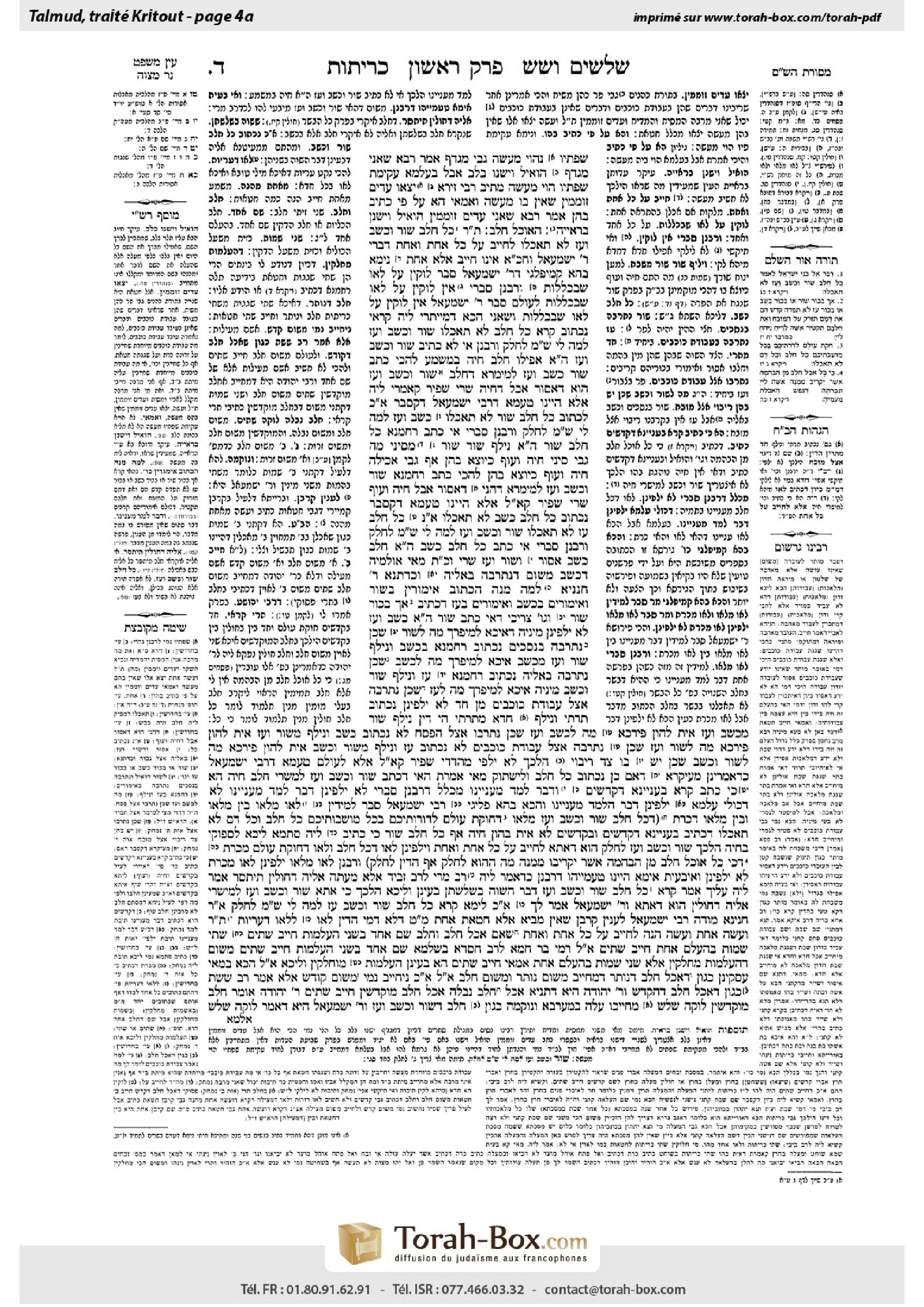
Keritot 4a: Talmud study for Daf Yomi
Daf Yomi is the daily study of one Talmud folio. Explore 37 tractates with scans, Hebrew text, Sefaria English and AI-generated French translations where annotated.
Passage selection and English or AI-generated French translation are available where the scan has annotations. Daf Study is independent of Torah-Box and Sefaria.
Browse Keritot · כריתות · All tractatesKeritot 4a text and translations
This page of Keritot includes the Aramaic text, an English translation and an AI-generated French translation, alongside the scan above.
כריתות ד׳ א · Aramaic and Hebrew text
שְׂפָתָיו נֶהֱוֵי מַעֲשֶׂה גַּבֵּי מְגַדֵּף? אָמַר רָבָא: שָׁאנֵי מְגַדֵּף, הוֹאִיל וְיֶשְׁנוֹ בַּלֵּב, אֲבָל בְּעָלְמָא עֲקִימַת שְׂפָתָיו הָוֵי מַעֲשֶׂה.
מֵתִיב רַבִּי זֵירָא: יָצְאוּ עֵדִים זוֹמְמִין שֶׁאֵין בּוֹ מַעֲשֶׂה, וְאַמַּאי? הָא ״עַל פִּי״ כְּתִיב בָּהֶן! אָמַר רָבָא: שָׁאנֵי עֵדִים זוֹמְמִין, הוֹאִיל וְיֶשְׁנָן בִּרְאִיָּיה.
הָאוֹכֵל חֵלֶב. תָּנוּ רַבָּנַן: ״כׇּל חֵלֶב שׁוֹר וְכֶשֶׂב וָעֵז לֹא תֹאכֵלוּ״ – לְחַיֵּיב עַל כׇּל אַחַת וְאַחַת, דִּבְרֵי רַבִּי יִשְׁמָעֵאל. וַחֲכָמִים אוֹמְרִים: אֵינוֹ חַיָּיב אֶלָּא אַחַת.
נֵימָא בְּהָא קָמִיפַּלְגִי, דְּרַבִּי יִשְׁמָעֵאל סָבַר: לוֹקִין עַל לָאו שֶׁבִּכְלָלוֹת, וְרַבָּנַן סָבְרִי: אֵין לוֹקִין עַל לָאו שֶׁבִּכְלָלוֹת?
לְעוֹלָם סָבַר רַבִּי יִשְׁמָעֵאל: אֵין לוֹקִין עַל לָאו שֶׁבִּכְלָלוֹת, וְשָׁאנֵי הָכָא, דִּמְיַיתְּרִי לֵיהּ קְרָאֵי – נִכְתּוֹב קְרָא ״כׇּל חֵלֶב לֹא תֹאכֵלוּ״, ״שׁוֹר וְכֶשֶׂב וָעֵז״ לְמָה לִי? שְׁמַע מִינַּהּ לְחַלֵּק.
וְרַבָּנַן? אִי לָא כְּתִיב: ״שׁוֹר וְכֶשֶׂב וָעֵז״ הֲוָה אָמֵינָא: אֲפִילּוּ חֵלֶב חַיָּה בַּמַּשְׁמָע, לְהָכִי כְּתַב: ״שׁוֹר כֶּשֶׂב וָעֵז״, לְמֵימְרָא: דְּחֵלֶב שׁוֹר וְכֶשֶׂב וָעֵז הוּא דְּאָסוּר, אֲבָל דְּחַיָּה שְׁרֵי.
שַׁפִּיר קָאָמְרִי לֵיהּ! אֶלָּא הַיְינוּ טַעְמָא, דְּרַבִּי יִשְׁמָעֵאל דְּקָסָבַר: אִם כֵּן, לִכְתּוֹב ״כׇּל חֵלֶב שׁוֹר לֹא תֹאכְלוּ״, ״כֶּשֶׂב וָעֵז״ לְמָה לִי? שְׁמַע מִינַּהּ לְחַלֵּק.
וְרַבָּנַן סָבְרִי: אִי כְּתַב רַחֲמָנָא ״כׇּל חֵלֶב שׁוֹר״, הֲוָה אָמֵינָא: נֵילַף ״שׁוֹר״ ״שׁוֹר״ מִסִּינַי,
מָה גַּבֵּי סִינַי – חַיָּה וָעוֹף כַּיּוֹצֵא בָּהֶן, אַף גַּבֵּי אֲכִילָה – חַיָּה וָעוֹף כַּיּוֹצֵא בָּהֶן, לְהָכִי כְּתַב רַחֲמָנָא ״שׁוֹר וְכֶשֶׂב וָעֵז״, לְמֵימְרָא דְּהָנֵי דְּאָסוּר, אֲבָל חַיָּה וָעוֹף שְׁרֵי.
שַׁפִּיר קָא אָמְרִי לֵיהּ! אֶלָּא הַיְינוּ טַעְמָא, דְּקָסָבַר: נִכְתּוֹב ״כׇּל חֵלֶב כֶּשֶׂב לֹא תֹאכֵלוּ״, אִי נָמֵי: ״כׇּל חֵלֶב עֵז לֹא תֹאכֵלוּ״, ״שׁוֹר וְכֶשֶׂב וָעֵז״ לְמָה לִי? שְׁמַע מִינַּהּ לְחַלֵּק.
וְרַבָּנַן סָבְרִי: אִי כְּתַב ״כָּל חֵלֶב כֶּשֶׂב״, הֲוָה אָמֵינָא: חֵלֶב כֶּשֶׂב אָסוּר, וְשׁוֹר וָעֵז שְׁרֵי. וְכִי תֵּימָא, מַאי אוּלְמֵיהּ דְּכֶשֶׂב – מִשּׁוּם דְּנִתְרַבָּה בְּאַלְיָה,
וְכִדְתָנָא רַבִּי חֲנַנְיָא: לָמָּה מָנָה הַכָּתוּב אֵימוּרִין בְּשׁוֹר וְאֵימוּרִים בְּכֶשֶׂב, וְאֵימוּרִים, בְּעֵז, דִּכְתִיב: ״אַךְ בְּכוֹר שׁוֹר וְגוֹ׳?
צְרִיכִי, דְּאִי כְּתַב שׁוֹר, הֲוָה אָמֵינָא: כֶּשֶׂב וָעֵז לָא יָלְפִינַן מִינֵּיהּ, דְּאִיכָּא לְמִיפְרַךְ: מָה לְשׁוֹר, שֶׁכֵּן נִתְרַבָּה בִּנְסָכִים.
נִכְתּוֹב רַחֲמָנָא בְּכֶשֶׂב וְנֵילַף שׁוֹר וָעֵז מִכֶּשֶׂב – אִיכָּא לְמִיפְרַךְ: מָה לְכֶשֶׂב, שֶׁכֵּן נִתְרַבָּה בְּאַלְיָה.
נִכְתּוֹב רַחֲמָנָא עֵז וְנֵילַף שׁוֹר וְכֶשֶׂב מִינֵּיהּ – אִיכָּא לְמִיפְרַךְ: מָה לְעֵז, שֶׁכֵּן נִתְרַבָּה אֵצֶל עֲבוֹדָה זָרָה.
מִן חַד לָא יָלְפִינַן, נִכְתּוֹב תַּרְתֵּי וְנֵילַף חֲדָא מִתַּרְתֵּי! הֵי דֵין? נֵילַף שׁוֹר מִכֶּשֶׂב וָעֵז – אִית לְהוֹן פִּירְכָא: מָה לְכֶשֶׂב וָעֵז, שֶׁכֵּן נִתְרַבּוּ אֵצֶל הַפֶּסַח!
לָא נִכְתּוֹב כֶּשֶׂב וְנֵילַף מִשּׁוֹר וָעֵז – אִית לְהוֹן פִּירְכָא: מָה לְשׁוֹר וָעֵז, שֶׁכֵּן נִתְרַבָּה אֵצֶל עֲבוֹדָה זָרָה!
לָא נִכְתּוֹב עֵז, וְנֵילַף מִשּׁוֹר וְכֶשֶׂב – אִית לְהוֹן פִּירְכָא: מָה לְשׁוֹר וְכֶשֶׂב, שֶׁכֵּן יֵשׁ בּוֹ צַד רִיבּוּי! הִלְכָּךְ לָא יָלְפִי מֵהֲדָדֵי.
שַׁפִּיר קָא אָמְרִי לֵיהּ! אֶלָּא לְעוֹלָם טַעְמָא דְּרַבִּי יִשְׁמָעֵאל כִּדְאָמְרִינַן מֵעִיקָּרָא, דְּאִם כֵּן נִכְתּוֹב ״כׇּל חֵלֶב״ וְלִישְׁתּוֹק. מַאי אָמְרַתְּ, הַאי דִּכְתַב ״שׁוֹר וְכֶשֶׂב וָעֵז״ לְמִשְׁרֵי חֵלֶב חַיָּה?
הָא כִּי כְּתַב קְרָא – בְּעִנְיָינָא דְקָדָשִׁים, וְדָבָר לָמֵד מֵעִנְיָינוֹ.
מִכְּלָל דְּרַבָּנַן סָבְרִי: לָא יָלְפִינַן דָּבָר לָמֵד מֵעִנְיָינוֹ? לָא, דְּכוּלֵּי עָלְמָא יָלְפִינַן דָּבָר הַלָּמֵד מֵעִנְיָינוֹ, וְהָכָא בְּהָא פְּלִיגִי, רַבִּי יִשְׁמָעֵאל סָבַר: לְמֵידִין לָאו מִלָּאו בֵּין מִלָּאו וּבֵין מִלָּאו דְּכָרֵת,
דְּ״כׇל חֵלֶב שׁוֹר וְכֶשֶׂב וָעֵז״, מִלָּאו דְּ״חֻקַּת עוֹלָם לְדֹרֹתֵיכֶם בְּכֹל מוֹשְׁבֹתֵיכֶם כׇּל חֵלֶב וְכׇל דָּם לֹא תֹאכֵלוּ״, דִּכְתִיב בְּעִנְיָינָא דְקָדָשִׁים, וּבְקָדָשִׁים לָא אִית בְּהוֹן חַיָּה, אַף ״כׇּל חֵלֶב שׁוֹר״, כִּי כְּתִיב לֵיהּ סְתָמָא לֵיכָּא לְסַפּוֹקֵי בְּחַיָּה, הִלְכָּךְ ״שׁוֹר וְכֶשֶׂב וָעֵז״ לְחַלֵּק הוּא דַּאֲתָא, לְחַיֵּיב עַל כׇּל אַחַת וְאַחַת.
וְיָלְפִינַן לָאו דְּ״כׇל חֵלֶב״ וְלָאו דְּ״חֻקַּת עוֹלָם״ מִכָּרֵת דְּ״כִי כׇּל אוֹכֵל חֵלֶב מִן הַבְּהֵמָה אֲשֶׁר יַקְרִיבוּ מִמֶּנָּה״, מָה הָהוּא לְחַלֵּק – אַף הַדִּין לְחַלֵּק.
וְרַבָּנַן, לָאו מִלָּאו יָלְפִינַן, לָאו מִכָּרֵת לָא יָלְפִינַן.
וְאִיבָּעֵית אֵימָא: הַיְינוּ טַעְמַיְיהוּ דְּרַבָּנַן, כְּדַאֲמַר לֵיהּ רַב מָרִי לְרַב זְבִיד: ״אֶלָּא מֵעַתָּה, אַלְיָה דְחוּלִּין תִּיתְּסַר אֲמַר לֵיהּ״ – ״עָלֶיךָ אָמַר קְרָא: ״כׇּל חֵלֶב שׁוֹר וְכֶשֶׂב וָעֵז״, דָּבָר הַשָּׁוֶה בִּשְׁלׇשְׁתָּן בָּעִינַן, וְלֵיכָּא״.
הִלְכָּךְ: כִּי אֲתָא ״שׁוֹר וְכֶשֶׂב וָעֵז״ – לְמִישְׁרֵי אַלְיָה דְחוּלִּין הוּא דַּאֲתָא. וְרַבִּי יִשְׁמָעֵאל, אָמַר לָךְ: אִם כֵּן, לֵימָא קְרָא ״כׇּל חֵלֶב שׁוֹר וְכֶשֶׂב״, עֵז לְמָה לִי? שְׁמַע מִינַּהּ לְחַלֵּק.
אָמַר רַבִּי חֲנִינָא: מוֹדֶה רַבִּי יִשְׁמָעֵאל לְעִנְיַן קׇרְבָּן שֶׁאֵין מֵבִיא אֶלָּא חַטָּאת אַחַת, מַאי טַעְמָא? דְּלָא דָּמֵי הָדֵין לָאו לְלָאו דַּעֲרָיוֹת.
תָּנוּ רַבָּנַן: ״וְעָשָׂה אַחַת״ ״וְעָשָׂה הֵנָּה״ – לְחַיֵּיב עַל כׇּל אַחַת וְאַחַת,
שֶׁאִם אָכַל חֵלֶב וְחֵלֶב, שֵׁם אֶחָד בִּשְׁנֵי הֶעְלֵמוֹת – חַיָּיב שְׁתַּיִם, שְׁתֵּי שֵׁמוֹת בְּהֶעְלֵם אַחַת – חַיָּיב שְׁתַּיִם.
אֲמַר לֵיהּ רָמֵי בַּר חָמָא לְרַב חִסְדָּא: בִּשְׁלָמָא שֵׁם אֶחָד בִּשְׁנֵי הֶעְלֵמוֹת חַיָּיב שְׁתַּיִם, מִשּׁוּם דְּהֶעְלֵמוֹת מְחַלְּקִין. אֶלָּא שְׁנֵי שֵׁמוֹת בְּהֶעְלֵם אַחַת, אַמַּאי חַיָּיב שְׁתַּיִם? הָא בָּעִינַן הֶעְלֵמוֹת מְוחַלְּקִין, וְלֵיכָּא!
אֲמַר לֵיהּ: הָכָא בְּמַאי עָסְקִינַן – כְּגוֹן דַּאֲכַל חֵלֶב דְּנוֹתָר, דְּמִחַיַּיב מִשּׁוּם נוֹתָר וּמִשּׁוּם חֵלֶב. אֲמַר לֵיהּ: אִם כֵּן, נִיחַיַּיב נָמֵי מִשּׁוּם קוֹדֶשׁ!
אֶלָּא אָמַר רַב שֵׁשֶׁת: כְּגוֹן דַּאֲכַל חֵלֶב דְּהֶקְדֵּשׁ, וְרַבִּי יְהוּדָה הִיא. דְּתַנְיָא: אָכַל חֵלֶב נְבֵלָה, אָכַל חֵלֶב מוּקְדָּשִׁין – חַיָּיב שְׁתַּיִם. רַבִּי יְהוּדָה אוֹמֵר: חֵלֶב מוּקְדָּשִׁין – לוֹקֶה שָׁלֹשׁ.
מְחַיְּיכוּ עֲלַהּ בְּמַעְרְבָא: וְנוֹקְמַהּ כְּגוֹן חֵלֶב דְּשׁוֹר וְכֶשֶׂב וָעֵז, וְרַבִּי יִשְׁמָעֵאל הִיא, דְּאָמַר: לוֹקֶה שְׁלֹשׁ!
Keritot 4a · English translation
his lips should be considered an action in the case of one who blasphemes. Rava said: The case of one who blasphemes is different, since it is primarily in the heart. In other words, the transgression of blasphemy is not the actual speech but the verbalizing of a sentiment. One is not liable to bring a sin offering for such an action, as it is essentially a matter of the heart. But in general, the twisting of one’s lips is considered an action.
Rabbi Zeira raises an objection from that which is taught in a different context. It is stated in a baraita that all who unwittingly transgress prohibitions punishable by death are liable to bring sin offerings, except for conspiring witnesses, who are not obligated to bring sin offerings, as their transgression does not involve an action. But why is that so? It is written with regard to such witnesses: “At the mouth of two witnesses” (Deuteronomy 17:6). They acted through speech, and the twisting of their lips should be considered an action, as they are liable for what they actually said, not for what was in their hearts. Rava said: The case of conspiring witnesses is different, since their transgression is primarily through sight, i.e., the important part of their testimony is what they saw, which is not an action.
§ The mishna included in its list of those liable to receive karet one who eats forbidden fat. With regard to this, the Sages taught a baraita which deals with the verse: “You shall eat no fat of ox, or sheep, or goat” (Leviticus 7:23). This verse serves to render one liable to receive lashes for each and every one, i.e., one who eats the fat of an ox, and a sheep, and a goat is liable to receive three sets of lashes. This is the statement of Rabbi Yishmael. And the Rabbis say he is liable to receive only one set of lashes.
The Gemara suggests: Let us say that Rabbi Yishmael and the Rabbis disagree about this matter, that Rabbi Yishmael maintains one is flogged for violating a general prohibition and the Rabbis maintain one is not flogged for violating a general prohibition. This is referring to the violation of a prohibition that includes several different actions, such as this one, which pertains to eating the fat of an ox, sheep, and goat. The Rabbis contend that one does not receive multiple sets of lashes for transgressing each element of such a prohibition.
The Gemara answers: Actually, Rabbi Yishmael also maintains that one is not flogged for violating a general prohibition, but here it is different, as elements of the verse are superfluous. The Gemara explains: Let the verse write only: You shall eat no fat, and all the individual types of fat would be included. Why do I need the additional terms: “Ox, or sheep, or goat”? Learn from it that the verse serves to separate between them and render one liable to receive a separate set of lashes for eating each type of forbidden fat.
The Gemara asks: And as for the Rabbis, how do they respond to this reading of the verse? The Gemara answers: The Rabbis would say that no element of the verse is superfluous, since if it had not written: “Ox, or sheep, or goat,” I would say that even the fat of an undomesticated animal is included in the prohibition. For this reason the verse writes: “Ox, or sheep, or goat,” to say that it is the fat of an ox, or a sheep, or a goat that is forbidden, but all the fats of an undomesticated animal are permitted.
The Gemara raises a difficulty against this interpretation of the dispute: The Rabbis spoke well to Rabbi Yishmael, i.e., their response is persuasive. The Gemara suggests an alternative explanation: Rather, this is the reasoning of Rabbi Yishmael, as he holds: If so, that the verse serves to exclude the fat of only an undomesticated animal from the prohibition, then let it write: You shall eat no fat of an ox, which would be understood as a paradigm representing every type of domesticated animal. Why do I need the phrase: “Sheep or goat”? Learn from it that the verse serves to separate between them and render one liable to receive a separate set of lashes for eating each type of forbidden fat.
And the Rabbis maintain that if the Merciful One had written only: You shall eat no fat of an ox, I would say: Let us derive a verbal analogy from the word “ox” stated here as a paradigm representing every type of domesticated animal [behema] and the word “ox,” i.e., behema, stated with regard to a mitzva given in preparation for the revelation at Sinai: “Whether it be animal [behema] or man, it shall not live” (Exodus 19:13).
The Gemara explains the meaning of this hypothetical verbal analogy: Just as with regard to the command at Sinai, undomesticated animals and birds are subject to the same prohibition as domesticated animals despite the use of the term behema, so too, with regard to eating their fat, undomesticated animals and birds are subject to the same prohibition as domesticated animals despite the verse employing the example of an ox. For this reason the Merciful One writes: “Ox, or sheep, or goat,” to say that these are forbidden, but all the fats of an undomesticated animal and birds are permitted.
The Gemara raises a difficulty against this interpretation of the dispute: The Rabbis spoke well to Rabbi Yishmael, i.e., their response is persuasive. How could he say the terms in the verse are superfluous? The Gemara suggests an alternative explanation: Rather, this is the reasoning of Rabbi Yishmael, as he holds: Let the verse write: You shall eat no fat of sheep; alternatively, let it state: You shall eat no fat of goat. Why do I need the verse to state all three: “Ox, or sheep, or goat”? Learn from it that the verse serves to separate between them and render one liable to receive a separate set of lashes for eating each type of forbidden fat.
And the Rabbis maintain that if the Torah had written merely: You shall eat no fat of sheep, I would say it is only the fat of sheep that is forbidden, but the fat of an ox or a goat is permitted. And if you would say: In what way is the category of sheep stronger, i.e., more fitting to have its fats forbidden, than the categories of ox and goats, that one would think the prohibition applies only to sheep? The answer is that one might have thought so due to the fact that there is an increased obligation with regard to a sheep’s tail, as it is sacrificed upon the altar, which is not the case with an ox or a goat.
And this is as Rabbi Ḥanina taught: Why does the verse list the obligation to burn the sacrificial portions on the altar with regard to a firstborn ox, and the obligation to burn the sacrificial portions [ve’eimurim] with regard to a firstborn sheep, and the obligation to burn the sacrificial portions with regard to a firstborn goat? As it is written: “But the firstborn of a bull, or the firstborn of a sheep, or the firstborn of a goat, you shall not redeem; they are sacred. You shall dash their blood against the altar, and shall make their fat smoke for an offering made by fire” (Numbers 18:17). The “fat” mentioned in this verse is their portions to be burned on the altar.
Rabbi Ḥanina explains: These repetitions are necessary, as, if the Torah had written this obligation only with regard to a firstborn ox I would say that we do not derive the halakha of a sheep and a goat from it, as that derivation can be refuted: What is notable about an ox? It is notable in that an ox has an increased number of wine libations, more than those poured with sheep and goat offerings. Therefore, perhaps the additional obligation to burn the sacrificial portions applies only with regard to an ox.
And likewise, if you were to suggest: Let the Merciful One write the obligation to burn the sacrificial portions only with regard to a sheep and we will derive the halakha of an ox and a goat from the halakha of a sheep, that derivation can be refuted: What is notable about a sheep? It is notable in that there is an increased obligation with regard to a sheep’s tail, as explained earlier.
And similarly, if you suggest: Let the Merciful One write the obligation to burn the sacrificial portions only with regard to a goat, and we will derive the halakha of an ox and a sheep from the halakha of a goat, this too can be refuted: What is notable about a goat? It is notable in that a goat has an increased applicability with regard to idol worship, as one who sins unwittingly in the case of idol worship is liable to bring a goat as a sin offering (see Numbers 15:27), unlike one who transgresses other prohibitions unwittingly, for which they are liable to bring a sheep.
Rabbi Ḥanina continues: We cannot derive these halakhot from the halakha of any one of the others, but let the Torah write two of them and we will derive the halakha of one of them from the halakha of the other two. Which is this animal that should not be written? If one suggests we will derive the obligation to burn the sacrificial portions of a firstborn ox from the obligation to burn the sacrificial portions of a sheep and a goat, this derivation has a refutation: What is notable about a sheep and a goat? They are notable in that that they have increased applicability, as they are suitable for the Paschal offering, whereas an ox is not suitable for this purpose.
If one suggests the verse should not write the obligation to burn the sacrificial portions of a sheep, and we will derive its halakha from the halakha of an ox and a goat, this derivation has a refutation: What is notable about an ox and a goat? They are notable in that they have increased applicability as suitable offerings to atone for an unwitting transgression of idol worship, as when a community unwittingly sins with regard to idol worship they bring an ox as a burnt offering and a goat as a sin offering (see Numbers 15:24), while an individual brings a goat but not a sheep.
If one suggests that the verse should not write the obligation to burn the sacrificial portions of a goat, and we will derive its halakha from the halakha of an ox and a sheep, this derivation has a refutation: What is notable about an ox and a sheep? They are notable in that each of them has an increased aspect of applicability with regard to the altar, as the libations for an ox are greater than those for a goat, and the tail of a sheep, but not that of a goat, is burned on the altar. Rabbi Ḥanina concludes: Therefore, all three cases are necessary, as they cannot be derived from each other.
The Rabbis have explained why all three mentions of an ox, a sheep, and a goat are necessary. Consequently, the Gemara again states: The Rabbis spoke well to Rabbi Yishmael, i.e., their response is persuasive. The Gemara suggests: Rather, the reason of Rabbi Yishmael is actually as we said at the outset, that if so, that one who eats the forbidden fats of all three animals is liable to receive only one set of lashes, let the verse write: You shall eat no fat, and be silent. What did you say in response? That this fact that the verse writes: “Ox, or sheep, or goat,” serves to permit the fat of an undomesticated animal? This is not a valid objection.
The Gemara explains: When the verse concerning forbidden fat is written it is in the context of sacrificial animals, since the subsequent verse concerning the prohibition against eating forbidden fat states: “For whoever eats the fat of the animal of which men present an offering of fire to the Lord, even the soul that eats it shall be cut off from his people” (Leviticus 7:25). The verse categorizes an animal whose fat one may not eat as an “animal of which men present an offering of fire to the Lord,” i.e., offerings. And one of the thirteen hermeneutical principles is: A matter is derived from its context, i.e., one interprets a verse according to the context in which it is written. Since offerings may be brought only from domesticated, not undomesticated, animals, the prohibition against eating forbidden fat applies only to such animals.
The Gemara raises a difficulty: Can one conclude by inference that the Rabbis maintain we do not derive halakhot by employing the hermeneutical principle of: A matter is derived from its context? This cannot be correct, as it is an accepted basic principle of exegesis. The Gemara answers: No, everyone agrees that we do derive halakhot by employing the hermeneutical principle of: A matter is derived from its context, and here it is about this issue that they disagree: Rabbi Yishmael maintains that we derive the halakhot of one prohibition from the halakhot of another prohibition, and this applies whether it is from a standard prohibition, whose transgression results in the punishment of lashes, or whether from a prohibition whose transgression results in the punishment of karet.
Accordingly, the prohibition of: “You shall eat no fat of ox, or sheep, or goat,” can be derived from the prohibition of: “It shall be a perpetual statute throughout your generations in all your dwellings, that you shall eat neither fat nor blood” (Leviticus 3:17), which is written with regard to the matter of sacrificial animals. And there are no undomesticated animals in the category of sacrificial animals. So too, with regard to the prohibition of: “You shall eat no fat of ox, or sheep, or goat,” when the verse writes it without further specification, there is no reason to be uncertain whether or not it is referring also to undomesticated animals. Therefore, the phrase “ox, or sheep, or goat” comes to separate, i.e., to render one liable for eating the forbidden fat of each and every one of them.
All this teaches only that a separate prohibition applies to each type of animal. And with regard to the liability to receive lashes for eating each one we derive the prohibition of: “You shall eat no fat,” and the prohibition of: “It shall be a perpetual statute,” from the example of karet stated in the verse: “For anyone who eats the fat of the domesticated animal, of which people present an offering of fire to the Lord, the soul that eats it shall be cut off from its people” (Leviticus 7:25). Just as that verse serves to separate and teach that if one unwittingly ate the fat of an ox, a goat, and a sheep he is liable to bring a sin offering for each one, so too, this verse serves to separate and teach that one is liable to receive lashes for eating the fat of each one.
And the Rabbis maintain we derive the halakhot of one standard prohibition from the halakhot of another standard prohibition, but we do not derive the halakhot of a standard prohibition from the halakhot of a prohibition whose transgression results in the punishment of karet.
The Gemara suggests: And if you wish, say instead that this is the reason of the Rabbis: As Rav Mari said to Rav Zevid when asked about a different issue: If that is so, that a sheep tail is categorized as fat by the verses and is included in the portions of an offering for which one is liable for the misuse of consecrated property, then the tail of a non-sacred animal should be prohibited for consumption as forbidden fat. Rav Zevid said to Rav Mari: With regard to your claim, the verse states concerning forbidden fat: “You shall eat no fat of ox, or sheep, or goat” (Leviticus 7:23). This teaches that for the prohibition against eating forbidden fat to take effect we require an item that is found equally in all three types of animals, an ox, and a sheep, and a goat, and that is not the case here. Since an ox and goat do not have tails, the tail is not prohibited even in the case of a sheep.
Therefore, the same applies with regard to the issue at hand: When the verse “ox, or sheep, or goat” comes, it comes to permit consumption of the tail of a non-sacred animal, and one cannot learn from here that a separate prohibition applies to each type of forbidden fat. And Rabbi Yishmael could say to you in response: If so, let the verse state: You shall eat no fat of ox or sheep; why do I need the mention of a goat? Learn from it that the verse serves to separate between them and render one liable to receive lashes for eating each type of forbidden fat.
Rabbi Ḥanina says: Although Rabbi Yishmael maintains that one who unwittingly eats the fat of an ox, a sheep, and a goat is liable to receive a separate set of lashes for each one, he concedes with regard to bringing an offering that if he ate those types of forbidden fat in a single lapse of awareness he brings only one sin offering. What is the reason? The reason is that this prohibition is not similar to the prohibition of those with whom relations are forbidden. As derived in the Gemara on 2b, one who unwittingly engages in intercourse with many women to whom he is forbidden is liable to bring a sin offering for each act. In that context the verse states a separate prohibition for each forbidden relative, whereas in this case there is a single prohibition that applies to the forbidden fat of all domesticated animals.
§ With regard to the sin offering required of one who transgresses the prohibition against eating forbidden fat, the Sages taught in a baraita: The verse states: “Speak to the children of Israel, saying: A soul that sins in error, from all the commandments of God that may not be performed, and from one of them” (Leviticus 4:2). This phrase should be interpreted as though it states: And performs one, and again states: And performs them, i.e., it serves to render one liable to bring a sin offering for each and every transgression.
The baraita continues: This teaches that if one ate forbidden fat and again ate forbidden fat, if it was from one category, i.e., the same type of forbidden fat, and he ate it in two lapses of awareness, that is, he was made aware of his sin after the first instance of consumption and then again ate unwittingly, he is liable to bring two sin offerings. If he ate forbidden fat from two categories, as the Gemara will soon explain, in one lapse of awareness, he is likewise liable to bring two sin offerings.
Rami bar Ḥama said to Rav Ḥisda: Granted, one who ate forbidden fat from one category in two lapses of awareness is liable to bring two sin offerings, as this is due to the fact that the lapses of awareness separate between his transgressions; each time he becomes aware of his transgression he is liable to bring another sin offering. But in a case where he ate forbidden fat from two categories in one lapse of awareness, why is he liable to bring two sin offerings? We require separate lapses of awareness and that is not the case here.
Rav Ḥisda said to him: Here we are dealing with a case where he ate forbidden fat left over from an offering after the time allotted for its consumption [notar], as he is liable due to eating notar and is also liable due to eating forbidden fat. These are the two categories mentioned in the baraita. Rami bar Ḥama said to him: If so, that the case involves more than one prohibition, let him be liable due to eating sacrificial food as well, and he should be liable to bring a guilt offering for the unwitting misuse of consecrated property (see Leviticus 5:14–16).
Rather, Rav Sheshet said: Here we are dealing with a case where he ate forbidden fat of sacrificial animals, and this ruling is in accordance with the opinion of Rabbi Yehuda, who renders one liable to bring two sin offerings for eating forbidden fat of sacrificial food. As it is taught in a baraita: If one ate forbidden fat of an animal carcass, or if he ate forbidden fat of sacrificial animals, he is liable to receive two sets of lashes, either for transgressing the prohibitions of eating forbidden fat and eating an animal carcass, or for both eating forbidden fat and transgressing the prohibition forbidding a non-priest to partake of sacrificial animals. Rabbi Yehuda says: If one ate forbidden fat of sacrificial animals he is flogged with three sets of lashes, because there are two separate prohibitions of forbidden fat in the case of sacrificial animals, as the Gemara will soon explain, in addition to the prohibition forbidding a non-priest to partake of sacrificial animals.
The Gemara comments: They laughed at this suggestion in the West, i.e., Eretz Yisrael: And let us interpret this baraita as referring to a case where he ate the forbidden fat of an ox, and of a sheep, and of a goat, and explain that it is in accordance with the opinion of Rabbi Yishmael, who says that he is flogged with three sets of lashes for the different types of fat, if he did so intentionally and was forewarned.
Keritot 4a · Traduction française (IA)
Ses lèvres doivent être considérées comme une action dans le cas de celui qui blasphème. Rava a dit : Le cas de celui qui blasphème est différent, car l’essentiel se situe dans le cœur. Autrement dit, la transgression du blasphème ne consiste pas dans la parole elle-même, mais dans l’expression verbale d’un sentiment. On n’est pas tenu d’apporter un sacrifice expiatoire pour une telle action, puisqu’il s’agit essentiellement d’une affaire de cœur. Mais, de manière générale, le mouvement des lèvres est considéré comme une action.
Rabbi Zeira soulève une objection à partir d’un enseignement formulé dans un autre contexte. Une baraïta enseigne que tous ceux qui transgressent par inadvertance des interdictions passibles de la peine de mort sont tenus d’apporter des sacrifices expiatoires, à l’exception des faux témoins conspirateurs, qui ne sont pas tenus d’apporter de sacrifices expiatoires, car leur transgression ne comporte pas d’action. Mais pourquoi en est-il ainsi ? Il est écrit au sujet de tels témoins : « À la déposition de deux témoins » (Deutéronome 17, 6). Ils ont agi par la parole, et le mouvement de leurs lèvres devrait être considéré comme une action, puisqu’ils sont responsables de ce qu’ils ont effectivement dit, et non de ce qui était dans leur cœur. Rava a dit : Le cas des faux témoins conspirateurs est différent, car leur transgression repose principalement sur la vue, c’est-à-dire que l’élément essentiel de leur témoignage est ce qu’ils ont vu, ce qui n’est pas une action.
§ La Michna a inclus dans sa liste de ceux qui encourent le retranchement celui qui mange du suif interdit. À ce sujet, les Sages ont enseigné une baraïta portant sur le verset : « Vous ne mangerez aucun suif de bœuf, de mouton ou de chèvre » (Lévitique 7, 23). Ce verset rend passible de flagellation pour chacun d’eux : celui qui mange le suif d’un bœuf, d’un mouton et d’une chèvre encourt trois séries de flagellations. Telle est la déclaration de Rabbi Yishmaël. Les Sages disent qu’il n’encourt qu’une seule série de flagellations.
La Guemara suggère : Peut-on dire que Rabbi Yishmaël et les Sages sont en désaccord sur ce point, Rabbi Yishmaël estimant qu’on est flagellé pour avoir transgressé une interdiction générale, tandis que les Sages estiment qu’on ne l’est pas ? Il s’agit de la transgression d’une interdiction qui englobe plusieurs actes différents, comme celle-ci, qui concerne la consommation du suif de bœuf, de mouton et de chèvre. Les Sages soutiennent qu’on ne reçoit pas plusieurs séries de flagellations pour avoir transgressé chacun des éléments d’une telle interdiction.
La Guemara répond : En réalité, Rabbi Yishmaël estime lui aussi qu’on n’est pas flagellé pour avoir transgressé une interdiction générale, mais ici, le cas est différent, car certains éléments du verset sont superflus. La Guemara explique : Le verset aurait pu dire seulement : « Vous ne mangerez aucun suif », ce qui aurait inclus toutes les sortes de suif. Pourquoi fallait-il ajouter les termes « de bœuf, de mouton ou de chèvre » ? Apprends-en que le verset vise à les distinguer et à rendre passible d’une série distincte de flagellations pour la consommation de chaque sorte de suif interdit.
La Guemara demande : Et que répondent les Sages à cette interprétation du verset ? La Guemara répond : Les Sages diraient qu’aucun élément du verset n’est superflu, car si le verset n’avait pas dit « de bœuf, de mouton ou de chèvre », j’aurais dit que même le suif d’un animal sauvage est compris dans l’interdiction. C’est pourquoi le verset dit « de bœuf, de mouton ou de chèvre », pour enseigner que seul le suif d’un bœuf, d’un mouton ou d’une chèvre est interdit, tandis que tout le suif des animaux sauvages est permis.
La Guemara soulève une difficulté contre cette interprétation du désaccord : Les Sages ont bien répondu à Rabbi Yishmaël, c’est-à-dire que leur réponse est convaincante. La Guemara propose une autre explication : En réalité, voici le raisonnement de Rabbi Yishmaël : puisqu’il en est ainsi, si le verset vise seulement à exclure le suif d’un animal sauvage de l’interdiction, qu’il dise : « Vous ne mangerez aucun suif de bœuf », ce qui serait compris comme un exemple représentant toutes les sortes d’animaux domestiques. Pourquoi fallait-il ajouter l’expression « de mouton ou de chèvre » ? Apprends-en que le verset vise à les distinguer et à rendre passible d’une série distincte de flagellations pour la consommation de chaque sorte de suif interdit.
Les Sages, eux, estiment que si le Miséricordieux avait écrit seulement : « Vous ne mangerez aucun suif de bœuf », j’aurais déduit par analogie verbale le terme « bœuf » mentionné ici, comme exemple représentant toutes les sortes d’animaux domestiques [behema], du terme « bœuf », c’est-à-dire behema, employé à propos d’une mitsva donnée en préparation de la révélation au Sinaï : « Que ce soit un animal [behema] ou un homme, il ne vivra pas » (Exode 19, 13).
La Guemara explique le sens de cette analogie verbale hypothétique : de même que, pour l’interdiction liée au Sinaï, les animaux sauvages et les oiseaux sont soumis à la même interdiction que les animaux domestiques, malgré l’emploi du terme behema, de même, concernant la consommation de leur suif, les animaux sauvages et les oiseaux sont soumis à la même interdiction que les animaux domestiques, bien que le verset donne le bœuf en exemple. C’est pourquoi le Miséricordieux écrit : « De bœuf, de mouton ou de chèvre », pour enseigner que ceux-là sont interdits, tandis que tout le suif des animaux sauvages et des oiseaux est permis.
La Guemara soulève une difficulté contre cette interprétation du désaccord : Les Sages ont bien répondu à Rabbi Yishmaël, c’est-à-dire que leur réponse est convaincante. Comment peut-il dire que les termes du verset sont superflus ? La Guemara propose une autre explication : En réalité, voici le raisonnement de Rabbi Yishmaël : que le verset dise : « Vous ne mangerez aucun suif de mouton » ; ou bien qu’il dise : « Vous ne mangerez aucun suif de chèvre ». Pourquoi le verset devait-il mentionner les trois : « De bœuf, de mouton ou de chèvre » ? Apprends-en que le verset vise à les distinguer et à rendre passible d’une série distincte de flagellations pour la consommation de chaque sorte de suif interdit.
Les Sages, eux, estiment que si la Torah avait simplement écrit : « Vous ne mangerez aucun suif de mouton », j’aurais dit que seul le suif du mouton est interdit, mais que celui du bœuf ou de la chèvre est permis. Et si tu dis : en quoi la catégorie du mouton est-elle plus importante, c’est-à-dire plus susceptible que le suif soit interdit, que celles du bœuf et de la chèvre, au point qu’on pourrait penser que l’interdiction ne s’applique qu’au mouton ? On pourrait le penser en raison de l’obligation supplémentaire concernant la queue du mouton, puisqu’elle est offerte sur l’autel, ce qui n’est pas le cas pour le bœuf ni pour la chèvre.
Et cela correspond à ce qu’a enseigné Rabbi Ḥanina : Pourquoi le verset mentionne-t-il l’obligation de brûler sur l’autel les parties sacrificielles du premier-né d’un bœuf, l’obligation de brûler les parties sacrificielles [ve’eimurim] du premier-né d’un mouton, et l’obligation de brûler les parties sacrificielles du premier-né d’une chèvre ? Car il est écrit : « Mais le premier-né d’un taureau, le premier-né d’un mouton ou le premier-né d’une chèvre, tu ne le rachèteras pas ; ils sont saints. Tu répandras leur sang contre l’autel et tu feras fumer leur suif en offrande consumée par le feu » (Nombres 18, 17). Le « suif » mentionné dans ce verset désigne les parties qu’il faut brûler sur l’autel.
Rabbi Ḥanina explique : Ces répétitions sont nécessaires, car si la Torah avait mentionné cette obligation uniquement à propos du premier-né d’un bœuf, j’aurais dit que nous n’en déduisons pas la halakha concernant le mouton et la chèvre, car on peut réfuter cette déduction : Qu’a-t-on de particulier dans le cas du bœuf ? Le bœuf se distingue par le nombre supérieur de libations de vin, plus important que celui versé avec les offrandes de moutons et de chèvres. Il se pourrait donc que l’obligation supplémentaire de brûler les parties sacrificielles ne s’applique qu’au bœuf.
De même, si tu proposais que le Miséricordieux ne mentionne l’obligation de brûler les parties sacrificielles qu’à propos d’un mouton, et que nous en déduisions la halakha pour le bœuf et la chèvre à partir de celle du mouton, cette déduction pourrait être réfutée : Qu’a-t-on de particulier dans le cas du mouton ? Il se distingue par l’obligation supplémentaire concernant sa queue, comme expliqué précédemment.
De même, si tu proposes que le Miséricordieux ne mentionne l’obligation de brûler les parties sacrificielles qu’à propos d’une chèvre, et que nous en déduisions la halakha pour le bœuf et le mouton à partir de celle de la chèvre, cette déduction pourrait elle aussi être réfutée : Qu’a-t-on de particulier dans le cas de la chèvre ? La chèvre se distingue par son applicabilité accrue en matière d’idolâtrie, car celui qui pèche par inadvertance dans le cas de l’idolâtrie doit apporter une chèvre comme sacrifice expiatoire (voir Nombres 15, 27), contrairement à celui qui transgresse par inadvertance d’autres interdictions, pour lesquelles il doit apporter un mouton.
Rabbi Ḥanina poursuit : Nous ne pouvons pas déduire ces halakhot de la halakha de l’un des autres animaux pris isolément ; mais que la Torah en mentionne deux, et nous déduirons la halakha du troisième à partir de celles des deux autres. Quel animal ne devrait-on pas mentionner ? Si l’on propose de déduire l’obligation de brûler les parties sacrificielles d’un premier-né de bœuf à partir de celle d’un mouton et d’une chèvre, cette déduction peut être réfutée : Qu’a-t-on de particulier dans le cas du mouton et de la chèvre ? Ils se distinguent par leur applicabilité accrue, car ils conviennent à l’offrande pascale, contrairement au bœuf.
Si l’on propose que le verset ne mentionne pas l’obligation de brûler les parties sacrificielles d’un mouton et que nous en déduisions la halakha à partir de celles du bœuf et de la chèvre, cette déduction peut être réfutée : Qu’a-t-on de particulier dans le cas du bœuf et de la chèvre ? Ils se distinguent par leur applicabilité accrue comme offrandes destinées à expier une transgression involontaire liée à l’idolâtrie : lorsqu’une communauté pèche par inadvertance en matière d’idolâtrie, elle apporte un bœuf comme holocauste et une chèvre comme sacrifice expiatoire (voir Nombres 15, 24), tandis qu’un particulier apporte une chèvre, mais pas un mouton.
Si l’on propose que le verset ne mentionne pas l’obligation de brûler les parties sacrificielles d’une chèvre et que nous en déduisions la halakha à partir de celles du bœuf et du mouton, cette déduction peut être réfutée : Qu’a-t-on de particulier dans le cas du bœuf et du mouton ? Chacun se distingue par un aspect d’applicabilité accrue concernant l’autel : les libations du bœuf sont plus importantes que celles de la chèvre, et la queue du mouton, contrairement à celle de la chèvre, est brûlée sur l’autel. Rabbi Ḥanina conclut : Par conséquent, les trois cas sont nécessaires, car ils ne peuvent être déduits les uns des autres.
Les Sages ont expliqué pourquoi les trois mentions du bœuf, du mouton et de la chèvre sont nécessaires. La Guemara réaffirme donc : Les Sages ont bien répondu à Rabbi Yishmaël, c’est-à-dire que leur réponse est convaincante. La Guemara suggère : En réalité, le raisonnement de Rabbi Yishmaël est celui que nous avons exposé au départ : si celui qui mange le suif interdit des trois animaux n’encourt qu’une seule série de flagellations, que le verset dise : « Vous ne mangerez aucun suif », et qu’il s’arrête là. Quelle réponse as-tu donnée ? Que le fait que le verset dise « de bœuf, de mouton ou de chèvre » sert à autoriser le suif d’un animal sauvage ? Ce n’est pas une objection valable.
La Guemara explique : Lorsque le verset concernant le suif interdit est énoncé, il l’est dans le contexte des animaux destinés aux sacrifices, puisque le verset suivant, relatif à l’interdiction de manger le suif interdit, dit : « Car quiconque mange le suif de l’animal dont les hommes présentent une offrande consumée par le feu à l’Éternel, l’âme qui en mangera sera retranchée de son peuple » (Lévitique 7, 25). Le verset qualifie l’animal dont on ne peut manger le suif d’« animal dont les hommes présentent une offrande consumée par le feu à l’Éternel », c’est-à-dire une offrande. Or, l’une des treize règles d’interprétation est qu’un élément se déduit de son contexte, autrement dit, qu’on interprète un verset selon le contexte dans lequel il est écrit. Puisque les offrandes ne peuvent être apportées que d’animaux domestiques, et non d’animaux sauvages, l’interdiction de manger le suif interdit ne s’applique qu’à ces animaux.
La Guemara soulève une difficulté : Peut-on déduire que les Sages estiment que nous ne déduisons pas de halakhot en appliquant la règle d’interprétation selon laquelle un élément se déduit de son contexte ? Cela ne peut être juste, puisqu’il s’agit d’un principe fondamental reconnu de l’exégèse. La Guemara répond : Non, tout le monde convient que nous déduisons des halakhot en appliquant la règle selon laquelle un élément se déduit de son contexte. Ici, leur désaccord porte sur cette question : Rabbi Yishmaël estime que nous déduisons les halakhot d’une interdiction à partir de celles d’une autre interdiction, qu’il s’agisse d’une interdiction ordinaire, dont la transgression entraîne la peine de flagellation, ou d’une interdiction dont la transgression entraîne le retranchement.
En conséquence, l’interdiction : « Vous ne mangerez aucun suif de bœuf, de mouton ou de chèvre » peut être déduite de l’interdiction : « Ce sera une loi perpétuelle pour vos générations, dans tous vos lieux d’habitation : vous ne mangerez ni suif ni sang » (Lévitique 3, 17), énoncée à propos des animaux destinés aux sacrifices. Or, les animaux sauvages ne font pas partie des animaux destinés aux sacrifices. De même, concernant l’interdiction « Vous ne mangerez aucun suif de bœuf, de mouton ou de chèvre », puisque le verset l’énonce sans autre précision, il n’y a pas lieu de se demander s’il fait également référence aux animaux sauvages. L’expression « de bœuf, de mouton ou de chèvre » vient donc distinguer ces animaux, c’est-à-dire rendre passible pour la consommation du suif interdit de chacun d’eux.
Tout cela enseigne seulement qu’une interdiction distincte s’applique à chaque sorte d’animal. Quant à l’obligation d’encourir des flagellations pour avoir mangé le suif de chacun d’eux, nous déduisons l’interdiction « Vous ne mangerez aucun suif » et l’interdiction « Ce sera une loi perpétuelle » de l’exemple du retranchement mentionné dans le verset : « Quiconque mange le suif de l’animal domestique dont les hommes présentent une offrande consumée par le feu à l’Éternel, l’âme qui en mangera sera retranchée de son peuple » (Lévitique 7, 25). De même que ce verset distingue les cas et enseigne que celui qui a mangé par inadvertance le suif d’un bœuf, d’une chèvre et d’un mouton doit apporter un sacrifice expiatoire pour chacun d’eux, de même ce verset distingue les cas et enseigne qu’on encourt des flagellations pour la consommation du suif de chacun d’eux.
Les Sages, eux, estiment que nous déduisons les halakhot d’une interdiction ordinaire à partir de celles d’une autre interdiction ordinaire, mais que nous ne déduisons pas les halakhot d’une interdiction ordinaire à partir de celles d’une interdiction dont la transgression entraîne le retranchement.
La Guemara suggère : Et si tu veux, dis plutôt que telle est la raison des Sages : comme Rav Mari l’a dit à Rav Zevid, interrogé sur une autre question : S’il en est ainsi, si les versets classent la queue du mouton parmi le suif et l’incluent dans les parties d’une offrande dont l’utilisation profane rend passible pour détournement de biens consacrés, alors la queue d’un animal non consacré devrait être interdite à la consommation en tant que suif interdit. Rav Zevid dit à Rav Mari : Quant à ton argument, le verset dit au sujet du suif interdit : « Vous ne mangerez aucun suif de bœuf, de mouton ou de chèvre » (Lévitique 7, 23). Cela enseigne que, pour que l’interdiction de manger du suif interdit s’applique, l’élément concerné doit se trouver également dans les trois sortes d’animaux : le bœuf, le mouton et la chèvre. Or, ce n’est pas le cas ici. Puisque le bœuf et la chèvre n’ont pas de queue, la queue n’est même pas interdite dans le cas du mouton.
Il en va donc de même pour la question présente : lorsque le verset dit « de bœuf, de mouton ou de chèvre », il vise à autoriser la consommation de la queue d’un animal non consacré, et on ne peut pas en déduire qu’une interdiction distincte s’applique à chaque sorte de suif interdit. Rabbi Yishmaël pourrait te répondre : s’il en est ainsi, que le verset dise : « Vous ne mangerez aucun suif de bœuf ou de mouton » ; pourquoi mentionner la chèvre ? Apprends-en que le verset vise à les distinguer et à rendre passible de flagellations pour la consommation de chaque sorte de suif interdit.
Rabbi Ḥanina dit : Bien que Rabbi Yishmaël estime que celui qui mange par inadvertance le suif d’un bœuf, d’un mouton et d’une chèvre encourt une série distincte de flagellations pour chacun d’eux, il reconnaît, en ce qui concerne l’apport d’un sacrifice, que s’il a mangé ces sortes de suif interdit au cours d’une seule absence de conscience, il n’apporte qu’un seul sacrifice expiatoire. Pour quelle raison ? Parce que cette interdiction ne ressemble pas à l’interdiction concernant les personnes avec lesquelles les relations sexuelles sont interdites. Comme cela a été déduit dans la Guemara, en 2b, celui qui a par inadvertance des rapports avec plusieurs femmes avec lesquelles les relations sont interdites doit apporter un sacrifice expiatoire pour chaque acte. Dans ce contexte, le verset énonce une interdiction distincte pour chaque proche avec lequel les relations sont interdites, alors qu’ici, une seule interdiction s’applique au suif interdit de tous les animaux domestiques.
§ À propos du sacrifice expiatoire que doit apporter celui qui transgresse l’interdiction de manger du suif interdit, les Sages ont enseigné une baraïta : Le verset dit : « Parle aux enfants d’Israël, en disant : Une personne qui pèche par inadvertance en commettant l’un des commandements de l’Éternel qui ne doivent pas être accomplis, et l’un d’eux » (Lévitique 4, 2). Cette expression doit être interprétée comme si le verset disait : « Et en accomplit un », puis ajoutait encore : « Et les accomplit » ; autrement dit, elle rend passible d’apporter un sacrifice expiatoire pour chaque transgression.
La baraïta poursuit : Cela enseigne que si quelqu’un a mangé du suif interdit, puis en a de nouveau mangé, si c’était dans une seule catégorie, c’est-à-dire une même sorte de suif interdit, et qu’il l’a mangé lors de deux absences de conscience, autrement dit, s’il a pris connaissance de sa faute après la première consommation, puis a de nouveau mangé par inadvertance, il doit apporter deux sacrifices expiatoires. S’il a mangé du suif interdit appartenant à deux catégories, comme la Guemara l’expliquera bientôt, pendant une seule absence de conscience, il doit également apporter deux sacrifices expiatoires.
Rami bar Ḥama dit à Rav Ḥisda : Il est compréhensible que celui qui a mangé du suif interdit d’une seule catégorie au cours de deux absences de conscience doive apporter deux sacrifices expiatoires, car les absences de conscience séparent ses transgressions : chaque fois qu’il prend conscience de sa transgression, il doit apporter un autre sacrifice expiatoire. Mais dans le cas où il a mangé du suif interdit appartenant à deux catégories au cours d’une seule absence de conscience, pourquoi doit-il apporter deux sacrifices expiatoires ? Il faut des absences de conscience distinctes, ce qui n’est pas le cas ici.
Rav Ḥisda lui dit : Nous parlons ici d’un cas où il a mangé du suif interdit provenant d’une offrande et resté après le délai fixé pour sa consommation [notar], car il est passible pour avoir mangé du notar, et aussi pour avoir mangé du suif interdit. Ce sont les deux catégories mentionnées dans la baraïta. Rami bar Ḥama lui dit : S’il en est ainsi, puisque ce cas implique plus d’une interdiction, qu’il soit également passible pour avoir mangé de la nourriture consacrée et qu’il doive apporter un sacrifice de culpabilité pour l’usage involontaire de biens consacrés (voir Lévitique 5, 14-16).
Rav Sheshet a plutôt dit : Nous parlons ici d’un cas où il a mangé du suif interdit provenant d’animaux destinés aux sacrifices, et cette décision est conforme à l’opinion de Rabbi Yehouda, qui rend passible d’apporter deux sacrifices expiatoires pour la consommation de suif interdit provenant de nourriture consacrée. Comme l’enseigne une baraïta : Si quelqu’un a mangé du suif interdit provenant d’une carcasse animale, ou s’il a mangé du suif interdit d’animaux destinés aux sacrifices, il encourt deux séries de flagellations, soit pour avoir transgressé les interdictions de manger du suif interdit et une carcasse animale, soit pour avoir mangé du suif interdit et transgressé l’interdiction qui défend à un non-prêtre de consommer des animaux destinés aux sacrifices. Rabbi Yehouda dit : Celui qui a mangé du suif interdit d’animaux destinés aux sacrifices encourt trois séries de flagellations, car, dans le cas des animaux destinés aux sacrifices, il existe deux interdictions distinctes concernant le suif interdit, comme la Guemara l’expliquera bientôt, auxquelles s’ajoute l’interdiction qui défend à un non-prêtre de consommer des animaux destinés aux sacrifices.
La Guemara fait remarquer : En Occident, c’est-à-dire en Terre d’Israël, on s’est moqué de cette proposition : Interprétons plutôt cette baraïta comme portant sur le cas d’une personne qui a mangé le suif interdit d’un bœuf, d’un mouton et d’une chèvre, et expliquons qu’elle est conforme à l’opinion de Rabbi Yishmaël, selon laquelle cette personne encourt trois séries de flagellations pour les différentes sortes de suif, si elle l’a fait intentionnellement et après avoir été avertie.
Traduction française générée par IA à partir de l’édition anglaise de Sefaria. Vérifie toujours un passage avec le texte source.
Text from Sefaria: William Davidson Edition - Vocalized Aramaic (CC BY NC); William Davidson Edition - English (CC BY NC).