Keritot 3b: Talmud study for Daf Yomi
Daf Yomi is the daily study of one Talmud folio. Explore 37 tractates with scans, Hebrew text, Sefaria English and AI-generated French translations where annotated.
Passage selection and English or AI-generated French translation are available where the scan has annotations. Daf Study is independent of Torah-Box and Sefaria.
Browse Keritot · כריתות · All tractatesKeritot 3b text and translations
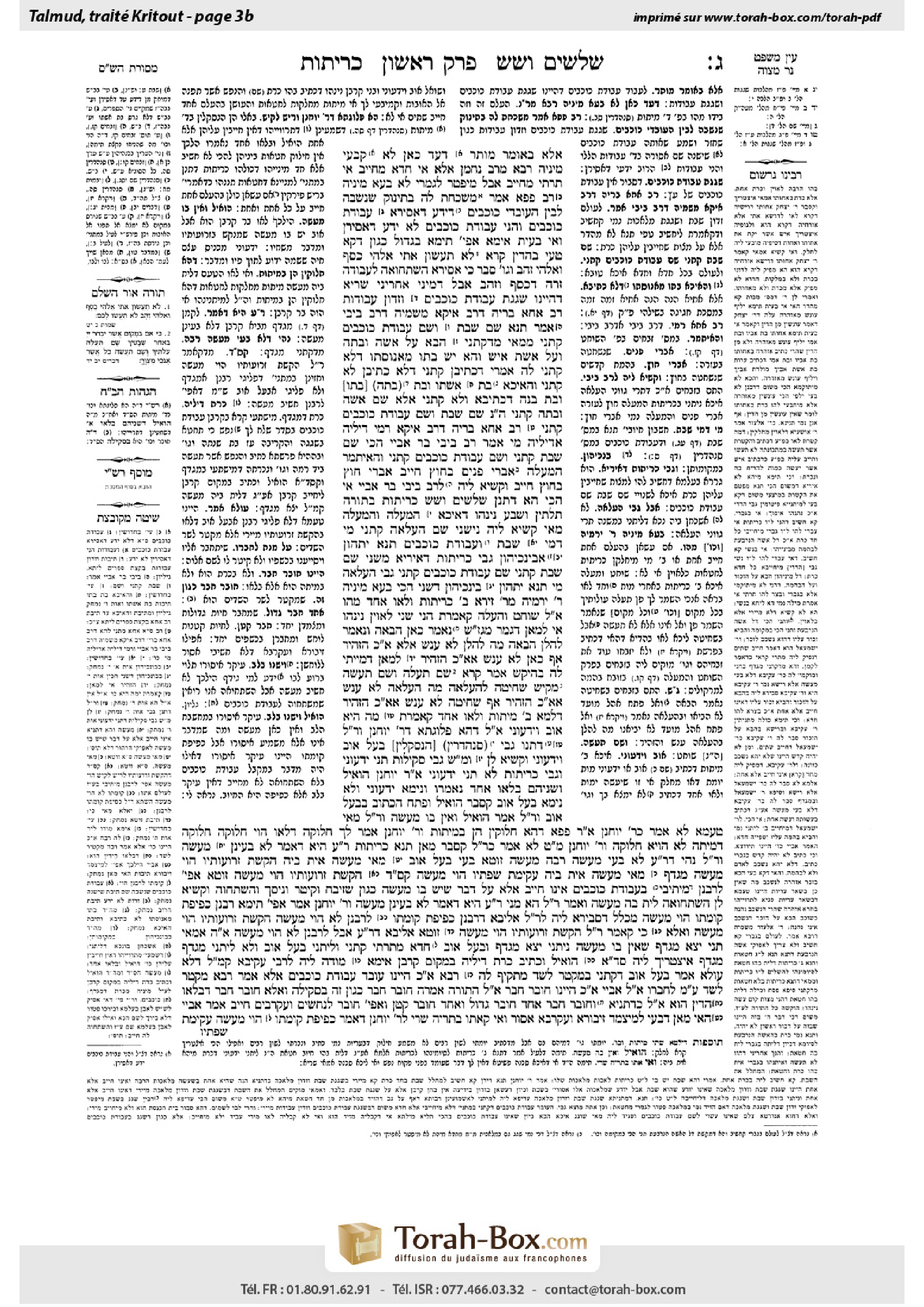
This page of Keritot includes the Aramaic text, an English translation and an AI-generated French translation, alongside the scan above.
כריתות ג׳ ב · Aramaic and Hebrew text
אֶלָּא בְּאוֹמֵר מוּתָּר, דְּעַד כָּאן לָא קָבָעֵי מִינֵּיהּ רָבָא מֵרַב נַחְמָן אֶלָּא אִי חֲדָא מִחַיַּיב אִי תַּרְתֵּי מִחַיַּיב, אָבֵל מִיפְּטַר לִגְמָרֵי לָא בְּעָא מִינֵּיהּ.
רַב פָּפָּא אָמַר: מַשְׁכַּחַתְּ לַהּ בְּתִינוֹק שֶׁנִּשְׁבָּה לְבֵין הַגּוֹיִם, דְּיָדַע דַּאֲסִירָא עֲבוֹדָה זָרָה, וְהָנֵי עֲבוֹדָה זָרָה לָא יָדַע דַּאֲסִירָן.
וְאִי בָּעֵית אֵימָא: אֲפִילּוּ תֵּימָא בְּגָדוֹל – כְּגוֹן דְּקָא טָעֵי בְּהָדֵין קְרָא: ״לֹא תַעֲשׂוּן אִתִּי אֱלֹהֵי כֶסֶף וֵאלֹהֵי זָהָב וְגוֹ׳״ סָבַר: כִּי אֲסִירָא הִשְׁתַּחֲוָאָה לַעֲבוֹדָה זָרָה דְּכֶסֶף וְזָהָב, אֲבָל דְּמִינֵי אַחֲרִינֵי שַׁרְיָא, דְּהַיְינוּ שִׁגְגַת עֲבוֹדָה זָרָה וּזְדוֹן עֲבוֹדוֹת.
רַב אַחָא בְּרֵיהּ דְּרַב אִיקָא מִשְּׁמֵיהּ דְּרַב בִּיבִי אָמַר: תַּנָּא שֵׁם שַׁבָּת וְשֵׁם עֲבוֹדָה זָרָה קָתָנֵי. מִמַּאי? מִדְּקָתָנֵי: הַבָּא עַל אִשָּׁה וּבִתָּהּ וְעַל אֵשֶׁת אִישׁ, וְהָא יֵשׁ בִּתּוֹ מֵאֲנוּסָתוֹ, דְּלָא קָתָנֵי לַהּ!
אָמְרִי: דִּכְתִיבָן קָתָנֵי, דְּלָא כְּתִיבָן לָא קָתָנֵי.
וְהָאִיכָּא בַּת אִשְׁתּוֹ וּבַת בִּתָּהּ וּבַת בְּנָהּ, דִּכְתִיבָא, וְלָא קָתָנֵי! אֶלָּא: שֵׁם אִשָּׁה וּבִתָּהּ קָתָנֵי? הָכִי נָמֵי: שֵׁם שַׁבָּת וְשֵׁם עֲבוֹדָה זָרָה קָתָנֵי.
רַב אַחָא בְּרֵיהּ דְּרַב אִיקָא רָמֵי דִּילֵיהּ אַדִּילֵיהּ: מִי אָמַר רַב בִּיבִי בַּר אַבָּיֵי הָכִי, שֵׁם שַׁבָּת קָתָנֵי וְשֵׁם עֲבוֹדָה זָרָה קָתָנֵי? וְהָאִיתְּמַר: הַמַּעֲלֶה אֵבְרֵי פְּנִים בַּחוּץ – חַיָּיב, אֵבְרֵי חוּץ בַּחוּץ – חַיָּיב.
וְקַשְׁיָא לֵיהּ לְרַב בִּיבִי בַּר אַבָּיֵי: ״אִי הָכִי, הָא דִּתְנַן: שְׁלֹשִׁים וָשֵׁשׁ כָּרֵיתוֹת בְּתוֹרָה – תְּלָתִין וּשְׁבַע נִינְהוּ, דְּאִיכָּא הַמַּעֲלֶה וְהַמַּעֲלֶה!״ מַאי קַשְׁיָא לֵיהּ? נִישְׁנֵי: שֵׁם הַעֲלָאָה קָתָנֵי!
מִי דָּמֵי? שַׁבָּת וַעֲבוֹדָה זָרָה תְּנָא יָתְהוֹן אַבִּינְכֵיהוֹן, גַּבַּי כָּרֵיתוֹת, דְּאִירְיָא, מְשַׁנֵּי: ״שֵׁם שַׁבָּת קָתָנֵי שֵׁם עֲבוֹדָה זָרָה קָתָנֵי״, גַּבֵּי הַעֲלָאָה, מִי תְּנָא יָתְהוֹן בִּינְכֵיהוֹן דְּשַׁנִּי הָכִי?
בְּעָא מִינֵּיהּ רַבִּי יִרְמְיָה מֵרַבִּי זֵירָא: שְׁתֵּי כָּרֵיתוֹת וְלָאו אֶחָד, מַהוּ? אֲמַר לֵיהּ: שׁוֹחֵט וְהֶעֱלָה קָאָמְרַתְּ? הָנֵי שְׁנֵי לָאוִין נִינְהוּ,
אִי לְמַאן דְּגָמַר מִגְּזֵרָה שָׁוָה – נֶאֱמַר כָּאן הֲבָאָה וְנֶאֱמַר לְהַלָּן הֲבָאָה,
מָה לְהַלָּן לֹא עָנַשׁ אֶלָּא אִם כֵּן הִזְהִיר – אַף כָּאן לֹא עָנַשׁ, אֶלָּא אִם כֵּן הִזְהִיר.
לְמַאן דְּמַיְיתֵי לַהּ בְּהֶיקֵּשׁ – אָמַר קְרָא: ״שָׁם תַּעֲלֶה... וְשָׁם תַּעֲשֶׂה״, מַקִּישׁ שְׁחִיטָה לְהַעֲלָאָה, מָה הַעֲלָאָה לֹא עָנַשׁ אֶלָּא אִם כֵּן הִזְהִיר, אַף שְׁחִיטָה לֹא עָנַשׁ אֶלָּא אִם כֵּן הִזְהִיר.
דִּלְמָא שְׁתֵּי מִיתוֹת וְלָאו אֶחָד קָאָמְרַתְּ? מָה הִיא – אוֹב וְיִדְּעוֹנִי.
אֲמַר לֵיהּ דְּהָא פְּלוּגְתָּא דְּרַבִּי יוֹחָנָן וְרֵישׁ לָקִישׁ. דְּתָנוּ גַּבֵּי סַנְהֶדְרִין: בַּעַל אוֹב וְיִדְּעוֹנִי, וְקַשְׁיָא לַן, וּמַאי שְׁנָא גַּבֵּי סְקִילוֹת תָּנֵי יִדְּעוֹנִי, וְגַבֵּי כָּרֵיתוֹת לָא תָּנֵי יִדְּעוֹנִי?
אָמַר רַבִּי יוֹחָנָן: הוֹאִיל וּשְׁנֵיהֶם בְּלָאו אֶחָד נֶאֶמְרוּ. וְנֵימָא יִדְּעוֹנִי, וְלָא נֵימָא בַּעַל אוֹב! קָסָבַר: הוֹאִיל וּפָתַח הַכָּתוּב בְּבַעַל אוֹב.
וְרֵישׁ לָקִישׁ אָמַר: הוֹאִיל וְאֵין בּוֹ מַעֲשֶׂה. וְרֵישׁ לָקִישׁ מַאי טַעְמָא לָא אָמַר כְּרַבִּי יוֹחָנָן?
אָמַר רַב פָּפָּא: דְּהָא חֲלוּקִין הֵן בְּמִיתוֹת. וְרַבִּי יוֹחָנָן אָמַר לְךָ: חֲלוּקָּה דְלָאו – הָוֵי חֲלוּקָּה, חֲלוּקָּה דְמִיתָה – לָא הָוְיָא חֲלוּקָּה.
וְרַבִּי יוֹחָנָן מַאי טַעְמָא לָא אָמַר כְּרֵישׁ לָקִישׁ? קָסָבַר: מַאן תַּנָּא כָּרֵיתוֹת – רַבִּי עֲקִיבָא הִיא, דְּאָמַר לָא בָּעִינַן מַעֲשֶׂה.
וְרֵישׁ לָקִישׁ? נְהִי דְּרַבִּי עֲקִיבָא לָא בָּעֵי מַעֲשֵׂה רַבָּה, מַעֲשֵׂה זוּטָא בָּעֵי.
בַּעַל אוֹב, מַאי מַעֲשֶׂה אִית בֵּיהּ? הֲקָשַׁת זְרוֹעוֹתָיו הָוֵי מַעֲשֶׂה. מְגַדֵּף, מַאי מַעֲשֶׂה אִית בֵּיהּ? עֲקִימַת שְׂפָתָיו הָוֵי מַעֲשֶׂה.
קָא סָלְקָא דַּעְתִּין: הֲקָשַׁת זְרוֹעוֹתָיו הָוֵי מַעֲשֶׂה זוּטָא אֲפִילּוּ לְרַבָּנַן. מֵיתִיבִי: בַּעֲבוֹדָה זָרָה אֵינוֹ חַיָּיב אֶלָּא עַל דָּבָר שֶׁיֵּשׁ בּוֹ מַעֲשֶׂה, כְּגוֹן שֶׁזִּיבַּח, וְקִיטֵּר, וְנִיסֵּךְ, וְהִשְׁתַּחֲוָה. וְקַשְׁיָא לַן, הִשְׁתַּחֲוָאָה לֵית בַּהּ מַעֲשֶׂה!
וְאָמַר רֵישׁ לָקִישׁ: הָא מַנִּי? רַבִּי עֲקִיבָא הִיא, דְּאָמַר לָא בָּעִינַן מַעֲשֶׂה. וְרַבִּי יוֹחָנָן אָמַר: אֲפִילּוּ תֵּימָא רַבָּנַן, כְּפִיפַת קוֹמָתוֹ הָוֵי מַעֲשֶׂה. מִכְּלָל דִּסְבִירָא לֵיהּ לְרֵישׁ לָקִישׁ אַלִּיבָּא דְרַבָּנַן כְּפִיפַת קוֹמָתוֹ לְרַבָּנַן לָא הָוֵי מַעֲשֶׂה. הֲקָשַׁת זְרוֹעוֹתָיו הָוֵי מַעֲשֶׂה?!
וְאֶלָּא כִּי קָאָמַר רֵישׁ לָקִישׁ הֲקָשַׁת זְרוֹעוֹתָיו הָוֵי מַעֲשֶׂה זוּטָא, אַלִּיבָּא דְּרַבִּי עֲקִיבָא, אֲבָל לְרַבָּנַן לָא הָוֵי מַעֲשֶׂה.
אִי הָכִי, אַמַּאי תָּנֵי: יָצָא מְגַדֵּף שֶׁאֵין בּוֹ מַעֲשֶׂה? נִיתְנֵי: יָצָא מְגַדֵּף וּבַעַל אוֹב! חֲדָא מִתַּרְתֵּי קָתָנֵי.
וְלִיתְנֵי בַּעַל אוֹב וְלָא לִיתְנֵי מְגַדֵּף! מְגַדֵּף אִיצְטְרִיךְ לֵיהּ, סָלְקָא דַּעְתָּךְ אָמֵינָא: הוֹאִיל וּכְתִיב כָּרֵת דִּילֵיהּ בִּמְקוֹם קׇרְבָּן, אֵימָא מוֹדֶה לֵיהּ לְרַבִּי עֲקִיבָא, קָא מַשְׁמַע לַן דְּלָא.
עוּלָּא אָמַר: בַּעַל אוֹב דְּקָתָנֵי בִּמְקַטֵּר לַשֵּׁד. מַתְקֵיף לַהּ רָבָא: אִם כֵּן, הַיְינוּ עוֹבֵד עֲבוֹדָה זָרָה! אֶלָּא אָמַר רָבָא: מְקַטֵּר לַשֵּׁד עַל מְנָת לְחַבְּרוֹ.
אֲמַר לֵיהּ אַבָּיֵי: אִם כֵּן, הָיִינוּ חוֹבֵר חָבֶר! אֲמַר לֵיהּ: הַתּוֹרָה אָמְרָה חוֹבֵר חָבֶר כְּגוֹן זֶה, בִּסְקִילָה. וְאֶלָּא חוֹבֵר חֶבֶר דִּבְלָאו – הֵדֵין הוּא?
אֲמַר לֵיהּ: כִּדְתַנְיָא: ״וְחוֹבֵר חָבֶר״ – אֶחָד חוֹבֵר גָּדוֹל וְאֶחָד חוֹבֵר קָטָן, וַאֲפִילּוּ חוֹבֵר לִנְחָשִׁים וְעַקְרַבִּים – חַיָּיב. אָמַר אַבָּיֵי: הַאי מַאן דְּבָעֵי לְמִיצְמַד זִיבּוּרָא וְעַקְרַבָּא – אָסוּר, וְאִי קָאָתוּ בָּתְרֵיהּ – שְׁרֵי.
לְרַבִּי יוֹחָנָן, דְּאָמַר כְּפִיפַת קוֹמָתוֹ הָוֵי מַעֲשֵׂה, עֲקִימַת
Keritot 3b · English translation
Rather, it is referring to a case where one says to himself that this is permitted. He is under the impression that idol worship is permitted, and his unwitting act was the result of ignorance, not forgetfulness. As, Rava raised a dilemma before Rav Naḥman with regard to Shabbat only so it could be determined whether to deem one who is unaware of both the essence of Shabbat and the specific prohibited labors liable to bring one sin offering, or whether to deem him liable to bring two sin offerings. But as for the possibility to exempt him completely, he did not raise such a dilemma before him.
Rav Pappa says: You find an act performed unwittingly with regard to idol worship in the case of a child who was taken captive among the gentiles and never taught about the Torah, as he knows that idol worship in general is prohibited, but with regard to these particular objects of idol worship that he is worshipping, he does not know that they are prohibited.
And if you wish, say instead: You may even say this ruling is stated with regard to an adult, i.e., one who was not captured by gentiles as a child, and it is speaking of a case where he erred with regard to this verse: “You shall not make with Me gods of silver and gods of gold, you shall not make for yourselves” (Exodus 20:20). This person thinks that when bowing to an idol is prohibited it applies only to an object of idol worship fashioned of silver or gold; but with regard to objects fashioned of other substances, such as wood or stone, it is permitted. And that is a case of an action that is unwitting with regard to idol worship but intentional with regard to the prohibited rites.
Rav Aḥa, son of Rav Ika, said a different interpretation of the mishna in the name of Rav Beivai: The tanna teaches the general category of Shabbat and the general category of idol worship, without mentioning the details of how many sin offerings one would be liable to bring for transgressing each prohibition. The Gemara asks: From where can one infer this is the case? From the fact that the mishna teaches: One who engages in intercourse with a woman and her daughter, or with a married woman. But there is the case of one’s daughter from the woman he raped, which the mishna does not teach. The case of a daughter from the woman one raped is included in the category of intercourse with a woman and her daughter, yet it is not taught explicitly. Evidently, it is included in the general category of intercourse with a woman and her daughter.
The Sages say in response to this inference: The tanna of the mishna teaches those prohibitions that are written explicitly in the Torah; he does not teach those prohibitions that are not written explicitly but are derived from the verses. That is the reason he does not teach the case of intercourse with a daughter from the woman one raped; it is not because he is teaching only general categories.
The Gemara challenges this explanation: But there is the case of one’s wife’s daughter, and the daughter of her daughter, and the daughter of her son, which are written explicitly, and yet the tanna does not teach them. Rather, you must say that he teaches the general category of intercourse with a woman and her daughter, which includes those cases. So too, he teaches the general category of Shabbat and the general category of idol worship.
Rav Aḥa, son of Rav Ika, raises a contradiction between one statement of Rav Beivai bar Abaye and another statement of his: Did Rav Beivai bar Abaye actually say this, that the tanna teaches the general category of Shabbat and teaches the general category of idol worship? But wasn’t it stated: One who offers up the limbs of an offering slaughtered inside the Temple outside the Temple, i.e., he slaughtered the animal within the Sanctuary in accordance with halakha but sacrificed its limbs on an altar outside the Temple, he is liable to bring a sin offering if he did so unwittingly. Likewise, if he sacrifices limbs of an offering slaughtered outside the Temple outside the Temple, he is liable.
And Rav Beivai bar Abaye raised a difficulty: If so, consider that which we learned in the mishna: There are thirty-six cases in the Torah with regard to which one who performs the action intentionally is liable to receive karet. They are actually thirty-seven, as there is the case of one who offers up the limbs of an offering slaughtered inside the Temple outside the Temple, and one who offers up limbs of an offering slaughtered outside the Temple outside the Temple. Rav Aḥa, son of Rav Ika, explains the contradiction: If Rav Beivai bar Abaye maintains that the tanna of the mishna does not tally all the relevant prohibitions but states general categories, what is difficult to him? Let him answer that he teaches the category of offering up in the clause: One who slaughters offerings and who sacrifices them outside the Temple. The tanna would not then need to list these individual transgressions.
The Gemara responds: Are these cases comparable? In the cases of Shabbat and idol worship the tanna taught their details in their places [abeinekheihon], on Shabbat 73a and Sanhedrin 60b, respectively. Consequently, with regard to karet, where it is necessary to mention them as part of a list of prohibitions that are punishable by karet, Rav Beivai bar Abaye answers that the tanna teaches the category of Shabbat and teaches the category of idol worship, but he did not need to specify the details in this manner. By contrast, with regard to bringing up an offering, does the tanna teach them in their place, so that Rav Beivai bar Abaye can answer in this manner?
§ It was stated earlier that Rabbi Elazar says that Rabbi Oshaya says: Anywhere you find two different prohibitions but only one punishment of karet is stated for both of them you should divide the sin offering between them, i.e., if one transgressed both prohibitions unwittingly he is liable to bring a sin offering for each. In a similar vein, Rabbi Yirmeya raised a dilemma before Rabbi Zeira: If there are two punishments of karet and only one prohibition written with regard to a certain act, what is the halakha? Is one liable to bring a separate sin offering for each act? Rabbi Zeira said to him: Are you saying this in reference to one who slaughters offerings outside the Temple and one who offered up the limbs of offerings outside the Temple? These do not match your description, as these are two separate prohibitions.
Rabbi Zeira elaborates: If one considers the matter according to the one who derives the prohibition from a verbal analogy, it is as though both prohibitions are written explicitly. As it is stated here an expression of bringing: “Or who slaughters it outside the camp, and to the entrance of the Tent of Meeting he did not bring it” (Leviticus 17:3–4), and it is stated there an expression of bringing: “Who sacrifices a burnt offering or sacrifice, and to the entrance of the Tent of Meeting he did not bring it” (Leviticus 17:8–9).
Since there is a verbal analogy linking slaughtering an offering outside the Temple to sacrificing one outside the Temple, it follows that just as there, with regard to sacrificing, the Torah did not prescribe punishment unless it explicitly prohibited the act, as it is written: “Take heed to yourself, lest you sacrifice your burnt offerings in every place that you see” (Deuteronomy 12:13), so too here, with regard to slaughtering, the Torah did not prescribe punishment unless it explicitly prohibited the act as a separate prohibition.
If one considers the matter according to the one who derives the prohibition from a juxtaposition, it is also as though both prohibitions are written explicitly. The juxtaposition is that the verse states: “There you shall sacrifice your burnt offerings and there you shall do all that I command you” (Deuteronomy 12:14). Here the verse juxtaposes slaughtering, in the phrase: “And there you shall do,” to offering up. This teaches that just as there, with regard to offering up, the Torah did not prescribe punishment unless it explicitly prohibited the act, so too here, with regard to slaughtering, the Torah did not prescribe punishment unless it explicitly prohibited the act. Whether one derives the prohibition by verbal analogy or juxtaposition, it is considered as though the Torah explicitly wrote a prohibition with regard to slaughtering, and therefore this would not meet the criteria of Rabbi Yirmeya’s dilemma.
Rabbi Zeira continues to address Rabbi Yirmeya: Perhaps you are stating your dilemma with regard to two prohibitions punishable by the death penalty and only one prohibition is written with regard to them, and your dilemma is whether one brings two sin offerings if one transgressed both unwittingly, despite the fact that only one prohibition is written with regard to both acts. What is such a circumstance? This applies in the case of a necromancer, who raises up the spirit of the dead, and a sorcerer, who places a certain bone in his mouth for it to speak of its own accord (see Leviticus 20:6, 27).
Rabbi Zeira further said to Rabbi Yirmeya: This should not be a dilemma, as this matter is a dispute between Rabbi Yoḥanan and Reish Lakish. As the Sages taught a baraita, where they list those liable to be executed by stoning, in tractate Sanhedrin (53a): A necromancer and a sorcerer, and the following presents a difficulty to us: And what is different with regard to stonings that the tanna teaches the case of a sorcerer, but the tanna does not teach the case of a sorcerer with regard to the list of transgressions punishable by karet, thereby indicating that one is liable to bring only a single sin offering for both transgressions?
Rabbi Yoḥanan said: The tanna in tractate Karetot does not count the case of the sorcerer on its own since both the sorcerer and the necromancer were stated in one prohibition: “Do not turn to the necromancers and the sorcerers” (Leviticus 19:31); therefore, there is no separate obligation to bring an offering for each of them. The Gemara clarifies: And let the tanna say the case of a sorcerer and let him not say the case of a necromancer, rather than the reverse. The Gemara explains: The tanna maintains that since the verse opened with the case of a necromancer, it is proper to list that transgression and omit the case of a sorcerer.
And Reish Lakish says: The case of the sorcerer is not included in the list of transgressions punishable by karet since it does not involve an action, but only speech, through the use of a bone, and one does not bring a sin offering for a prohibition that does not involve an action. The Gemara asks: And as for Reish Lakish, what is the reason he does not state an explanation in accordance with the explanation of Rabbi Yoḥanan?
Rav Pappa said: Reish Lakish disagrees with the explanation of Rabbi Yoḥanan because the cases of a necromancer and a sorcerer are divided in the verse with regard to the issue of the death penalty, i.e., one is liable to receive the death penalty for transgressing either prohibition, as it is stated: “And a man also or a woman, who are a necromancer or a sorcerer shall be put to death” (Leviticus 20:27). Consequently, one would be liable to bring a separate sin offering for the unwitting transgression of either prohibition were it not for the fact that sorcery does not involve an action. And Rabbi Yoḥanan could say to you that a division of a prohibition is considered a division that leads to separate sin offerings, whereas a division of separate death penalties is not considered a division in this regard.
The Gemara further asks: And as for Rabbi Yoḥanan, what is the reason he does not state an explanation in accordance with the explanation of Reish Lakish, who says the prohibition with regard to a sorcerer is not counted because it does not involve an action? The Gemara answers: Rabbi Yoḥanan maintains: Who is the tanna who taught the list of those liable to receive karet? It is Rabbi Akiva, who says: An action is not required for one to be liable to bring a sin offering.
The Gemara asks: And as for Reish Lakish, how does he respond to this claim? He could say that although Rabbi Akiva does not require a significant action for one to be liable to bring a sin offering, nevertheless he does require a minor action. The transgression of a sorcerer involves no action, as the voice emerges of its own accord, and therefore even Rabbi Akiva would not hold one liable to bring a sin offering for the unwitting violation of this prohibition.
The Gemara asks: In the case of a necromancer, what action is there in this transgression? The Gemara answers: The striking of his arms against each other to raise the spirit of the dead is considered an action. The Gemara further asks: In the case of one who blasphemes, who merely speaks, what action is there in this transgression? Since Rabbi Akiva holds that an unwitting blasphemer is liable to bring a sin offering, this apparently indicates that no action at all is necessary. The Gemara answers: The twisting of his lips while he speaks is considered an action.
The Gemara comments: It enters our mind that the striking of the necromancer’s arms against each other is considered a minor action even according to the opinion of the Rabbis, and they would deem him liable. The Gemara raises an objection from a baraita: With regard to idol worship, one is liable to be punished only for a matter that involves an action, for example where one slaughtered an offering, or burned incense, or poured a libation, or bowed. And the following matter poses a difficulty to us: Bowing does not involve an action.
And Reish Lakish said: In accordance with whose opinion is this baraita? It is in accordance with the opinion of Rabbi Akiva, who says: An action is not required for one to be liable to bring a sin offering for transgressing a prohibition. And Rabbi Yoḥanan said: You may even say that the baraita is in accordance with the opinion of the Rabbis, as the bending of his height when he bows is considered an action. One can conclude from here by inference that Reish Lakish maintains that according to the opinion of the Rabbis, the bending of his height is not considered an action. If so, can it be said that the striking of his arms against each other, which is less of a movement than bending one’s height, is considered an action?
But rather, you must explain that when Reish Lakish says the striking of his arms against each other is considered a minor action, he is speaking only in accordance with the opinion of Rabbi Akiva; but according to the opinion of the Rabbis it is not considered an action.
The Gemara raises a difficulty: If so, that the Rabbis hold that the necromancer does not perform an action, why does the mishna teach that the Rabbis say: The list in the mishna is excluding one who blasphemes, as he does not perform an action, but rather he sins with speech. Let it teach instead: The list in the mishna is excluding one who blasphemes and a necromancer. The Gemara answers: The tanna teaches one of two examples that the Rabbis could have mentioned.
The Gemara questions this explanation: But if that is so, let the mishna teach the statement of the Rabbis with regard to a necromancer and let it not teach the statement of the Rabbis with regard to one who blasphemes. The Gemara answers: It was necessary for the tanna to mention one who blasphemes, as it might enter your mind to say: Since its punishment of karet is written in the place where the verse discusses an offering (see Numbers 15:28–30), one might say that in this case the Rabbis concede to Rabbi Akiva that one is liable to bring a sin offering despite the fact that no action is involved. To counter this, the mishna specifically mentions the exclusion of one who blasphemes to teach us that this is not the case.
Ulla said: The reason the Rabbis did not state: Excluding one who blasphemes and a necromancer, is that the action of the necromancer that the mishna teaches is referring to one who burns incense to a demon in order to raise the dead, which is a full-fledged action. Rava objects to this answer from Ulla: If so, i.e., if the necromancer burns incense to a demon, this is the same as an idol worshipper, which is already mentioned in the mishna. Rather, Rava said: The mishna is referring to one who burns incense to a demon in order to gather it together with other demons, i.e., he does not burn incense to a demon by means of a rite but in a manner of sorcery, to bring the demons to one place to then make use of them.
Abaye said to Rava: If so, this is the same as a ḥover ḥever, one who gathers together, which is stated in the Torah as a separate prohibition (Deuteronomy 18:11) and which is a prohibition that does not carry the punishment of karet. Rava said to him: It is true that such an individual is also a ḥover ḥever, but the Torah stated: A ḥover ḥever such as this, who gathers demons together, is included in the category of a necromancer and therefore his punishment is death by stoning, and transgressing this prohibition also results in karet. Abaye inquired: But then the case of a ḥover ḥever, which is a prohibition that does not entail karet, what is it?
Rava said to Abaye: As it is taught in a baraita with regard to the verse: “And a ḥover ḥaver” (Deuteronomy 18:11), this is referring to both one who uses sorcery and thereby gathers large beasts into one place, and also to one who gathers small beasts into one place, and even to one who gathers into one place snakes and scorpions; all of these individuals are liable. With regard to this prohibition Abaye says: In the case of this one, who through sorcery wants to gather together a hornet and a scorpion, this is prohibited. But if they are pursuing him and he merely seeks to defend himself, it is permitted.
The Gemara objects: According to the opinion of Rabbi Yoḥanan, who says the bending of one’s height is considered an action, the twisting of
Keritot 3b · Traduction française (IA)
Au contraire, il fait référence à un cas où l'on se dit que cela est permis. Il est sous l'impression que le culte des idoles est permis, et son acte commis sans intention était le résultat de l'ignorance, et non de l'oubli. Car Rava a posé un dilemme à Rav Naḥman concernant le Chabbat, uniquement pour déterminer si l'on doit considérer celui qui ignore à la fois l'essence du Chabbat et les travaux spécifiques interdits comme tenu d'apporter un seul sacrifice expiatoire, ou s'il est tenu d'en apporter deux. Mais quant à la possibilité de l'exonérer complètement, il ne lui a pas posé un tel dilemme.
Rav Pappa dit : Vous trouvez un acte commis sans intention en matière de culte des idoles dans le cas d'un enfant qui a été capturé parmi les non-Juifs et n'a jamais été enseigné sur la Torah, car il sait que le culte des idoles en général est interdit, mais quant à ces objets spécifiques du culte des idoles qu'il adore, il ne sait pas qu'ils sont interdits.
Et si vous le souhaitez, dites plutôt : Vous pouvez même dire que ce jugement est énoncé à propos d'un adulte, c'est-à-dire d'une personne qui n'a pas été capturée par des non-Juifs enfant, et il s'agit d'un cas où il s'est trompé concernant ce verset : « Vous ne ferez pas avec Moi des dieux d'argent et des dieux d'or, vous ne vous ferez pas » (Exode 20:20). Cette personne pense que lorsque l'inclination devant une idole est interdite, cela ne s'applique qu'à un objet du culte des idoles façonné en argent ou en or ; mais quant aux objets façonnés en d'autres substances, tels que le bois ou la pierre, c'est permis. Et c'est un cas d'action qui est sans intention en matière de culte des idoles, mais intentionnelle en matière de rites interdits.
Rav Aḥa, fils de Rav Ika, a proposé une interprétation différente de la Michna au nom de Rav Beivai : Le tanna enseigne la catégorie générale du Chabbat et la catégorie générale du culte des idoles, sans mentionner les détails concernant le nombre de sacrifices expiatoires dont on serait tenu d'apporter pour avoir transgressé chaque interdiction. La Guemara demande : D'où peut-on inférer que c'est le cas ? Du fait que la Michna enseigne : Celui qui a des rapports avec une femme et sa fille, ou avec une femme mariée. Or, il y a le cas de la fille d'une femme qu'il a violée, que la Michna n'enseigne pas. Le cas d'une fille issue d'une femme violée est inclus dans la catégorie des rapports avec une femme et sa fille, et pourtant il n'est pas enseigné explicitement. Évidemment, il est inclus dans la catégorie générale des rapports avec une femme et sa fille.
Les Sages répondent à cette inférence : Le tanna de la Michna enseigne les interdits qui sont écrits explicitement dans la Torah ; il n'enseigne pas les interdits qui ne sont pas écrits explicitement mais qui sont dérivés des versets. C'est la raison pour laquelle il n'enseigne pas le cas des rapports avec une fille issue d'une femme violée ; ce n'est pas parce qu'il enseigne seulement des catégories générales.
La Guemara conteste cette explication : Mais il y a le cas de la fille de sa femme, et la fille de sa fille, et la fille de son fils, qui sont écrits explicitement, et pourtant le tanna ne les enseigne pas. Il faut plutôt dire qu'il enseigne la catégorie générale des rapports avec une femme et sa fille, qui inclut ces cas. De même, il enseigne la catégorie générale du Chabbat et la catégorie générale du culte des idoles.
Rav Aḥa, fils de Rav Ika, soulève une contradiction entre une déclaration de Rav Beivai bar Abaye et une autre déclaration de ce dernier : Rav Beivai bar Abaye a-t-il vraiment dit que le tanna enseigne la catégorie générale du Chabbat et enseigne la catégorie générale du culte des idoles ? Mais n'a-t-il pas été dit : Celui qui offre les membres d'une offrande abattue à l'intérieur du Temple à l'extérieur du Temple, c'est-à-dire qu'il a abattu l'animal dans le Sanctuaire conformément à la halakha mais a sacrifié ses membres sur un autel à l'extérieur du Temple, est tenu d'apporter un sacrifice expiatoire s'il l'a fait sans intention. De même, s'il sacrifie les membres d'une offrande abattue à l'extérieur du Temple à l'extérieur du Temple, il est tenu.
Et Rav Beivai bar Abaye a soulevé une difficulté : Si c'est ainsi, considérez ce que nous avons appris dans la Michna : Il y a trente-six cas dans la Torah pour lesquels celui qui commet l'acte intentionnellement est passible de la kareth. Il y en a en réalité trente-sept, car il y a le cas de celui qui offre les membres d'une offrande abattue à l'intérieur du Temple à l'extérieur du Temple, et celui qui offre les membres d'une offrande abattue à l'extérieur du Temple à l'extérieur du Temple. Rav Aḥa, fils de Rav Ika, explique la contradiction : Si Rav Beivai bar Abaye soutient que le tanna de la Michna ne compte pas toutes les interdictions pertinentes mais énonce des catégories générales, qu'est-ce qui lui pose problème ? Qu'il réponde qu'il enseigne la catégorie de l'offrande dans la clause : Celui qui abatte des offrandes et qui les sacrifie à l'extérieur du Temple. Le tanna n'aurait alors pas besoin de lister ces transgressions individuelles.
La Guemara répond : Ces cas sont-ils comparables ? Dans les cas du Chabbat et du culte des idoles, le tanna a enseigné leurs détails à leur place respective [abeinekheihon], dans Chabbat 73a et Sanhédrin 60b, respectivement. Par conséquent, en matière de kareth, où il est nécessaire de les mentionner comme faisant partie d'une liste d'interdits punissables par la kareth, Rav Beivai bar Abaye répond que le tanna enseigne la catégorie du Chabbat et enseigne la catégorie du culte des idoles, mais qu'il n'a pas besoin de spécifier les détails de cette manière. En revanche, en matière de présentation d'une offrande, le tanna les enseigne-t-il à leur place, de sorte que Rav Beivai bar Abaye puisse répondre de cette manière ?
§ Il a été dit plus tôt que Rabbi Elazar dit que Rabbi Oshaya dit : Partout où l'on trouve deux interdictions différentes, mais qu'une seule punition de kareth est mentionnée pour les deux, on doit diviser le sacrifice expiatoire entre elles, c'est-à-dire que si une personne a transgressé les deux interdictions sans le vouloir, elle est tenue d'apporter un sacrifice expiatoire pour chacune. De même, Rabbi Yirmeya a posé un dilemme devant Rabbi Zeira : S'il y a deux punitions de kareth et qu'une seule interdiction est écrite à propos d'un certain acte, quelle est la halakha ? Est-on tenu d'apporter un sacrifice expiatoire distinct pour chaque acte ? Rabbi Zeira lui dit : Est-ce que tu dis cela à propos de celui qui égorge des offrandes en dehors du Temple et de celui qui offre les membres des offrandes en dehors du Temple ? Ces cas ne correspondent pas à ta description, car il s'agit de deux interdictions distinctes.
Rabbi Zeira précise : Si l'on examine la question selon celui qui déduit l'interdiction par une analogie verbale, c'est comme si les deux interdictions étaient écrites explicitement. En effet, il est dit ici une expression d'apport : « Ou celui qui l'égorgera en dehors du camp, et qui ne l'aura pas apporté à l'entrée de la Tente de la Rencontre » (Lévitique 17:3-4), et il est dit là une expression d'apport : « Celui qui sacrifiera un holocauste ou un sacrifice, et qui ne l'aura pas apporté à l'entrée de la Tente de la Rencontre » (Lévitique 17:8-9).
Puisqu'il existe une analogie verbale reliant l'égorgement d'une offrande en dehors du Temple au sacrifice d'une offrande en dehors du Temple, il s'ensuit que, de même qu'il y a, à propos du sacrifice, la Torah n'a pas prescrit de punition à moins d'interdire explicitement l'acte, comme il est écrit : « Prends garde à toi, de peur que tu ne sacrifies tes holocaustes en tout lieu que tu verras » (Deutéronome 12:13), de même ici, à propos de l'égorgement, la Torah n'a pas prescrit de punition à moins d'interdire explicitement l'acte en tant qu'interdiction distincte.
Si l'on examine la question selon celui qui déduit l'interdiction par juxtaposition, c'est également comme si les deux interdictions étaient écrites explicitement. La juxtaposition est que le verset énonce : « Là, tu sacrifieras tes holocaustes, et là, tu feras tout ce que je te commande » (Deutéronome 12:14). Ici, le verset juxtapose l'égorgement, dans l'expression : « Et là, tu feras », à l'offrande. Cela enseigne que, de même qu'en ce qui concerne l'offrande, la Torah n'a pas prescrit de punition à moins d'interdire explicitement l'acte, de même ici, en ce qui concerne l'égorgement, la Torah n'a pas prescrit de punition à moins d'interdire explicitement l'acte. Que l'on déduise l'interdiction par analogie verbale ou par juxtaposition, cela est considéré comme si la Torah avait écrit explicitement une interdiction concernant l'égorgement, et par conséquent, cela ne remplirait pas les critères du dilemme de Rabbi Yirmeya.
Rabbi Zeira continue d'adresser la parole à Rabbi Yirmeya : Peut-être que tu poses ton dilemme à propos de deux interdictions punies de la peine de mort, alors qu'une seule interdiction est écrite à leur égard, et ton dilemme est de savoir si l'on apporte deux sacrifices expiatoires si l'on a transgressé les deux sans le vouloir, malgré le fait qu'une seule interdiction soit écrite à propos des deux actes. Quelle est une telle circonstance ? Cela s'applique dans le cas d'un nécromancien, qui fait revivre l'esprit des morts, et d'un sorcier, qui place un certain os dans sa bouche pour qu'il parle de lui-même (voir Lévitique 20:6, 27).
Rabbi Zeïra dit encore à Rabbi Yirmeya : Cela ne devrait pas poser de difficulté, car cette question fait l'objet d'un désaccord entre Rabbi Yoḥanan et Reish Lakish. Comme les Sages ont enseigné une baraïta, où ils énumèrent ceux qui sont passibles de la lapidation, dans le traité Sanhédrin (53a) : « Un nécromancien et un sorcier », et le passage suivant nous pose une difficulté : Et qu'est-ce qui est différent à propos des lapidations pour que le tanna enseigne le cas d'un sorcier, mais que le tanna n'enseigne pas le cas d'un sorcier à propos de la liste des transgressions punies par le karet, indiquant ainsi qu'une personne n'est tenue d'apporter qu'un seul sacrifice expiatoire pour les deux transgressions ?
Rabbi Yoḥanan a dit : Le tanna dans le traité Keritot ne compte pas le cas du sorcier à part, car à la fois le sorcier et le nécromancien ont été mentionnés dans une seule interdiction : « Ne vous tournez pas vers les nécromanciens et les sorciers » (Lévitique 19:31) ; par conséquent, il n'y a pas d'obligation distincte d'apporter une offrande pour chacun d'eux. La Guemara précise : Et que le tanna dise le cas d'un sorcier et qu'il ne dise pas le cas d'un nécromancien, plutôt que l'inverse. La Guemara explique : Le tanna soutient que puisque le verset a commencé par le cas d'un nécromancien, il est approprié d'énumérer cette transgression et d'omettre le cas d'un sorcier.
Et Reish Lakish dit : Le cas du sorcier n'est pas inclus dans la liste des transgressions punies par le karet car il ne implique pas une action, mais seulement la parole, par l'utilisation d'un os, et l'on n'apporte pas de sacrifice expiatoire pour une interdiction qui ne implique pas une action. La Guemara demande : Et quant à Reish Lakish, quelle est la raison pour laquelle il ne formule pas une explication conformément à l'explication de Rabbi Yoḥanan ?
Rav Pappa a dit : Reish Lakish est en désaccord avec l'explication de Rabbi Yoḥanan, car les cas du nécromancien et du sorcier sont distingués dans le verset en ce qui concerne la question de la peine de mort, c'est-à-dire qu'une personne est passible de la peine de mort pour la transgression de l'une ou l'autre interdiction, comme il est écrit : « Et un homme ou une femme qui est nécromancien ou sorcier sera mis à mort » (Lévitique 20:27). Par conséquent, on serait tenu d'apporter un sacrifice expiatoire distinct pour la transgression involontaire de l'une ou l'autre interdiction, n'était le fait que la sorcellerie ne comporte pas d'action. Et Rabbi Yoḥanan pourrait vous répondre qu'une division d'une interdiction est considérée comme une division qui entraîne des sacrifices expiatoires distincts, tandis qu'une division de peines de mort distinctes n'est pas considérée comme une division à cet égard.
La Guemara demande encore : Quant à Rabbi Yoḥanan, quelle est la raison pour laquelle il ne formule pas une explication conforme à celle de Reish Lakish, qui affirme que l'interdit concernant le sorcier n'est pas compté parce qu'il ne comporte pas d'action ? La Guemara répond : Rabbi Yoḥanan soutient : Qui est le tanna qui a enseigné la liste de ceux qui sont passibles de la karet ? C'est Rabbi Akiva, qui dit : Une action n'est pas requise pour qu'une personne soit passible d'offrir un sacrifice expiatoire.
La Guemara demande : Quant à Reish Lakish, comment répond-il à cette objection ? Il pourrait dire que bien que Rabbi Akiva ne requière pas une action significative pour qu'une personne soit passible d'offrir un sacrifice expiatoire, il requiert néanmoins une action mineure. La transgression du sorcier ne comporte aucune action, car la voix émerge d'elle-même, et par conséquent, même Rabbi Akiva ne tiendrait pas une personne pour passible d'offrir un sacrifice expiatoire pour la violation involontaire de cet interdit.
La Guemara demande : Dans le cas d'un nécromancien, quelle action y a-t-il dans cette transgression ? La Guemara répond : Le fait de frapper ses bras l'un contre l'autre pour faire monter l'esprit des morts est considéré comme une action. La Guemara demande encore : Dans le cas de celui qui blasphème, qui ne fait que parler, quelle action y a-t-il dans cette transgression ? Puisque Rabbi Akiva soutient qu'un blasphémateur involontaire est passible d'offrir un sacrifice expiatoire, cela indique apparemment qu'aucune action n'est nécessaire du tout. La Guemara répond : Le mouvement de ses lèvres lorsqu'il parle est considéré comme une action.
La Guemara commente : Il nous vient à l'esprit que le fait de frapper les bras l'un contre l'autre par le nécromancien est considéré comme une action mineure même selon l'opinion des Sages, et ils le tiendraient pour passible. La Guemara soulève une objection à partir d'une baraïta : Concernant le culte des idoles, on n'est passible de punition que pour une affaire qui comporte une action, par exemple lorsqu'on a immolé une offrande, ou brûlé de l'encens, ou versé une libation, ou s'est prosterné. Et la question suivante nous pose une difficulté : La prosternation ne comporte pas d'action.
Et Reish Lakish a dit : Selon l'opinion de qui est cette baraïta ? Elle est conforme à l'opinion de Rabbi Akiva, qui dit : Une action n'est pas requise pour qu'une personne soit passible d'offrir un sacrifice expiatoire pour avoir transgressé un interdit. Et Rabbi Yoḥanan a dit : Vous pouvez même dire que la baraïta est conforme à l'opinion des Sages, car le fait de baisser sa stature lorsqu'il se prosterne est considéré comme une action. On peut en conclure par inférence que Reish Lakish soutient que selon l'opinion des Sages, le fait de baisser sa stature n'est pas considéré comme une action. Si tel est le cas, peut-on dire que le fait de frapper ses bras l'un contre l'autre, qui est un mouvement moindre que le fait de baisser sa stature, est considéré comme une action ?
Mais plutôt, vous devez expliquer que lorsque Reish Lakish affirme que le fait de frapper ses bras l'un contre l'autre est considéré comme une action mineure, il ne parle qu'en accord avec l'opinion de Rabbi Akiva ; mais selon l'opinion des Sages, ce n'est pas considéré comme une action.
La Guemara soulève une difficulté : Si tel est le cas, à savoir que les Sages soutiennent que le nécromancien ne commet pas d'action, pourquoi la Michna enseigne-t-elle que les Sages disent : La liste dans la Michna exclut celui qui blasphème, car il ne commet pas d'action, mais plutôt il pèche par la parole. Qu'elle enseigne plutôt : La liste dans la Michna exclut celui qui blasphème et un nécromancien. La Guemara répond : Le tanna enseigne l'un des deux exemples que les Sages auraient pu mentionner.
La Guemara met en question cette explication : Mais si tel est le cas, que la Michna enseigne l'énoncé des Sages concernant un nécromancien et qu'elle n'enseigne pas l'énoncé des Sages concernant celui qui blasphème. La Guemara répond : Il était nécessaire pour le tanna de mentionner celui qui blasphème, car il pourrait vous venir à l'esprit de dire : Puisque sa punition de la karet est écrite à l'endroit où le verset discute d'une offrande (voir Nombres 15:28–30), on pourrait dire que dans ce cas, les Sages concèdent à Rabbi Akiva qu'une personne est passible d'offrir un sacrifice expiatoire malgré le fait qu'aucune action ne soit impliquée. Pour contrer cela, la Michna mentionne spécifiquement l'exclusion de celui qui blasphème pour nous enseigner que ce n'est pas le cas.
Ulla a dit : La raison pour laquelle les Sages n'ont pas formulé : « Excluant celui qui blasphème et un nécromancien », est que l'action du nécromancien dont parle la Michna désigne celui qui brûle de l'encens à un démon afin de faire monter les morts, ce qui constitue une action à part entière. Rava objecte à cette réponse d'Ulla : Si tel est le cas, c'est-à-dire si le nécromancien brûle de l'encens à un démon, cela revient à l'adoration des idoles, qui est déjà mentionnée dans la Michna. Plutôt, Rava a dit : La Michna fait référence à celui qui brûle de l'encens à un démon afin de le rassembler avec d'autres démons, c'est-à-dire qu'il ne brûle pas d'encens à un démon par le biais d'un rituel, mais par une pratique de sorcellerie, pour amener les démons en un seul endroit afin de s'en servir ensuite.
Abaye a dit à Rava : Si tel est le cas, cela revient à un ḥover ḥever, celui qui rassemble, qui est énoncé dans la Torah comme une interdiction distincte (Deutéronome 18:11) et qui est une interdiction qui n'entraîne pas la punition de la karet. Rava lui a dit : Il est vrai qu'un tel individu est aussi un ḥover ḥever, mais la Torah a énoncé : Un ḥover ḥever de ce type, qui rassemble les démons, est inclus dans la catégorie du nécromancien et par conséquent sa punition est la mort par lapidation, et la transgression de cette interdiction entraîne également la karet. Abaye a demandé : Mais alors, le cas d'un ḥover ḥever, qui est une interdiction qui n'entraîne pas la karet, qu'est-ce que c'est ?
Rava dit à Abaye : Comme il est enseigné dans une baraïta au sujet du verset : « Et un ḥover ḥaver » (Deutéronome 18:11), cela fait référence à la fois à celui qui utilise la sorcellerie pour rassembler de grandes bêtes en un même lieu, et à celui qui rassemble de petites bêtes en un même lieu, et même à celui qui rassemble en un même lieu des serpents et des scorpions ; tous ces individus sont passibles de peine. Concernant cette interdiction, Abaye dit : Dans le cas de celui qui, par la sorcellerie, veut rassembler une guêpe et un scorpion, cela est interdit. Mais si elles le poursuivent et qu'il cherche simplement à se défendre, c'est permis.
La Guemara objecte : Selon l'opinion de Rabbi Yoḥanan, qui dit que la flexion de sa taille est considérée comme une action, le retournement de
Traduction française générée par IA à partir de l’édition anglaise de Sefaria. Vérifie toujours un passage avec le texte source.
Text from Sefaria: William Davidson Edition - Vocalized Aramaic (CC BY NC); William Davidson Edition - English (CC BY NC).