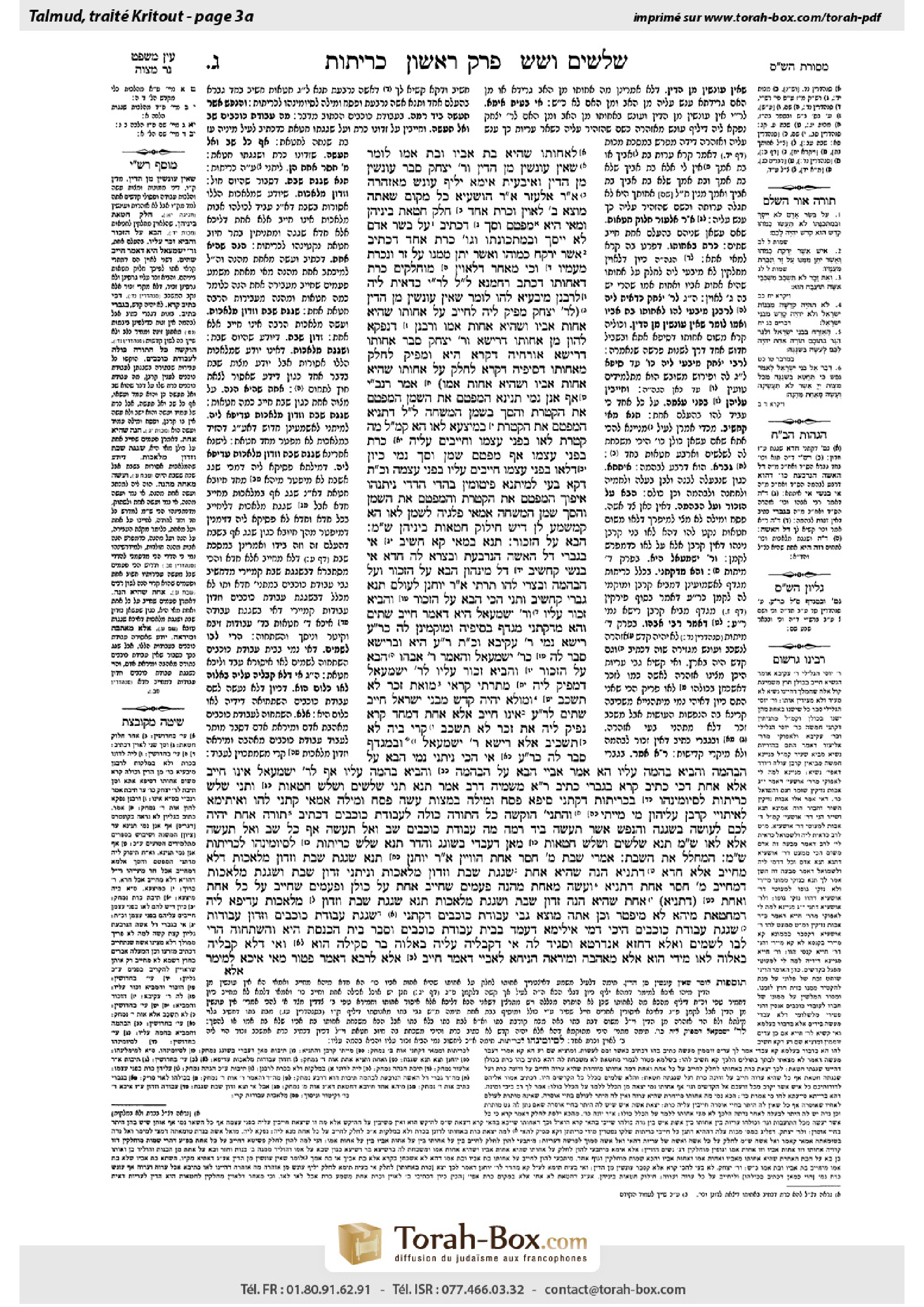
Keritot 3a: Talmud study for Daf Yomi
Daf Yomi is the daily study of one Talmud folio. Explore 37 tractates with scans, Hebrew text, Sefaria English and AI-generated French translations where annotated.
Passage selection and English or AI-generated French translation are available where the scan has annotations. Daf Study is independent of Torah-Box and Sefaria.
Browse Keritot · כריתות · All tractatesKeritot 3a text and translations
This page of Keritot includes the Aramaic text, an English translation and an AI-generated French translation, alongside the scan above.
כריתות ג׳ א · Aramaic and Hebrew text
לַאֲחוֹתוֹ שֶׁהִיא בַּת אָבִיו וּבַת אִמּוֹ, לוֹמַר שֶׁאֵין עוֹנְשִׁין מִן הַדִּין.
וְרַבִּי יִצְחָק, סָבַר: עוֹנְשִׁין מִן הַדִּין. וְאִיבָּעֵית אֵימָא: יָלֵיף עוֹנֶשׁ מֵאַזְהָרָה.
אָמַר רַבִּי אֶלְעָזָר אָמַר רַבִּי הוֹשַׁעְיָא: כׇּל מָקוֹם שֶׁאַתָּה מוֹצֵא שְׁנֵי לָאוִין וְכָרֵת אֶחָד – חַלֵּק חַטָּאת בֵּינֵיהֶן. וּמַאי הִיא? מְפַטֵּם וְסָךְ, דִּכְתִיב: ״עַל בְּשַׂר אָדָם לֹא יִיסָךְ וּבְמַתְכֻּנְתּוֹ וְגוֹ׳״, כָּרֵת אֶחָד, דִּכְתִיב: ״אֲשֶׁר יִרְקַח כָּמֹהוּ וַאֲשֶׁר יִתֵּן מִמֶּנּוּ עַל זָר וְנִכְרַת מֵעַמָּיו״.
וְכִי מֵאַחַר דְּלָאוִין מוּחְלָקִים, כָּרֵת דַּאֲחוֹתוֹ דִּכְתַב רַחֲמָנָא לְמָה לִי?
לְרַבִּי יִצְחָק – כִּדְאִית לֵיהּ, לְרַבָּנַן מִיבַּעְיָא לְהוּ: לוֹמַר, שֶׁאֵין עוֹנְשִׁין מִן הַדִּין! לְרַבִּי יִצְחָק, מַפֵּיק לֵיהּ לְחַיֵּיב עַל אֲחוֹתוֹ שֶׁהִיא אֲחוֹת אָבִיו וְשֶׁהִיא אֲחוֹת אִמּוֹ.
וְרַבָּנַן? דְּנָפְקָא לְהוֹן מִן ״אֲחֹתוֹ״ דְרֵישָׁא. וְרַבִּי יִצְחָק? סָבַר ״אֲחוֹתוֹ״ דְרֵישָׁא אוֹרְחֵיהּ דִּקְרָא הִיא, וּמַפֵּיק לְחַלֵּק מֵ״אֲחֹתוֹ״ דְּסֵיפֵיהּ דִּקְרָא, לְחַלֵּק עַל אֲחוֹתוֹ שֶׁהִיא אֲחוֹת אָבִיו וְשֶׁהִיא אֲחוֹת אִמּוֹ.
אָמַר רַב נַחְמָן בַּר יִצְחָק, אַף אֲנַן נָמֵי תְּנֵינָא: הַמְפַטֵּם אֶת הַשֶּׁמֶן, הַמְפַטֵּם אֶת הַקְּטֹרֶת, וְהַסָּךְ בְּשֶׁמֶן הַמִּשְׁחָה.
לְמָה לִי דְּתַנְיָא הַמְפַטֵּם אֶת הַקְּטֹרֶת בְּמִיצְעָא? לָאו הָא קָא מַשְׁמַע לַן: מָה קְטֹרֶת לָאו בִּפְנֵי עַצְמוֹ וְחַיָּיבִים עָלֶיהָ כָּרֵת בִּפְנֵי עַצְמוֹ – אַף מְפַטֵּם שֶׁמֶן וְסָךְ נָמֵי, כֵּיוָן דְּלָאו בִּפְנֵי עַצְמוֹ – חַיָּיבִים עָלָיו בִּפְנֵי עַצְמָהּ?
וְכִי תֵּימָא דְּקָא בָּעֵי לְמִיתְנָא פִּיטּוּמִין בַּהֲדֵי הֲדָדֵי – נִיתְנִהוּ אֵיפוֹךְ: הַמְפַטֵּם אֶת הַקְּטֹרֶת, וְהַמְפַטֵּם אֶת הַשֶּׁמֶן, וְהַסָּךְ שֶׁמֶן הַמִּשְׁחָה, אַמַּאי פַּלְּגֵיהּ לְשֶׁמֶן? לָאו הָא קָמַשְׁמַע לַן, דְּיֵשׁ חִילּוּק חַטָּאוֹת בֵּינֵיהֶן? שְׁמַע מִינַּהּ.
הַבָּא עַל הַזָּכוּר. תַּנָּא בְּמַאי קָא חָשֵׁיב?
אִי בְּגַבְרֵי – דַּל הָאִשָּׁה הַנִּרְבַּעַת, וּבָצְרָא לַהּ חֲדָא! אִי בִּנְשֵׁי קָחָשֵׁיב – דַּל מִינְּהוֹן הַבָּא עַל הַזָּכוּר וְעַל הַבְּהֵמָה, וּבָצְרִי לְהוּ תַּרְתֵּי!
אָמַר רַבִּי יוֹחָנָן: לְעוֹלָם תַּנָּא גַּבְרֵי קָחָשֵׁיב, וְתָנֵי הָכִי: הַבָּא עַל הַזָּכוּר וְהֵבִיא זָכוּר עָלָיו, וְרַבִּי יִשְׁמָעֵאל הִיא, דְּאָמַר: חַיָּיב שְׁתַּיִם.
וְהָא מִדְּקָתָנֵי מְגַדֵּף בְּסֵיפֵיהּ, וּמוֹקְמִינַן לַהּ כְּרַבִּי עֲקִיבָא, רֵישָׁא נָמֵי רַבִּי עֲקִיבָא!
וְכִי תֵּימָא: רַבִּי עֲקִיבָא הִיא, וּבְרֵישָׁא סָבַר לַהּ כְּרַבִּי יִשְׁמָעֵאל, וְהָאָמַר רַבִּי אֲבָהוּ: הַבָּא עַל הַזָּכוּר וְהֵבִיא זָכוּר עָלָיו, לְרַבִּי יִשְׁמָעֵאל דְּמַפֵּיק לֵיהּ מִתַּרְתֵּי קְרָאֵי, מִ״וְּאֶת זָכָר לֹא תִשְׁכַּב״, וּמִ״וְּלֹא יִהְיֶה קָדֵשׁ מִבְּנֵי יִשְׂרָאֵל״ – חַיָּיב שְׁתַּיִם,
לְרַבִּי עֲקִיבָא אֵינוֹ חַיָּיב אֶלָּא אַחַת, דְּמֵחַד קְרָא נָפֵיק לֵיהּ: ״אֶת זָכָר לֹא תִשְׁכַּב״, קְרִי בֵּיהּ: לֹא תִשָּׁכֵיב!
אֶלָּא: רֵישָׁא רַבִּי יִשְׁמָעֵאל, וּבִמְגַדֵּף סָבַר לַהּ כְּרַבִּי עֲקִיבָא. אִי הָכִי, נִיתְנֵי נָמֵי: הַבָּא עַל הַבְּהֵמָה, וְהֵבִיא בְּהֵמָה עָלָיו!
הָא אָמַר אַבָּיֵי: הַבָּא עַל הַבְּהֵמָה וְהֵבִיא בְּהֵמָה עָלָיו, אַף לְרַבִּי יִשְׁמָעֵאל אֵינוֹ חַיָּיב אֶלָּא אַחַת, דְּכִי כְּתִיב קְרָא – בְּגַבְרֵי כְּתִיב.
רַבִּי אֶלְעָזָר מִשְּׁמֵיהּ דְּרַב אָמַר: תַּנָּא תְּנִי שְׁלֹשִׁים וְשָׁלֹשׁ חַטָּאוֹת, וּתְנִי שָׁלֹשׁ כָּרֵיתוֹת, לְסַיּוֹמִינְהוּ בְּכָרֵיתוֹת.
דְּקָתָנֵי סֵיפָא: פֶּסַח וּמִילָה בְּמִצְוַת עֲשֵׂה – פֶּסַח וּמִילָה אַמַּאי קָתָנֵי לְהוּ?
וְאִיתֵּימָא לְאֵיתוֹיֵי קׇרְבָּן עֲלֵיהוֹן, מִי מַיְיתֵי? וְהָתַנְיָא: הוּקְּשָׁה כָּל הַתּוֹרָה כּוּלָּהּ לַעֲבוֹדָה זָרָה, דִּכְתִיב: ״תּוֹרָה אַחַת יִהְיֶה לָכֶם לָעוֹשֶׂה בִּשְׁגָגָה. וְהַנֶּפֶשׁ אֲשֶׁר תַּעֲשֶׂה בְּיָד רָמָה״ –
מָה עֲבוֹדָה זָרָה שֵׁב וְאַל תַּעֲשֶׂה, אַף כֹּל שֵׁב וְאַל תַּעֲשֶׂה!
אֶלָּא לָאו שְׁמַע מִינַּהּ: תְּנָא שְׁלֹשִׁים וְשָׁלֹשׁ חַטָּאוֹת מַאן דְּעָבְדִי בְּשׁוֹגֵג, וַהֲדַר תְּנָא שָׁלֹשׁ כָּרֵיתוֹת לְסַיּוֹמִינְהוּ לְכָרֵיתוֹת, שְׁמַע מִינַּהּ.
הַמְחַלֵּל אֶת הַשַּׁבָּת. אָמְרִי: שַׁבָּת אַרְבָּעִים חָסֵר אַחַת הָוְויָין! אָמַר רַבִּי יוֹחָנָן: תַּנָּא שִׁגְגַת שַׁבָּת וּזְדוֹן מְלָאכוֹת, דְּלָא מִחַיַּיב אֶלָּא חֲדָא.
דְּתַנְיָא: ״הֵנָּה״ שֶׁהִיא ״אַחַת״ – שִׁגְגַת שַׁבָּת וּזְדוֹן מְלָאכוֹת.
וְנִיתְנֵי זְדוֹן שַׁבָּת וְשִׁגְגַת מְלָאכוֹת, דְּמִחַיַּיב אַרְבָּעִים חָסֵר אַחַת!
דְּתַנְיָא: ״וְעָשָׂה מֵאַחַת מֵהֵנָּה״ – פְּעָמִים שֶׁחַיָּיב אַחַת עַל כּוּלָּן, וּפְעָמִים שֶׁחַיָּיב עַל כׇּל אַחַת וְאַחַת. דְּתַנְיָא: ״אַחַת״ שֶׁהִיא ״הֵנָּה״ – זְדוֹן שַׁבָּת וְשִׁגְגַת מְלָאכוֹת!
תְּנָא שִׁגְגַת שַׁבָּת וּזְדוֹן מְלָאכוֹת עֲדִיפָא לֵיהּ, דְּמֵחַטָּאת מִיהָא לָא מִיפְּטַר.
וְכֵן אַתָּה מוֹצֵא גַּבֵּי עֲבוֹדָה זָרָה, דְּקָתָנֵי: שִׁגְגַת עֲבוֹדָה זָרָה וּזְדוֹן עֲבוֹדוֹת.
שִׁגְגַת עֲבוֹדָה זָרָה הֵיכִי דָּמֵי? אִילֵּימָא דְּעָמַד בְּבֵית עֲבוֹדָה זָרָה וְסָבַר בֵּית הַכְּנֶסֶת הִיא וְהִשְׁתַּחֲוָה – הֲרֵי לִבּוֹ לַשָּׁמַיִם!
וְאֶלָּא דַּחֲזָא אִנְדְּרָטָא וּסְגֵיד לֵהּ? אִי דְּקַבְּלֵיהּ עֲלֵיהּ בֶּאֱלוֹהַּ – בַּר סְקִילָה הוּא! וְאִי דְּלָא קַבְּלֵיהּ בֶּאֱלוֹהַּ – לָאו מִידֵּי הוּא!
אֶלָּא, מֵאַהֲבָה וּמִיִּרְאָה.
הָנִיחָא לְאַבַּיֵּי דְּאָמַר חַיָּיב, אֶלָּא לְרָבָא דְּאָמַר פָּטוּר, מַאי אִיכָּא לְמֵימַר?
Keritot 3a · English translation
to teach the halakha in the case of his sister who is both his father’s daughter and his mother’s daughter, and this serves to say that one does not administer punishment based on an a fortiori inference. Although the verses state a punishment both for one who engages in intercourse with his half sister who is his father’s daughter and for his half sister who is his mother’s daughter, one cannot learn via an a fortiori inference that he should also be punished for engaging in intercourse with his sister from both parents, as punishments are applied only when the Torah expressly imposes them.
The Gemara notes: And Rabbi Yitzḥak, who does not interpret the verses in this manner, maintains that one administers punishment based on an a fortiori inference. And if you wish, say instead a different reason why Rabbi Yitzḥak does not require this exposition: He derives the punishment of karet for engaging in intercourse with a sister from both parents from the warning, i.e., the prohibition that is stated with regard to her. Just as the verse explicitly prohibited engaging in intercourse with a sister from both parents, so too, the same punishment of karet applies to engaging in intercourse with her as it does to engaging in intercourse with other forbidden relatives.
§ Rabbi Elazar says that Rabbi Hoshaya says: Anywhere you find two different prohibitions, and only one punishment of karet is stated for both of them, you should divide the sin offering between them, i.e., if one transgressed both prohibitions unwittingly he is liable to bring a sin offering for each. And what is this case? One who blends the anointing oil according to the specifications of the oil prepared by Moses in the wilderness, for purposes other than use in the Temple, and one who applies this anointing oil to the skin of a person, as it is written: “Upon the flesh of man it shall not be applied, neither shall you make any like it according to its composition” (Exodus 30:32). These are two prohibitions, one for applying the oil and the other for blending it, and one karet is stated with regard to both, as it is written: “Whoever compounds any like it, or whoever puts any of it upon a stranger, he shall be cut off from his people” (Exodus 30:33).
The Gemara challenges this statement: But accordingly, once there are separate prohibitions stated in the Torah with regard to engaging in intercourse with all forbidden relatives (Leviticus, chapter 18), and at the conclusion of that passage it is written: “For whoever shall do any of these abominations, the souls that do them shall be cut off from among their people” (Leviticus 18:29), it is indicated that the punishments of karet or a sin offering apply to all these prohibitions. If so, why do I need the punishment of karet that the Merciful One writes with regard to one’s sister, in a separate passage: “And they shall be cut off in the sight of the children of their people; he has uncovered his sister’s nakedness” (Leviticus 20:17)?
The Gemara explains: This verse is required to teach one halakha according to the opinion of the Rabbis, and one halakha according to Rabbi Yitzḥak, per his opinion. The Gemara elaborates: According to the opinion of the Rabbis, they require this verse to say that one does not administer punishment based on an a fortiori inference. According to Rabbi Yitzḥak, he derives that this verse comes to deem one liable to bring three separate sin offerings for unwittingly engaging in intercourse with his own sister who is also his father’s sister and who is also his mother’s sister.
The Gemara asks: And as for the Rabbis, from where do they derive this halakha? The Gemara answers: One can say that they derive it from the term “his sister” written in the first clause of the verse: “And if a man shall take his sister” (Leviticus 20:17). And Rabbi Yitzḥak holds that one cannot derive a halakha from the term “his sister” written in the first clause, as it is the manner of the verse to describe the case in detail before stating the prohibition that applies to it. And therefore he derives from the term “his sister” written in the latter clause of the verse that this comes to separate between the prohibitions and render one liable to bring three separate sin offerings for engaging in intercourse with his own sister who is also his father’s sister and who is also his mother’s sister.
§ The Gemara returns to Rabbi Elazar’s statement that one who unwittingly blends the anointing oil and applies it to the skin is liable to bring two sin offerings. Rav Naḥman bar Yitzḥak says: We learn in the mishna as well: And one who blends the anointing oil, and one who blends the incense, and one who applies the anointing oil to his skin.
Rav Naḥman bar Yitzḥak explains his inference: Why do I need the tanna to teach the clause: One who blends the incense, in the middle, between the two cases concerning the anointing oil? Is it not correct that this is what the mishna teaches us: Just as blending the incense is an independent prohibition and one is liable to receive karet for it by itself, and to bring a sin offering for its unwitting transgression, so too, with regard to one who blends the anointing oil and one who applies the anointing oil to his skin, since they are each an independent prohibition, one is liable to receive karet for each action by itself, and to bring a sin offering for the unwitting transgression of each of them.
And if you would say the mishna uses this order because it wants to teach the two cases involving blending together, let the tanna teach those two halakhot in the reverse order: One who blends the incense, and one who blends the anointing oil, and one who applies the anointing oil. In this manner the two clauses addressing blending would be adjacent, and likewise the two clauses addressing the anointing oil would be adjacent. Why did the tanna divide the cases involving the anointing oil by teaching the halakha of one who blends the incense in between them? Is it not correct that this teaches us that there is a separation between the two prohibitions, requiring one to bring two sin offerings? The Gemara affirms: Conclude from the mishna that this is the case.
§ The mishna included in its list of those liable to receive karet a male who engages in intercourse with another male or one who copulates with an animal, and a woman who brings an animal upon her to engage in bestiality. The Gemara asks: According to what criteria does the tanna of the mishna tally the prohibitions in the mishna? Rabbi Yoḥanan explained that the tally stated in the mishna serves to teach that one who violated every prohibition against engaging in forbidden intercourse in a single lapse of awareness is liable to receive punishment for each and every one. Which individual could have committed all these transgressions?
The Gemara elaborates: If he is referring to prohibitions transgressed by men, then one should remove the case of a woman who brings an animal upon her to engage in bestiality, and if so, one case of karet is lacking from the tally. If he is referring to prohibitions transgressed by women, one should remove from them the case of a male who engages in intercourse with another male or with an animal, and if so, two cases of karet are lacking from the tally.
Rabbi Yoḥanan said: Actually, the tanna is referring to prohibitions transgressed by men. One should remove the case of a woman who brings an animal upon her to engage in bestiality, and instead teach the mishna like this: A male who engages in intercourse with another male, and a male who brings another male upon him to engage in intercourse. And this mishna is in accordance with the opinion of Rabbi Yishmael, who says that one who transgresses both of these prohibitions in a single lapse of awareness is liable to bring two sin offerings.
The Gemara raises a difficulty: But from the fact that the mishna teaches in its latter clause the case of one who blasphemes, and we interpret this clause in accordance with the opinion of Rabbi Akiva, it may be inferred that the first clause of the mishna is also in accordance with the opinion of Rabbi Akiva.
The Gemara suggests: And if you would say the entire mishna is in fact in accordance with the opinion of Rabbi Akiva, and with regard to the halakha listed in the first clause he holds in accordance with the opinion of Rabbi Yishmael, that is not tenable, as doesn’t Rabbi Abbahu say: In the case of a male who engages in intercourse with another male, and a male who brings another male upon him to engage in intercourse, according to the statement of Rabbi Yishmael, who derives these prohibitions from two separate verses, from: “And you shall not lie with a man as with a woman” (Leviticus 18:22), and from: “There shall not be a sodomite of the sons of Israel” (Deuteronomy 23:18), which is referring to one who engages in homosexual intercourse passively, one who transgresses both of these prohibitions in a single lapse of awareness is liable to bring two sin offerings.
Rabbi Abbahu continues: By contrast, according to the opinion of Rabbi Akiva, he is liable to bring only one sin offering, as he derives both prohibitions from one verse: “You shall not lie [tishkhav] with a man,” in the active form, as one can read the verb in this verse, written in the Torah without vowels, as though it stated: Enable your being lain with [tishakheiv], in the passive. Evidently, Rabbi Akiva disagrees with the opinion of Rabbi Yishmael with regard to a male who engages in intercourse with another male and a male who brings another male upon him to engage in intercourse.
The Gemara suggests: Rather, the first clause is in accordance with the opinion of Rabbi Yishmael, and with regard to one who blasphemes he holds in accordance with the opinion of Rabbi Akiva. The Gemara raises a difficulty: If so, let the tanna also teach two additional cases with regard to bestiality: One who copulates with an animal, derived from the verse: “And you shall not lie with any beast” (Leviticus 18:23); and a man who brings an animal upon him for bestiality, derived from: “There shall not be a sodomite of the sons of Israel” (Deuteronomy 23:18), which can be interpreted as applying to all forms of male anal intercourse, including with animals.
The Gemara answers: Didn’t Abaye say: With regard to one who copulates with an animal, and who brings an animal upon him to engage in bestiality, even according to the opinion of Rabbi Yishmael he is liable to bring only one sin offering, as when the verse: “There shall not be a sodomite,” is written, it is written with regard to men, i.e., the term sodomite does not include one who engages in bestiality. In conclusion, according to Rabbi Yoḥanan, the mishna is listing prohibitions transgressed by men, and therefore one should remove from the tally the case of a woman who brings an animal upon her to engage in bestiality, and add the case of a man who brings another male upon him to engage in intercourse, in accordance with the opinion of Rabbi Yishmael.
The Gemara cites another interpretation: Rabbi Elazar said in the name of Rav: The mishna is listing prohibitions transgressed by men and not women, but one should not remove from the tally the case of a woman who brings an animal upon her to engage in bestiality. The reason is that the tanna of the mishna teaches thirty-three prohibitions for which a man brings sin offerings, and he teaches another three instances of karet in order to complete the list of transgressions for which one is liable to be punished with karet. Those three do not meet the same criteria as the other thirty-three, and the case of a woman who brings an animal upon her to engage in bestiality is one of those three.
What supports this interpretation? As the mishna teaches in the latter clause: And one is liable to receive karet for failure to fulfill the mitzva of bringing the Paschal offering and the mitzva of circumcision, which unlike the cases of prohibitions enumerated in the mishna, are positive mitzvot. Why does the tanna teach the cases of the Paschal offering and circumcision?
And if you say the mishna mentions these positive mitzvot to teach that one brings an offering for unwittingly failing to perform them, does one in fact bring an offering in such a case? But isn’t it taught in a baraita: The entire Torah is juxtaposed to idolatry, as it is written: “You shall have one law [torah] for him that does unwittingly. But the soul that does with a high hand, whether he be home-born or a stranger, he blasphemes the Lord; and that soul shall be cut off from among his people” (Numbers 15:29–30).
The phrase “But the soul that does with a high hand, whether he be home-born or a stranger, he blasphemes the Lord” is referring to one who engages in idol worship, and it is derived from here: Just as idol worship is a situation in which the Torah says to a person: Sit and refrain from action, and one who transgresses this prohibition unwittingly must bring a sin offering, so too, with regard to every transgression in which the Torah says that one must sit and refrain from action, one is liable to bring a sin offering for performing the act. Accordingly, one is not liable to bring an offering for the unwitting failure to perform a positive mitzva, such as bringing the Paschal offering or circumcision.
The Gemara concludes its statement: Rather, isn’t it correct to conclude from the mishna that the tanna of the mishna taught thirty-three prohibitions for which a man brings sin offerings, which apply to one who acts unwittingly, and he taught another three instances of karet in order to complete the list of transgressions for which one is liable to be punished with karet? These three instances are a woman who brings an animal upon her to engage in bestiality, one who fails to bring the Paschal offering, and one who fails to perform circumcision. The Gemara affirms: Conclude from the mishna that this is the case.
§ The mishna’s list of prohibitions for whose unwitting violation one must bring a sin offering includes one who desecrates Shabbat. The Sages express their surprise at this ruling and say: The primary labors of Shabbat are forty-less-one, and one is liable to bring a sin offering for each primary labor he violates. That alone totals more than the thirty-six cases mentioned in the mishna. Rabbi Yoḥanan said: The tanna taught a case where his action was unwitting with regard to Shabbat, i.e., he was unaware it was Shabbat, and his action was intentional with regard to the prohibited labors, in that he was aware that the acts he performed were labors that are prohibited on Shabbat. In that case, the halakha is that he is liable to bring only one sin offering, as he committed only a single error.
As it is taught in a baraita: The verse states: “Speak to the children of Israel, saying: A soul that sins in error, from all the commandments of God that may not be performed, and performs from one of them [me’aḥat mehena]” (Leviticus 4:2). The expression “me’aḥat mehena” is interpreted in several ways. One of them is: There is an instance of “them [hena],” i.e., many unwitting transgressions, which is like “one [aḥat],” a single unwitting transgression, in that one is liable to bring only one sin offering. How so? When one performed many labors where his action was unwitting with regard to Shabbat but his action was intentional with regard to the prohibited labors, he brings only one sin offering. That is the case referred to in the mishna.
The Gemara challenges: But let the tanna teach a case where his action was intentional with regard to Shabbat, i.e., he knew it was Shabbat, but his action was unwitting with regard to the prohibited labors, as he was unaware they were prohibited. In that case, the halakha is that he is liable to bring forty-less-one sin offerings, one for each primary category of labor.
The Gemara elaborates that this is as it is taught in a baraita: The verse states: “And performs from one of them.” This teaches that there are times when one is liable to bring one sin offering for all of his transgressions, and there are times when one is liable to bring a sin offering for each and every transgression. And it is further taught in a baraita: There is “one [aḥat],” i.e., the transgression of one prohibition, which is like “them [hena],” i.e., many unwitting transgressions, in that one is liable to bring multiple sin offerings. How so? When one performs many labors where his action was intentional with regard to Shabbat but his action was unwitting with regard to the prohibited labors, he brings multiple sin offerings.
The Gemara answers: The tanna prefers to state the case of one who performed many labors where his action was unwitting with regard to Shabbat but it was intentional with regard to the prohibited labors, in order to emphasize that he is not exempt from bringing at least one sin offering, even though he performed the acts of labor intentionally.
The Gemara notes: And likewise, you find that the tanna of the mishna taught in this manner with regard to idol worship, as he teaches liability to bring one sin offering, despite the fact that the sinner may have performed four prohibited rites: Slaughtering, burning incense, pouring libations, and bowing. How so? This was a case where, as with Shabbat, his actions were unwitting with regard to idol worship, as he did not know he was worshipping an idol, but they were intentional with regard to the prohibited rites, i.e., he was aware these rites are prohibited.
The Gemara asks: What are the circumstances of performing an act unwittingly with regard to idol worship? If we say it is referring to a case where he was standing in a house of idol worship and thought that it was a synagogue and bowed there, and it turned out that he bowed toward an idol, in this situation he commits no transgression: Since his heart was directed toward Heaven it is not even an unwitting transgression.
Rather, one might say it is referring to a case where he saw a statue [andarta] in the image of the king and bowed to it. Again, what are the circumstances of this case? If the baraita is referring to a situation where he bowed because he accepted that image upon himself as a god, he engaged in idol worship intentionally and therefore he is subject to death by stoning, and he is not required to bring a sin offering. And if he did not accept that image upon himself as a god and bowed merely in deference to the monarch, it is a meaningless act, not idol worship at all.
Rather, it is referring to a case where one bowed out of love for someone who requested that he bow before the statue, or out of fear of someone demanding of him to do so. He was under the impression that unless he wholeheartedly has the intention to worship the idol there is no prohibition involved. This is an unwitting transgression.
The Gemara comments: This works out well according to Abaye, who says: One who bows to an idol out of love or fear is liable to bring a sin offering. But according to Rava, who says: One who bows to an idol out of love or fear is exempt from bringing a sin offering, what can be said? What are the circumstances of an unwitting transgression with regard to idol worship?
Keritot 3a · Traduction française (IA)
afin d'enseigner la halakha dans le cas de sa sœur qui est à la fois la fille de son père et la fille de sa mère, et cela sert à établir qu'on n'applique pas de châtiment sur la base d'une inférence a fortiori. Bien que les versets énoncent un châtiment tant pour celui qui a des rapports sexuels avec sa demi-sœur qui est la fille de son père que pour sa demi-sœur qui est la fille de sa mère, on ne peut pas déduire par une inférence a fortiori qu'il doit également être puni pour avoir des rapports sexuels avec sa sœur issue des deux parents, car les châtiments ne sont appliqués que lorsque la Torah les impose expressément.
La Guemara note : Et Rabbi Yitzḥak, qui n'interprète pas les versets de cette manière, soutient qu'on applique le châtiment sur la base d'une inférence a fortiori. Et si vous le souhaitez, dites plutôt une autre raison pour laquelle Rabbi Yitzḥak n'exige pas cette exégèse : Il déduit le châtiment de la karet pour avoir des rapports sexuels avec une sœur issue des deux parents de l'avertissement, c'est-à-dire de l'interdit qui est énoncé à son égard. Tout comme le verset interdit explicitement d'avoir des rapports sexuels avec une sœur issue des deux parents, de même, le même châtiment de la karet s'applique aux rapports sexuels avec elle, comme aux rapports sexuels avec d'autres parents interdits.
§ Rabbi Elazar dit que Rabbi Hoshaya dit : Partout où l'on trouve deux interdictions différentes, et qu'un seul châtiment de karet est énoncé pour les deux, on doit diviser le sacrifice expiatoire entre elles, c'est-à-dire que si l'on a transgressé les deux interdictions sans le savoir, on est tenu d'offrir un sacrifice expiatoire pour chacune. Et quel est ce cas ? Celui qui mélange l'huile d'onction selon les spécifications de l'huile préparée par Moïse dans le désert, à d'autres fins que l'usage dans le Temple, et celui qui applique cette huile d'onction sur la peau d'une personne, car il est écrit : « On ne l'appliquera pas sur la chair d'un homme, et vous ne ferez rien de semblable selon sa composition » (Exode 30:32). Ce sont deux interdictions, l'une pour l'application de l'huile et l'autre pour son mélange, et une seule karet est énoncée à l'égard des deux, car il est écrit : « Quiconque en composera de semblable, ou qui en mettra sur un étranger, sera retranché de son peuple » (Exode 30:33).
La Guemara conteste cet énoncé : Mais en conséquence, dès lors qu'il existe des interdictions distinctes énoncées dans la Torah à l'égard des rapports sexuels avec tous les parents interdits (Lévitique, chapitre 18), et qu'à la conclusion de ce passage il est écrit : « Quiconque fera l'une de ces abominations, les âmes qui les commettront seront retranchées du milieu de leur peuple » (Lévitique 18:29), il est indiqué que les châtiments de la karet ou du sacrifice expiatoire s'appliquent à toutes ces interdictions. Si c'est le cas, pourquoi ai-je besoin du châtiment de la karet que le Tout-Puissant écrit à l'égard de sa sœur, dans un passage distinct : « Ils seront retranchés aux yeux des enfants de leur peuple ; il a découvert la nudité de sa sœur » (Lévitique 20:17) ?
La Guemara explique : Ce verset est nécessaire pour enseigner une halakha selon l'opinion des Sages, et une halakha selon l'opinion de Rabbi Yitzḥak. La Guemara développe : Selon l'opinion des Sages, ce verset est nécessaire pour établir qu'on n'administre pas de châtiment sur la base d'une inférence a fortiori. Selon Rabbi Yitzḥak, il déduit que ce verset vient rendre tenu d'offrir trois sacrifices expiatoires distincts pour avoir eu des rapports sexuels sans le savoir avec sa propre sœur, qui est aussi la sœur de son père et qui est aussi la sœur de sa mère.
La Guemara demande : Et quant aux Sages, d'où déduisent-ils cette halakha ? La Guemara répond : On peut dire qu'ils la déduisent du terme « sa sœur » écrit dans la première partie du verset : « Et si un homme prend sa sœur » (Lévitique 20:17). Et Rabbi Yitzḥak soutient qu'on ne peut pas déduire une halakha du terme « sa sœur » écrit dans la première partie, car c'est la manière du verset de décrire le cas en détail avant d'énoncer l'interdit qui s'y applique. Et par conséquent, il déduit du terme « sa sœur » écrit dans la seconde partie du verset que cela vient séparer les interdictions et rendre tenu d'offrir trois sacrifices expiatoires distincts pour avoir eu des rapports sexuels avec sa propre sœur, qui est aussi la sœur de son père et qui est aussi la sœur de sa mère.
§ La Guemara revient à l'énoncé de Rabbi Elazar selon lequel celui qui mélange sans le savoir l'huile d'onction et l'applique sur la peau est tenu d'offrir deux sacrifices expiatoires. Rav Naḥman bar Yitzḥak dit : Nous apprenons également dans la Michna : Et celui qui mélange l'huile d'onction, et celui qui mélange l'encens, et celui qui applique l'huile d'onction sur sa peau.
Rav Naḥman bar Yitzḥak explique son raisonnement : Pourquoi ai-je besoin que le tanna enseigne la clause : Celui qui mélange l'encens, placée au milieu, entre les deux cas concernant l'huile d'onction ? N'est-il pas exact que c'est ce que la Michna nous enseigne : Tout comme le mélange de l'encens constitue une interdiction indépendante, pour laquelle on est passible de la karet à titre isolé, et pour laquelle on doit offrir un sacrifice expiatoire en cas de transgression involontaire, de même, à l'égard de celui qui mélange l'huile d'onction et de celui qui applique l'huile d'onction sur sa peau, puisque chacun constitue une interdiction indépendante, on est passible de la karet pour chaque action à titre isolé, et on doit offrir un sacrifice expiatoire pour la transgression involontaire de chacune d'elles.
Et si vous disiez que la Michna utilise cet ordre parce qu'elle veut enseigner les deux cas impliquant le mélange, que le tanna enseigne ces deux halakhot dans l'ordre inverse : Celui qui mélange l'encens, et celui qui mélange l'huile d'onction, et celui qui applique l'huile d'onction. De cette manière, les deux clauses traitant du mélange seraient adjacentes, et de même les deux clauses traitant de l'huile d'onction seraient adjacentes. Pourquoi le tanna a-t-il séparé les cas impliquant l'huile d'onction en enseignant la halakha de celui qui mélange l'encens entre eux ? N'est-il pas exact que cela nous enseigne qu'il y a une séparation entre les deux interdictions, exigeant d'offrir deux sacrifices expiatoires ? La Guemara confirme : Concluez de la Michna que c'est le cas.
§ La Michna inclut dans sa liste de ceux qui sont passibles de la peine de karet un homme qui a des rapports sexuels avec un autre homme, ou un homme qui a des rapports sexuels avec un animal, ainsi qu'une femme qui amène un animal sur elle pour commettre de la bestialité. La Guemara demande : Selon quels critères le tanna de la Michna compte-t-il les interdictions dans la Michna ? Rabbi Yoḥanan a expliqué que le décompte énoncé dans la Michna sert à enseigner qu'une personne qui a violé toutes les interdictions concernant les rapports sexuels interdits dans un seul moment d'insouciance est passible de punition pour chacune d'entre elles. Quel individu aurait pu commettre toutes ces transgressions ?
La Guemara développe : S'il fait référence aux interdictions transgressées par des hommes, alors on devrait retirer le cas d'une femme qui amène un animal sur elle pour commettre de la bestialité, et dans ce cas, un cas de karet manque au décompte. S'il fait référence aux interdictions transgressées par des femmes, on devrait retirer d'entre elles le cas d'un homme qui a des rapports sexuels avec un autre homme ou avec un animal, et dans ce cas, deux cas de karet manquent au décompte.
Rabbi Yoḥanan a dit : En réalité, le tanna fait référence aux interdictions transgressées par des hommes. On devrait retirer le cas d'une femme qui amène un animal sur elle pour commettre de la bestialité, et enseigner la Michna de la manière suivante : Un homme qui a des rapports sexuels avec un autre homme, et un homme qui amène un autre homme sur lui pour avoir des rapports sexuels. Et cette Michna est conforme à l'opinion de Rabbi Yishmael, qui dit qu'une personne qui transgresse ces deux interdictions dans un seul moment d'insouciance est passible d'apporter deux sacrifices expiatoires.
La Guemara soulève une difficulté : Mais du fait que la Michna enseigne dans sa dernière clause le cas de celui qui blasphème, et que nous interprétons cette clause conformément à l'opinion de Rabbi Akiva, on peut en déduire que la première clause de la Michna est également conforme à l'opinion de Rabbi Akiva.
La Guemara suggère : Et si vous disiez que l'ensemble de la Michna est en réalité conforme à l'opinion de Rabbi Akiva, et qu'en ce qui concerne la halakha énumérée dans la première clause, il est conforme à l'opinion de Rabbi Yishmael, cela n'est pas soutenable, car Rabbi Abbahu ne dit-il pas : Dans le cas d'un homme qui a des rapports sexuels avec un autre homme, et d'un homme qui amène un autre homme sur lui pour avoir des rapports sexuels, selon l'énoncé de Rabbi Yishmael, qui déduit ces interdictions de deux versets distincts, à savoir : « Tu ne coucheras pas avec un homme comme avec une femme » (Lévitique 18:22), et : « Il n'y aura pas de sodomite parmi les fils d'Israël » (Deutéronome 23:18), qui fait référence à celui qui a des rapports homosexuels passivement, une personne qui transgresse ces deux interdictions dans un seul moment d'insouciance est passible d'apporter deux sacrifices expiatoires.
Rabbi Abbahu continue : En revanche, selon l'opinion de Rabbi Akiva, il n'est passible que d'apporter un seul sacrifice expiatoire, car il déduit les deux interdictions d'un seul verset : « Tu ne coucheras [tishkhav] pas avec un homme », à la forme active, car on peut lire le verbe de ce verset, écrit dans la Torah sans voyelles, comme s'il disait : « Laisse-toi coucher [tishakheiv] », à la forme passive. Évidemment, Rabbi Akiva est en désaccord avec l'opinion de Rabbi Yishmael en ce qui concerne un homme qui a des rapports sexuels avec un autre homme et un homme qui amène un autre homme sur lui pour avoir des rapports sexuels.
La Guemara suggère : Plutôt, la première clause est conforme à l'opinion de Rabbi Yishmael, et en ce qui concerne celui qui blasphème, il est conforme à l'opinion de Rabbi Akiva. La Guemara soulève une difficulté : Si c'est le cas, que le tanna enseigne également deux cas supplémentaires concernant la bestialité : Celui qui a des rapports sexuels avec un animal, déduit du verset : « Tu ne coucheras pas avec toute bête » (Lévitique 18:23) ; et un homme qui amène un animal sur lui pour commettre de la bestialité, déduit de : « Il n'y aura pas de sodomite parmi les fils d'Israël » (Deutéronome 23:18), qui peut être interprété comme s'appliquant à toutes les formes de rapports anaux masculins, y compris avec des animaux.
La Guemara répond : Abaye n'a-t-il pas dit : En ce qui concerne celui qui a des rapports sexuels avec un animal, et celui qui amène un animal sur lui pour commettre de la bestialité, même selon l'opinion de Rabbi Yishmael, il n'est passible que d'apporter un seul sacrifice expiatoire, car lorsque le verset : « Il n'y aura pas de sodomite » est écrit, il est écrit à propos des hommes, c'est-à-dire que le terme sodomite n'inclut pas celui qui commet de la bestialité. En conclusion, selon Rabbi Yoḥanan, la Michna énumère des interdictions transgressées par des hommes, et par conséquent, on devrait retirer du décompte le cas d'une femme qui amène un animal sur elle pour commettre de la bestialité, et ajouter le cas d'un homme qui amène un autre homme sur lui pour avoir des rapports sexuels, conformément à l'opinion de Rabbi Yishmael.
La Guemara cite une autre interprétation : Rabbi Elazar a dit au nom de Rav : La Michna énumère des interdictions transgressées par des hommes et non par des femmes, mais on ne doit pas retirer du décompte le cas d'une femme qui amène un animal sur elle pour commettre de la bestialité. La raison en est que le tanna de la Michna enseigne trente-trois interdictions pour lesquelles un homme apporte des sacrifices expiatoires, et il enseigne trois autres cas de karet afin de compléter la liste des transgressions pour lesquelles on est passible de la peine de karet. Ces trois cas ne remplissent pas les mêmes critères que les trente-trois autres, et le cas d'une femme qui amène un animal sur elle pour commettre de la bestialité est l'un de ces trois.
Qu'est-ce qui soutient cette interprétation ? Car la Michna enseigne dans sa dernière clause : Et on est passible de la peine de karet pour le non-accomplissement de la mitsva d'apporter l'offrande de Pâque et la mitsva de la circoncision, qui, contrairement aux cas d'interdictions énumérés dans la Michna, sont des mitsvot positives. Pourquoi le tanna enseigne-t-il les cas de l'offrande de Pâque et de la circoncision ?
Et si vous dites que la Michna mentionne ces mitsvot positives pour enseigner qu'on apporte une offrande pour la non-exécution involontaire de celles-ci, apporte-t-on réellement une offrande dans un tel cas ? N'est-il pas enseigné dans une baraïta : Toute la Torah est juxtaposée à l'idolâtrie, comme il est écrit : « Vous aurez une seule loi [torah] pour celui qui pèche par erreur. Mais l'âme qui agit avec arrogance, qu'elle soit née dans le pays ou étrangère, elle blasphème l'Éternel ; et cette âme sera retranchée du milieu de son peuple » (Nombres 15:29-30).
L'expression « Mais l'âme qui agit avec arrogance, qu'elle soit née dans le pays ou étrangère, elle blasphème l'Éternel » fait référence à celui qui s'adonne au culte des idoles, et il en est déduit : De même que le culte des idoles est une situation où la Torah dit à une personne : Assieds-toi et abstiens-toi d'agir, et celui qui transgresse cette interdiction involontairement doit apporter un sacrifice expiatoire, de même, en ce qui concerne toute transgression où la Torah dit qu'on doit s'asseoir et s'abstenir d'agir, on est tenu d'apporter un sacrifice expiatoire pour avoir accompli l'acte. En conséquence, on n'est pas tenu d'apporter une offrande pour la non-exécution involontaire d'une mitsva positive, telle que l'apport de l'offrande de la Pâque ou la circoncision.
La Guemara conclut son énoncé : Plutôt, n'est-il pas correct de conclure de la Michna que le tanna de la Michna a enseigné trente-trois interdictions pour lesquelles un homme apporte des sacrifices expiatoires, qui s'appliquent à celui qui agit involontairement, et qu'il a enseigné trois autres cas de karet afin de compléter la liste des transgressions pour lesquelles on est tenu d'être puni par le karet ? Ces trois cas sont une femme qui amène un animal sur elle pour commettre l'inceste bestial, celui qui ne présente pas l'offrande de la Pâque, et celui qui ne pratique pas la circoncision. La Guemara confirme : Concluez de la Michna que c'est le cas.
§ La liste des interdictions de la Michna, dont la violation involontaire oblige à offrir un sacrifice expiatoire, inclut celui qui profane le Chabbat. Les Sages expriment leur surprise face à ce jugement et disent : Les travaux principaux du Chabbat sont quarante moins un, et on est tenu d'offrir un sacrifice expiatoire pour chaque travail principal qu'on viole. Cela seul totalise plus que les trente-six cas mentionnés dans la Michna. Rabbi Yoḥanan a dit : Le tanna a enseigné un cas où son action était involontaire en ce qui concerne le Chabbat, c'est-à-dire qu'il ignorait que c'était le Chabbat, et où son action était intentionnelle en ce qui concerne les travaux interdits, en ce sens qu'il savait que les actes qu'il accomplissait étaient des travaux interdits le Chabbat. Dans ce cas, la halakha est qu'il n'est tenu d'offrir qu'un seul sacrifice expiatoire, car il n'a commis qu'une seule erreur.
Comme il est enseigné dans une baraïta : Le verset dit : « Parle aux enfants d'Israël, en disant : L'âme qui pèche par erreur, parmi tous les commandements de Dieu qui ne doivent pas être accomplis, et qui en accomplit un [me'aḥat mehena] » (Lévitique 4:2). L'expression « me'aḥat mehena » est interprétée de plusieurs manières. L'une d'elles est : Il y a un cas de « d'entre elles [hena] », c'est-à-dire de nombreuses transgressions involontaires, qui est comme « un [aḥat] », une seule transgression involontaire, en ce sens qu'on n'est tenu d'offrir qu'un seul sacrifice expiatoire. Comment cela ? Quand on a accompli de nombreux travaux où son action était involontaire en ce qui concerne le Chabbat mais intentionnelle en ce qui concerne les travaux interdits, on n'offre qu'un seul sacrifice expiatoire. C'est le cas mentionné dans la Michna.
La Guemara objecte : Mais que le tanna enseigne un cas où son action était intentionnelle en ce qui concerne le Chabbat, c'est-à-dire qu'il savait que c'était le Chabbat, mais où son action était involontaire en ce qui concerne les travaux interdits, car il ignorait qu'ils étaient interdits. Dans ce cas, la halakha est qu'il est tenu d'offrir quarante moins un sacrifices expiatoires, un pour chaque catégorie principale de travail.
La Guemara précise que c'est ainsi qu'il est enseigné dans une baraïta : Le verset dit : « Et qui en accomplit un d'entre elles. » Cela enseigne qu'il y a des cas où l'on est tenu d'apporter un seul sacrifice expiatoire pour toutes ses transgressions, et des cas où l'on est tenu d'apporter un sacrifice expiatoire pour chacune de ses transgressions. Et il est encore enseigné dans une baraïta : Il y a « un [aḥat] », c'est-à-dire la transgression d'une interdiction, qui est comme « d'entre elles [hena] », c'est-à-dire de nombreuses transgressions involontaires, en ce sens qu'on est tenu d'apporter plusieurs sacrifices expiatoires. Comment cela ? Quand on accomplit de nombreux travaux où son action était intentionnelle en ce qui concerne le Chabbat mais involontaire en ce qui concerne les travaux interdits, on apporte plusieurs sacrifices expiatoires.
La Guemara répond : Le tanna préfère énoncer le cas de celui qui a accompli de nombreux travaux où son action était involontaire en ce qui concerne le Chabbat mais intentionnelle en ce qui concerne les travaux interdits, afin de souligner qu'il n'est pas exempté d'apporter au moins un sacrifice expiatoire, même s'il a accompli les actes de travail intentionnellement.
La Guemara note : Et de même, vous trouvez que le tanna de la Michna a enseigné de cette manière en ce qui concerne le culte des idoles, car il enseigne la responsabilité d'apporter un seul sacrifice expiatoire, malgré le fait que le pécheur ait pu accomplir quatre rites interdits : l'abattage, la combustion d'encens, la libation et la prosternation. Comment cela ? C'était un cas où, comme pour le Chabbat, ses actions étaient involontaires en ce qui concerne le culte des idoles, car il ne savait pas qu'il adorait une idole, mais elles étaient intentionnelles en ce qui concerne les rites interdits, c'est-à-dire qu'il savait que ces rites sont interdits.
La Guemara demande : Quelles sont les circonstances d'un acte accompli involontairement en matière de culte des idoles ? Si l'on dit qu'il s'agit d'un cas où l'on se trouvait dans une maison de culte idolâtre et croyait que c'était une synagogue, et que l'on s'y prosternait, et qu'il s'avère que l'on s'est prosterné devant une idole, dans cette situation, on ne commet aucune transgression : puisque son cœur était dirigé vers le Ciel, ce n'est même pas une transgression involontaire.
Plutôt, on pourrait dire qu'il s'agit d'un cas où l'on a vu une statue [andarta] à l'image du roi et s'est incliné devant elle. Encore une fois, quelles sont les circonstances de ce cas ? Si la baraïta fait référence à une situation où l'on s'est incliné parce qu'on a accepté cette image comme un dieu pour soi-même, on a pratiqué l'idolâtrie intentionnellement et est donc passible de la mort par lapidation, et on n'est pas tenu d'offrir un sacrifice expiatoire. Et si l'on n'a pas accepté cette image comme un dieu pour soi-même et s'est incliné par simple déférence envers le monarque, il s'agit d'un acte dénué de sens, et non d'idolâtrie du tout.
Plutôt, il s'agit d'un cas où l'on s'est incliné par amour pour quelqu'un qui lui avait demandé de s'incliner devant la statue, ou par crainte de quelqu'un qui lui en faisait la demande. Il était dans l'impression que, sauf s'il avait l'intention sincère d'adorer l'idole, aucune interdiction n'était en jeu. Il s'agit d'une transgression involontaire.
La Guemara commente : Cela fonctionne bien selon Abaye, qui dit : Celui qui s'incline devant une idole par amour ou par crainte est tenu d'offrir un sacrifice expiatoire. Mais selon Rava, qui dit : Celui qui s'incline devant une idole par amour ou par crainte est exempté d'offrir un sacrifice expiatoire, que peut-on dire ? Quelles sont les circonstances d'une transgression involontaire en matière d'idolâtrie ?
Traduction française générée par IA à partir de l’édition anglaise de Sefaria. Vérifie toujours un passage avec le texte source.
Text from Sefaria: William Davidson Edition - Vocalized Aramaic (CC BY NC); William Davidson Edition - English (CC BY NC).